Pisa is a famous city in the west of Florence. It is well known in the world due to its leaning tower. In the Chistmas of 2019, I just took one hour train from Florence to visit this beautiful town during the christmas.
Caprice No. 24 For Solo Violin – PaganiniPonte Solfreno
The city straddles the Arno river. Along the river sides, I could see many old buildings that could be traced back to the medieval times. This is the picture I took on the bridge of Solfreno.
这座城市横跨阿诺河。沿着河边,可以看到许多追溯到中世纪的古老建筑。这是我在索尔弗雷诺桥上拍的照片。
Santa Maria della Spina
At the south bank of river, this small church could be found just near the bridge. It is the Santa Maria della Spina built round 1230 with the Pisan Gothic style. This church is extremely small, even lower than the common 4 level house. Compared with the huge church in Milan and Florence, it looks like a toy.
This is another bridge called Ponte di Mezzo. The fluttering flag in the wind is the flag of Tuscany. This is one of the two major bridges connecting both sides of the river.
这是另一座叫Mezzo的桥。风中飘扬的旗帜就是托斯卡纳的区旗。这是连接河流两岸的两座主要桥梁之一。
Piazza del Duomo
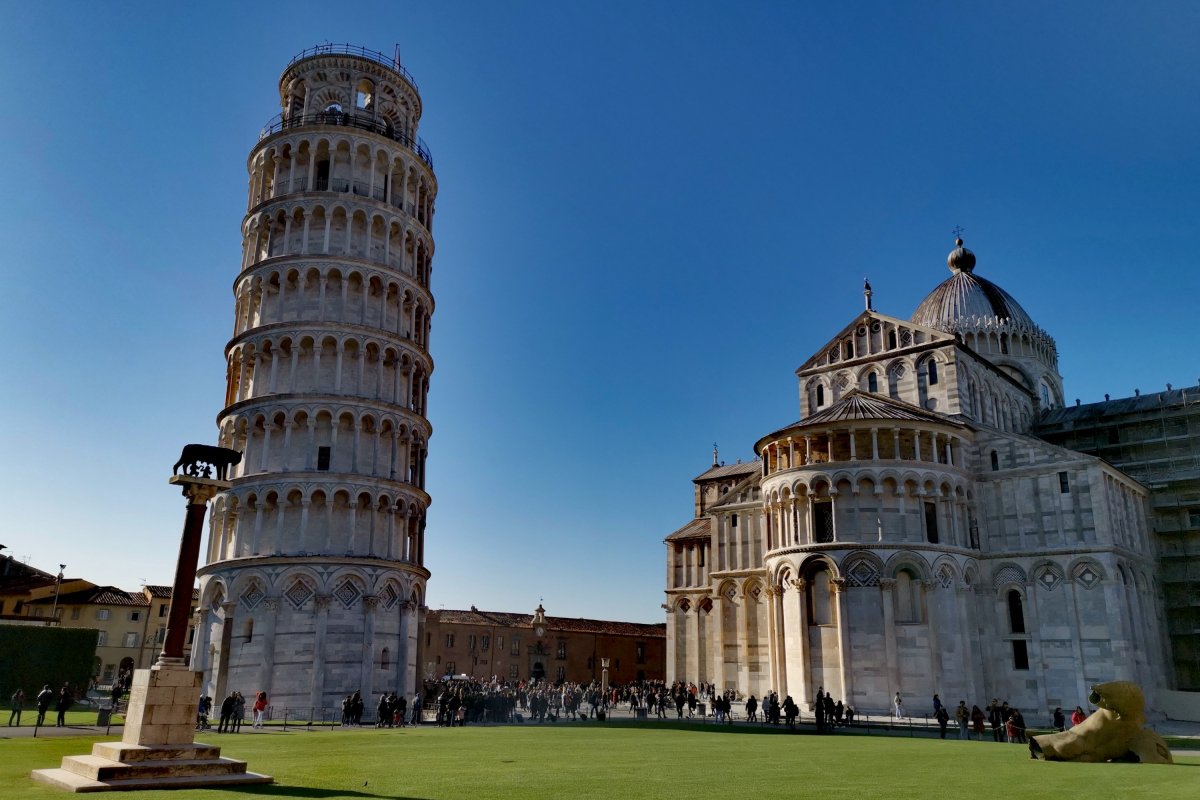
The most famous view points are in the square Piazza del Duomo. The square is dominated by four great religious edifices of medieval architecture: the Pisa Cathedral, the Pisa Baptistry, the Campanile, and the Camposanto Monumentale. In 1987, it was declared as a UNESCO World Heritage Site. This day is a sunny day in cold winter. At the center of square, I basked in the warm sun light at ease and gazed at the streaming crowds around the bell tower like the King of Tuscany browsing through his citizens.
Of course, all the people come here because of the leaning tower which construction could be traced to 1173. M The height of the tower is 55.86 metres from the ground on the low side and 56.67 metres on the high side with nearly 4 degree lean. From my view at the field, it toppled seriously, looks like falling down at any time. This tower is also famous for the story which was taught in the physics class when I was in high school. Galileo Galilei had dropped two cannonballs of different masses from the tower to demonstrate that their speed of descent was independent of their mass.
The Battistero di San Giovanni is a Roman Catholic ecclesiastical building in the square. The baptistery was designed by Diotisalvi, whose signature can be read on two pillars inside the building, with the date 1153. Its façade looks elegant with white columns and brown dome. There is an interesting small bronze scuplture on the top of the dome.
Cattedrale Metropolitana Primaziale di Santa Maria Assunta
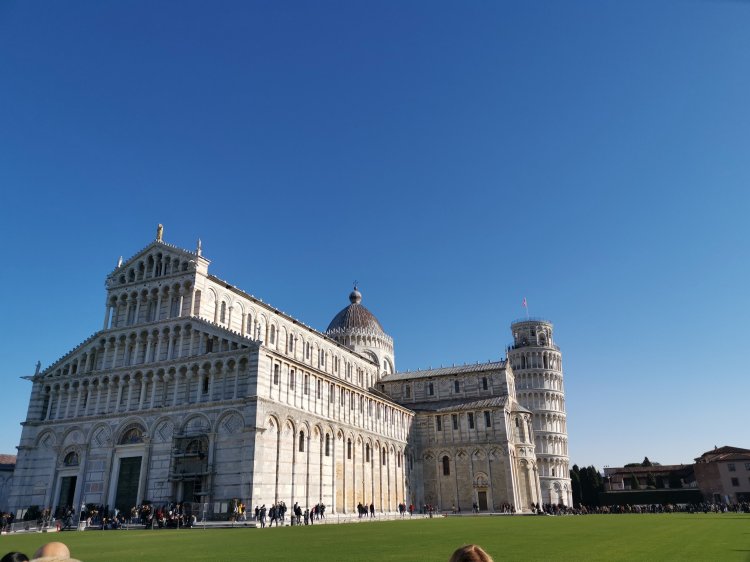
This cathedral is the Pisa Cathedral. It is a notable example of Romanesque architecture, in particular the style known as Pisan Romanesque. It was built in in 1063. The interesting point of this church is the bronze griffin on the cathedral roof. It seems that the designers of the buildings in Pisa prefered to add some unique elements at the top.
On this square, I could see the city surrounded by the city walls. It is heard that the wall was built in 11 century. The walls were built to protect the cathedral and baptistery from assault of other city state. The visitors could climb on the walls and discover more beauties of this medieval city.
When I walked along the city wall, I found this Roman relic near the Porta a Lucca. It is the Baths of Nero, the only Roman remaining still standing in the city. The building on the picture is the laconicum, the dry sweating room.
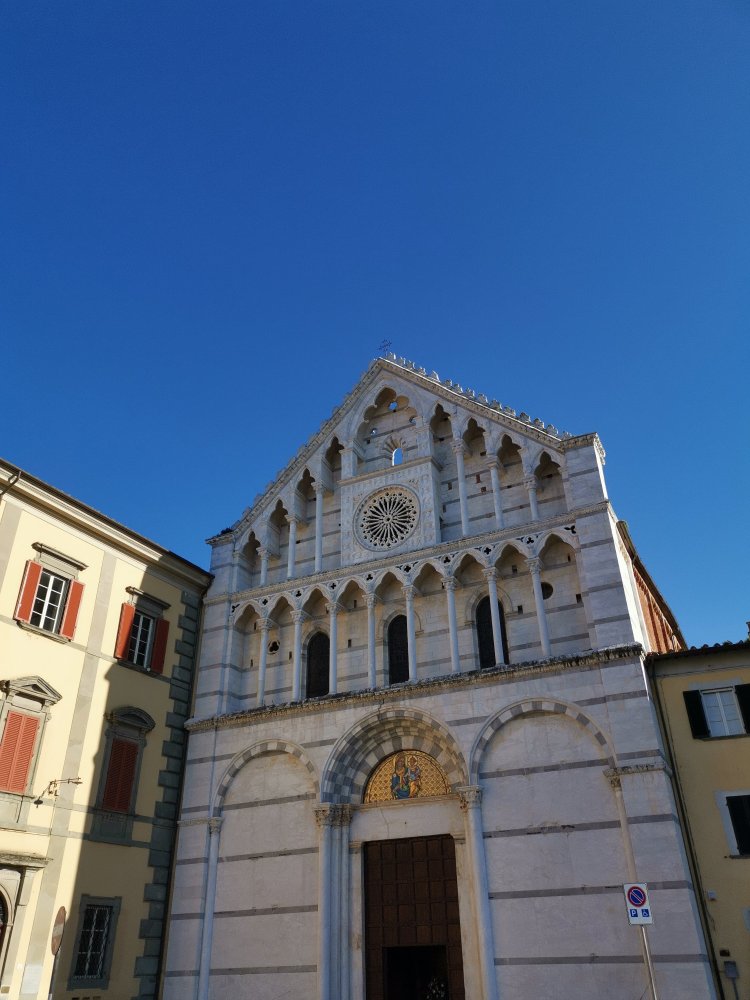
There are some interesting buildings in Pisa as well that display the art of architecture in the region. This is a church near the roman relic in the picture above. Its name is Chiesa di Santa Caterina d’Alessandria. The design of the façade is similar with the one in Florence.
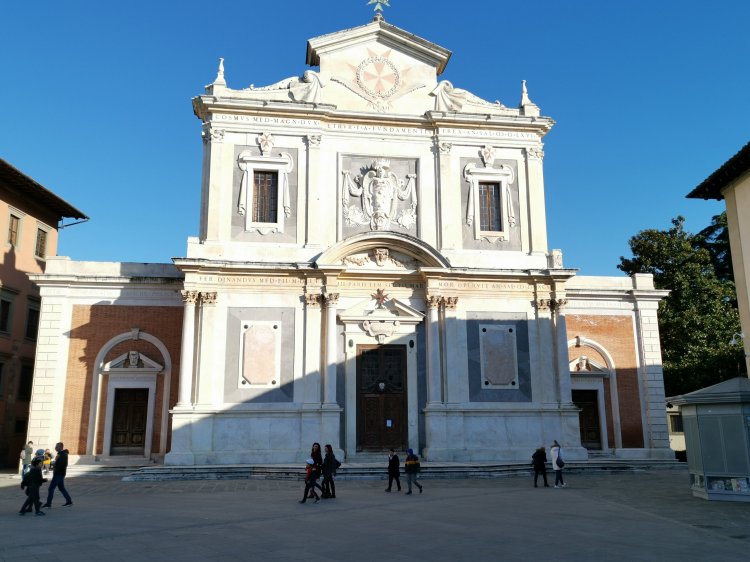
This is another church in the Piazza dei Cavalieri called Chiesa Nazionale di Santo Stefano dei Cavalieri which was built in 1565. The façade is similar with the house of Medici family in Florence with white marble column. The bulding has a sculpture on the top of the roof as well. Maybe it is the characteristic style of Tuscany.
This is the major building in piazza dei Cavalieri. It was built between 1562 and 1564. Now it becomes a school. There are some busts sitting in the niche on the wall of façade. The art of Italien sculpture is always so fantastic. The omniform sculptures are on every building in every place.
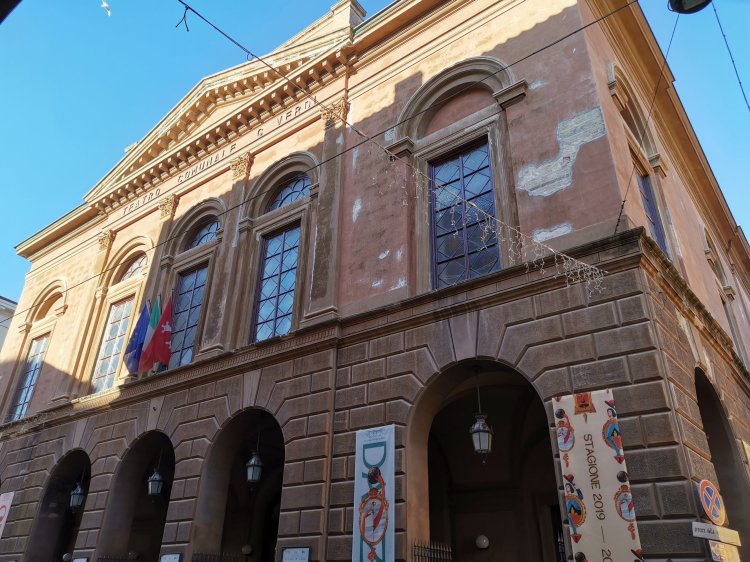
Italy is the country famous for the opera. The theater of Verdi is the theater built in 1865. It takes the name from the famous musician Guiseppe Verdi. When I passed the gate, I catched a glimpse of the posters. The opera to be played that day was the Swan lake.
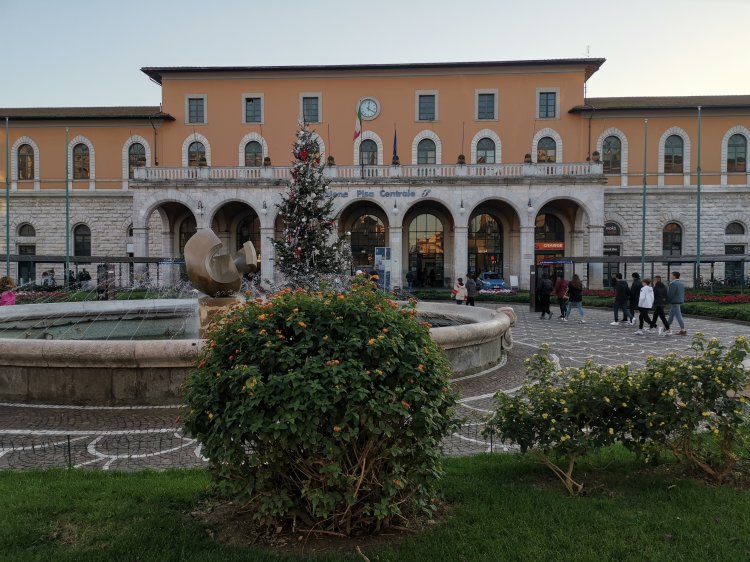
Pisa is a small city and it only takes half day to finish the visit. At four o’clock , I took the train and returned to Florence. The station is decorated with Chistmas tree with still remaining the atmosphere of festival. Although the trip was not as amazing as the one in Florence, it was worth enough to see the old buildings here especially the famous leaning tower. Anyway I will always treasure every place that I have visited.
Milan was the first place of Italy I visited during the Christmas trip. Before I came here, the impression of the city lies in the abundance of luxury brands shops and fiery Milan Derby in San Siro. Until my arrival, I realized that it was also a gorgeous city combined with classical and artistic elements. It was the old capital of the Western Roman Empire, also collects larges amounts of works of Leonardo da Vinci.
Puccini – Tosca – E lucevan le stellePiazza del Duomo
I arrived at the city at Christmas night. The Piazza del Duomo was aswarm with frantical people celebrating Christmas. This is the main visiting point of Milan. Tonight, the focus of attention was the large Christmas tree with splendid colors. The large square was illuminated by the eye-dazzling lustre like daytime.
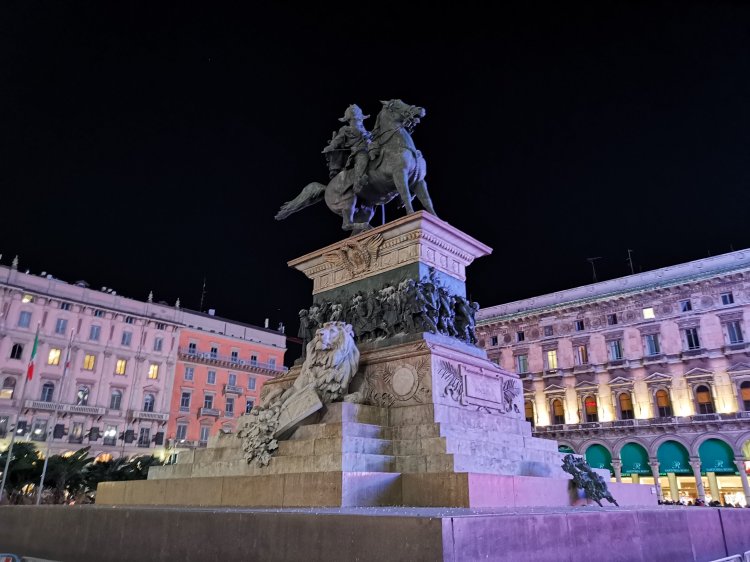
This is the stature of Victor Emmanuel II in the center of the square. He became the first king of a united Italy and was repected as the father of the country.
这是在广场中心维克托·伊曼努埃尔二世的雕像。他是统一的意大利的第一位国王,并被尊为国父。
Galleria Vittorio Emanuele II
On the square, even quite far away, I could also see the famous Galleria Vittorio Emanuele II which is the Italy’s oldest shopping mall with a four-story double arcade. The Galleria is named after Victor Emmanuel II. It was designed in 1861 and built by architect Giuseppe Mengoni between 1865 and 1877. The façade of the gallery is the magnificent triumphal arch, decorated with the colonnades.
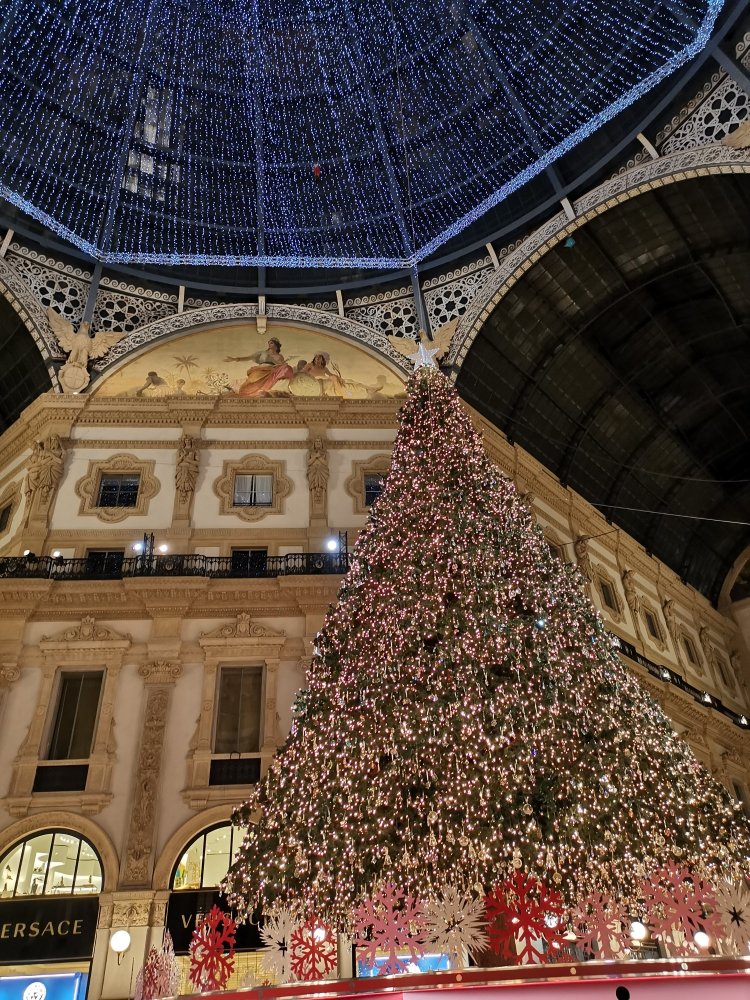
In the glamorous gallery, the tall and fully decorated Christmas tree was silhouetted against the scintillating glass dome that highlights the ardent ambience of festival these days. The gallery had the large spans of the vaults and the ethereal effect of the entire glass canopy. It displayed numerous luxury brands shops of haute couture and jewelry in the arcades, showcase of the luxurious and glorious history of the city. Italians are the born talents of paintings and sculptures. Even on the wall of the shopping mall, I could still discover many reliefs of eagle shape and scuplture of Santa Maria.
Milan is an ancient city with long history. There are many old gates scattering in the different areas. Porta Venezia is one of the historical gates of the city. Its origins can be traced back to the medieval period but now it just stands tranquilly among the sparkling glims of the modern city, with the testimony of the vicissitude of life.
On the way back to hotel, I could see many streets with the luxury brands shops. Although it was the christmas night, those stores were still open. Shadows of pendent lamps flicked on the windows of the shops. The gaudy ornaments and garments displayed inside are telling us that it is indeed the capital of fashion.
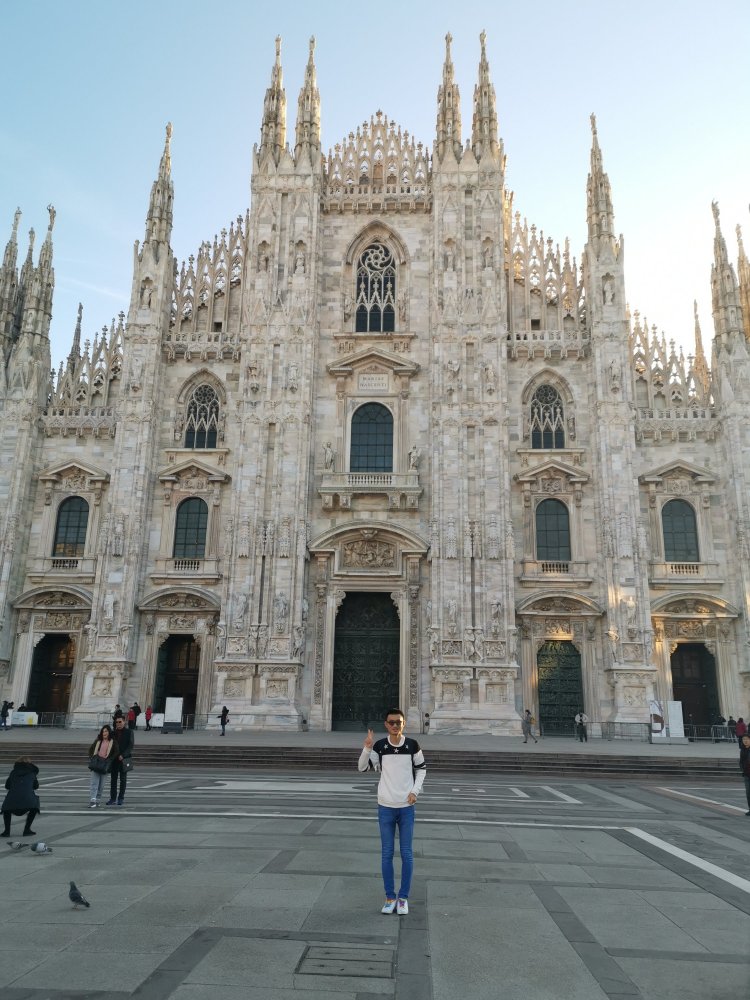
After one night’s rest, I came here again to take the picture of this magnificant church, the famous Milan Cathedral. The cathedral took nearly six centuries to complete. It is the largest Gothic church in the world with the construction starting from 1386. It is the symbol of Milan, also the fourth largest church in the world.
The roof of the cathedral is renowned for the forest of openwork pinnacles and spires. In 1805, Napoleon Bonaparte, about to be crowned King of Italy, ordered the finish. Finally, after it was finished, a statueof Napoleon was placed at the top of one of the spires. The decoration is so fantastic that it is hard to describe it with simple words. When I was staring it at the bottom of its wall, I was just amazed at its imposing grandiosity and the tininess of myself.
Near the square opposite to the Vittorio Emanuele II gallery, the Royal Palace of Milan could be found. It was the seat of government in the middle ages but now served as a cultural center and it is home to international art exhibitions. Compared with the luxuirious palace in France, it was really too ‘plain’.
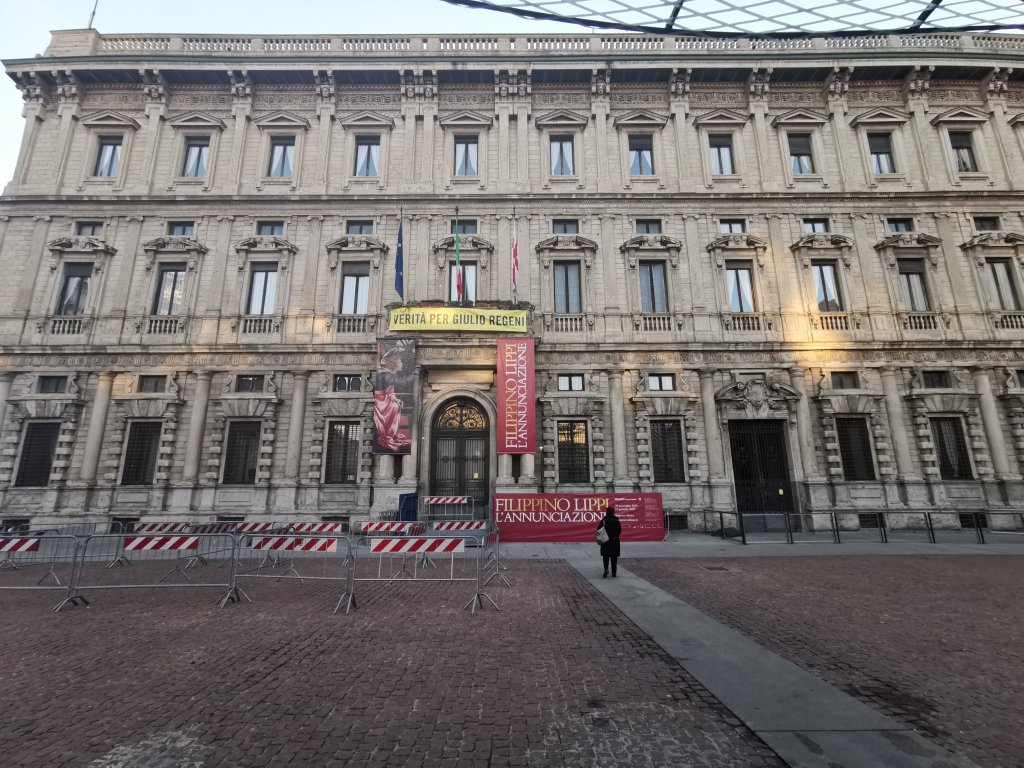
On the north entrance of the gallary of Vittorio Emanuele II. There is another museum displaying the art works of Filippino Lippi. It is the Palazzo Marino, a 16th-century palace located in Piazza della Scala. It has been Milan’s city hall since 9 September 1861. The palace was built for, and is named after, the Genoan trader and banker Tommaso Marino. The famous opera house Scala is also around the square.
There is another building attracting my attention due to its eight obvious outruding figures. Casa degli Omenoni is the name of the historic palace which was designed by sculptor Leone Leoni. He lived and worked there. It owes its name to the eight atlantes decorating its facade, termed “omenoni” (“big men” in Milanese). Actually I have no ideas of the meaning of these atlantes with different postures.
There are not only luxury shops but many old churches in Milan as well. The Basilica of San Lorenzo Maggiore church was originally built in Roman times and subsequently rebuilt several times over a number of centuries. It is one of the oldest churches in Milan. The statue in front of the church seems to be the emperor Auguste.
This is the side view of the church from the Basilicas park. It has the old towers and brick walls eroded by times.
这是在大教堂公园一侧的教堂的背面,古老的塔和被时间侵蚀的和砖墙。
Colonne di San Lorenzo
The Colonne di San Lorenzo is a group of ancient Roman ruins, located in front of the Basilica of San Lorenzo. In the 4th century, the columns were moved here, after removal from a likely 2nd century pagan temple or public bath house structure. These columns are similar with the ones in the temple of Rome.
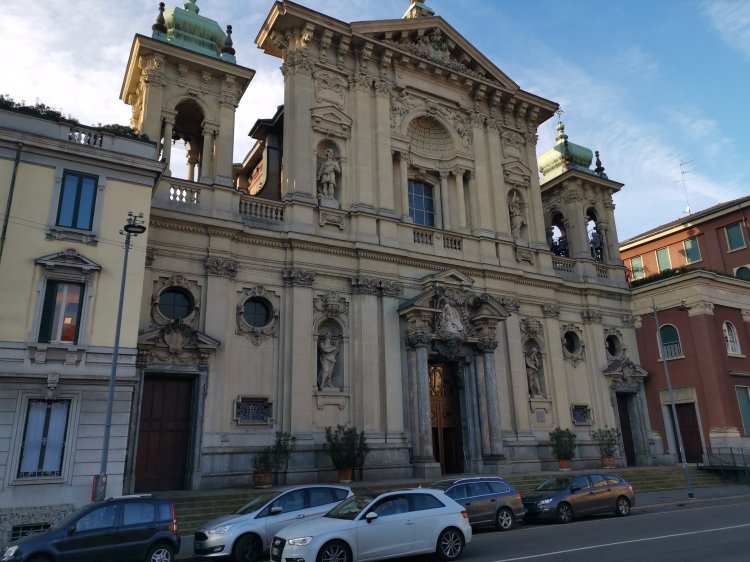
Another church with very long history is the Basilica di Sant’Ambrogio, built by St. Ambrose from 379 to 386. Numerous martyrs of the Roman persecutions had been buried here. The first name of the church was in fact Basilica Martyrum. I have no knowledge about architecture but I found this building is different with other church. It has two bell towers and its entrance is an arched arcade. The main color style of the building is red instead of white.
Next one is the super famous Santa Maria delle Grazie which is a church and Dominican convent. It is a UNESCO World Heritage site due to the mural of The Last Supper by Leonardo da Vinci, which is in the refectory of the convent. This church is free to visit but the visit of the Last Supper is charged and needs to be appointed in advance. Because of this reason I could not see the painting in person. What a pity!
The mural painting is the one of the most well-known paintings in the world. It was finished by Leonardo Da Vinci in 1490 with dimensions of 700 cm × 880 cm. It was the scene of the Last Supper of Jesus with his apostles. The painting depicted vividly the consternation that occurred among the twelve apostles when Jesus announced that one of them would betray him.
Parrocchia di Santa Maria Segreta is a small catholic church. There is nothing special about it. I just took the picture because of several beautiful sculptures in the niche on the facade. All these churches actually are not far from each others. 1 hour walk is enough to visit all of them.
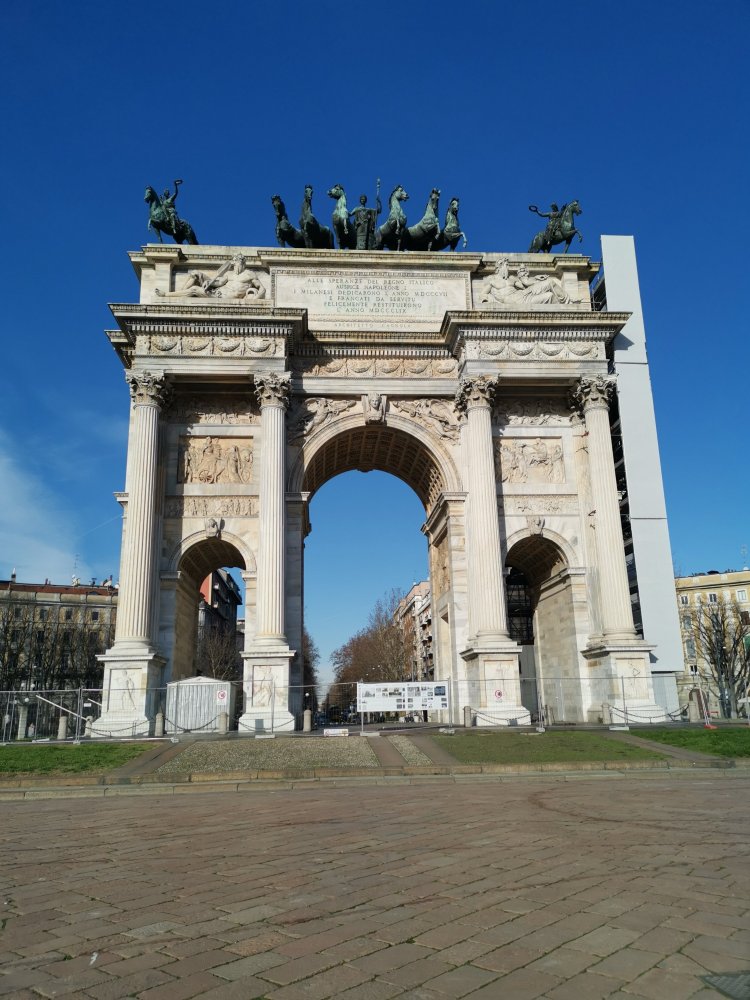
Arco della Pace is the triumphal arch at the entrance of Sforza Castle. It is at the gate of Sempione which origins could be traced back to a gate of the Roman walls. It’s a neoclassical triumphal arch, 25 m high and 24 m wide. There are some bronze sculptures of roman cavalries on the top of the arch.
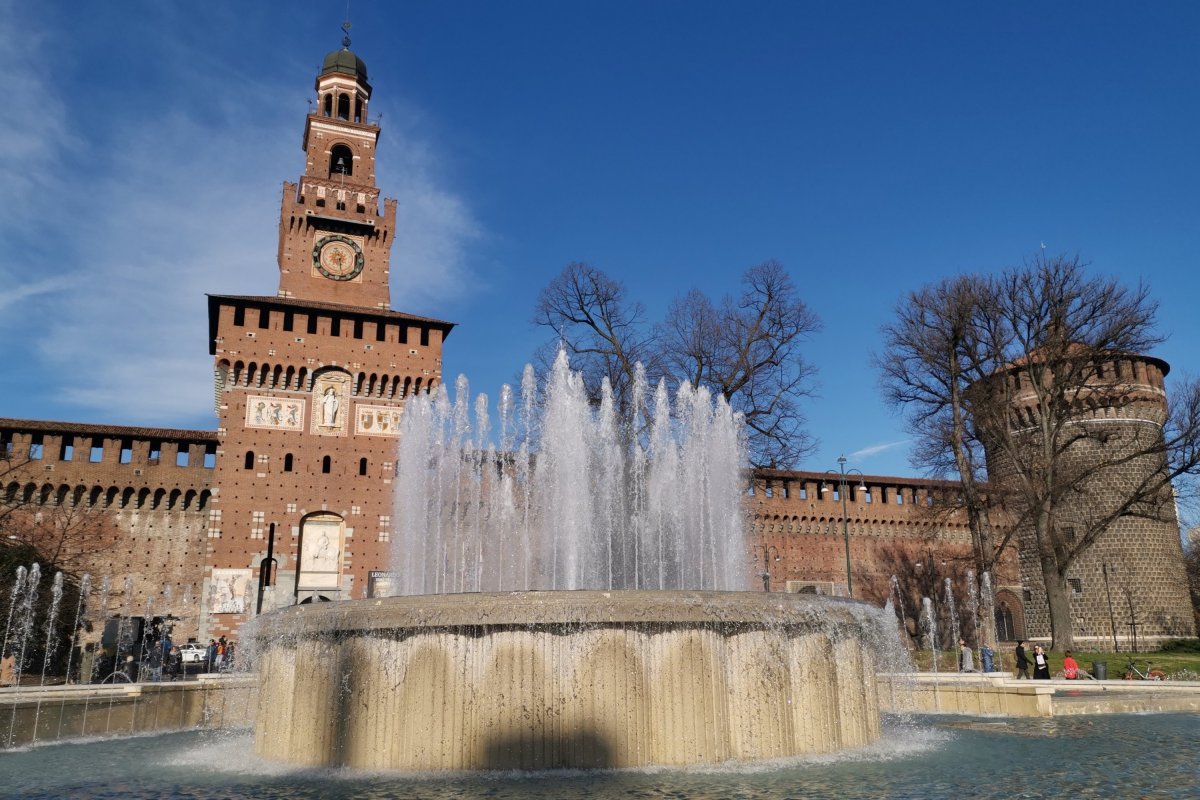
Another symbol of Milan is the Sforza Castle that was built in the 15th century by Francesco Sforza, Duke of Milan. Later renovated and enlarged, in the 16th and 17th centuries it was one of the largest citadels in Europe. Rebuilt by Luca Beltrami from 1891 to 1905, it became city’s museums with many art collections.
In 1450, Francesco Sforza began reconstruction of the castle to turn it into his princely residence. In 1452 he hired architect Filarete to design and decorate the central tower, which was known as Torre del Filarete. After Francesco’s death, the construction was continued by his son Galeazzo Maria, under architect Benedetto Ferrini.
This castle has been used as the military fortress so now some of its defense systems are still kept.
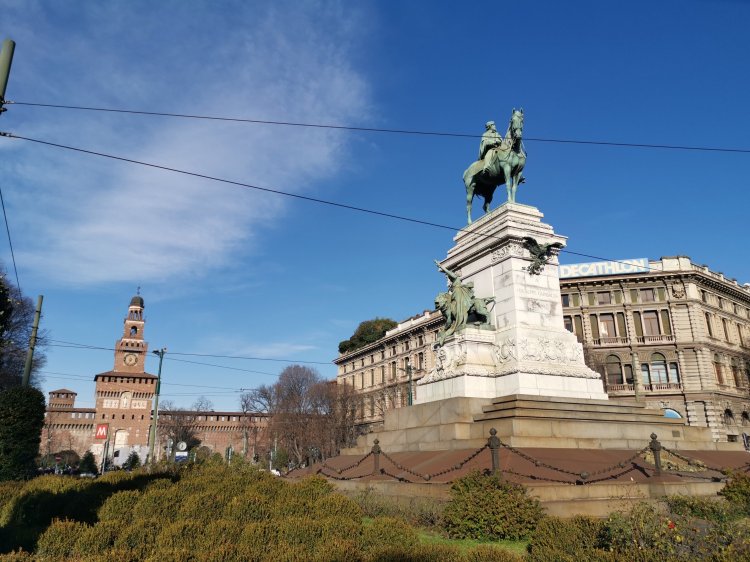
This sculpture at the gate of the castle memorizes the great general Giuseppe Maria Garibaldi. He contributed greatly to the Italian unification and the creation of the Kingdom of Italy. He is considered one of the greatest generals of modern times and one of Italy’s “fathers of the fatherland” along with Camillo Benso, Count of Cavour, Victor Emmanuel II and Giuseppe Mazzini.
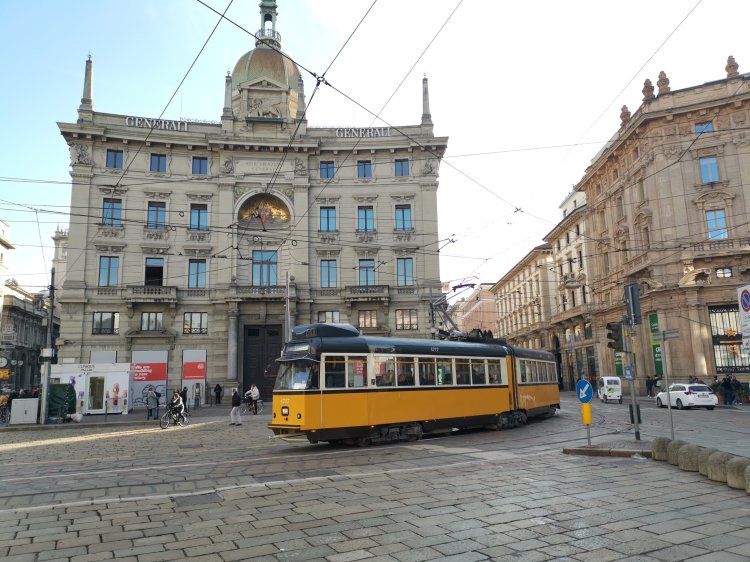
This is the street view that was randomly taken before I left. There are many old styles of trams in Milan so the electric cables are everywhere in the street.
这是我离开米兰前随便拍摄的街景。米兰有许多老式的电车,所以街道上到处都是电车的电缆。
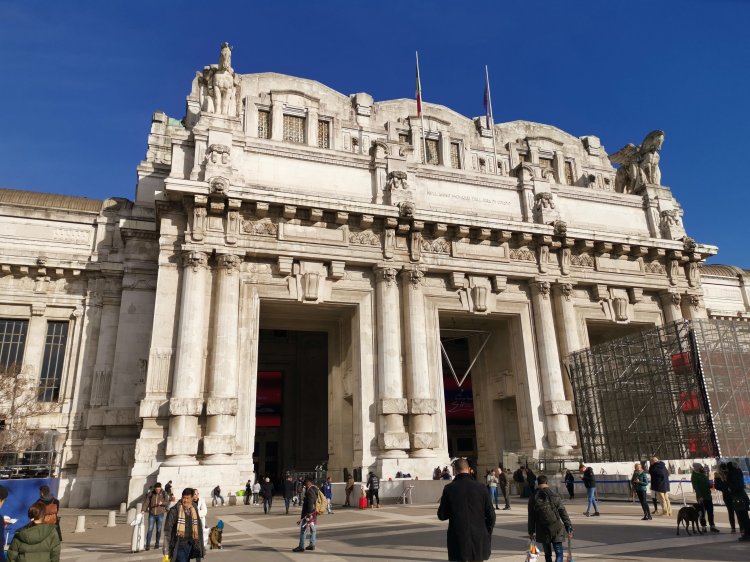
Stazione Milano Centrale
I only stayed in Milan for 1 day so there are many places that I didn’t have chance to visit. There are so many museums in Italy that it is difficult to visit them one by one. This last photo is the Milan central station that looks quite beautiful, like a museum. I would take high speed trains from here to Firenze. Hopefully I could have chance to come here again and see The Last Supper next time.
This christmas holiday, I have spent 8 days in Italy. That is a great experience for me. I have played the game Roma Total War before and I really enjoy it so Rome has always been a city that I dreamed of. I went there by the high speed train Frecciarosa, it is really fast. Since there are too many places to visit, I will only introduce the most important ones.
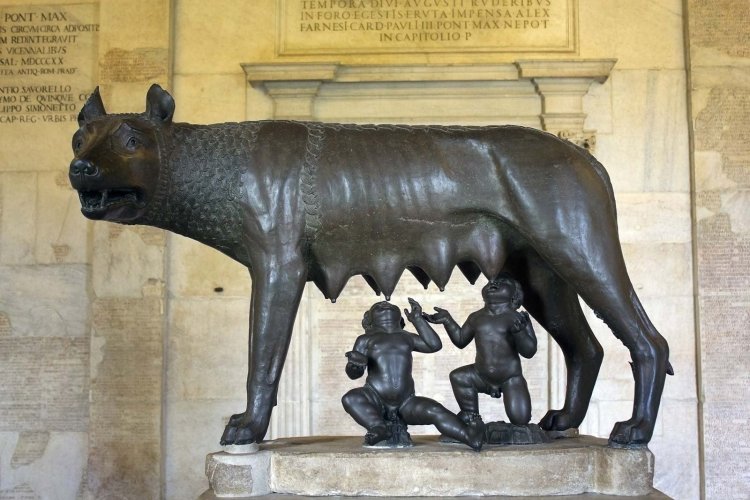
The story of the founding of Rome city comes from Romulus and Remus, twins who were suckled by a wolf as infants in the 8th century BC. This statue shows this story. Another stories say that the Roman people are descended from Trojan War hero Aeneas, who escaped to Italy after the war, and whose son, Iulus, was the ancestor of the family of Julius Caesar.
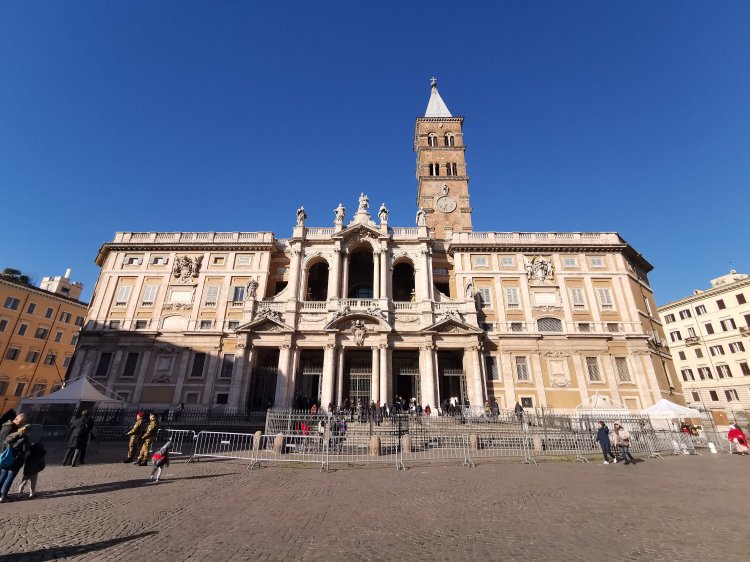
This was the first place I visited after I left the station Roma Termini because it was near the station. The church of Santa Maria Maggiore is the largest Catholic Marian church in Rome. It was built under Celestine I (422–432). Vatican City still fully owns the Basilica although it is in Italy territory.
This is the view of the church from backside, from the Piazza dell’Esquilino. There is an obelisk on the square. This kind of building could be found in many squares of Rome.
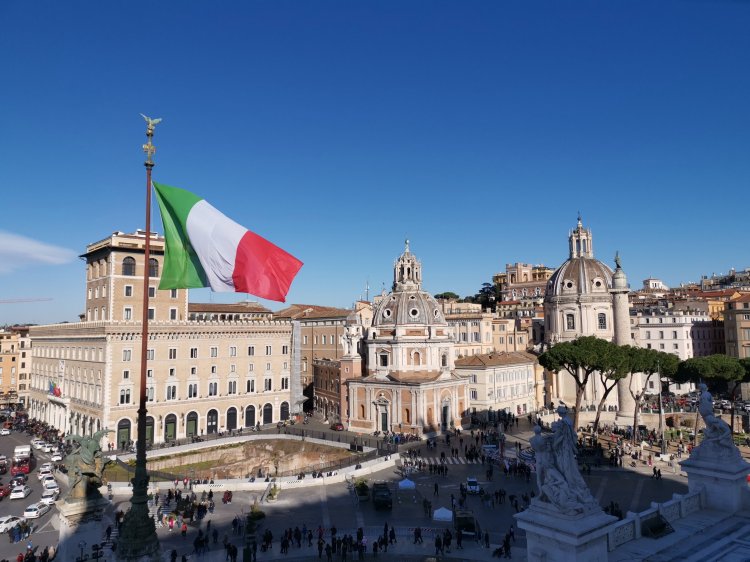
After 10 minutes walk, I arrived at the most beautiful place in Rome, the Piazza Venezia. It is located at the historical center of Rome. On this square, we could see the Palazzo Venezia and the statue of Victor-Emmanuel II who was the first king of Italy and get the panaromic view of ruins of ancient Rome. Piazza Venezia was named after the Cardinal Venezia, who ordered the construction of his own place, Palazzo Venezia, in 1455.
There are three important main roads around this square, la via dei Fori imperiali, la via del Corso and la via del Teatro di Marcello. As the idiom said, all roads lead to Rome. We could find many statues of goddess here. The 16 scupltures of pediment marks the regions of Italy and the two fountains represent the Tyrrhenian Sea and the Adriatic Sea. The Romans call this building as “the cake of mariage” due to the shape of the building.
This is the statue of Vittorio Emanuele II who leads the unification of Italy. Italiens respect him much, as the father of the country. The base of statue is made of marbre, built by Giuseppe Sacconi on 19th century.
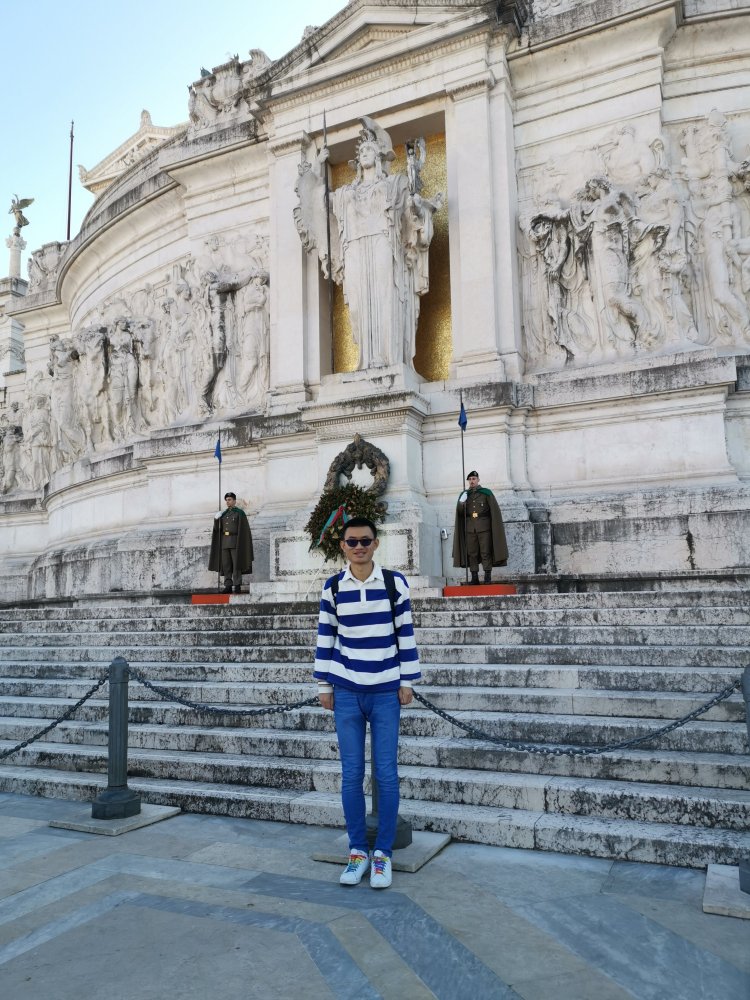
Also we could find a monument in the square as a memorial to the death solders. This is the Tomb of the Unknown Soldier.
我们还可以在广场上看到一座纪念碑,纪念意大利的阵亡战士。这是牺牲的无名战士的陵墓。
Forum Traiani
On the east side of the square, the Forum Traiani could be seen clearly with three relics Basilica Ulpia, Colonna Traiana and Macellum Traiani. This forum was built on the order of the emperor Trajan due the conquest of Dacia, which was done in 106. There is a long post with 38 meters length. That is the famous Colonna Traiana, i.e Trajan’s Column. The column is most famous for its spiral bas relief, which artistically represents the wars between the Romans and Dacians. The whole history of Roman empire was the history of conquest and war.
On the terrasse of the square staring far away, the major historical building of Rome and the skyline could be oberved, like the Colosseo, the Roman theater, the Roman forum. At the moment of watching the beautiful scenes , it was really difficult to describe it with just several words. It is as if all the scenes in the game of Rome Total War suddenly becomes reality and the history of thousand years’ fall and rise of Roman empire flashes into my eyes like replays of movies.
The Macellum Traiani is a ruin of Roman market located on the Via dei Fori Imperiali built in 100-110 AD by Apollodorus of Damascus. It was the world’s oldest shopping mall. The shops were built in a multi-level structure and it is still possible to visit several of the levels.
Rome is famous for beautiful fountains. This is one fountain located at the corner of the square, Fontana Del Tirreno. This fountain represents the Tyrrhenian Sea.
Not far from the square, in the north of the square Venezia, there is one famous fountain attracting many tourists around the world. It is designed by Italian architect Nicola Salvi and completed by Giuseppe Pannini and several others in 1762. Standing against the Palazzo Poli, it is the largest Baroque fountain in the city. The fountain represents the ocean and there is the statue of the god of ocean Neptune in the center of the fountain. It is heard that if you want to return to Roma, you should throw a coin to the basin. Of course I did it, and made a wish for the upcoming new year.
Next I went to a magnificant building with many large granite Corithian columns. The Pantheon is a former Roman temple, now a church. It was completed by the emperor Hadrian. It means relating to all the gods. The temple Maison Carré in Nimes looks similar with this one but this one is bigger. After the Battle of Actium (31 BC), Marcus Agrippa started an impressive building program including the Pantheon. There is Latin words on the front of the temple which reads: M·AGRIPPA·L·F·COS·TERTIVM·FECIT. It means “Marcus Agrippa, son of Lucius, made [this building] when consul for the third time.
On the west of the Pantheon, it is the Piazza Navona, built in the 1st century AD, and it has a long oval shape because it was once the site of the Stadium of Domitian where festivals and sporting events took place. There are three fountains on the square. Surrounded by the restaurant, this is a pleasant place to have a drink or meal.
In the center of the square, it is the famous Fontana dei Quattro Fiumi or Fountain of the Four Rivers (1651) designed by Gian Lorenzo Bernini. The Fountain of the Four Rivers depicts Gods of the four great rivers in the four continents as then recognized by the Renaissance geographers: the Nile in Africa, the Ganges in Asia, the Danube in Europe and the Río de la Plata in America. Each location is represented by one characteristic sculpture. The Ganges carries a long oar, representing the river’s navigability. The Nile’s head is draped with a loose piece of cloth, meaning that no one at that time knew exactly where the Nile’s source was. The Danube touches the Papal coat of arms, since it is the largest river closest to Rome. And the Río de la Plata is sitting on a pile of coins, a symbol of the riches America might offer to Europe.
Another is the Fontana del Moro with a basin and four Tritons sculpted by Giacomo della Porta in 1575 and Bernini added a statue of a Moor, wrestling with a dolphin in 1673.
In the south of the square Navona and west of the square Venezia, there is one square with four Roman Republican temples and the remains of Pompey’s Theatre. Julius Caesar was killed in the Curia of the Theatre of Pompey. This should be the place where he had been assassinated.
After I walked along the road eastward, I went back to the Venezia square and discovered the Palazzo Venezia. There are many palms planted in the garden. This building could trace back to 15th centuary and used to be the residencial place of pope. In 20th centuary, it was occupied by Mussolini. Mussolini used it as the regime’s main palace, with its balcony, famous for being the place from which war was announced.
In this area, there are many ways leading to the Via dei Fori Imperiali. I chose another road with steps instead of the main road. This road leads me to the Piazza del Campidoglio (Capitole square). There is the statue of Marc Aurele in the center of the square. Marc Aurele was the Roman emperor from 161 to 180 and a stoic philosopher. He was the last of the rulers known as the Five Good Emperors.
The most magnificant place of Rome certainly is the Via dei Fori Imperiali which means the road of empire. This is a long road connecting Piazza Venezia and the Coliseo. Along this road, all the Roman relics could be seen and you will feel that you are walking on the street of Roman Empire. The Coliseo of course is the icon of Rome. It was built of travertine limestone, tuff (volcanic rock), and brick-faced concrete; it was the largest amphitheatre ever built and held 50,000 to 80,000 spectators. Its construction began under the emperor Vespasian in AD 72 and was completed in AD 80 under his successor Titus.
The Colosseum is just east of the Roman Forum. The forum is a rectangularsquare surrounded by the ruins of several important ancient government buildings. I have seen many cute sea gulls in the square, they like to land at the places with many people. They are really friendly with the visitors.
Along the Via dei Fori Imperiali, I could see clearly The Arch of Septimius Severus (Arco di Settimio Severo) at the northwest end of the Roman Forum; it is a white marble triumphal arch to commemorate the victories of Emperor Septimius Severus and his two sons, Caracalla and Geta, in the two campaigns against the Parthians of 194/195 and 197–199.
The temple of Saturn is the temple dedicated to Saturn built at the beginning of Rome republic. In the forum of Rome there are many remnants of the bases of temples or basilique and it is difficult to distinguish them but this one is quite obvious. In Roman mythology, Saturn ruled during the Golden Age and he is associated with wealth. His temple housed the treasury, the aerarium, where the Roman Republic’s reserves of gold and silver were stored.
Along this road there are some statues of Roman leaders for example Julius Caesar; also we could find the S.P.Q.R on the statues and many places in Rome. This is the symbol of Roman Republic and represents the political power of Rome. In movies and games, we could see the S.P.Q.R symbols on the flag of Roman armies!
After one night’s rest, I started my trip from the Piazza del Popolo. It is a square with style of neo-classic. It is the important starting point of via Flaminia leading to the north of Italy. Before the period of railway, this is the first view point seen by the visitors when they arrived at Rome. The cathedrales on the square is totally symmetrical, a strange design.
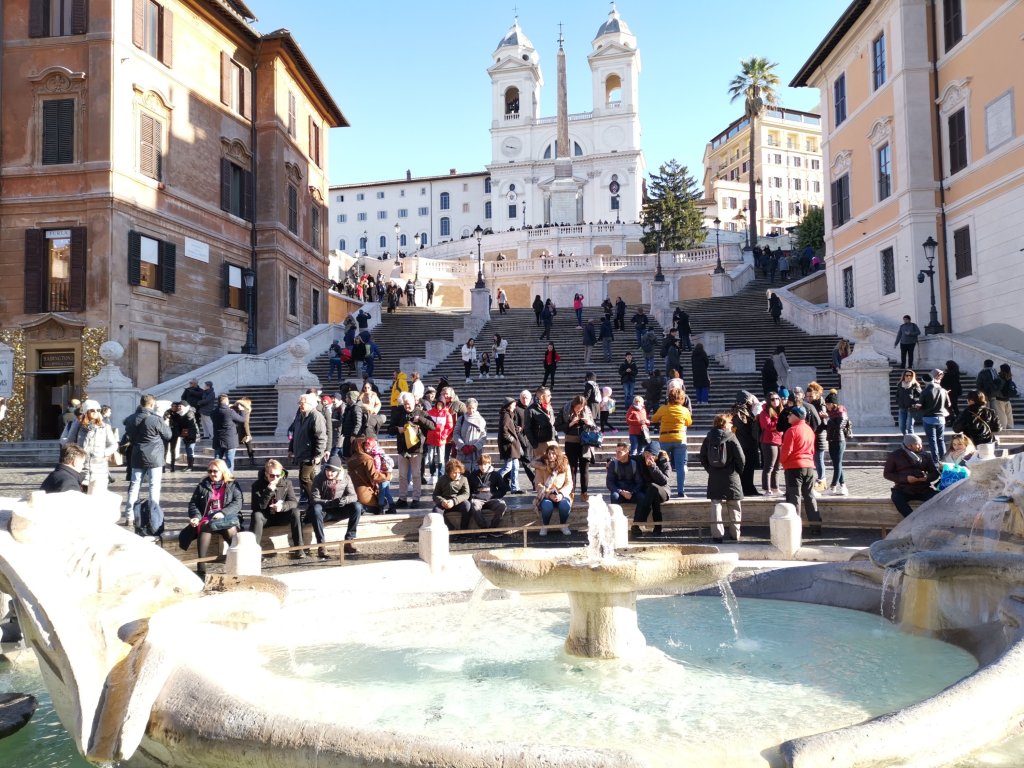
Walking along the Piazza del Popolo southwards, there is another romantic square, the Piazza di Spagna. One scene of the famous movie Roman Holiday is taken here. Audrey Hepburn was eating ice cream together with Gregory Peck at the step of the square.
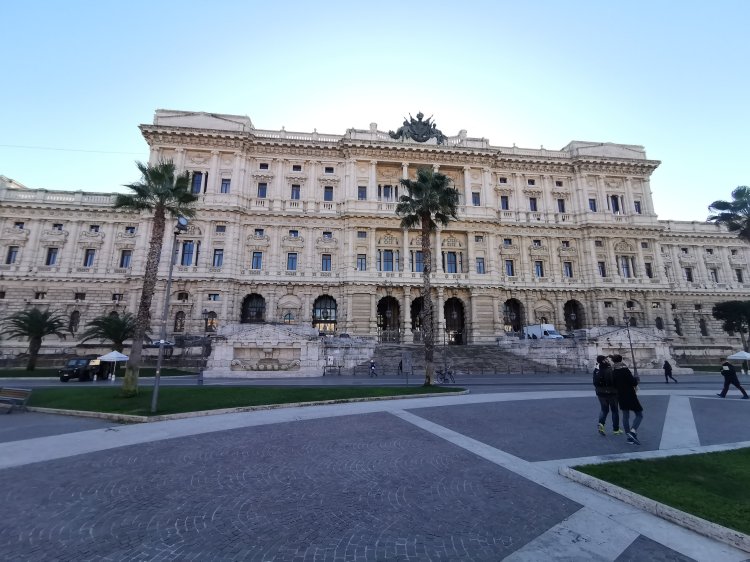
Next I moved towards the direction of Vatican city. On the way, there is a beautiful square Piazza Cavour. The building on this picture is the palace of justice of Italy.
接下来我朝梵蒂冈城的方向走去。在路上,有一个美丽的卡武广场。这个照片上的建筑是意大利司法宫。
The statue on the square is the Count of Cavour who led the movement toward Italian unification. After the unification of Kingdom of Italy, Cavour took office as the first Prime Minister of Italy.
广场上的雕像是领导意大利统一运动的卡武伯爵。意大利王国统一后,他就任意大利的第一任首相。
Ponte Sant’Angelo
The Vatican city is at the west side of the Tibre river. To cross the river, I needed to cross the Ponte Sant’Angelo. It was a Roman bridge completed in 134 AD by Roman Emperor Hadrian to span the Tiber from the city centre to his newly constructed mausoleum, the Castel Sant’Angelo.
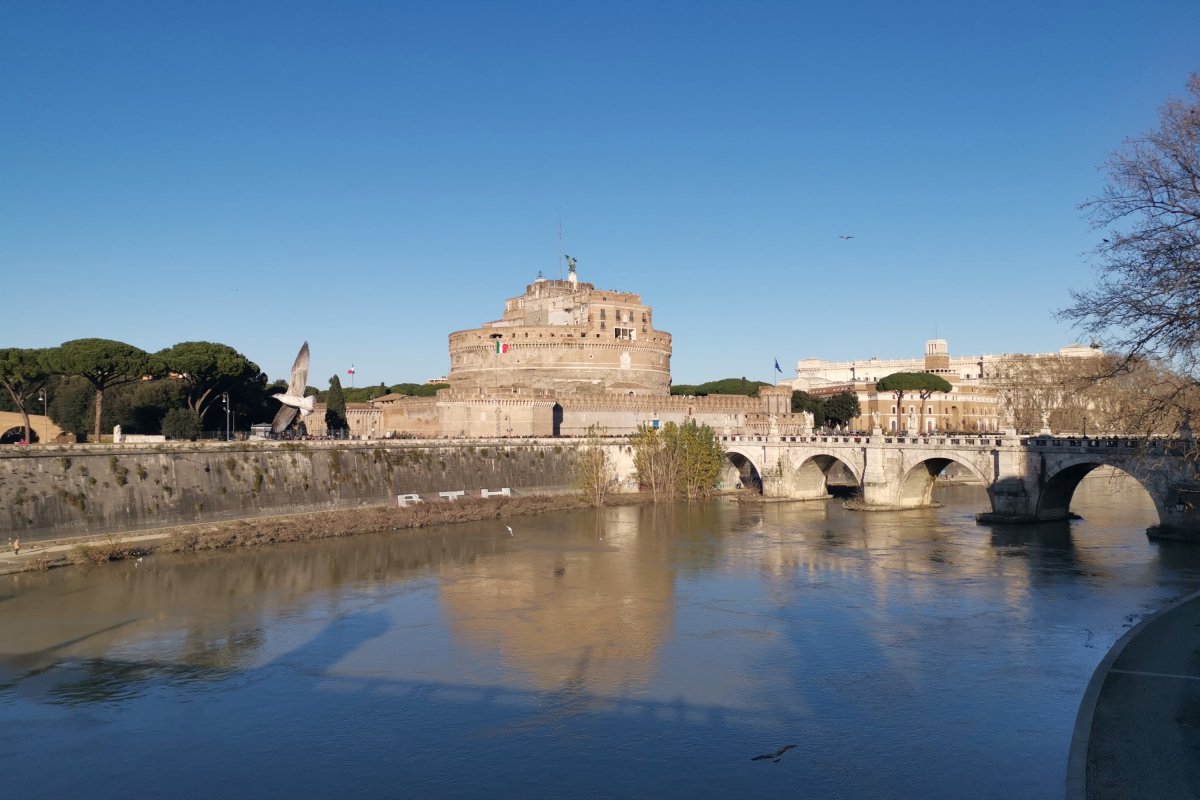
The Castel Sant’Angelo was built starting from 123-125, ending in 139, designed to be the mausoleum of the emperor Hadrian. It is a very large castle but I did not enter it due to a long queue. On the top of the castle, there is a statue of Saint Michel with swords in the hands.
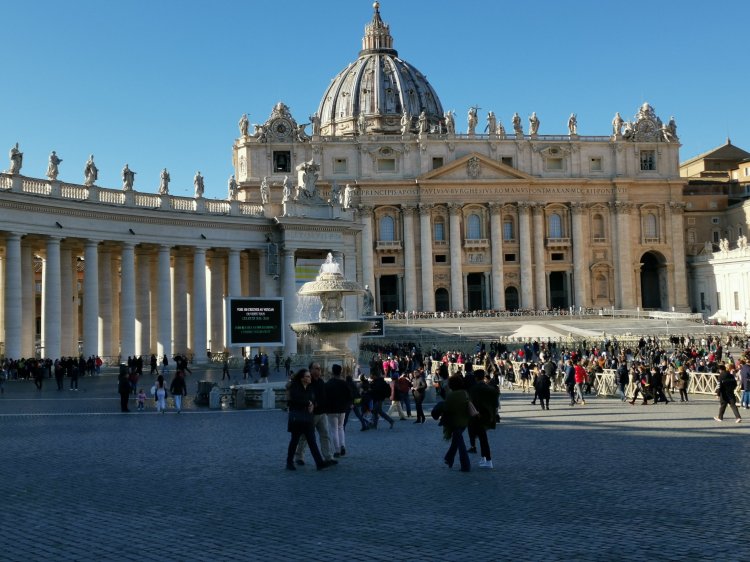
Vatican City is the smallest country in the world which is located at the west side of the Castel Sant’Angelo. It is the main travelling site for every visitors. Huge amounts of tourists come so it took me 2 hours for the queue of visiting the Basilica Saint-Pierre which is the largest in the world. It is also listed as the world heritage by UNESCO. It was built under the order of Constantine 1st, finished on 1626. The tourists could only visit the museum and the basilica but could not access to other parts of the country.
Constantine I was the first Roman emperor to convert to Christianity. From that time, Christianity has become the dominating religion in Europe.
The basilica has a big dome and the decoration inside is beautiful including many pictures on the wall and dome. It is highly recommended to visit it despite of the long queue. The building itself is like a masterpiece of arts. Outside the basilica, there is one post office. Visitors could send postcards with postmark of Vatican City.
After I left the Vatican City, it was afternoon, and I had to be on my way to the train station. This basilica is a famous one. It was bult under Calixte 1st, and became the first place of Christian religion that is open to the public.
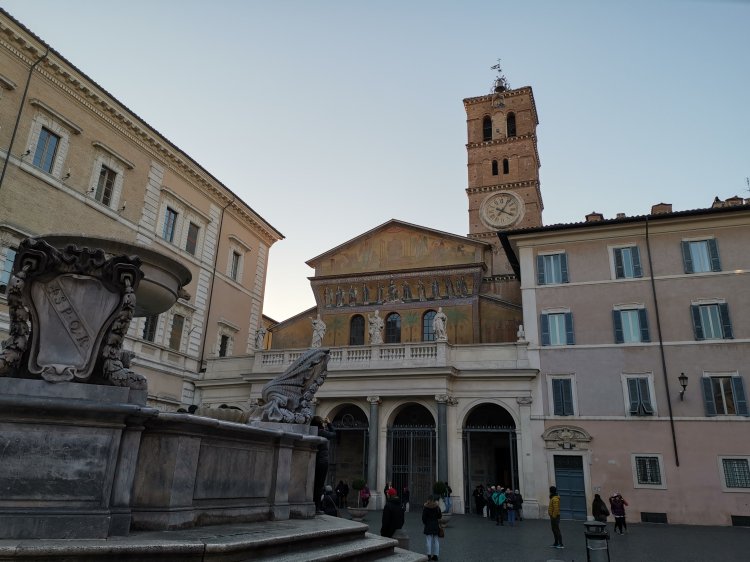
When the sun started to go down, I visited the last site of my trip in Rome, the Sainta-Maria in Cosmedin. It is a common church but many people come here because of the Bocca della Verità.
Bocca della Verità means Mouth of Truth. It is a marble mask in the corner of the Sainta-Maria in Cosmedin. It weighs about 1300 kg and depicts the face of the sea titan god Oceanus. Many visitors will put their hands in the mouth and it was said that if you were talking the lies, the mouth of truth will bite your hand. Very interesting!
I would end my travel by the mouth of truth and I hope I will always be on the way of pursuing the truth. Rome is a fantastic city with so many relics, architectures, statues in the periods of Roman Empire, and it is really worth of visiting. I hope the Trevi fountain could bring good luck to me in the new year 2020 and I will come Rome next time!

























 Gone like the wind