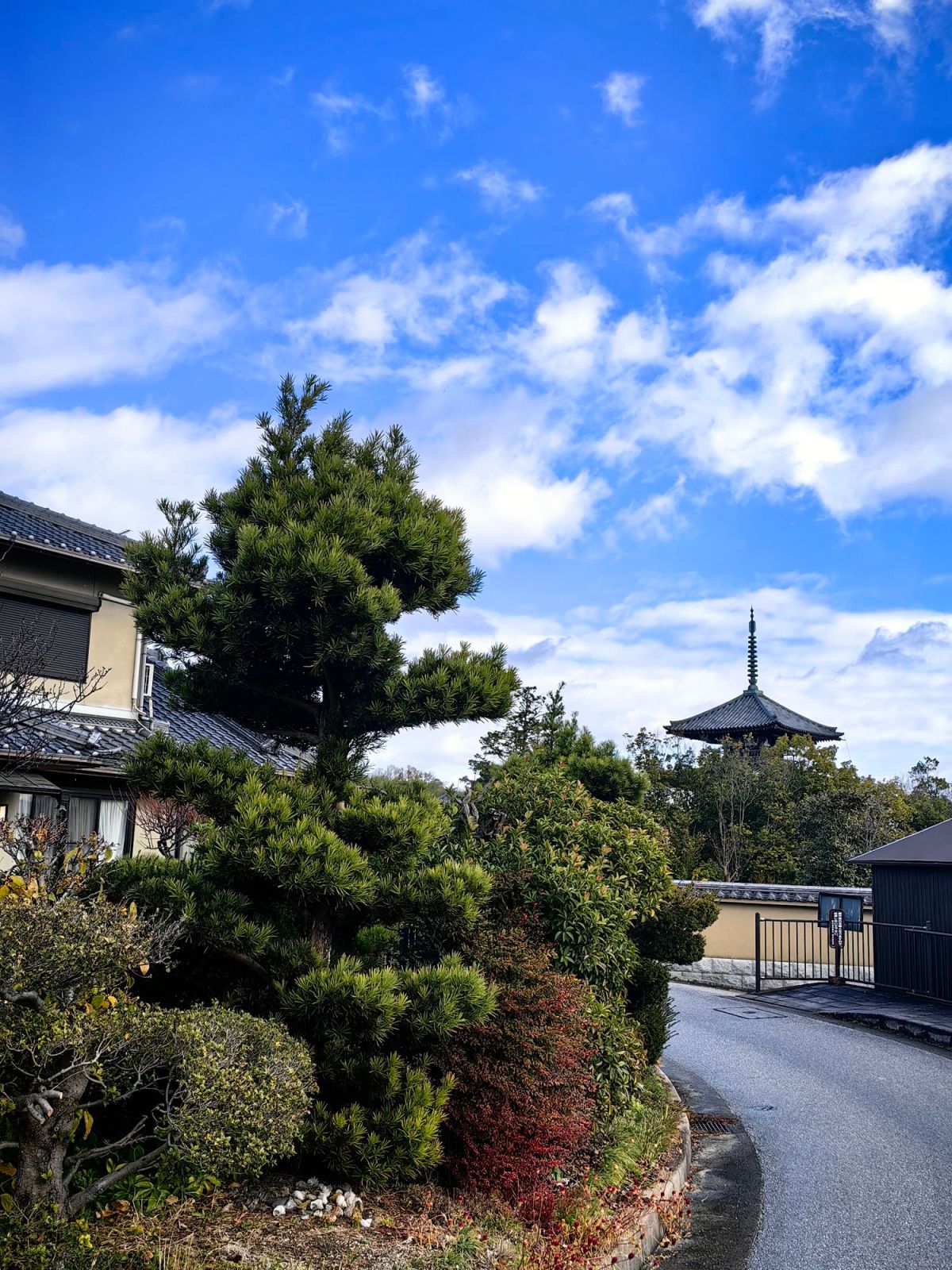
Ikaruga is a historic town near Nara, known for its important role in the early development of Buddhism and Japanese culture. The town is home to Hōryū-ji, one of Japan’s most significant ancient Buddhist temples. Founded in the early seventh century and closely associated with Prince Shōtoku, Hōryū-ji preserves some of the oldest surviving wooden structures in the world. In 1993, the Buddhist Monuments in the Hōryū-ji Area were inscribed on the UNESCO World Heritage List. The site was recognized for its exceptional wooden architecture, its importance in the history of Buddhism in Japan, and the way its buildings demonstrate the adaptation of Chinese Buddhist architectural traditions to Japanese culture.
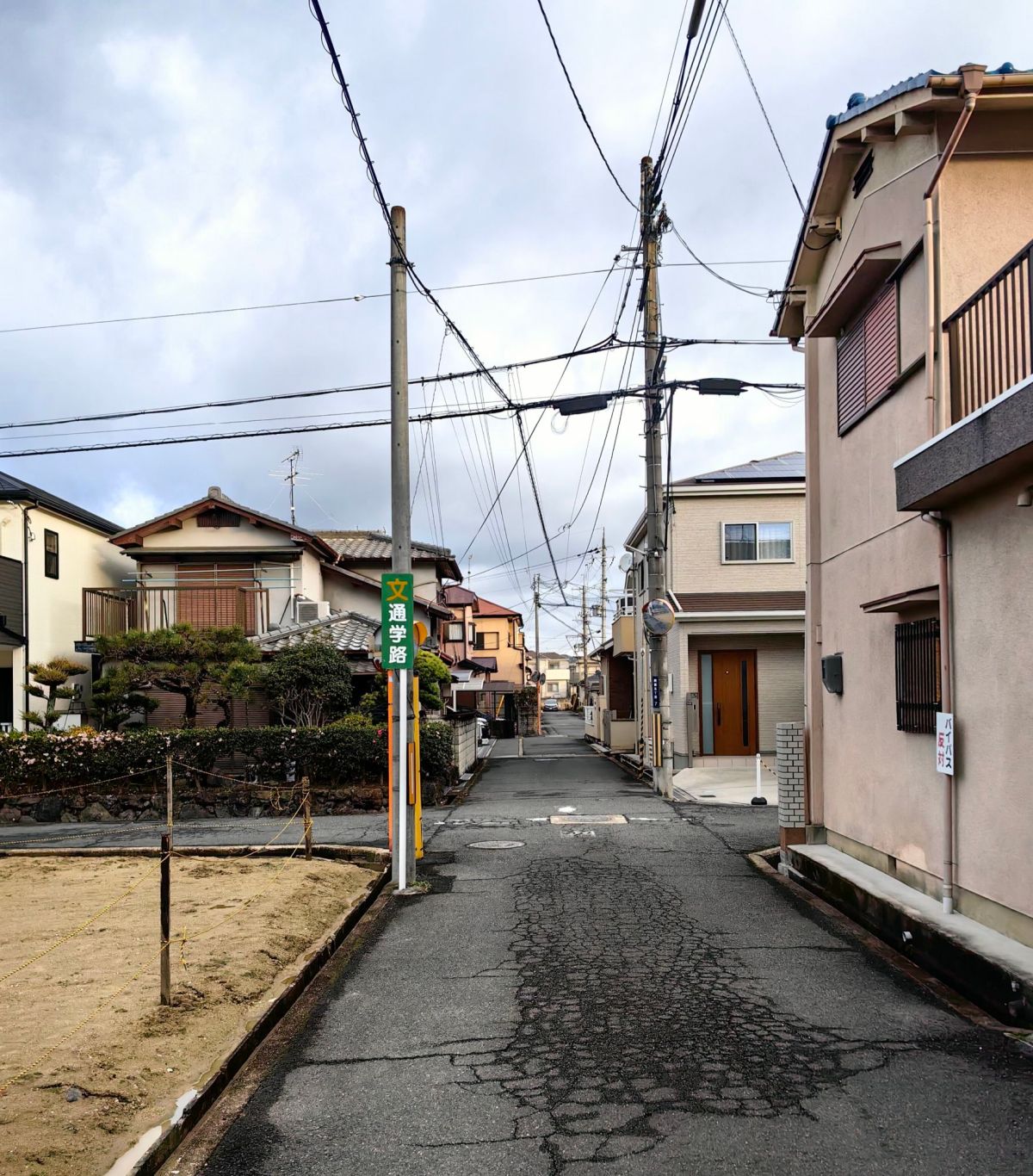
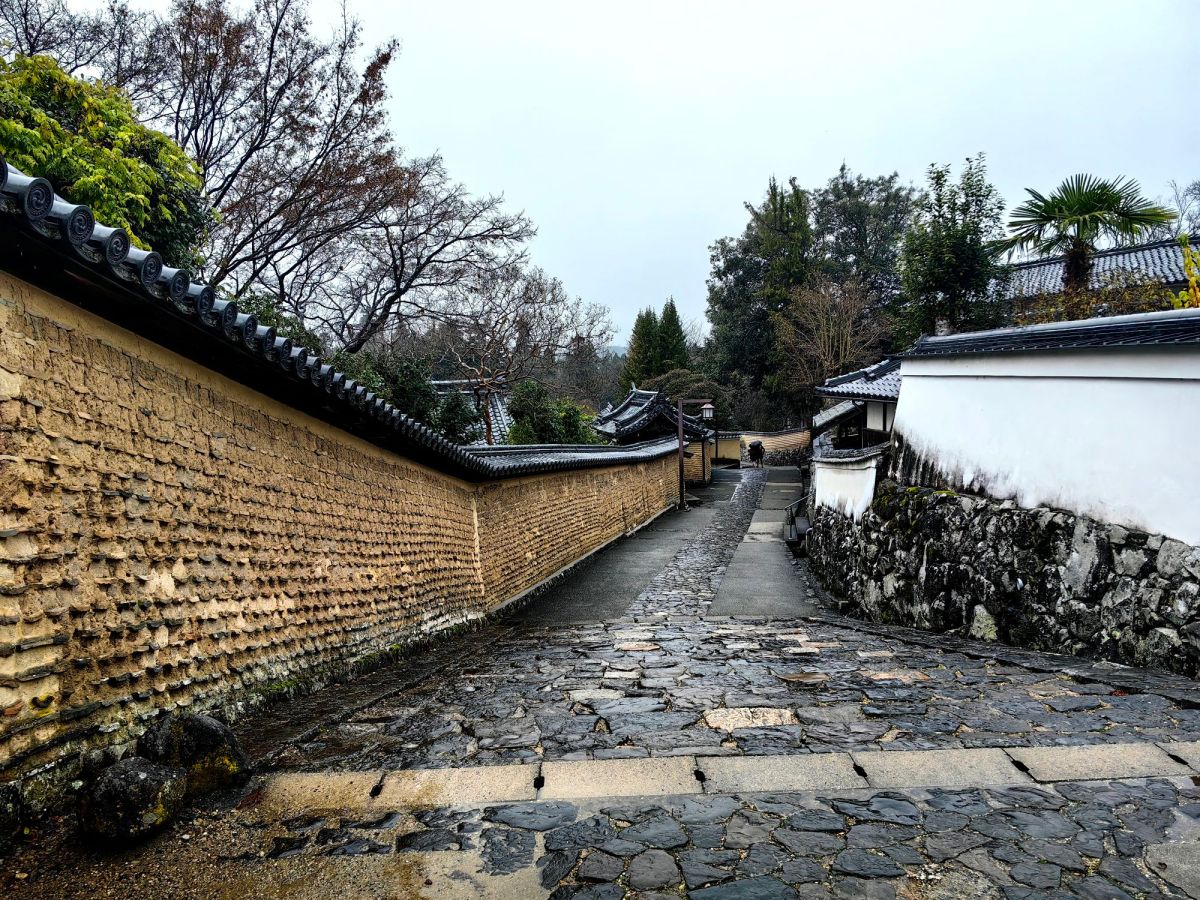
I travelled to Ikaruga in the early morning of December 2025, arriving while the town was still wrapped in the quietness of the beginning of the day. Unlike the busy streets of Osaka, Ikaruga felt almost completely removed from the rhythm of a modern tourist city. There were few people on the streets, little traffic, and hardly any of the noise. The town itself was modest and unassuming. Small, individually built houses stood closely along narrow streets, their tiled roofs and weathered walls softened by the pale winter light. Some houses had small gardens enclosed by low walls or wooden fences.
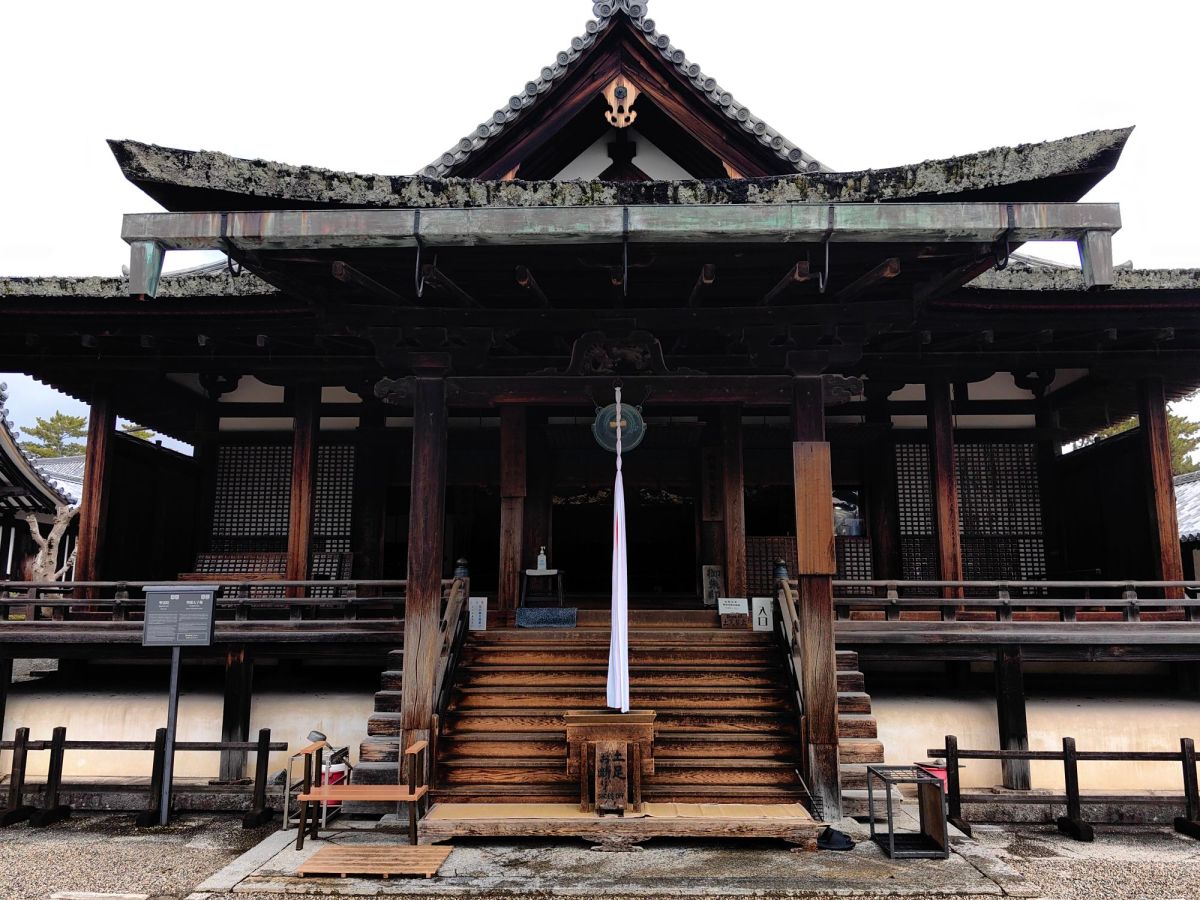
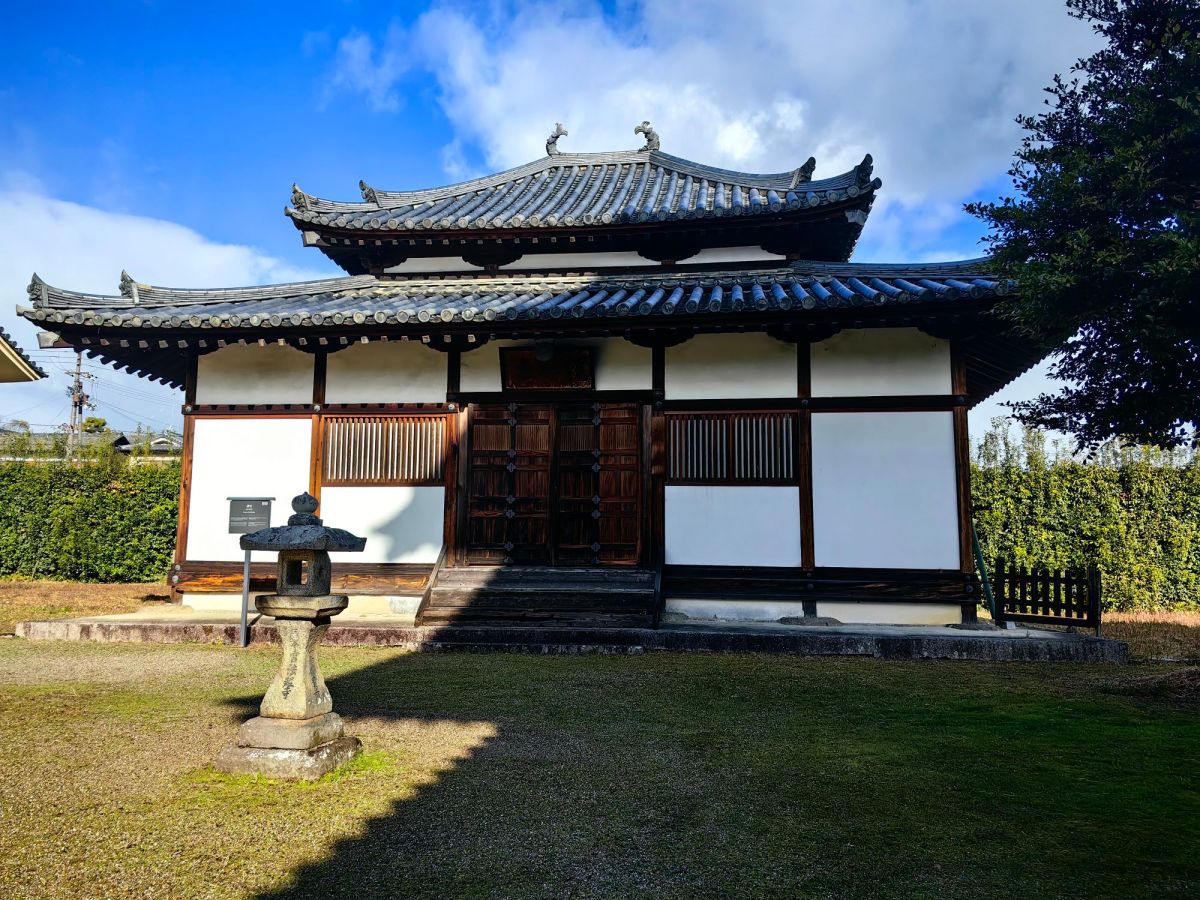
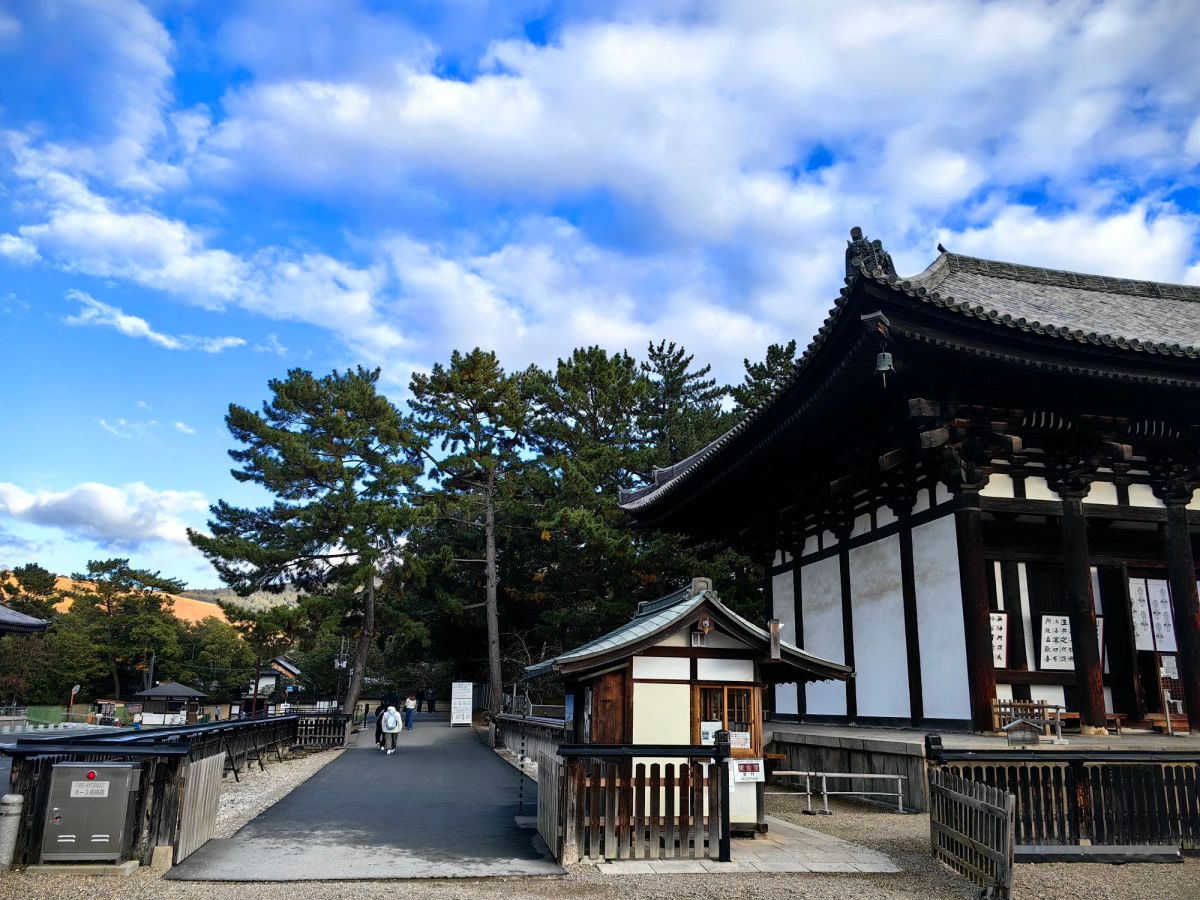
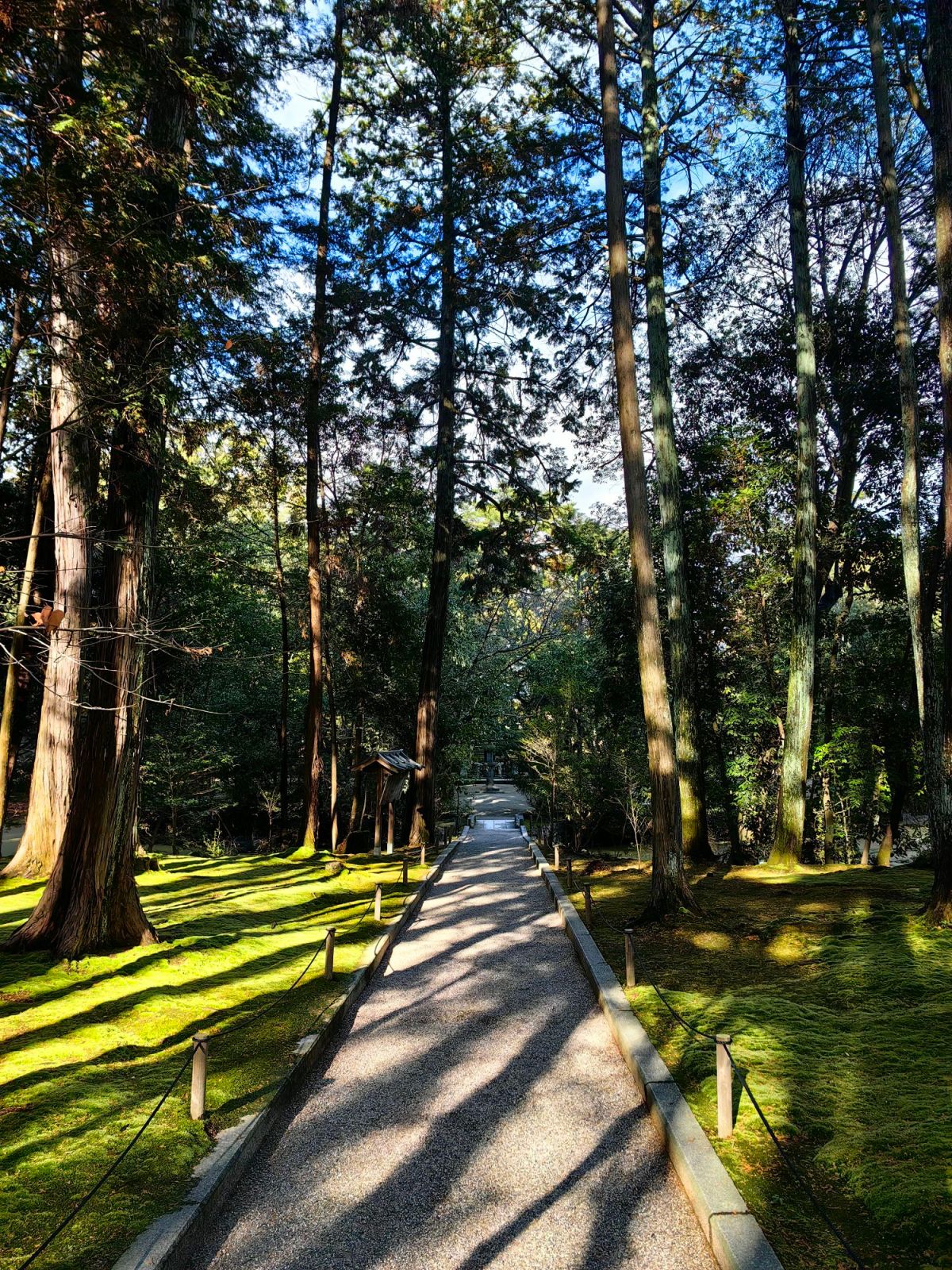
Chumon
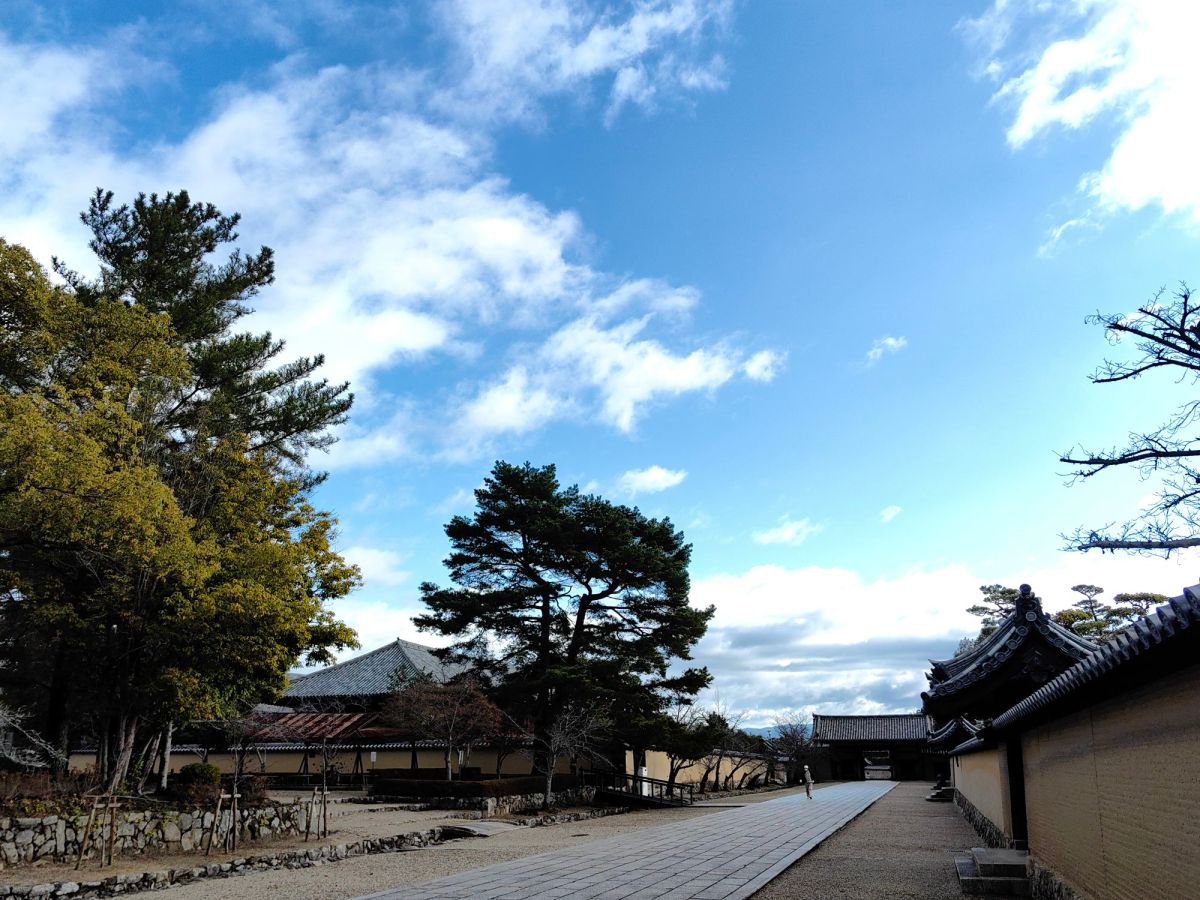
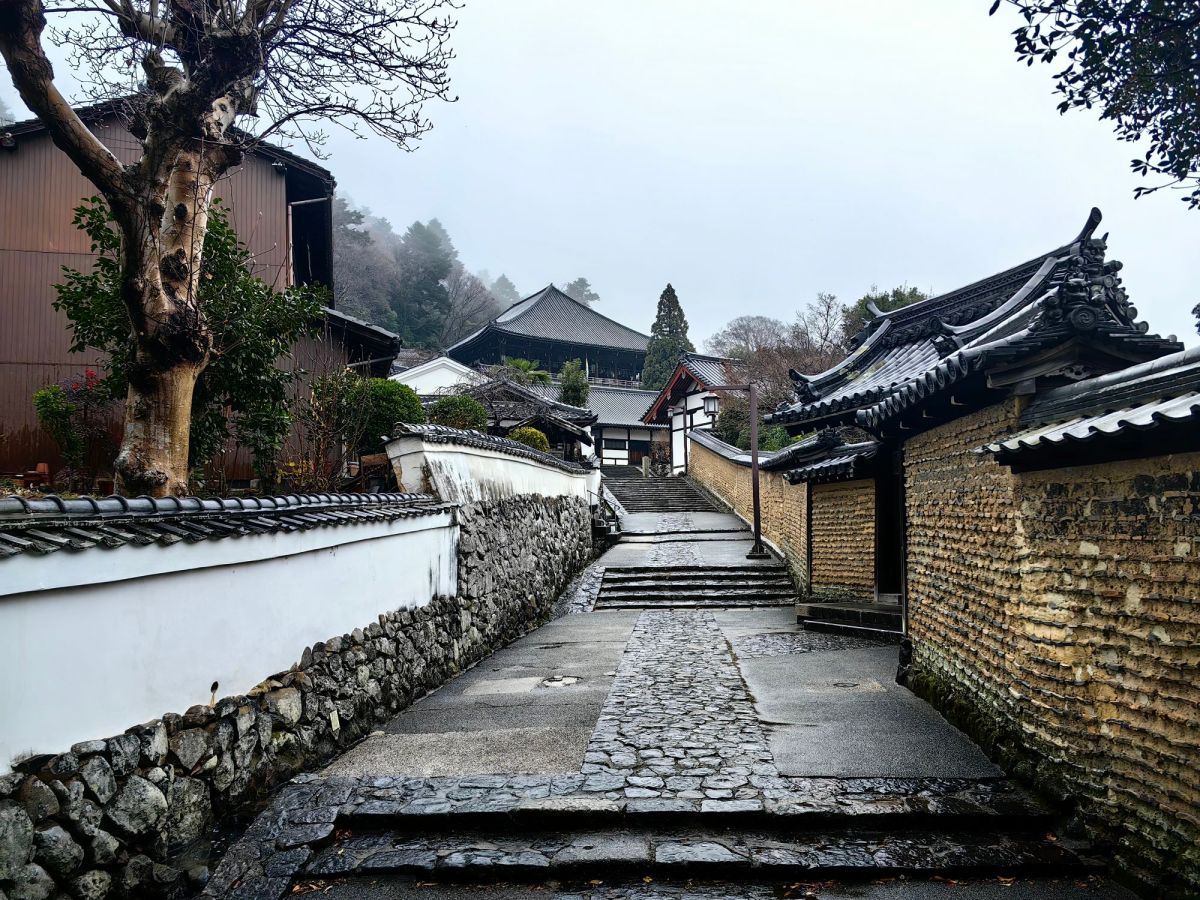
Rather than broad roads leading dramatically towards Hōryū-ji, there were small residential streets and narrow lanes, turning gently between houses and disappearing from view. The December morning air was cool and clean. The trees had largely lost their leaves, leaving bare branches silhouetted against a soft winter sky, while patches of evergreen remained around gardens and temple grounds. The low morning sunlight fell gently across the walls and rooftops. The temple was not immediately revealed in some grand approach. Instead, the route seemed to unfold gradually through the town.
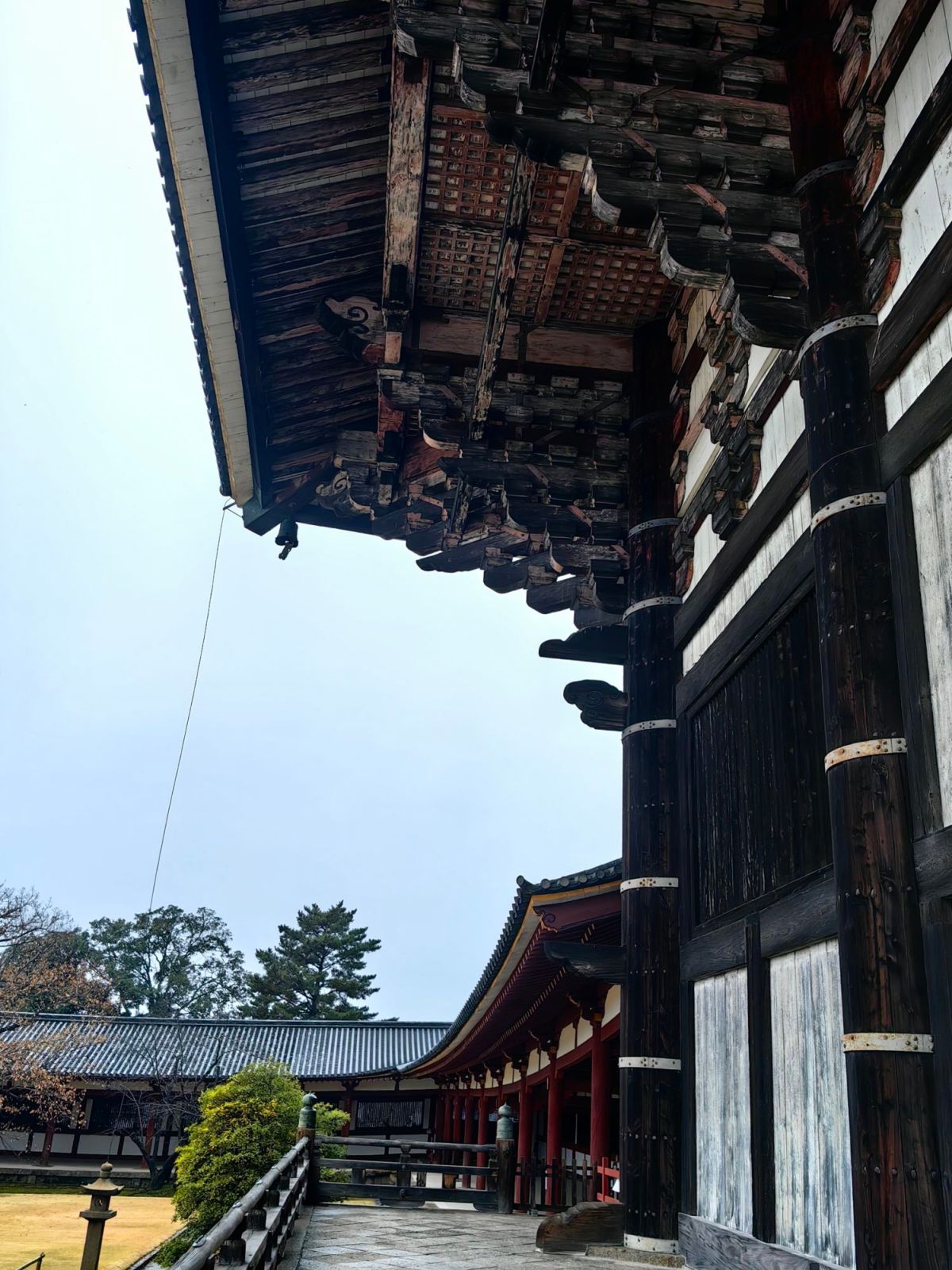
There was something beautiful about approaching Hōryū-ji in this way. At the end of the quiet road, the South Gate of Hōryū-ji suddenly came into view. After walking through the small residential lanes of Ikaruga, the sight of the great wooden gate felt almost like crossing a threshold into another age. It was imposing yet remarkably graceful. Its dark, weathered timber had been softened by centuries of exposure to sun, rain and wind, giving the wood a deep brown color and a texture that seemed to carry the weight of time. The massive wooden pillars rose firmly from the stone pavement, supporting the broad tiled roof whose gently curved eaves extended outward in the characteristic manner of traditional Japanese temple architecture.
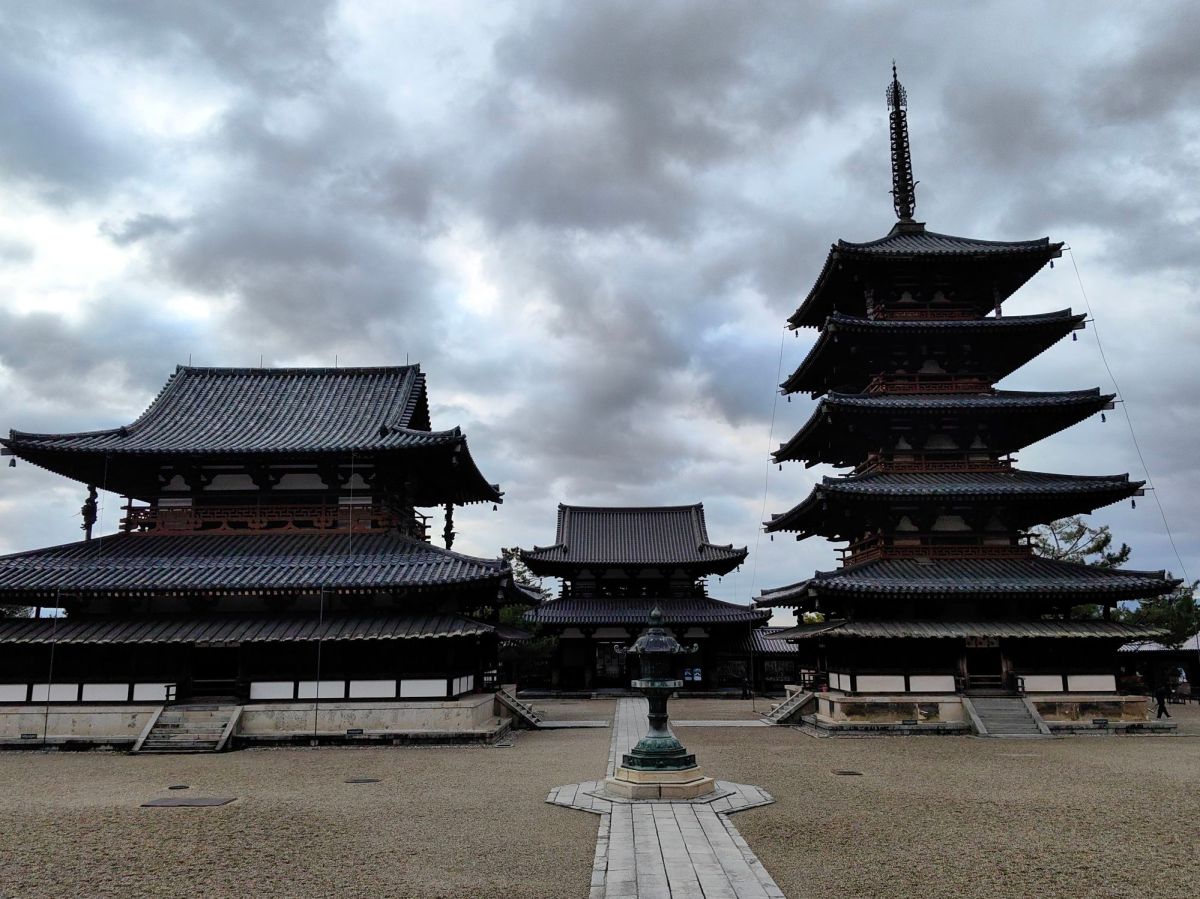
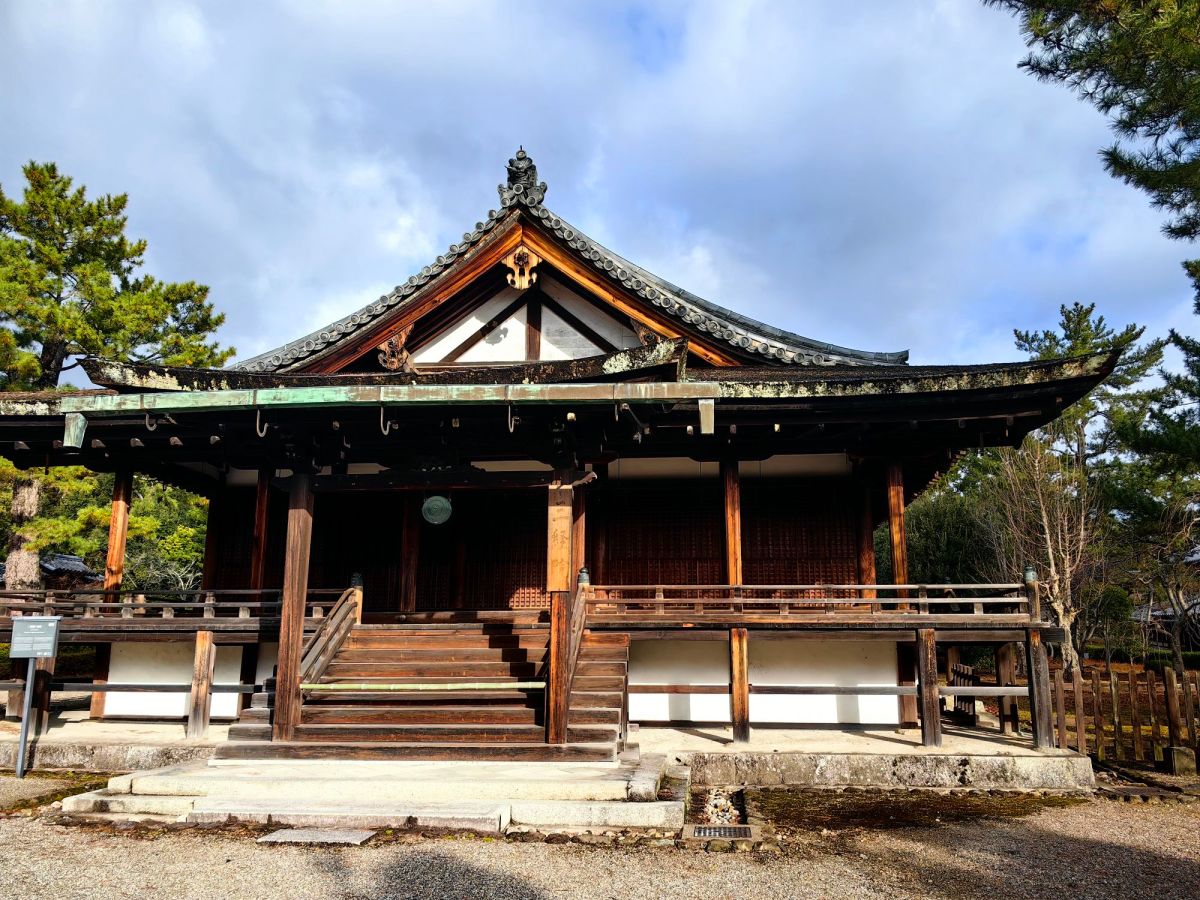
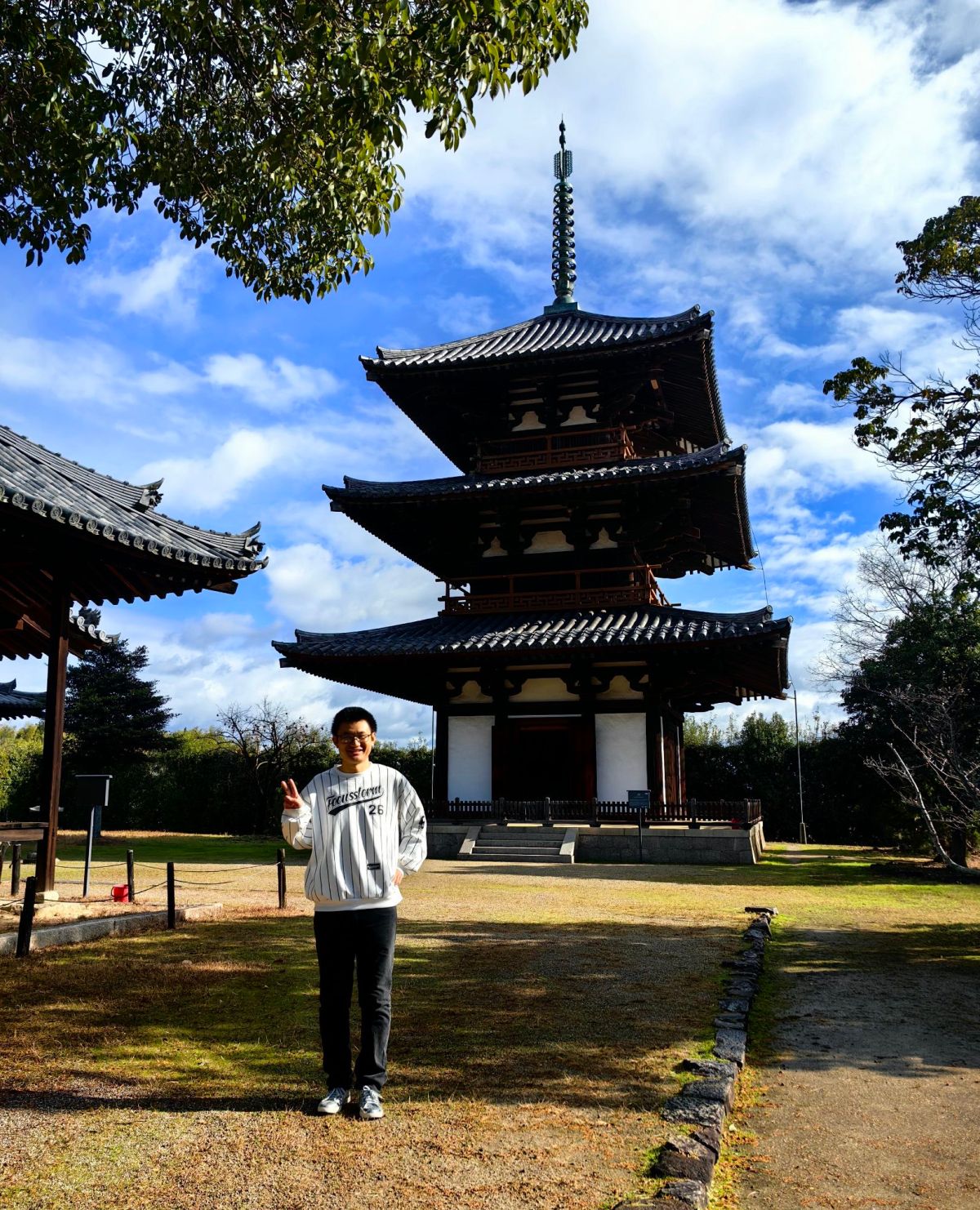
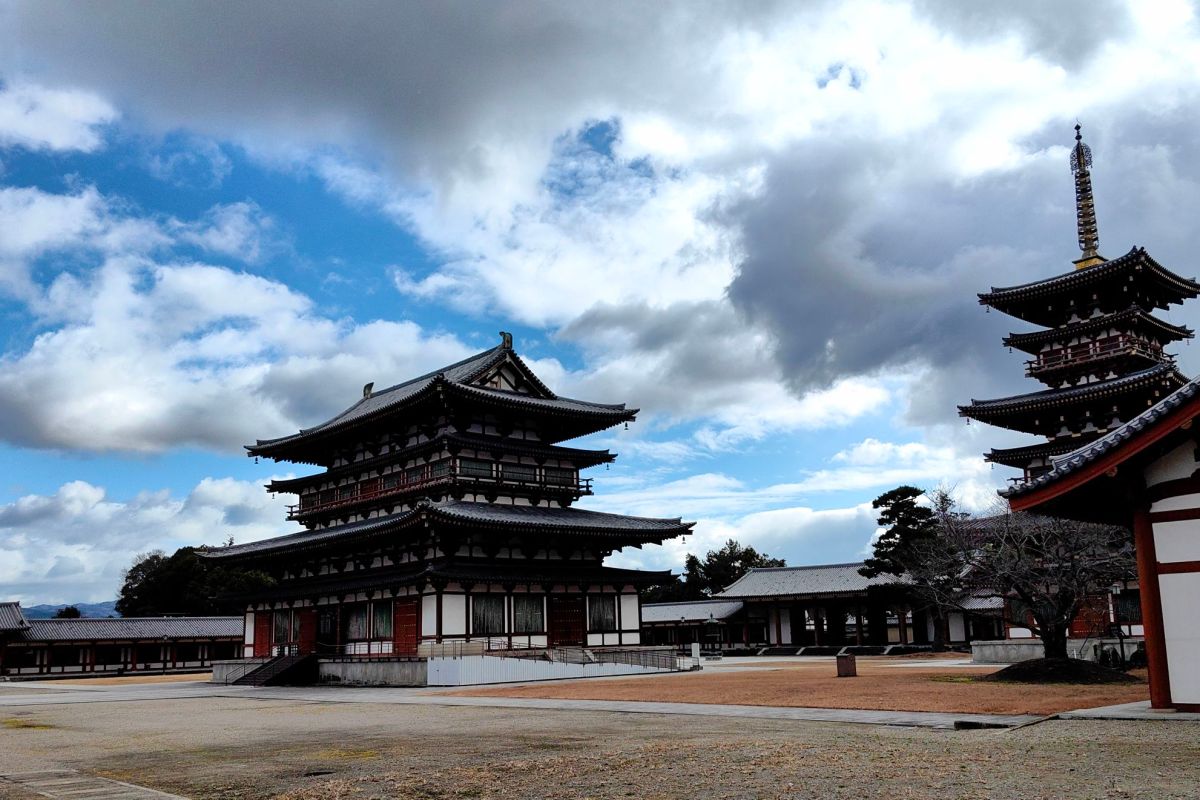
Kondo and Gojunoto
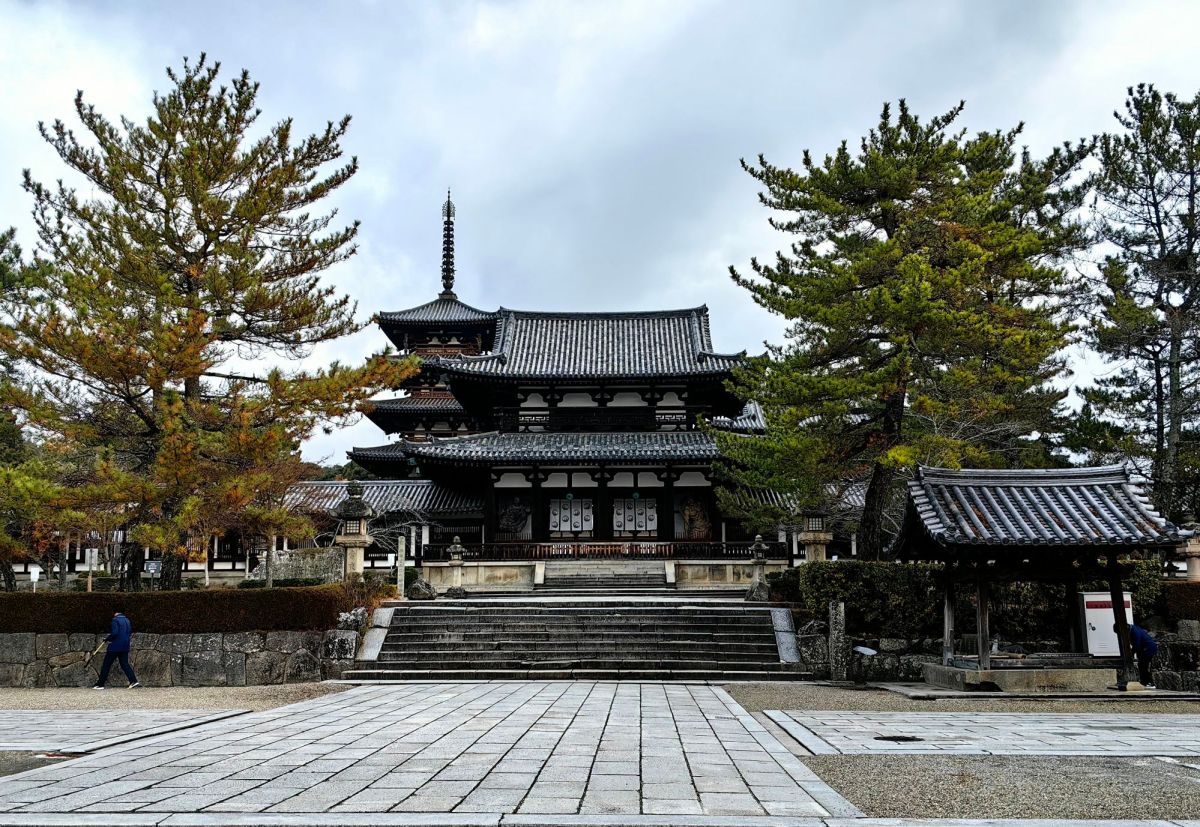
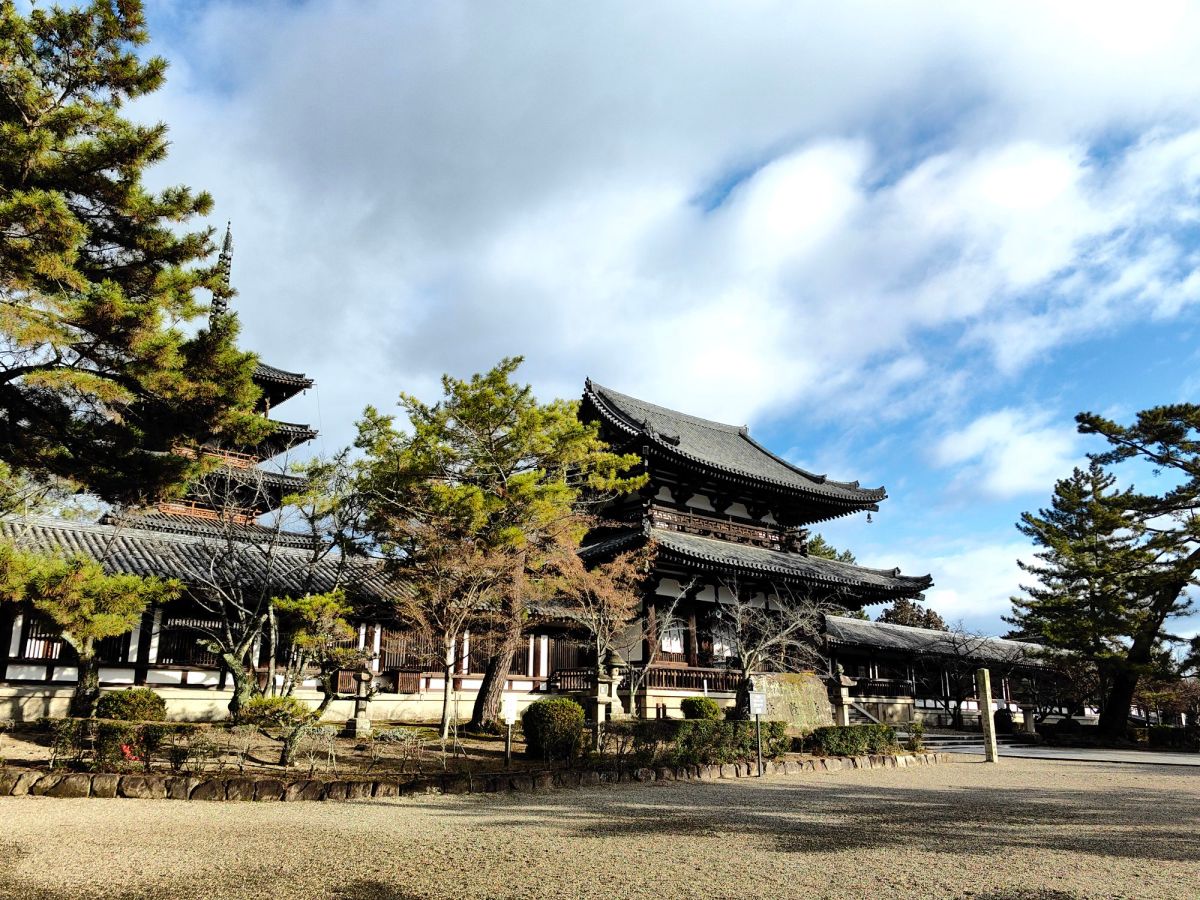
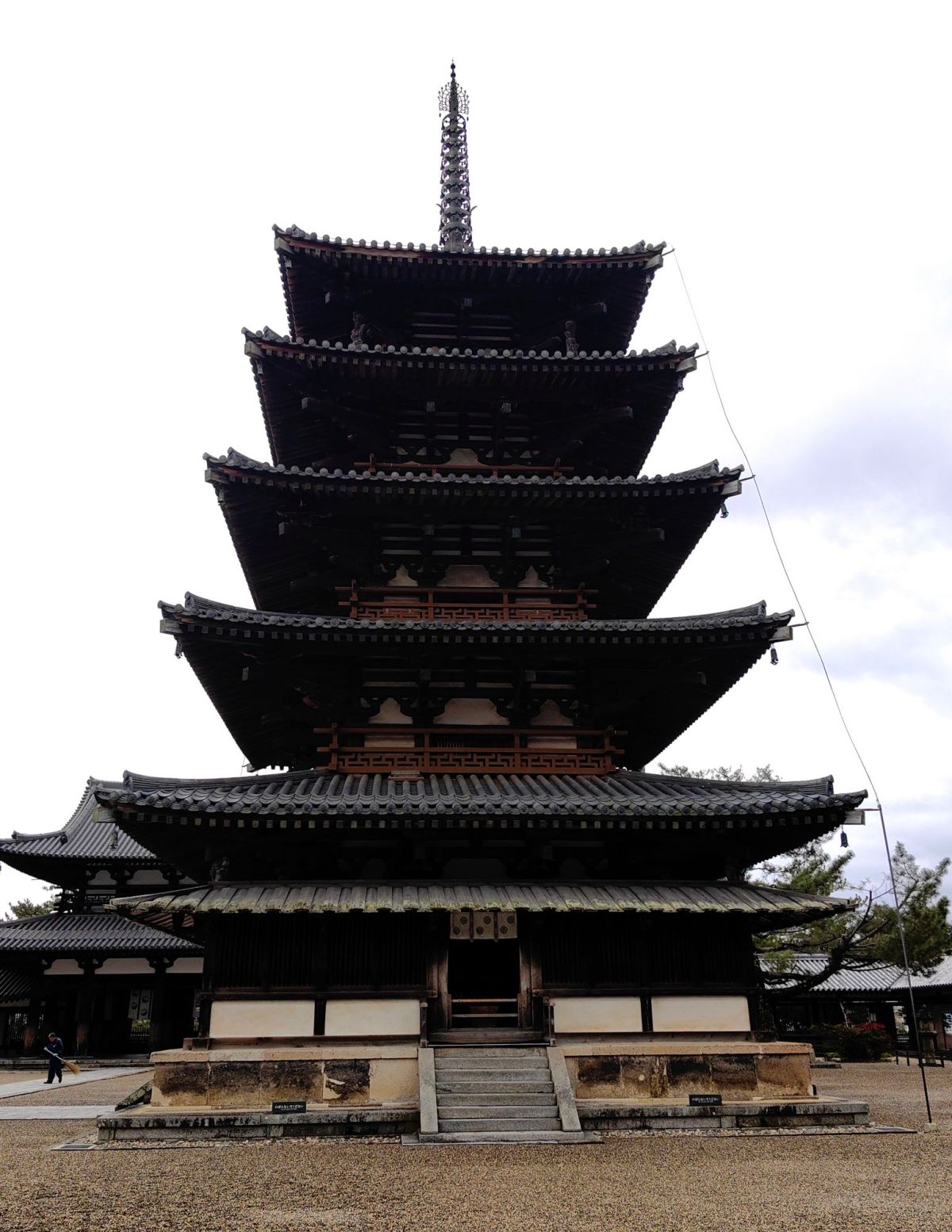
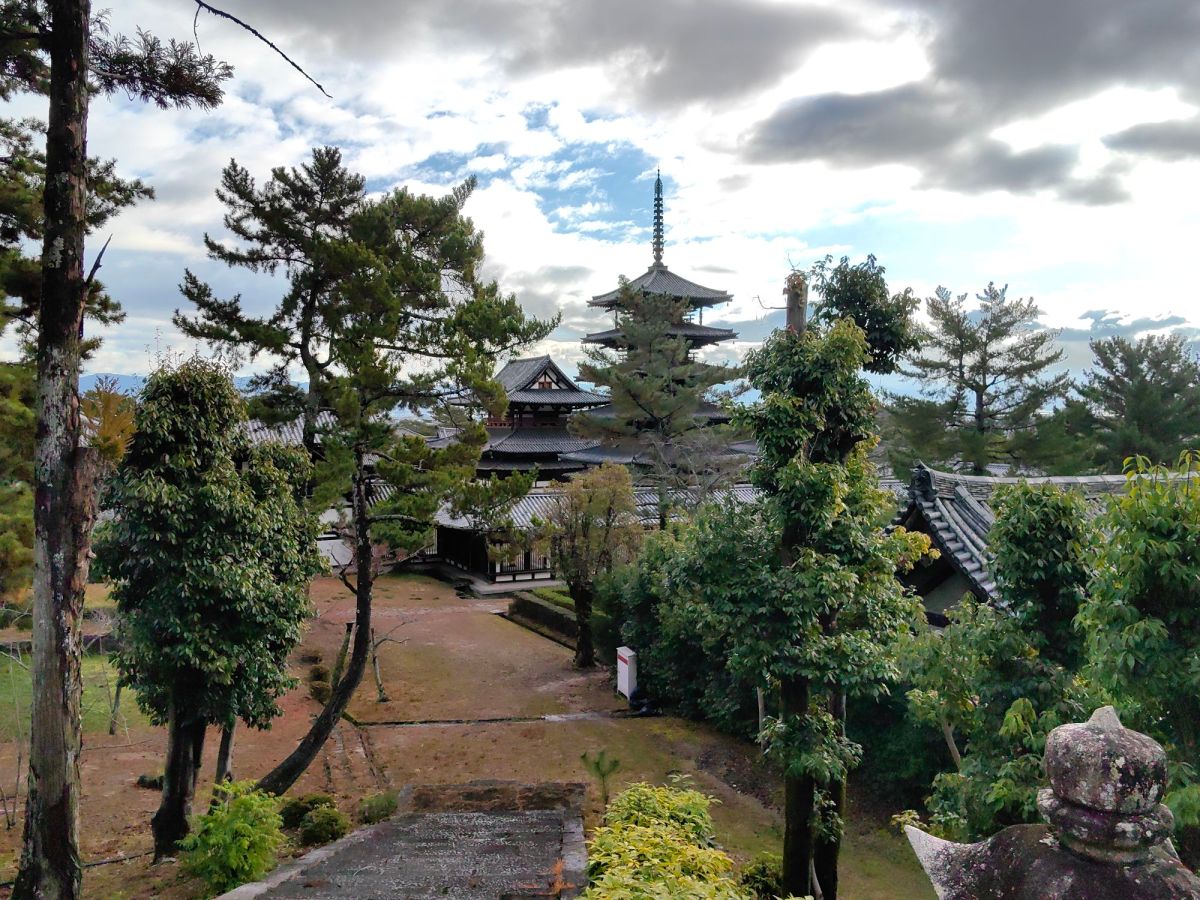
Beyond the gate, my first glimpse of Hōryū-ji opened gradually. The Five-Story Pagoda rose prominently in the distance, its dark wooden tiers becoming smaller and smaller as they climbed towards the sky. Its silhouette was remarkably elegant—five carefully balanced roofs stacked one above another, each projecting outward beneath the next. Beside it stood the Main Hall (Kondō), lower and broader, with its own sweeping tiled roof and rows of ancient wooden columns.
What struck me most was the pagoda under the pale winter sky. It was not brightly coloured or freshly polished. Their surfaces had been naturally darkened by age, and the weathered timber seemed almost black from a distance. Yet this subdued appearance made the architecture feel even more ancient. The courtyard was spacious and remarkably quiet that morning. The stone pavement, the aged timber, the tiled roofs and the towering pagoda formed a composition of extraordinary simplicity. I seemed to be the first visitor to arrive at Hōryū-ji that morning. The temple grounds were almost completely empty. A few monks were already at work.They moved quietly across the temple grounds, each holding a simple broom of straw and slowly sweeping the stone paths and courtyard. The gentle, rhythmic sound of the bristles brushing against the ground was almost the only sound in the morning.
For a moment, its history was not only preserved in ancient timber, tiled roofs or priceless Buddhist sculptures. It was also preserved through small actions repeated day after day: opening the gates, sweeping the paths, tending the grounds, and beginning another morning in the same sacred place. Perhaps this was one of the most beautiful things about arriving so early. Before the temple became a destination for visitors, it was simply a temple beginning another day. There were no crowds and no voices around me. Only the soft sound of the brooms moved across the stone accompanied by the faint winter air.
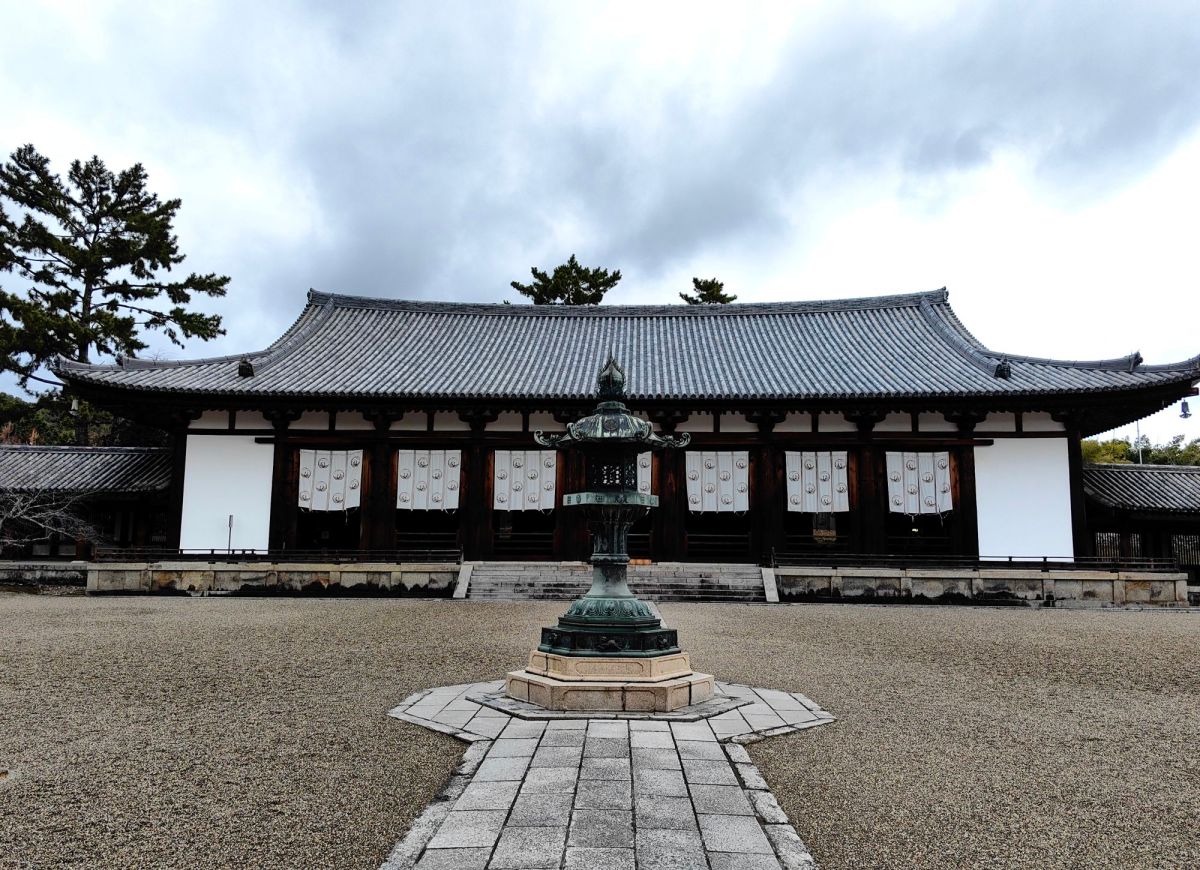
Daikodo
The Daikōdō stands at the northern end of Hōryū-ji’s central courtyard, its broad horizontal form creating a striking contrast with the towering Five-Story Pagoda. With its deep tiled roof, gently curved eaves, and dark, weathered wooden columns, the hall has a dignified yet peaceful appearance. Traditionally associated with Buddhist teaching and study, it was a place where monks gathered to learn and contemplate Buddhist teachings. Inside, the tranquil wooden interior houses Yakushi Nyorai, the Buddha of healing, accompanied by attendant bodhisattvas.
Outside the main temple buildings, Hōryū-ji opened into a much wider and more tranquil landscape outside the courtyard. The atmosphere here was completely different from the enclosed courtyards. Green trees were scattered throughout the grounds, their foliage standing out against the muted colors of the December landscape.
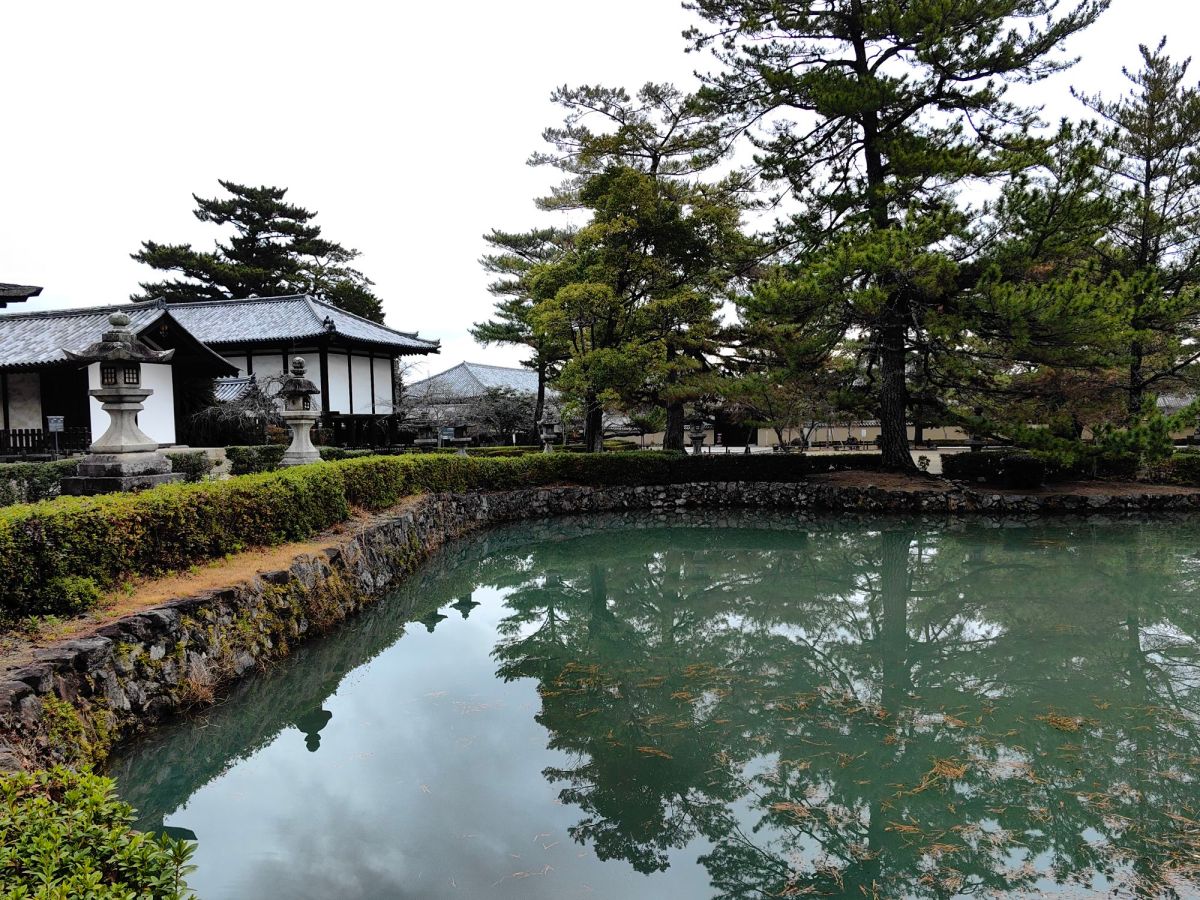
Small ponds appeared among the trees, their still surfaces reflecting fragments of the sky, branches and surrounding greenery. The wide paved paths stretched gently between the trees and temple buildings, leaving plenty of open space. Walking there alone, I felt no need to hurry from one attraction to another. The peaceful surroundings invited me simply to slow down, wander and stay for a while.
Saien-do
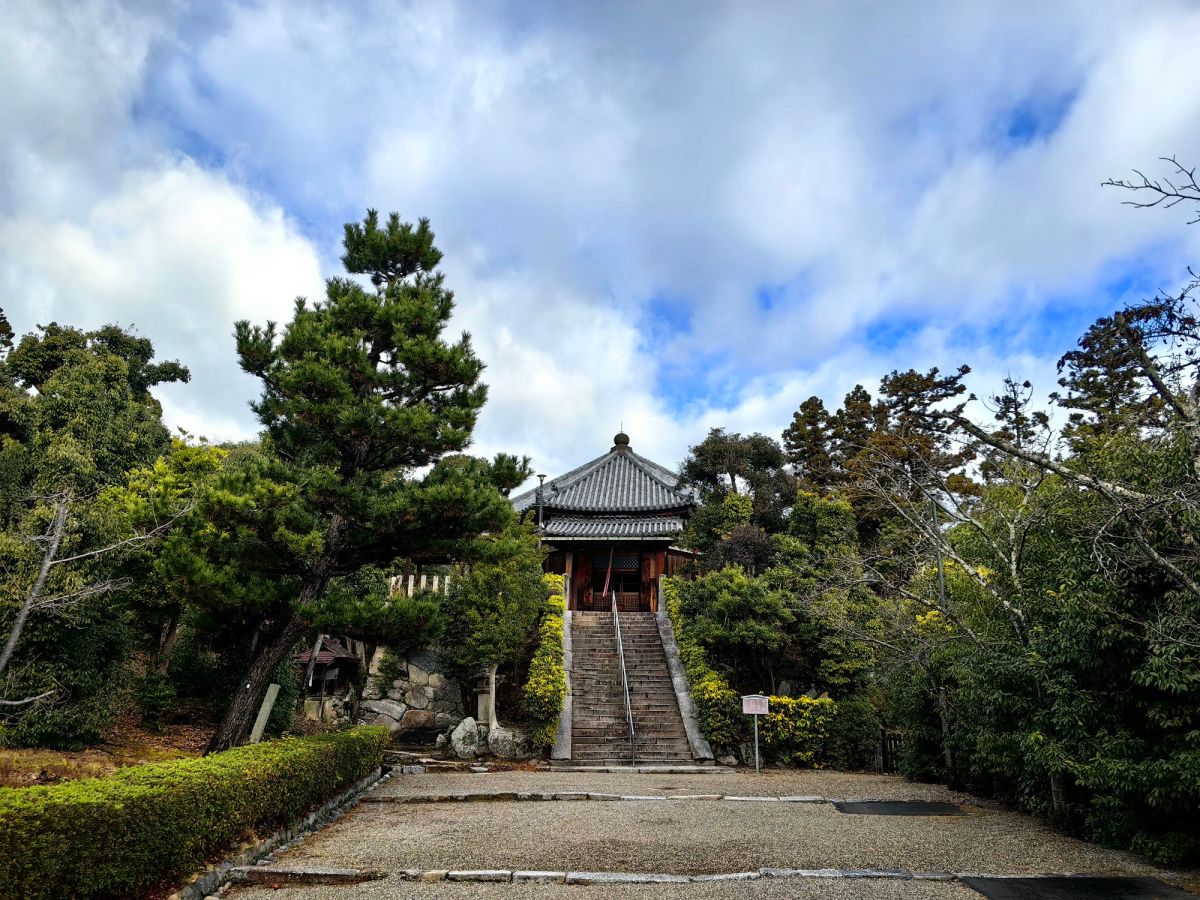
On the western side of Hōryū-ji, away from the more famous Five-Story Pagoda and Main Hall, I came to the Saien-dō, a smaller and more secluded temple hall standing quietly among the trees. The approach itself felt different from the grand central precinct. Instead of arriving at another monumental gate or an imposing courtyard, I followed a quieter path that gradually led upward through the greenery. Saien-dō has a much more modest presence than the great buildings of Hōryū-ji. Its circular form and gently curved tiled roof give it an unusual appearance among the predominantly rectangular halls of the temple complex.
Standing before it, I found myself surrounded by the aged wooden surfaces, the ancient roof tiles, the wooden railings and the shadows cast beneath the eaves. The surrounding trees added greatly to its atmosphere. Their branches framed the roof against the winter sky, while fallen leaves lay scattered along the ground. The December landscape had a subdued beauty, with patches of green remaining among the bare branches and the soft light filtering through the trees.
Nishimuro
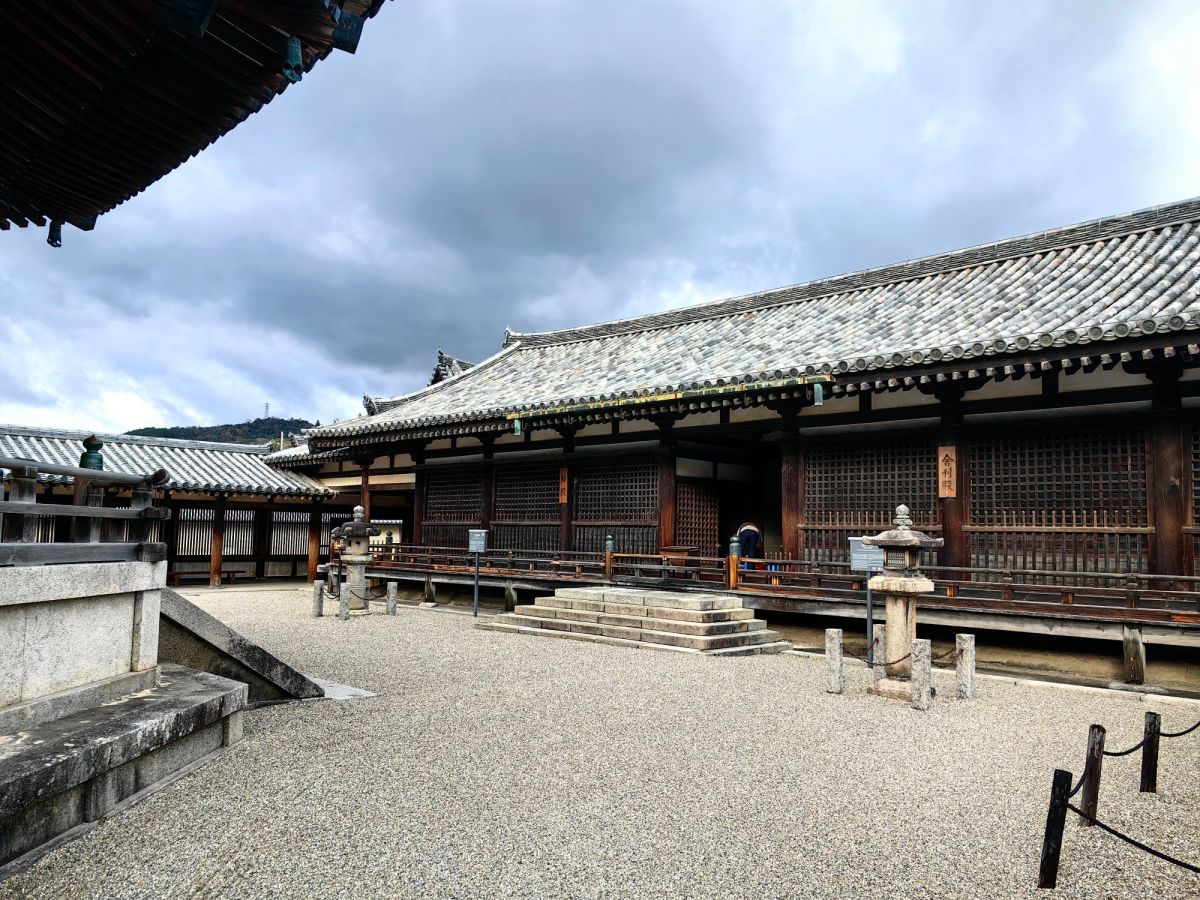
In this temple, I have observed many similar buildings of this style. The Nishimuro is a long, relatively low wooden building, associated with the living quarters and activities of monks. Its architectural speciality is its early Japanese Buddhist timber construction. The building demonstrates the characteristic techniques of the Asuka–Nara architectural tradition which marks the introduction and early development of Buddhism and Buddhist architecture in Japan. It is characterized by timber construction with post-and-lintel structures, large timber columns supported horizontal beams, bracketing systems, large tiled roofs, symmetrical temple layouts. Like other buildings at Hōryū-ji, it is especially significant because the temple preserves some of the oldest surviving wooden architecture in the world.
Daihozoin
After wandering through the ancient temple grounds, I came to the Daihōzō-in, the Gallery of Temple Treasures. The collection inside is extraordinary in its variety. There are Buddhist statues, bodhisattvas, guardian figures, paintings, ritual objects, textiles and other works of religious art. Many of them are extraordinarily old, reaching back to the Asuka and Nara periods. Looking at them, I was struck by how different their appearance was from the familiar Buddhist images of later Japanese temples.
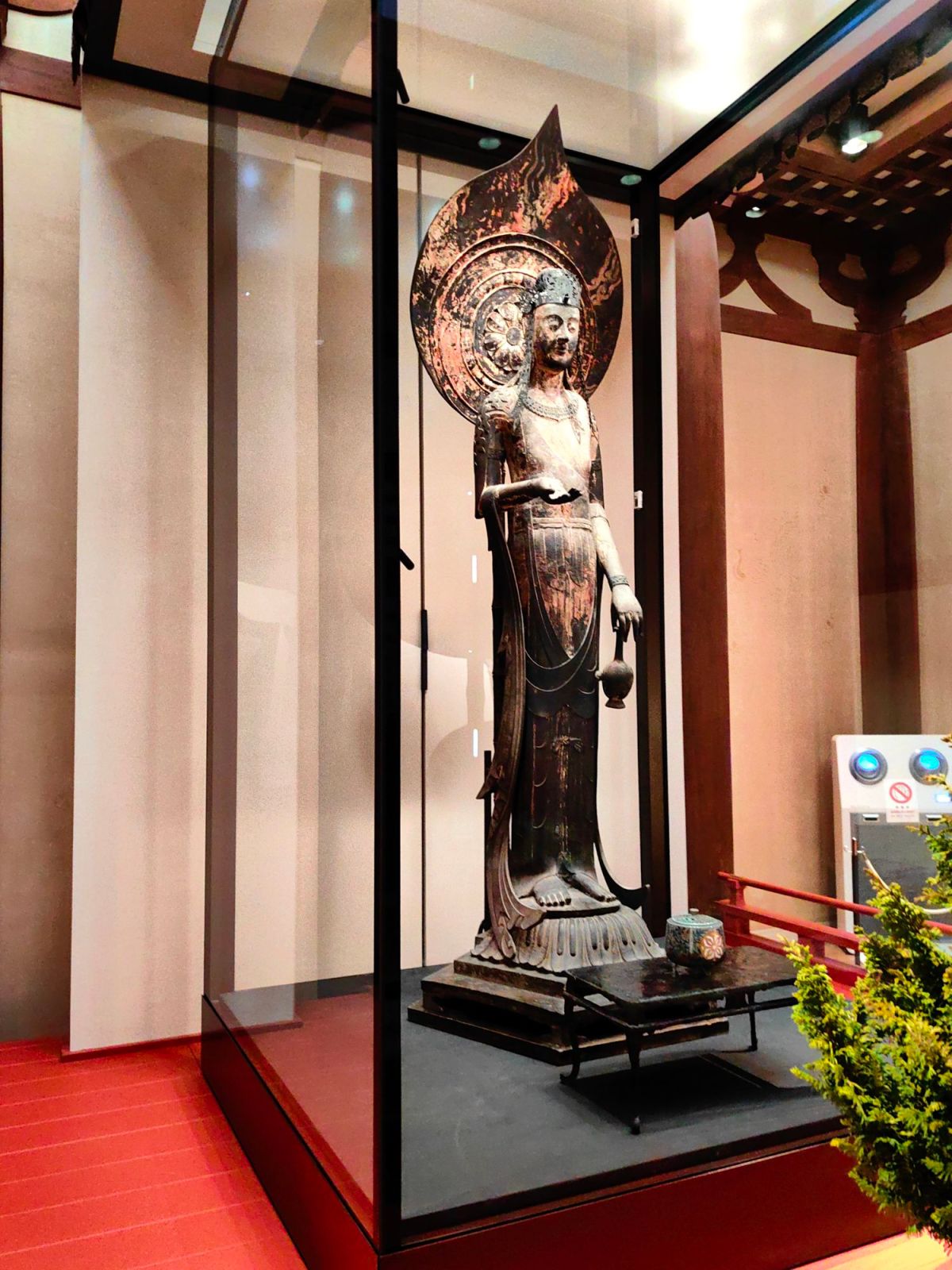
One of the most remarkable treasures associated with Hōryū-ji is the Kudara Kannon, a tall wooden image of Kannon traditionally associated with Baekje Korea. Its extraordinarily slender proportions and serene expression give it an almost otherworldly presence. The sculpture does not have the massive physicality of many later Buddhist statues. Instead, it seems to rise lightly and vertically, its elongated body creating an impression of extraordinary elegance.
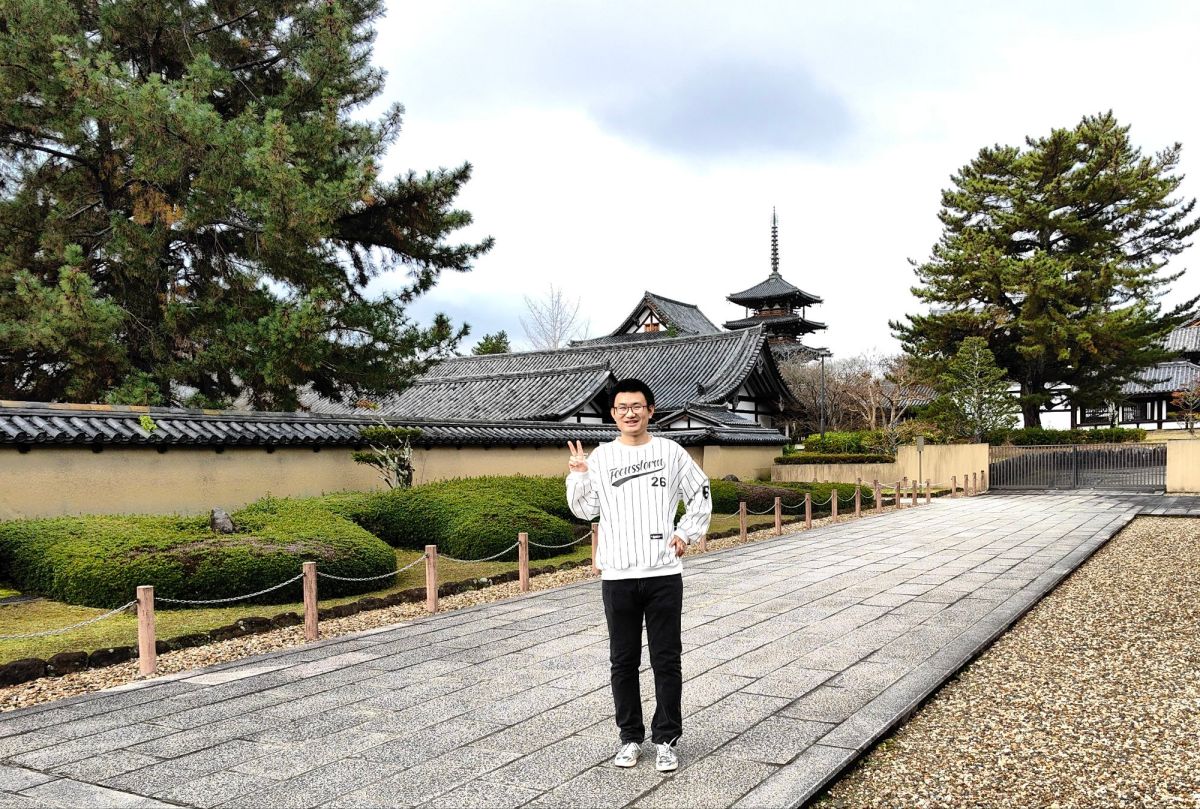
The complex of Hōryū-ji is very large and needs around 1.5 hours to go through all the areas. It is worthy to visit it because I could experience one of the world’s most important surviving collections of early wooden Buddhist architecture in its original temple setting. It gives me a physical way to understand the transition from the Asuka period (538–710) into the Nara period (710–794) and the growing influence of Buddhism on Japanese culture. Of course, everyone will take a photo with the iconic five-story pagoda which is a classical memory of Japanese travel.
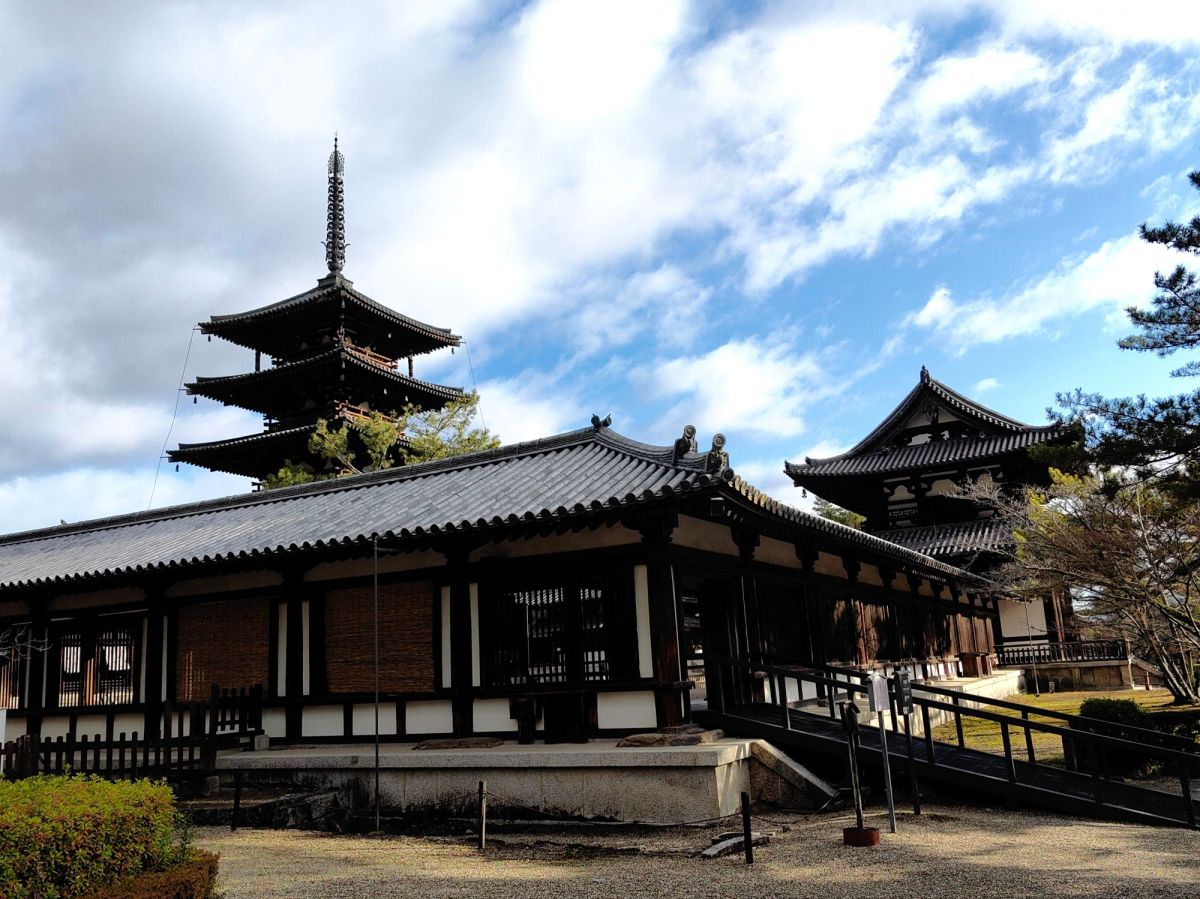
The Eastern Precinct (Tō-in) of Hōryū-ji is especially famous for the Yumedono (Hall of Dreams). Compared with the Western Precinct, which is associated with some of Japan’s oldest surviving Buddhist buildings, the Eastern Precinct has a somewhat different character: it is a memorial complex connected with Prince Shōtoku who was an influential Japanese prince, political leader, and patron of Buddhism during the Asuka period. He served as regent for Empress Suiko and is traditionally credited with helping strengthen the central government through the Seventeen-Article Constitution. According to temple tradition, he established the original temple, known as Wakakusa-garan, in the early 7th century.
Yumedono
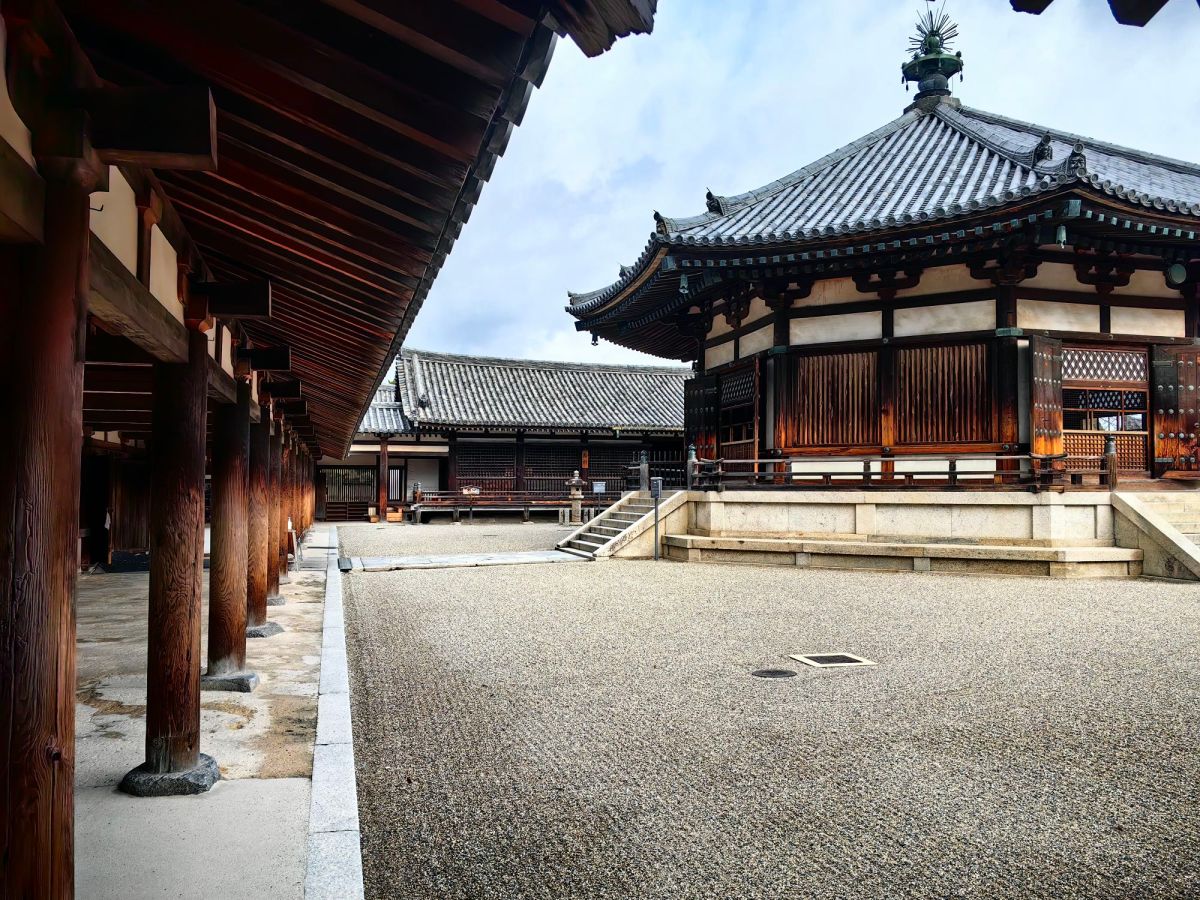
The Eastern Precinct was established later, around the 8th century. Its centre is the famous Yumedono. It functions as a place where Prince Shōtoku’s spiritual legacy is commemorated. It stands at the centre of the Eastern Precinct, surrounded by a cloister. The name Yumedono, translated as “Hall of Dreams,” is connected with traditions about Prince Shōtoku receiving a vision or divine revelation at this location. The octagonal form makes the building visually distinctive.
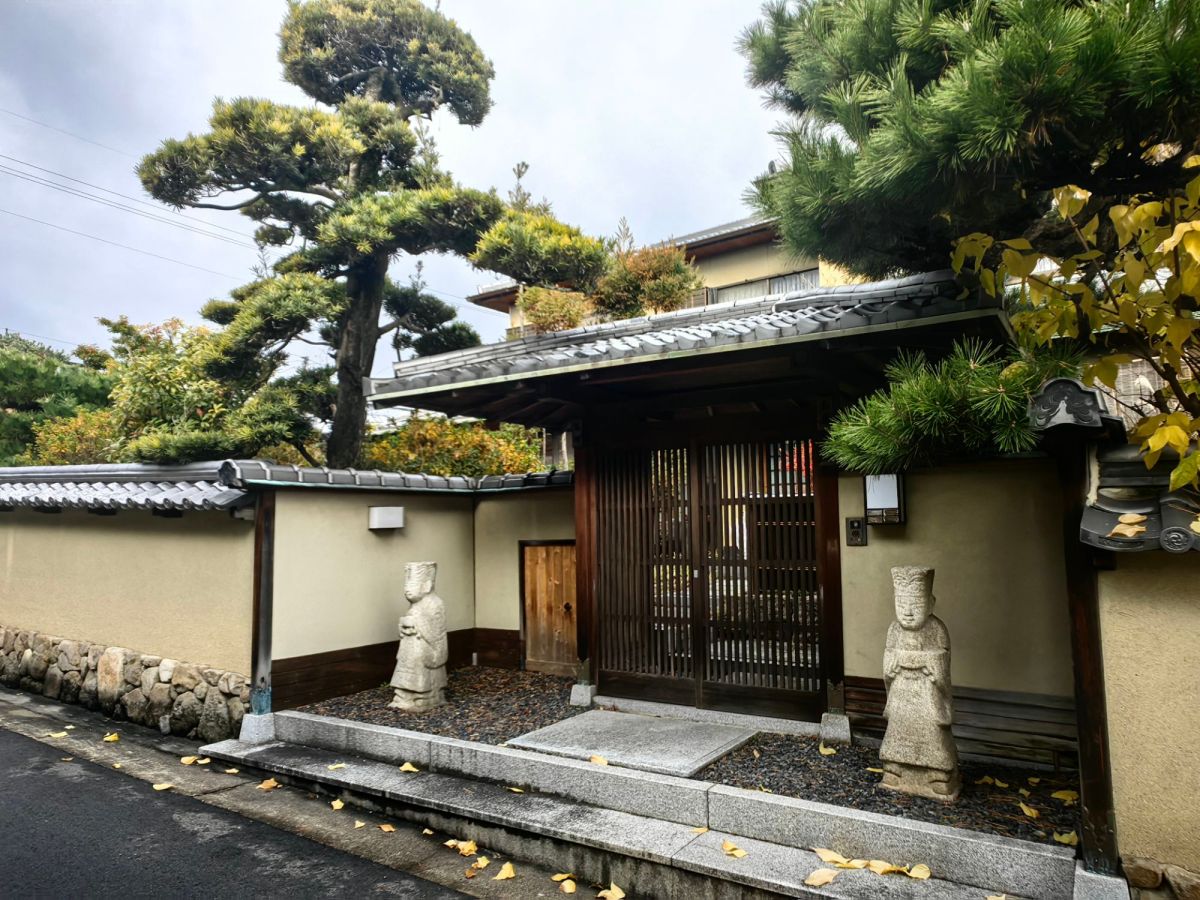
After I left the Hōryū-ji, I passed a traditional Japanese private residence tucked along the quiet road toward Hōrin-ji. Its entrance is set behind a stone-walled courtyard, where green plants grow naturally around the edges, giving the property a secluded and peaceful character. A wooden entrance door forms the focal point, with two stone statues placed in front as quiet guardians. The combination of weathered stone, dark wood, and greenery gives the house a simple beauty typical of the traditional Japanese landscape with a sense of harmony, simplicity, and tranquillity.
Hōrin-ji
Ikaruga was a center of the early Buddhist and political world around Prince Shōtoku. His religious establishments were concentrated in this area. After his death, other members of his family continued establishing temples connected with him and his legacy. That’s why I could find many temples with the similar names. Hōrin-ji is a small and peaceful temple , just north of Hōryū-ji. It has a more rustic atmosphere than the larger Hōryū-ji complex.
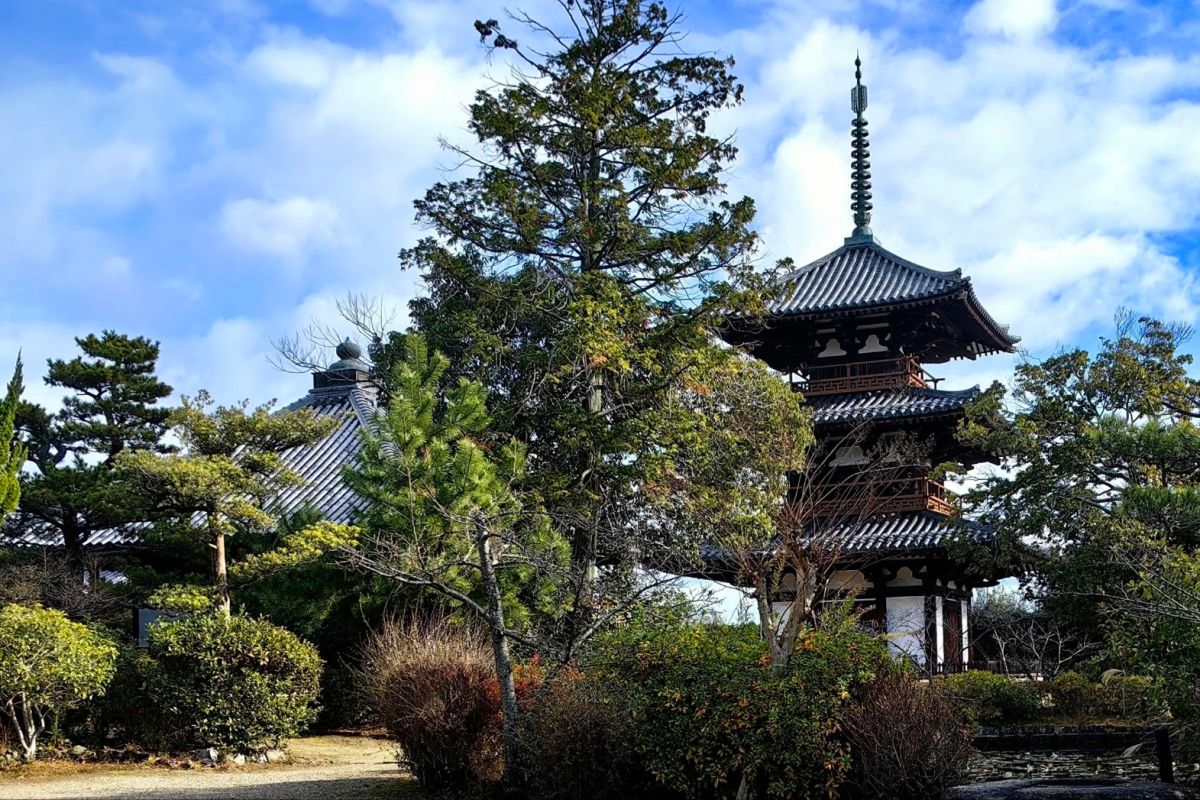
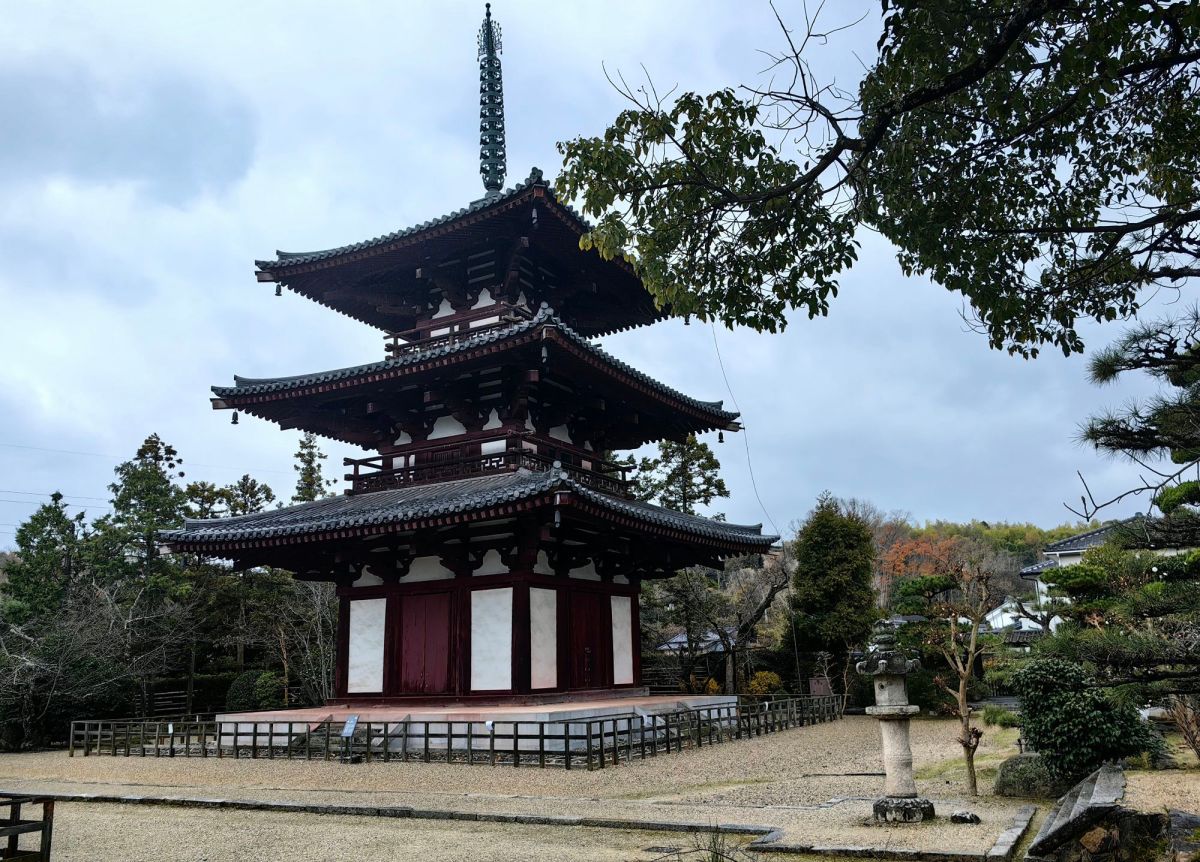
Similar to Hōryū-ji, it has a three-story pagoda rising above the surrounding trees, which is one of the distinctive landmarks of Ikaruga. Traditional wooden temple buildings, with dark timber, tiled roofs, and restrained architectural decoration was surrounded by stone features and garden vegetation. Its name means “Temple of the Dharma Wheel.” Tradition says it was founded by Prince Shōtoku’s son, Prince Yamashiro, to pray for his father’s recovery.
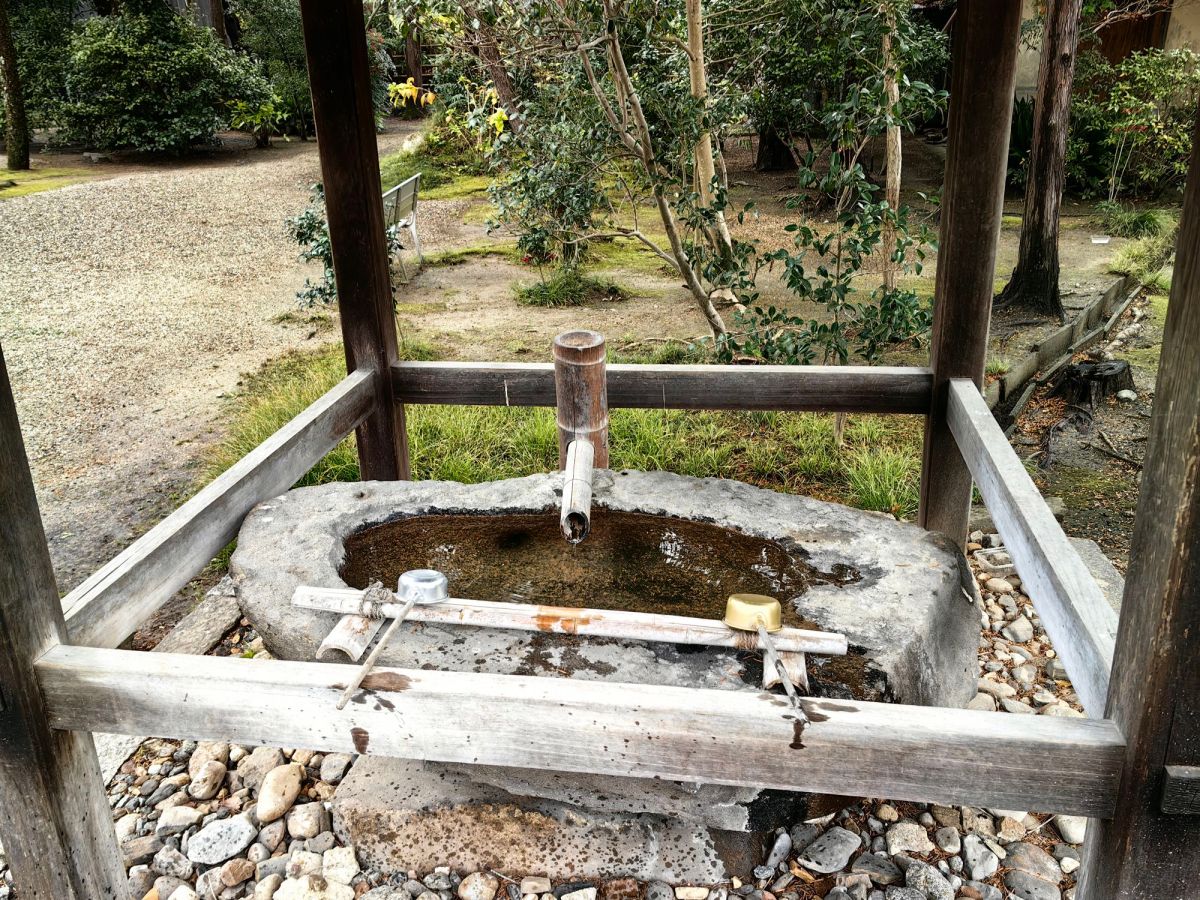
Near the temple buildings stands a large stone temizu basin filled with clear water. A small ladle rests beside it, inviting visitors to scoop the water and purify themselves before continuing through the temple grounds. This kind of device can be seen in many temples in Japan. It maybe a symbolic act of purification before approaching sacred spaces.
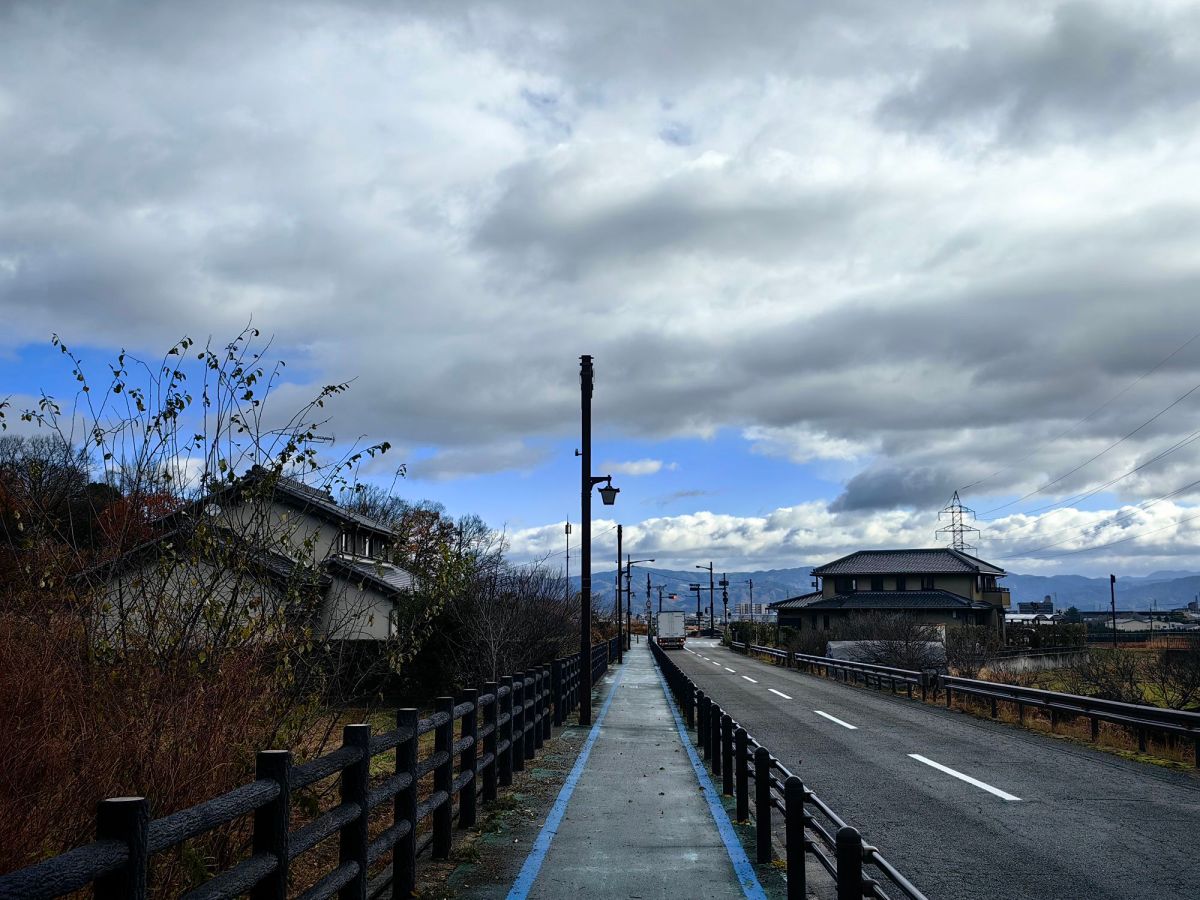
The walk I took from Hōryū-ji to Hōrin-ji to Hōkki-ji is actually passing through one of Japan’s most concentrated landscapes of 7th-century Buddhist history. The ordinary houses, stone walls, fields, and narrow roads between the temples are part of that historic Ikaruga setting rather than simply being a modern neighborhood around three temples.
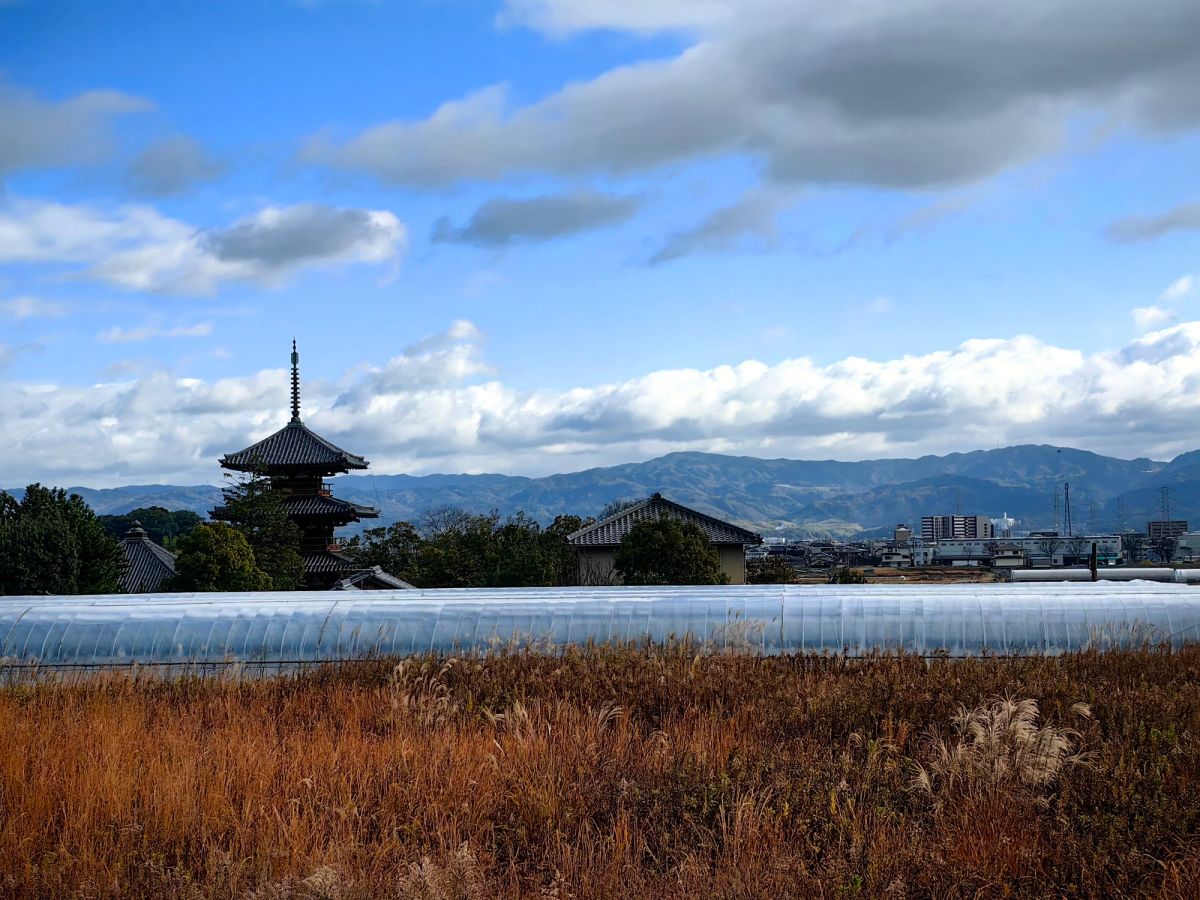
The wide fields, distant mountains and an expansive sky, create a peaceful rural horizon. Standing there with the fields stretching out before me, I took a photograph of the landscape: the low mountains forming a gentle backdrop, the broad agricultural land spreading across the foreground, and the enormous winter sky above. Many Japanese towns are framed by mountains, particularly toward the north, because much of Japan’s interior is mountainous. Even places densely populated often have mountains quietly appearing beyond the buildings. In Ikaruga, however, there were few structures to interrupt the view, so the town, the fields and the surrounding mountains was especially clear.
Hōki-ji
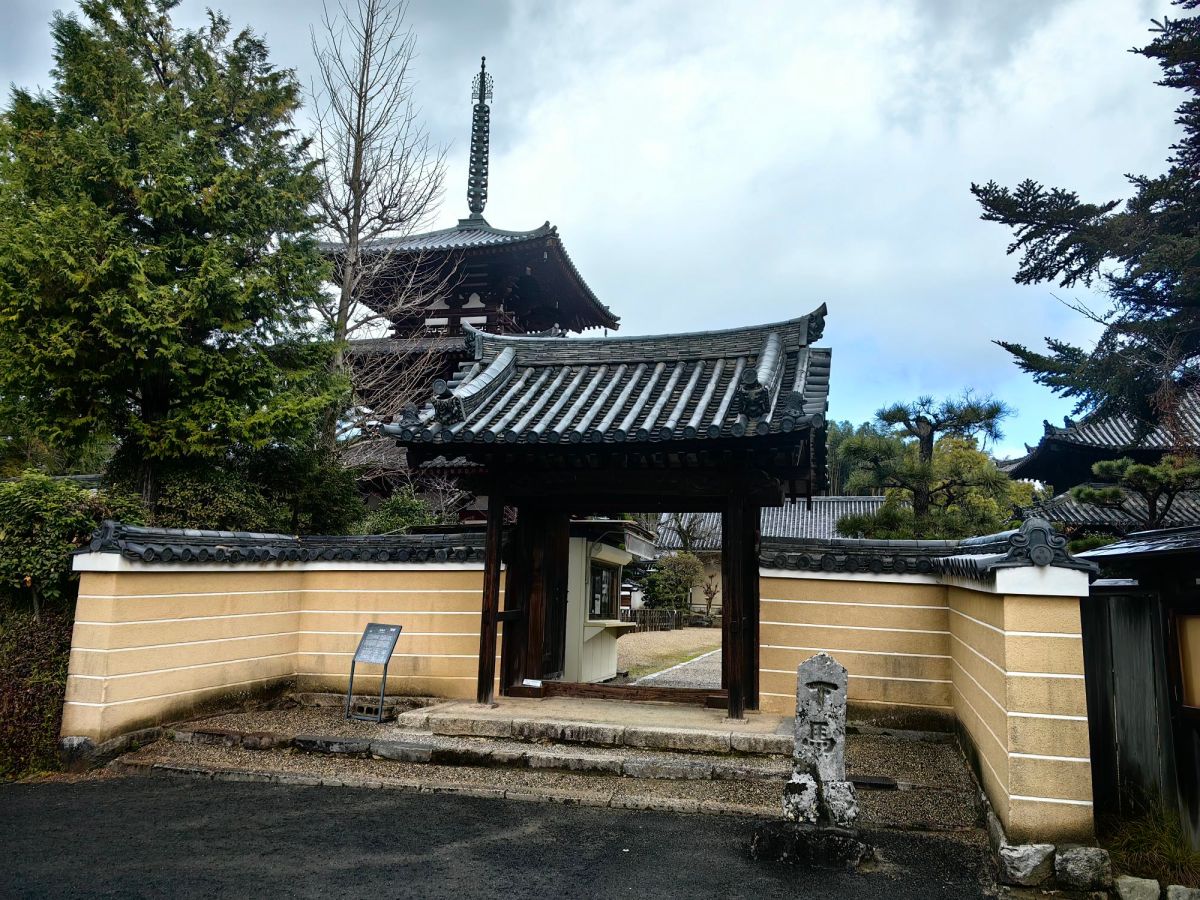
At a quiet corner of the country road, I unexpectedly encountered my last destination, Hōki-ji. It was almost hidden from view, tucked away in a small patch of woodland at the edge of the fields. Through the trees I caught my first glimpse of the three-story pagoda, rising quietly above the surrounding greenery. This temple is also deeply connected with the early history of Japanese Buddhism. Tradition associates it with Prince Yamashiro no Ōe, the son of Prince Shōtoku.
The main hall, although much less imposing than the great halls of Hōryū-ji was modest with traditional tiled roofs, and the surrounding grounds were simple and uncluttered. The three-Story Pagoda was built in the seventh century; one of the oldest surviving three-story pagodas in Japan and the oldest surviving pagoda in the country. Its dark wooden structure stood beautifully against the open sky, each successive roof becoming smaller as the tower rose upward.
By the time I reached Hōki-ji, I had spent the day walking through the small lanes of Ikaruga, visiting ancient temples and gradually moving farther into the countryside. The temple felt like a fitting conclusion to the journey. What moved me most was that history here did not feel like something preserved only for tourists; it remained quietly rooted in everyday life and in the corner of country landscape. That was the most moving part of the journey. After so many centuries, history in Ikaruga does not seem to shout for attention. It was simply waiting for those who are willing to slow down and notice it.
More than a thousand years have passed since Nara stood at the heart of Japan as the imperial capital of Heijō-kyō. In the Man’yōshū, the poet praised the ancient city: “Beautiful Nara, the ancient capital, flourishes now like flowers in full bloom.” Those words conjure Nara in the height of its splendor, when its palaces, temples, and streets were filled with the life and ambition of a flourishing new capital. Today, much of that city has disappeared, leaving only fragments scattered across the landscape. Yet walking through Nara, the passage of time does not feel distant. It lingers in the weathered stones, the ancient wooden halls, the quiet forests, and the deer wandering beneath the trees. The capital that once flourished like flowers has faded, but something of its spirit remains.
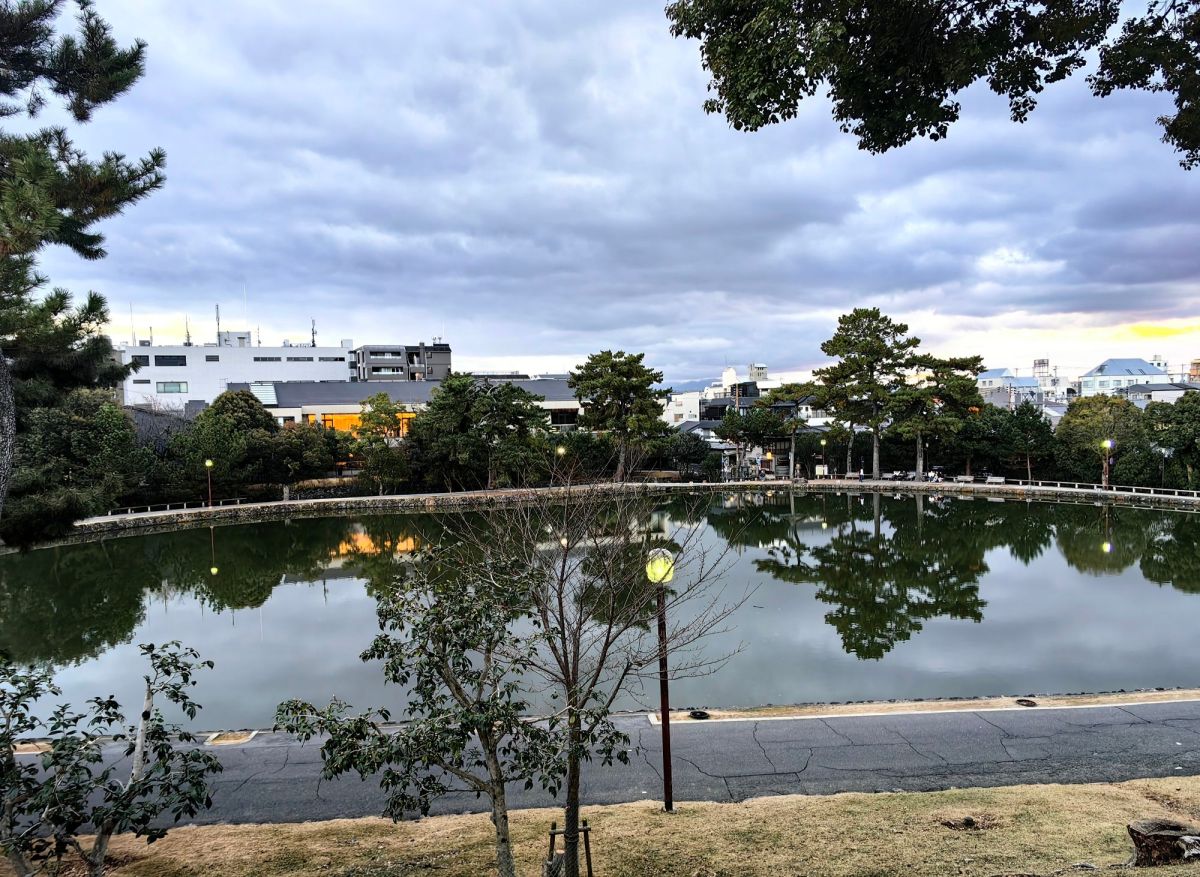
I continued my journey from Osaka to Nara on December 21st 2025 and stayed near the Sarusawa Pond, a peaceful and scenic spot in the heart of the city. The pond is famous for its beautiful views of Kōfuku-ji’s five-story pagoda, which rises above the surrounding trees and traditional streets. Walking around the area, I could enjoy the calm water, historic atmosphere, and glimpse of Nara’s historic scent. It felt like a perfect place to experience the quiet, traditional side of Nara while still being close to the city’s many historic attractions which are parts of the UNESCO World Heritage Site ‘Historic Monuments of Ancient Nara.’
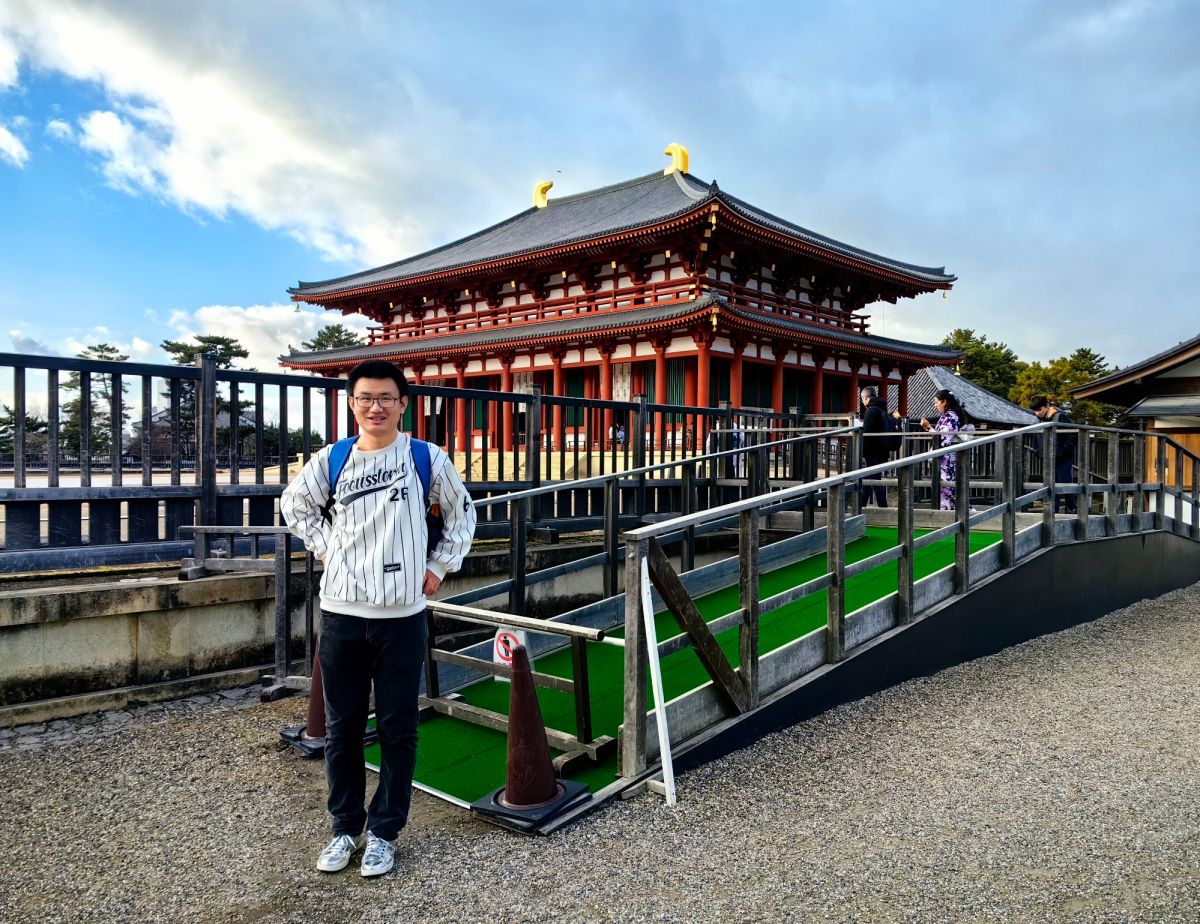
My first point of attraction in Nara was Kōfuku-ji, one of the city’s most famous and historic Buddhist temples. As I walked through the temple grounds, I was surrounded by beautiful traditional architecture and a peaceful atmosphere. Kōfuku-ji’s long history and impressive buildings gave me my first glimpse into Nara’s rich cultural and religious heritage. Kōfuku-ji has a long and fascinating history dating back to 669 AD. It was originally founded in Kyoto by Kagami no Ōkimi to pray for the recovery of her husband, Fujiwara no Kamatari, the founder of the powerful Fujiwara clan. In 710, when the capital was moved to Nara, the temple was relocated to the city and became one of the most important Buddhist temples in Japan.
我在奈良的第一处游览地便是是兴福寺。它是这座古都最著名、也最具历史底蕴的佛教寺院之一。走入寺院的境内,古朴典雅的传统建筑映入眼帘,四周弥漫着一种宁静而悠远的气息。兴福寺悠长的历史与恢弘的建筑,也成为我初次触摸奈良深厚文化与宗教传统的一扇窗口。其历史可以追溯至公元669年。最初,它并不在奈良,而是由日本飞鸟时代的著名女性和歌诗人镜王女(Kagami no Ōkimi)建立于京都,为祈求丈夫藤原镰足(Fujiwara no Kamatari)早日康复。藤原镰足后来成为强大的藤原氏始祖,而这座寺院也由此与日本历史上最具影响力的家族之一结下了深厚的渊源。公元710年,日本迁都奈良,兴福寺也随之迁至这座新都。在此后的岁月里,它逐渐成为日本最重要的佛教寺院之一。
Chū-Kondō
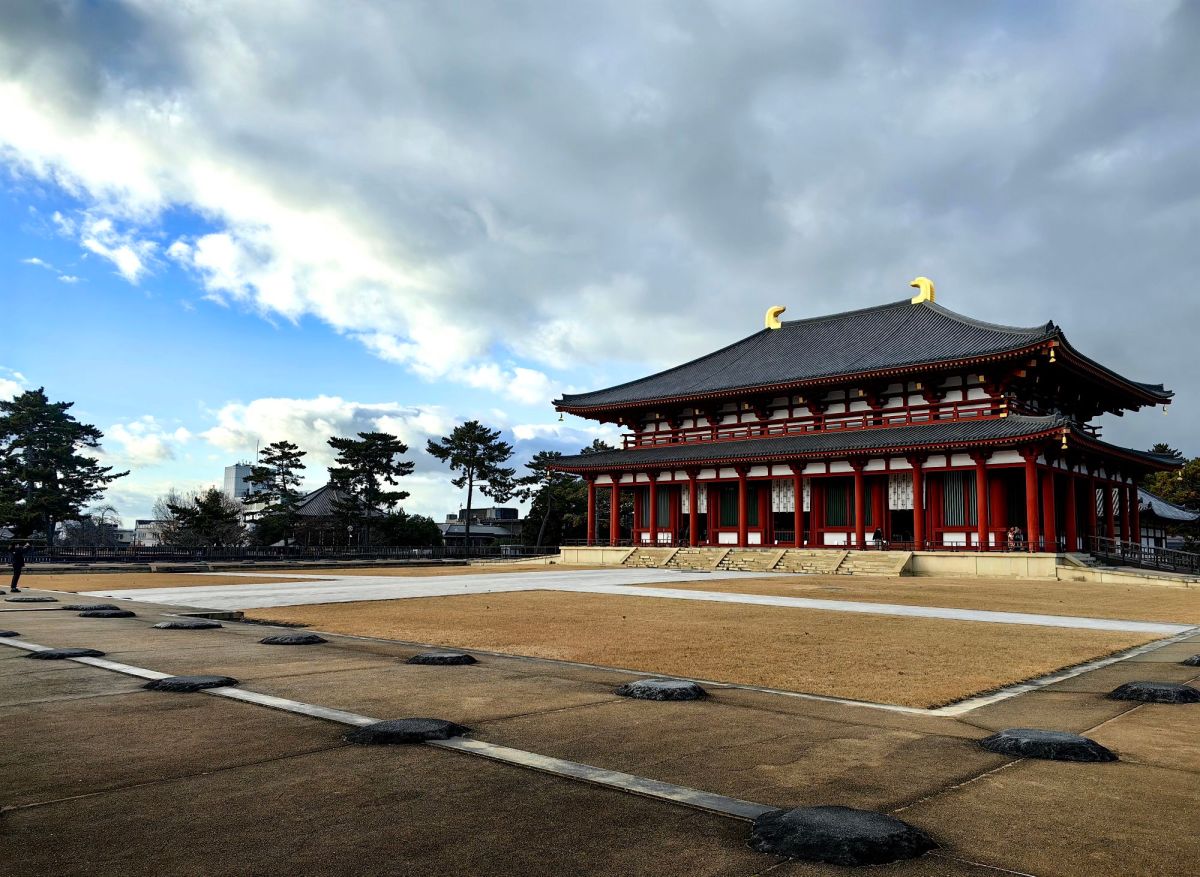
The Central Golden Hall (Chū-Kondō) stood at the heart of Kōfuku-ji, its vermilion columns and broad tiled roof giving the temple precinct a dignified and symmetrical appearance. Although the present hall is a modern reconstruction, its design follows the traditional character of the ancient temple, allowing the historic layout of Kōfuku-ji to emerge once again. Kōfuku-ji has endured repeated fires and destruction throughout its long history, and many of its buildings have been rebuilt over the centuries.
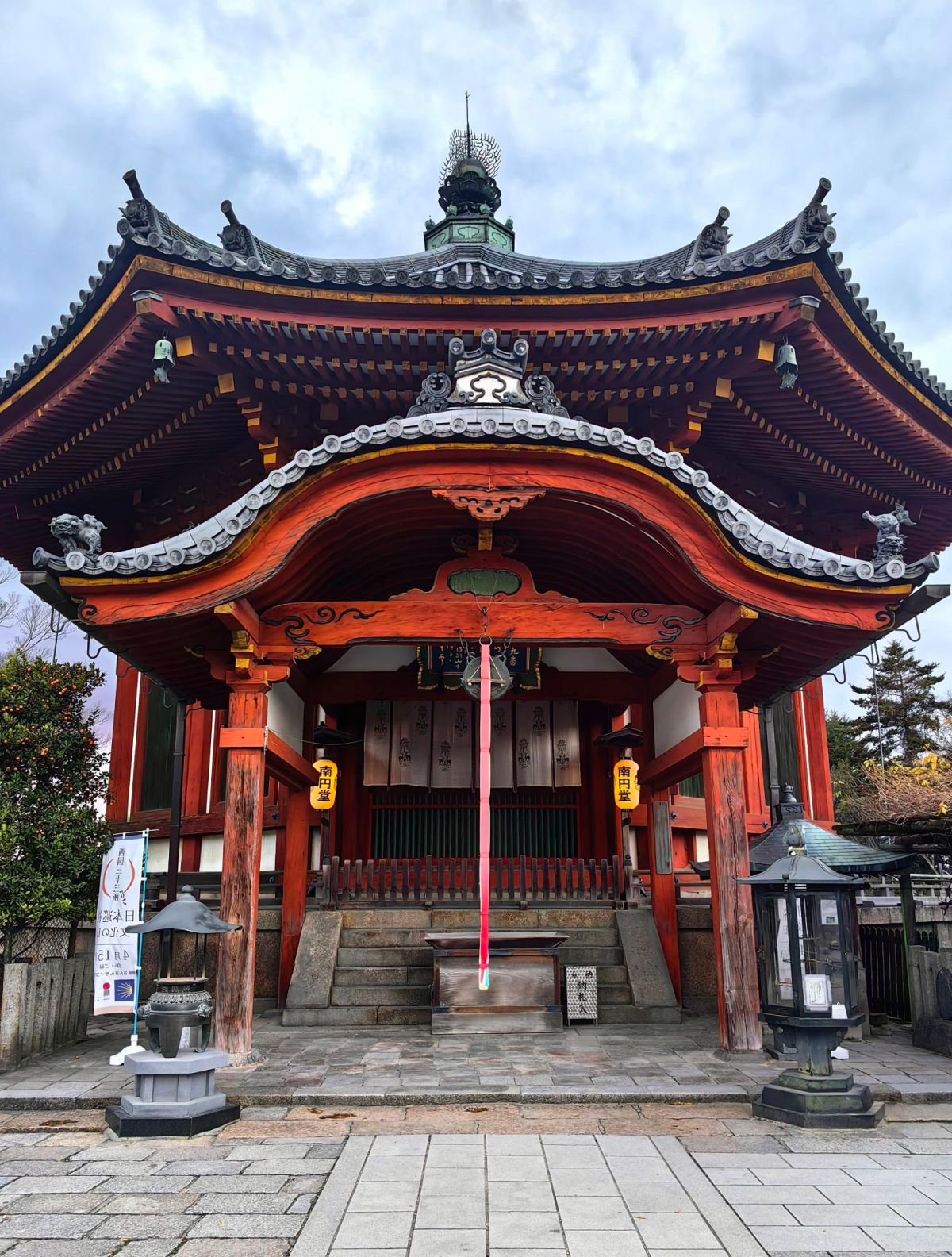
Nanen-dō is a small but historically significant Buddhist hall within Kōfuku-ji. It is especially famous for being the 9th temple on the Saigoku Kannon Pilgrimage, a pilgrimage route connecting 33 temples dedicated to Kannon, the Buddhist bodhisattva of compassion. Built in 813 by Fujiwara no Fuyutsugu, Nanen-dō was originally established as a place of prayer for the Fujiwara family. The present building dates from 1789, after the earlier structure was destroyed by fire. Its simple, octagonal design contrasts with the larger and more elaborate buildings elsewhere at Kōfuku-ji.
The influence of Fujiwara family is deeply woven into the history of Nara. It rose to prominence in the 7th century through Nakatomi no Kamatari, who helped Emperor Tenji carry out the Taika Reforms. In recognition of his service, he was given the surname Fujiwara in 669. His descendants gradually became one of the most influential families at the imperial court. Their greatest political strength came not from becoming emperors themselves, but from controlling the imperial court through marriage. Fujiwara men frequently served as regents and senior court officials, while Fujiwara women married emperors and became mothers of future emperors. Through this network, the family could exercise enormous political influence while remaining behind the imperial throne. Kōfuku-ji became the testimony of this history, it was the family temple of the Fujiwara, functioning not only as a religious institution but also as an important symbol of the family’s status and power.
Tōkondō is called Eastern Golden Hall because it belongs to the group of Kon-dō (Golden Halls) that once formed the heart of the temple complex. Its elegant traditional architecture, with its dark wooden structure, copper bells and distinctive tiled roof, gives it a dignified and timeless appearance. It was originally built in726 by Emperor Shōmu to pray for the recovery of his father, Emperor Genmei. The present building dates from 1415.
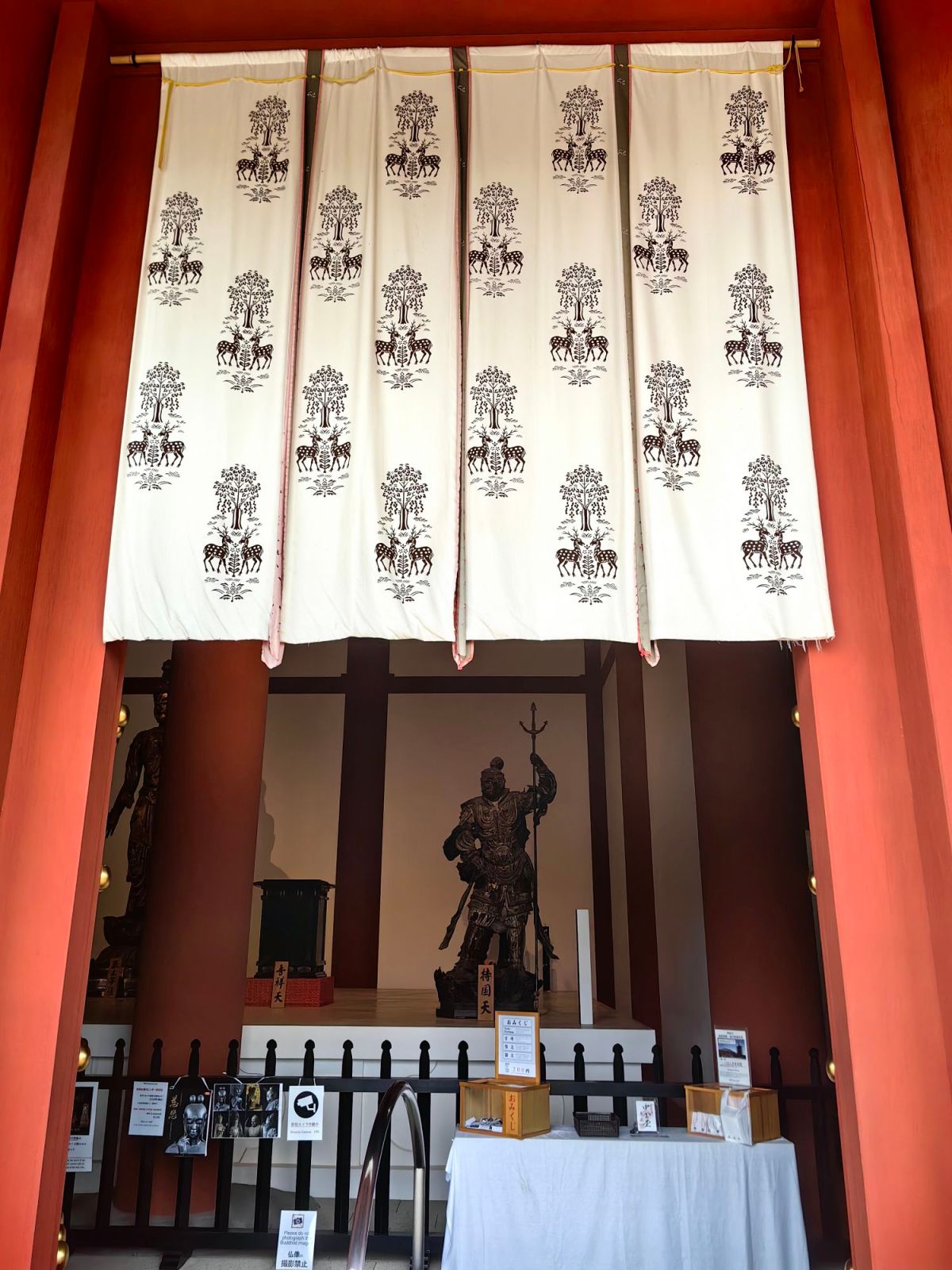
Inside, Tōkondō is particularly important for its collection of Buddhist statues and religious treasures which made me feel the religious atmosphere. Among them is a revered statue of Yakushi Nyorai, accompanied by other Buddhist figures. The hall provides a peaceful space to appreciate the artistic and spiritual traditions of medieval Japanese Buddhism. At the entrance, I noticed the hanging curtain with a particularly beautiful detail. The curtain features a traditional pattern of two deer under a tree, reflecting the strong connection between Nara and its sacred deer. Deer have long been regarded as sacred messengers of the gods, particularly because of their association with Kasuga Taisha. Seeing the deer motif on the curtain connects the Buddhist temple with the wider spiritual traditions of Nara.
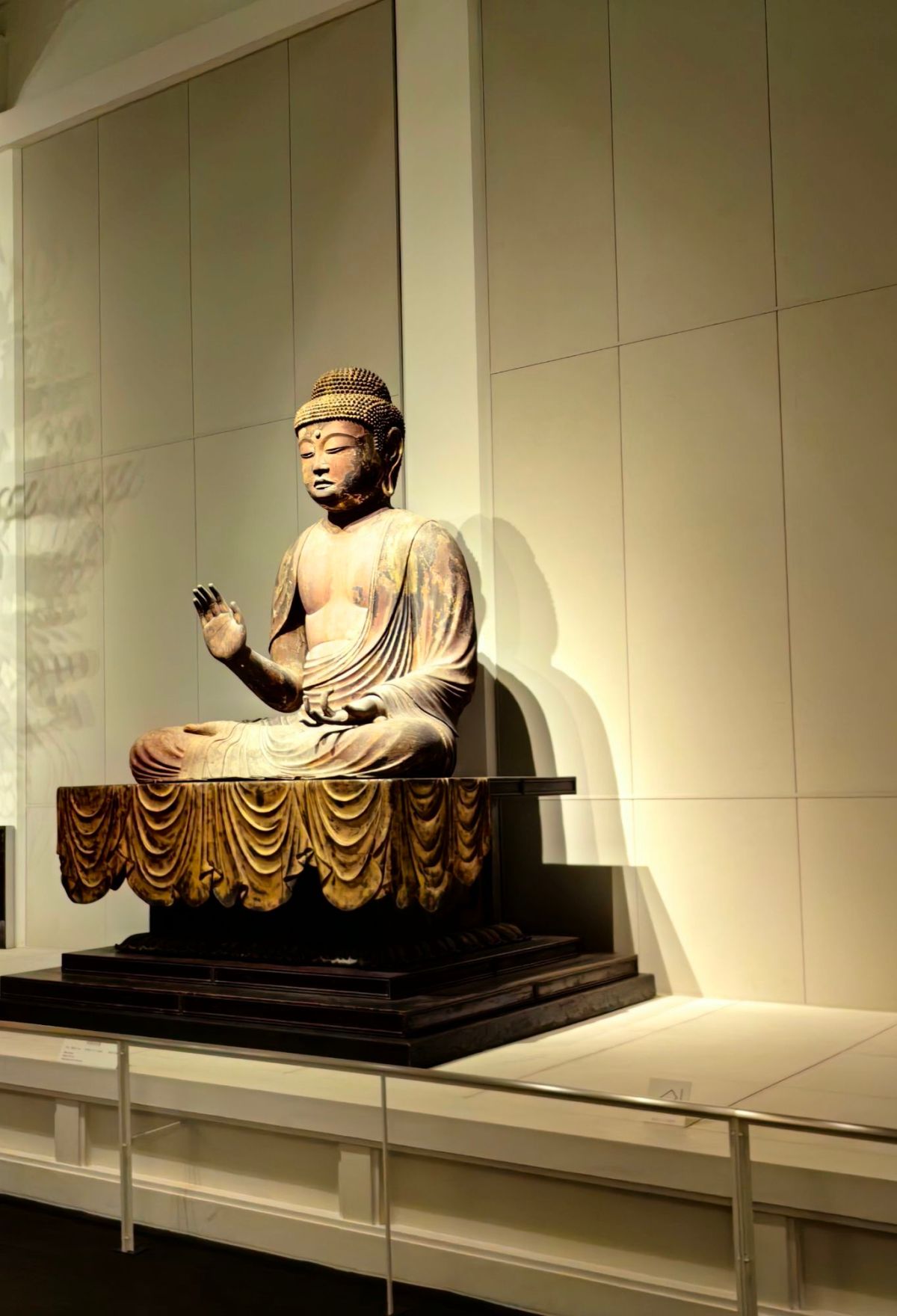
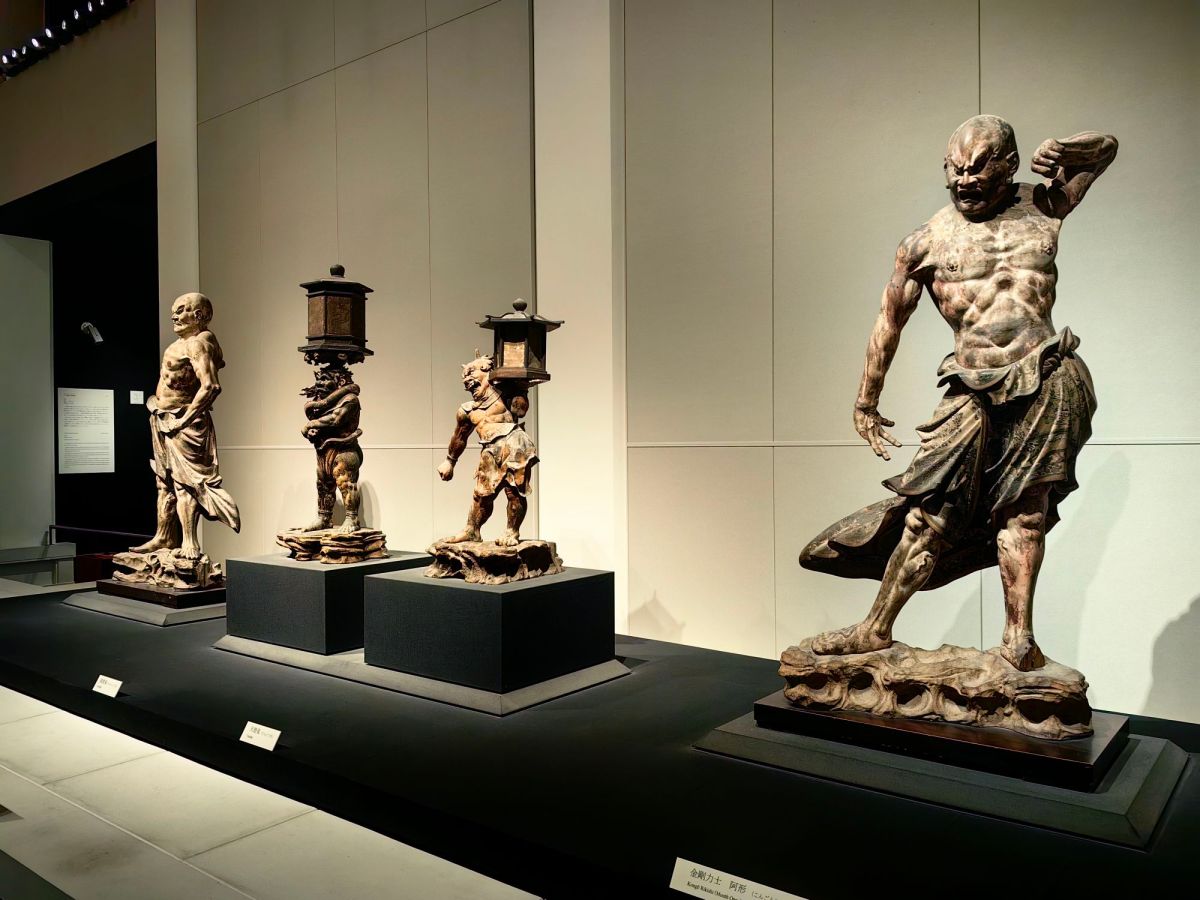
Kōfuku-ji National Treasure Museum is one of the highlights of a visit to Kōfuku-ji, especially for anyone interested in Japanese Buddhist art and history. The museum houses an impressive collection of Buddhist statues, paintings, and other cultural treasures that were preserved by the temple over many centuries. The artworks and statues made the history of the temple feel more personal and tangible.
The Kongō Rikishi are among the temple’s remarkable Buddhist guardian sculptures and are designated National Treasures of Japan. They represent powerful protective deities who guard Buddhist teachings and sacred spaces from evil and harm. The two guardians are traditionally depicted as muscular, dynamic figures with fierce expressions. Their dramatic poses, bulging muscles, flowing robes, and intense facial expressions create a striking contrast with the calm and compassionate appearance of Buddha and bodhisattva statues. What makes the Kongō Rikishi especially impressive is the exceptional craftsmanship of their wooden sculpture. The sculptors captured movement and emotion with remarkable detail, from the tension in the bodies to the expressive faces and flowing garments.
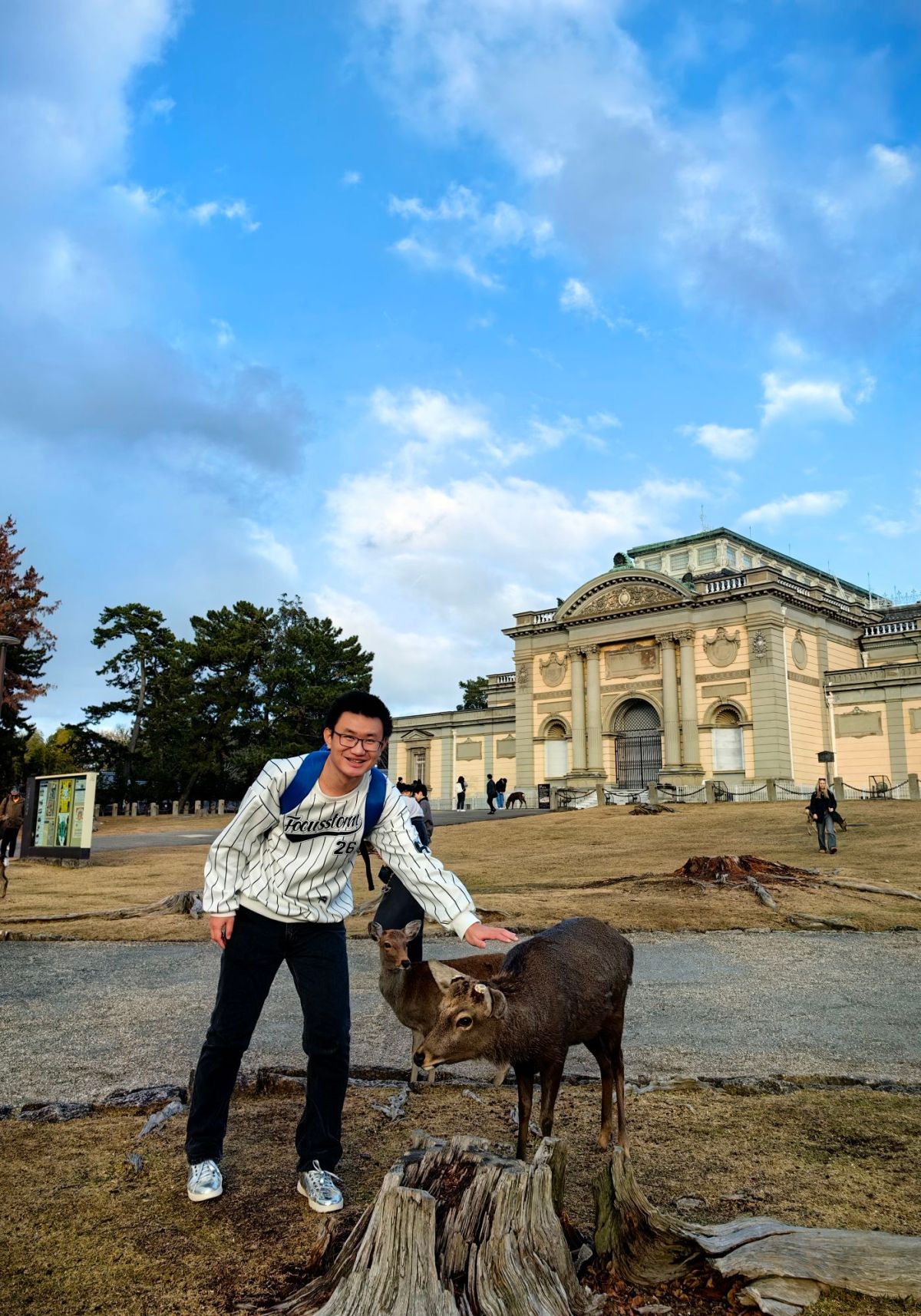
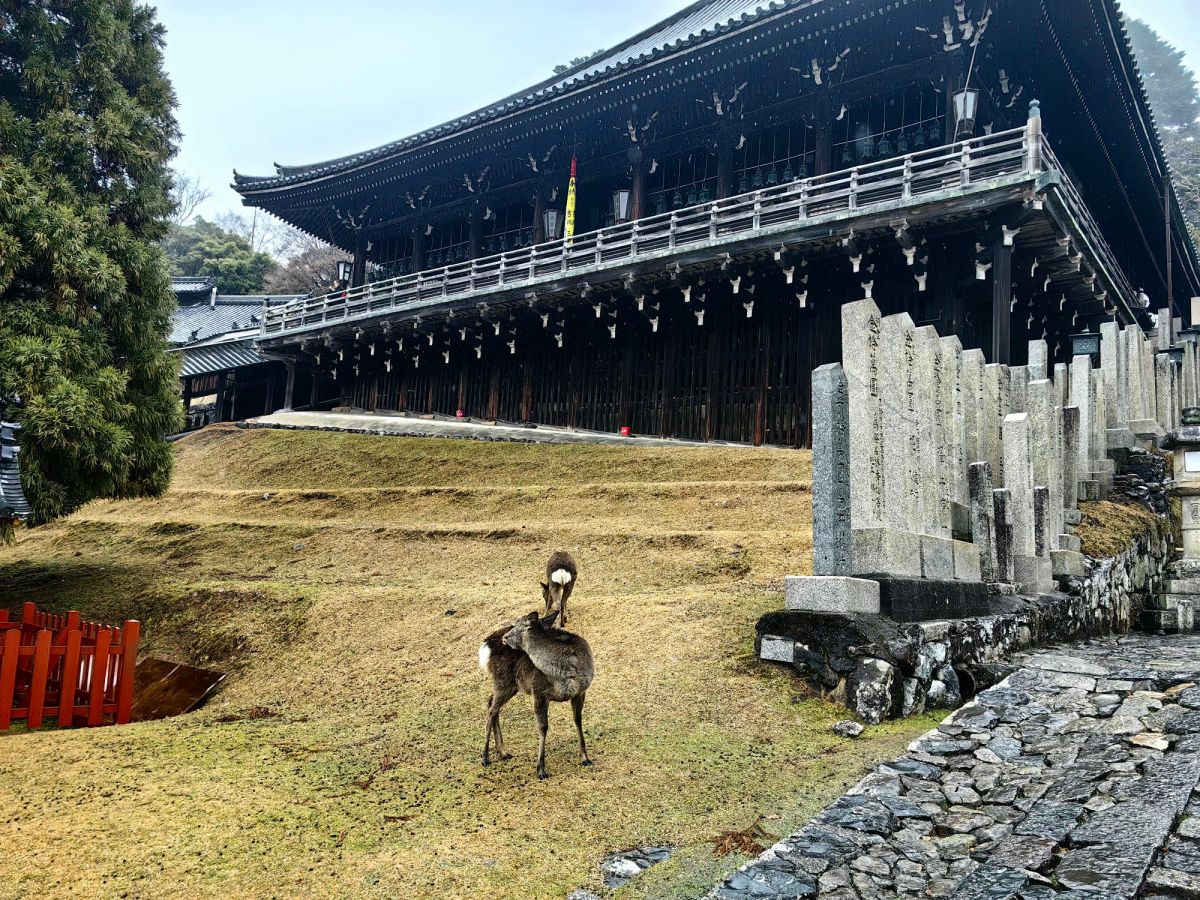
Nara left a deep impression on me, not only because of its rich history and beautiful temples, but also because of its peaceful natural environment and abundance of deer. As I walked through the city, especially around Nara Park, the presence of deer made the experience feel unique and almost magical. They wandered freely among the trees, pathways, and historic temples. Here, the deer seemed to be part of everyday life. They would cross the roads freely, and cars would patiently stop to let them pass. I was amazed by how comfortable they were around people and close to people. Some of the deer came close enough for me to touch their soft fur. They showed little fear of human beings and simply stood there quietly, occasionally lifting their heads to glance at me, before continuing on their way as if nothing had happened.
The calm surroundings, fresh greenery, and gentle presence of the deer offered a refreshing contrast to the busy atmosphere of Osaka. I slowed down and felt the city’s clamor gradually receded behind me, leaving only the shadows of trees, the gentle breeze, and the light, graceful footsteps of the deer. The experience made my visit feel more than just a sightseeing trip. It was a chance to experience the harmony between nature and history that makes Nara so special.
Nara has so many deer because they have been protected there for more than 1,300 years, and they are deeply connected to the city’s religious history. The story goes back to Kasuga Taisha, where deer were traditionally regarded as sacred messengers of the gods. According to legend, the deity Takemikazuchi-no-Mikoto arrived at Mount Mikasa on a white deer. Because of this, deer in the Nara area came to be treated as sacred animals and were protected rather than hunted. Over the centuries, this tradition continued. The deer gradually became an important part of Nara’s cultural identity. Today, the deer roaming freely around Nara Park, Kasuga Taisha, and the surrounding temple grounds. They have become accustomed to human presence, although they remain wild animals, rather than domesticated pets.
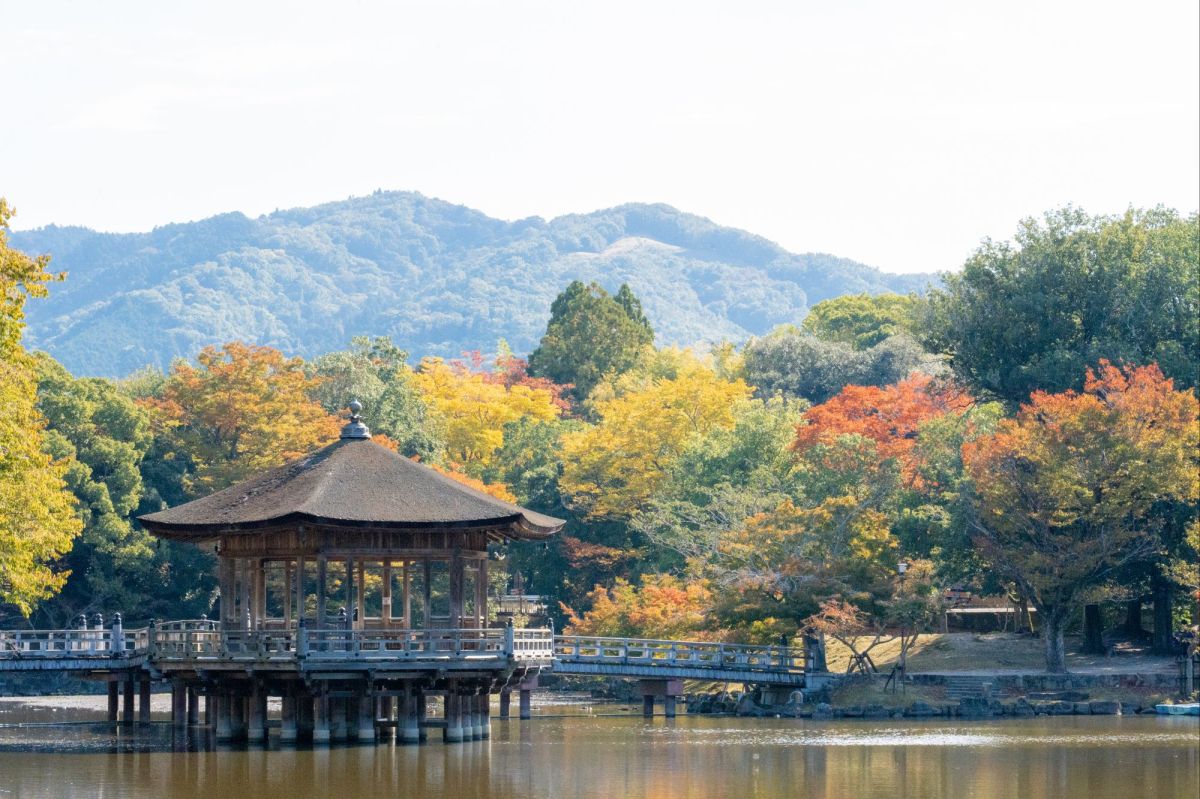
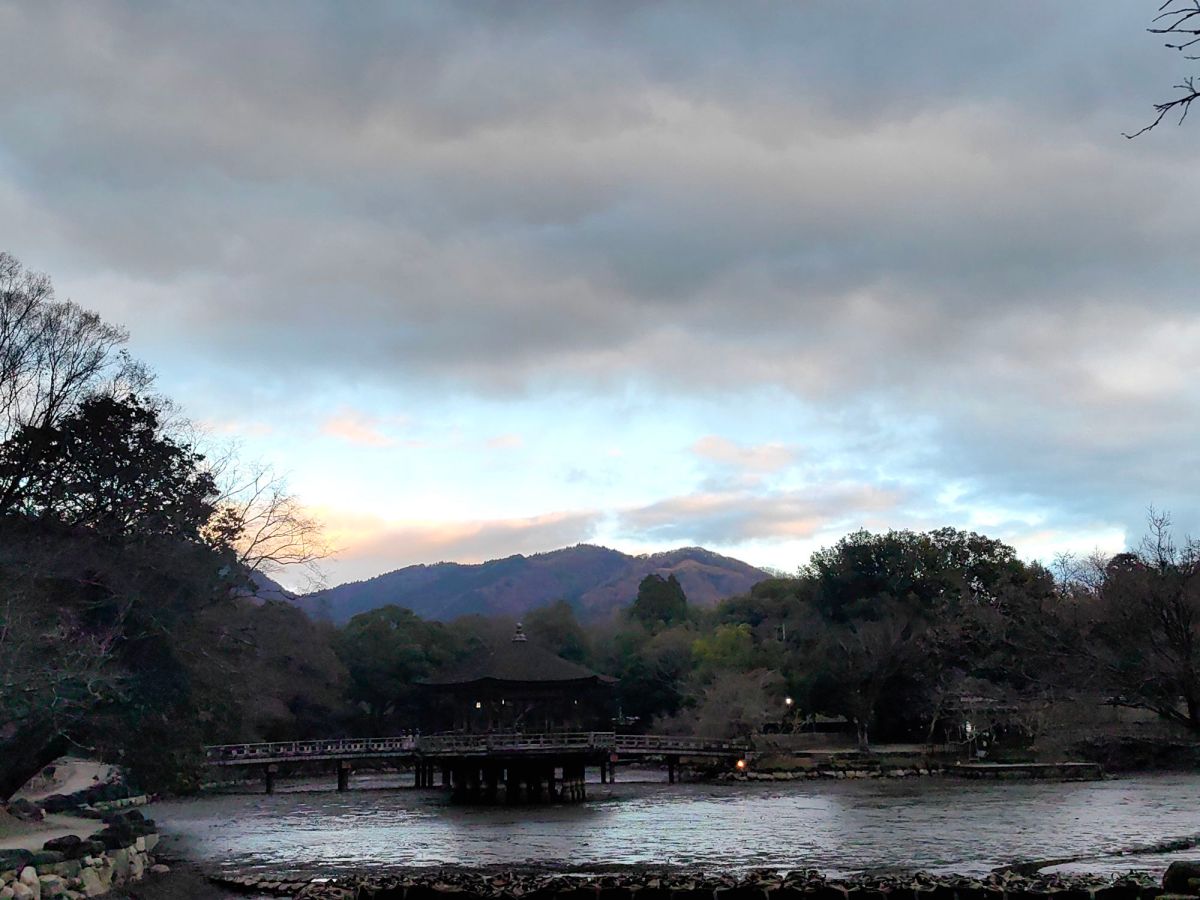
The Ukimido Pavilion is one of the most tranquil and picturesque places in the south of Nara Park.The present pavilion was constructed in 1916 and has a distinctive hexagonal shape with a traditional cypress-bark roof.The surroundings are just as beautiful as the pavilion itself. The pavilion seemed to float on the Sagiike Pond which is enclosed by trees and greenery. The area around the pond forms part of Asajigahara, a quiet, gently hilly section of Nara Park near Kasuga Taisha. I enjoyed the amazing wide landscapes of Nara Park. The vast green forests were filled with deer wandering freely among the trees and along the quiet pathways. In the distance, Mount Kasuga provided a beautiful natural backdrop.
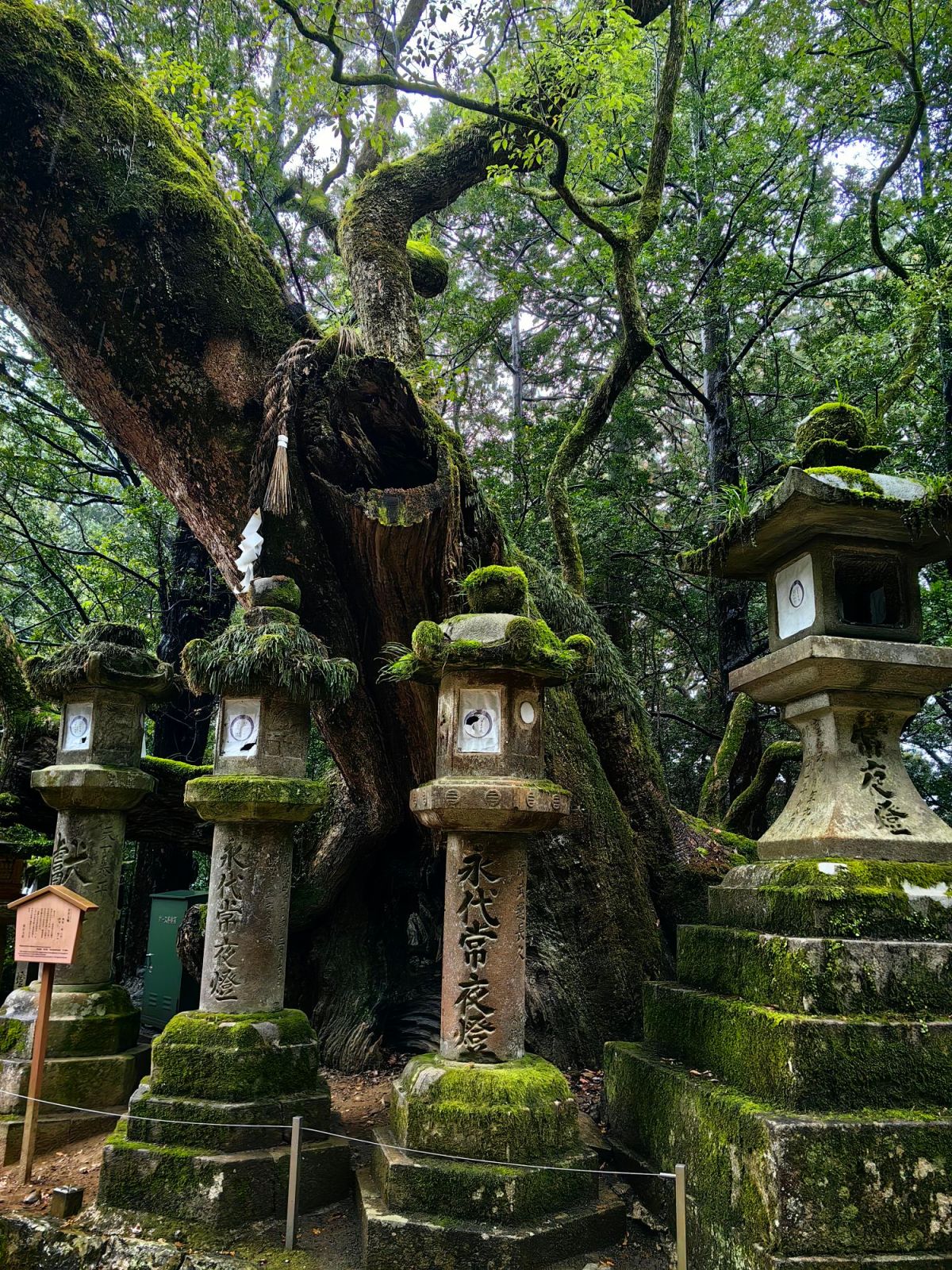
After walking along a stone-paved path lined with rows of perpetual stone lanterns(Eitai Jōyatō), I arrived at the famous Kasuga Taisha in the south of Nara. The path itself was an unforgettable part of the journey. Hundreds of stone lanterns stood quietly among the trees, creating a mysterious and sacred atmosphere as they guided me deeper into the forest. These stone lanterns, known as tōrō, were donated by worshippers over the centuries as offerings to the shrine. Many are covered with green moss, weathered by time, and blend beautifully into the surrounding forest. Seeing so many lanterns standing along both sides of the path made me feel as though I were travelling through a passage connecting the present with Nara’s ancient past.
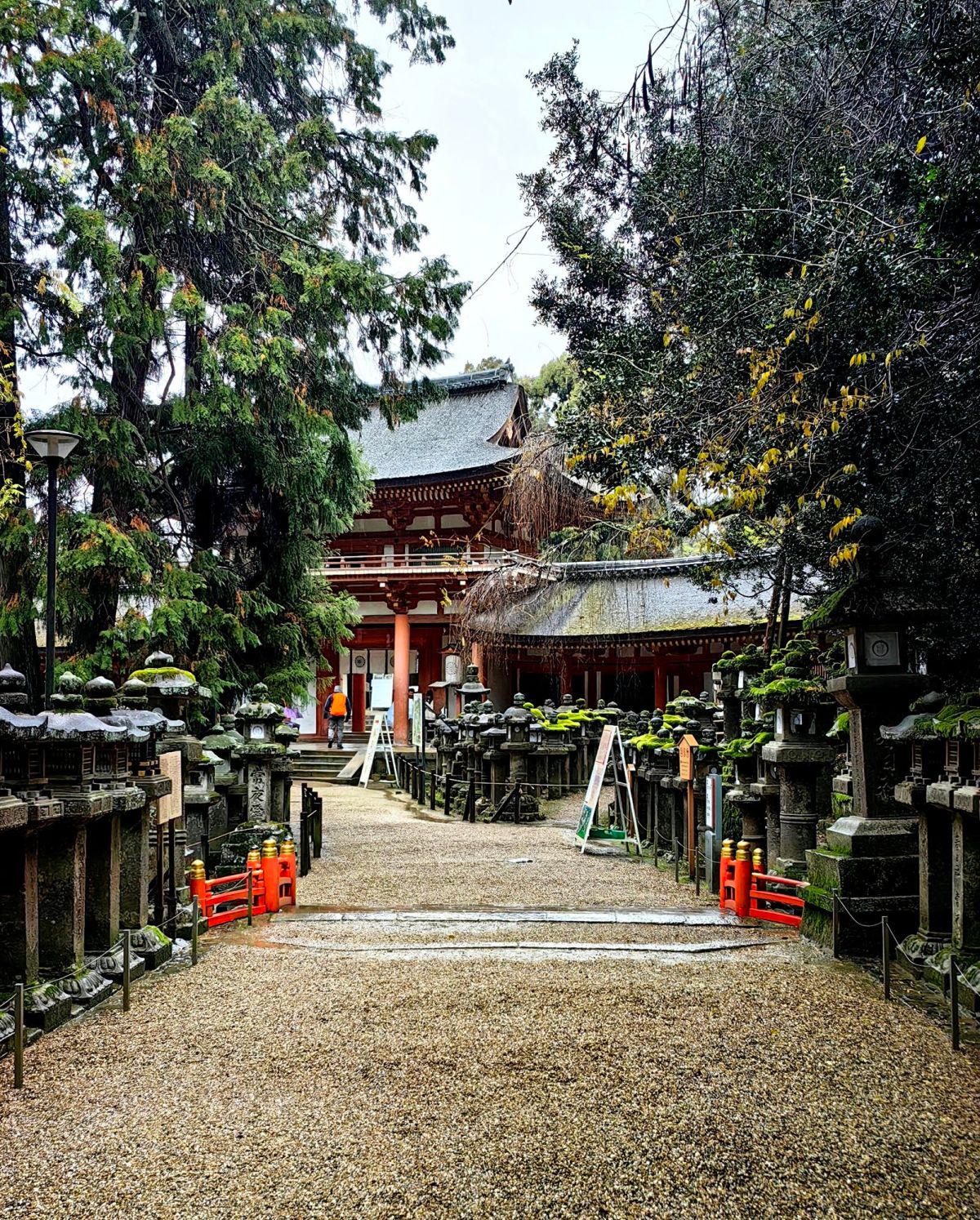
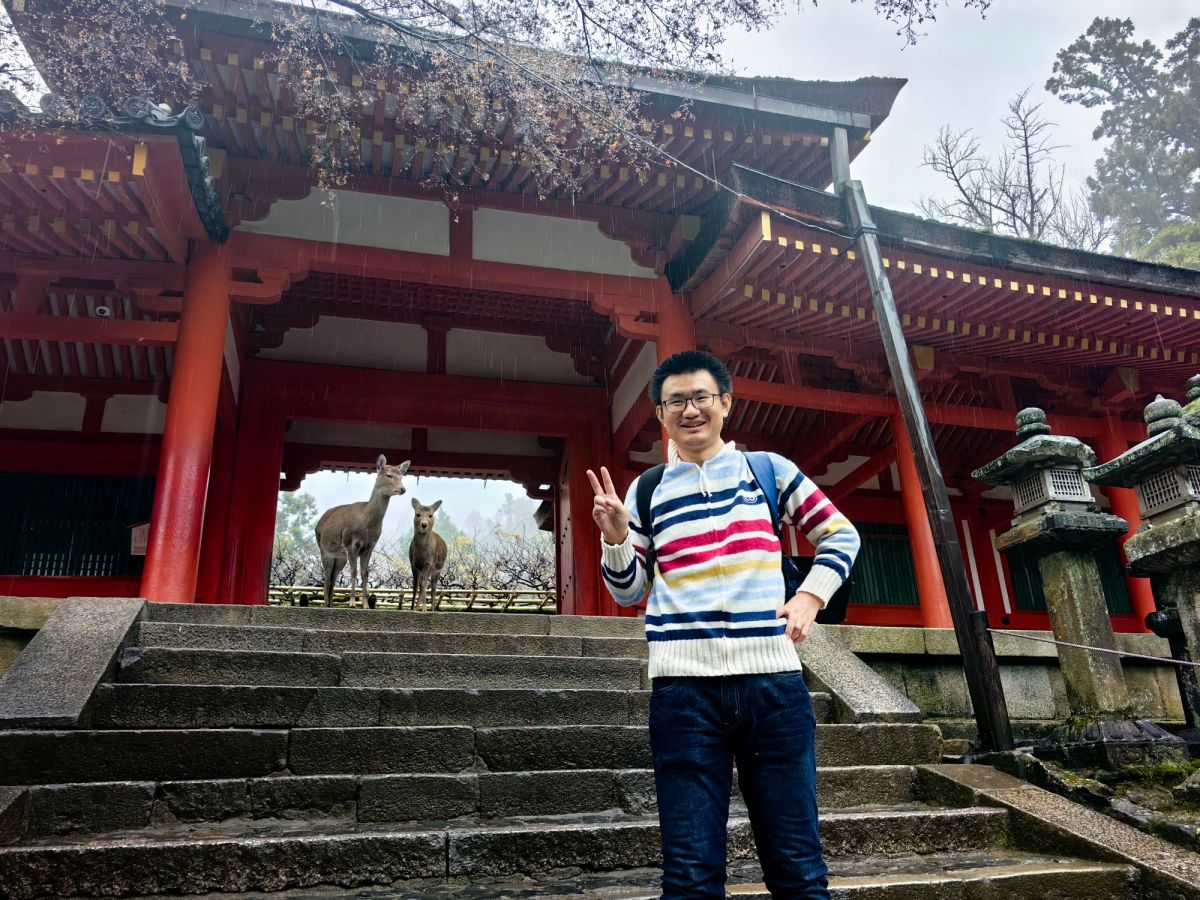
The red main gate of Kasuga Taisha was one of the most striking sights along my journey. Rising about 12 meters high, it is the largest gate of the shrine and serves as the important entrance to the inner shrine precinct. As I approached the red gate, the weathered stone lanterns seemed to form a natural procession leading me toward the sacred grounds. The contrast between the bright vermillion gate, grey stone lanterns, and lush green trees created an unforgettable scene.
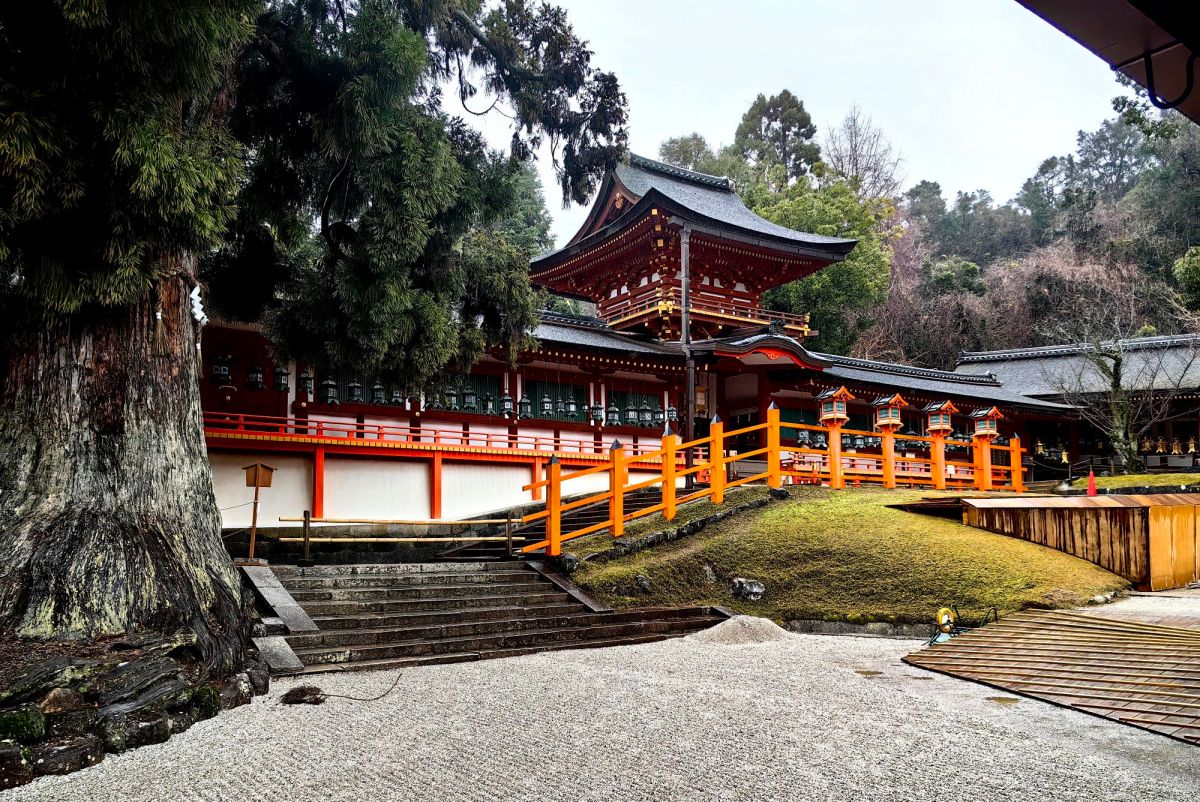
Kasuga Taisha is the most famous and beautiful Shinto shrines in Nara. It was officially established in 768, when the Fujiwara family established the shrine to enshrine their ancestral and tutelary deities and to protect the ancient capital. The Main Sanctuary is the most sacred and architecturally distinctive part of the shrine. Its architecture style ‘the Kasuga-zukuri ‘ is a distinctive form of Japanese Shinto architecture. Each small shrine has a steeply curved gabled roof covered with layers of Japanese cypress bark, with the entrance positioned beneath the gable. A small projecting roof shelters the entrance and staircase. Surrounding the sanctuary is the Oro which is an open veranda whose shape resembles a bird spreading its wings. The surrounding corridors are decorated with numerous hanging ancient bronze lanterns.
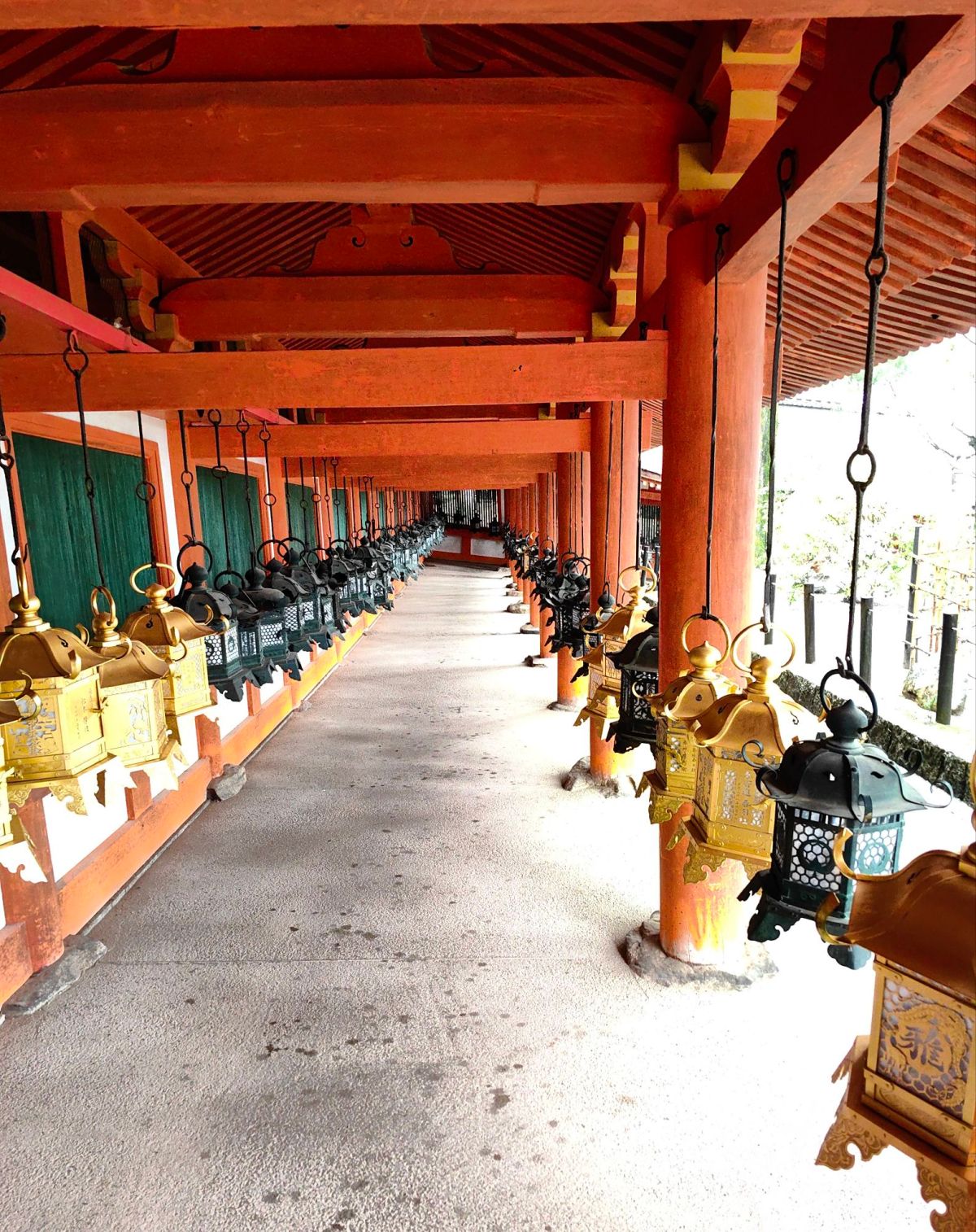
Along the corridor of Kasuga Taisha, there are roughly 1,000 bronze hanging lanterns, called tsuri-dōrō. They were donated by worshippers as offerings to the Shinto deities, representing their prayers, gratitude, and wishes. They were like a physical expression of a person’s devotion. The grey or greenish-black color comes largely from the natural patina that develops on bronze over time. For me, walking beneath the long rows of bronze lanterns was almost like passing through a corridor of thousand prayers.
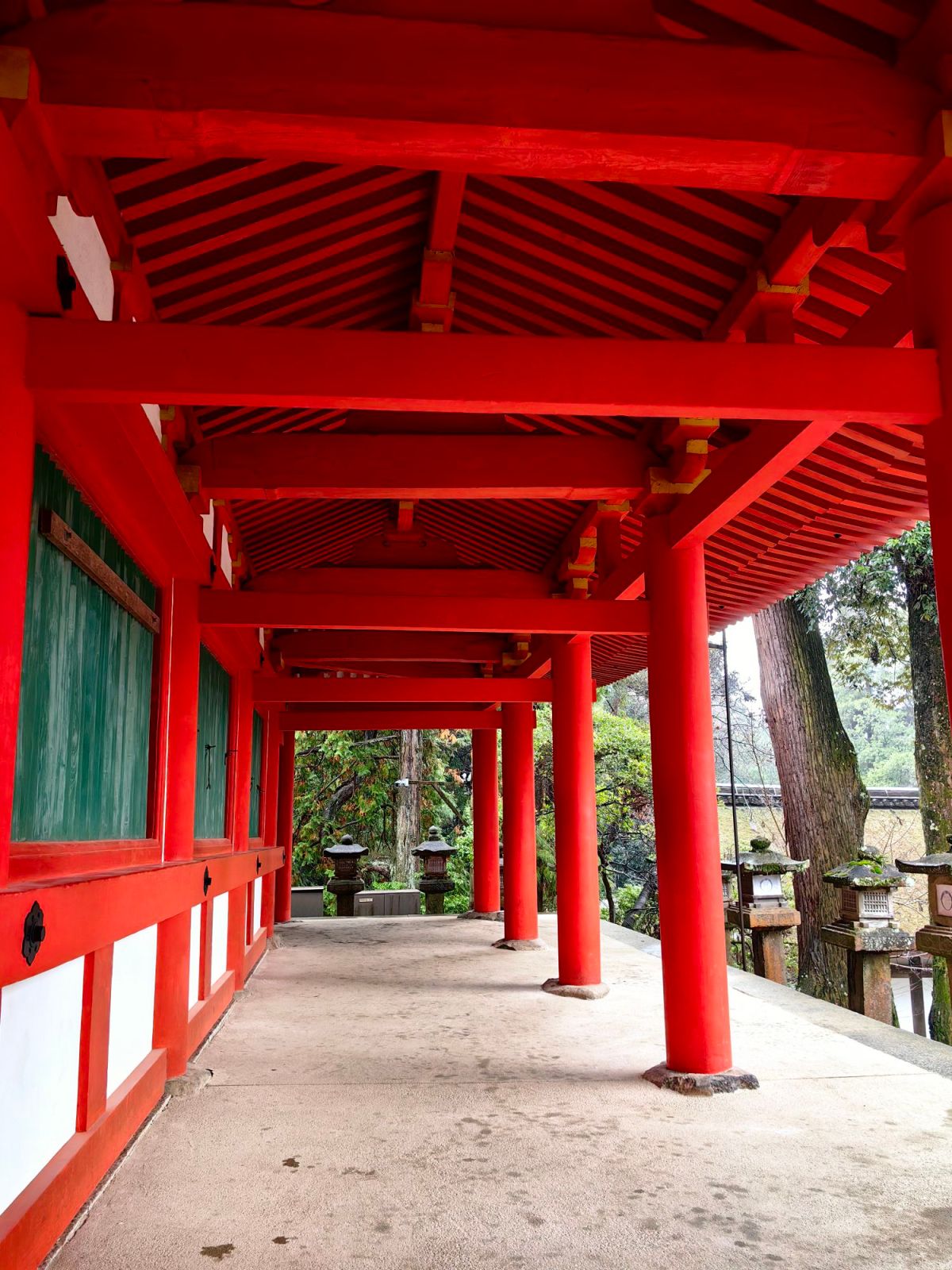
The main sanctuary is famous for its vivid vermilion columns in the long corridor. As the corridor receded into the distance, the repeating columns and lanterns created a graceful rhythm, drawing my eyes deeper into the far end. The brilliant red of the wood, the muted bronze of the lanterns, and the shadowy forest seemed to bring me back to the passing centuries.
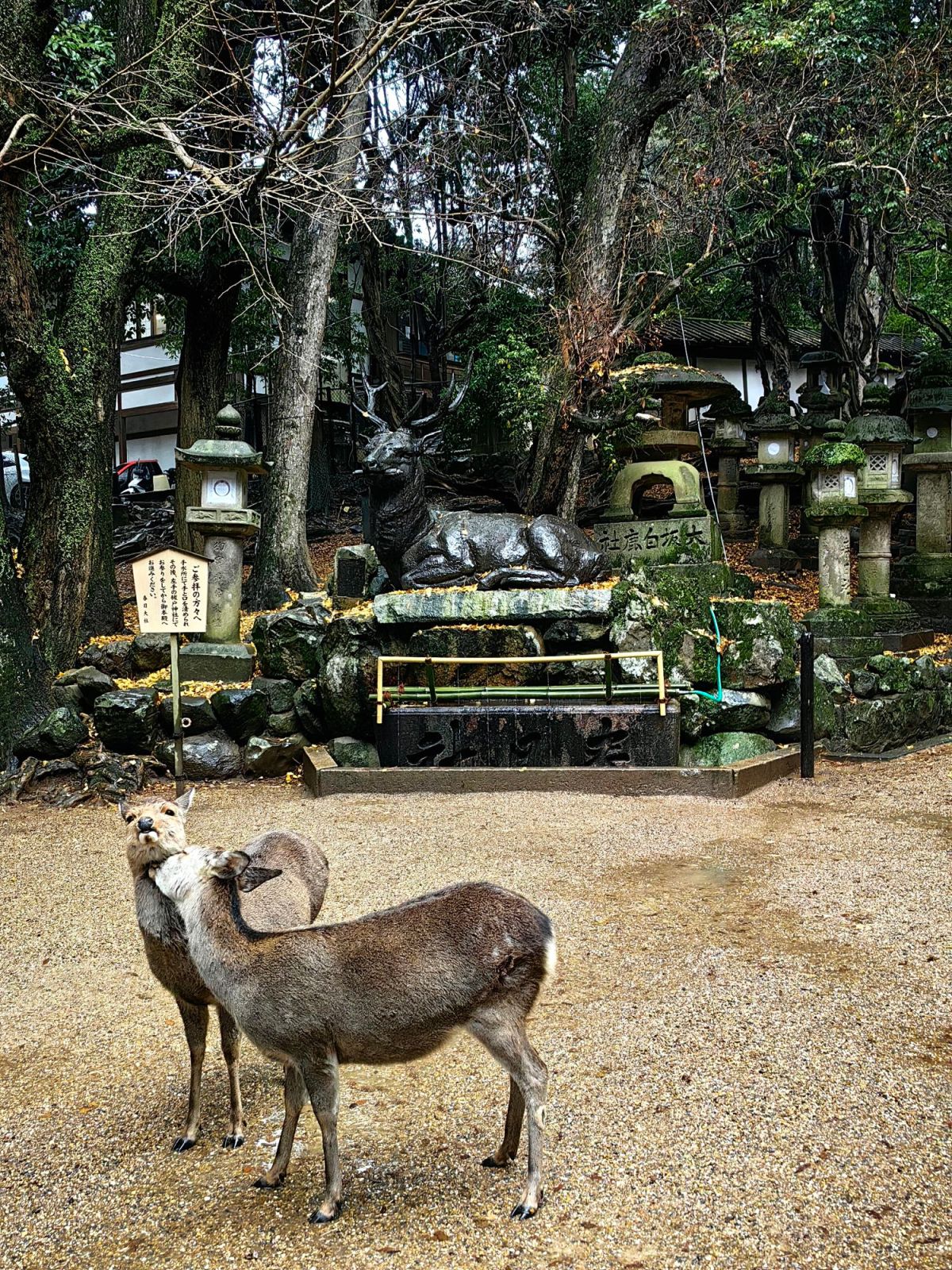
At the side door of the sanctuary, I unexpectedly came upon two deer standing quietly together. They stood there and turned their heads toward me, watching with gentle curiosity, as though wondering what had brought this stranger into their ancient forest. For a moment, we simply stood there looking at one another. Their quiet presence made the shrine feel as if the sacred and the natural seemed to exist side by side.
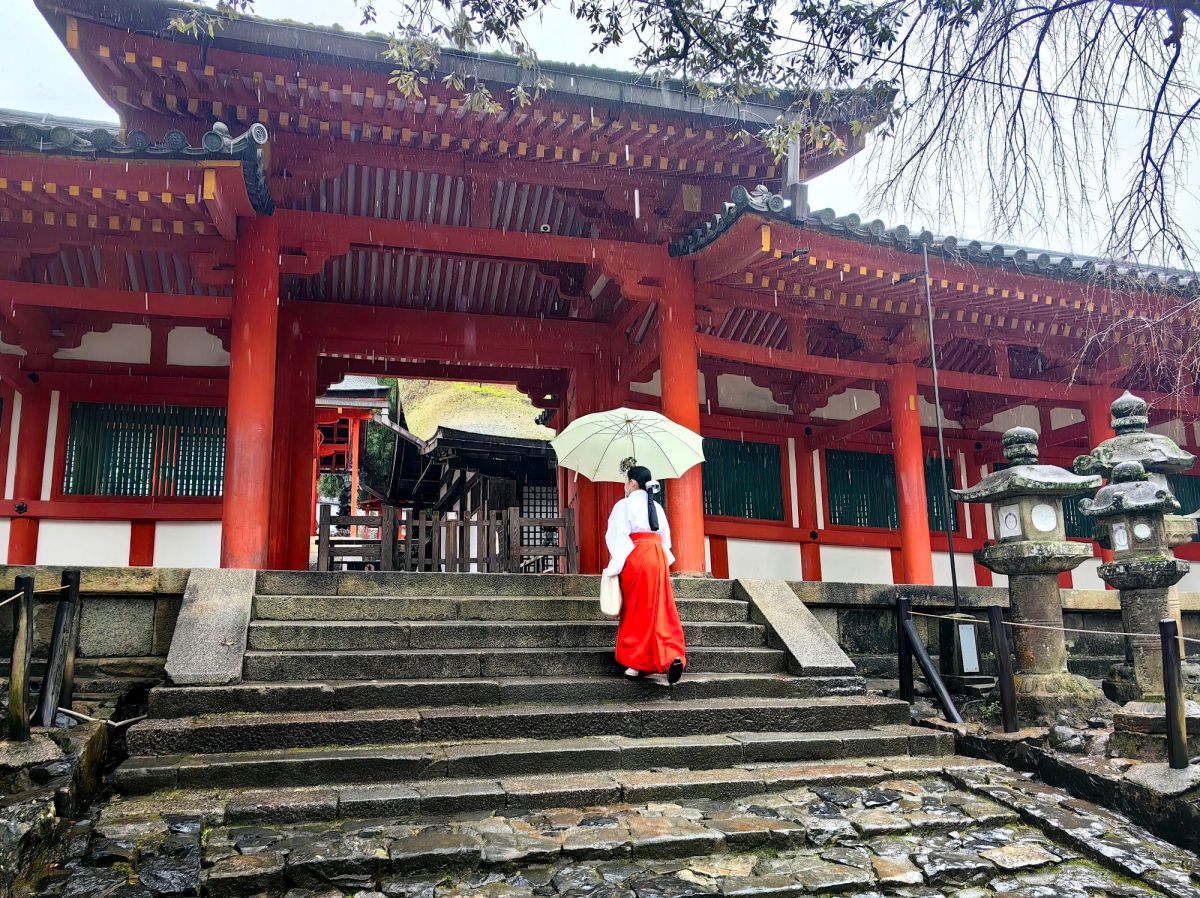
Before I left, a gentle rain fell over Kasuga Taisha, veiling the ancient forest in a soft mist and lending the shrine an almost otherworldly stillness. The vivid vermilion columns glistened with rain, their colors deepening against the moss-covered trees. Beneath a simple umbrella, a shrine maiden appeared in her traditional white and vermilion robes, walking quietly through the rain. For a fleeting moment, the scene felt suspended between past and present. The ancient forest, the sacred shrine, the falling rain, and the solitary figure moving through the vermilion corridor seem to allow a fragment of old Nara to quietly reappear before my eyes.
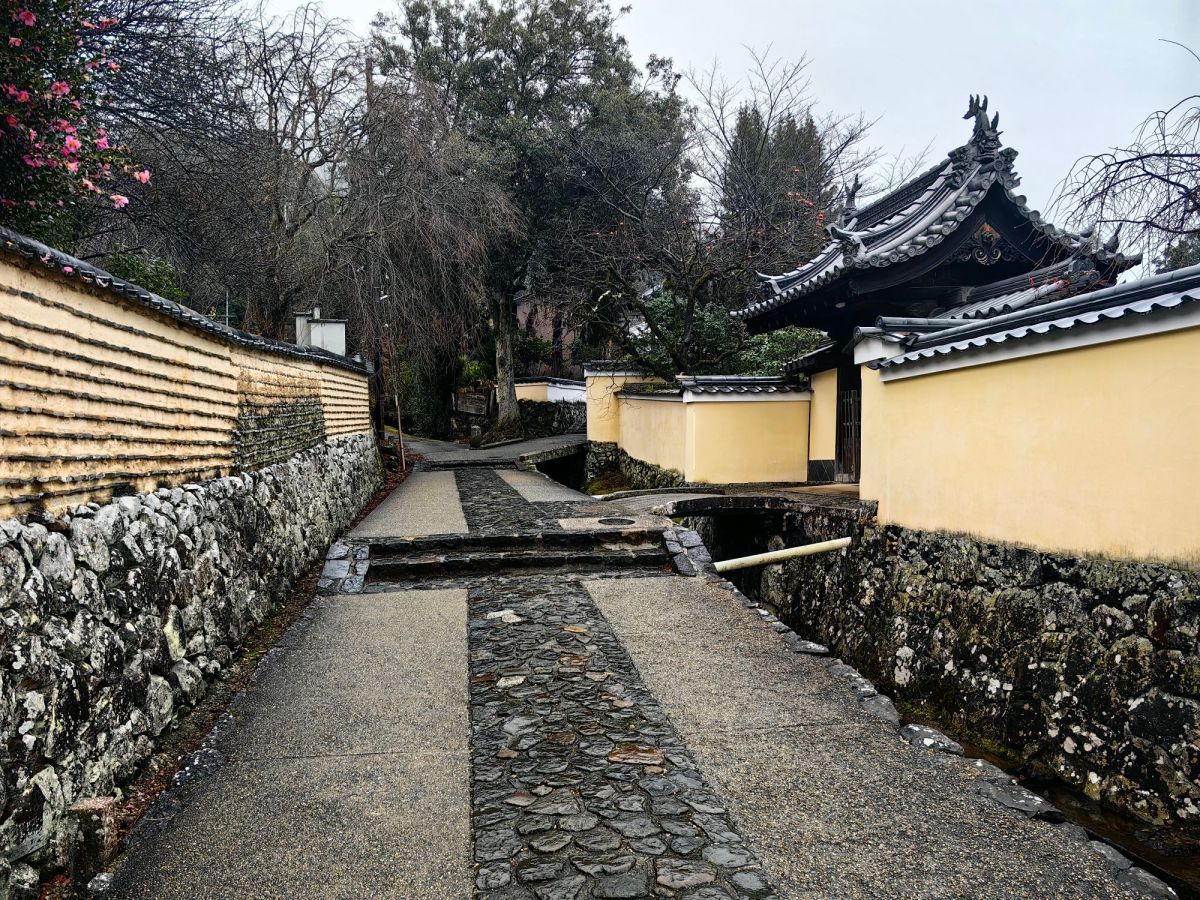
Nara is a place where the passage of time can still be felt, not only in its ancient temples and shrines, but also in the quiet streets that lie beyond the well-trodden paths. In the northern part of the city, narrow stone-paved lanes wind between old houses, many of them sheltered beneath deep, gracefully curved eaves reminiscent of the architectural traditions brought from Tang Dynasty China more than a thousand years ago. Along the walls painted in muted yellow and white, small streams flow quietly beside the streets, their clear water slipping past moss-covered stones as it has done for generations.
The weathered walls, wooden facades, tiled roofs, and the soft sound of running water … Yet perhaps this is where the age of Nara can be felt most intimately. Walking through these unassuming lanes, I imagined that the centuries have not entirely passed, but have simply settled gently into the landscape, leaving behind a quiet world where the present continues to live alongside the memory of the ancient capital. Here I could touch the most authentic essence of Nara. It was not a past story preserved within a museum, but an ancient memory that remains alive in everyday life.
I walked slowly uphill along the Urasando beneath a gentle rain, with no other visitors in sight. The path was quiet and almost entirely my own, winding through the greenery in a peaceful solitude that felt far removed from the crowded streets and well-known sights of Nara. The rain softened the sounds of the surrounding forest, leaving only the faint rustling of leaves and the occasional trickle of water along the path. I loved this quieter side of Nara, where nature seemed to take precedence over everything and every corner invited a slower pace.
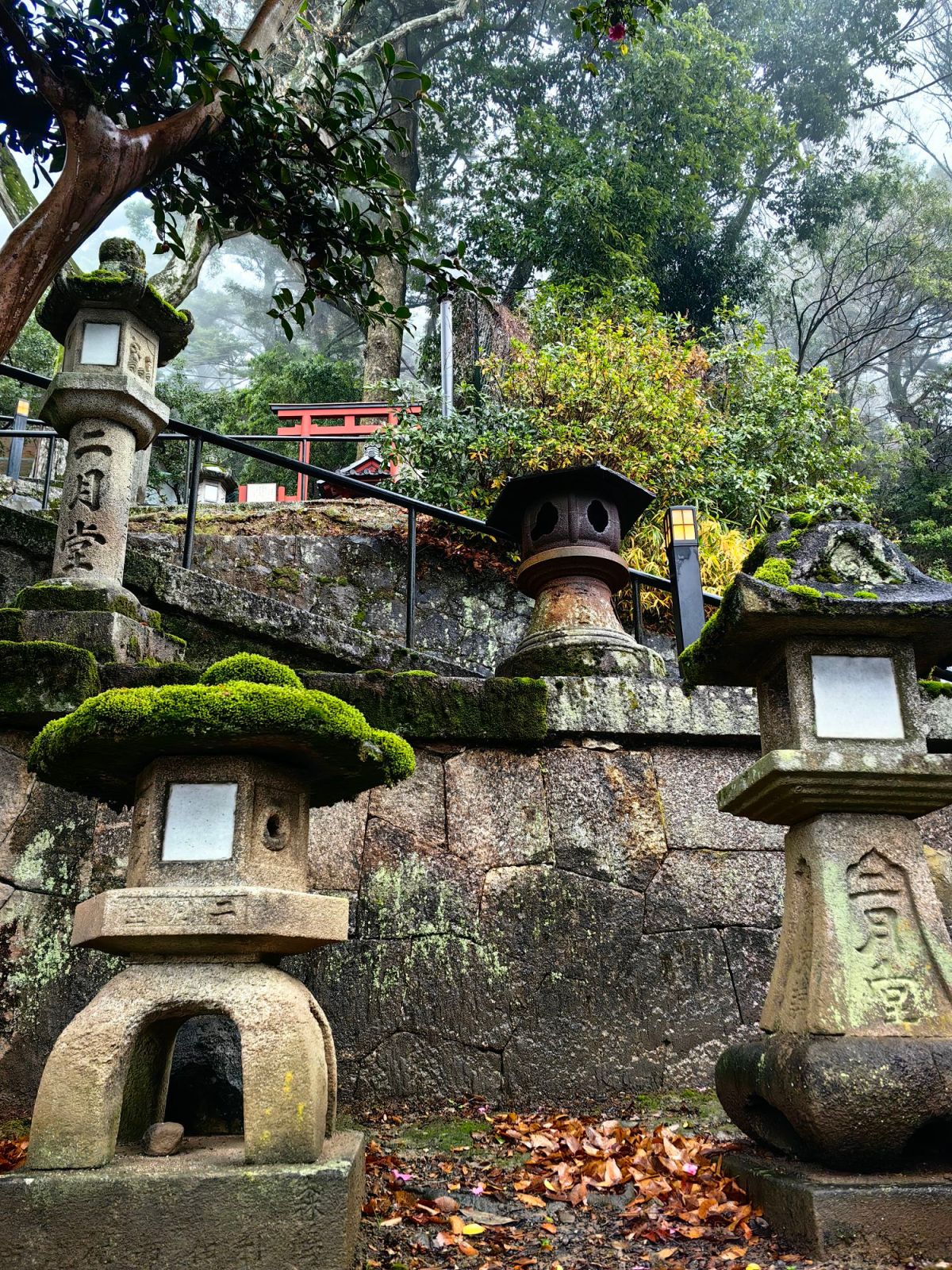
With no crowds to hurry me along, I could pause whenever I wished, observe the details of the landscape, and simply wander without a destination, allowing the ancient atmosphere of Nara to reveal itself gradually. It made me thought of a poem of Song Dynasty: Beside the village shrine, the old thatched inn lies as before; turning past the stream and bridge, it suddenly appears before my eyes. The Nigatsu-do is a small temple on my way. The weathered wooden structure, stone lanterns, ancient trees, and quiet hillside create an leisurely atmosphere quite different from the grandeur of Tōdai-ji below.
The old wooden hall is raised high on sturdy pillars. Its weathered timbers darkened by the rain. Stone lanterns stood silently along the steps, softened by moss and years of weather, while the broad veranda opened toward the distant roofs and streets of Nara. On the rainy day, the wood darkened with moisture and the surrounding forest becomes veiled in mist, making the place feel even more secluded.
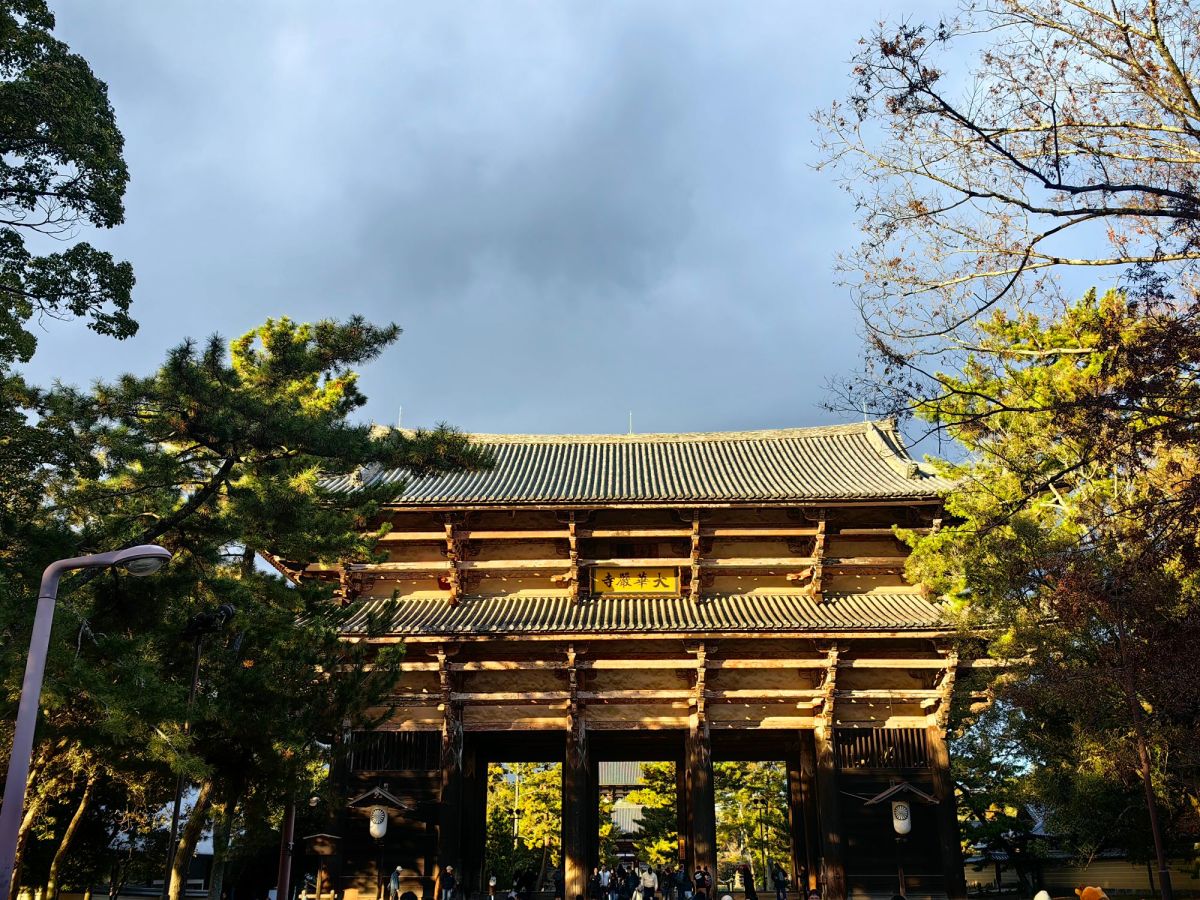
After some time, the Nandaimon Gate of Tōdai-ji rose before me like a monumental gateway. Its enormous wooden pillars, darkened and weathered by centuries of rain and sunlight, seemed to possess a strength that belonged to another age. Beneath the great tiled roof stood the two fierce Niō guardians with powerful bodies and they had been watching over the temple for centuries. Walking beneath the immense gate, I felt small beside the towering timbers and massive statues. More than simply an entrance to Tōdai-ji, it felt like a threshold between the present and the ancient world of Nara.
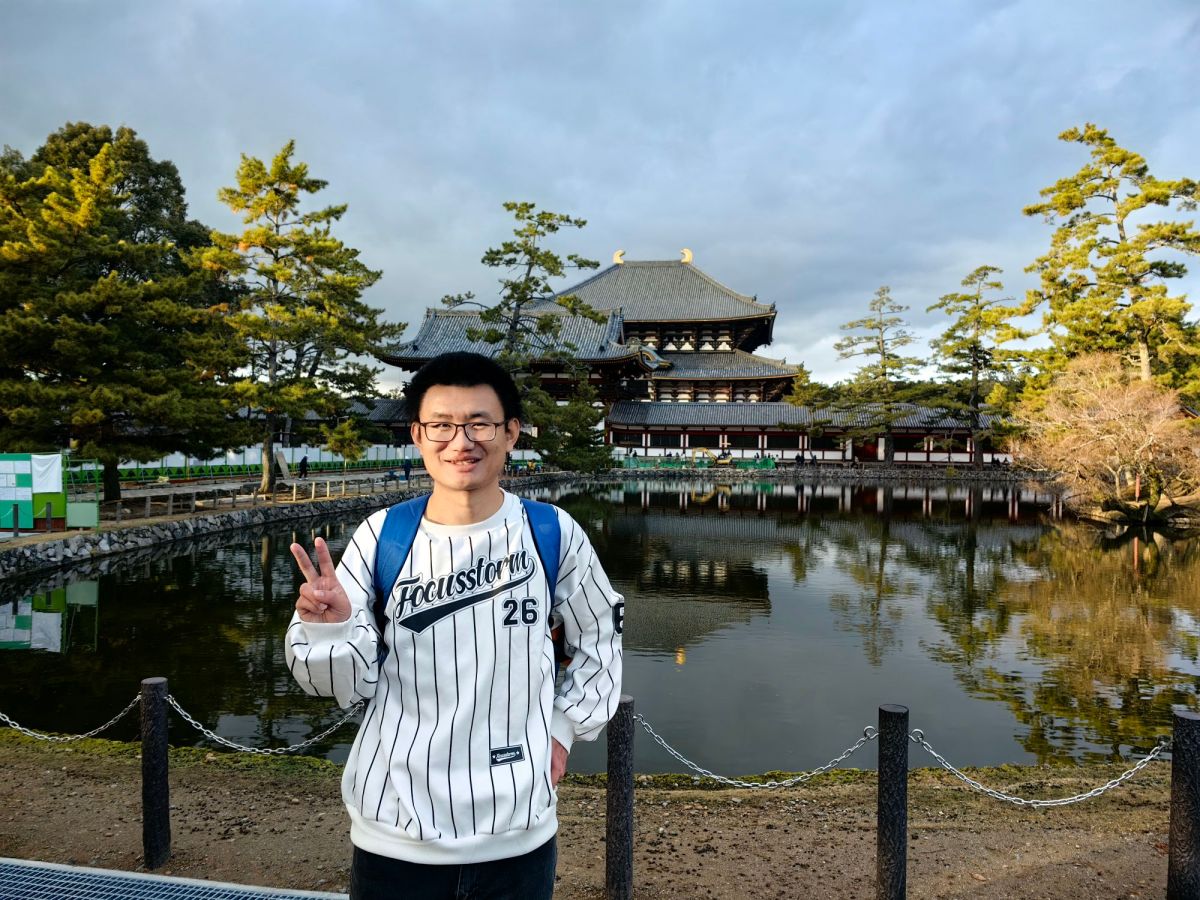
I continued walking through the temple grounds and soon arrived at Kagami-ike Pond, the quiet body of water lying before the entrance to the famous Tōdai-ji. Its still surface reflected the surrounding trees, temple roofs, and muted sky, creating an elegant scene. The gentle rain added another layer of tranquility, softening the outlines of the ancient buildings and turning the pond into a mirror of the misty landscape.
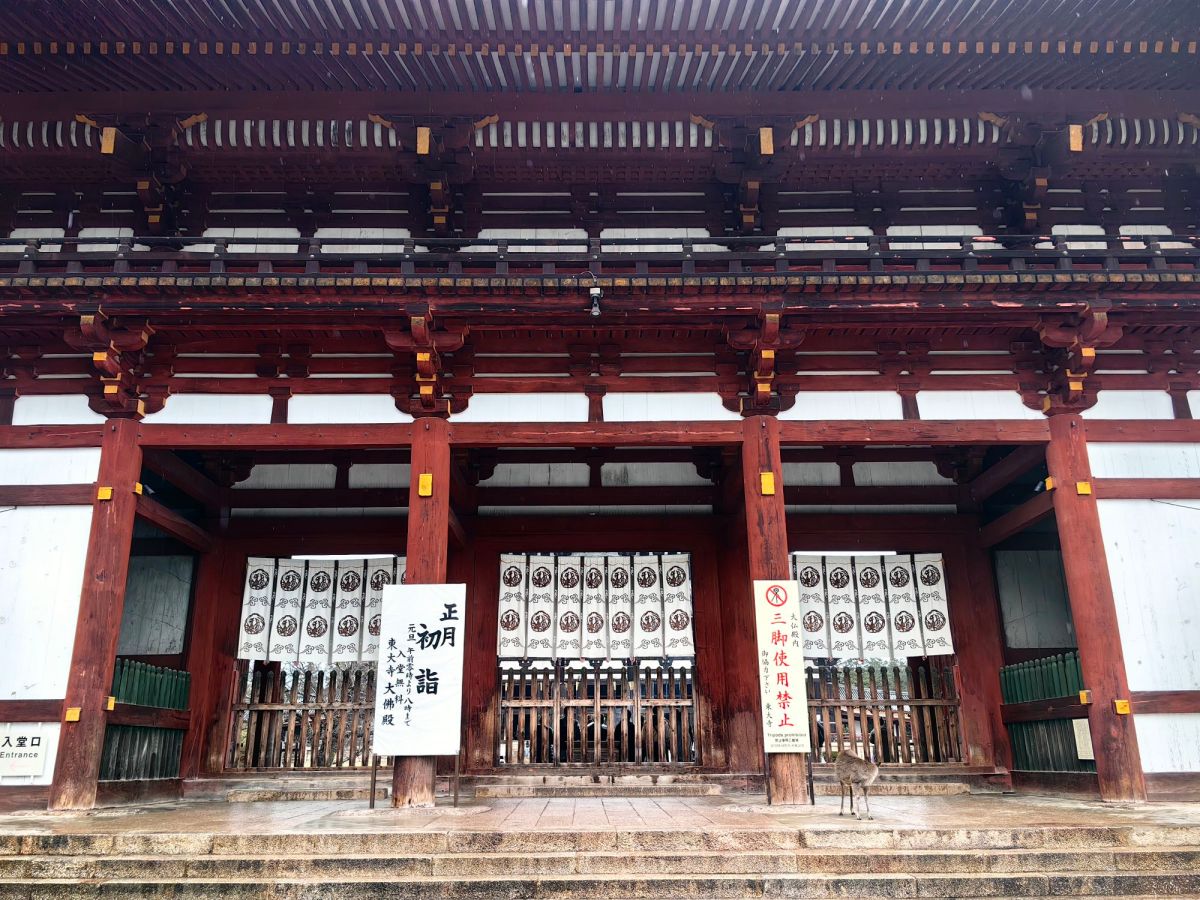
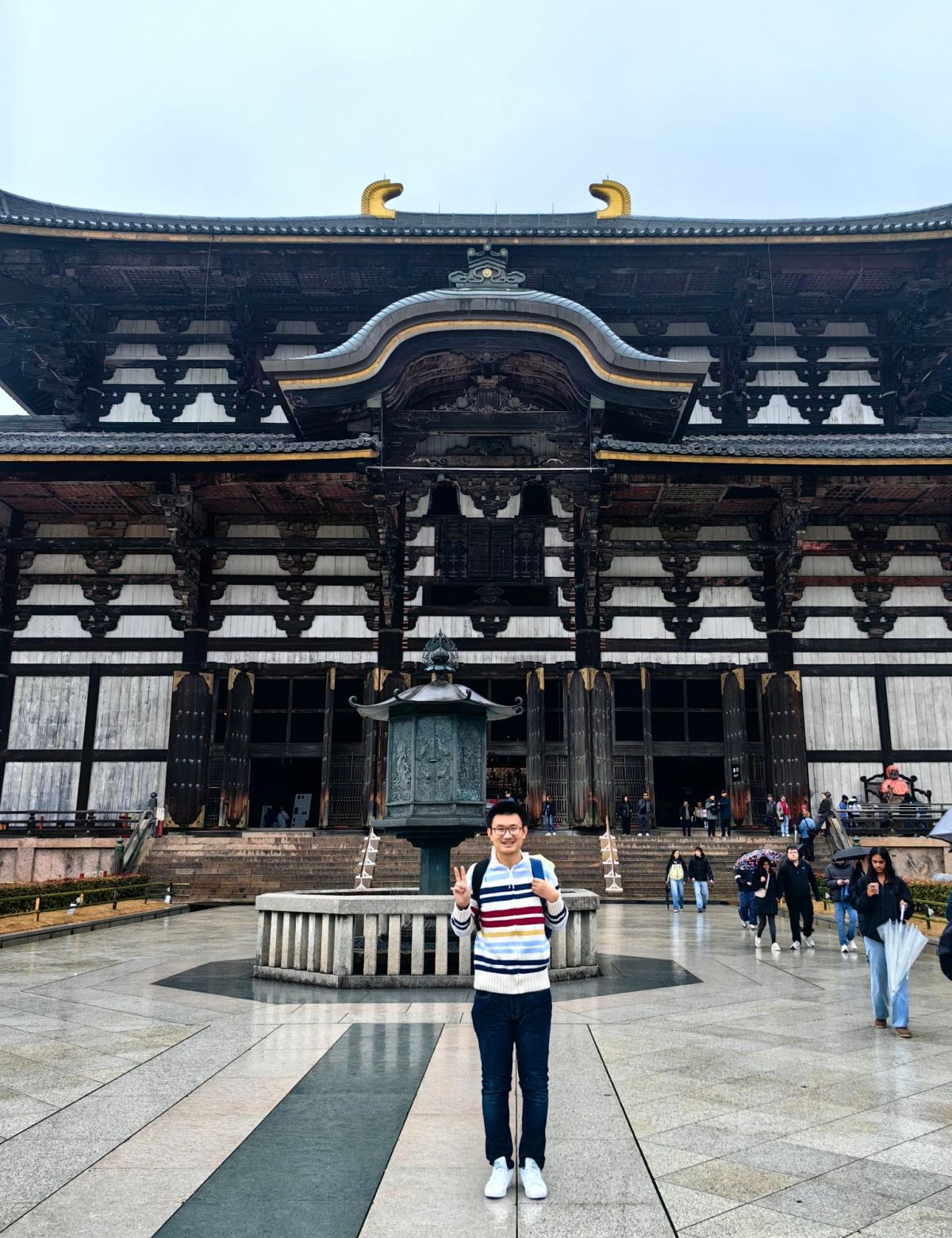
Beyond Kagami-ike Pond, I continued toward the Chūmon, the Central Gate of Tōdai-ji. Its graceful vermilion-and-white structure stood quietly beneath the broad tiled roof, framed by the surrounding trees and the vast temple grounds. After the monumental Nandaimon, the Chūmon felt more restrained and serene, it carried a sense of ceremony. Through the gate, the enormous Great Buddha Hall could be glimpsed beyond, its immense wooden form rising at the heart of the temple precinct.
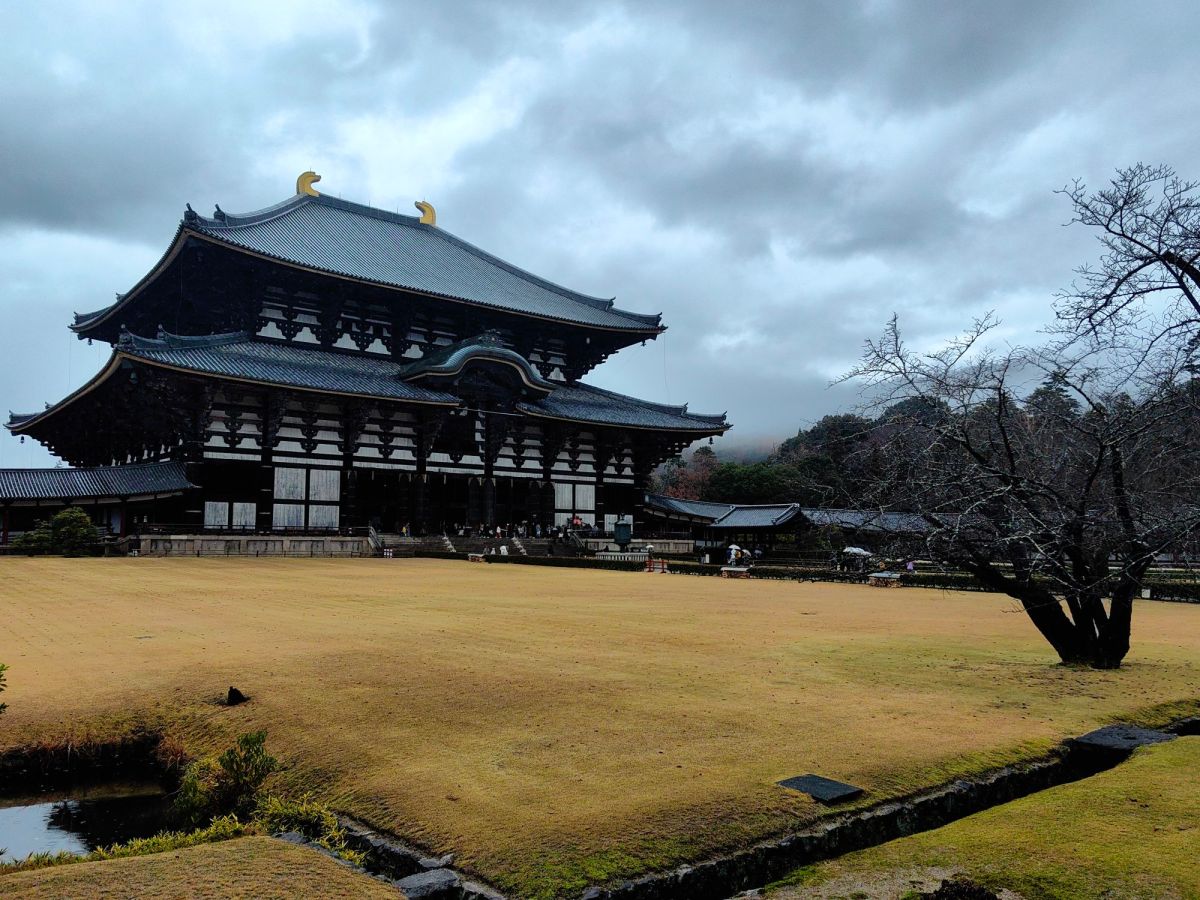
From the entrance, the Great Buddha Hall rose before me with an overwhelming sense of height and scale. Its immense tiled roof seemed to stretch across the sky, while the vast wooden structure beneath it appeared almost impossibly tall and monumental. Standing at the entrance, I could only look upward, gradually taking in the enormous proportions of the building.
Tōdai-ji is perhaps the most representative monument of Nara, embodying the city’s identity as Japan’s ancient capital. Built in the eighth century, when Nara was known as Heijō-kyō, the temple reflected the enormous political and spiritual ambitions of its age. Standing there, I felt that Tōdai-ji was really a surviving expression of Nara’s golden age, where architecture, faith, and history had remained intertwined for more than a thousand years. A bronze octagonal lantern rose quietly in the open space before it. Known as the Kondō Hakkaku Tōrō, the lantern which is one of the relatively few surviving objects from the original Nara-period is a national treasure. In Buddhist tradition, the light of a lantern represents the wisdom of the Buddha, dispelling the darkness of ignorance.
Tōdai-ji’s architecture was strongly influenced by Tang-dynasty China. During the Nara period, Japan actively adopted Chinese institutions, Buddhism, urban planning, and artistic styles. Nara itself was modeled partly on the Tang capital Chang’an. The broad tiled roof, monumental timber framework, bracket systems, and proportions all belong to an architectural tradition that Japan inherited and adapted from China. Standing beneath the vast roof of the Great Buddha Hall, I could almost sense the ancient cultural exchange that had once connected Nara with the distant Tang China.
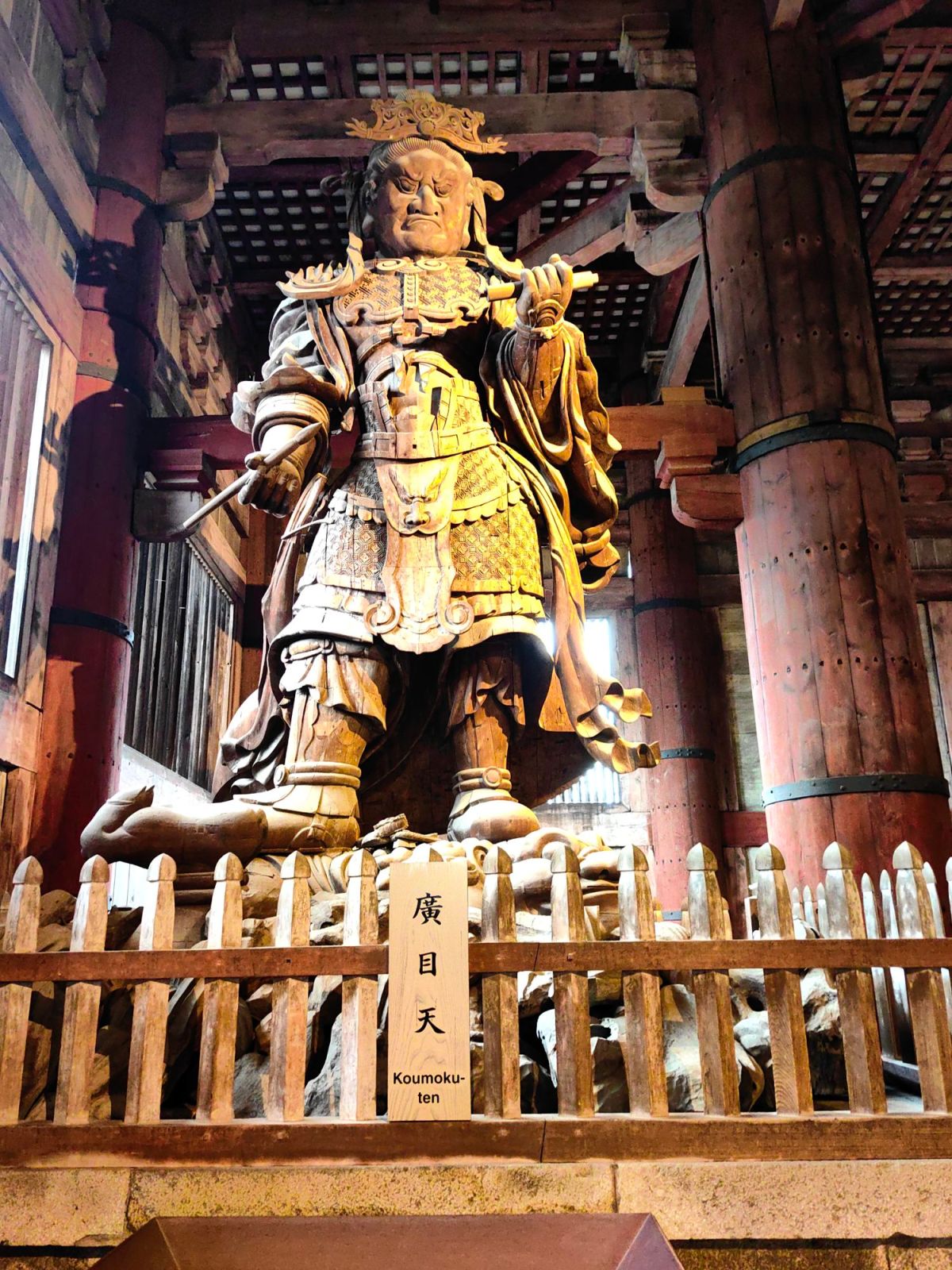
Inside the Great Buddha Hall, I encountered Komokuten, the Heavenly Guardian of the West, standing watch beside the Great Buddha. One hand held his traditional weapon and the expression was full of majesty and power. The central figure in the hall is the Great Buddha (Daibutsu), a colossal bronze statue of Vairocana Buddha. It represents Vairocana, the Cosmic Buddha whose wisdom and light are understood to permeate the entire universe. Buddhism arrived in Japan from the Korean Peninsula in the sixth century. By the Nara period, it had become closely connected with the imperial court and the state, and Emperor Shōmu envisioned Buddhism as a force that could protect and unite the country.
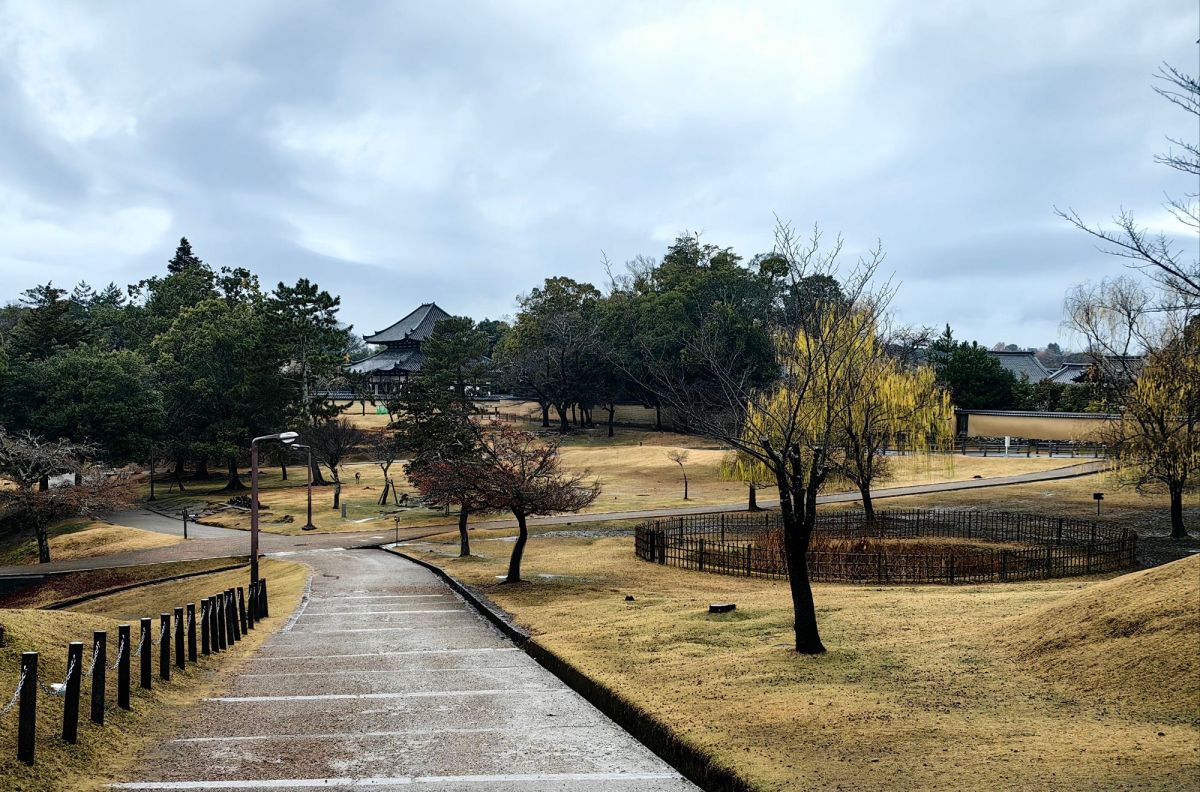
Behind Tōdai-ji, the monumental temple gradually gave way to a broad expanse of green, scattered with mature trees and quiet paths. There were very few tourists here, and the atmosphere was completely different from the busy areas around the Great Buddha Hall. The trees stood peacefully across the open grass, their branches moving gently in the breeze, while the sounds of the temple grounds faded into the distance.
Among these queit buildings, I came upon the Shōsō-in Repository, an ancient wooden storehouse that has preserved treasures from the world of eighth-century Nara. Unlike the monumental Great Buddha Hall, which expresses the grandeur of imperial Buddhism, Shōsō-in seemed almost modest, its walls built from rows of natural timber logs in the distinctive azekura style. Yet within this unassuming structure lay an extraordinary record of the ancient world—Buddhist objects, musical instruments, textiles, manuscripts, and precious belongings associated with Emperor Shōmu and the people of his age.
After wandering through Nara’s main sights, I finally brought my first day in the ancient capital to an end. As evening settled over the city, I stopped at a small local restaurant and ordered a simple bowl of ramen. After a long day of walking, the steaming broth and warm noodles were more than enough to satisfy me. Travelling in Japan had also taught me that a memorable meal does not have to come from an expensive or fashionable restaurant. Sometimes, the simplest places like a small shop with a few seats, a steaming bowl of ramen could offer exactly what I need at the end of a long day.
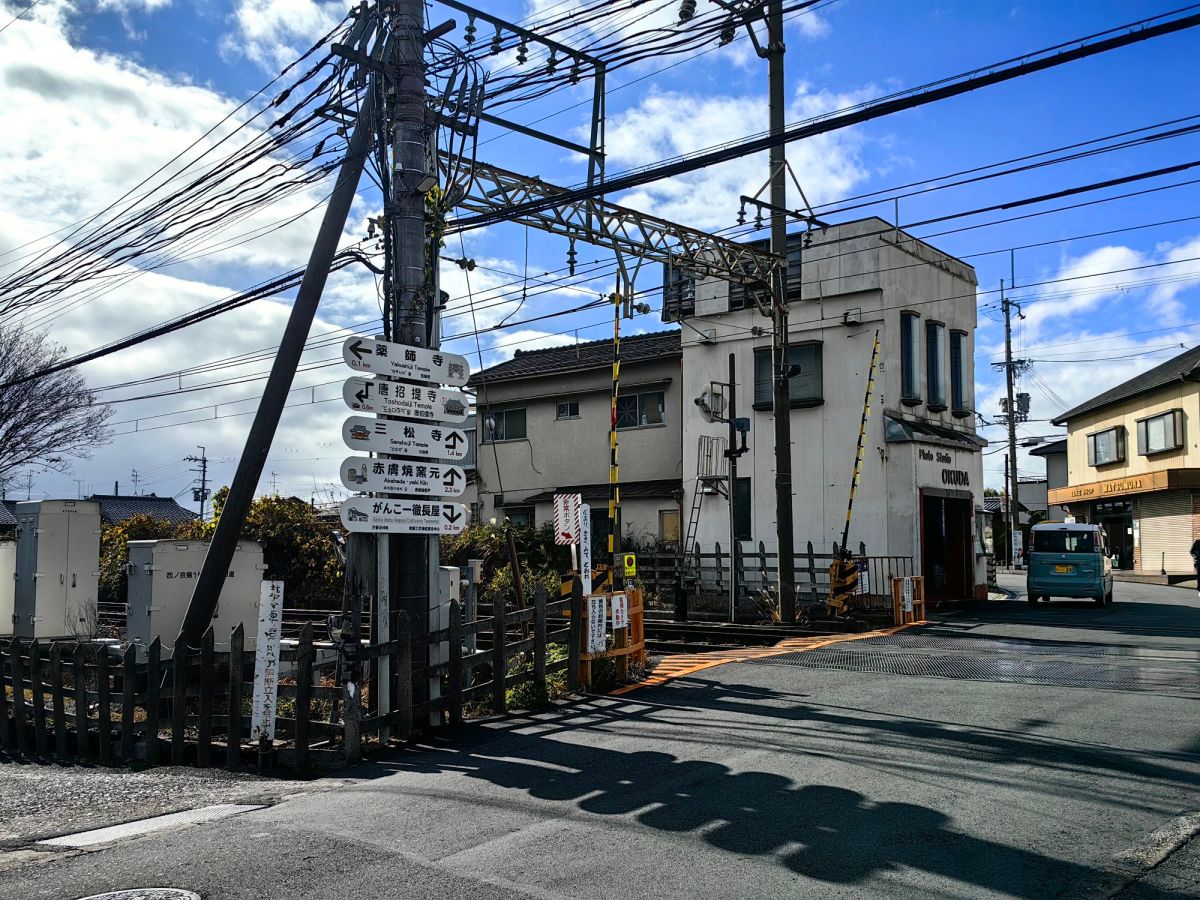
My second day in Nara took me to Nishinokyō, meaning the “Western Capital,” an area west of the ancient Heijō-kyō. Away from the center of modern Nara, this quieter district preserves some of the most important remnants of the city’s eighth-century Buddhist heritage. Two remarkable temples awaited me there: Yakushi-ji and Tōshōdai-ji, both deeply connected with the history of Nara’s ancient capital. Reaching them was remarkably easy. Japan’s railway system is exceptionally convenient, with trains and local lines connecting cities, neighborhoods, and even places far from the main tourist routes.
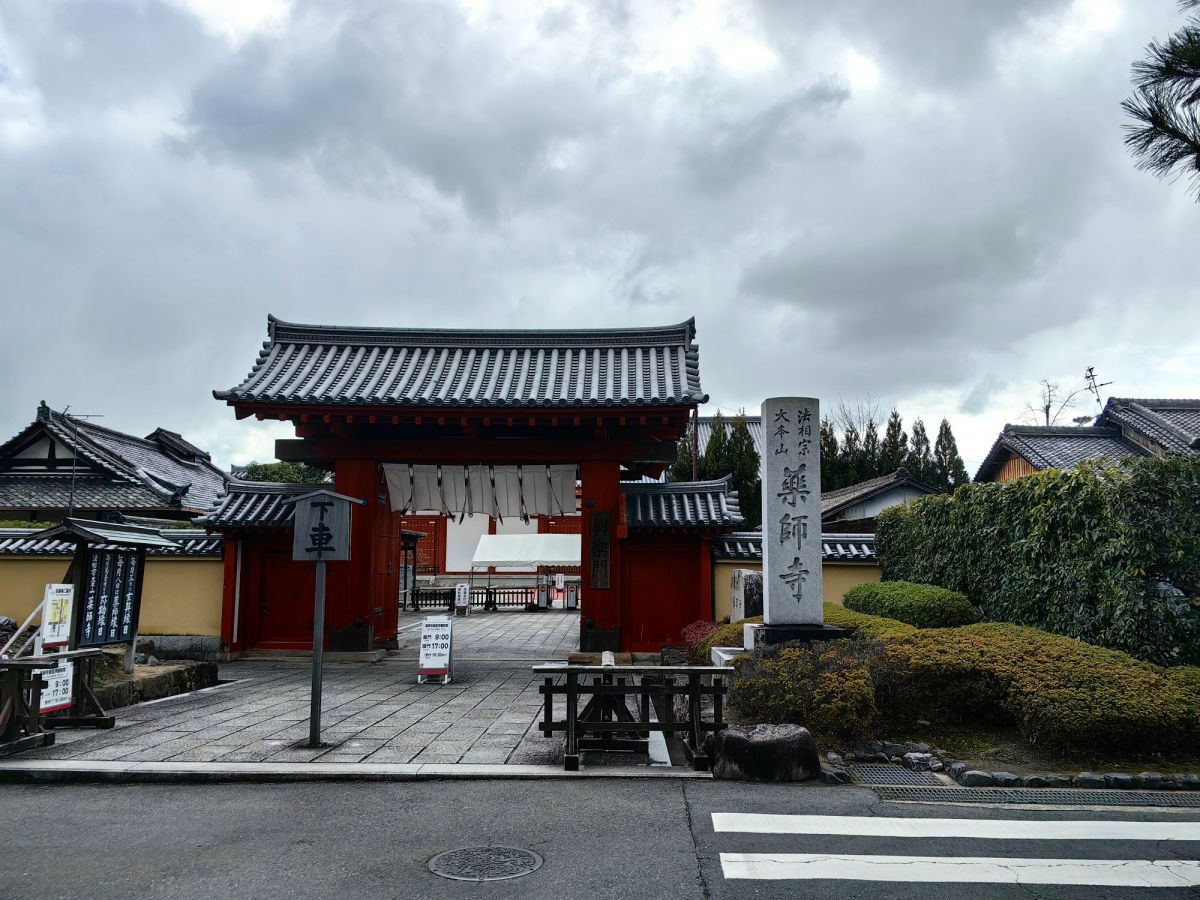
Following the directions, I made my way to my first destination, Yakushi-ji. Even before entering, I was intrigued by its long and fascinating history. It carries a history almost as old as Nara itself. The temple was first founded in 680 by Emperor Tenmu, who prayed for the recovery of his ailing wife and dedicated the temple to Yakushi Nyorai, the Buddha of healing. Originally built at Fujiwara-kyō, it was moved to Heijō-kyō when the capital was transferred to Nara in the early eighth century, becoming one of the great Buddhist temples of the new imperial city.
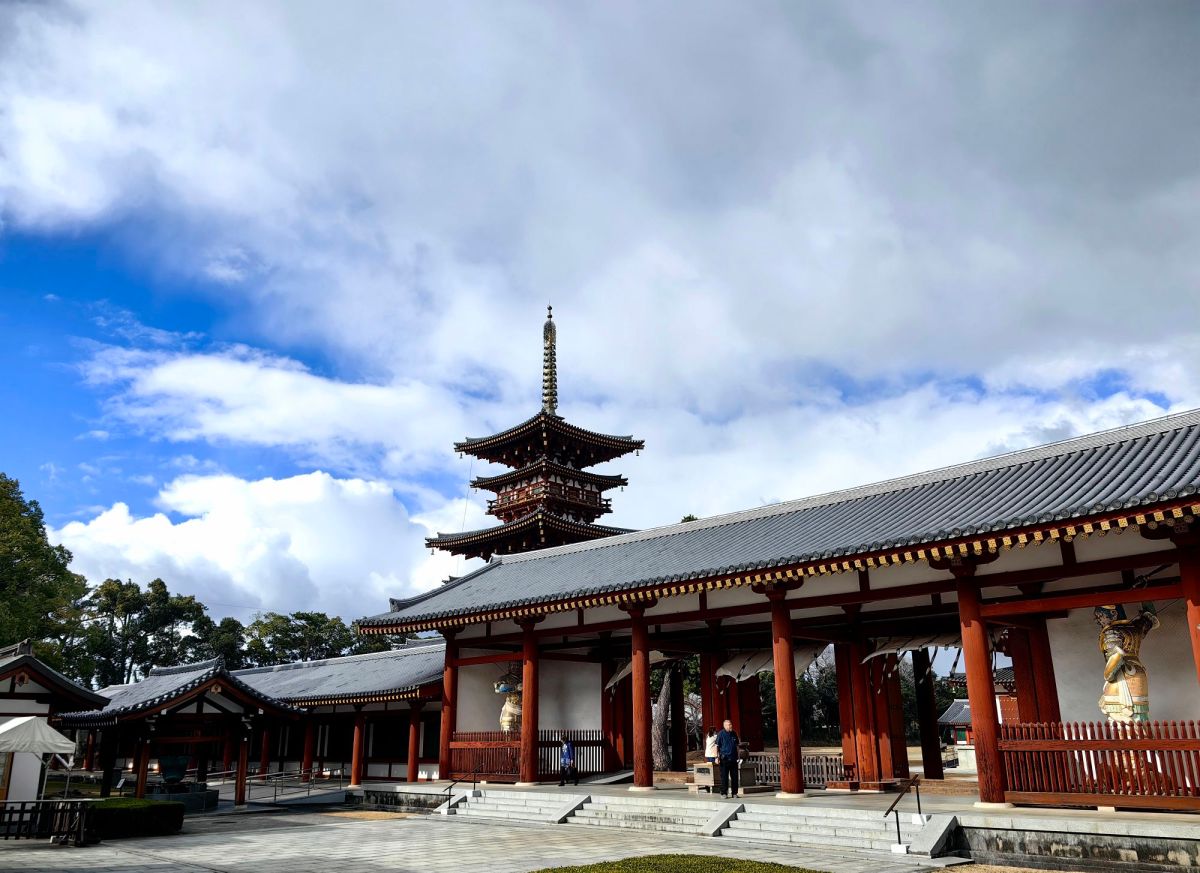
The whole temple was an immense and symmetrical complex, reflecting the sophisticated temple architecture and continental influences of the Nara period. Yet the temple’s long history was marked by repeated fires, wars, and destruction. Much of its ancient architecture disappeared, leaving the East Pagoda as its most remarkable survivor, still standing in its original form from 730.
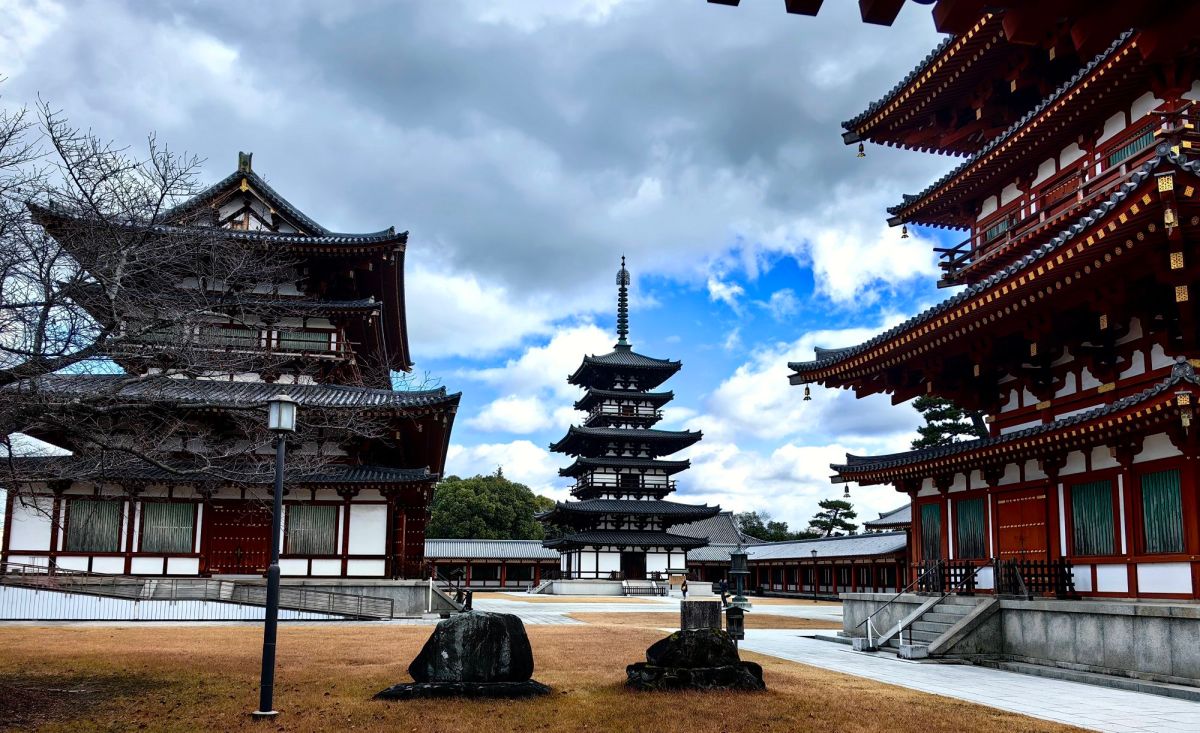
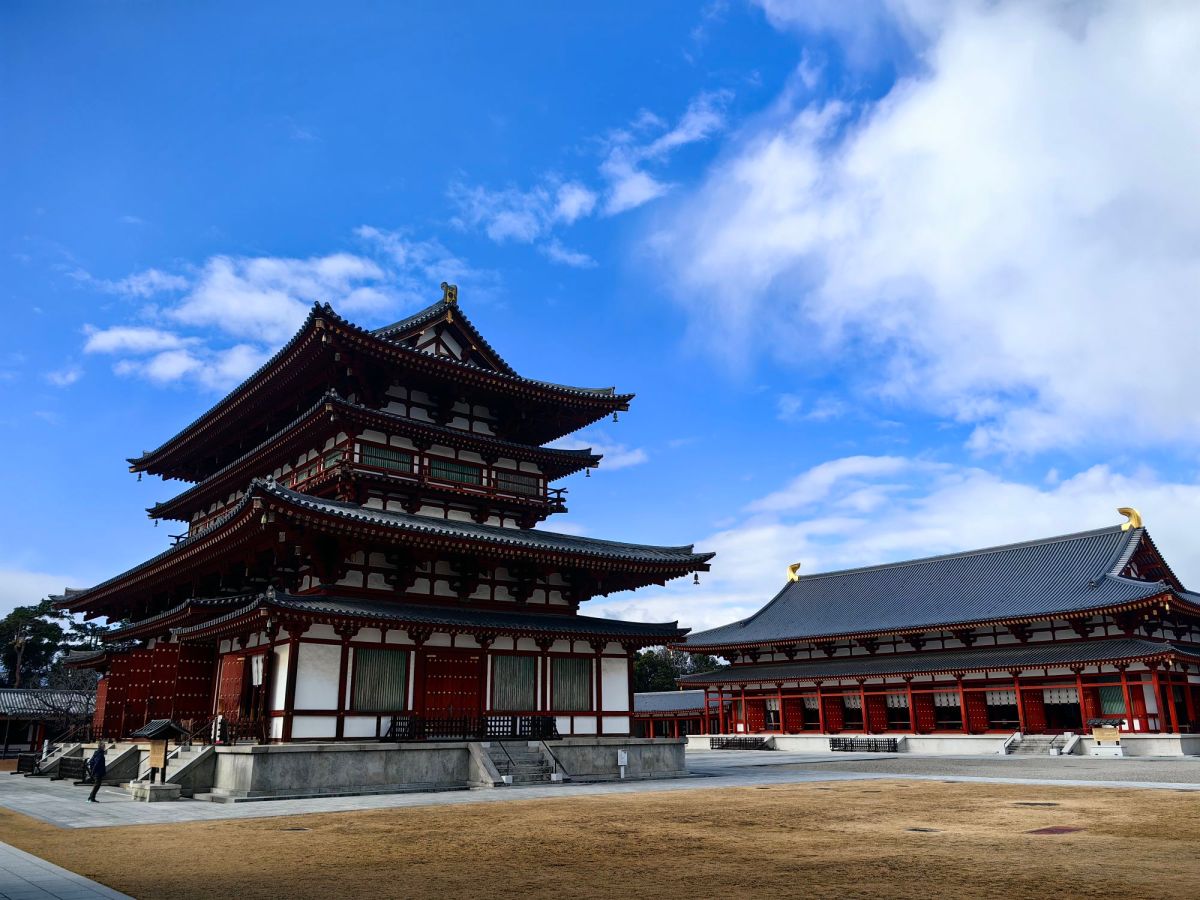
Under the brilliant blue sky, the East Pagoda of Yakushi-ji rose gracefully above the temple grounds, its dark wooden tiers standing in striking contrast to the clear expanse of sky behind it. It is the only surviving original structure of Yakushi-ji from that age. Although only three stories in structure, the smaller roofs between the main levels give the pagoda the appearance of six stories, creating a distinctive rhythm as the eaves rise one above another. Sunlight traced the edges of its sweeping roofs and delicate wooden details, while the deep tones of the aged timber revealed the passing of more than twelve centuries.
The temple complex of Yakushi-ji unfolded before me in a graceful and carefully ordered arrangement. The buildings including the Golden Hall and the Grand Lecture Hall stood along a central axis. Vermilion pillars and white walls stood vividly against the blue sky, while the dark tiled roofs and wooden details gave the complex a more solemn character.
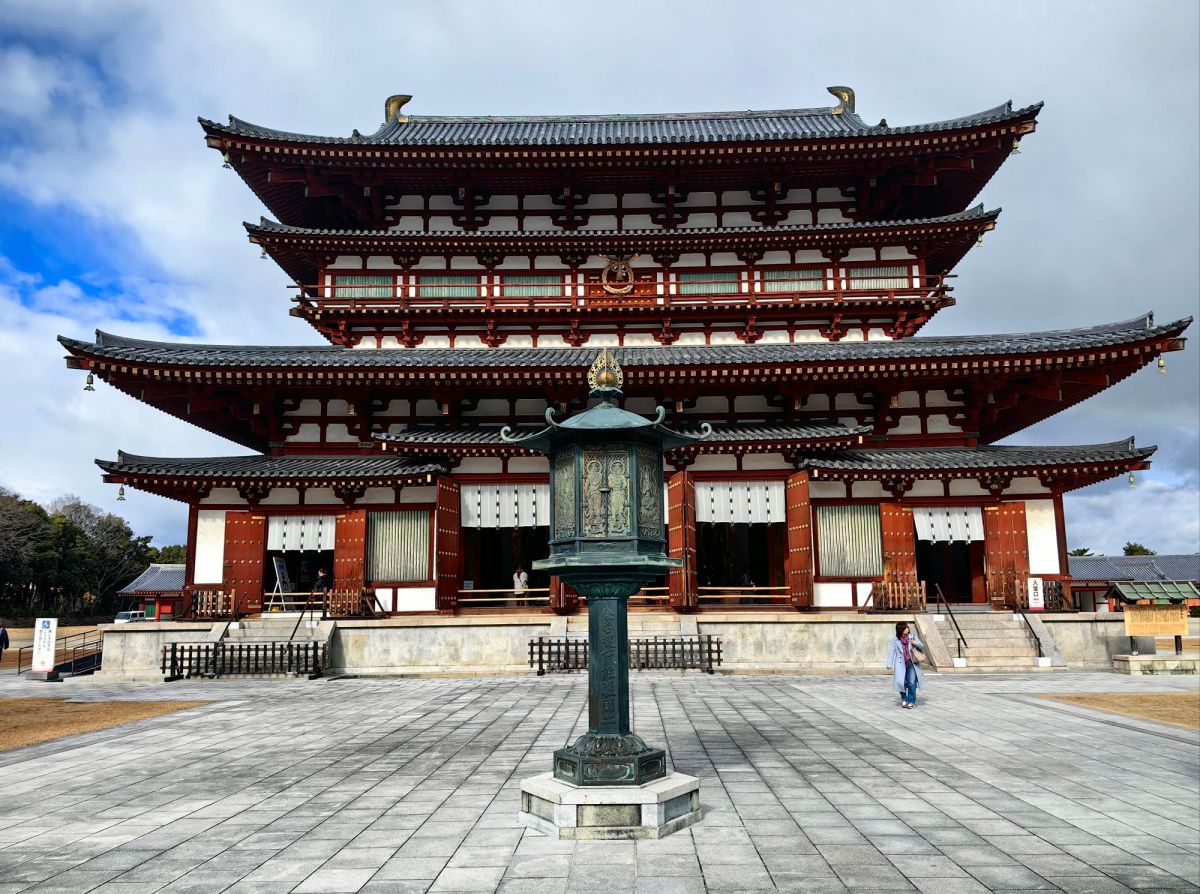
At the heart of Yakushi-ji stood the magnificent Golden Hall. In front of it stood a solitary stone lantern (tōrō), which is modest in size. In Japanese Buddhism, the light of a lantern symbolizes the wisdom of the Buddha, illuminating the darkness of ignorance and guiding those who seek enlightenment. I could always see such a decoration in the Japanese temple. A lantern placed before the main hall helps create a sacred approach, marking the space between the ordinary world and the Buddha’s realm.
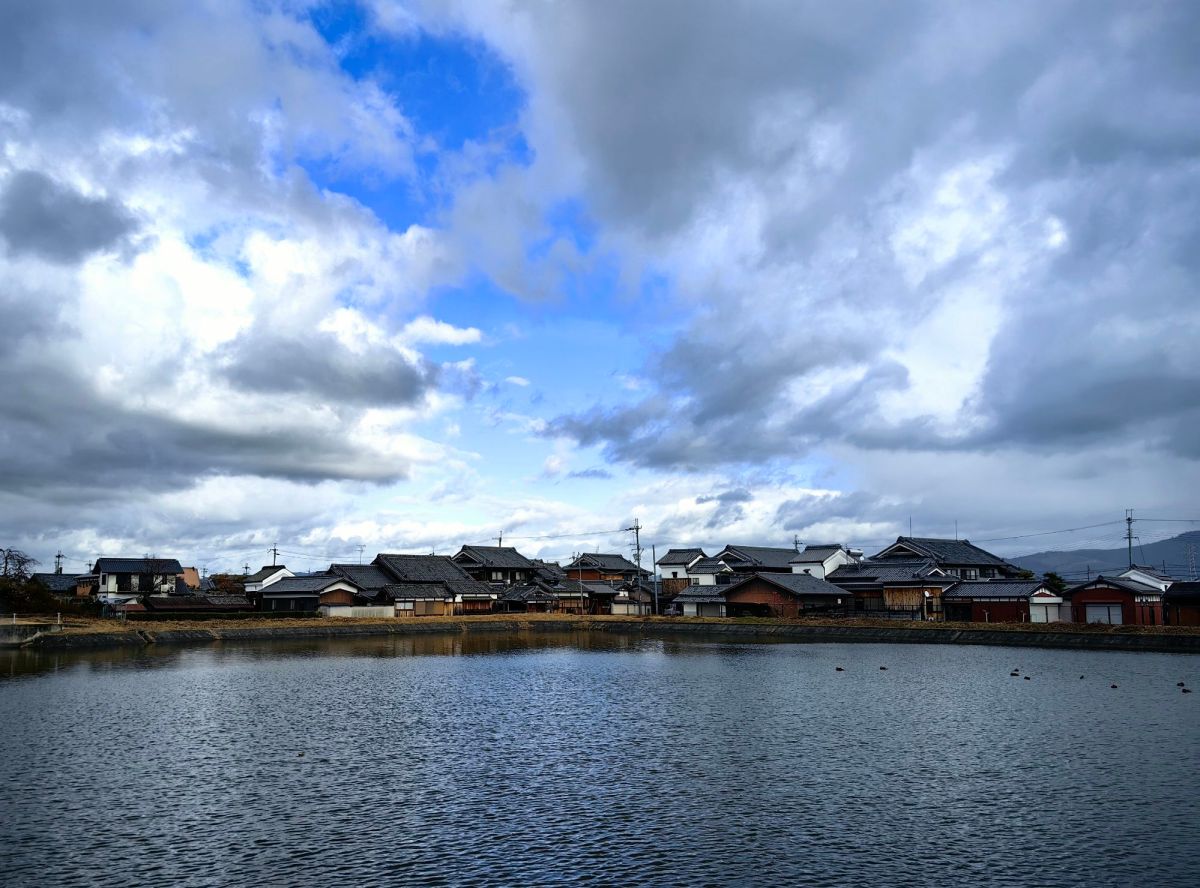
Outside Yakushi-ji, Kannon-ike Pond nearby offered a rustic scene far removed from the grandeur of the temple buildings. The quiet water reflected the surrounding trees and the changing sky, while along its edge stood traditional Japanese wooden houses. Their restrained appearance seemed to belong naturally to the old landscape, as though they had been standing beside the pond for generations. The scene felt like a small corner of old Nara that had escaped the rush of modern life, preserving the simplicity of the past.
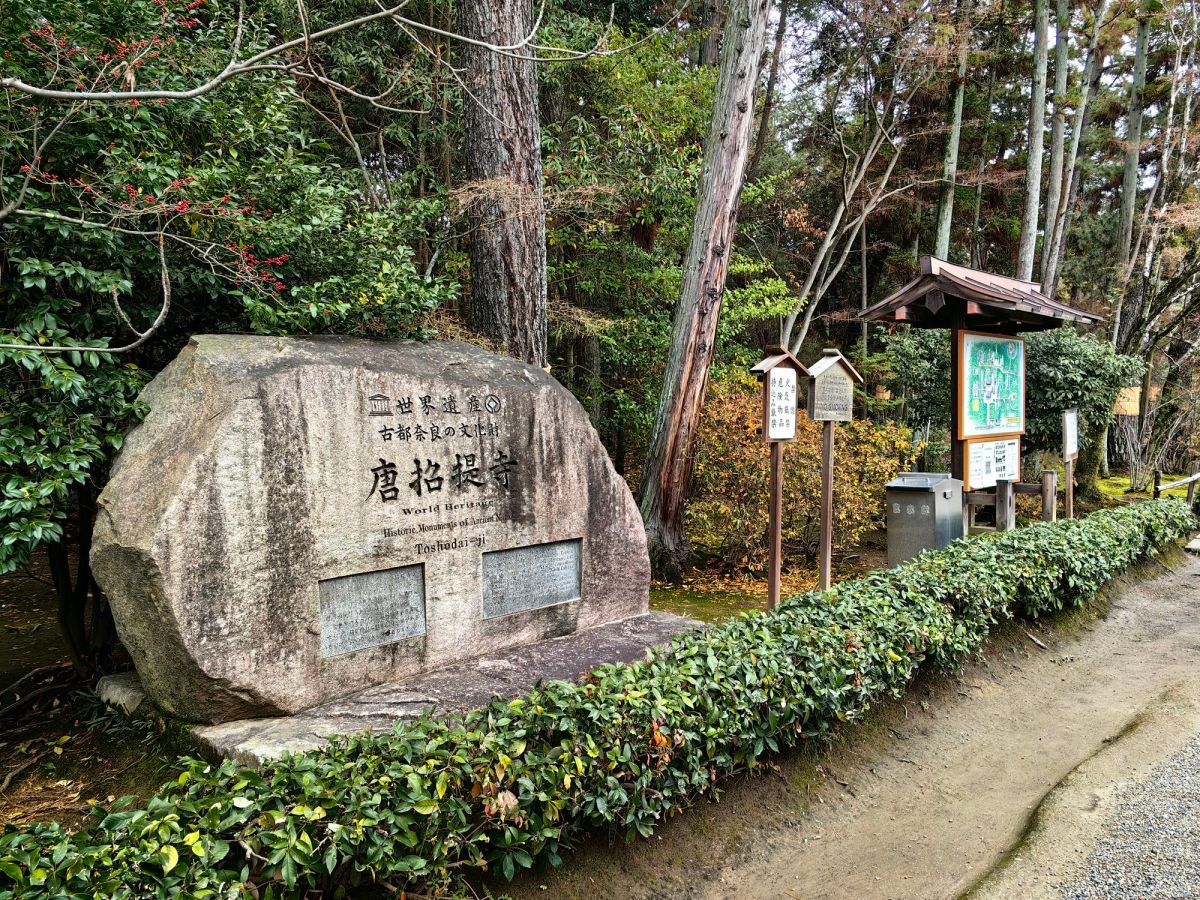
From Yakushi-ji, I continued toward Tōshōdai-ji, another important temple of Nara’s ancient Nishinokyō district. Both temples form part of UNESCO’s World Heritage property, the “Historic Monuments of Ancient Nara,” inscribed in 1998. The temple was nearby, but even its name immediately transported me to a much more distant world. Written as 唐招提寺, the first character, 唐, refers to the Tang dynasty, while 招提 is an ancient Buddhist term connected with a monastic community, giving the name the sense of a temple associated with monks invited from Tang China. For a Chinese speaker, the characters were immediately familiar, creating a curious feeling of recognition across more than a thousand years of history.
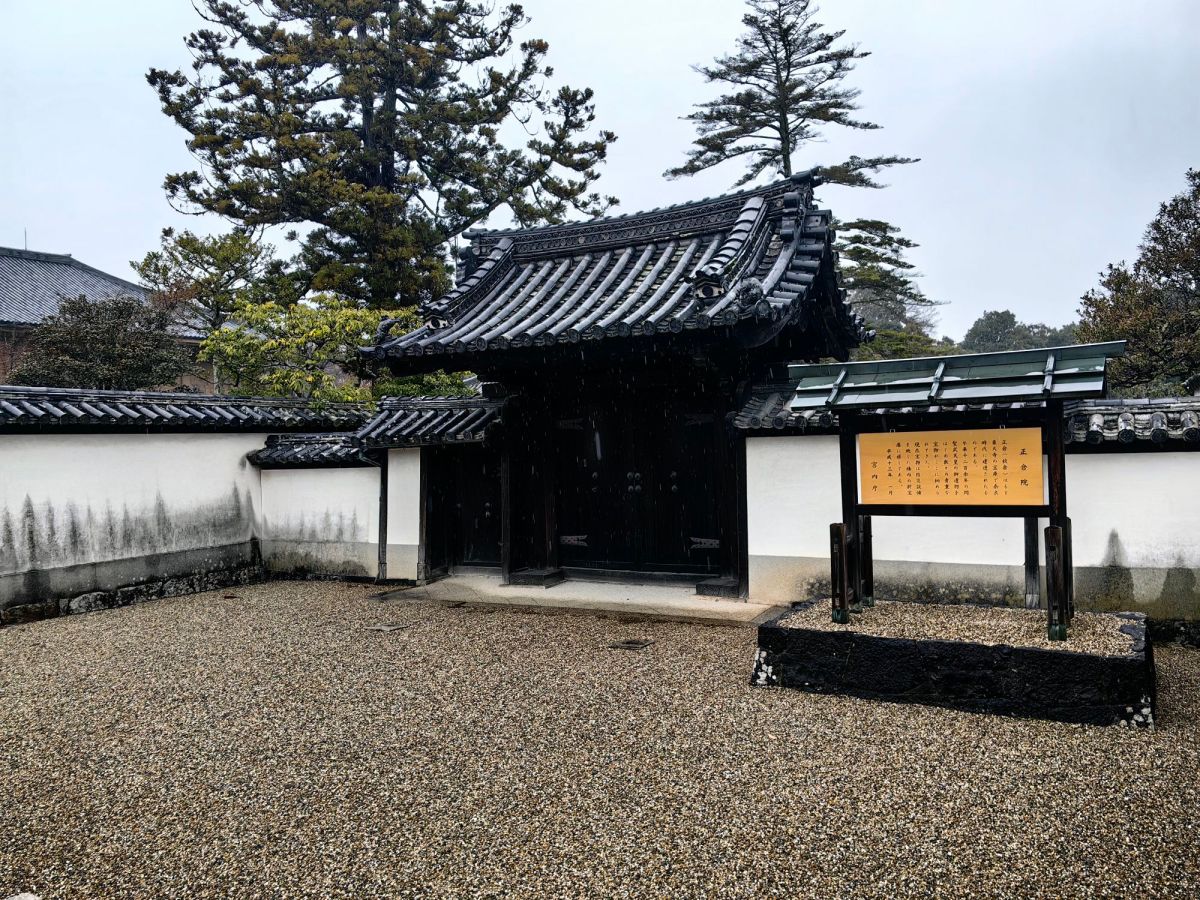
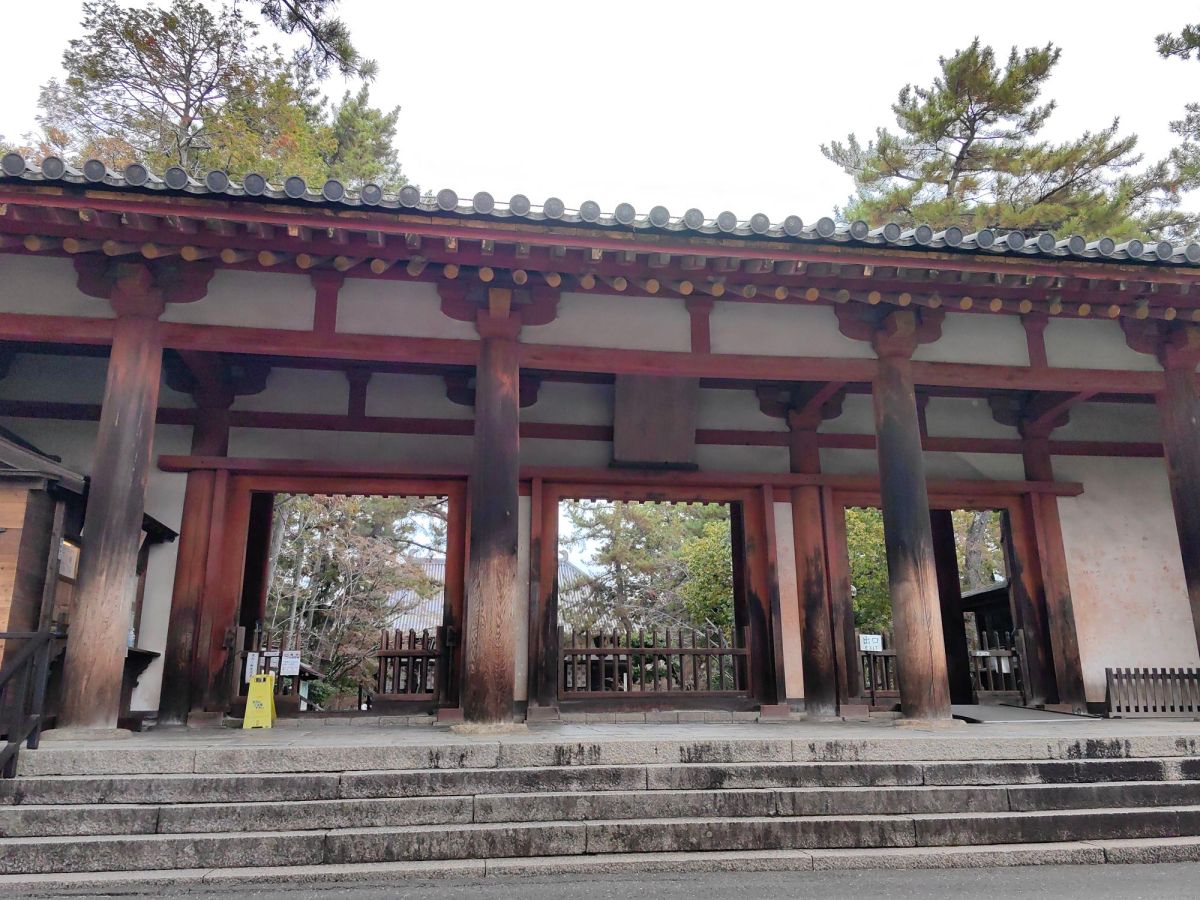
The Nandaimon of Tōshōdai-ji stood quietly at the entrance to the temple grounds, welcoming visitors into one of Nara’s most important Buddhist sites. Compared with the enormous Nandaimon of Tōdai-ji, this gate was more restrained and elegant, with a simple wooden structure, dark tiled roof, and graceful proportions. Its understated appearance seemed perfectly suited to the reserved character of Tōshōdai-ji. Passing through the gate, I felt a subtle transition from the ordinary streets outside into a quieter world of ancient trees, weathered wooden buildings, and long Buddhist history.
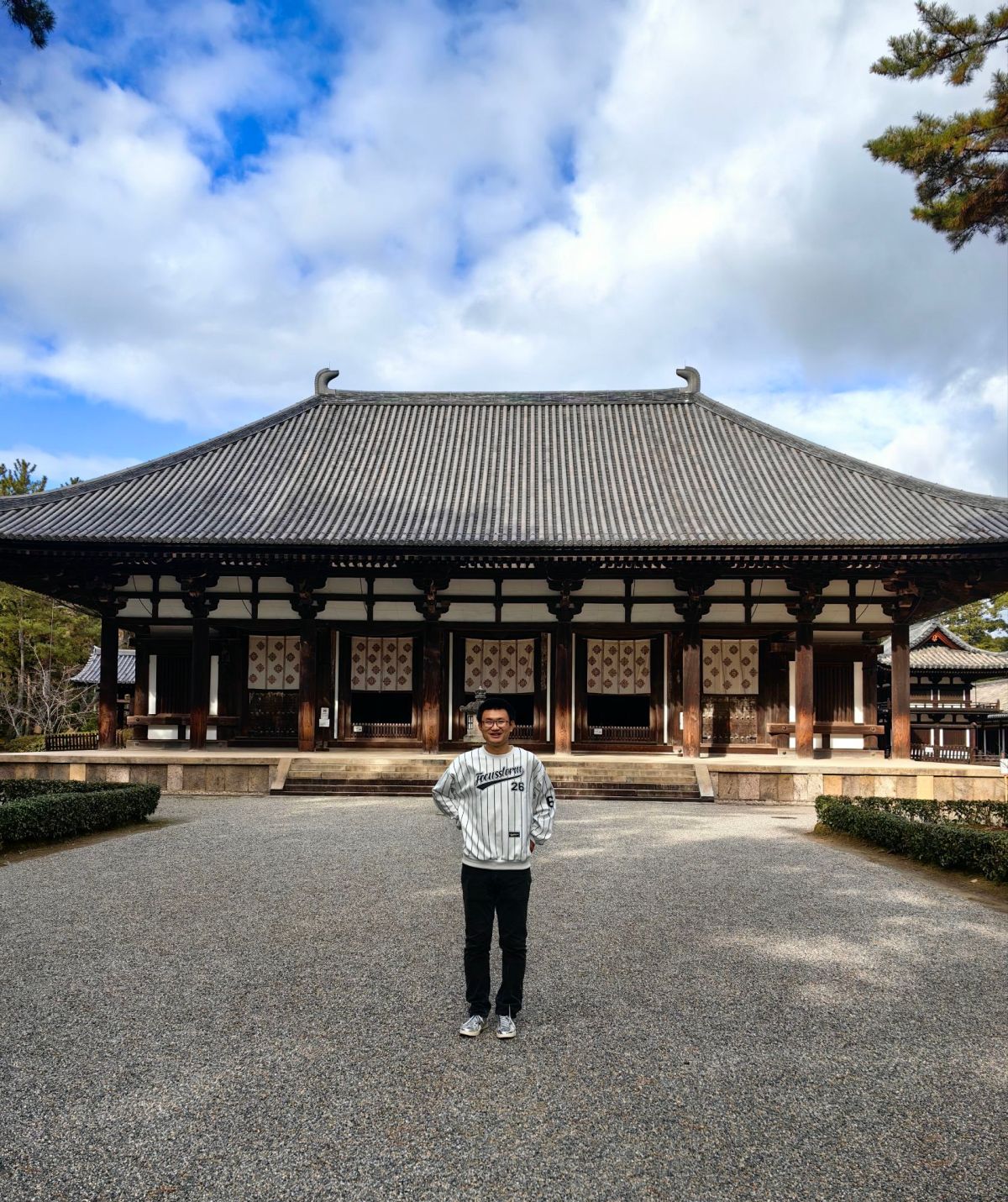
At the heart of Tōshōdai-ji stood the magnificent Golden Hall, the hall completed in Nara period has survived for more than twelve centuries and remains one of the finest expressions of ancient Japanese Buddhist architecture. There was little unnecessary decoration, allowing the elegant proportions, dark timber, and sweeping roofline to speak for themselves. Standing before it, I could see the influence of the Tang Dynasty that had shaped so much of Nara’s early architecture: the ordered symmetry, monumental wooden construction, deep eaves, and sophisticated roof structure. Over centuries, these imported ideas had been absorbed into the Japanese landscape and transformed into something uniquely Japanese.
Walking deeper into this temple, I came upon the Kōdō, or Lecture Hall. Built in the late eighth century, the hall originally belonged to the imperial palace of Heijō-kyō before being moved here and transformed into a Buddhist lecture hall. The timber had witnessed more than twelve centuries of changing seasons, while the hall had passed from the world of the emperor into the world of Buddhist learning. It seemed to embody the continuity of Nara’s history, where buildings themselves could carry their stories from one age into another.
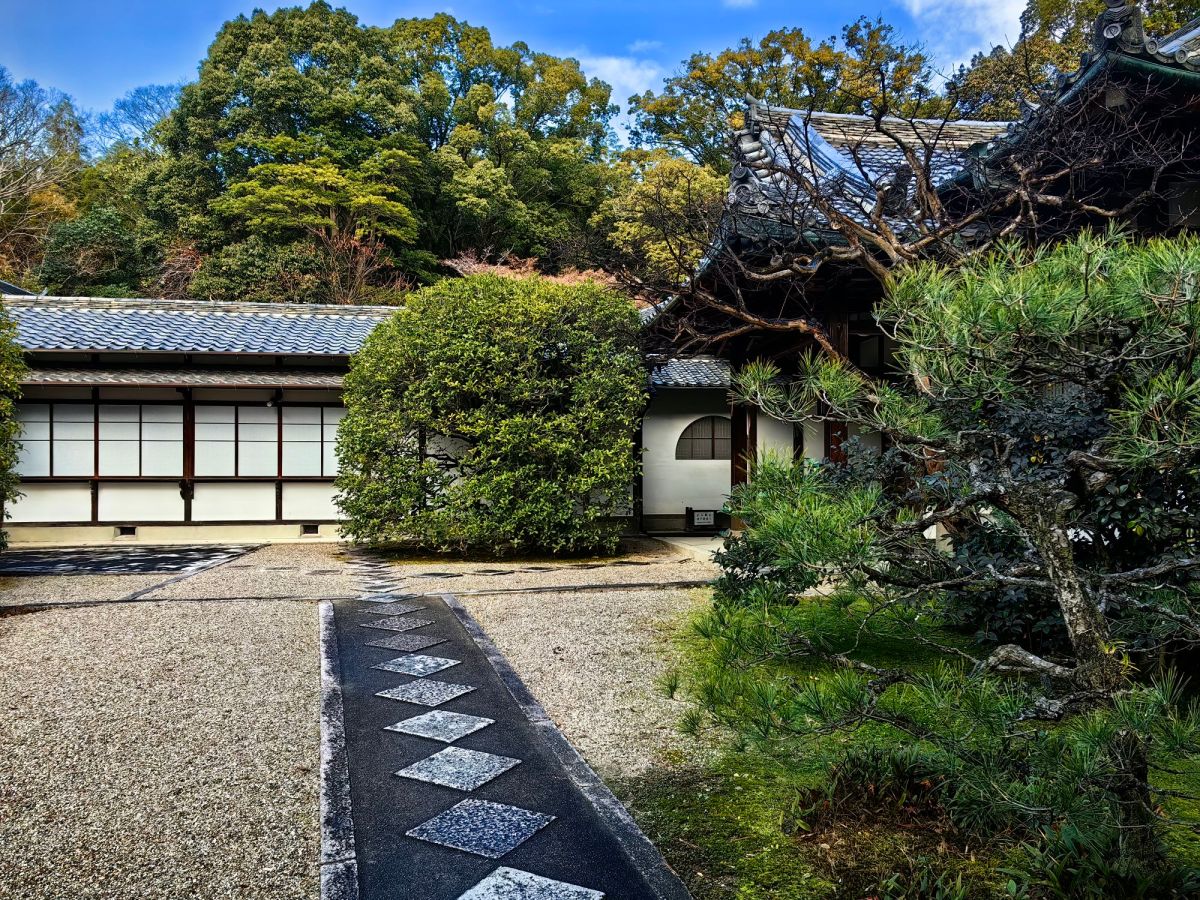
The atmosphere here was very quiet. Narrow paths wound gently through the temple grounds, shaded by tall trees whose branches formed a cool green canopy overhead. Sunlight filtered through the leaves in scattered patches, falling softly across the old stone paths and moss-covered ground.
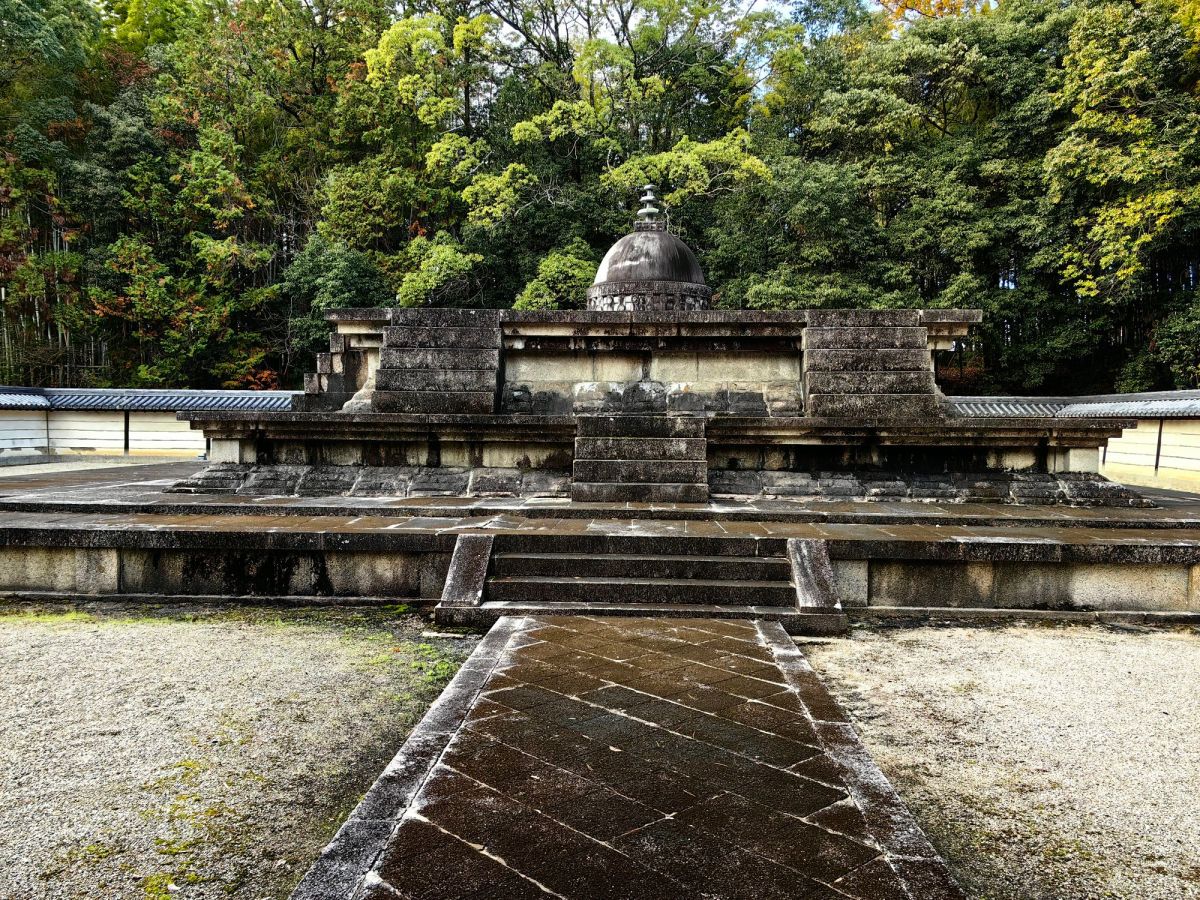
Tōshōdai-ji was founded by the Chinese monk Jianzhen, who travelled to Japan in the eighth century, bringing with him Buddhist teachings, religious practices, and knowledge from the Tang Dynasty. He had attempted to travel from Tang China to Japan five times, enduring storms, shipwrecks, illness, and eventually losing his eyesight. Even after all these hardships, he continued his journey and finally reached Japan in 754. The Ganjin Wajō Gobyō is the mausoleum of Jianzhen. It lies at the end of a quiet, wooded path within the temple grounds. As I stood in front of it, I felt that I was not simply moving from one Nara temple to another, but following an ancient cultural bridge that once connected Nara Japan with Changan China.
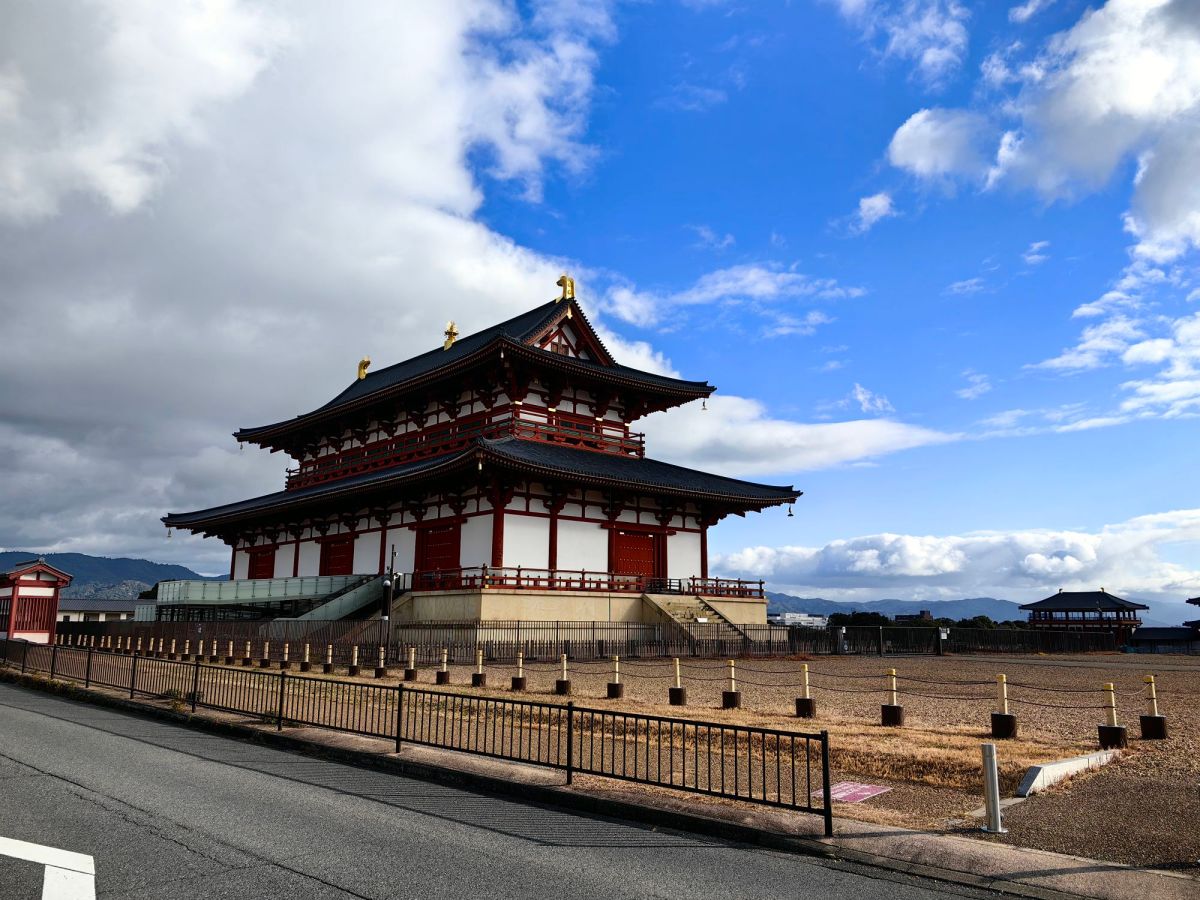
Afterwards, I took the train to the Heijō Palace Site Historical Park, the final major attraction of my Nara journey. After spending the day among ancient temples, I was curious to see the place where the political heart of eighth-century Nara had once stood. I entered the vast site from the northern side, beginning at the First Daigokuden, the reconstructed Great Audience Hall. The enormous open landscape was strikingly different from the shaded temple grounds of Yakushi-ji and Tōshōdai-ji.
As I learned more about the history of Nara, I began to see that the city was the result of a much larger transformation in Japan. One of the important turning points came in 645 with the Taika Reforms. The reforms sought to strengthen the authority of the imperial court and create a more centralized system of government, drawing in part on political and administrative ideas from the continental world. This new political order eventually found its physical expression in the capital of Heijō-kyō, established in Nara in 710. The city was carefully planned, with a great imperial palace, government offices, temples, and broad avenues arranged along a formal grid. All these interesting historic events happened thousand years ago in the place in front of me.
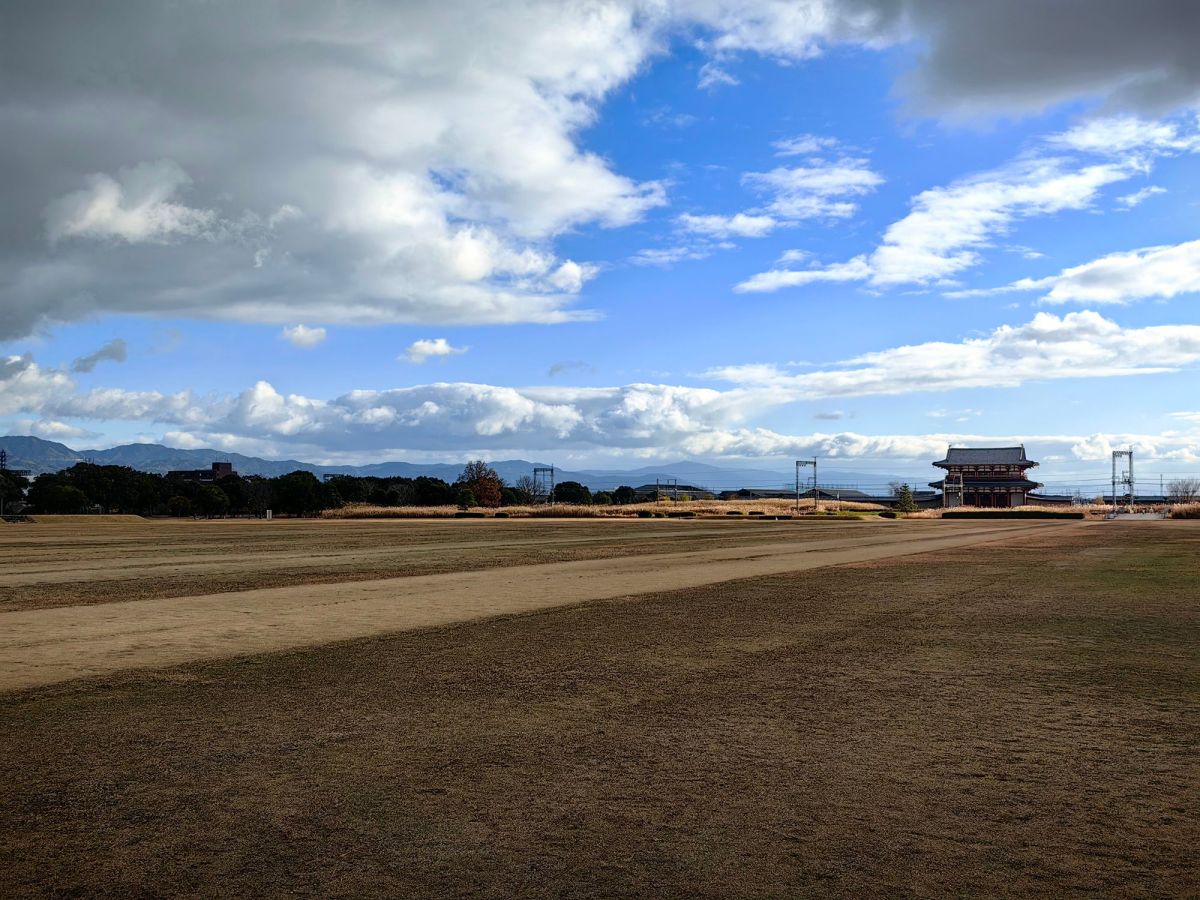
Here, there were broad expanses of grass and sky, with the remains and reconstructions of the ancient palace scattered across the former capital. There were few tourists. As I walked through the grounds, it was easy to imagine the imperial city that once stood here—the ceremonies, officials, and daily activities of a capital that flourished more than twelve centuries ago. Yet much of the original city has disappeared, leaving only traces beneath the open landscape. Perhaps this absence made the passage of time feel even more tangible.
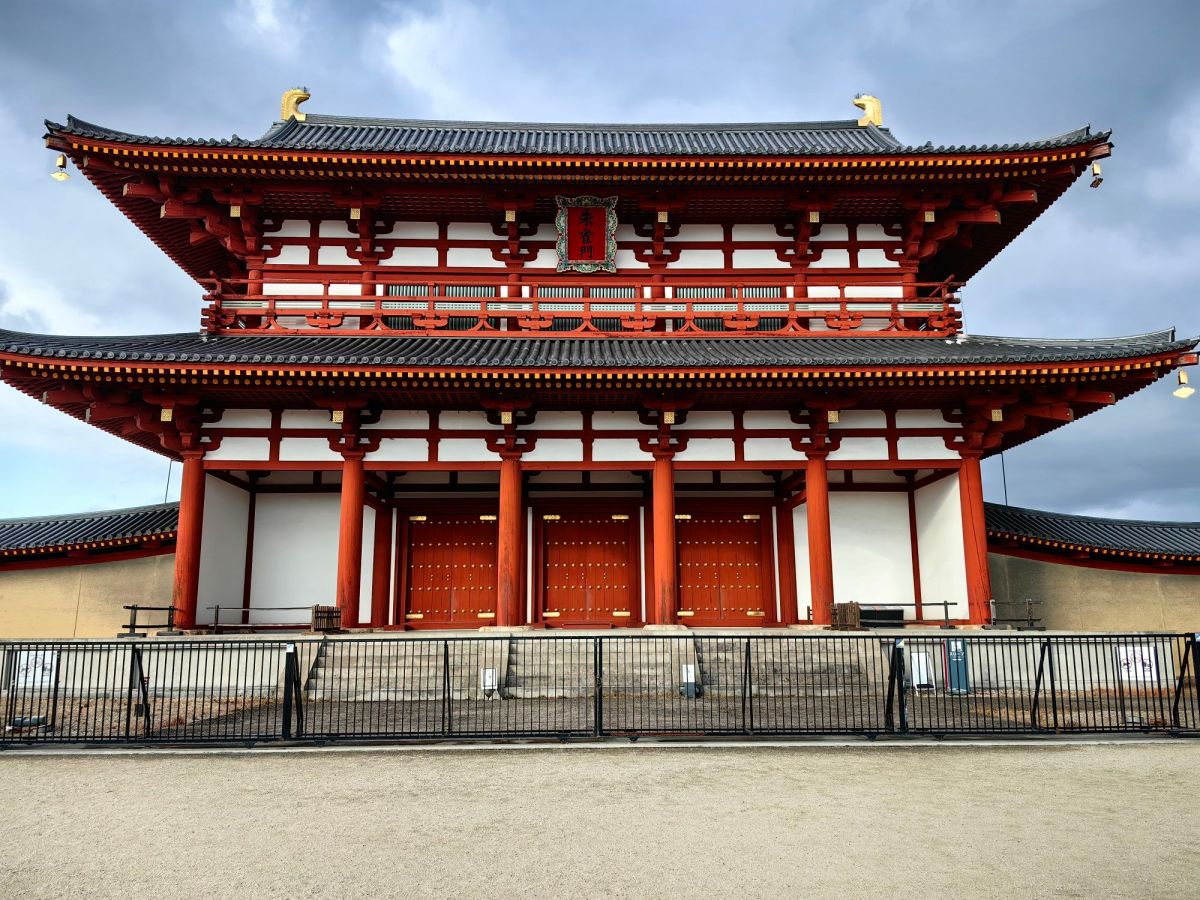
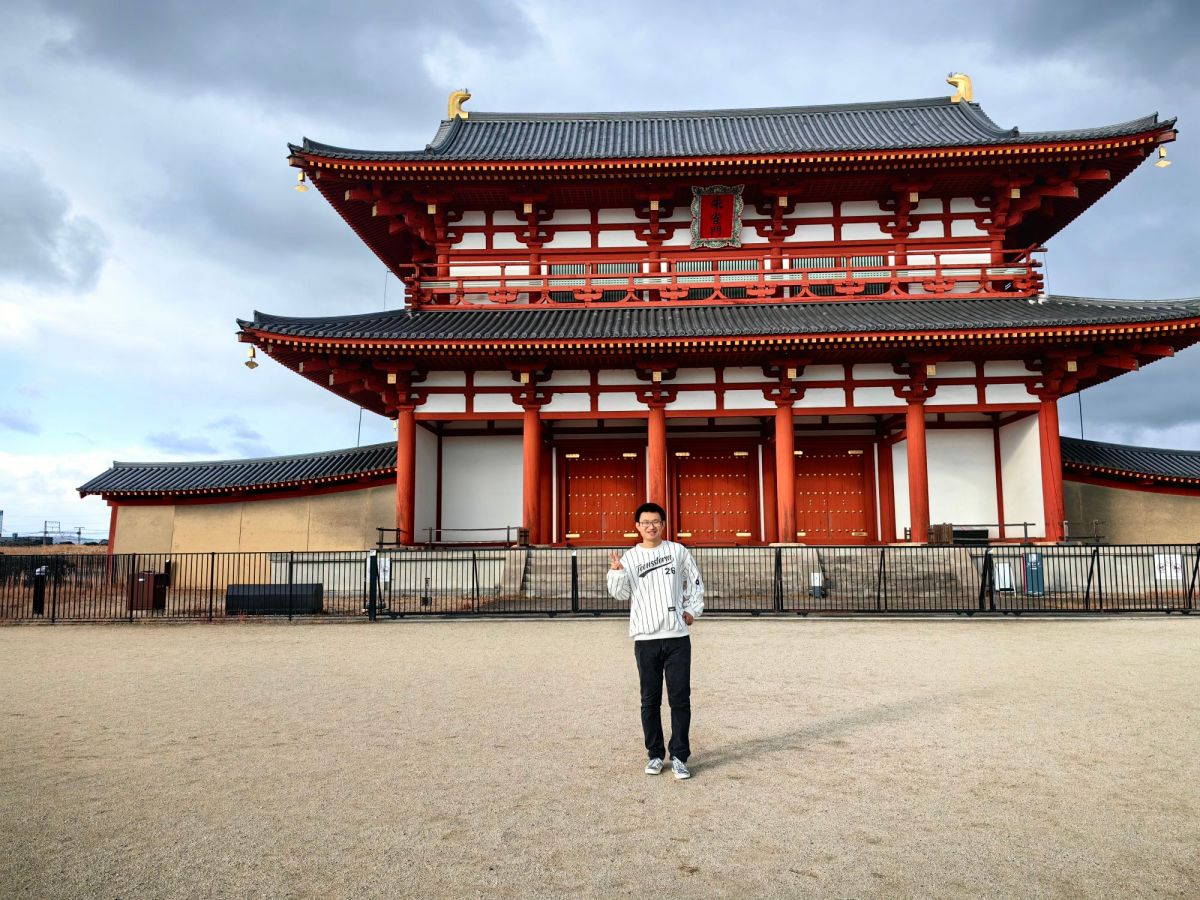
Standing before the magnificent Suzakumon Gate, I was reminded that Nara was once much more than an isolated Japanese capital. The gate was the southern main entrance to the Heijō Palace, opening onto Suzaku Avenue, the great north-south axis of Heijō-kyō. The avenue was once an enormous ceremonial road, about seventy metres wide, running straight through the ancient capital. The name itself carried a connection to China: 朱雀, “Vermilion Bird,” was the sacred creature associated with the south in the traditional East Asian cosmological system. More strikingly, the same name appeared in the great Tang capital of Chang’an, where Zhuque Avenue formed the city’s central north-south axis.
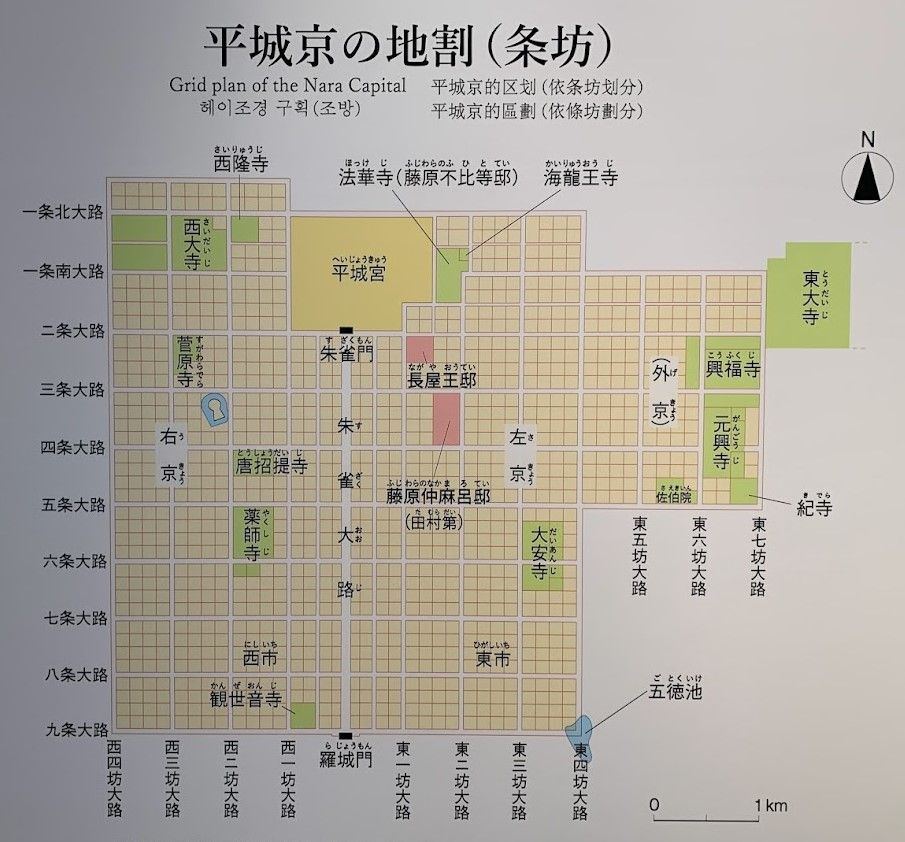
This is the map of Heijō-kyō which had been planned with Chang’an as one of its important models, adopting the continental idea of an orderly city arranged around a powerful central axis. From the map, I could see names of many famous attraction sites like Tōdai-ji, Toshodai-ji and Yakushi-ji. Standing before Suzakumon, I could therefore imagine the ancient avenue stretching straight ahead, with the palace behind the gate and the city unfolding symmetrically to either side. The connection becomes even more fascinating because Zhuque Avenue has not completely disappeared in China. In present-day Xi’an, the modern city still has a major thoroughfare called Zhuque Street, preserving the name and much of the historical north-south axis of Tang Chang’an.
This was one of the most fascinating moments of my journey: history was no longer something I had only read about in books. I felt as though two ancient capitals, separated by the sea, were briefly connected through a single name. More than twelve centuries ago, ideas of urban planning, architecture, government, and culture travelled from the Tang world to Japan. Today, the reconstructed gate in Nara and the surviving name of Zhuque Street in Xi’an offer two distant echoes of that extraordinary period of cultural exchange. This is what makes travelling to historical places so rewarding for me: a name, a building, or a street can suddenly bring something I once encountered in a history book to life. For a moment, the past no longer felt distant, and it was standing directly in front of me.
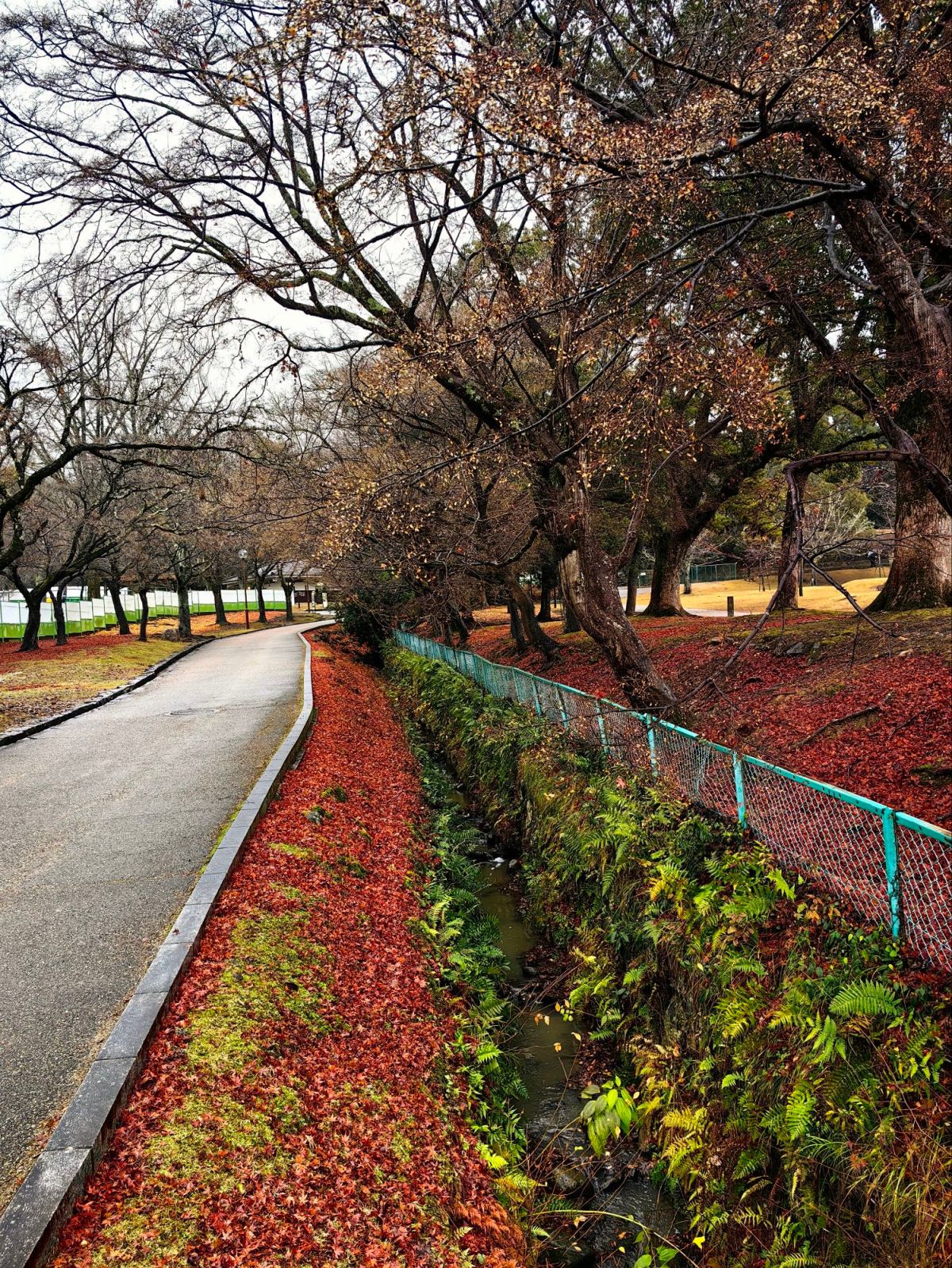
After completing a full day of exploring Nara, I still had some time before sunset, so instead of returning directly to my hotel, I wandered freely along the small lanes around the city. There was no particular destination and no need to follow a schedule. The narrow paths were lined with forests, with fallen red leaves scattered across the green grass and occasional patches of sunlight filtering through the trees. The late afternoon light softened the landscape.
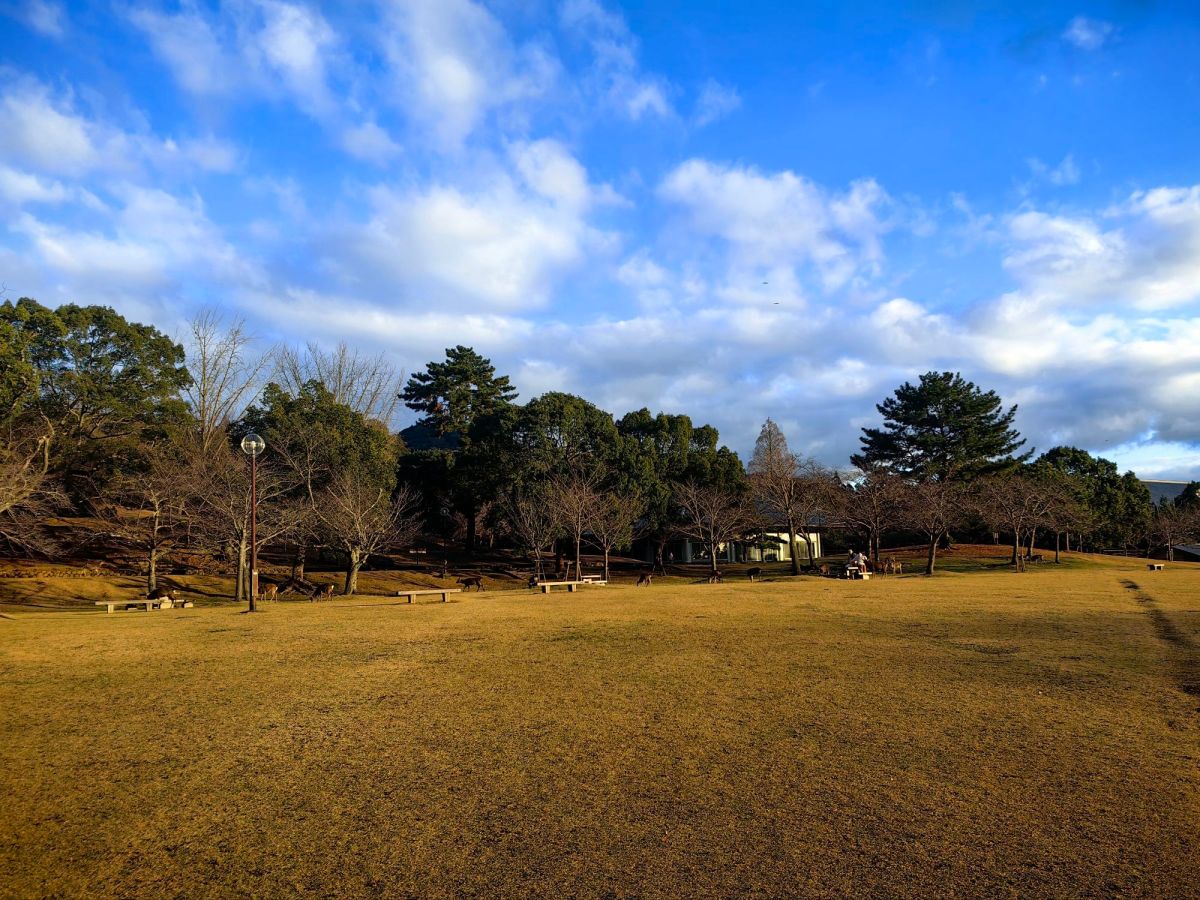
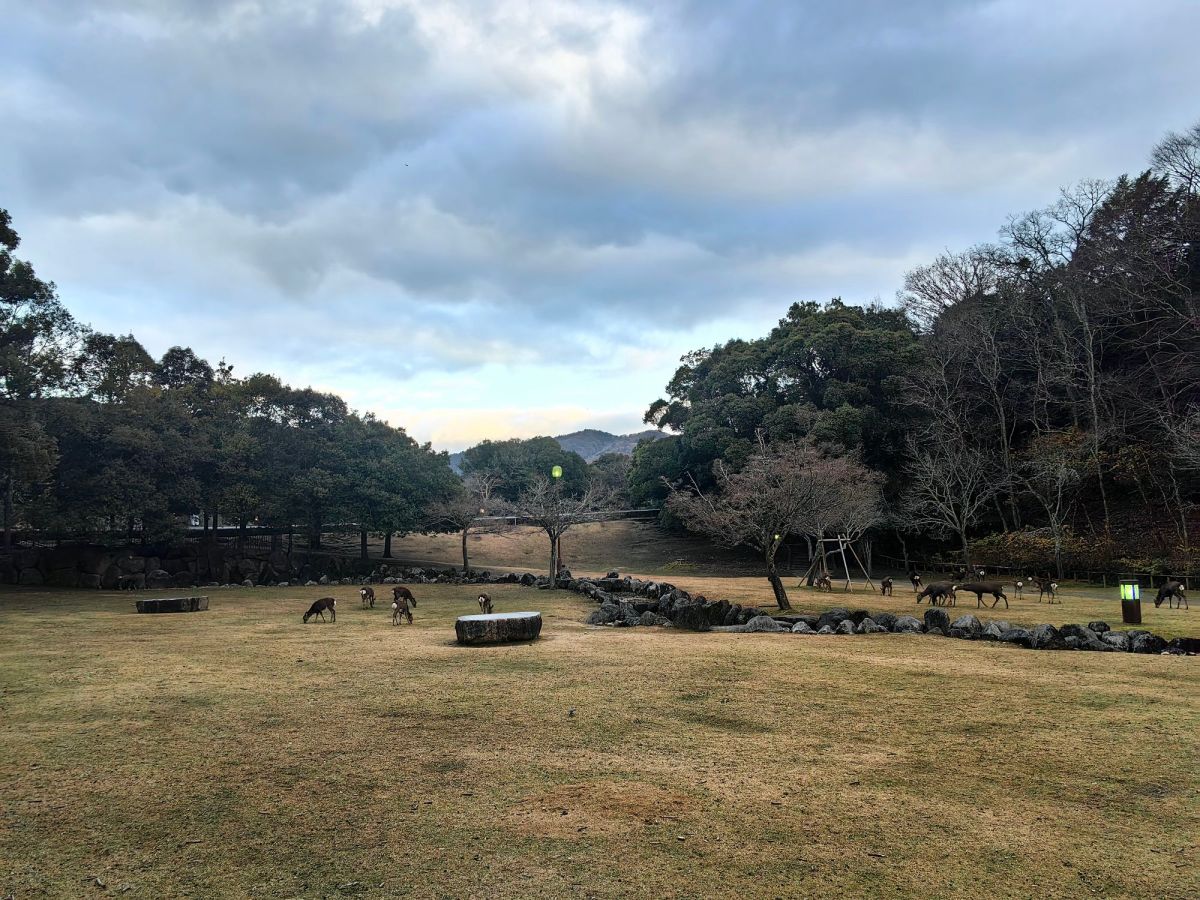
As the afternoon slowly gave way to sunset, many deer lay lazily on the grass, completely undisturbed by the people passing nearby. The soft evening light gradually illuminated the Noborioji park, casting a warm glow over the green landscape. In the distance, Mount Wakakusayama appeared faintly beyond the open fields, its gentle slopes partially hidden by clouds and the fading light of the sunset. I lingered there for a longer time. The deer resting on the grass, the open green space, the distant mountain disappearing into the clouds, and the quiet atmosphere created one of the most treasured moments of my journey through Japan. It was a rare feeling of being completely free and undisturbed, able to admire nature and let time pass without hurry.
Looking back on my journey, this quiet evening in the Noborioji Park left the deepest impressions on me. Nara had given me magnificent temples, ancient architecture, cute deer, and a remarkable sense of history, but it was perhaps this simple landscape at sunset that stayed with me most strongly. Among all the places I visited in Japan, Nara became my favorite. It is a place where history, natural environment, and everyday life seemed to exist together in perfect harmony.
After spending time in the lively streets of Osaka, I decided to take a break from the crowds and travel to Minoh, a peaceful town surrounded by forested hills just outside the city. Compared to the vibrant streets of Namba and Dotonbori, it felt like another world. My pace slowed, the air became fresher, and the city noise gradually faded away, replaced by the rustling of leaves in the wind and the tranquility of nature.
After I get off from the train, I arrived at this small town in the north of Osaka. What I particularly enjoyed about Minoh was its tranquility. Compared with Osaka’s famous tourist attractions, Minoh receives far fewer international travelers, and even the popular walking trail can feel surprisingly peaceful. There were moments when I could simply walk along the forest path without being surrounded by tour groups or crowds, but only the swaying shadows of the trees and the rustling sound of foot accompanying me.
The journey to Minoh was not about checking off famous landmarks. Instead, it was about enjoying the simple experience of walking through the forest, listening to the flowing water, watching the leaves move gently in the breeze, and taking my time to appreciate the scenery. Sometimes, the most memorable places on a journey are not the ones filled with people, but the quiet ones where I can slow down and truly feel my surroundings.
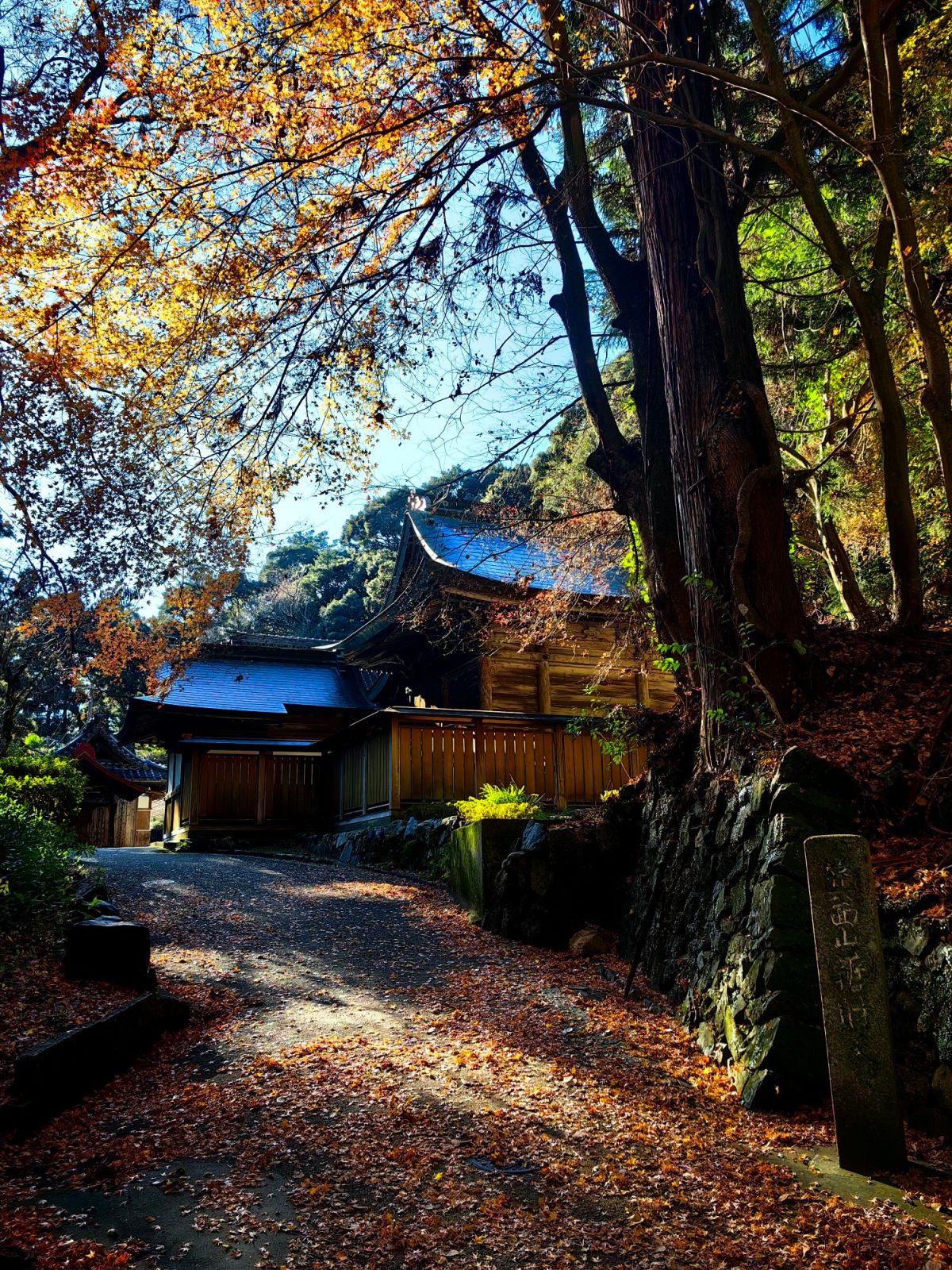
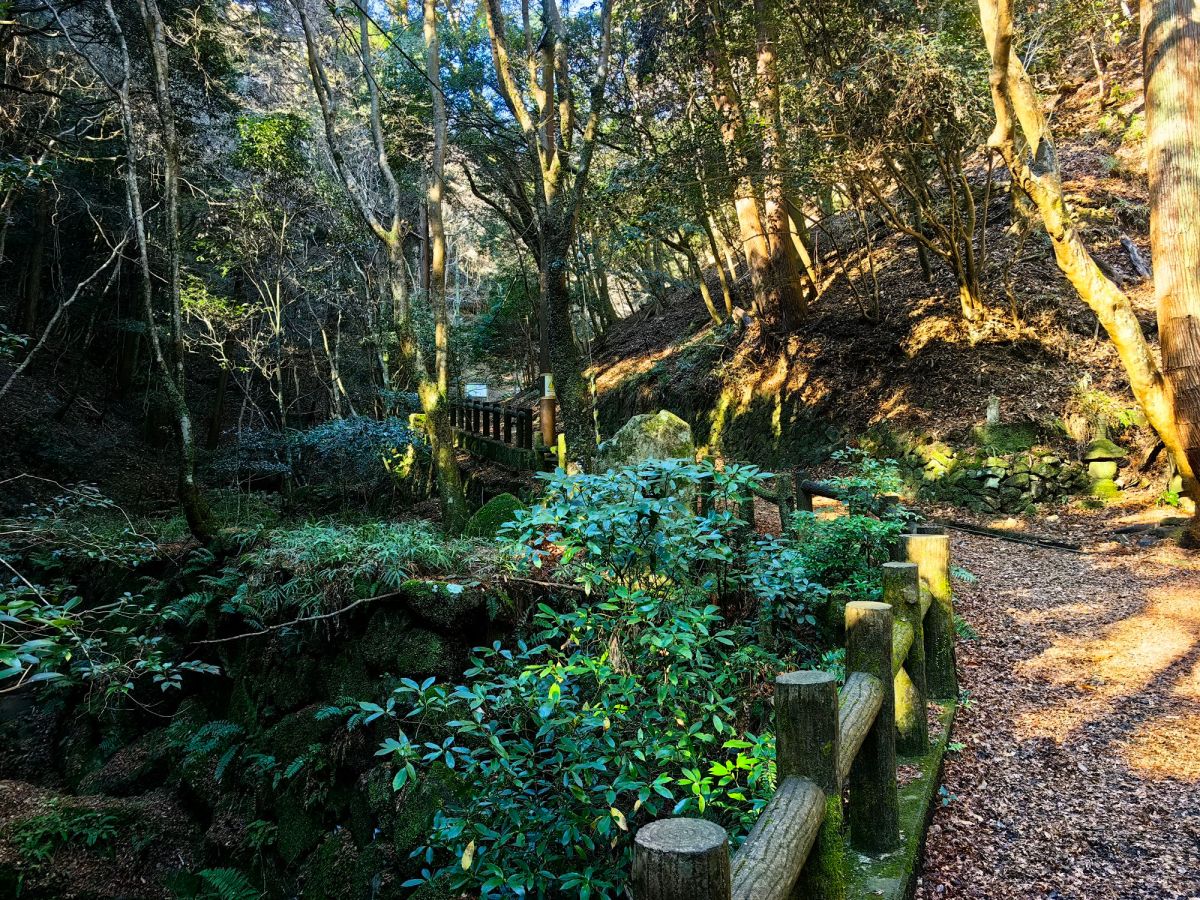
By December, I had already missed the best time to see Minoh’s famous maple leaves. The brilliant reds and oranges of autumn had largely disappeared from the trees, leaving only memories of the season that had just passed. The ground was covered with a thick carpet of fallen leaves, their faded reds, oranges and browns scattered across the forest path.
The December morning was a little cold. I could feel the crispness of winter in the air, but the sunlight was warm. Golden rays filtered through the remaining green leaves above me, falling softly onto the path and warmed my face. Looking down at the leaves beneath my feet, I felt that each step made a soft, gentle sound, as if the forest was quietly accompanying my walk. Without the crowds of the autumn season, I could walk slowly and listen to the water, the rustling leaves and the occasional sound of birds.
As I walked through Minoh Park, I passed several old temples that were quiet and almost empty, with very few tourists around. The peaceful surroundings made the journey feel unbothered and unhurried. Being able to walk alone through the temples and forest gave me a sense of solitude and allowed me to fully appreciate the beauty of nature.
Hidden deep within the forest, the ancient temple seems to belong to an isolated world. The weathered wooden beams, etched by time, stood silently beneath the pale winter sky. Moss-covered stones were scattered throughout the woods, quietly disappearing into the dense undergrowth. A thin mist swirled among the treetops and blurred the boundary between heaven and earth, immersing the entire forest in a tranquil and mysterious atmosphere.
I walked all through the main walking route follows the Minoh River through the forest. The path was gentle and enjoyable, making it possible to appreciate the scenery without the feeling of a difficult mountain hike. Along the way, the sound of running water accompanied the walk, while tall trees created a cool and refreshing canopy overhead.
Along the forest trail in Minoh Park, there is a remarkable giant rock known as Himeiwa. Unlike an ordinary boulder, Himeiwa looks as though it has been dramatically cut in half by a giant blade. A narrow passage runs between the two enormous pieces of rock, just wide enough for a person to squeeze through. There is also a charming local belief associated with Himeiwa. Passing through the narrow opening is traditionally said to bring the blessing of children, giving the rock a spiritual meaning beyond its unusual appearance.
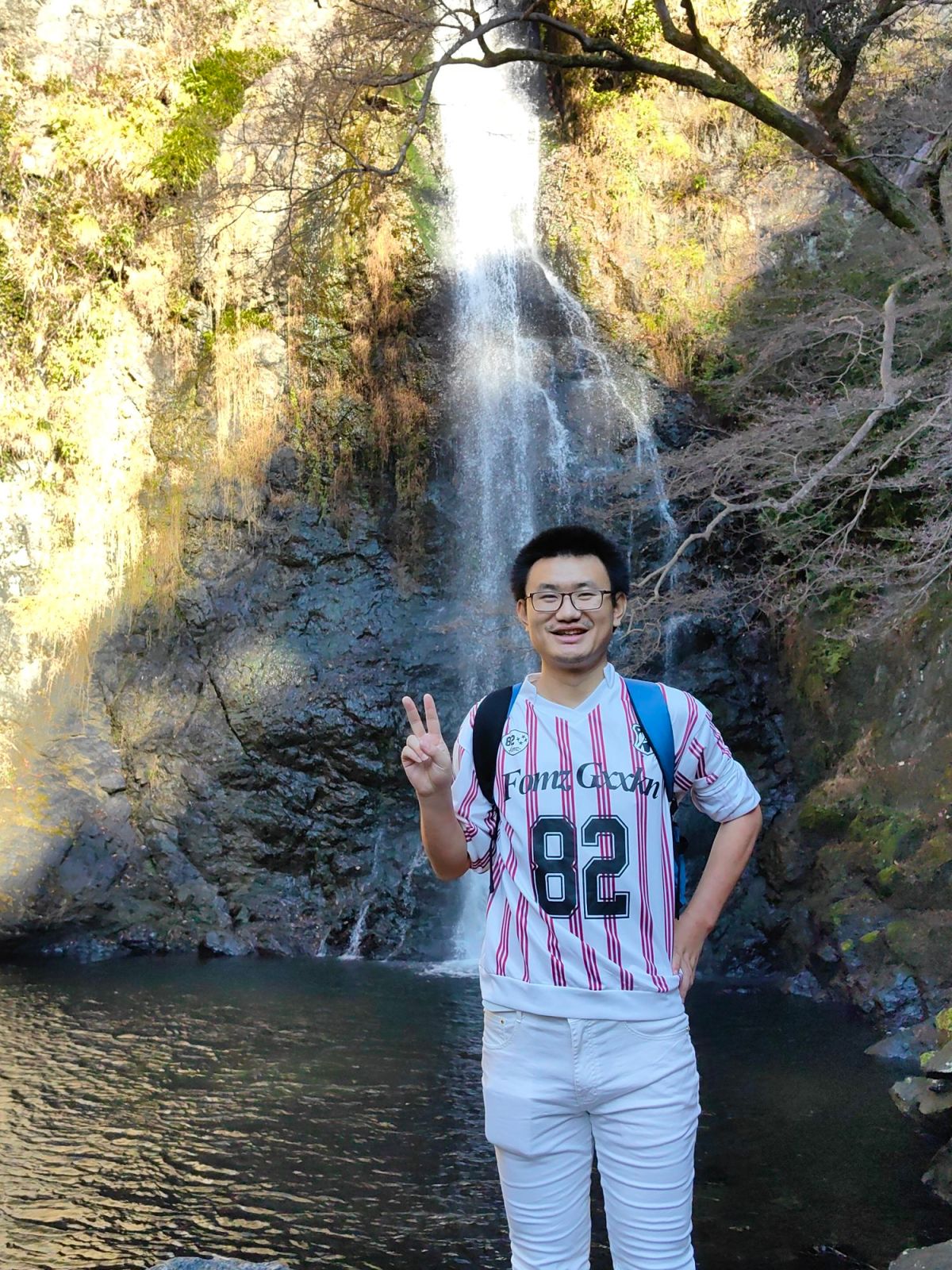
One of the highlights of Minoh Park is Minoh Waterfall, a beautiful 33-metre cascade at the end of the trail. The waterfall is especially impressive after walking quietly through the forest for some time. It is not an enormous waterfall, but its setting makes it particularly beautiful. Surrounded by tall trees and steep forested slopes, the falling water was perfectly integrated into the landscape rather than standing apart from it. I stood there for a while, listening to the continuous sound of water falling over the rocks. The walk through the forest made the waterfall feel like a natural reward at the end of the trail.
After spending some time at Minoh Waterfall, I continued my journey toward Katsuoji Temple, one of the most famous temples in the Minoh area. Instead of returning along the same forest trail, I climbed up from the steps of waterfall toward the main road. The change in scenery was gradual. The narrow forest path gave way to a wider mountain road lined with tall trees. The road gradually led me deeper into the mountains toward Katsuoji. Although the walk was uphill in places, I enjoyed taking my time and appreciating the changing landscape.
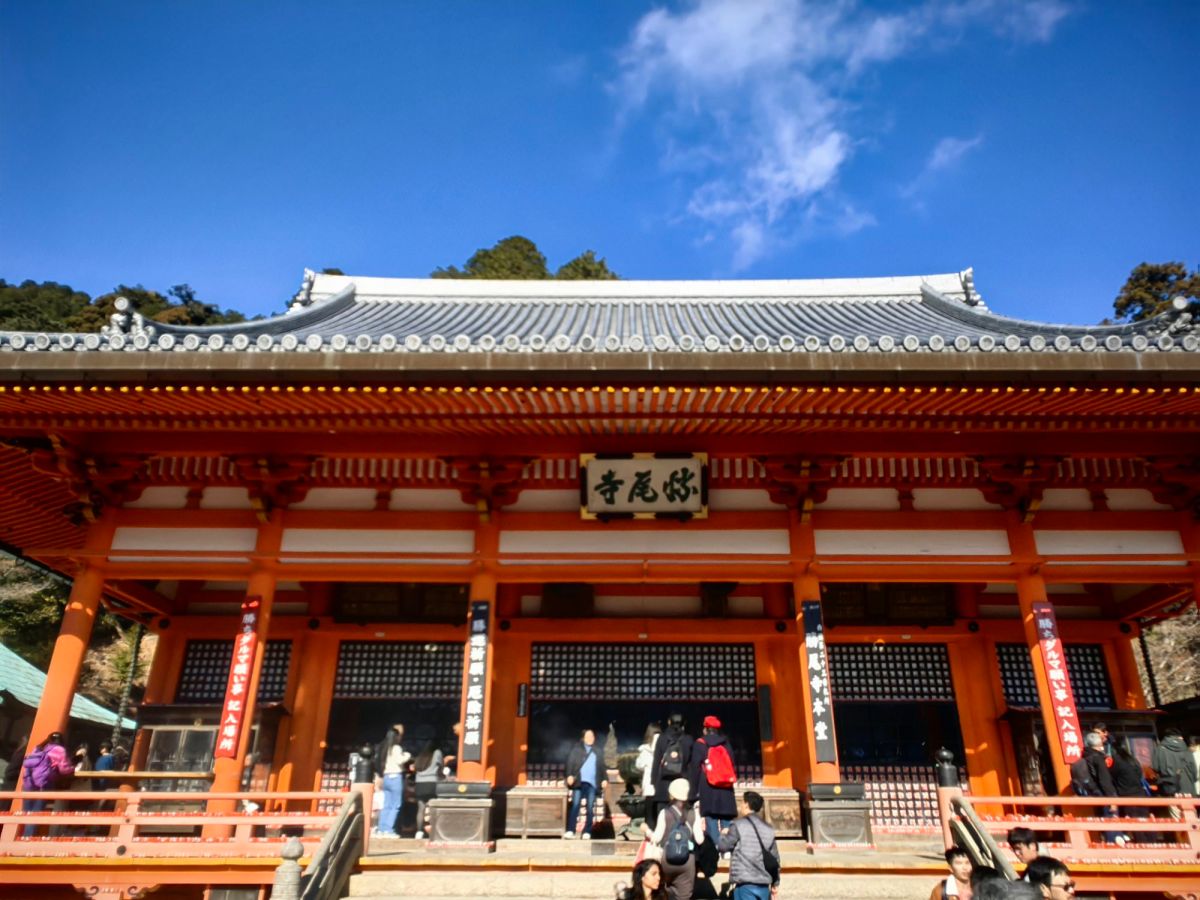
Eventually, I arrived at the Sanmon of Katsuoji Temple, famous for its thousands of Daruma dolls and its long history of being associated with victory and good fortune. Surrounded by dense forest and carefully landscaped gardens, the temple felt peaceful and secluded, despite being one of the best-known places to visit in the Minoh area.
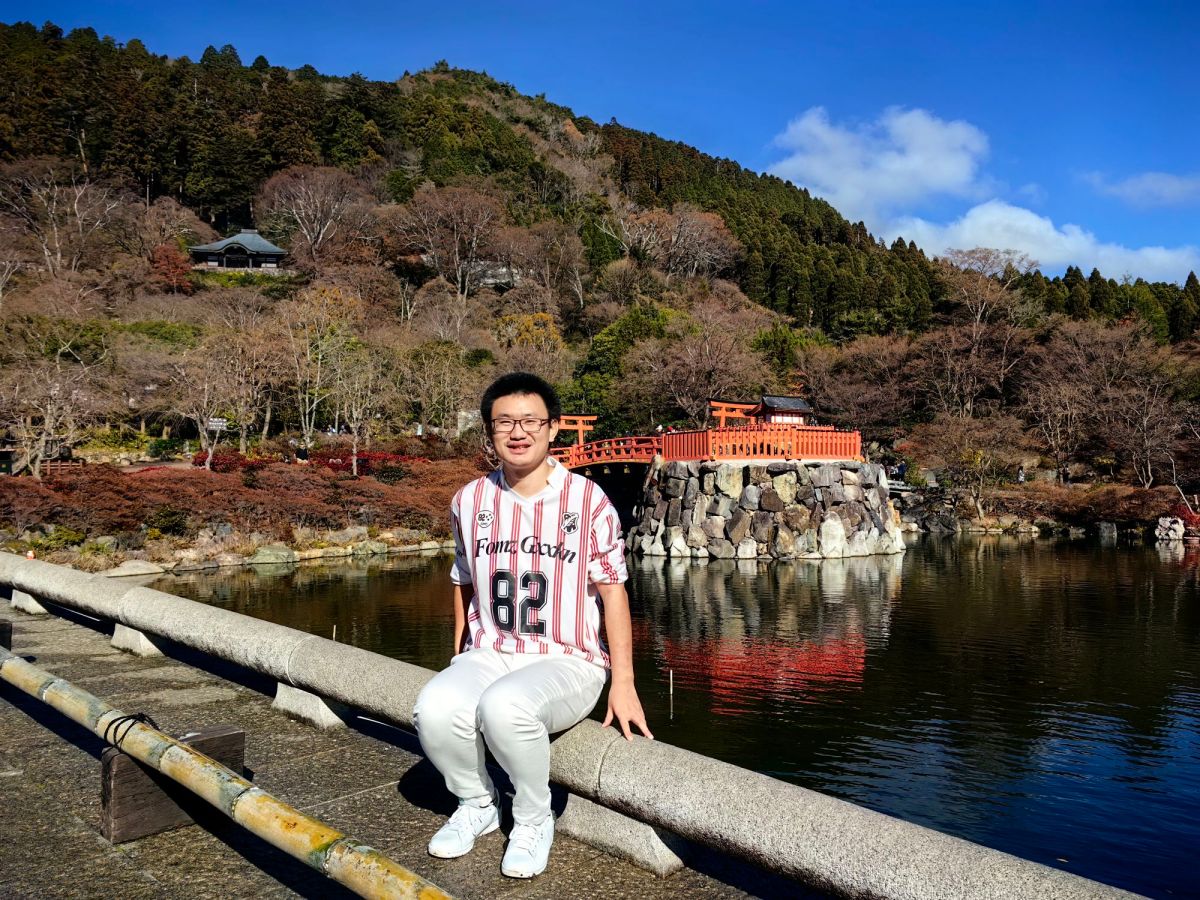
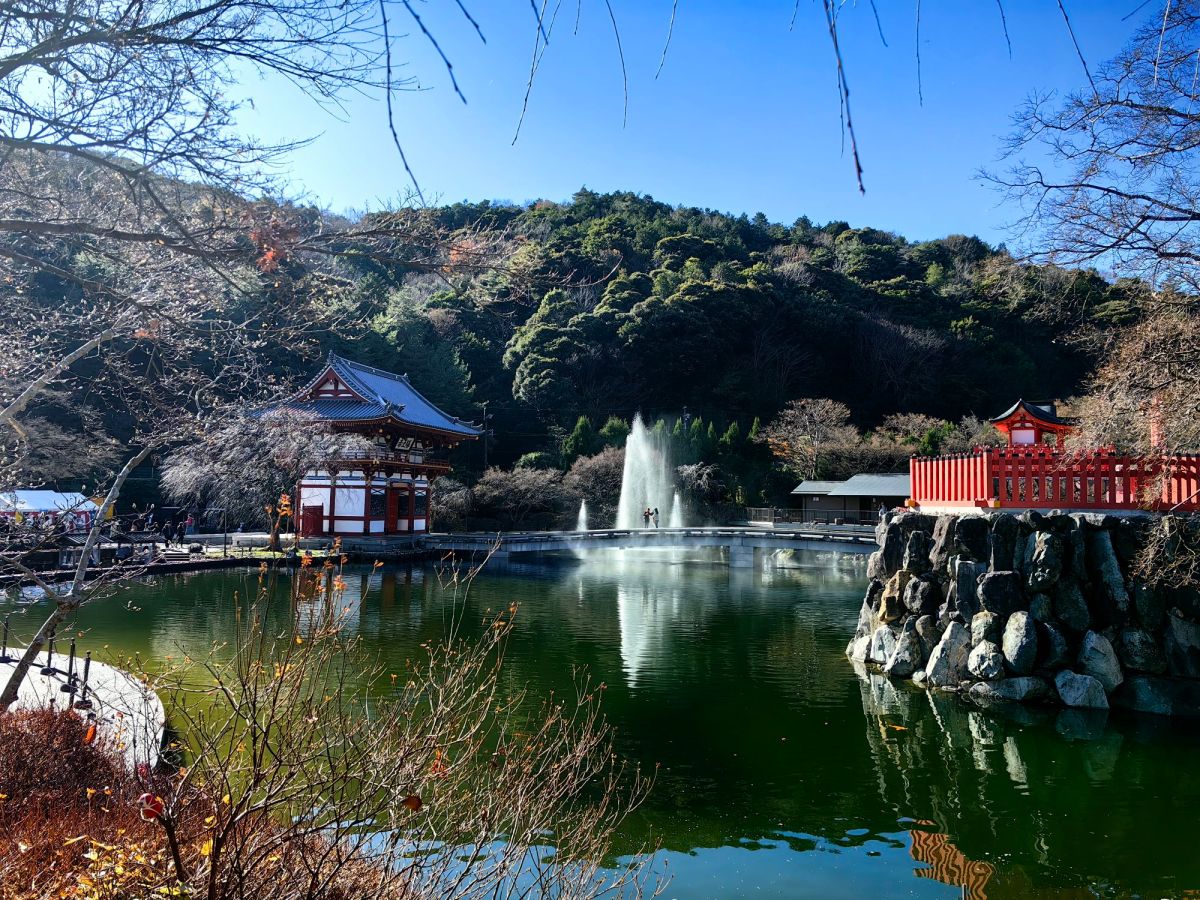
Ponds, bridges, stone paths and carefully maintained gardens blend naturally with the forested mountains. In December, the atmosphere was particularly peaceful. Many of the maple leaves had already fallen, covering the ground with a layer of autumn color. According to temple tradition, the temple was founded in 727 by two brothers, Zenchū and Zensan, who built a small hermitage in the mountains. The temple’s connection with victory also has an interesting origin. During the reign of Emperor Seiwa, the emperor was seriously ill, and prayers were offered at the temple for his recovery. According to tradition, the emperor eventually recovered, and the temple’s spiritual power became associated with victory and overcoming difficulties.
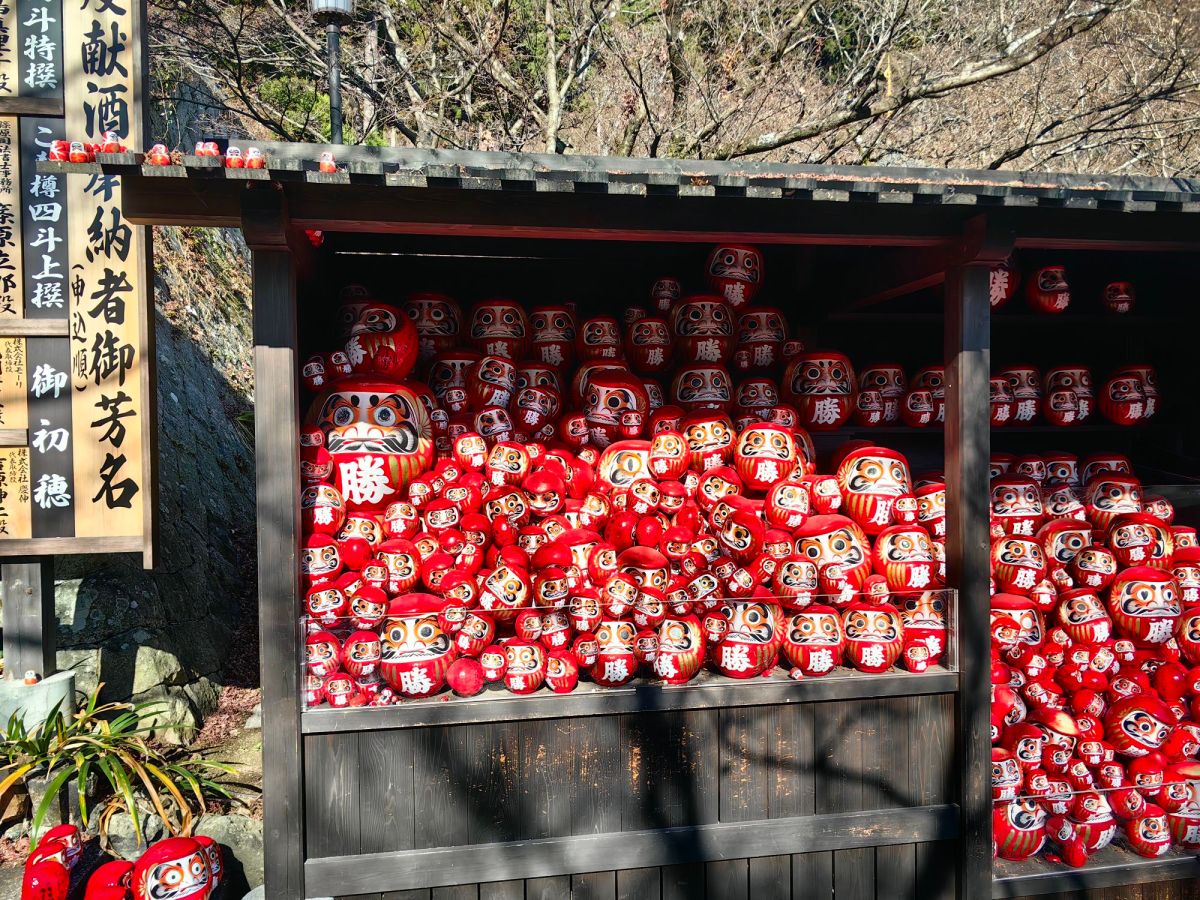
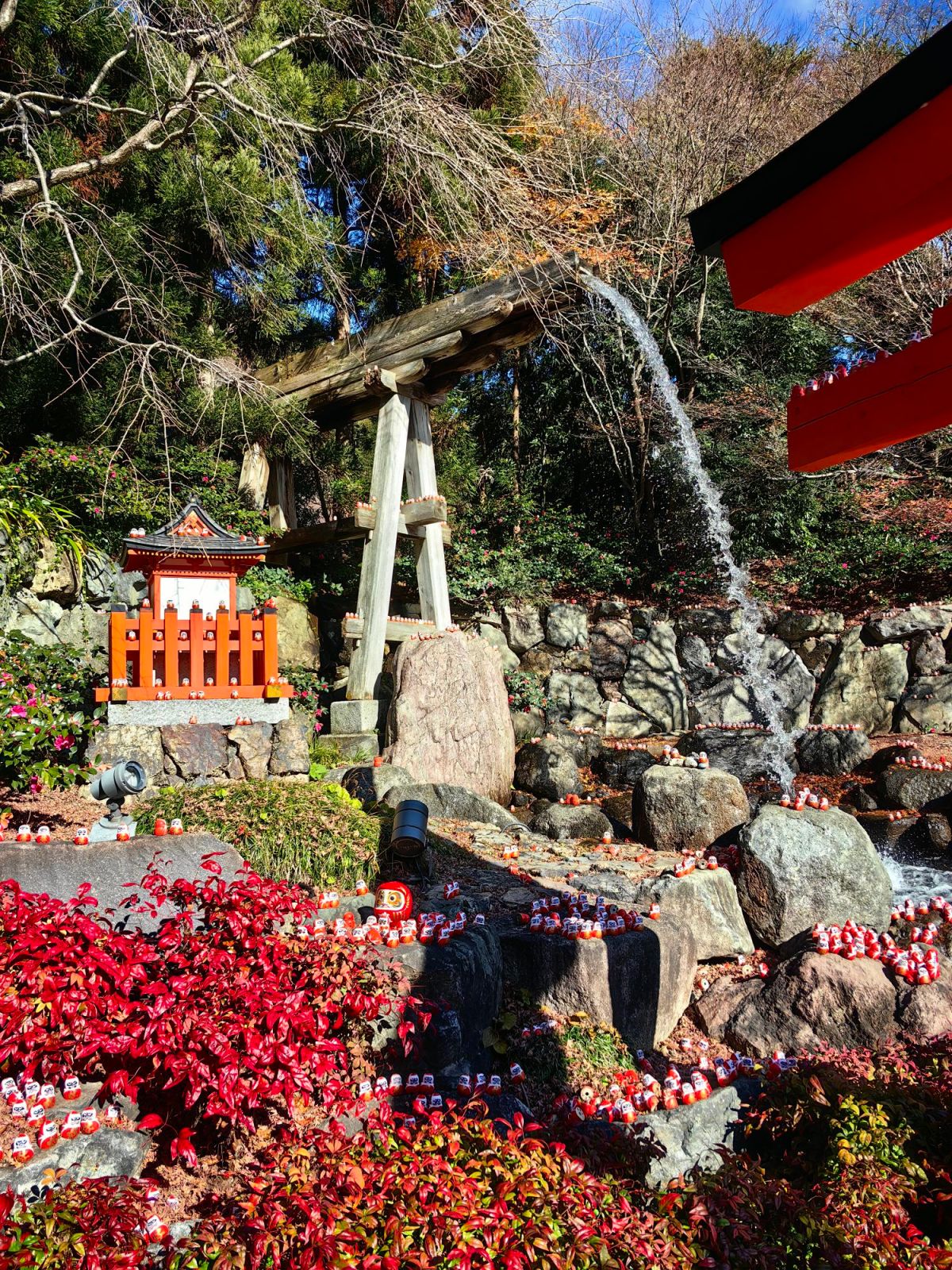
What immediately caught my attention was the extraordinary number of Daruma dolls throughout the temple grounds. These traditional Japanese dolls are symbols of determination and perseverance. Their round bodies and striking faces can be seen sitting on steps, beside pathways, on shelves and among the gardens. Some are large and impressive, while others are tiny enough to fit in the palm of a hand. Walking through the temple grounds felt almost like entering a world of Daruma. Instead of seeing just a few traditional ornaments, I encountered them everywhere I looked. Their presence gave the temple a playful character that contrasted beautifully with its quiet mountain setting.
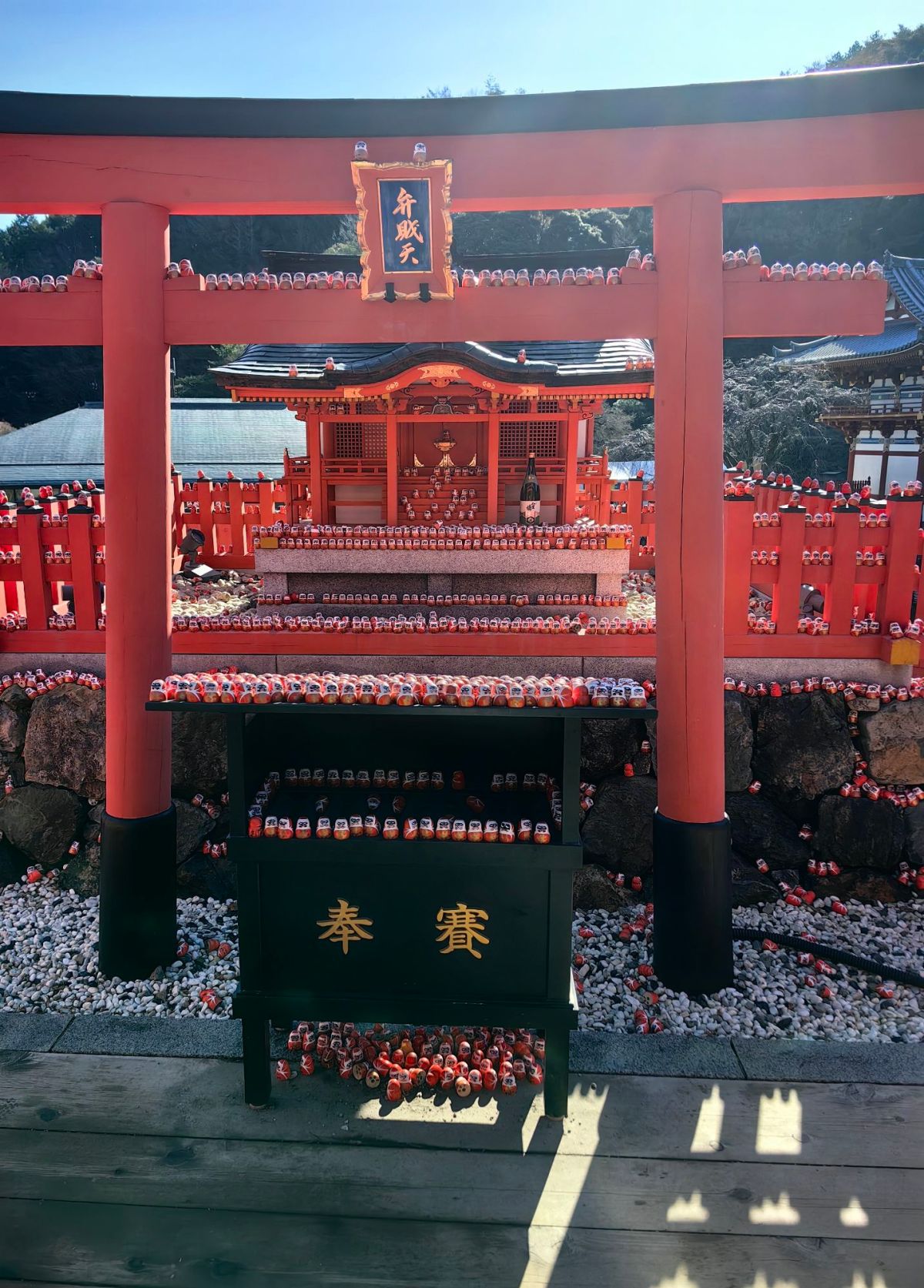
The Daruma has large eyes, thick eyebrows and moustache which are traditionally associated with Bodhidharma (Daruma). At Katsuoji Temple, it has a special connection with the temple’s reputation for victory and success. Visitors often buy Daruma when praying for success in an examination, or a competition. What makes Katsuoji particularly fascinating is the sheer number of Daruma scattered throughout the temple grounds. Visitors offered Daruma in designated areas, so the dolls gradually accumulate across the gardens, steps and temple buildings. This creates a very distinctive scene: hundreds or even thousands of red Daruma seemingly watching over the temple from every corner. It is one of the things that makes Katsuoji unlike most other traditional temples in Japan.
One of the other things that caught my attention at Katsuoji was the vivid red colour of its traditional architecture. Against the deep green of the surrounding mountains, the vermilion buildings, gates and bridges stood out with remarkable intensity, creating a scene that felt both elegant and almost dreamlike. I particularly enjoyed the way Katsuoji combines architecture with nature. The buildings are not isolated monuments surrounded by concrete; they are woven into the mountains, gardens, ponds and forests.
Among the rocks and greenery, I noticed a miniature vermilion shrine surrounded by red railings. A series of bright red traditional torii gates led toward it, creating a striking contrast with the natural landscape. This was Benzaiten Shrine, dedicated to Benzaiten, a deity associated with water, wisdom, music and the arts. I have found many similar things in the garden. Torii are traditionally associated with Shinto shrines, while Katsuoji itself is a Buddhist temple. Historically, however, Buddhism and Shinto were deeply intertwined in Japan for centuries. Before the Meiji period, it was common for Buddhist temples to contain Shinto shrines and for Buddhist and Shinto practices to coexist.
Benzaiten has a fascinating origin. She developed in Japan from Saraswati, an ancient Indian goddess associated with water, knowledge, music and the arts. When Buddhism spread to Japan, this deity was incorporated into Japanese religious traditions and gradually took on additional associations. She is worshipped in many different forms across Japan. Some places have grown into large religious complexes devoted to her, while other, like this little shrine at Katsuoji, was simply a small sacred corner within a much larger temple.
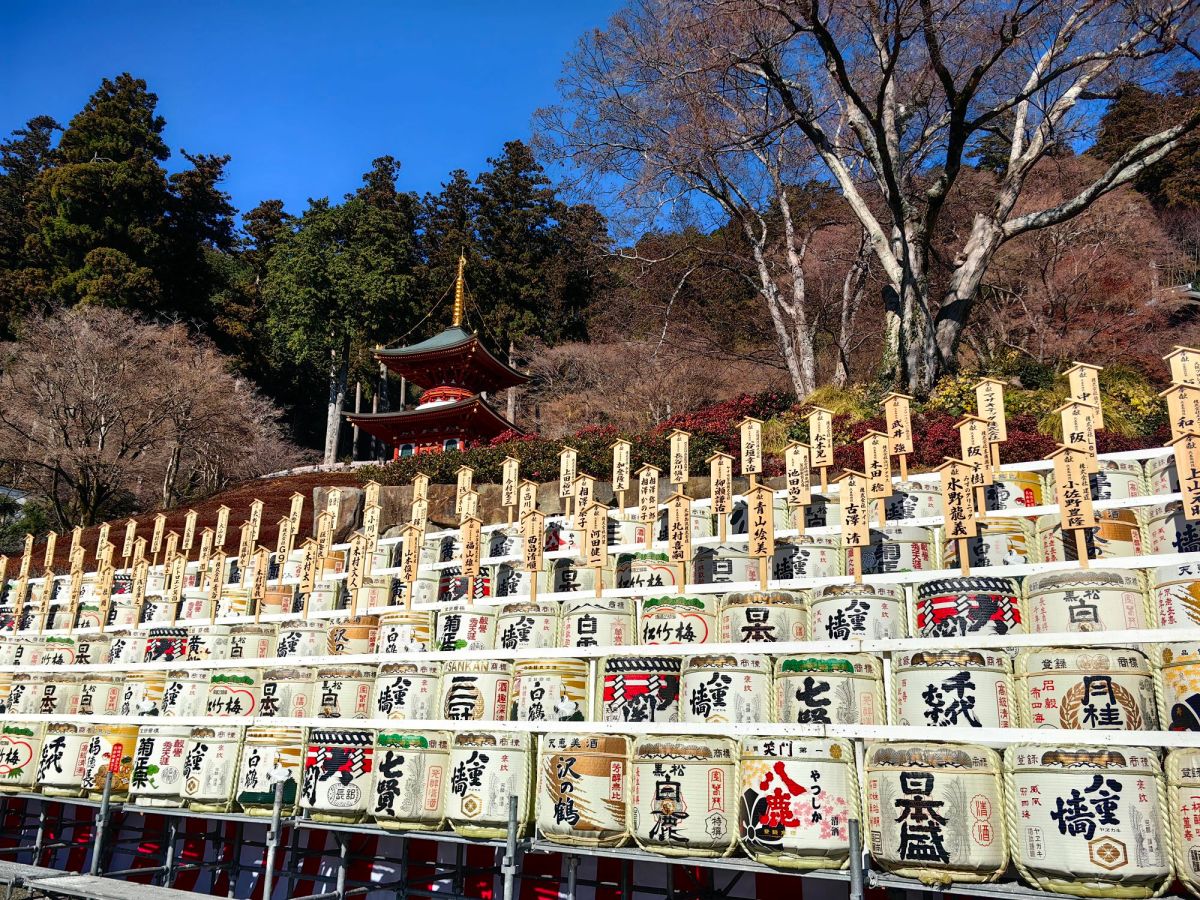
As I walked through Katsuoji, I came across a remarkable display of sake barrels stacked in rows along the hillside. Each barrel carried different Japanese characters, names and colorful logos, representing different sake breweries and producers. These were not simply decorations; sake has long played an important role as a religious offering in Japan, and breweries often donate sake to temples and shrines. The scene was particularly striking at Katsuoji. Hundreds of barrels formed a wall of white, black and red, while the elegant vermilion pagoda rose above them among the trees. This creates a scene with a distinctly Japanese character.
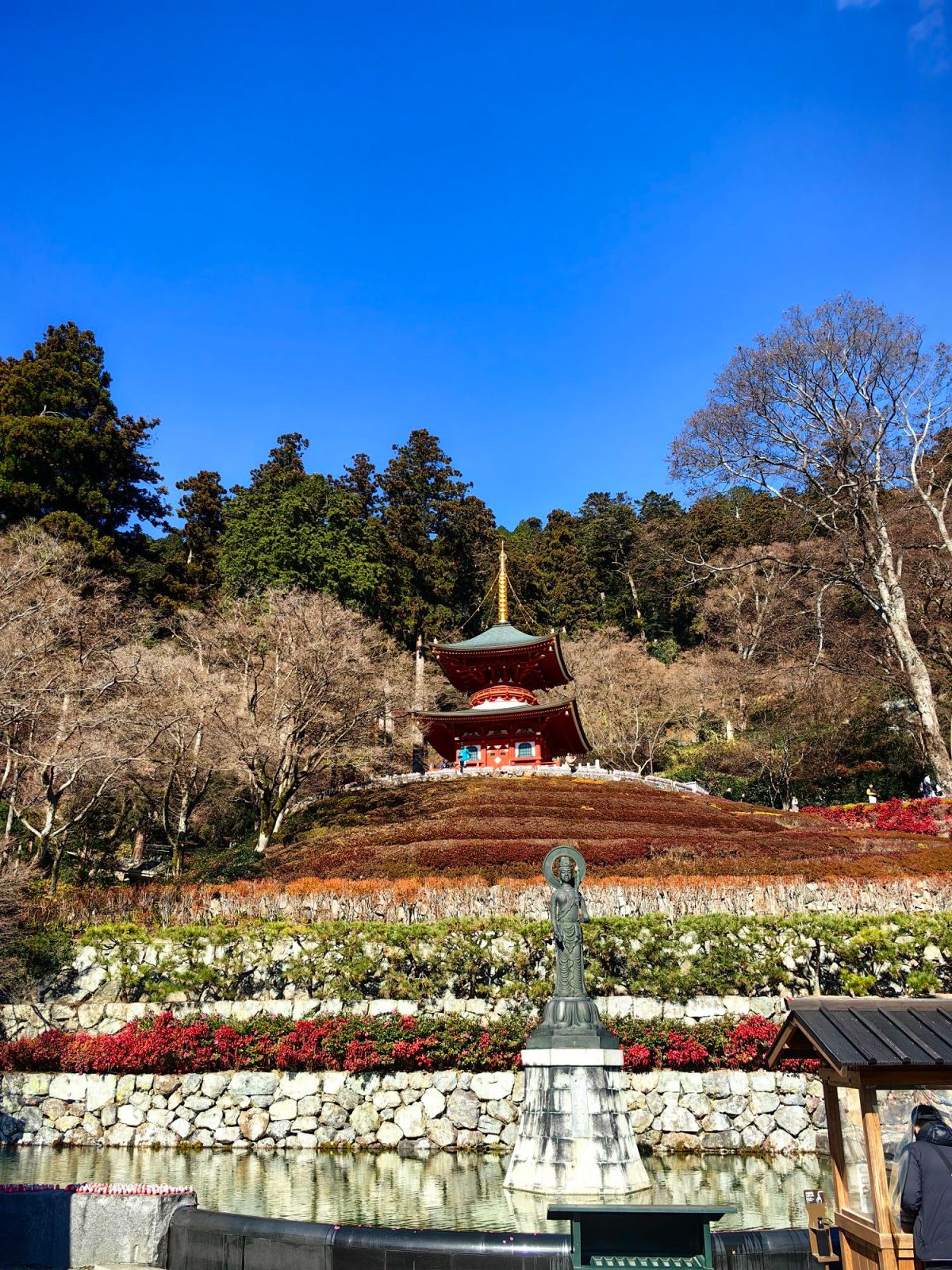
The pagoda called Tahōtō originated in ancient India as the stupa, a structure associated with the Buddha and used to preserve sacred relics. As Buddhism spread through Asia, the stupa gradually evolved into different architectural forms. Japanese pagodas are usually built with three or five storeys, with the five-storey pagoda being particularly iconic. The number five has Buddhist and cosmological significance, traditionally representing the five elements: earth, water, fire, wind and space.
During my trip, I noticed a series of unusual stone towers standing beside the old pilgrimage route. These were Gorintō, not simply memorial stones but Chōishi, distance markers for pilgrims and it shew directions for the pilgrims. The oldest surviving ones date back to 1247, to the Kamakura period. Standing beside them with hundred years history, I imagined the pilgrims who had walked this same route more than seven hundred years ago. They would have passed these stones one by one like me. The stones therefore felt like more than historical objects. They were silent witnesses to generations of journeys, prayers and footsteps.
In this temple, I have seen many ancient-looking Buddhist monuments. A weathered stone pagoda rose on one side, while a tall inscription pillar stood like a silent marker beside the path. The large structure on the left is a stone pagoda, built in the traditional Buddhist architectural form. It has multiple levels with projecting roofs, giving it the appearance of a miniature stone version of pagoda. It is quite different from the Tahōtō behind it. The large stone pillar is an inscription monument with the Japanese name of the mountain Ocho-san (応頂山) and the Japanese name of the temple Katsuō-ji(勝尾寺). Japanese character is similar to the Chinese character even I don’t know any Japanese but I could still recognize them. This sense of familiarity that transcends language and culture makes my travels particularly enjoyable.
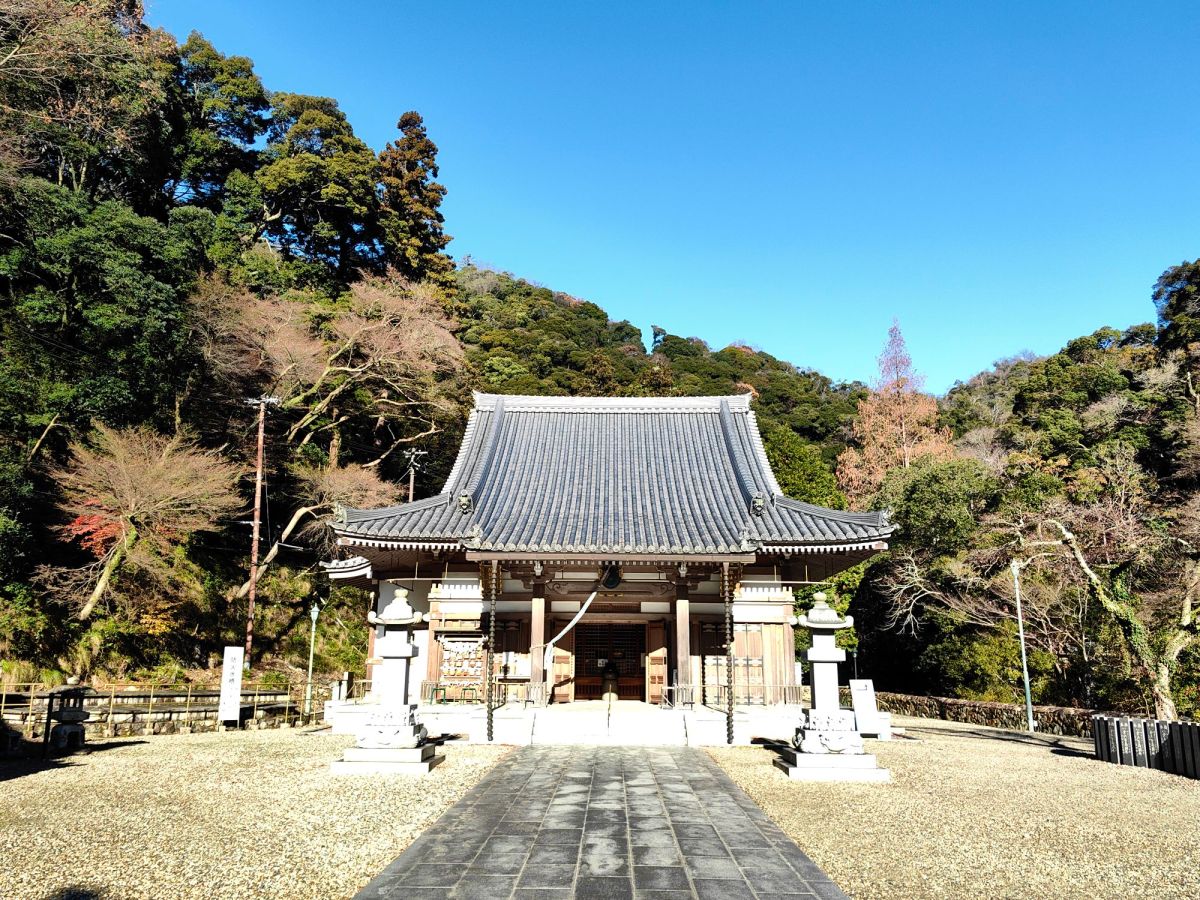
The Hondō(main hall) of Katsuō-ji is a traditional wooden Buddhist main hall characterized by its broad tiled roof, deep eaves, and simple wooden structure. The structure is mainly natural wood, with dark brown and muted tones that blend into the mountain setting. Many people visit the Hondō to pray for success, good fortune, and the fulfillment of their wishes. Standing in front of it, I could feel a solemn and peaceful atmosphere.
In winter, Katsuō-ji offers a peaceful panoramic view of the surrounding mountains and forests. The bare trees and evergreen foliage create a quiet, subdued landscape immersed in the clouds, giving the scenery a calm and misty appearance. From the elevated temple grounds, I could appreciate the beauty and tranquility of the winter mountains.
After leaving Katsuō-ji, I stopped at a small local restaurant and had unadon for lunch. The dish consisted of tender grilled eel served on a bowl of warm, fluffy rice and covered with a rich, sweet and savory sauce. The plating of the Japanese food was beautifully arranged and visually appealing. It looked simple, but I could feel the chef’s attention to details. The ingredients were carefully placed in the dish, creating a balanced combination of colors, textures, and shapes. The eel had a slightly smoky flavor from the grilling, while the sauce added a delicious balance of sweetness and saltiness. The simple presentation and cozy atmosphere of the small restaurant made the meal feel especially authentic and comforting after visiting the temple.
By the time I returned to Osaka, I felt refreshed by my brief escape to Minoh. Although it was only a short journey, the quiet forests, mountains, hidden temples, and crisp winter air created a peaceful distance from the bustle of the city. Walking alone through the tranquil landscape, pausing at old temples, enjoying the scenery and a simple Japanese meal, I found myself slowing down and appreciating the moment. Minoh reminded me that a journey does not have to be long to be meaningful; sometimes, a few hours surrounded by nature are enough to relax, clear the mind, and continue my jourmey with a renewed sense of calm.
In December 2025, I embarked on my very first journey to Japan. For years, I had dreamed of exploring a country where ancient traditions coexist with cutting-edge modernity, and the Kansai region was the destination I chose to begin that dream. As the largest city in western Japan and the gateway to the Kansai region, Osaka was the perfect introduction to the country and was the perfect place to experience my first glimpse of Japan. when I arrived, the city welcomed me with its vibrant energy, dazzling streets, and warm, down-to-earth atmosphere.
On 19 December 2025, I arrived at Osaka’s Kansai International Airport, the gateway to my first journey in Japan. Even before stepping outside the terminal, the airport itself left a lasting impression. Built entirely on a man-made island in the heart of Osaka Bay, it appears to rise gracefully from the sea, surrounded by water in every direction. As the aircraft began its descent, I gazed out of the window and watched the long, slender runway emerge from the shimmering bay, linked to the mainland by a bridge that seemed to stretch endlessly across the water.
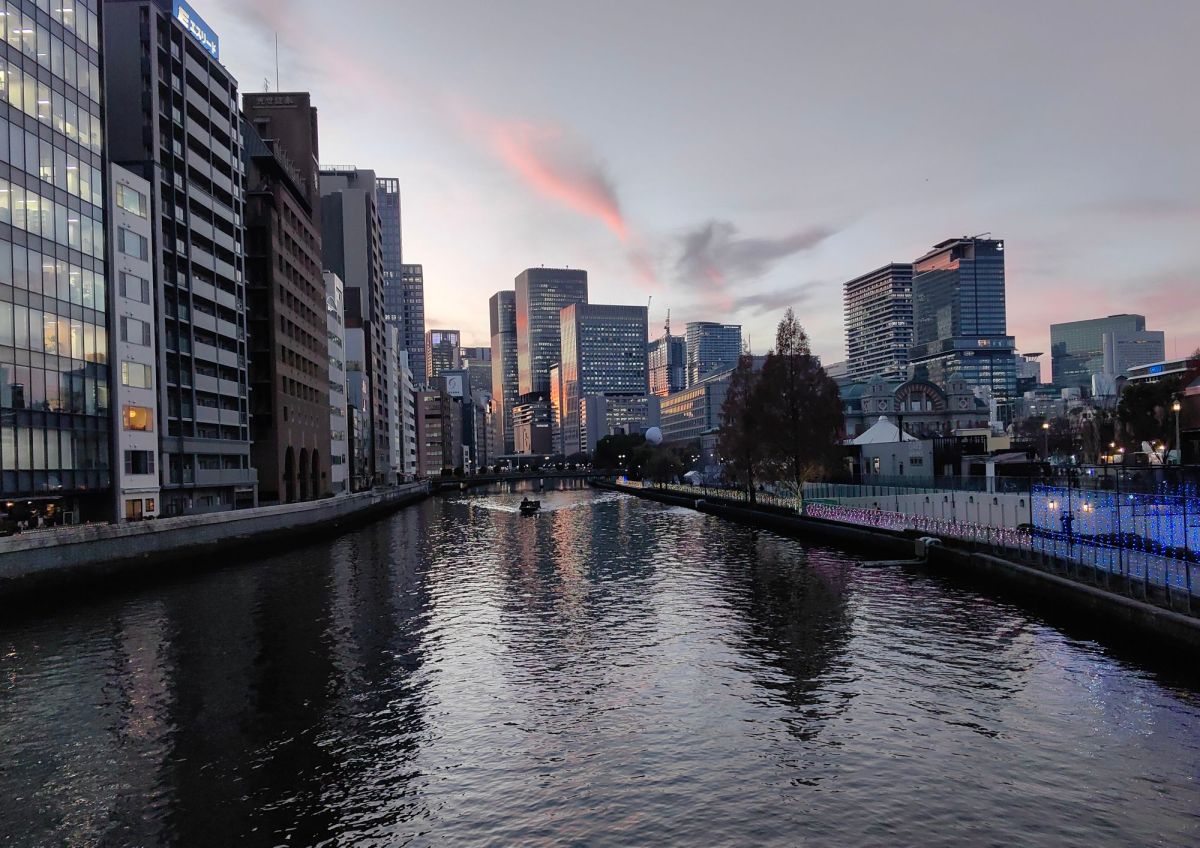
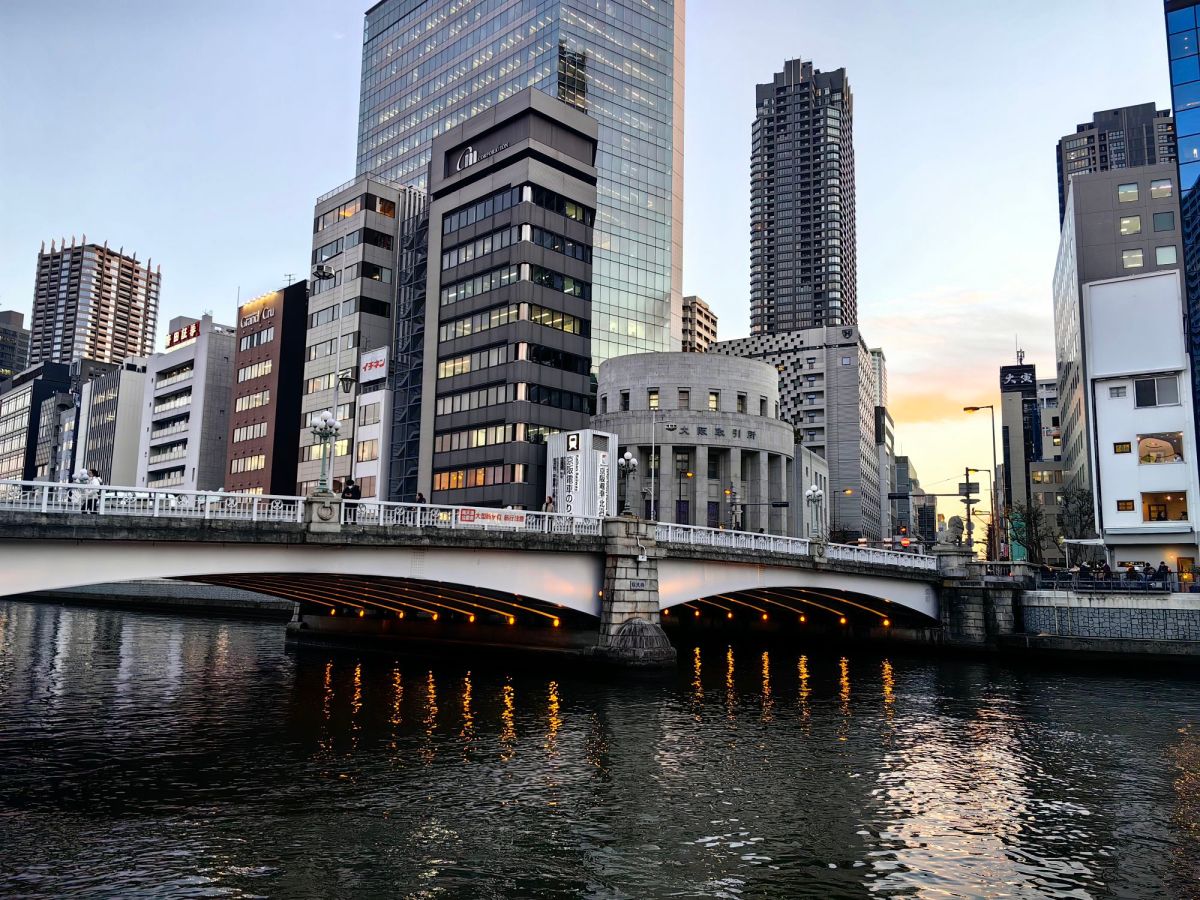
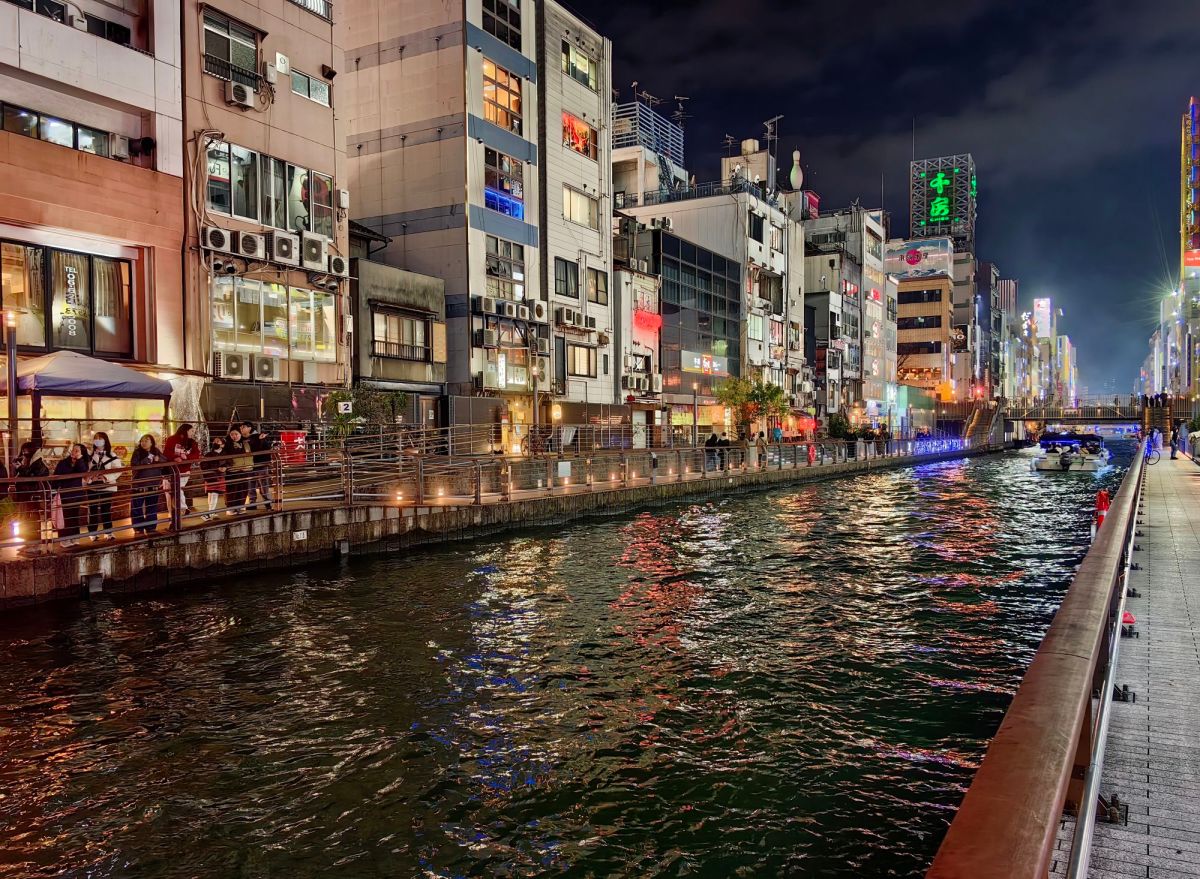
Stepping out of the airport, I was filled with a quiet sense of excitement and anticipation. For my stay in Osaka, I chose a hotel within walking distance of Dotonbori, the city’s most iconic entertainment and shopping district. Staying in the heart of the city meant that everything was only a short stroll away from lively shopping arcades and elegant department stores to countless restaurants serving Osaka’s celebrated local specialties.
The canal that winds through the district was first excavated in the early Edo period, and over the centuries it has grown into one of Osaka’s most recognizable landmarks. Today, people from every corner of the world gather along its lively waterfront, soaking in the city’s infectious energy and colorful street life. Standing beside the historic canal on my very first evening in Japan, I felt that there could hardly have been a better place to begin my journey.
No visit to Osaka would be complete without tasting takoyaki, the city’s most iconic street food and a dish that perfectly captures its lively culinary culture. As I wandered through the bustling streets of Dotonbori, the irresistible aroma of batter sizzling on hot iron griddles filled the air, drawing people towards the countless food stalls lining the streets. Freshly prepared before my eyes, the takoyaki emerged as perfectly round, golden-brown balls with a crisp, lightly toasted exterior. Each one was filled with tender pieces of octopus, finely chopped green onions and crunchy tempura flakes, then generously topped with savory takoyaki sauce, creamy Japanese mayonnaise, a sprinkle of seaweed powder, and delicate bonito flakes that danced in the rising heat. It looked really delicious.
From the very first bite, I understood why takoyaki has become synonymous with Osaka. I instantly fell in love with it. The crisp outer layer has a soft, creamy centre that was almost molten. The tender octopus added a satisfying chewiness, while the savory sauce and fragrant toppings brought every bite together in a perfect harmony.
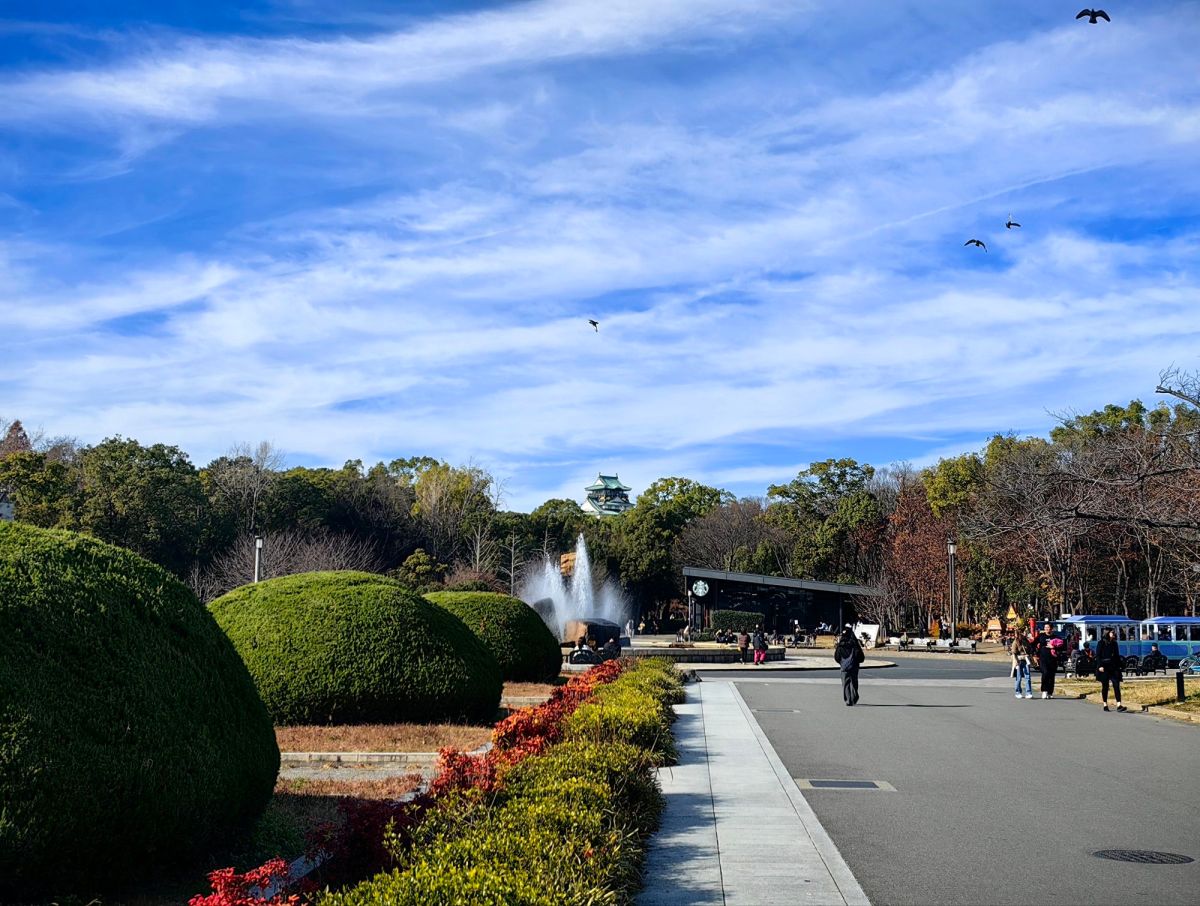
One of the highlights of my journey was my visit to Osaka Castle Park, a vast green oasis surrounding one of Japan’s most celebrated landmarks. In the heart of the bustling city, the park offered a welcome sense of tranquility. Although it was winter, the park possessed a quiet charm of its own. The crisp air, the stillness of the grounds, and the gentle rustle of bare branches invited me to slow my pace and savor the moment. As I approached the castle, the magnificent white-and-green keep gradually emerged above the treetops. Framed by the surrounding greenery and rising proudly above its massive stone foundations, it was an unforgettable sight.
The exterior of Osaka Castle is both elegant and majestic, making it one of Japan’s most recognizable landmarks. Rising above its immense stone foundations, the castle’s brilliant white walls stand in striking contrast to its emerald-green roofs, which are adorned with shimmering gold decorations that gleam in the sunlight. Perched at the corners of the rooftops are magnificent gilded shachihoko (mythical creatures with the head of a tiger and the body of a carp). According to Japanese tradition, these legendary guardians possess the power to summon water and protect buildings from fire.
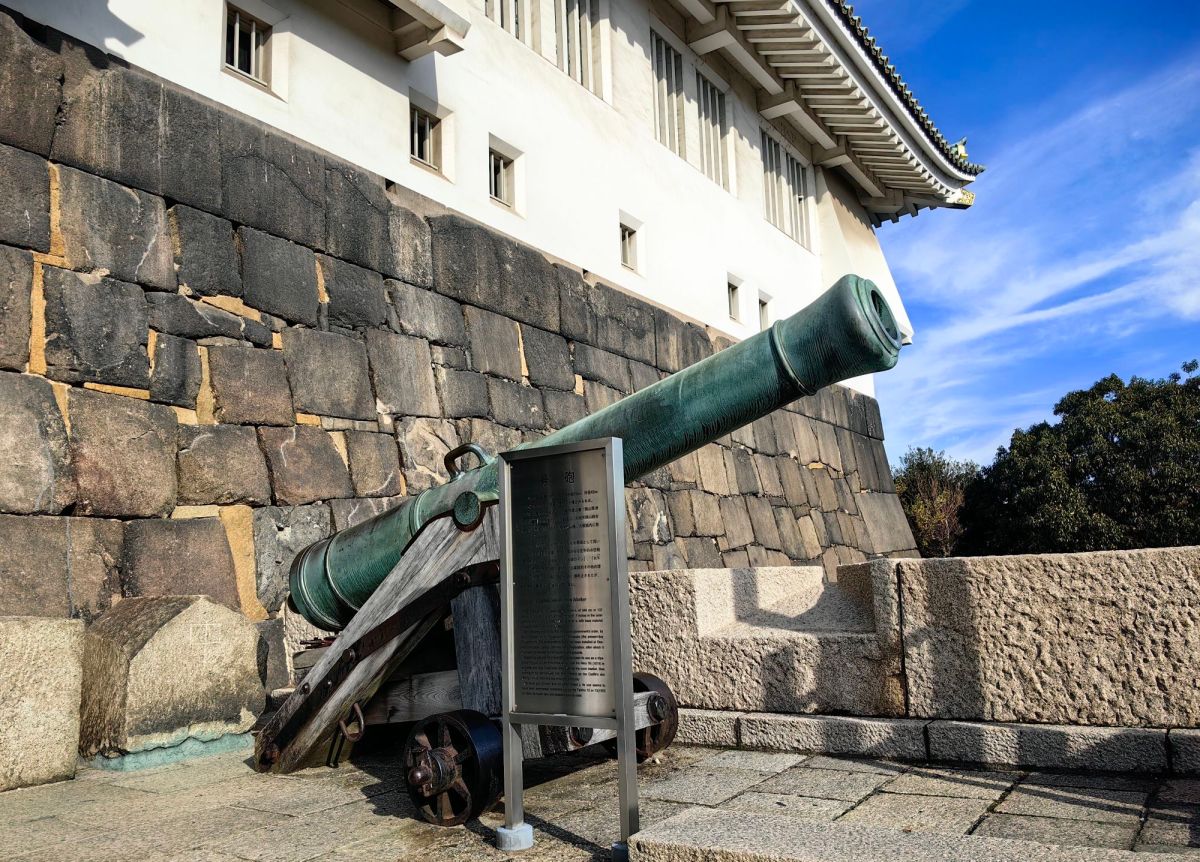
Beyond its beauty, Osaka Castle occupies a central place in Japanese history. It was originally built in 1583 by the powerful warlord Toyotomi Hideyoshi, who sought to unify Japan after more than a century of civil war during the Sengoku Period (1467–1615). Designed as the political and military headquarters of the Toyotomi clan, the castle became one of the largest and most formidable fortresses in the country. Its massive stone walls, broad moats, and strategic location reflected Hideyoshi’s ambition to establish a unified Japan under his rule. Although the present castle is a modern reconstruction completed in 1931 and later restored, it faithfully preserves the appearance of Toyotomi Hideyoshi’s original masterpiece.
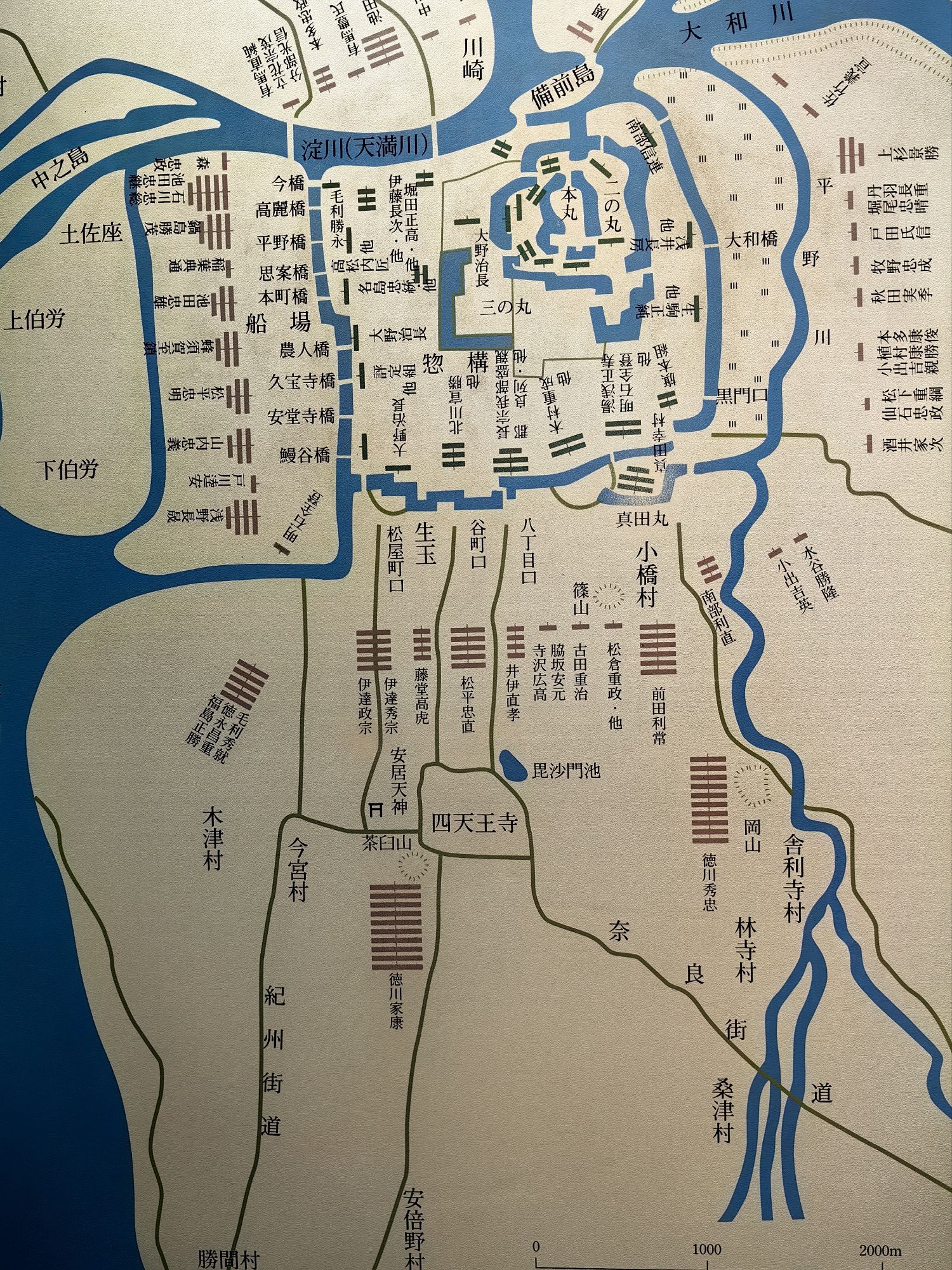
The castle now becomes a museum displaying the model of this castle and the history of that period and narrating the ebb and flow of that period. I like to play games like Nobunaga’s Ambition and familiar with the history of Sengoku Period so I really enjoyed the immersive travel experience here as if I visited that period by myself. The castle also witnessed the dramatic conclusion of the Sengoku era. Following Hideyoshi’s death, tensions between the Toyotomi clan and Tokugawa Ieyasu escalated into the Siege of Osaka in 1614 and 1615. Standing on this castle, I could observe clearly the outline of the whole war field around this castle. I imagined the decisive battle determining Japan’s fate, once took place fiercely here.
Following the death of Toyotomi Hideyoshi, his young son and heir, Toyotomi Hideyori, remained in Osaka Castle, while Tokugawa Ieyasu, victorious at the Battle of Sekigahara in 1600, had already emerged as the most powerful political figure in Japan. Although the Toyotomi clan still possessed immense wealth and the formidable defences of Osaka Castle, Ieyasu regarded them as the final obstacle to bringing the entire country under Tokugawa rule. This rivalry would ultimately culminate in the Siege of Osaka, one of the most decisive conflicts in Japanese history, marking the end of the Toyotomi clan and the beginning of more than two and a half centuries of Tokugawa shogunate rule.
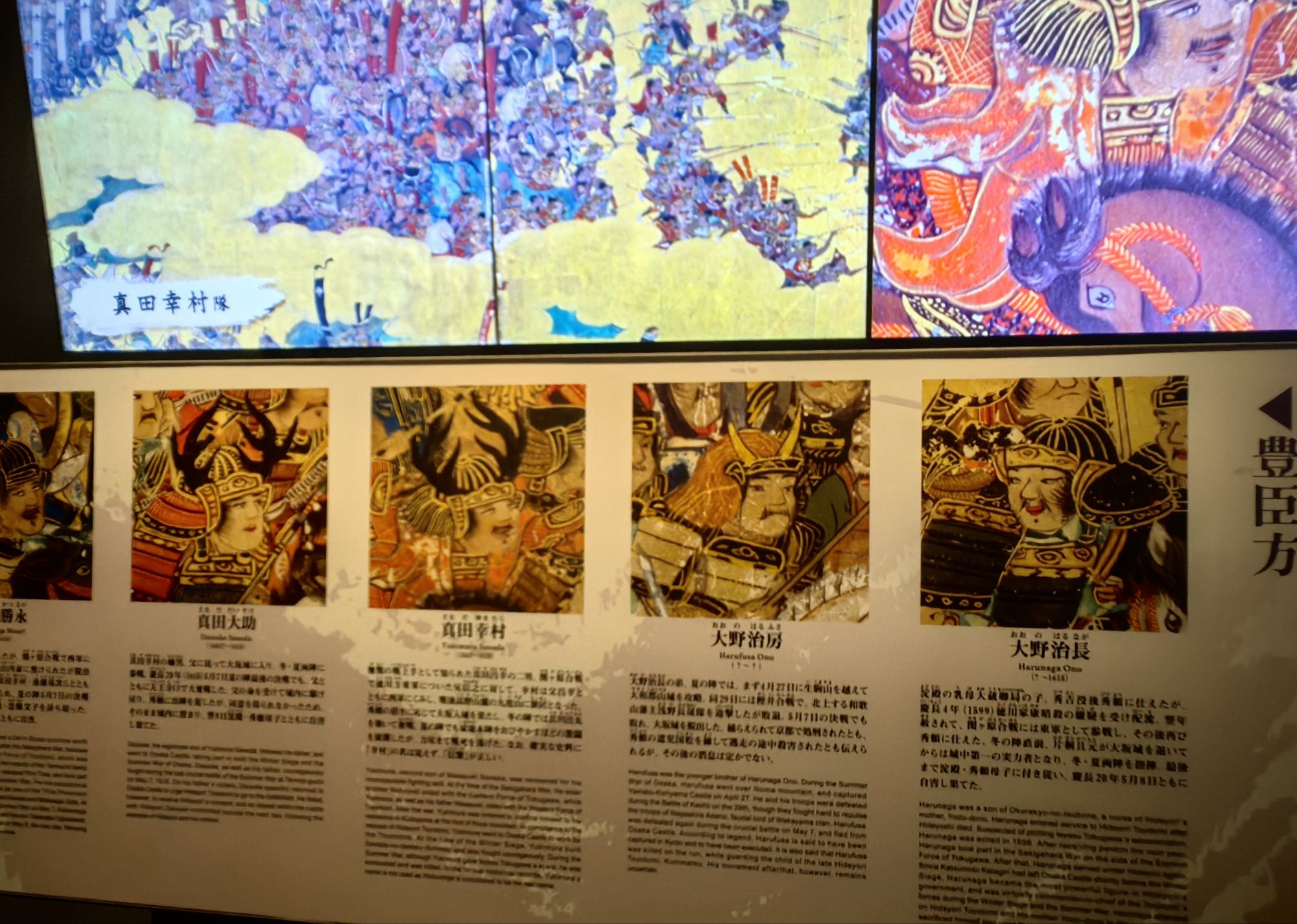
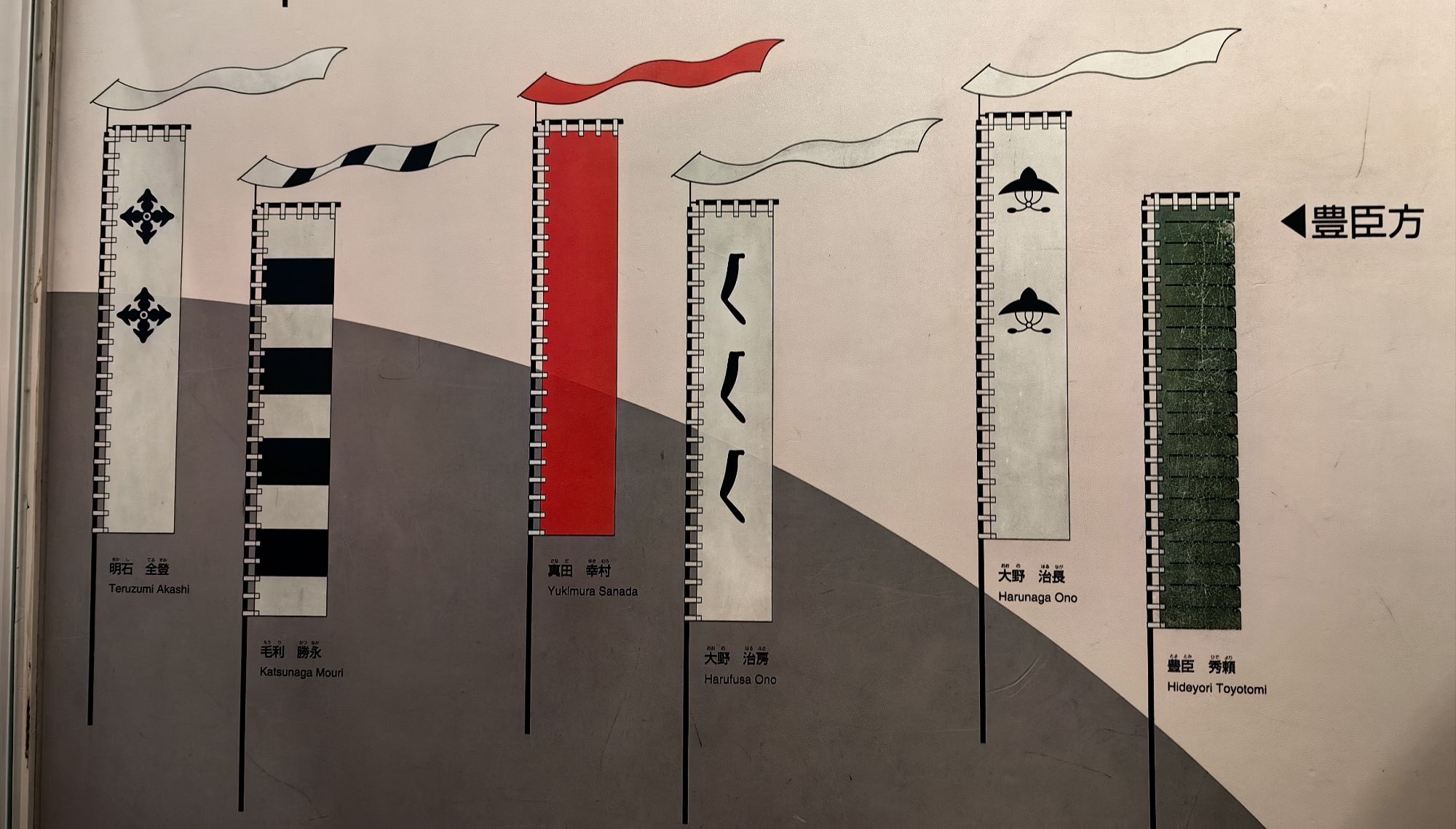
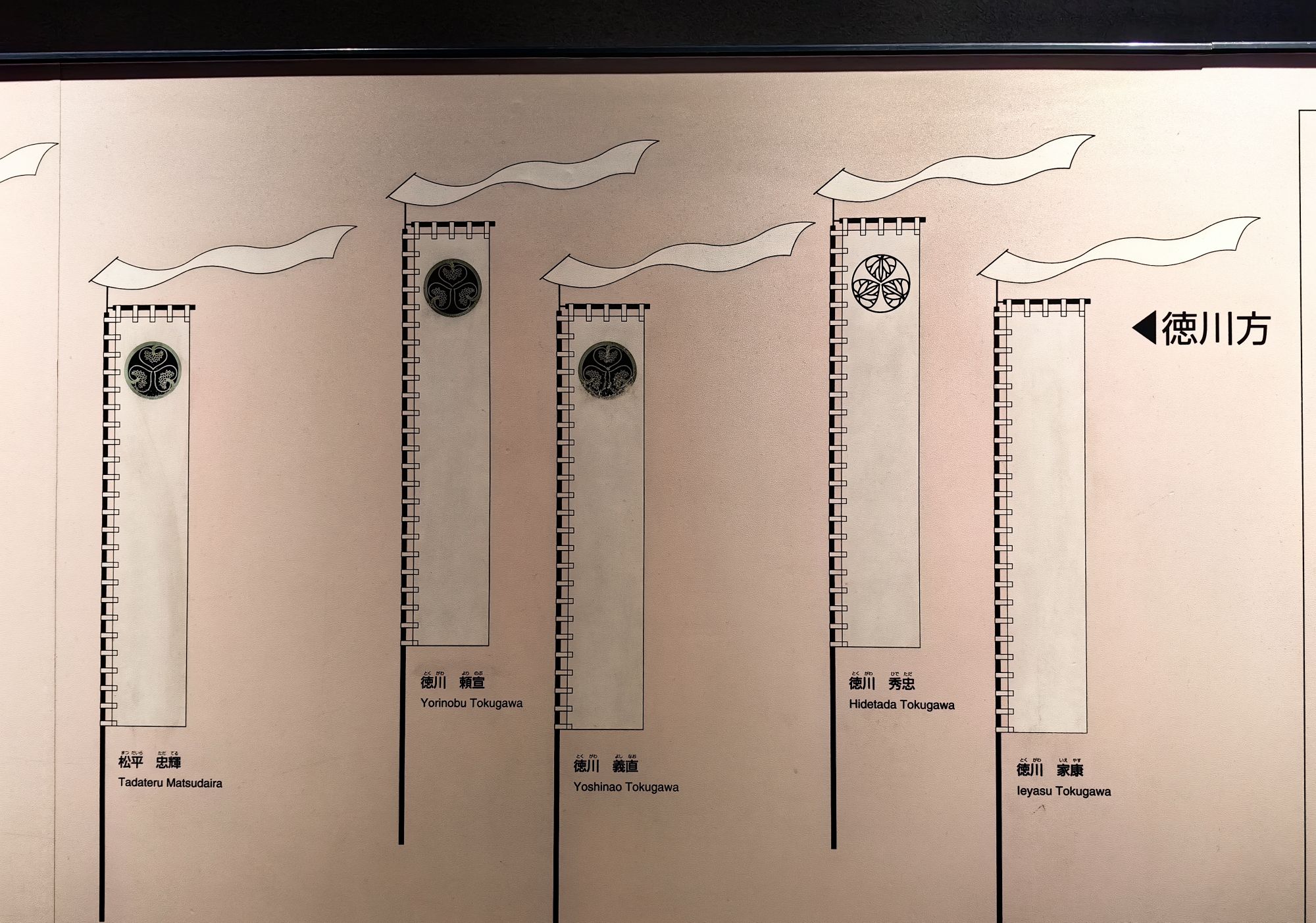
Today, the castle serves not only as one of Osaka’s most famous landmarks but also as a fascinating museum that brings this dramatic chapter of history to life. As I explored its galleries, I found detailed exhibits dedicated to Hideyori’s loyal generals, their armour and weapons, and the distinctive battle standards that once identified their armies on the battlefield.
In the winter of 1614, Tokugawa Ieyasu personally led a vast army to lay siege to Osaka Castle. Rather than relying solely on brute force, he combined overwhelming military strength with calculated strategy to break down the defenders’ resistance. The Winter Campaign ended in a negotiated truce, but the agreement came at a heavy cost for the defenders. Under its terms, the Tokugawa forces dismantled much of the castle’s outer fortifications and filled in large sections of its protective moats, leaving what had once been an impregnable fortress dangerously exposed.
When hostilities resumed during the Summer Campaign of 1615, the balance of power had shifted decisively. Tokugawa’s forces launched a final offensive that overwhelmed the Toyotomi defenders. Osaka Castle fell, and Toyotomi Hideyori died within the castle, bringing the Toyotomi lineage to an end. With that victory, Tokugawa Ieyasu secured control of Japan, ushering in more than 260 years of peace and stability under the Tokugawa shogunate.
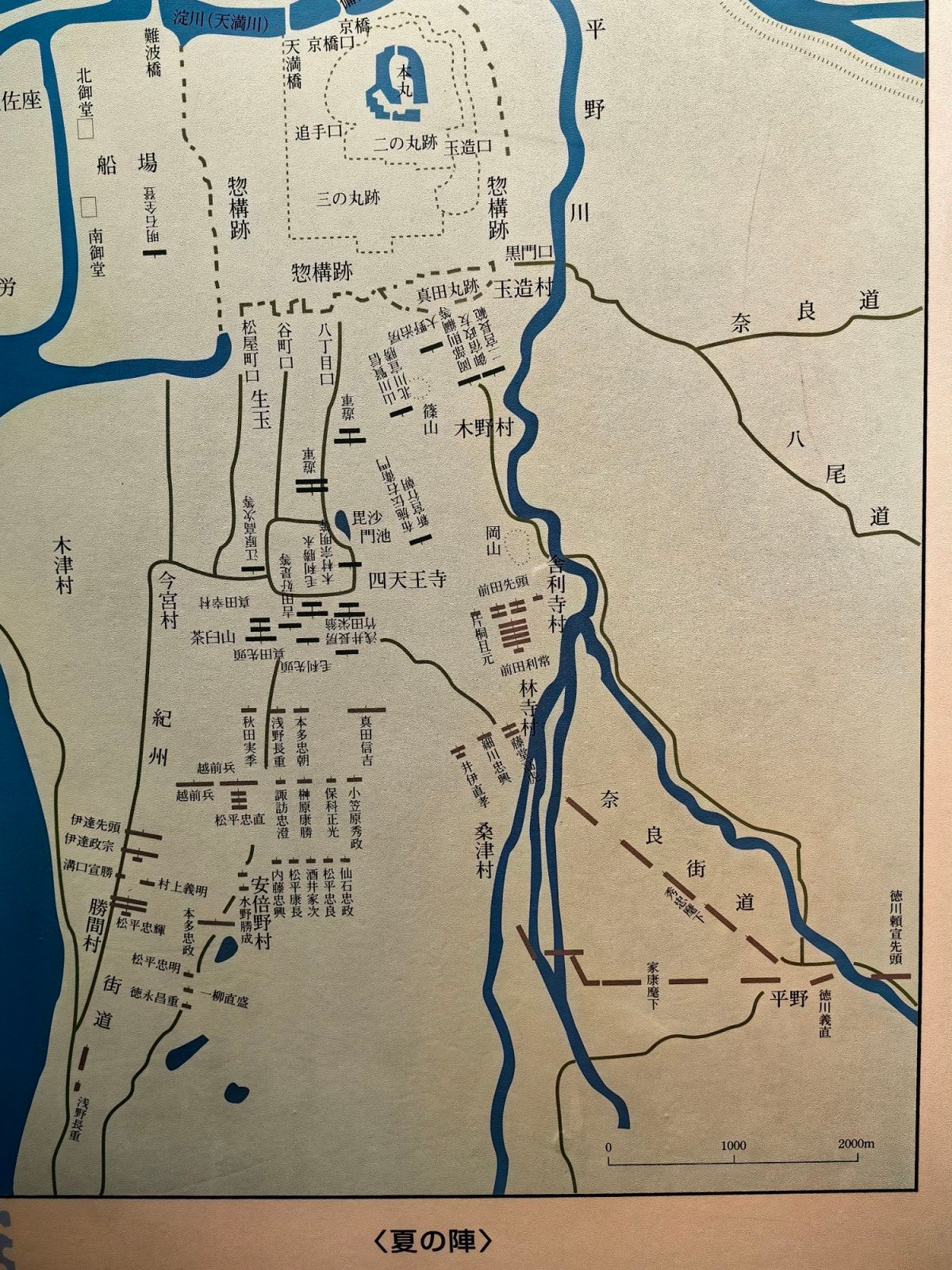
The third floor of the castle museum vividly recounts these two historic campaigns. Through detailed battle maps, scale models, and illustrated displays, I could follow the movements of both armies and understand how the siege unfolded step by step. The historical maps depicted Osaka as it appeared more than four hundred years ago, yet many familiar place names have survived to the present day. Among them was Shitennō-ji, one of Japan’s oldest Buddhist temples. Seeing a name that still exists on a map from the early seventeenth century made history feel remarkably tangible.
Several renowned Tokugawa commanders played pivotal roles in the Siege of Osaka. Among them was Ii Naotaka, commander of the legendary “Red Devils” cavalry. Famed for the striking crimson armor worn by his warriors, he led his troops with distinction during the campaign and later became one of the Tokugawa shogunate’s most trusted daimyō. Another prominent figure was Honda Tadatomo, the son of the celebrated warrior Honda Tadakatsu, who was widely regarded as one of the greatest generals of his age. Tadatomo earned recognition for his courage and capable leadership on the battlefield, continuing the military legacy of his distinguished family.
Also fighting on the Tokugawa side was Date Masamune, the powerful lord of Sendai. Easily recognized in portraits by his distinctive crescent-moon helmet, Masamune contributed a substantial force to the Tokugawa coalition while maintaining his reputation as one of the most charismatic and influential daimyō of the era. Seeing these familiar names in the museum exhibits brought the history of the siege vividly to life, transforming what I had once known only from books into the stories of real people who chose their fate in the course of Japan’s history.
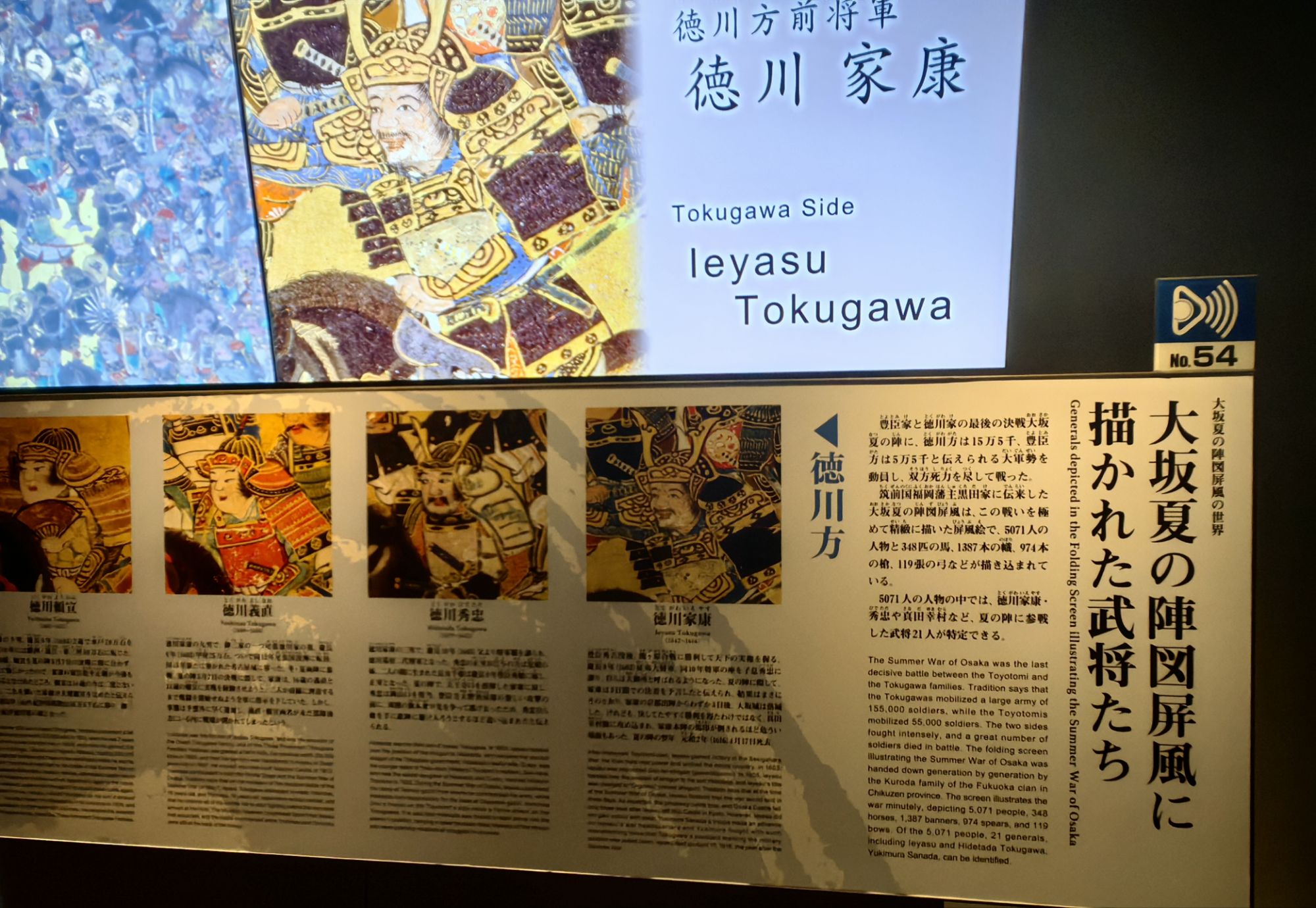
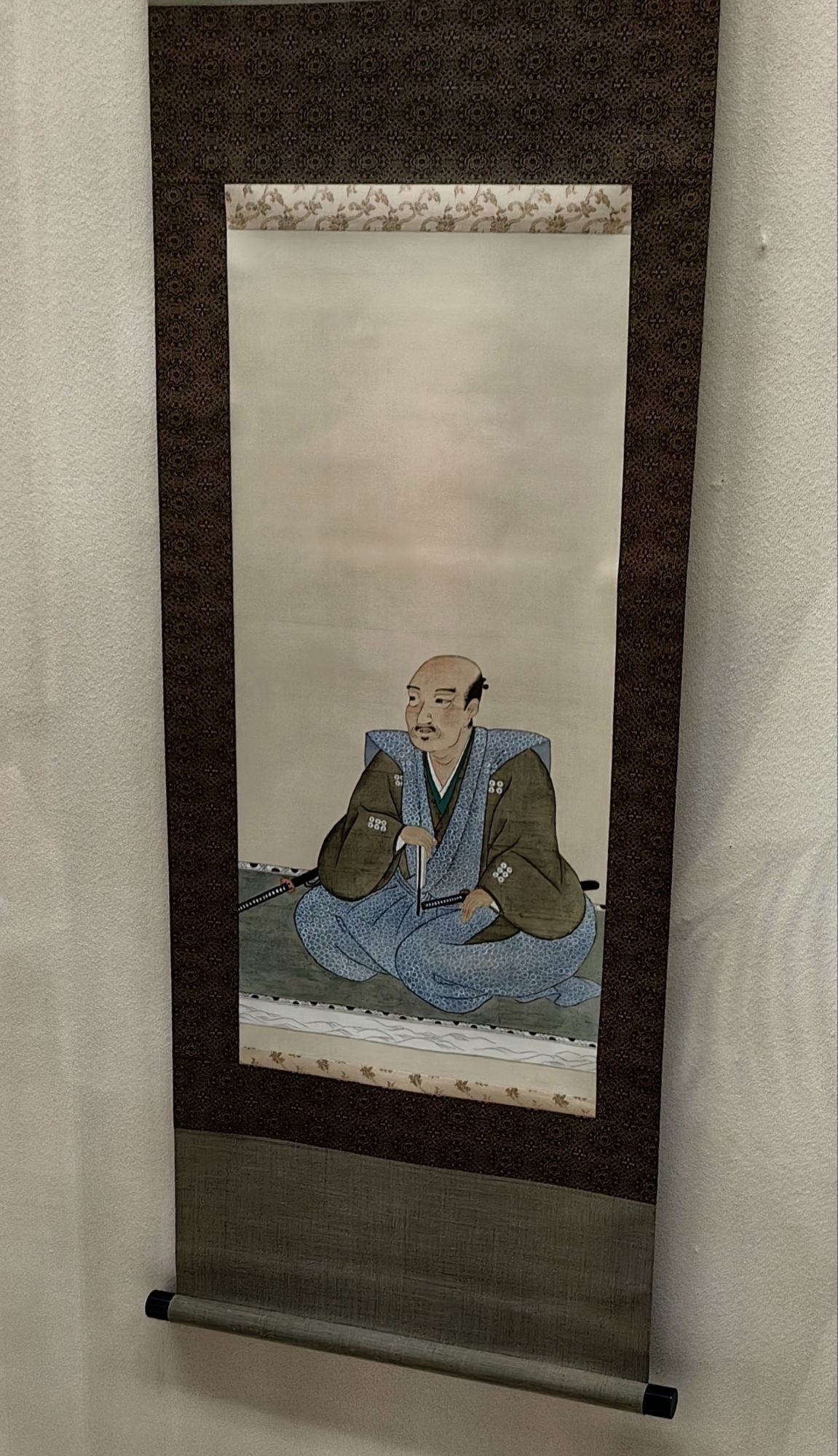
This is the portrait of Tokugawa Ieyasu who was the winner of this war. The victory at Osaka eliminated the final military challenge to Tokugawa authority. With the Toyotomi clan destroyed, Tokugawa Ieyasu secured the foundation of the Tokugawa Shogunate, which would govern Japan for more than 250 years. Walking through Osaka Castle today, it is remarkable to think that these peaceful grounds once witnessed the battle that ended the Age of Warring States and ushered in one of the longest periods of peace in Japanese history.
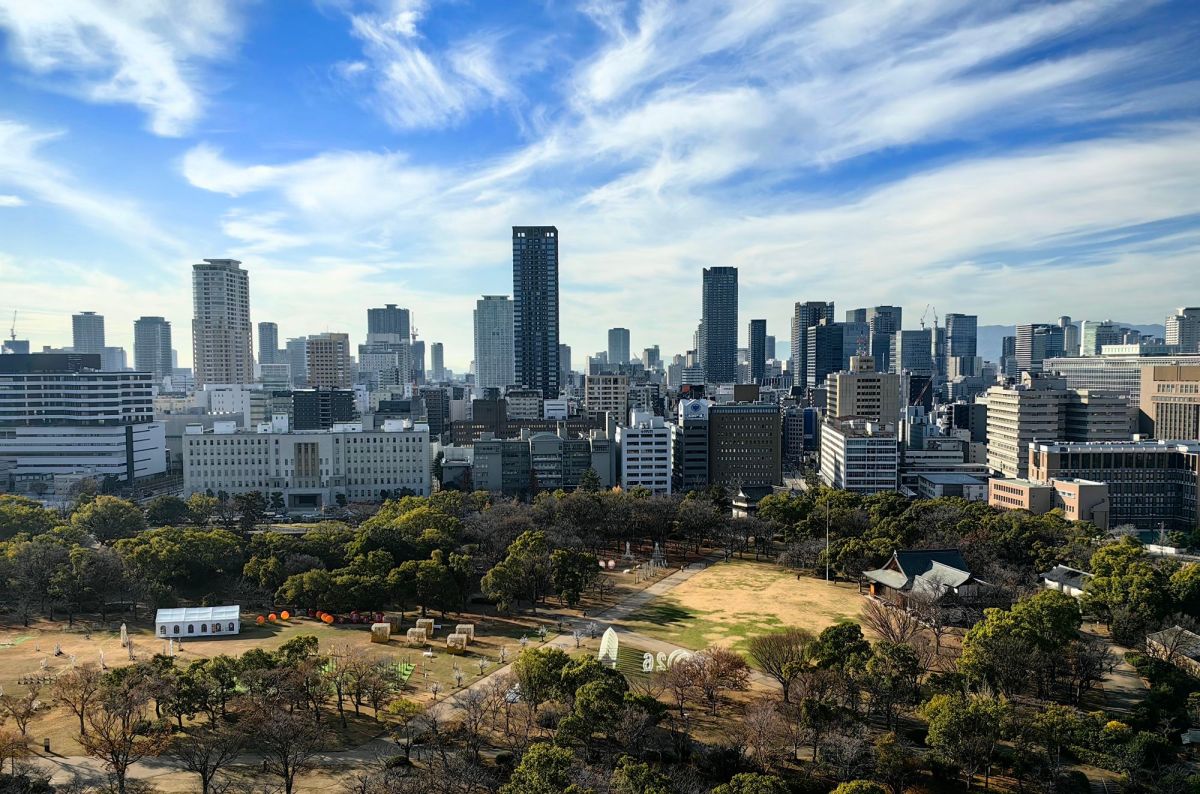
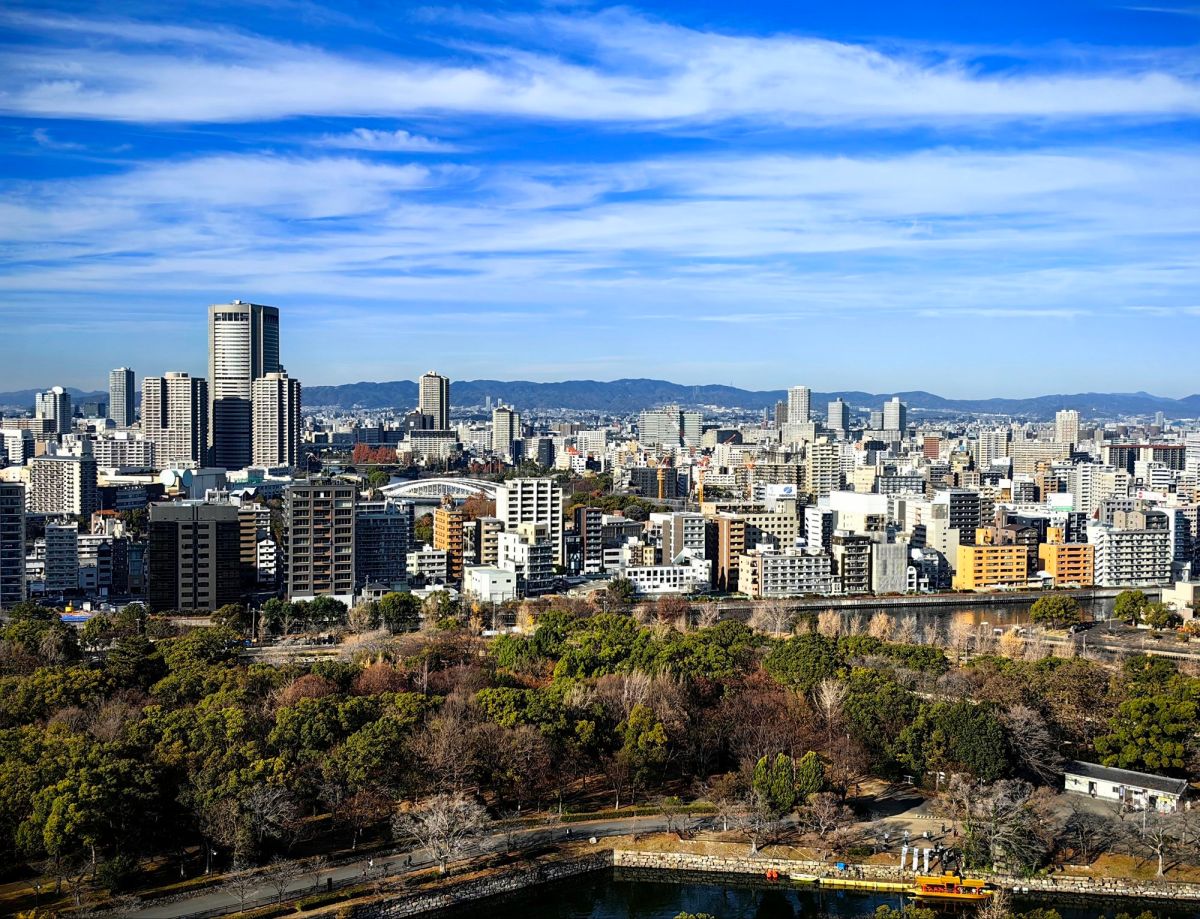
After exploring the castle museum, I made my way to the observation deck at the top of Osaka Castle. From there, a breathtaking panorama unfolded in every direction. The skyline stretched endlessly towards the horizon, where countless skyscrapers, office towers, apartment blocks, and commercial buildings formed a vast sea of steel and glass. The city seemed to pulse with life, its modern skyline standing in striking contrast to the centuries-old castle beneath my feet.
Looking out across the sprawling cityscape, I could truly appreciate how Osaka has evolved over the centuries. What was once a castle town of samurai residences, merchant quarters, and narrow streets has grown into one of Japan’s largest and most dynamic metropolitan centres, home to millions of people. Yet despite its remarkable transformation, Osaka Castle still stands proudly at the heart of the city, serving as a timeless reminder of the events that shaped its history.
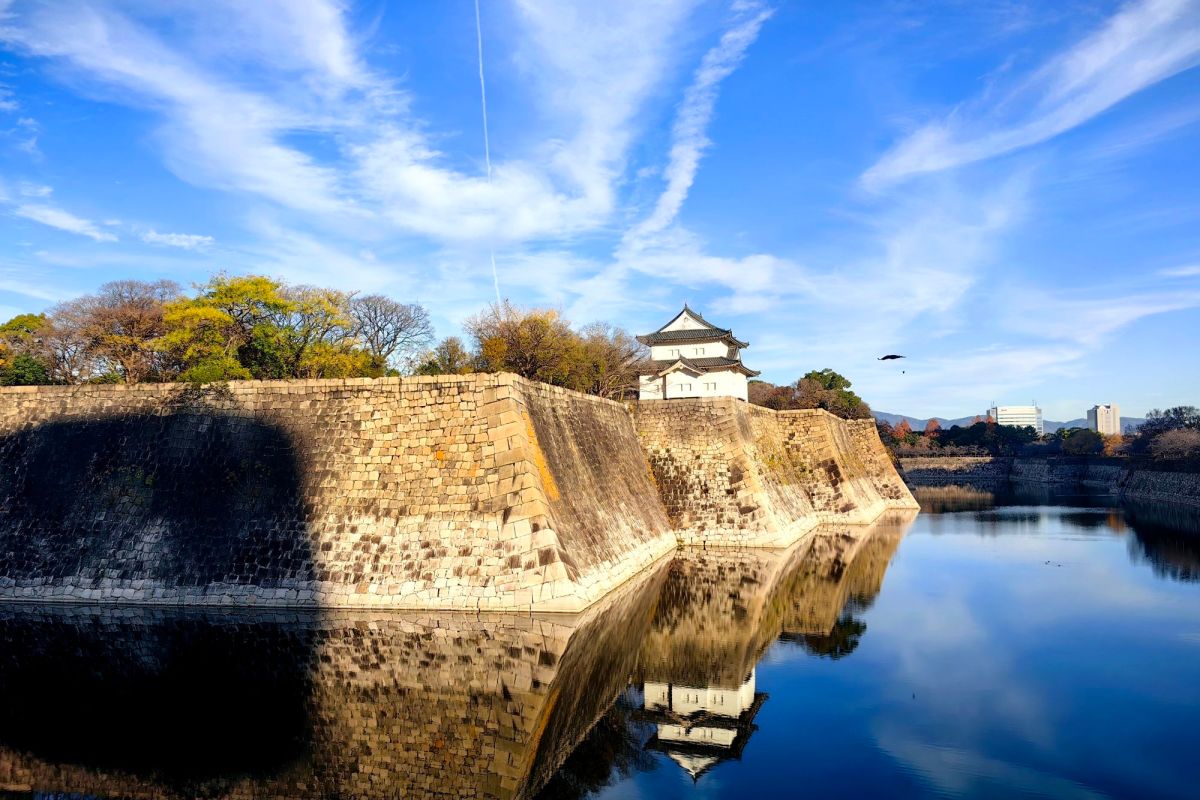
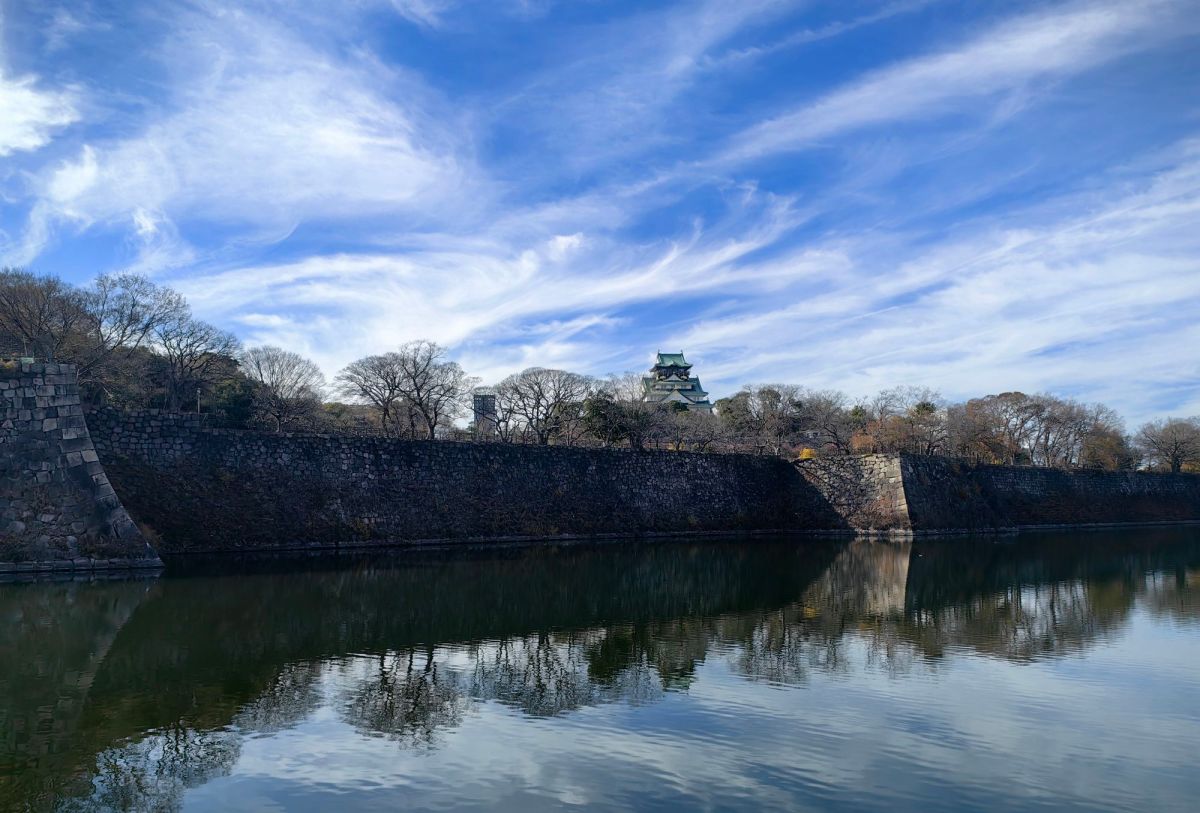
Standing within Osaka Castle Park today, it was difficult to imagine that these peaceful grounds had once witnessed some of the most decisive battles in Japanese history. I also walked around the outer grounds of the castle, where its immense scale became even more apparent. The keep rises from an enormous stone foundation encircled by broad moats that once formed a formidable line of defence. Many of the granite blocks used to construct the massive walls are among the largest ever quarried, transported, and assembled in Japan.
Viewed from across the moat, the castle appeared especially magnificent. It seemed to emerge naturally from its colossal granite base, while its brilliant white walls and emerald-green roofs, adorned with gleaming gold ornaments, shone vividly beneath the pale winter sky. The calm water reflected the castle’s graceful silhouette, creating a scene of quiet beauty.
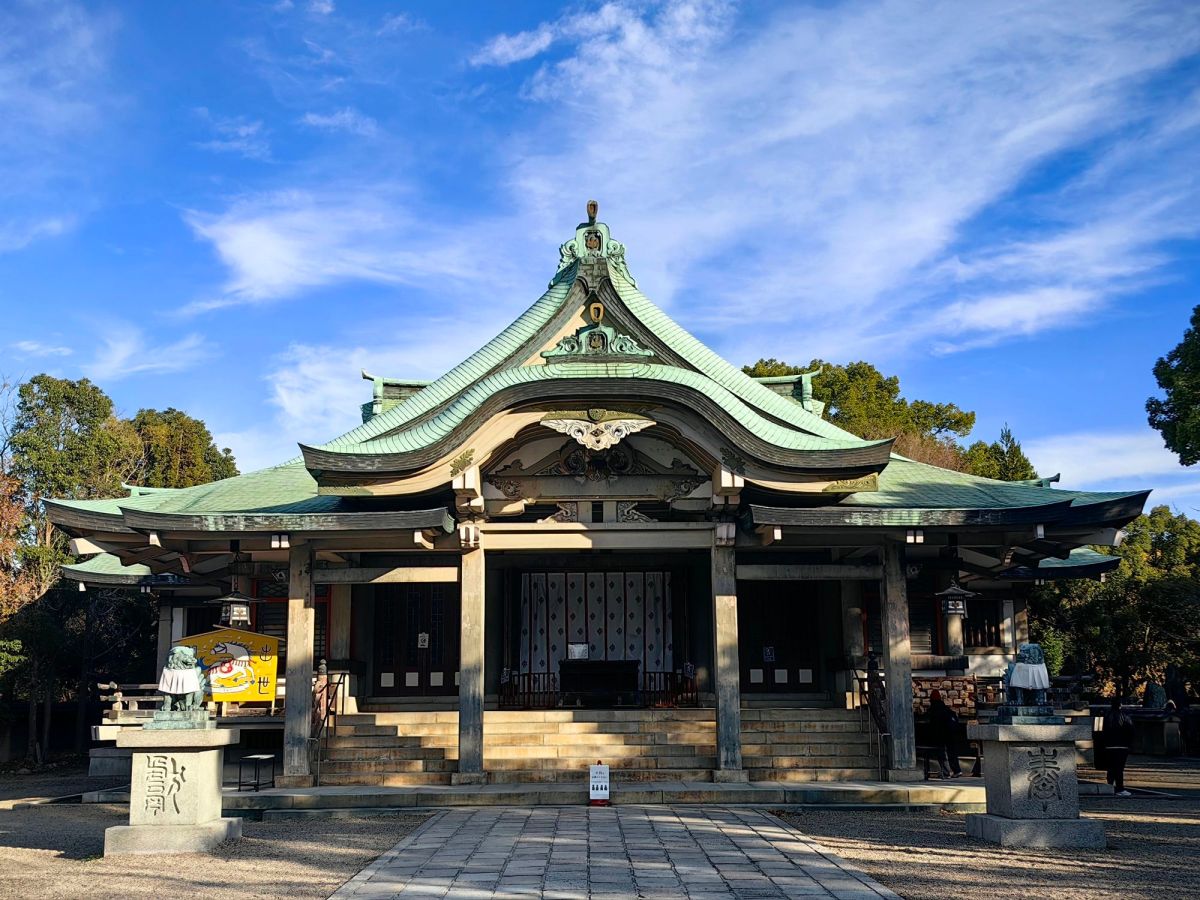
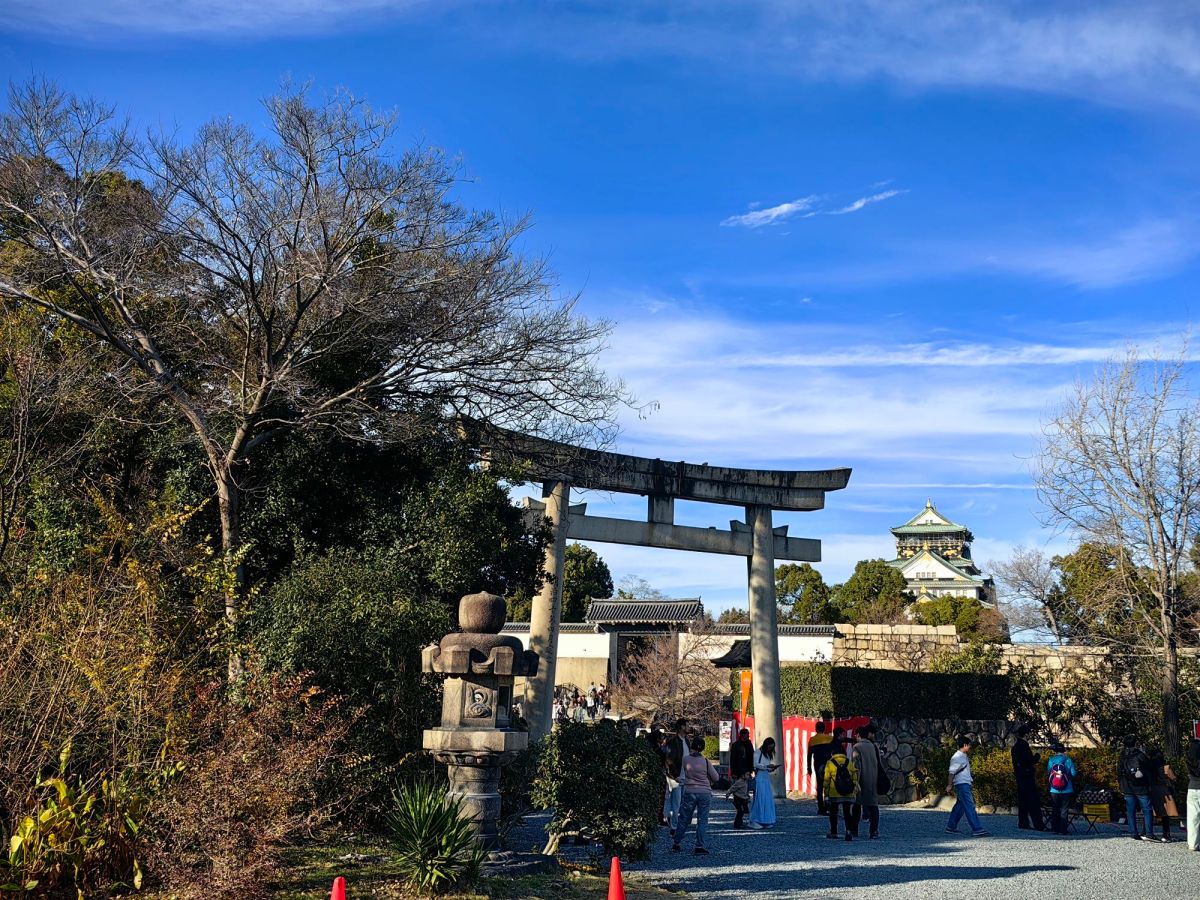
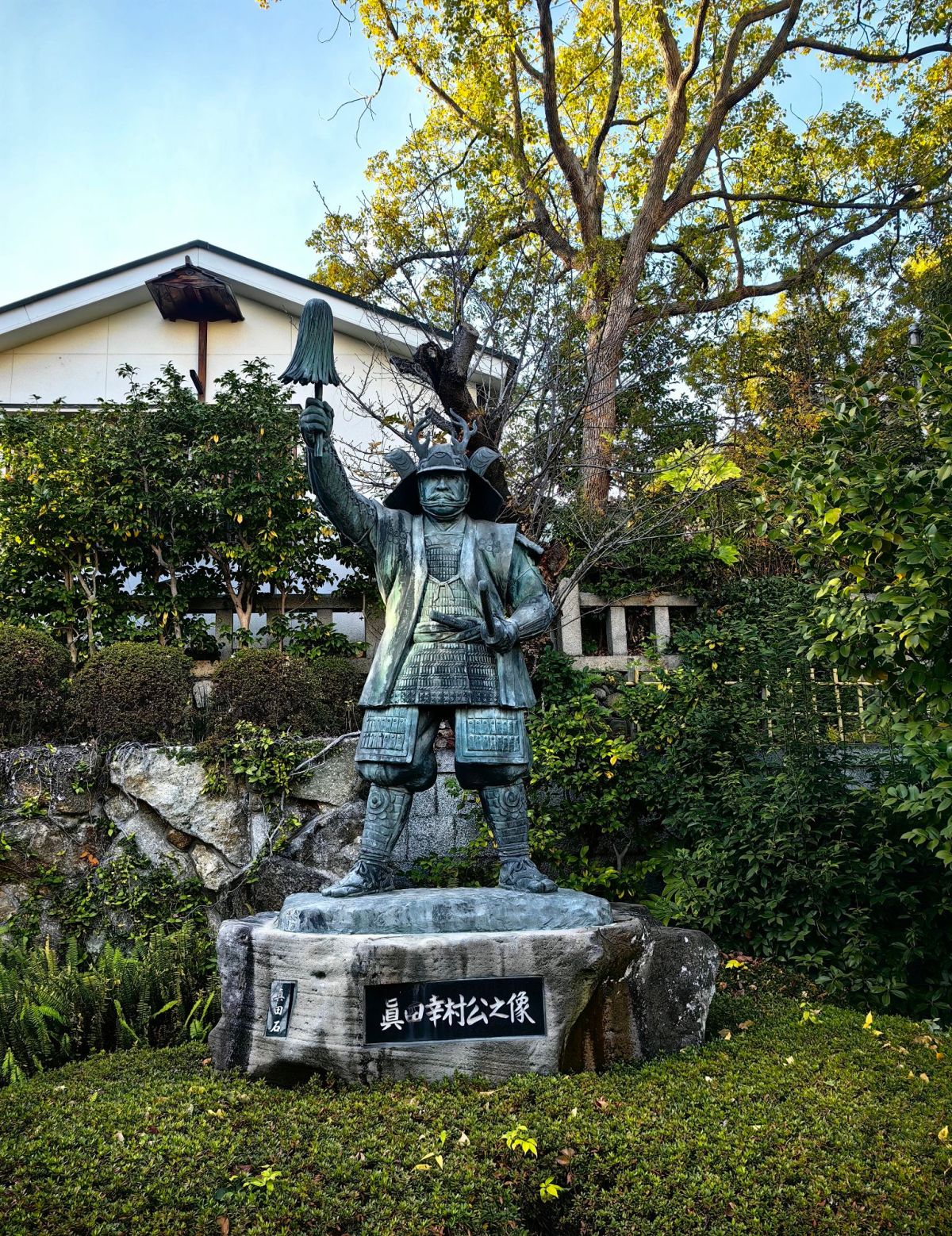
A short walk from Osaka Castle stands Hokoku Shrine, a peaceful Shinto shrine dedicated to Toyotomi Hideyoshi. In front of the shrine stands a striking bronze statue. He is portrayed in formal samurai attire, standing confidently with one hand resting on the hilt of his sword and the other holding a military command baton, symbolizing his authority as one of Japan’s greatest strategists and unifiers. Toyotomi Hideyoshi is a real legend in Japanese history. He rises from humble origins as the son of a peasant to become the most powerful man in Japan. Few figures in Japanese history experienced such a remarkable ascent and obtained such an achievement.
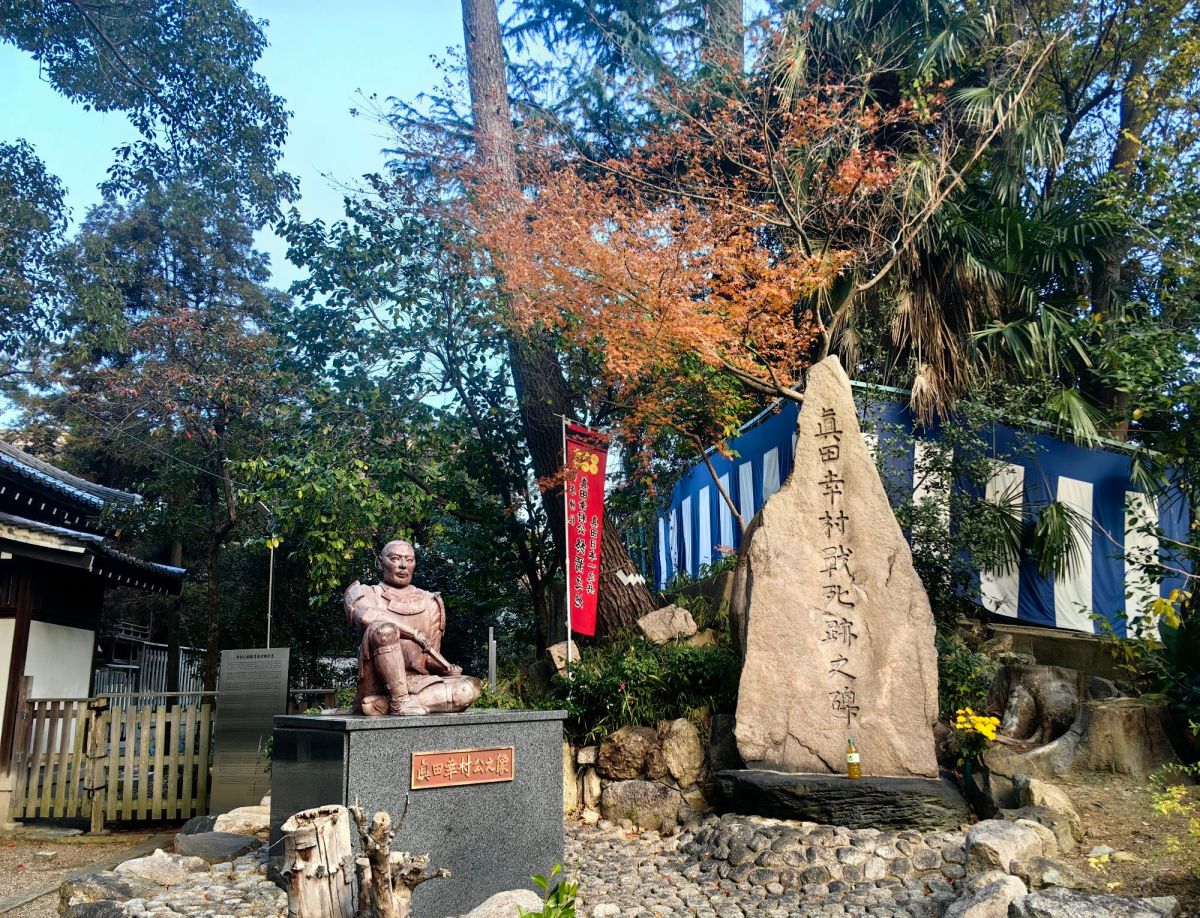
The shrine commemorates not only Toyotomi Hideyoshi, but also members of the Toyotomi family whose efforts contributed to the unification of Japan. Although the Toyotomi political legacy came to an end with the fall of Osaka Castle during the Siege of Osaka, Hideyoshi’s influence on the course of Japanese history remains profound. His military achievements brought an end to more than a century of civil war and laid the foundations for the peaceful Edo period that followed. As I stood before the shrine, I found myself reflecting on the fate of the Toyotomi clan.
In my view, Toyotomi Hideyori’s defeat was not simply the result of a single mistake made during the Siege of Osaka. Rather, its roots can be traced to decisions made years earlier by his father. Although Hideyoshi succeeded in unifying Japan, he did not establish a political system strong enough to endure after his own death. His heir, Hideyori, was still a child and lacked an effective institutional framework to protect his position. At the same time, Tokugawa Ieyasu remained the most powerful daimyō in the country, commanding unrivalled military resources and political influence. Hideyoshi’s costly invasions of Korea also placed a heavy burden on the nation and weakened support for the Toyotomi government. Finally, the stability of his regime depended largely on the personal loyalty of the Council of Five Elders rather than on enduring political institutions. Once Hideyoshi was gone, those personal bonds quickly unraveled, allowing Ieyasu to consolidate power.
History rarely turns on a single battle or a single decision. As I left the shrine, I felt that the fall of the Toyotomi clan was the culmination of choices made over many years. It’s a reminder that lasting political success depends not only on military brilliance, but also on building a mature institution capable of surviving the ambitions and lifetimes of individual leaders.
After leaving Osaka Castle Park, I made my way to Sankō Shrine, a quiet shrine best known for its association with the legendary samurai Sanada Yukimura, one of the most celebrated warriors of Japan’s Sengoku era. The shrine is dedicated to the Shinto deities Amaterasu, Tsukuyomi, and Susanoo. Yet for many visitors, its greatest attraction is the “Sanada’s Escape Tunnel.” According to local tradition, this mysterious underground passage once connected the Sanada Maru which is the fortified stronghold defended by Yukimura during the Siege of Osaka.
The shrine also features a bronze statue of Yukimura and is a popular destination for visitor like me who is interested in Japan’s Sengoku-era history. Born into the Sanada clan, Yukimura was the son of Sanada Masayuki, a skilled strategist. After the decisive Battle of Sekigahara in 1600, Yukimura was defeated for supporting the Western Army (Toyotomi clan) and were exiled to Kudoyama at the foot of Mount Koya, where they spent more than ten years in seclusion.
In 1614, the Siege of Osaka broke out. At the invitation of Toyotomi Hideyori, Sanada Yukimura left his exile and entered Osaka Castle, joining the Toyotomi army and shouldering the heavy responsibility of resisting Tokugawa Ieyasu. In the Siege of Osaka from 1614 to 1615, he led the defending troops in valiant fighting, becoming one of the most representative heroes of the Toyotomi clan’s last resistance against the Tokugawa Shogunate.
This photo was taken in the place near Yasui Shrine where Yukimura Sanada lost the final battle. He earned lasting fame through his brilliant leadership during the Siege of Osaka. He designed and defended the Sanada Maru, a fortified outwork that successfully repelled repeated Tokugawa attacks during the Winter Siege of 1614. During the Summer Siege in 1615, he led a bold and desperate cavalry charge that came close to reaching Tokugawa Ieyasu himself before being overwhelmed and killed in battle.
The portrait of Yukimura Sanada in the Osaka castle museum
I found his portrait in the Osaka castle museum. Although the Toyotomi forces supported by Yukimura were finally defeated, his courage, tactical skill, and unwavering loyalty turned him into a legendary figure. Often called “the greatest warrior in Japan”, he has been immortalized in literature like ‘The Sanada Gunki’, television dramas like ‘Sanada Maru’, video games like Nobunaga’s Ambition, and local legends, making him one of the most famous and admired samurai in Japanese history.
As I wandered through the suburban streets of Osaka, I discovered a quieter side of the city, where everyday life unfolded at an unhurried pace. A network of narrow lanes, often barely wide enough for a single car, wound between rows of modest three-storey houses standing shoulder to shoulder. Small balconies were decorated with potted plants, bicycles rested casually against walls, and neatly arranged entrances reflected the quiet routines of daily life.
Walking through them felt like catching a glimpse of the Osaka that local residents experience every day, far removed from the bright lights and bustling crowds of the city centre. Towering utility poles lined the streets, forming one of the most distinctive features of Japanese residential neighborhoods. Countless power lines stretched from pole to pole, hanging in gentle curves overhead and weaving an intricate pattern against the sky. At first, the dense web of cables seemed almost chaotic, but the longer I looked, the more it became part of the city’s unique visual identity.
As evening approached and I made my way back to my hotel, Nakanoshima revealed a strikingly different side of Osaka from the quiet residential neighborhoods I had explored earlier. Situated on a long island between the Dojima and Tosabori Rivers, Nakanoshima is one of the city’s principal business and cultural districts, where broad boulevards, graceful bridges, and sleek skyscrapers combine to create a sophisticated urban skyline. Towering glass office buildings rose above the waterfront, their façades reflecting the fading colors of the winter sky as daylight gradually gave way to evening. The rivers mirrored the city lights, while the silhouettes of bridges stretched elegantly across the water, lending the district a calm yet cosmopolitan atmosphere.
Unlike the narrow lanes of the suburbs, Nakanoshima offered wide, tree-lined promenades and spacious riverside parks that invited me to slow down and enjoy the scenery. I strolled along the riverbanks, watching office workers, joggers, and couples passing by as the city settled into the evening. Within a single day, I had experienced the city’s historic heart, its peaceful residential streets, and its modern financial centre. Each revealed a different character of Osaka.
At night, the Dōtonbori Canal became one of Osaka’s most vibrant and recognizable urban landscapes. The waterway was bordered by a continuous wall of illuminated buildings, where enormous LED billboards, animated signs, and colorful advertisements reflected across the gently rippling surface of the canal. Both banks of the canal are lined with wide pedestrian promenades crowded with locals and visitors. Restaurants, izakayas and cafés spilled light and laughter onto the waterfront, while the enticing aromas of grilled seafood, ramen and freshly made takoyaki drifted through the air.
I enjoyed dinner at a restaurant by the canal, savoring Japan’s famous Wagyu beef yakiniku. Wagyu is renowned for its fine and marbling, melt-in-mouth tenderness, and rich, full-bodied flavor. Unlike Western steaks, Wagyu yakiniku is typically not served in whole, but rather sliced into thin pieces or bite-sized chunks, which diners grill themselves slowly over charcoal at their tables.
As the beef sizzled on the charcoal, the fine fat gradually melted, giving the slices an enticing sheen and releasing a rich aroma. When the outer layer slightly caramelized and turned golden brown, the inside remained tender and juicy. The grilled Wagyu, served with garlic, onions, and other vegetables, and dipped in a flavorful Japanese yakiniku sauce, offered a multi-layered and unforgettable experience with every bite.
Sitting by the canal, admiring the city lights reflected on the water’s surface while enjoying the steaming Wagyu yakiniku, I found a perfect way to conclude one day’s trip. On a cold winter night, this warm and sumptuous dinner became one of my most unforgettable culinary experiences upon arriving in Japan.
I stayed in Osaka for two days and visited several cultural places on the second day. Sumiyoshi Taisha is one of Japan’s oldest and most revered Shinto shrines. Founded in the 3rd century, before the introduction of Buddhism to Japan, the shrine is dedicated to the Sumiyoshi Sanjin, three deities believed to protect travelers, sailors, fishermen, and all who journey by sea. Because Osaka developed as an important port city, Sumiyoshi Taisha became a spiritual guardian for merchants, seafarers, and imperial envoys. Today, it remains the head shrine of more than 2,000 Sumiyoshi shrines across Japan.
The shrine is internationally renowned for its distinctive Sumiyoshi-zukuri architectural style, one of the oldest surviving forms of Japanese shrine architecture. Unlike many later shrines that incorporated Chinese and Buddhist influences, Sumiyoshi-zukuri preserves a purely indigenous and simple Japanese design. The four main sanctuary buildings stand in a straight line at the central axis, with elevated wooden floors, straight gabled roofs covered in cypress bark, crossed finials (chigi) projecting above the roof, and horizontal log weights (katsuogi) running along the ridge. The simple lines, natural wood, and elegant colors combine to create a rustic and dignified aesthetic, making one feel as if they have traveled back to the beginning of Japanese Shinto culture.
Among the shrine’s most recognizable landmarks is the graceful Sorihashi Bridge, often known as the Taiko Bridge because its elegant arch resembles the curved profile of a traditional Japanese drum. Spanning a tranquil pond before the shrine entrance, the bridge forms one of Osaka’s most picturesque and frequently photographed scenes. Its vivid vermilion railings stand in beautiful contrast to the surrounding greenery and the still waters below, creating a composition of remarkable balance and serenity. As I paused to admire the bridge, its gentle curve seemed to invite visitors to leave the bustle of the outside world behind and enter the sacred precincts of the shrine with a calm and reflective mind.
Culturally, Sumiyoshi Taisha has played a central role in Japanese religious life for nearly two millennia. Throughout its long history, emperors, samurai, merchants, sailors, and ordinary citizens have come here to offer prayers for safe journeys, prosperous businesses, family well-being, and good fortune. As one of Japan’s oldest and most revered Shinto shrines, it continues to be a place where ancient traditions remain an active part of everyday life. When I visited, the shrine was filled with local worshippers with devout solemn expressions, quietly making their way from one shrine building to another. Some people bowed gently before the worship hall, threw incense money, and rang the bell rope according to the shrine’s etiquette, the crisp sound of the bell echoing in the courtyard; others put their hands together and prayed silently, hoping to convey their wishes to the Sumiyoshi Sanjin.
The shrine is also deeply woven into Japanese literature, poetry, and classical art, often appearing as a symbol of longevity, protection, and divine blessing. The main hall is also one of the most sought-after venues for traditional Japanese Shinto wedding ceremonies. Many Japanese couples choose the shrine because marriage in Shinto is regarded as a sacred union witnessed by the kami (deities), with the blessings extending not only to the couple but also to their families and future generations.
I spent nearly an hour at the shrine observing the wedding ceremony, fascinated by this important expression of Japanese culture and tradition. Unlike the grand celebrations often seen elsewhere, the ceremony unfolded with quiet dignity and there was not loud music, nor any grand ceremony. A traditional Shinto wedding at Sumiyoshi Taisha typically begins with a solemn procession led by Shinto priests, followed by purification rituals to symbolically cleanse the couple before the gods. Afterwards, the bride and groom then make offerings to the deities, exchange cups of ceremonial sake in the ancient san-san-kudo ritual, recite their wedding vows, and present sacred evergreen branches, known as tamagushi, as offerings of gratitude and sincerity.
The bride was dressed in an elegant white silk shiromuku, the traditional bridal kimono whose pure white color symbolizes purity and sincerity. Beside her, the groom wore a formal white montsuki haori hakama, the classic ceremonial attire reserved for important occasions. Surrounded by close family members, the couple exchanged their vows in an atmosphere of quiet reverence. Their presence highlighted an important aspect of Japanese culture: marriage is regarded not only as the union of two individuals, but also as the coming together of two families. The ceremony emphasized harmony, mutual respect, and the bonds that extend beyond the bride and groom themselves. As I quietly watched the ceremony unfold, I realized that I was witnessing more than a wedding. It was a living tradition that has been passed down through generations.
Ōsaka Tenman-gū is another shrine that I visited. It is one of Osaka’s most important religious and cultural landmarks. While Sumiyoshi Taisha is dedicated to the deities who protect travelers and the sea, Ōsaka Tenman-gū is dedicated to Sugawara no Michizane, the Heian-period scholar, poet, and statesman who was later deified as Tenjin, the Shinto deity of scholarship, learning, and the arts.
Osaka Tenmangu Shrine’s architecture perfectly embodies the elegant charm of Edo-period shrine architecture. Although the shrine has been destroyed by fire and war multiple times, and most of the current buildings are reconstructed. The exquisitely decorated halls, intricately carved wooden components, vibrant vermilion architecture, and tranquil gardens still perfectly preserve the solemn and rustic atmosphere of a traditional Japanese shrine. The plum trees within the shrine are also renowned. This is because Sugawara no Michizane, who was enshrined here, was deeply fond of plum blossoms, and the plum blossom thus became one of his symbols. It is a legend when Michizane was exiled from Kyoto, the plum tree in his home, longing for its master, flew to his side overnight. This is the famous Japanese legend of the “Flying Plum Blossom.”
It plays an especially important role in the lives of students. Before school entrance examinations, university admissions, or professional certification exams, thousands of people visit the shrine to pray for success. Many purchaseema (wooden prayer plaques) on which they write their academic wishes, or protective amulets (omamori) believed to bring good fortune in examinations. This tradition has made the shrine one of Japan’s most significant centers for educational blessings.
Hidden among the bustling streets of central Osaka, Namba Yasaka Jinja is relatively small compared with Osaka’s more famous historical sites. As I approached the shrine, I was attracted by its extraordinary Shishiden, an enormous lion’s head standing approximately twelve meters high. Its fierce golden eyes, flared nostrils, and wide-open mouth created a dramatic and unforgettable sight. According to local tradition, the lion’s open mouth is believed to swallow evil spirits and bad fortune while attracting good luck, prosperity, and success.
Although it is in the city center, the wooden shrine buildings, stone lanterns, and carefully maintained grounds reflect the quiet elegance of traditional Shinto architecture. The contrast between the ancient shrine and the surrounding high-rise buildings perfectly captures the character of Osaka, where centuries-old traditions continue to thrive within a vibrant modern city.
Osaka is a very modern city but there are still some traditional houses and gardens for me to visit. Within Tennoji Park, Keitakuen Garden is one of Osaka’s finest examples of a traditional Japanese landscape garden. Originally completed in 1908 as part of the residence of the distinguished merchant Sumitomo Kichizaemon, the garden was designed according to the principles of traditional Japanese landscape architecture, recreating the beauty of nature in miniature. Every winding path, carefully placed stone, tranquil pond, and gently shaped hill was arranged with meticulous care to evoke the scenery of mountains, rivers, and forests within a relatively compact space. The concept of miniature landscapes is to encompass an infinite range of mountains and rivers within a limited space.
At the heart of the garden lies a tranquil pond, its surface reflected the surrounding pines, maples, and carefully sculpted shrubs. Winding paths led me around the water, revealing a different perspective at every turn. Small stone bridges span narrow inlets, while natural rock formations and gentle slopes are arranged to resemble mountains and valleys. Every element has been meticulously positioned to create a balanced composition.
Keizei-en Garden was the last stop on my trip to Osaka. There, I sat in a traditional wooden house built beside a pond, quietly admiring the garden view from the wooden-framed window. Ripples spread across the pond, a gentle winter breeze rustled the trees, and a serene tranquility enveloped me. Sitting there quietly, savoring this moment of peace, I couldn’t help but reflect on my journey.
Just the day before, I had arrived at Kansai International Airport, embarking on my first trip to Japan with anticipation; and now, I found myself in a traditional garden that embodies over a century of garden art and Japanese aesthetics, experiencing a completely different side of Japan. In just two days, I witnessed the Sengoku Period history of Osaka Castle, strolled through the vibrant streets and alleys, wandered through the dazzling nightscape of the modern city, and experienced the traditional culture that continues to this day in shrines and gardens. That peaceful winter afternoon ultimately became one of my most precious memories of Osaka. I gradually understood that what truly moves me is not just its world-famous landmarks, but also the moments that allow me to slow down and quietly feel the passage of time.
This blog is my 100th blog which is dedicated to Singapore where I have been living for more than twenty years. I will narrate in the view of a resident but not a tourist.
In 2005, I arrived in Singapore as a secondary school student carrying little more than curiosity, uncertainty, and expectations for a new life. At that time, I never imagined that this small island would eventually become my second hometown. Over these two decades, Singapore has become more than a place where I studied and worked, it has become the backdrop of my youth and adulthood. Here, I learned to adapt to unfamiliar cultures, make friendships across different backgrounds, and find my own place in a fast-moving society. There were moments of excitement and achievement, but also periods of loneliness, pressure, self-doubt, and quiet persistence that few people could see.
Life in Singapore has never felt one-dimensional to me. It tasted sweet in moments of growth and belonging; sour when plans did not go as expected; spicy in the intensity and competition that pushed me forward; and bitter in missed opportunities, and the distance from what once felt like home. Yet looking back, every stage became part of the person I am today.
For many people arriving in Singapore, the first memory begins at the airport. Mine did too. The moment I stepped out of Changi Airport, I still remember the sensation vividly. Before I had time to notice the surroundings, I felt the warm, humid air wrapping around me instantly. It was so different from where I had come from. There was no dramatic welcome, no grand moment, just that quiet realization that I had entered a completely different climate, a different rhythm of life, and perhaps the beginning of a different version of myself.
Changi Jewel was the landmark which was built years after I arrived in Singapore. What impressed me most was the vast glass dome filled with natural light and tropical greenery. At its center, water falls continuously from above. At night, streams of coloured light begin to move across the falling water while music fills the vast glass dome. The waterfall becomes a shifting curtain of light, changing from deep blue to warm gold, from soft waves to bursts of color and motion. Every time when I passed through and hear the sound of falling water beneath the glass roof, I am reminded of that first arrival many years ago.
The first place I called home in Singapore was the Hwa Chong boarding school. Looking back now, it feels strange to realize that my understanding of Singapore did not begin in the city center, among skyscrapers, but in a school campus. In the mornings, birds would begin singing before the day fully started. Throughout the day, insects buzzed among the trees, creating a constant background soundtrack that made the environment feel alive.
Coming from a different place, I was surprised that a highly developed city could still feel so green and so connected to nature. The sky seemed so blue, brighter than I expected. Everywhere was greenery. Trees lining the roads, lawns stretching between buildings, and tropical plants appeared dense and full of life. Angsana trees grow so tall and elegant with dense foliage and are planted extensively along the Bukit Timah Road.
Although so many years passed, the memory of the campus still lingered in my memory. The campus was spacious, with broad roads, old buildings, soccer fields, and mature trees. The iconic clock tower standing above the grounds gave the place a certain solemnity. The school traces its origins to The Chinese High School, founded in 1919 by Tan Kah Kee, one of the most influential overseas Chinese philanthropists and educators. Years later, when I visited Jimei School Village in Xiamen, I experienced an unexpected sense of familiarity. Both were created through Tan Kah Kee’s educational vision and developed into a complete educational community.
Life at the boarding school was also my first lesson in independence. Everything suddenly became my own responsibility: waking up on time, managing schoolwork, adjusting to new food, making friends, and learning how to live away from family. Not far from the boarding school was a place that quietly became part of my first memories of Singapore: the Singapore Botanic Gardens.
Whenever I visited it on weekends, I was struck by how natural everything felt. Tall rain trees stretched their branches across wide lawns, tropical plants grew in layers of green, and shaded paths curved gently instead of following rigid lines. The air always seemed cooler, softened by the dense vegetation. After a sudden tropical rain, the scent of wet soil would linger in the air. Many families would come here for a picnic on the lawns.
It has extraordinary historical significance. Founded in 1859, it became Singapore’s only UNESCO World Heritage Site in 2015. The gardens played an important role in the cultivation and distribution of rubber across Southeast Asia in the late nineteenth and early twentieth centuries, shaping the economic development of the region. UNESCO also recognized it as an exceptionally well-preserved example of a British tropical colonial botanic garden whose original landscape have remained remarkably intact over time.
Unlike the wider Botanic Gardens, where greenery stretches quietly and naturally across the landscape, the Orchid Garden feels more curated. Walking through its entrance, I felt being greeted by layers of color. Against the tropical backdrop of palms, old trees, and filtered sunlight, the garden was like a living gallery.
Before visiting it, I thought that orchids were elegant but simple flowers. Inside, I discovered how different they could be, tiny and delicate, large and sculptural, pure white, vivid purple, spotted and striped. The garden was designed with different sections with different color and landscape.
Orchids are more than ornamental flowers. They became part of the country’s identity, national flower of Singapore. The beautiful Vanda orchid is very commonly displayed in the garden. It has thick strap-like leaves growing along an upright stem and large flat flowers with the characteristic purple or pink tessellated pattern. They looked really elegant with long and wide petals and soft colors.
I enjoyed the atmosphere around lakes in the garden. Early in the morning, the water is as smooth as glass, perfectly reflecting the surrounding rainforest trees, elegant palms, and the blue sky. A gentle breeze occasionally ripples the surface, causing the reflections to shimmer like an impressionist painting. Walking along the lakeside paths, I could hear birds singing and leaves rustling in the wind and felt completely removed from the pressures of school.
I spent two years in Xinmin Secondary School (my first school in Singapore) preparing for the O Level examinations, but looking back, the examinations themselves were only part of the challenge. The greater test was learning how to begin in a completely unfamiliar environment. The school system was different, and I must improve my English to adapt to it. The teaching methods were different, and I suddenly found myself surrounded by classmates who had grown up in a culture that was still new to me. Every day brought something unfamiliar, from the way lessons were conducted to the conversations happening around me. I gradually learnt to adapt to this international and multicultural environment.
The first thing that Singapore left me deep impression was the co-existence of different cultures. Although Singapore is a small island, it is home to people of many different ethnicities and religions. Chinese, Malays, Indians, and Eurasians have lived together for generations, each contributing to the country’s identity while preserving their own traditions. Christian churches form an important part of Singapore’s architectural landscape. Historic buildings such as St Andrew’s Cathedral, with its elegant white Gothic Revival architecture, stand as reminders of Singapore’s past.
In Kampong Glam, the golden dome of Sultan Mosque rises above rows of restored shophouses. The district reflects Singapore’s rich Malay and Arab heritage, where traditional architectures and historic streets coexist with contemporary art and design, forming the unique charisma of this city.
I passed by many traditional shophouses with colorful wooden shutters and decorative windows near Chinatown. Some of these historic streets, especially along Telok Ayer Street reminded me of the old streets of Quanzhou. Their rows of narrow shophouses, timber window shutters, and pastel-coloured façades share a similar architectural heritage, reflecting the influence of Southern Chinese migrants who settled throughout Southeast Asia in the nineteenth century.
A short distance away lies Little India, where brightly painted buildings, colorful murals, and the magnificent Indian Temple create an atmosphere entirely different from Chinatown. Singapore places great importance on racial harmony and mutual respect. The architectures of different styles and neighborhoods quietly demonstrate how different cultures can preserve their own identities while contributing to a shared national community.
Although adapting to school demanded most of my time and energy, I also wanted to discover the country that had suddenly become my new home. Whenever I had a free weekend or during school holidays, I would visit different parts of Singapore. Everything was new to me. I remember taking my first trip to Sentosa, where the beaches and relaxed atmosphere made it feel like a tropical resort.
Most of the time, I did not take the monorail to Sentosa. Instead, I preferred to walk from HarbourFront along the Sentosa Boardwalk. Although it took a little longer, the journey itself became part of the experience. The promenade stretches gently over the water, connecting the mainland to the island. Walking there, I was accompanied by the sea breeze, the sound of waves lapping against the shore, and the warm tropical sunshine. On one side lay the calm blue waters of Keppel Harbour, where yachts rested quietly in the marina. On the other side, Sentosa’s beaches and lush greenery gradually came into view, making the island feel closer with every step. Above me, the cable car glided silently across the sky. Its colorful cabins looked almost like small floating lanterns moving steadily between HarbourFront and Sentosa.
Sentosa feels like a place designed for leisure and escape. Surrounded by the sea, the island offers sandy beaches, tropical forests, waterfront promenades, and attractions that invite people to slow down and enjoy the outdoors. Over the years, I encountered several joint events of collaboration held on the island. This picture was taken on 2022 when Genshin Impact gained great reputation internationally and its main character and also my favorite character Paimon arrived at Sentosa.
These days, Disney brought its beloved characters and stories to the waterfront through family-friendly events. Familiar beaches that I had walked along countless times suddenly took on an entirely different atmosphere. What impressed me was how naturally these events blended with the tropical surroundings. Instead of feeling like temporary exhibitions placed on a beach, the colorful installations stood among coconut trees, against the backdrop of blue skies and the sea.
When I first arrived in Singapore, Sentosa was already a popular destination, but over the years I witnessed its remarkable transformation. New attractions, hotels, and entertainment facilities continued to emerge. One of the most significant additions was Resorts World Sentosa, an integrated resort that transformed the northern part of the island. At its heart stands Universal Studios Singapore, the first Universal Studios theme park in Southeast Asia. Walking beneath the iconic rotating globe at its entrance always feels like stepping into another world.
For me, I prefer beach more than those entertainment facilities. I enjoy the moment of stepping onto the soft sand of Palawan Beach. The white sandy shore curves gently around clear blue water, making it an ideal place for a leisure walk. The iconic suspension bridge leading to the small offshore islet has become one of Sentosa’s most recognizable landmarks. Standing there, surrounded by the sea and looking towards the horizon, I often felt far away from the bustling city.
After crossing the suspension bridge. I was fascinated by the sign marking it as the “Southernmost Point of Continental Asia.” Standing there, surrounded by the sea on all sides, I felt as though I had reached the edge of a vast continent and was connected to the remoteness in an interesting way.
The observation towers offered panoramic views of the Malacca Strait. Every day, thousands of vessels pass through this narrow gateway linking the Indian Ocean with the South China Sea and the Pacific Ocean. Standing on the southern shore of the island, my eyes were always drawn towards the vast expanse of water stretching into the distance. On clear days, the sea and the sky seemed to merge into a single line at the horizon. Looking back toward the island, palm trees, beaches, and the skyline of Singapore appeared in the distance.
What I loved most was staying here until sunset. As evening approached, the tropical heat gradually softened, and the sea breeze became cooler. The sky transformed from brilliant blue to shades of gold, orange, pink, and finally deep purple. The sunlight shimmered across the calm water, creating a path of light that seemed to stretch endlessly toward the horizon. The silhouettes of coconut trees stood against the glowing sky, while small waves rolled gently onto the shore with a soothing rhythm. I walked barefoot along the beach, leaving footprints that disappeared with the next wave. I listened to the sound of the waves and felt the warm sea breeze brushing against my cheek. After days filled with studying and adapting to a new life, those evenings by the sea brought a rare sense of peace.
Compared with Palawan Beach, the Siloso Beach is livelier and more energetic, with beach volleyball courts, cafés, and people enjoying water sports or simply gathering with friends. Music drifts through the air, and the promenade is always full of joggers, cyclists, and families strolling beneath rows of palm trees. The background is the Shangri-la Sentosa hotel which is popular place for tourists.
Unlike most luxury hotels in the city centre, which overlook skyscrapers and busy streets, this hotel faces the sea. Tucked away at the western end of Siloso Beach and surrounded by tropical greenery, it feels like a quiet sanctuary where the pace of life slows down. What I loved most was the view from the room’s balcony. Looking out through the floor-to-ceiling windows, the first thing that caught my attention was the endless blue sea stretching towards the horizon. Sunlight danced across the water, creating countless sparkling reflections that changed with every passing cloud. Rows of coconut palms swayed gracefully in the warm tropical breeze.
In my school weekends, I would visit the famous sites in the city center. For me, the city centre of Singapore is more than a collection of famous landmarks. It is a place where the country’s history, which I first learned in social studies lessons, comes alive. As a student, I memorized dates and events for examinations. Years later, walking through these same places, I realized that the lessons were no longer just words in a textbook. They had become part of the landscape around me.
Whenever my friends or relatives visited Singapore, I would often take them on the same route. I usually began at Merlion Park. Standing beside the Merlion, with water continuously flowing from its mouth into Marina Bay. The lion represents the legendary story of discovery when explorer first landed in Singapore, while the fish body reflects the country’s humble origins as a fishing village known as Temasek. Behind the statue rose the gleaming skyline of the financial district, creating a striking contrast between Singapore’s distant past and its modern identity.
From there, the view naturally led towards Raffles Place, the heart of Singapore’s financial centre. Glass skyscrapers now dominate the skyline, housing banks, multinational corporations, and global financial institutions. Yet beneath this modern landscape lies the foundation laid by Sir Stamford Raffles in 1819, when Singapore was established as a British trading port.
In my social studies and history classes, I learnt that Sir Stamford Raffles introduced the first town plan for Singapore, later known as the Jackson Plan. It organized the young settlement into districts for different communities. In 19th century, Singapore was a sparsely populated island at the Strait of Malacca, but Raffles recognized its extraordinary geographical advantage. His policy of free trade attracted traders from China, the Malay Archipelago, and the Middle East, laying the foundation for the multicultural society that defines Singapore today.
Walking through the Civic District today feels like stepping into that chapter of history. Along the Singapore River stand elegant white colonial buildings whose architecture contrasts sharply with the surrounding glass skyscrapers. Their tall columns, wide verandas, symmetrical façades, and high ceilings were designed not only to reflect British architectural traditions but also to adapt to Singapore’s tropical climate by encouraging natural ventilation.
Among the most impressive is the former Parliament House, one of Singapore’s oldest surviving government buildings. It has a beautiful neoclassical facade. This building witnessed some of the country’s most important moments, from the Japanese surrender at the end of the Second World War to the political developments that eventually led to Singapore’s independence.
Further along the river is the former Fullerton Building. Once the General Post Office and an important administrative centre during the colonial era, it now serves as the luxurious Fullerton Hotel. Its transformation reflects Singapore’s approach to development: preserving historical architecture while giving old buildings new life.
Not far away, Victoria Theatre and Victoria Concert Hall continue to host performances more than a century after they were built in 1905 as the Victoria Memorial Hall, which was erected to commemorate the death of Queen Victoria. The name “Victoria” appears throughout Singapore because of its history as a British colony. The clock tower remains one of the familiar landmarks along the river, quietly linking the colonial past with the cultural life of present-day Singapore.
What fascinates me most is the contrast. Within a few minutes’ walk, I can move from nineteenth-century colonial buildings to some of the most futuristic skyscrapers in Asia. When I stand in front of the lawn in City Hall, I had a panoramic view of the city. On one side stand the grand colonial buildings: the Old Supreme Court and the former Parliament House which are reminders of the British era. On the other side rises a completely different Singapore: a skyline of glass, steel, and ambitious architecture built after the nation became independent in 1965.
Once upon time, Marina Bay was far less developed. Some of today’s most famous landmarks did not exist. Over the years, I watched new buildings rise, new parks appear, and the waterfront gradually become recognizable cityscapes in the world. One of the most striking symbols of this transformation is the Marina Bay Sands built around 2010. Rising above the skyline of Marina Bay, it is one of Singapore’s most recognizable architectural masterpieces. Three elegant glass towers stand side by side, appearing like giant pillars reaching toward the sky. Resting across their summits is a remarkable structure that resembles a sleek ship floating high above the city. Every tourist will take a photo together with this building to memorize their trips of Singapore.
Standing along Marina Bay, the view is especially striking at night. Its illumination shimmer against the skyline, while music often drifts from the outdoor stages. From the seaside promenade, visitors can enjoy sweeping views of the bay, the illuminated city’s skyscrapers, and the sparkling surrounding landmarks.
The Esplanade (Theatres on the Bay) has the nick name “Durian” due to its shape. The building is so recognizable because of its two distinctive domes covered with more than 7,000 triangular aluminum sunshades. Opened in 2002 along the Marina Bay waterfront, it makes the arts accessible to everyone. Throughout these years, it hosts hundreds of free performances ranging from local bands and traditional music to dance and school performance.
The Singapore Flyer which looks like the London Eyes is another quite recognizable landmarks and one of the world’s tallest observation wheels, standing 165 meters high. Completed in 2008, the Singapore Flyer was designed to symbolize the nation’s ambition and confidence as a modern global city. From a distance, its elegant circular form has become an iconic feature of the Marina Bay skyline.
On the opposite side of Marina Bay stands the Garden by the Bay. The giant Supertrees, futuristic conservatories, and waterfront gardens show a vision of Singapore that goes beyond simple urban development. Instead of choosing between a modern city and nature, Singapore tried to combine both. This was one of the things that impressed me most over the years. Even as new skyscrapers appeared in the city center, greenery remained an essential part of the city.
Whenever I walk through the gardens today, I think about how much Singapore has changed since my first arrival. Every time I raised my head, and I would watch new landmarks rise, new buildings emerge, and the skyline continually evolve. Gardens by the Bay is perhaps the clearest symbol of that transformation.
The most iconic feature in this garden is undoubtedly the Supertree Grove. Rising between 25 and 50 meters above the ground, these towering steel structures resemble giant trees from a science-fiction world. Covered with thousands of orchids, ferns, bromeliads, and other tropical plants, they are not merely sculptures but living vertical gardens.
The extraordinary diversity of plants fascinated me as well. I had never imagined that a single garden could bring together vegetation from so many different climates and continents. I felt like walking through a living museum of the world’s most unusual plants like Madagascar Palm, Baobab Trees, Nepenthes…
The outdoor gardens and lakes are home to elegant Amazon water lilies, one of my favorite sights. They are the most eye-catching aquatic plants. Their broad, circular leaves float effortlessly on the still water, while delicate flowers bloom in shades of white and pink. On calm mornings, the flowers are perfectly reflected on the water’s surface, creating a scene that feels almost like a landscape painting of Claude Monet.
I enjoy walking along the seaside of Marina Bay. The skyline changed continuously during the years that I was growing up here. As a secondary school student, I learned Singapore’s history from textbooks. As an adult, I saw those chapters reflected in the city itself, from the colonial buildings around City Hall to the futuristic towers of Marina Bay. That is why these areas remains one of my favorite places. Within a single walk, I can move through more than two centuries of history and, at the same time, see a glimpse of the future that the city is still trying to build.
After O level exam, I entered the Victoria Junior College in 2008. For many students in Singapore, junior college is one of the next stages of education similar to pre-university school. The two years preparing for the A Levels often feel intense, because the results influence which university and path may open afterward. Looking back, my time at Victoria Junior College was one of the most demanding periods of my student life, but also one of the most memorable.
The campus was just five minutes’ walk distance from the East Coast, and that proximity changed the rhythm of life. Unlike the dense urban image many people have of Singapore, my memories of those school days are filled with open skies and the blue sea which is always my favorite landscape.
Life there required discipline and persistence. Weekdays were filled with lectures, tutorials, assignments. On some afternoons, after classes ended, I could see the blue water stretching into the distance. I would walk along the East Coast promenade beneath rows of coconut trees. The sea breeze softened the heat of the day, and for a while the pressure of studying seemed to drift away with the sound of the waves.
Weekends felt like small rewards after a week of studying. Sometimes I went with friends to the East Coast food village. We would sit together eating freshly fried chicken wings and drinking cold coconut juice while talking about school, exams and future plans. Other times, we rented bicycles and rode along the coastline. With the sea breeze greeting me and the wheels rolling along the coastal path, those simple, carefree moments remain to this day among my most cherished memories of my junior college years.
At the time, those moments felt ordinary. We rarely thought they would become memories worth keeping. But now, even years after graduation, when I think back to that period, what returns first is not exam scores. I remember the sea reflecting the evening light, the rows of coconut trees, the laughter of friends over simple food, and the feeling of freedom hidden inside a busy student life.
After the end of A-Level examinations in Dec 2009, life suddenly slowed down. There was 7 months gap before university started. Like many students, I took the opportunity to experience working life. I found a part-time job as a waiter in a hotel at the Clarke Quay, serving guests from all over the world. It was my first taste of earning my own salary and learning what it meant to be responsible in a professional environment. Standing for long hours, carrying trays, and serving customers was tiring, but it taught me lessons that could never be learned in a classroom.
Looking back, those months formed a bridge between school and adulthood. In July 2020, I started my university life in Nanyang Technological University. Among all the places I studied in Singapore, it remains the most beautiful in my eyes. At the Yunnan garden stands the iconic memorial gate, one of the symbols linking the university to its origins. It traces back to Nanyang University, founded in 1955 through the vision and support of the Chinese community in Southeast Asia. The gate quietly connects the modern university with its historical roots.
Yunnan Garden carries a different atmosphere from the rest of the university. Designed in the style of a traditional Chinese landscape garden, it combines water, stone, bridges, trees, and carefully arranged spaces to create a sense of calm and balance. Walking there in the evening felt like stepping into another world. There were flowering plants throughout the seasons, quiet ponds reflecting the sky, shaded paths, and corners where students sat to read or simply enjoy the silence.
Unlike the dense urban landscape that many people associate with Singapore, the campus felt open and almost retreat-like. It was built on rolling land and surrounded by greenery. There were red-roofed residential halls scattered across the hills, small lakes reflecting the changing sky, tropical forests preserved between buildings, and gardens woven naturally into daily student life. In the mornings, the air often felt fresher than in the city, and after rain the scent of wet grass and trees lingered on the pathways.
Today, many people associate NTU with The Hive which is the famous learning hub with its distinctive rounded towers that resembles beehives. It has surname ‘Xiaolongbao’ because it really looks like bamboo steamers of xiaolongbao stacked together. It has become one of the university’s most recognizable landmarks and appears in countless photographs. Yet it was completed after I had already graduated, so my memories belong to an earlier NTU. When I return and see The Hive standing there now, it feels like seeing a younger generation’s version of the university.
For me, I spent 8 years studying in Singapore. Finishing secondary school led to junior college, finishing A Levels led to university. But graduation in NTU marked something more final, it marked the transition from adolescence into adulthood. It was the end of nearly a decade of studies and the beginning of working life. Standing at the graduation ceremony in July 2014 in graduation robes, I realized that Singapore had quietly become more than a place where I came to study. It had become the place where I grew up.
Graduating from Nanyang Technological University marked the end of my years as a student, but it also marked the beginning of a new chapter in my life. For the first time, I entered the workforce and began building a career in Singapore. The island that had once been a place of study gradually became the place where I lived, worked, and planned my future. As the years passed, I became a Singapore Permanent Resident, and later, a Singapore citizen. For so many years, what impresses me most is its environment.
Singapore is often described as a “City in a Garden”. One of the most remarkable aspects of Singapore is the way nature coexists with urban life. In the Central Business District, towering skyscrapers of glass and steel rise above streets lined with rain trees and tropical palms. Vertical gardens climb the façades of office buildings, rooftop parks create green spaces high above the city.
As a resident, I became interested in a different side of the country. Instead of rushing to the most popular tourist destinations, I found myself enjoying places where Singaporeans spend their everyday lives. I walked through the quiet trails of Fort Canning Park, where history is hidden beneath lush greenery and ancient trees. Standing on a hill in the heart of the city, the park offers a peaceful escape from the surrounding skyscrapers. It is hard to imagine that just beyond the trees lie Orchard Road, Clarke Quay, and the busy Central Business District.
Walking through the park, I often felt as though I was travelling through different periods of Singapore’s history. Long before the arrival of the British, this hill was believed to be the seat of the Malay kings of ancient Singapura. This Pancur Larangan garden on the way to the hilltop means “Forbidden Spring” in Malay. According to historical accounts and local legend, this was once a sacred spring reserved exclusively for the royal family of the ancient Kingdom of Singapura. Ordinary people were forbidden from using its waters, giving rise to the name that has survived for centuries.
In the nineteenth century, Sir Stamford Raffles chose the hill as the site of his residence because of its commanding view over the Singapore River and the harbour. Later, the hill became an important military stronghold, and during the Second World War it served as the headquarters of the British Malaya Command. It was here that British commanders made the difficult decision to surrender Singapore to the Japanese in 1942.
Now the park has wide lawns stretching beneath towering rain trees, and shaded pathways wind through tropical gardens, and colorful flowering plants brighten every corner. Ancient trees stand beside archaeological sites, while historic gates, stone walls, and colonial relics quietly blend into the landscape.
The famous spiral staircase at the exit of the park descends through a circular opening surrounded by enormous rain trees. Looking upward from the bottom, the layers of branches and leaves frame the sky like a natural cathedral. It has become one of Singapore’s most photographed locations.
Singapore feels so different from many other global cities. Despite its high population density, the city rarely feels dominated by concrete. Instead, tropical trees, flowering shrubs, lakes, and parks create a sense of openness and calm. In many cities, disused railway lines are demolished and quickly replaced by new buildings. In Singapore, the former railway was preserved and transformed into a continuous ecological corridor that connects parks, forests, and nature reserves across the island. It is a perfect place for residents to have a jogging and approaching nature in the weekend.
Nowadays, I live in the neighborhood not far away from Bukit Timah Nature Reserve, one of Singapore’s oldest and most important, protected rainforests. Whenever I have free time at the weekend, I enjoy walking through the reserve to the summit of Bukit Timah Hill, the highest natural point in Singapore, standing at just 163 meters above sea level. Although the hill is modest in height compared with mountains in other countries, the journey is surprisingly rewarding. The trail winds through one of the few remaining patches of primary rainforest in Singapore, where towering trees form a dense canopy overhead, allowing only scattered rays of sunlight to reach the forest floor.
One of the things I have to appreciate most is how well the natural environment is protected inSingapore. Even near my home, I often encounter animals that remind me how closely the city and nature coexist. During my walks through nearby parks and nature reserves, it is common to see squirrels darting effortlessly between tree branches, pausing for a moment before disappearing into the canopy. Large lizards move slowly along the edges of lakes and streams. Elegant swans and other water birds glide across the reservoirs, their reflections mirrored on the still water.
Singapore was the first foreign country I ever visited, and it became the gateway that opened my eyes to the wider world. Looking back over the past twenty years, my relationship with Singapore has evolved alongside my own life. It is the place that gave me the confidence to begin every journey that followed and also becomes my second hometown. Each time I walked through those arrival halls of Changi Airport with words ‘Welcome home’ and felt the familiar humid air again, there was always a quiet thought in my mind: I’m back home!
Durante mi estancia en Montpellier, había ciudades que aparecían constantemente en las conversaciones de viajeros y estudiantes: lugares cercanos que prometían una breve escapada lejos de la rutina universitaria. Entre ellas, Girona despertaba una curiosidad especial. Situada al otro lado de la frontera entre Francia y España, parecía reunir en sus calles antiguas una mezcla de serenidad mediterránea, historia medieval y una belleza discreta.
Así, una mañana de julio de 2020, partí en una excursión de un día desde Portbou hacia Girona, sin esperar mucho más que un paseo tranquilo. Sin embargo, al llegar, la ciudad comenzó a revelarse lentamente: las fachadas de colores junto al río, las callejuelas de piedra, las murallas silenciosas y la luz suave que caía sobre el casco antiguo creaban una atmósfera única. Era una ciudad que invitaba a caminar despacio y a observar en silencio cada rincón.
Los edificios de colores bordeaban el río en Girona. En primer lugar, muchas de estas fachadas no fueron construidas originalmente para ser coloridas, sino que se trataba de estructuras sencillas recubiertas de estuco o yeso. Con el paso de los siglos, ese revestimiento fue renovado y pintado repetidamente para proteger los muros de la humedad y el desgaste. El resultado es esa sucesión de tonos amarillos, ocres, rojos y azules que caracteriza el paisaje urbano de la ciudad.
Los callejones medievales parecían formar un pequeño laberinto de piedra donde el tiempo avanzaba con lentitud. A medida que me adentraba en el casco antiguo, las calles se estrechaban entre muros antiguos y fachadas desgastadas por siglos de historia. Algunas eran tan silenciosas que solo se escuchaban los pasos sobre el pavimento irregular y el eco lejano de conversaciones que se perdían bajo los arcos de piedra.
La luz de la mañana entraba en aquellos pasajes estrechos, iluminando balcones, ventanas de madera y pequeñas escaleras que ascendían hacia plazas diminutas. La luz y la sombra danzaban entre los muros de piedra. Cada rincón parecía guardar una escena distinta: puertas antiguas marcadas por el paso del tiempo, faroles de hierro suspendidos en las paredes y enredaderas que se extendían a lo largo de la piedra medieval. En los balcones colgaban pequeñas macetas y plantas verdes que aportaban un toque suave de color entre las paredes envejecidas.
La Catedral de Girona fue uno de los monumentos más impresionantes de Cataluña y el símbolo más representativo de la ciudad. Situada en la parte más alta del casco antiguo, dominaba el paisaje urbano con su imponente silueta y su espectacular escalinata barroca. Tuve que subir numerosos escalones para llegar hasta ella. La construcción de la catedral se prolongó durante varios siglos, desde el siglo XI hasta el XVIII, lo que explica la combinación de estilos arquitectónicos que presenta. Aunque conserva elementos románicos y barrocos, destaca principalmente por su arquitectura gótica.
La Catedral de Girona alcanzó una gran proyección internacional gracias a su aparición en la serie Game of Thrones. Durante el rodaje de la sexta temporada, la catedral y sus alrededores fueron utilizados como escenario para representar el Gran Septo de Baelor, uno de los edificios más importantes de la ciudad ficticia de King’s Landing. La espectacular escalinata barroca de la catedral aparece en varias de las escenas más memorables de la serie.
Además de la catedral, otros rincones de Girona también sirvieron como localizaciones para la serie, convirtiendo la ciudad en un importante destino para los seguidores de Game of Thrones. La Pujada de Sant Domènec, una pintoresca escalera medieval rodeada de edificios históricos, se utilizó como una de las calles de Braavos, transformando rincones tranquilos de la realidad en parte de un mundo de ficción.
除了大教堂之外,赫罗纳的许多其他地点也曾出现在剧集中,使这座城市成为《权力的游戏》粉丝的重要朝圣之地。其中,圣多梅内克阶梯(Pujada de Sant Domènec)是一条极具风情的中世纪阶梯,四周被古老建筑环绕。在剧中,这里被用作布拉佛斯的一条街道,将现实中的静谧角落转化为虚构世界的一部分。
Las calles de Braavos en Game of Thrones
Los productores eligieron esta ciudad por su excelente conservación medieval, que permitía representar de forma convincente la atmósfera de la ciudad. En la serie, la Pujada de Sant Domènec aparecía como una de las calles por las que camina Arya Stark durante su estancia en Braavos.
También se utilizaron los alrededores de los Baños Árabes de Girona y varias callejuelas del Call de Girona, el antiguo barrio judío de la ciudad. Sus estrechos pasajes de piedra, arcos y escaleras ayudaron a crear el aspecto laberíntico y comercial característico de Braavos.
A pesar de su nombre, no fueron construidos por los árabes, sino por cristianos en el siglo XII, inspirándose en el modelo de los baños públicos romanos y musulmanes que existían en la península ibérica. El edificio está construido principalmente en piedra y presenta una arquitectura de estilo románico, sencilla y elegante.
Estas localizaciones aparecen en escenas en las que Arya Stark vende ostras, recorre mercados o huye por las calles tras ser atacada por la Niña Abandonada en Game of Thrones. La Carrer del Bisbe Josep Cartañà es una estrecha calle situada junto a la catedral de Girona. En la serie, aparecía como parte de King’s Landing. En pantalla, el escenario se adapta para mostrar una ciudad bulliciosa, pero también opresiva.
Cuando llegué a la calle, era un lugar tranquilo. Los muros de piedra, el pavimento desgastado y las vistas de la catedral creaban una atmósfera que me permitía imaginar cómo era la vida en la Girona medieval. En barrios históricos como el Barri Vell, las calles eran angostas y los edificios altos proyectaban sombras frescas sobre el pavimento. Los pequeños callejones y las escalinatas empinadas me dejaron una profunda impresión.
Caminé por este barrio histórico y encontré gran parte de su trazado medieval, con pequeñas plazas y restos de murallas. La Plaça dels Jurats es una plaza histórica situada al pie de la Muralla de Girona, en uno de los rincones más pintorescos del casco antiguo. Es un amplio espacio abierto, pavimentado con piedra. Durante eventos como el Temps de Flors, la plaza suele transformarse con instalaciones artísticas y decoraciones florales.
El casco antiguo de Girona está apartado del flujo principal, lo que le confería una atmósfera más silenciosa. La fachada del Monasterio de Sant Pere de Galligants transmitía una sensación de solidez antigua. Su arquitectura sobria parecía surgir directamente de la piedra misma, sin necesidad de ornamentos excesivos. Hoy, el conjunto alberga parte del Museo de Arqueología de Cataluña y sigue siendo portadora de los recuerdos más profundos de la ciudad.
El Puente de Sant Pere de Galligants es una pequeña construcción situada junto al conjunto monástico de Sant Pere de Galligants. Se trata de un puente de piedra de origen medieval que atraviesa el río Galligants, afluente del Onyar. Su diseño, sencillo y funcional, es característico de las construcciones urbanas de la Edad Media. Tradicionalmente, servía para comunicar el monasterio con el resto de la ciudad.
Alrededor del Monasterio de Sant Pere de Galligants, la vegetación se extendía como un gran jardín cuidadosamente diseñado. Las plantas que rodeaban el conjunto tenían un marcado carácter mediterráneo: árboles que filtraban la luz sobre los muros, pequeños parterres y arbustos de un verde intenso. Después de recorrer los callejones medievales, el suave movimiento de las hojas introducía un leve murmullo que apenas alteraba la quietud del entorno.
He visitado algunas casas residenciales en Girona. Los patios eran espacios acogedores que reflejaban el carácter mediterráneo de la región. Estaban rodeados por muros de piedra y creaban una atmósfera tranquila y privada. Estos patios funcionaban como una extensión natural de la vivienda, un lugar donde las familias podían descansar y comer al aire libre. La vegetación tenía un papel importante en estos patios. Era común encontrar plantas aromáticas como el romero, la lavanda y el tomillo, además de arbustos floridos y pequeños árboles que creaban un entorno verde y vibrante.
En las zonas históricas de Girona encontré casas de este estilo, con una arquitectura que conserva el encanto medieval de la ciudad. En la planta baja destacaba un gran arco de piedra de forma semicircular. Sobre la entrada se encontraba un pequeño balcón protegido por una sencilla barandilla de hierro forjado.
La arquitectura de arcos era muy común en las calles de Girona. Durante la Edad Media, Girona era una ciudad amurallada con calles estrechas y edificios construidos muy cerca unos de otros. Los arcos permitían distribuir mejor el peso de las construcciones de piedra, creando entradas sólidas sin necesidad de muros excesivamente gruesos. Además, los arcos servían para conectar edificios situados a ambos lados de una calle, aprovechando al máximo el limitado espacio dentro de las murallas.
Aunque Girona no era una ciudad muy famosa por el turismo, cuenta con una señalización vial detallada para guiar a los visitantes. La mayoría de las señales están escritas en catalán, como «Banys Àrabs», que es la lengua oficial de Cataluña junto con el español.
Mi lugar favorito en Girona era la plataforma frente a la catedral. Desde aquí, la ciudad se desplegaba a los pies del visitante, combinando tejados rojizos, torres medievales y el trazado irregular de sus calles históricas. A lo lejos, se extendía el paisaje verde de colinas que rodeaba Girona y envolvía suavemente esta antigua ciudad.
Al caer la tarde, mi viaje llegó a su fin después de un día lleno de experiencias inolvidables. Fue una excursión de un día para relajarme durante mis estudios en Francia. Además, me llevé recuerdos muy valiosos, fotografías increíbles y la sensación de haber conocido un lugar único. Esta experiencia me dejó con ganas de regresar a España en el futuro.
Zaragoza es una ciudad donde la historia, el arte y la vida cotidiana se entrelazan con naturalidad. Situada a orillas del río Ebro, conserva un patrimonio que refleja siglos de influencias romanas, árabes y cristianas. Recorrer sus calles es descubrir plazas llenas de vida, iglesias majestuosas y rincones que invitan a detenerse. Fue una parada corta de mi viaje en Espagnol 2020 entre Madrid y Barcelona.Viajar a Zaragoza fue para mí una experiencia especial en que conocí los grandes maestros de Francisco de Goya.
El Palacio de la Aljafería fue la primer lugar que visite en Zaragoza. Es cerca de la estacion de alta velocidad Zaragoza-Delicias. Desde el primer momento, su arquitectura me transmitió una mezcla de fortaleza y delicadez. Por fuera, el palacio de stylo islamico se alzaba sobrio e imponente; por dentro, revelaba un mundo de detalles que invitaban a mirar despacio. Zaragoza tiene edificios islámicos porque durante varios siglos formó parte de al-Ándalus, el territorio de la península ibérica bajo dominio musulmán en la Edad Media.
La gran puerta de entrada imponía desde el primer instante. La madera, oscura y robusta, mostraba vetas profundas y pequeñas huellas del tiempo que revelaban su antigüedad. Los herrajes metálicos añadían carácters pesados, sobrios y cuidadosamente trabajados, reforzaban esa imagen de fortaleza que define al palacio.
Lo más especial fue la sensación que produjo atravesarla. Al pasar de la luz exterior al interior del palacio, el ambiente cambiaba de inmediato: el ruido de la ciudad quedaba atrás y daba paso a una calma distinta. Cruzar aquella gran puerta fue como abrir un capítulo del pasado.
Los arcos de herradura, los delicados motivos geométricos y la armonía de los patios reflejaban la huella del arte islámico que dio origen al lugar. Los arcos elegantes que rodeaban el patio, con sus formas delicadas y proporciones precisas, enmarcaban la luz de una manera especial. Son uno de los rasgos islamicos más característicos. Tienen una forma semicircular que se cierra ligeramente hacia dentro.
En el centro, el jardín daba vida al espacio con una frescura serena. El verde de las plantas contrastaba con los tonos cálidos de la piedra, creando una atmósfera apacible. En la tradición islámica, el jardín representa un refugio idealizado, un espacio de paz que evoca el paraíso. Por ello, las plantas se disponen de forma simétrica, generando una sensación de armonía. Los caminos y parterres se organizan en trazados rectilíneos, reforzando la idea de equilibrio.
El Palacio de la Aljafería fue construido en el siglo XI por la dinastía musulmana de los Banu Hud. En 1118, Zaragoza fue conquistada por el rey Alfonso I de Aragón. A partir de ese momento, muchos edificios islámicos fueron transformados y reutilizados, incorporando elementos cristianos sin perder completamente su esencia original. El arte mudéjar es un estilo artístico que combina técnicas y decoración del arte islámico con estructuras y funciones cristianas.
Visité algunas salas cuyo interior destacaba por la riqueza de sus techos de madera tallada. Presentaban formas geométricas entrelazadas, casetones, motivos vegetales y detalles dorados que reflejaban una extraordinaria delicadeza. El arte mudéjar heredó del mundo islámico el gusto por los patrones repetitivos: estrellas, lazos, líneas entrecruzadas y composiciones simétricas. En uno de los muros colgaba un gran escudo heráldico, probablemente vinculado a la monarquía aragonesa. De forma rectangular, como un estandarte, estaba enmarcado por una cenefa decorativa que reforzaba su solemnidad.
Muchos arcos, puertas y ventanas presentaban relieves en yeso con dibujos delicados. Esta técnica permite crear superficies ligeras y muy ornamentadas. Los relieves de leones destacaban por su fuerza simbólica y su delicadeza técnica. El león representaba poder y autoridad.
Se conservaban los restos de un capitel y elementos epigráficos en relieve pertenecientes al periodo de taifas (siglo XI). Constituían uno de los ejemplos más refinados de la decoración epigráfica del arte andalusí. El capitel, con decoración de hojas, aparecía en una forma derivada del capitel corintio, pero reinterpretada en clave islámica. Los fragmentos de yesería con inscripciones árabes empleaban escritura cúfica o cursiva. Eran poco profundos, pero muy detallados.
El Palacio de la Aljafería se alzaba en el oeste de la ciudad, como un testigo silencioso de su historia. Desde allí, continué mi recorrido por el corazón de Zaragoza. Me cautivó su paisaje, profundamente marcado por la presencia del río Ebro, cuya corriente parecía dar vida a la ciudad. A lo largo de sus orillas, lo natural y lo urbano se entrelazaban con armonía. La vegetación crecía con libertad, desplegando árboles y zonas verdes que suavizaban el entorno y envolvían el paisaje en una serena belleza.
El Puente de Piedra es uno de los símbolos más antiguos y representativos de la ciudad. Construido en piedra, con varios arcos amplios que se reflejaban en el agua, su estructura era sencilla pero elegante. Uno de los detalles más llamativos eran los leones situados en sus extremos, símbolos de fuerza y vigilancia, que parecian custodiar el acceso al puente.
Siempre vuelve a mí el recuerdo de aquella tarde tibia y acogedora. Desde el puente, las vistas se desplegaban como un cuadro vivo: el río se extendía sereno, reflejando la luz con un murmullo silencioso; las orillas, cubiertas de verde, respiraban una quietud profunda; y, en la distancia, la silueta majestuosa de la catedral se elevaba. Caminar sobre aquel puente era recorrer siglos de historia.
En el monumento situado en el Puente de Piedra se encontraba la inscripción: «Aquí fueron vilmente asesinados…». Estas palabras recuerdan un episodio trágico ocurrido tras la capitulación de la ciudad el 21 de febrero de 1809, durante el segundo sitio de Zaragoza en la Guerra de la Independencia Española. La cruz, sencilla en su forma, se elevaba como símbolo de memoria y duelo.
En el sur del río se encontraba el centro histórico, con numerosos edificios antiguos. En la gran plaza frente a la Catedral-Basílica de Nuestra Señora del Pilar, las múltiples torres se alzaban y dejaban en mí una impresión sobrecogedora. Desde la plaza, al alzar la vista, tenía la sensación de que las torres me envolvían. Las líneas verticales de cada torre contrastaban con las formas redondeadas de las cubiertas.
Al mirarlas, sentí que no eran estructuras aisladas, sino parte de una composición pensada para inspirar admiración. Lo más impactante fue cómo cambiaban con la luz. Durante el día, reflejaban tonos claros y vivos. Me llamaron la atención los colores verde, amarillo y azul, en dibujos geométricos que cubrían las superficies curvas de las cúpulas. Desde lejos, parecían un mosaico; de cerca, se apreciaba el trabajo minucioso de las tejas vidriadas, más estático.
Al este de la plaza se alzaba la Catedral del Salvador de Zaragoza. Desde el exterior, lo que primero captaba mi mirada era la armoniosa convivencia de estilos: las huellas románicas y góticas se entrelazaban con la exuberancia barroca,. Pero era su fachada mudéjar me cautivaba. El ladrillo y la cerámica tejían delicados patrones geométricos, ricos en detalle y ritmo. La torre, esbelta, se elevaba con elegancia y dominaba el perfil del lado oriental de la plaza.
En el centro de la Plaza del Pilar se encontraba la escultura dedicada a Francisco de Goya. No solo recuerda a uno de los grandes artistas de España, sino que también añade una dimensión cultural al conjunto de la plaza. Goya nació y se formó en Zaragoza, donde recibió importantes encargos. Uno de los más destacados se encuentra en la Catedral-Basílica de Nuestra Señora del Pilar, donde pintó frescos como La adoración del nombre de Dios y Regina Martyrum. También dejó su huella en la Catedral del Salvador de Zaragoza, participando en la decoración de algunos espacios. Recorrer Zaragoza era, en cierto modo, seguir las huellas de Goya.
La cúpula Regina Martyrum de la Catedral-Basílica de Nuestra Señora del Pilar es una de las obras más expresivas de Francisco de Goya. Al entrar en la catedral, sentí cómo el bullicio exterior quedaba atrás. Al alzar la vista, la escena se desplegó ante mí con una fuerza inesperada. En el centro, la Virgen aparecía como Reina de los Mártires, rodeada de santos que parecían girar a su alrededor en una espiral ascendente que casi parecía moverse. Me impresionó especialmente la manera en que la luz y el color daban vida a la composición: las zonas iluminadas emergían sobre fondos más oscuros. Aquí, el artista explora una forma más personal de expresar lo religioso. Es un lugar donde se percibe claramente el genio de Goya.
El Museo Goya es uno de los espacios más significativos para comprender la obra y la evolución de Francisco Goya. Ubicado en una antigua casa renacentista del siglo XVI, al sur de la Plaza del Pilar, el edificio es un palacio urbano con detalles decorativos que reflejan la riqueza de la Zaragoza renacentista. En la entrada, una pancarta anunciaba el famoso cuadro Retrato de María Luisa de Parma.
Al entrar, la sensación es de transición entre la arquitectura histórica y el espacio cultural. El museo estaba organizado en varias plantas. En la primera se presentan obras anteriores a Goya; en la segunda, el recorrido se centra en sus pinturas, retratos y célebres grabados.
El Retrato de María Luisa de Parma pertenece a su etapa como pintor de corte, donde debía cumplir con las convenciones del retrato oficial. La reina esta vestida con ropas ricas, adornos y detalles que reflejan el poder de la monarquía. Goya no idealiza a María Luisa de Parma pero capta a la persona real detrás del título. La luz resalta el rostro y los tejidos, creando contraste y volumen, mientras el fondo se mantiene más neutro para centrar la atención en la figura.
Goya es tan famoso en Zaragoza que su nombre se ve en muchos rincones de la ciudad. Frente al ayuntamiento, también pude ver la pancarta del Museo de Goya y son famoso cuadro ‘Retrato de Félix de Azara’.
El Retrato de Félix de Azara es muy representativo de la obra de Goya. El artista construye la figura de Félix con una gran economía de recursos. El fondo es neutro, sin distracciones, lo que hace que toda la atención recaiga en el rostro y la expresión. La luz, suave pero precisa, modela los rasgos con delicadeza, destacando la inteligencia y el carácter del personaje sin exageraciones. Una de las cualidades más notables de Goya es su capacidad para captar no solo la apariencia, sino también la personalidad.
Aparte de las pinturas de Goya, también me resultaba especialmente interesante la arquitectura mudéjar en Zaragoza. Esta constituía un claro ejemplo de síntesis cultural y estilística, en la que se combinan tradiciones islámicas con formas arquitectónicas cristianas (góticas, románicas e incluso renacentistas). El estilo mudéjar surgió tras la Reconquista, cuando artesanos musulmanes continuaron trabajando en territorios cristianos. La Iglesia de San Pablo constituye un ejemplo paradigmático de la arquitectura mudéjar.
Su torre junto con su decoración exterior mostraban muy claramente esa fusión de técnica islámica y función cristiana. Estaba construida siguiendo el modelo de los minaretes, con una torre interior y otra exterior (estructura “de torre dentro de torre”). De planta octogonal y realizada principalmente en ladrillo, se organizaba en distintos niveles con paños ornamentales. Los motivos geométricos repetitivos creaba un ritmo visual muy característico.
Me gustaba la decoración geométrica y colorida del estilo mudéjar. Las cerámicas vidriadas, con azulejos verdes, blancos o azules incrustados en el ladrillo, contrastaban con el rojo cálido de este y creaban juegos de luz que cambiaban según la hora del día.
Encontré el vestigio de Roma en Zaragoza al llegar al Teatro Romano, un lugar donde el pasado emerge de forma directa, casi tangible. A diferencia de otros monumentos más completos, aquí son las ruinas (restos de gradas, muros y estructuras), las que me permitían imaginar la magnitud original del edificio. Construido en el siglo I d. C., el teatro fue uno de los centros más importantes de la vida pública en la antigua ciudad romana, Caesaraugusta. El contraste entre las piedras antiguas y la ciudad moderna que lo rodea resultaba especialmente impactante.
Zaragoza es una ciudad tranquila y auténtica, con un ritmo más relajado y menos masificado. La Fuente de la Samaritana se encontraba en una pequeña plaza. No era un espacio grandioso ni monumental, y ahí residía su encanto. La fuente presentaba la figura de la samaritana, sosteniendo un cántaro como símbolo del agua y la vida. Era un lugar donde la calma del entorno creaba una experiencia muy distinta a la de los grandes monumentos. Podía tomarme un breve descanso en un banco y observar la vida cotidiana en Zaragoza.
Al final de mi día en Zaragoza, sentí que la ciudad se me había revelado poco a poco. Desde la serenidad del río Ebro hasta la grandeza de la Catedral-Basílica de Nuestra Señora del Pilar, todo parecía formar parte de una experiencia equilibrada entre monumentalidad y calma. No fue un viaje abrumador, sino que me invitó a mirar con atención, a detenerme y a sentir, dejándome un recuerdo sereno y duradero de España.
Valencia es una ciudad donde la historia, la cultura y el estilo de vida mediterráneo se mezclan de una forma única. Situada en la costa este de España, combina monumentos históricos, arquitectura moderna y una gastronomía reconocida en todo el mundo. Durante mi viaje de verano a España en agosto de 2020, fue una ciudad de paso entre Tarragona y Madrid. Aunque solo me quedé una noche, tuve la oportunidad de disfrutar plenamente de su animada vida nocturna.
Me gusta mucho el fútbol, y fue precisamente esta pasión la que me llevó a conocer Valencia. Descubrí la ciudad gracias al Valencia Club de Fútbol y a jugadores como Pablo Aimar, David Villa y Vicente Rodríguez. Su estadio, el Estadio de Mestalla, es uno de los más emblemáticos de España y un lugar donde se vive intensamente la pasión del fútbol.
Llegué a la Estación del norte desde Tarragona por la tarde. Fue uno de los mejores ejemplos de la arquitectura modernista. Diseñada por el arquitecto Demetrio Ribes Marco e inaugurada en 1917, la estación reflejaba la influencia del Modernismo valenciano, una variante local del Art Nouveau. La fachada principal destacaba por su composición simétrica y su rica decoración. Está revestida con cerámica vidriada, mosaicos y relieves que representan elementos típicos valencianos como naranjas, flores y motivos agrícolas.
La cultura taurina en España es una tradición compleja y profundamente arraigada, que mezcla historia y arte. El escenario principal de esta tradición es la plaza de toros, como la Plaza de Toros de Valencia. Allí se desarrolla un ritual cuidadosamente codificado, donde el torero se enfrenta al toro en una serie de fases.
西班牙斗牛是一项历史悠久且内涵复杂的传统,将仪式性与艺术表现融为一体。其核心舞台便是各地的斗牛场,比如图中的瓦伦西亚斗牛场(Plaza de Toros)。在那里,一整套严谨而精心编排的仪式依次展开,斗牛士按照既定的阶段与公牛对峙与周旋。
Situadas junto a la Estación del Norte de Valencia, Las Plaza de Toros de Valencia son uno de los edificios más representativos de la ciudad. Construidas en el siglo XIX, su diseño se inspira claramente en la arquitectura de la antigua Coliseo de Roma. Su planta circular, las galerías de arcos superpuestos y la simetría perfecta evocan la grandeza de los anfiteatros romanos.
La esencia histórica de Valencia se percibía en cada rincón del casco antiguo. La Ciutat Vella era, quizás, su zona más representativa. Pasear por el barrio era adentrarse en un laberinto de calles estrechas, murallas antiguas y plazas llenas de vida. Construido entre finales del siglo XIX y principios del XX, el Ayuntamiento reflejaba una época de crecimiento y modernización. Su imponente fachada de estilo ecléctico combinaba elementos clásicos y barrocos, mientras sus torres coronadas por cúpulas y el gran balcón central le conferían un aire majestuoso.
La fuente de la Plaza del Ayuntamiento de Valencia, al caer la noche, se transformaba en un espectáculo de luz que envolvía el corazón de la ciudad en un aire mágico. A su alrededor, la iluminación resaltaba los detalles arquitectónicos de los edificios, mientras la combinación de luz y arquitectura convertía este rincón en un lugar especialmente evocador.
Cuando el sol se ocultaba, la ciudad adqueria una atmósfera especial. Más allá del centro histórico, sus plazas se llenaban de vida, los restaurantes y bares abrian sus terrazas y las luces iluminaban calles llenas de historia. Pasear por Valencia de noche permitia descubrir otra cara de la ciudad: más tranquila, romántica y llena de ambiente local.
La noche en Valencia tenía un encanto especial. La luz tenue de las farolas iluminaba fachadas antiguas, balcones de hierro forjado y callejones estrechos, creando juegos de sombras. El ritmo de vida aquí era lento. Se podía caminar sin prisa, sentarse en una terraza y disfrutar del ambiente agradable de la noche en el murmullo de la gente.
Flanqueada por edificios antiguos, la calle de la Lonja de la Seda respiraba el pasado mercantil de la ciudad. Por la noche, la iluminación resaltaba la textura de la piedra, y el tiempo parecía transcurrir más despacio. Acostumbrado a viajar de día, descubrí que la noche ofrecía una experiencia distinta: las calles se volvían más silenciosas y cada rincón se llenaba de sombras y matices.
La luz tenue de las farolas apenas delineaba las fachadas antiguas. Los balcones de hierro proyectaban sombras alargadas, mientras los muros de piedra, desgastados por el tiempo, parecían guardar secretos de siglos pasados. El misterio de la noche nacía también del silencio. El viento que recorría las calles arrastraba voces lejanas, como si la ciudad susurrara fragmentos olvidados de su memoria.
En este ambiente, los monumentos como la Lonja de la Seda envueltas en penumbra se convertian en presencias casi vivas. Es uno de los edificios más emblemáticos de Valencia y una de las joyas del gótico civil europeo. Construida entre los siglos XV y XVI, simboliza el esplendor comercial de la ciudad durante su “Edad de Oro”. Funcionaba como una especie de bolsa de comercio medieval, donde los mercaderes se reunían para negociar y firmar contratos de compra de seda. En el exterior, sus muros de piedra y su torre almenada transmitian una sensación de solidez y prestigio.
La Lonja de la Seda fue declarada Patrimonio de la Humanidad por la UNESCO en 1996. Es uno de los ejemplos más perfectos y mejor conservados de arquitectura gótica civil en Europa. A diferencia de muchas construcciones góticas como catedrales, este edificio está dedicado al comercio, lo que lo hace único. Su espacio más famoso es la Sala de Contratación, un gran salón con columnas helicoidales que crean una sensación de bosque de piedra. Estas columnas, altas y esbeltas, se abrian en lo alto para sostener las bóvedas góticas.
El Consulado del Mar, situado en la planta superior, tenía una función administrativa y jurídica, ya que en él se resolvían conflictos relacionados con el comercio marítimo. Su decoración, elegante pero sobria, reflejaba su carácter institucional. Destacaba el artesonado de madera, ricamente trabajado, que contrastaba con la solidez de la piedra del resto del edificio.
Era agradable hacer un recorrido por el casco histórico a pie. Caminé hacia el norte de la ciudad, donde se alzan las Torres de Serranos, uno de los monumentos más emblemáticos de Valencia y testigos silenciosos de su pasado medieval. Construidas a finales del siglo XIV, estas torres formaban parte de la antigua muralla que protegía la ciudad y servían como una de las principales puertas de entrada, especialmente para quienes llegaban desde el norte.
Crucé la gran puerta de madera de las Torres de Serranos. Imponente y maciza, estaba formada por gruesas tablas ensambladas, reforzadas con clavos y herrajes de hierro. Su superficie, marcada por el paso del tiempo, mostraba vetas, desgastes y cicatrices que parecían guardar siglos de historia.
Al pasar al otro lado, sentí cómo el ambiente cambiaba. El bullicio de la ciudad quedaba atrás, y ante mí se abría un espacio cargado de historia. Al contemplarlo, especialmente por la noche, cuando la luz resaltaba la textura de la piedra, percibí toda la fuerza del pasado que encerraba. Imaginé a viajeros, comerciantes y soldados cruzando ese mismo umbral siglos atrás, bajo la atenta vigilancia de las torres.
Más tarde, al adentrarme en uno barrio de atmósfera bohemia, la noche cobraba una vida más intensa. El tintinear de las copas se entrelazaba con la música suave que escapaba de los pequeños bares. Era un rincón donde la cultura y la energía se fundían en el aire. Caminé sin prisa por la calle, envuelta en el bullicio discreto de los locales.
La comida siempre ocupa un lugar especial en mis viajes: no es solo una necesidad, sino una forma de descubrir el alma de cada destino. Probé la paella en una plaza llena de vida, donde el murmullo de la gente se mezclaba con el aroma cálido del arroz recién hecho. Aquella experiencia quedó grabada como uno de los momentos más inolvidables del viaje.
La paella valenciana es la emblema de Valencia. El arroz, de grano corto y ávido de caldo, se cuece lentamente en la paellera junto al pollo, la judía verde y el tomate, que se reparten con cuidado hasta alcanzar su textura perfecta. Lejos de allí, es frecuente encontrar versiones con mariscos u otros ingredientes. Sin embargo, no es la paella valenciana auténtica.
La plaza de la Virgen me dejó una impresión profunda durante mi viaje a Valencia. Se asienta sobre lo que fuera el antiguo foro romano de la ciudad. La iluminación de la plaza y de la catedral creaba un juego de luces y sombras. Las piedras, bañadas por un tono amarillento, desprendían una nostalgia silenciosa.
En el centro, la fuente del Turia brillaba, y los reflejos danzaban con el movimiento del agua. La luz dibujaba los contornos de la plaza, suavizando el espacio. Para mí, era un lugar perfecto para sentarse, observar la vida pasar y sentir el ritmo pausado de la ciudad.
La Catedral de Valencia, majestuosa y fruto de una mezcla de estilos, dominaba uno de los lados de la plaza. La luz realzaba sus detalles arquitectónicos, mientras las esculturas de la muralla exterior componían un auténtico relato en piedra. Representaban personajes bíblicos, santos y escenas religiosas; talladas con gran precisión, mostraban rostros expresivos, pliegues en las vestimentas y gestos que parecían capturar emociones humanas. Me detuve en las columnas, cuyos capiteles, adornados con motivos vegetales y simbólicos, aportaban una delicada elegancia al conjunto.
Más allá de la ciudad vieja, la Valencia moderna encuentra su mejor expresión en la Ciudad de las Artes y las Ciencias. Este complejo, símbolo del carácter contemporáneo de la ciudad, reúne arquitectura, ciencia y arte en un conjunto espectacular. Diseñado principalmente por Santiago Calatrava, sorprende por sus formas futuristas, inspiradas en la naturaleza y en estructuras orgánicas. Sus edificios, de un blanco luminoso, parecían emerger del agua como esculturas vivas, reflejándose en los estanques que los rodean.
Las superficies blancas capturaban la luz artificial y la reflejaban. Me gustaban los estanques que rodeaban las estructuras actúan como espejos. Las líneas de los edificios se prolongaban en el reflejo como si el conjunto flotaba entre la realidad y su imagen. El contraste con la Ciudad de las Artes y el casco antigo fue aún más impactante. Allí, la luz transformaba todo en un paisaje casi futurista, donde los reflejos en el agua iluminada creaban una atmósfera casi irreal.
Caminar por calles antiguas, iluminadas solo por la tenue luz de las farolas, despertaba mi curiosidad. Aunque breve, este viaje nocturno me permitió descubrir Valencia desde otra perspectiva. Fue una experiencia en la que la ciudad parecía susurrar, revelando su esencia más íntima en el silencio de la noche. En esa calma, sentí que la ciudad dejaba ver su verdadera alma.
Situada en la costa de Cataluña, Tarragona es una ciudad donde la historia no está aislada en un museo, sino incrustada en las fachadas, en las piedras gastadas y en el horizonte abierto del mar. Fundada como la antigua Tarraco, fue uno de los principales centros administrativos y políticos de Hispania durante el Imperio romano.El conjunto arqueológico de Tarraco fue declarado Patrimonio de la Humanidad por la UNESCO en el año 2000. Hoy, al recorrer sus calles, se perciben las murallas ciclópeas, foros imperiales solemnes y anfiteatros al mar que conservan la memoria de siglos.
Siempre me interesaron los edificios del imperio romano. Tarragona fue mi primera parada de mi viaje por España en agosto de 2020. Era una ciudad pequeña pero posee muchas reliquias romanas. En el corazón de la antigua Tarraco, el Foro Colonial fue el auténtico centro de la vida pública durante la época romana. No era el foro monumental vinculado al poder imperial, sino el espacio cotidiano de la colonia: el lugar donde se cruzaban comerciantes, magistrados, ciudadanos y viajeros.
Construido en el siglo I, este foro articulaba la ciudad baja con una organización típica del urbanismo romano. Pude ver una plaza porticada rodeada de edificios administrativos, templos y basílicas. Aquí se administraba justicia, se celebraban ceremonias y se tomaban decisiones que afectaban a la comunidad. Hoy, al recorrer sus restos, emergen las huellas de aquel orden urbano, incluidas los basamentos de columnas que dibujan la antigua plaza y los fragmentos de muros y estructuras que pertenecieron a la basílica judicial.
En el recinto del Foro Colonial de Tarraco se alzaba la escultura dedicada a Joan Serra i Vilaró, uno de los arqueólogos fundamentales para la recuperación y el estudio del pasado romano de Tarragona. El monumento funcionaba como puente entre dos tiempos. Frente a los basamentos de columnas y los restos de muros, la escultura recordaba que el patrimonio no solo sobrevive por azar, sino gracias al trabajo paciente de quienes lo investigan y protegen.
Las columnas romanas, formaban parte de pórticos que rodeaban el foro, creando corredores cubiertos donde los ciudadanos podían pasear, comerciar o resguardarse del sol mediterráneo. Este sistema de galerías porticadas era característico del urbanismo romano.En algunas zonas se distinguien partes del fuste cilíndrico o de los capiteles, que pertenecieron a órdenes arquitectónicos clásicos, probablemente corintios o compuestos. Hoy, dispersas entre los restos de muros y plataformas, estas columnas actúan como marcadores silenciosos de la antigua plaza.
A finales del siglo XIX y comienzos del XX, el crecimiento urbano trajo nuevos estilos influenciados por el modernismo catalán. En pleno centro de Tarragona se levantaba el Mercat Central, uno de los edificios más representativos de la arquitectura modernista de la ciudad. Inaugurado en 1915 y diseñado por el arquitecto Josep Maria Pujol de Barberà, el edificio destacaba por su estructura de hierro y ladrillo. La fachada combinaba líneas sobrias con elementos decorativos discretos, mientras que los grandes ventanales permitían que la luz natural penetrara en el interior.
En la parte central de la Rambla Nova se alzaba el Monumento a los Héroes de 1811, dedicado a los ciudadanos que defendieron la ciudad durante el asedio napoleónico en la Guerra de la Independencia Española. La obra conmemoraba el sacrificio de los habitantes de Tarragona que resistieron el ataque de las tropas francesas durante el dramático asalto del año 1811. En su base se encontraban figuras escultóricas de bronce que representaban alegóricamente el heroísmo, la lucha y el sacrificio de la población.
La arquitectura de Tarragona es el resultado de más de dos mil años de historia. En la ciudad se superponen diferentes estilos que reflejan las distintas civilizaciones. La Iglesia de los Carmelitas se encontraba en el centro urbano de Tarragona y formaba parte del antiguo conjunto religioso vinculado a la orden del Carmelo. La orden nació hacia el siglo XII en el Monte Carmelo, en Tierra Santa. Allí, un grupo de ermitaños cristianos decidió vivir una vida de retiro y oración inspirada en la figura del profeta Elías, que según la tradición había vivido en esa montaña. Con el tiempo, estos eremitas se organizaron como comunidad religiosa y adoptaron una regla de vida basada en la austeridad, el silencio y la contemplación.
Durante la Edad Media, la ciudad se reorganizó sobre las antiguas estructuras romanas. En la zona de la Part Alta aparecieron calles estrechas y casas de piedra que siguen un trazado irregular. El edificio más representativo de este periodo es la Catedral de Tarragona, que combina elementos románicos y góticos y domina la parte más alta de la ciudad. La fachada principal era uno de los elementos más impresionantes del edificio. En su centro destacaba un gran rosetón gótico, que iluminaba el interior. Bajo él se abre un portal monumental ricamente decorado con esculturas y arquivoltas que representan figuras bíblicas y motivos simbólicos.
El estilo más antiguo y emblemático proviene de la época de Tarraco. Uno de los ejemplos más destacados es la muralla. Construida hacia finales del siglo III, durante los primeros momentos de la presencia romana en la península ibérica, esta fortificación formaba parte del sistema defensivo que protegía la ciudad y su puerto estratégico en el Mediterráneo.
Recorrí el Passeig Arqueològic, un paseo que discurre junto a los antiguos muros. La muralla se levantó con grandes bloques de piedra irregular. Sobre esta base primitiva, en épocas posteriores los romanos añadieron nuevas capas de sillares más regulares, reforzando la estructura original. A lo largo del recorrido todavía se podían ver las torres defensivas integradas en la muralla. Estas torres permitían vigilar los alrededores y reforzar los puntos estratégicos de la fortificación.
Caminar junto a estos muros es recorrer más de dos mil años de historia, desde los primeros asentamientos romanos hasta la ciudad actual. Se encuentraba una escultura dedicada al emperador Augusto. Residió aquí durante un tiempo a finales del siglo I a. C., cuando dirigía las campañas militares en Hispania. Durante su reinado, la ciudad se consolidó como capital de la provincia Hispania Tarraconensis, convirtiéndose en uno de los centros políticos más importantes de la península.
En el Passeig Arqueològic pude ver varias piezas de artillería histórica colocadas sobre las fortificaciones. Durante la Edad Moderna, y especialmente entre los siglos XVII y XIX, las antiguas murallas romanas fueron adaptadas a las nuevas técnicas militares. Con la aparición de la pólvora y la artillería, las ciudades reforzaron sus fortificaciones para resistir ataques con cañones. Los cañones que hoy se conservan sobre la muralla recuerdan ese periodo de transformación militar.
Desde la posición elevada de la muralla, la ciudad se desplegaba en diferentes niveles, mostrando el casco histórico de calles estrechas y edificios de piedra que descendían hacia el Mediterráneo. Las avenidas modernas y los barrios más recientes se extendían hacia la costa, donde el azul del mar se convertía en el telón de fondo permanente de la ciudad. La luz mediterránea, especialmente al atardecer, bañaba las fachadas y resaltaba los tonos cálidos de la piedra y las tejas.
El Circo Romano era uno de otro ejemplos destacado de la arquitectura romana. Fue uno de los edificios más espectaculares de la antigua ciudad romana y uno de los mejor conservados de este tipo en Europa. Construido en el siglo I d. C., durante el reinado del emperador Domiciano, el circo estaba destinado principalmente a las carreras de carros, uno de los espectáculos más populares del mundo romano.
Este enorme edificio se extendía a lo largo de unos 300 metros de longitud y podía albergar a decenas de miles de espectadores. Las gradas se levantaban sobre una compleja estructura de galerías, bóvedas y corredores que permitían organizar el acceso del público y sostener el peso de la construcción.
Hoy gran parte del circo permanece integrado en el tejido urbano de Tarragona. Lo que más impresiona al visitante son los largos pasillos abovedados de piedra, que aún conservan la monumentalidad de la ingeniería romana. Estos corredores servían para circular bajo las gradas y acceder a diferentes sectores del recinto.
En la arena central se desarrollaban las carreras de carros, donde los aurigas competían a gran velocidad alrededor de la spina, el muro central que dividía la pista. Estos espectáculos eran eventos multitudinarios que mezclaban deporte, rivalidad entre facciones y entusiasmo popular. A diferencia del anfiteatro destinado a combates de gladiadores, el circo era un espacio dedicado al entretenimiento colectivo y festivo.
La Torre del Pretorio conectaba el foro provincial con el Circo Romano de Tarraco. Construida en el siglo I d. C., durante el apogeo de la ciudad romana, la torre tenía originalmente una función administrativa y de espectáculos. Servía como torre de acceso y comunicación, permitiendo conectar distintos niveles del complejo urbano romano, que estaba organizado en grandes terrazas adaptadas a la topografía de la ciudad. Durante la Edad Media fue utilizada como palacio y posteriormente como prisión.
La altura de la torre me permitía apreciar claramente la estructura de la antigua Tarraco. Desde sus niveles superiores, disfrutaba de excelentes vistas del casco antiguo y del Mediterráneo, lo que facilitaba comprender mejor la disposición de la ciudad romana.
Hacia un lado se distinguía la Part Alta, el núcleo histórico donde las calles estrechas y las casas de piedra seguían el trazado heredado de la época medieval. Entre los tejados emergía la silueta dominante de la Catedral de Tarragona, que ocupa el punto más elevado de la ciudad.
Mirando hacia el este y el sur, pude observar la larga estructura del Anfiteatro Romano, integrada entre edificios posteriores. El anfiteatro era un edificio destinado principalmente a espectáculos violentos y dramáticos. La perspectiva desde arriba permitía imaginar mejor la escala del antiguo recinto, donde se celebraban combates de gladiadores y ejecuciones públicas, y evocaba el poder del Imperio romano.
Su forma era elíptica, con una arena en el centro rodeada de gradas. Esta disposición permitía que el público observara los espectáculos desde todos los ángulos. En Tarragona, el anfiteatro se construyó en el siglo II d. C., junto al mar Mediterráneo, una ubicación espectacular que hoy sigue siendo uno de los lugares más emblemáticos de la ciudad.
Se estimaba que podía albergar alrededor de 14.000 espectadores, una cifra considerable para la población de la ciudad en aquella época. Hoy, sus ruinas bien conservadas todavía me permiten imaginar el bullicio de los espectáculos romanos.
Uno de los aspectos más llamativos del anfiteatro es su ubicación frente al mar. Parte de las gradas se excavó directamente en la roca natural de la colina, mientras que el resto se levantó mediante estructuras de piedra. Esta combinación integraba el edificio de forma armoniosa en el paisaje costero. El contraste entre la piedra histórica de las murallas y del anfiteatro y el horizonte marino creaba una sensación única. Las ruinas romanas parecían vigilar el mar, como centinelas de siglos de historia.
Me gustaba el paisaje costero de gran belleza aqui. Las aguas reflejaban los tonos azules y verdes del mar bajo la luz del sol. Las olas rompian suavemente contra las playas pintorescas, mientras el aroma salino del mar se mezclaba con la brisa que recorre las calles del casco histórico.
La jornada inolvidable terminó con un momento tranquilo y evocador. Por la tarde, dejé la ciudad en tren de alta velocidad desde la estación situada cerca de la playa. Desde allí pude echar un último vistazo al litoral y al casco histórico. El murmullo de las olas y la brisa marina acompañaban la despedida, mientras la ciudad quedaba atrás, iluminada por la cálida luz del atardecer.
Segovia es una de esas ciudades que se descubren con los sentidos y se recuerdan con emoción. Situada en el corazón de Castilla y León, su silueta de piedra, marcada por el imponente acueducto romano y el perfil inconfundible del Alcázar, parece suspendida entre la historia y el presente. Pasear por su casco antiguo es recorrer siglos de cultura, donde conviven huellas romanas, esplendor medieval y tradición castellana en un espacio urbano sorprendentemente bien conservado.
Llegué a la ciudad el 18 de agosto de 2020, tras tomar el tren de alta velocidad desde Madrid. Me embarqué en un viaje para dialogar con la historia.
Castilla y León es una tierra amplia y serena, donde el paisaje se abre en horizontes casi infinitos. Es la comunidad más extensa de España y una de las regiones con mayor peso histórico y cultural del país. Tomé esta foto fuera de la estación de tren de Segovia Guiomar. Esta pradera de amarillo dorado se extendía como un mar de hierba y cereal. Era un paisaje sobrio y silencioso, donde el cielo parecía más grande. El viento recorría la pradera como un susurro antiguo y dejaba al descubierto al ganado y a las ovejas, tendidos sobre la hierba. Lejos de ser un espacio vacío, la pradera estaba llena de tradiciones agrícolas y de una belleza austera que invita a la contemplación.
La UNESCO declaró Segovia Patrimonio Mundial en 1985 debido a su extraordinario conjunto monumental, encabezado por el Acueducto romano, una obra maestra de la ingeniería antigua, construido sin argamasa y conservado casi intacto. Construido a finales del siglo I, se alza majestuoso sobre la ciudad con más de 160 arcos de granito. La historia de Segovia se remonta a la época romana. La construcción del acueducto demuestra la importancia de la ciudad como núcleo urbano estratégico.
Su tramo más espectacular se encuentra en la Plaza del Azoguejo, donde alcanza casi 30 metros de altura y se integra con naturalidad en la vida cotidiana de la ciudad. Bajo el arco, los peatones iban y venían, y los cafés se sucedían uno al lado del otro. Lejos de ser una ruina estática, el acueducto fue durante siglos una infraestructura viva, encargada de llevar el agua desde la sierra hasta Segovia, demostrando la funcionalidad y durabilidad del legado romano.
Subí los múltiples escalones hasta una terraza elevada. Desde allí, la Plaza del Azoguejo se revelaba en toda su dimensión y belleza. La vista panorámica permitía comprender la magnitud real del espacio y la fuerza visual del acueducto romano. La plaza, vista desde lo alto, parecía un punto de confluencia natural. La gente se movía lentamente, las calles irradiaban hacia el casco antiguo y la vida cotidiana fluía bajo la sombra milenaria del acueducto. El contraste entre el granito antiguo y el movimiento moderno creaba una imagen viva, profundamente segoviana.
Después, visité la Plaza Mayor de Segovia, considerada el gran salón urbano de la ciudad. Era un espacio amplio y luminoso donde la vida social se desplegaba con naturalidad. Rodeada de edificios históricos, soportales elegantes y terrazas animadas, la plaza combinaba solemnidad y cotidianidad en un equilibrio muy castellano.
Aquí se alzaba la Catedral de Santa María, cuya imponente fachada gótica dominaba la plaza. Construida entre los siglos XVI y XVIII, es una de las últimas grandes catedrales góticas de Europa. Su exterior imponía por la verticalidad de sus formas: contrafuertes esbeltos, pináculos afilados y una torre majestuosa. La piedra clara reflejaba la luz de la mañana, otorgándole una presencia noble y serena.
Me gusta pasear alrededor de edificios antiguos y detenerme en sus detalles arquitectónicos. En uno de los rincones más discretos, una pequeña escultura de león sosteniendo un panel pasaba fácilmente desapercibida para el visitante apresurado. Sin embargo, este detalle tallado encerraba una delicadeza y un simbolismo propios del lenguaje gótico tardío. La escultura aparecía como un guardián simbólico, sosteniendo el panel con una mezcla de fuerza y equilibrio. En la tradición medieval, el león representa poder y protección, una imagen recurrente en la iconografía cristiana asociada a la defensa de lo sagrado.
Caminar por la ciudad antigua de Segovia era una experiencia lenta. Las calles empedradas me obligaban a bajar el ritmo, y ese paso pausado me permitía descubrir fachadas de piedra, escudos tallados y balcones de hierro que revelaban siglos de uso y transformación. A cada giro, el paisaje urbano cambiaba. Una calle estrecha se abría de pronto a una plaza tranquila; una torre o una cúpula aparecía entre los tejados. La ciudad no se mostraba de golpe, sino que se dejaba leer poco a poco.
Al final del paseo, quedabame la sensación de haber atravesado no solo un espacio urbano, sino una continuidad viva entre pasado y presente. La Puerta de San Andrés es una de las entradas más bellas de la muralla de Segovia. Situada en el lado sur del recinto amurallado, fue durante siglos el acceso principal al barrio de la Judería, y aún hoy conservaba un fuerte carácter simbólico y defensivo. Su estructura era sólida y sobria, formada por dos torres robustas unidas por un arco.
La muralla de Segovia rodeaba el casco antiguo como un cinturón de piedra, adaptándose a la topografía del terreno y marcando con claridad el límite entre la ciudad histórica y el paisaje circundante. Su origen se remonta a la época romana, aunque la mayor parte de la muralla que hoy se conserva fue reconstruida y reforzada entre los siglos XI y XIII. Construida principalmente en sillería de granito, presentaba un trazado irregular de más de tres kilómetros, salpicado de torres defensivas y cubos semicirculares.
Desde el Mirador Calle del Socorro, la silueta de Segovia en la manana se recortaba con claridad. En la distancia, las vistas se abrian hacia la Catedral de Santa María. Las piedras de los edificios, erosionadas por el tiempo, guardaban la memoria de siglos de historia.
Este mirador ofrecia una perspectiva amplia y profunda sobre el valle del río Eresma. Situado sobre un promontorio rocoso, el Alcázar de Segovia se alzaba en la confluencia de los ríos Eresma y Clamores, dominando el paisaje desde una posición estratégica.
A sus pies, el valle se desplegaba en tonos verdes y ocres, con senderos que serpenteaban entre vegetación, antiguas huertas y restos de construcciones históricas. El valle invitaba a un paseo distinto al urbano: la sombra de los árboles y el sonido del agua. Era un lugar donde Segovia respiraba, lejos del bullicio.
Desde abajo, la fortaleza parecia surgir directamente de la roca, con sus torres y murallas fundiéndose con el relieve, creando una imagen poderosa y casi irreal. El verde del valle envolvia la base del Alcázar. El contraste entre la solidez del granito y la suavidad del paisaje natural intensificaba la sensación de aislamiento. La Torre de Juan II se alzaba como punto focal.
Al observarlo desde la distancia, especialmente bajo la luz suave del amanecer, se transformaba en una imagen poética. Su silueta, con torres esbeltas y tejados de pizarra puntiagudos, recordaba inevitablemente al castillo del cuento de Blancanieves y los siete enanitos. Era, sin duda, un icono visual que despertaba la imaginación, como esos castillos que todos hemos visto alguna vez en los libros y en la pantalla.
Subí las escaleras desde la valle para visitar Alcázar de Segovia. El Monumento a Daoíz y Velarde es un monumento histórico y artístico situado en la Plaza de la Reina Victoria Eugenia, frente al Alcázar de Segovia. Fue realizado por el escultor Aniceto Marinas e inaugurado en 1910 para rendir homenaje a los capitanes de artillería Luis Daoíz y Torres y Pedro Velarde y Santillán, héroes del levantamiento del 2 de mayo de 1808 contra las tropas napoleónicas. El pedestal, decorado con relieves en bronce y escudos, representaba escenas de la defensa del Parque de Monteleón.
El Alcázar combina carácter defensivo y elegancia palaciega. A lo largo de los siglos, ha sido fortaleza militar, residencia real, prisión y academia, reflejando las distintas etapas de la historia de Castilla. Se accedía a él tras cruzar un puente de piedra que antiguamente podía aislarse mediante un sistema levadizo. La entrada estaba flanqueada por muros macizos y Torres de Juan II, construidos en sillería de granito. La puerta pequeña recordaba al visitante que este no era solo un palacio, sino, ante todo, una fortaleza estratégicamente concebida.
Al atravesar la puerta, la sensación cambiaba de inmediato. El espacio se abría hacia el Patio de Armas, un recinto sobrio que conservaba el carácter militar original del edificio. Tras la penumbra del acceso, la luz volvía a imponerse sobre la piedra, revelando muros gruesos, ventanas estrechas y torres interiores.
La Sala de los Ajimeces es una estancia que combina elementos decorativos con la función militar del castillo. Su nombre proviene de los ajimeces, ventanas geminadas que permitían la entrada de luz al tiempo que conservaban la protección de los muros, típicas de la arquitectura medieval. Esta sala destacaba por las armas y armaduras exhibidas, que recordaban la función histórica del Alcázar como fortaleza.
Espadas, lanzas, escudos y cascos estaban dispuestos cuidadosamente, no solo como colección decorativa, sino como un testimonio del poder militar y de la vida cotidiana de los habitantes del castillo en tiempos pasados. Encontré la bandera de los Habsburgo en esa sala. Los Habsburgo del Sacro Imperio Romano Germánico gobernaron España desde comienzos del siglo XVI hasta finales del siglo XVII, periodo en el que el Alcázar no solo continuó siendo residencia real, sino también centro de poder administrativo y militar en Castilla. La bandera y las armas recordaban que durante ese tiempo Segovia vivió un periodo de esplendor cultural y arquitectónico bajo la monarquía de los Habsburgo.
En la sala, los cañones históricos se presentaban como testigos silenciosos de la evolución militar del castillo. Los cañones, generalmente de hierro o bronce, mostraban formas robustas. Algunos conservaban relieves, inscripciones o escudos que indicaban su procedencia o el periodo al que pertenecían. La luz tenue de la sala resaltaba la textura metálica envejecida. Me agaché y observé con atención los detalles de las fundiciones, desde las líneas de los patrones decorativos hasta el pulido de la boca, que revelaban tanto el ingenio técnico como la destreza artesanal de su tiempo.
Al avanzar hacia el interior, se accedía a espacios más recogidos que marcaban la transición del ámbito militar al residencial. La Sala de los Reyes es uno de los espacios más simbólicos del castillo y el más grande del Palacio. Lo primero que llamaba mi atención era el techo, ricamente trabajado en madera. La combinación de madera tallada, escudos heráldicos y la disposición ordenada de los monarcas generaba una sensación de autoridad y continuidad histórica.
A lo largo de los muros se disponían las representaciones de los reyes de Castilla, formando una secuencia histórica que convertía la sala en una auténtica galería dinástica. Cada figura reforzaba la idea de linaje, herencia y poder transmitido a través de generaciones. Allí el visitante podía leer el pasado. El edificio dejaba de ser fortaleza y se convertía en escenario político.
El artesonado en forma de quilla invertida en la Sala de la Galera me impresionaba. Las vigas y paneles formaban un ritmo que dirigía mi mirada hacia el centro y resaltaba la verticalidad del espacio. Parecía como si el esqueleto del barco estuviera colgado boca abajo en el aire. Históricamente, la sala tenía un papel ceremonial y diplomático. Aquí se recibían embajadores, dignatarios y personajes importantes de la corte. La decoración reflejaba esta función, pero sin caer en la ostentación excesiva. Los colores y la luz que atravesaban la sala creaban un ambiente cálido y solemne.
La Sala del Trono es otro de los espacios más solemnes y representativos del castillo. Al cruzar el umbral, la atmósfera era majestuosa. En el centro visual de la sala se situaban los tronos reales, dispuestos bajo un dosel y acompañados por el escudo de los Reyes Católicos. El elemento más impresionante era el artesonado mudéjar del techo. Tallado en madera con complejos motivos geométricos y heráldicos, creaba una estructura visual que dirigía la mirada hacia arriba.
En la sala, las vidrieras con la inscripción “Alfonso VI Rey” no son simples elementos decorativos. Las letras, integradas en el diseño del vidrio coloreado, aparecian enmarcadas por motivos heráldicos y geométricos que dialogan con la estética medieval. Tras la caída del Imperio Romano, Segovia experimentó varias ocupaciones, incluyendo la visigoda y, más tarde, la musulmana. Fue reconquistada por los cristianos en el siglo XI, durante el reinado de Alfonso VI. En esta época se consolidó su muralla defensiva y se desarrolló el casco histórico. Mu gustaban la delicadeza del trazado, el equilibrio entre texto e imagen y el color suave. Las vidrieras convertian la luz en mensaje, recordando la historia de la arquitectura palaciega.
La Sala de las Piñas del Alcázar es una de las estancias más singulares y refinadas del castillo. Su nombre proviene del extraordinario artesonado de madera que cubre el techo. Las piñas, repetidas con precisión geométrica, generan ritmo y profundidad en el techo. La sala mantenia proporciones armoniosas. No era tan ceremonial como la Sala del Trono, pero posia una elegancia más sutil. La luz, filtrada suavemente, resaltaba los relieves y acentúaba la textura del techo.
Las ventanas ajimeces ofrecían vistas limitadas hacia el exterior, permitiendo observar el entorno. Situado en una zona elevada junto a las murallas, el jardín ofrecía un contraste delicado entre la piedra firme de la fortaleza y la frescura de la vegetación. No era un jardín exuberante ni ornamental en exceso; mantenía una elegancia geométrica. Caminos definidos, parterres ordenados y arbustos cuidadosamente recortados estructuraban el espacio ordenado. Podía detenerme, respirar y observar la naturaleza que lo rodeaba.
Las torres y las almenas en forma triangular dibujaban sobre el cielo una silueta de «dientes de sierra». Los triángulos repetidos creaban una línea quebrada que aportaba ligereza al conjunto. Desde lejos, las formas triangulares destacaban con claridad, recortándose contra el cielo. Más allá de su función militar original, hoy se percibían como una obra estética.
Observadas de cerca, las almenas revelaban la precisión de la sillería y el cuidado constructivo. Las coronas almenadas y las múltiples hiladas de piedra subrayaban el carácter estratégico del edificio. Las piedras, ligeramente erosionadas por el paso de los siglos, conservaban marcas del tiempo, pero permanecían tan sólidas como siempre.
Las marcas históricas de Segovia no se encontraban solo en sus grandes monumentos, sino también en los detalles silenciosos de sus edificios antiguos. Caminar por el casco histórico era leer la ciudad como si fuera un libro de piedra. Cada fachada conservaba huellas del paso del tiempo.
En muchos muros escondidos en las calles se observaban escudos heráldicos tallados, símbolos de linajes y familias nobles que afirmaban su presencia en la ciudad. Estas piedras esculpidas, a veces desgastadas por siglos de viento y lluvia, seguían proclamando identidad y prestigio. También aparecían inscripciones, fechas y símbolos religiosos que permitían situar la construcción en un contexto histórico concreto. Las curvaturas del arco, las líneas del dintel y los métodos de trabajo de la piedra eran señales visibles de transformaciones arquitectónicas.
Pasé un día entero explorando cada rincón de esta antigua ciudad que habla desde el pasado. Para quien disfruta observar los detalles arquitectónicos, Segovia es un escenario privilegiado. No solo impresiona por su conjunto monumental, sino por esa acumulación de pequeñas evidencias y matices que cuentan una historia más continua y profunda. Las marcas históricas convierten la ciudad en un espacio vivo, donde pasado y presente se superponen con naturalidad y cada edificio antiguo se transforma en testimonio tangible del tiempo.
Salamanca es una de las ciudades más emblemáticas y representativas de España, famosa por su universidad histórica y su arquitectura de piedra dorada. Fue declarada Patrimonio Mundial por la UNESCO porque conserva un conjunto urbano excepcional, donde monumentos como la Plaza Mayor, las Catedrales y la Universidad forman un testimonio único del desarrollo artístico y cultural a lo largo de los siglos.
Después de despedirme de Ávila en la tarde del 17 de agosto de 2020, continué mi camino hacia Salamanca. El centro histórico de Salamanca era un auténtico museo al aire libre donde cada calle y cada plaza contaban siglos de historia. Construido en gran parte con la característica piedra de Villamayor, el casco antiguo ofrecía una atmósfera cálida y monumental que me envolvía desde el primer paso.
Muchas casas conservaban balcones de hierro forjado, ventanas rectangulares bien ordenadas y portales de piedra con arcos o dinteles robustos. Su belleza estaba en la proporción y en los detalles. El domo de la Catedral de Salamanca se alzaba sobre el horizonte y destacaba por su forma octogonal, coronada por una pequeña torre y una veleta en forma de gallo. El cimborrio, que es un símbolo visual de la ciudad, estába decorado con escamas de piedra y ventanas estrechas que permitían la entrada de una luz suave.
El corazón del casco histórico es la Plaza Mayor, considerada una de las más bellas de Europa. La Plaza Mayor tenía varios accesos o puertas de entrada que comunicaban el espacio porticado con las calles del casco histórico. Se trataba de un arco amplio y elevado, integrado en la arquitectura uniforme de la plaza. Estaba construido, como el resto del conjunto, con piedra de Villamayor, lo que le permitía fundirse visualmente con las fachadas que lo rodeaban.
Al atravesarla, se producía un fuerte contraste espacial. Se pasaba de calles relativamente cerradas a un espacio luminoso, abierto y perfectamente simétrico. La plaza tenía una planta casi cuadrangular y una composición plenamente armonizada. Está rodeada por edificios de tres pisos, organizados en galerías porticadas sostenidas por robustos pilares de piedra. Sobre ellos se alzan balcones y ventanas alineadas con gran regularidad. En la parte superior de las fachadas se encuentran los famosos medallones de piedra, que representan a reyes, personajes históricos y figuras ilustres de la historia de España, y añaden una rica profundidad histórica y un marcado significado simbólico
Es el espacio urbano más emblemático de la ciudad y uno de los mejores ejemplos de plaza barroca cerrada de Europa. Construida entre 1729 y 1755, fue diseñada principalmente por Alberto y Nicolás de Churriguera. Uno de los lados principales de la plaza está ocupado por el Ayuntamiento, fácilmente reconocible por su fachada más monumental y el reloj situado en el centro. Es un lugar vivido y el principal punto de encuentro de la ciudad, rodeado de cafés y restaurantes.
Desde la Plaza Mayor, partian calles que conducian a joyas como la Universidad de Salamanca, una de las más antiguas de Europa. Las calles estrechas formaban un entramado que invitaba a perderse sin prisa por el corazón de la ciudad histórica. Son vías conservaban el trazado medieval, donde cada curva parece esconder una sorpresa. Cuando el sol se filtraba entre los muros de piedra dorada, el ambiente se volveia mágico.
La Casa de las Conchas es uno de los edificios más singulares y reconocibles de Salamanca por su fachada única. Su elemento más llamativo es, sin duda, la espectacular fachada decorada con más de trescientas conchas de piedra. En primer lugar, las conchas están asociadas al propietario original del edificio, Rodrigo Arias Maldonado. Este símbolo representaba al caballero santiaguista y estaba ligado a los ideales de protección, honor y servicio. Además, la concha es uno de los emblemas más antiguos del Camino de Santiago, por lo que también alude al peregrinaje, la fe y el viaje espiritual. Colocar este símbolo en la fachada era una manera de mostrar públicamente la devoción religiosa.
Situada muy cerca de la Casa de las Conchas, la Iglesia del Espíritu Santo es uno de los conjuntos religiosos más imponentes y representativos de Salamanca. Sus altas torres gemelas, visibles desde numerosos puntos de la ciudad, dominaba el perfil del casco histórico. La fachada principal impresiona por su monumentalidad: grandes columnas, frontones y nichos con esculturas crean un conjunto armónico.
Las calles del centro histórico de Salamanca eran estrechas y estaban flanqueadas por edificios antiguos desde la Edad Media. La ciudad se desarrolló en una época en la que no existía una planificación urbana moderna. Las calles crecían de forma natural alrededor de iglesias, conventos, murallas y plazas. Cuando caminaba por ellas, me sentía como si estuviera en la época medieval.
La Universidad de Salamanca, fundada en 1218, es una de las más antiguas de Europa y el gran símbolo cultural de la ciudad. El elemento más emblemático de la universidad es su famosa fachada plateresca, una de las joyas del Renacimiento español. En ella se combinan escudos reales, medallones, motivos vegetales, figuras mitológicas y símbolos religiosos. En el centro de la fachada destaca el escudo de los Reyes Católicos, que subraya la importancia política y académica que la universidad tenía en aquella época.
Entre los muchos relieves se esconde la famosa rana situada sobre una calavera. Los turistas estaban mirando y buscando la rana, pero encontrarla no era tarea fácil. Se esconde entre decenas de figuras talladas en piedra, lo que ha convertido su búsqueda en un auténtico rito. Según la tradición popular, quien logra encontrarla tendrá buena suerte en los estudios y aprobará sus exámenes. Hoy se ha convertido en un emblema turístico y cultural.
La entrada principal del edificio de la Casa-Museo de Unamuno, que data del siglo XVIII, está adosada a la fachada plateresca de las Escuelas Mayores. En ella se encontraba un escudo de la Universidad de Salamanca. El escudo llevaba una inscripción en latín que dice: «OMNIVM SCIENTARVM PRINCEPS SALMANTICA DOCET». Esto se traduce aproximadamente como: «Salamanca, primera en todas las ciencias, enseña».
建于18世纪的乌纳穆诺故居博物馆,其主入口与萨拉曼卡大学主校区(Escuelas Mayores)著名的银匠式立面相连。入口处曾悬挂着萨拉曼卡大学的校徽,徽章上刻有拉丁文铭文:“OMNIVM SCIENTARVM PRINCEPS SALMANTICA DOCET.”,意为“萨拉曼卡在所有科学领域中居于首位”,彰显了这所大学悠久而卓越的学术传统。
Al cruzar la fachada se accedía al Patio de Escuelas, un espacio solemne rodeado de edificios históricos como las Escuelas Mayores, las Escuelas Menores y el Hospital del Estudio. Sus amplios espacios me permitían contemplar con calma la riqueza arquitectónica que lo rodeaba: muros de piedra dorada, escudos, balcones y detalles renacentistas. Era un lugar de encuentro entre pasado y presente: los estudiantes iban a clase y los turistas buscaban la historia.
穿过银匠式立面,便进入学校的内庭院。这是一处庄严而静谧的空间,四周环绕着多座历史悠久的建筑,包括大学院(Escuelas Mayores)、小学院(Escuelas Menores)以及学生医院(Hospital del Estudio)。宽敞的庭院使人得以静心欣赏这些建筑瑰宝:温润的金色石墙、精致的纹章、整齐的阳台,以及丰富而细腻的文艺复兴时期装饰细节。踏足这里仿佛是过去与现在的交汇点。学生在此学习求知,游客则循着建筑与历史的脉络,追寻昔日的记忆。
La Catedral Nueva
La Catedral de Salamanca y la Universidad forman uno de los conjuntos más emblemáticos y armoniosos del centro histórico, donde fe y saber han convivido durante siglos en un mismo espacio urbano. Cerca de la universidad, se alza el impresionante complejo de las Catedrales Vieja y Nueva, unidas físicamente pero distintas en estilo y época. La Catedral Vieja, de origen románico, transmitía sobriedad y espiritualidad, mientras que la Catedral Nueva, de estilo gótico y renacentista, sorprendía por su monumentalidad y riqueza arquitectónica.
La cúpula de la Catedral Nueva de Salamanca es uno de los elementos más impresionantes y reconocibles de todo el conjunto catedralicio. Construida en el siglo XVI, la cúpula responde a un estilo gótico tardío con influencias renacentistas, reflejando un momento de transición artística. En el interior, las nervaduras y los elementos arquitectónicos dirigían mi mirada hacia lo alto. La hermosa cúpula destacaba por su rica decoración y por la forma en que la luz natural se filtraba a través de sus ventanas, creando un juego de claroscuros que reforzaba la solemnidad del espacio.
Descubrí que había muchas pequeñas esculturas en la Catedral Nueva de Salamanca. Repartidas por fachadas, portadas, capiteles y cornisas, estas figuras de pequeño tamaño representan una gran variedad de temas visuales y delicadas capas decorativas.
Muchas de ellas muestran personajes bíblicos, santos, ángeles y escenas religiosas. En una época en la que la mayoría de la población no sabía leer, las imágenes servían para transmitir enseñanzas morales y mensajes religiosos.
Uno de los aspectos que más llamaba mi atención es la presencia de figuras aparentemente modernas, como este famoso astronauta. La escultura se encuentra en la Portada de Ramos. A primera vista, un astronauta con casco, traje espacial y botas, tallado en piedra, aparecía entre relieves de estilo gótico y renacentista. Aunque muchos piensan que se trata de un misterio inexplicable, de hecho, el astronauta no pertenece a la construcción original del templo. Fue añadido durante una restauración realizada en 1992, cuando los canteros siguieron una antigua tradición medieval: incorporar un elemento contemporáneo que representara la época.
La Catedral Vieja de Salamanca es uno de los monumentos más antiguos de la ciudad. Construida entre los siglos XII y XIV, es un ejemplo sobresaliente de la arquitectura románica con influencias góticas, mostrando la transición artística de la Edad Media en España. La catedral destaca por su fachada sobria y robusta, típica del románico, con muros gruesos. Fue la sede religiosa principal de Salamanca durante siglos y refleja la importancia espiritual y cultural de la ciudad en la Edad Media.
El Renacimiento español es un movimiento artístico y cultural que se desarrolló en España entre los siglos XV y XVI, inspirado en las ideas del Renacimiento italiano. En arquitectura, el Renacimiento español se caracteriza por el uso de proporción, simetría y equilibrio, así como por la recuperación de elementos clásicos como columnas, arcos de medio punto, frontones y medallones.
El Palacio de la Salina es uno de los ejemplos más elegantes del Renacimiento civil. Fue mandado construir en el siglo XVI por Rodrigo Gil de Hontañón, uno de los arquitectos más importantes del Renacimiento español. El edificio presenta una fachada equilibrada y refinada, con ventanas decoradas con motivos clásicos y detalles escultóricos. El elemento más destacado del palacio es su patio interior. De planta cuadrada, está rodeado por dos pisos de galerías con arcos sostenidos por columnas finamente decoradas. El nombre del palacio está relacionado con la familia propietaria, vinculada al negocio de la sal, un producto de gran valor económico en la época.
El Palacio de Monterrey es otro ejemplo del Renacimiento civil español. La fachada es uno de sus elementos más admirados. Está organizada con un claro sentido de simetría y proporción, y decorada con balcones ricamente ornamentados que fueron un símbolo del poder nobiliario del siglo XVI. En las esquinas se alzan torres coronadas por cresterías y pináculos.
Mi experiencia caminando por las estrechas calles del casco antiguo de Salamanca fue como adentrarme en un laberinto lleno de vida. Entre esos muros de piedra surgían bares y restaurantes con pequeñas terrazas al aire libre. Muchas mesas aparecían semi-escondidas tras una esquina, protegidas por la sombra de un farol antiguo o cobijadas bajo arcos de piedra. Sentarse en uno de estos lugares era detener el tiempo. El murmullo de las conversaciones, el tintinear de los vasos y el aroma de la comida se mezclaban con la quietud de las calles empedradas.
En España, el bocadillo es un tipo de sándwich hecho con pan largo relleno de ingredientes variados, como jamón ibérico, lomo, queso o tortilla, e incluso calamares. Probé uno bocadillo del jamón ibérico. El jamón ibérico de Salamanca es uno de los productos más emblemáticos de la gastronomía de la región. Se trata de un tipo de jamón curado procedente de cerdos de raza ibérica, criados en las dehesas de Salamanca, donde los animales se alimentan de bellotas, hierba y pastos naturales. La carne es de color rojo intenso, entreverada con vetas de grasa blanca, y su sabor combina notas dulces, saladas y ligeramente tostadas.
Salamanca fue una ciudad del Imperio romano, conocida entonces como Salmantica. El legado más visible de esta época es el Puente Romano de Salamanca, construido en el siglo I. Formaba parte de la Vía de la Plata, una importante calzada que conectaba el norte y el sur de la península ibérica. De piedra sillar y compuesto por una larga serie de arcos de medio punto y tajamares triangulares, alcanza una longitud cercana a los 330 metros y conserva en varios tramos impostas y dovelas romanas reconocibles.
萨拉曼卡是罗马帝国时期的一座城市,当时被称为萨尔曼提卡(Salmantica)。这一时期最显著的遗迹是建于公元1世纪的萨拉曼卡罗马桥。它是连接伊比利亚半岛南北的重要道路Vía de la Plata的一部分。这座桥由方石砌成,由一系列半圆形拱和三角形分水墩组成,全长约330米,在多个桥段仍保留着清晰可见的罗马拱座和拱石。
Se sitúa sobre el río Tormes, al sur del casco histórico de Salamanca, enlazando la ciudad con vías de acceso hacia el sureste. Forma un eje visual con la Catedral Vieja y la orilla histórica, integrándose en el sistema de defensas y comunicación de la ciudad desde la Antigüedad hasta la Edad Moderna.
La ribera del Tormes era un paisaje sereno. Descansé un rato a la orilla del río. En muchos tramos, la ribera estaba salpicada de praderas y senderos que invitan a pasear o a sentarse a escuchar el murmullo del agua. El río discurría con calma entre orillas verdes, donde abundaban los álamos, sauces y fresnos.
Mi fin de viaje en Salamanca fue de esos que se quedan flotando un rato largo en la memoria. La ciudad tenía ese aire dorado de despedida: la piedra de la Plaza Mayor encendida al atardecer y el murmullo del río Tormes. Antes de irme, hubo un punto de nostalgia bonita: la última foto frente a la catedral y el puete romano, dejando la sensación de que no es un adiós, sino un “hasta pronto”.