Doi Suthep is a mountain located in Northern Thailand, just a short distance from the city of Chiang Mai. It stands at an elevation of about 1,676 meters above sea level and is part of the Doi Suthep-Pui National Park, a protected area known for its rich biodiversity, lush forests, and stunning viewpoints. Hiking to Doi Suthep is highly recommended when visiting Chiang Mai. It offers breathtaking views of lush forests, cascading waterfalls, and panoramic vistas over the ancient city.
My trip started from the Chiang Mai university which is located at the foot of Doi Suthep mountain. It has well-maintained gardens, tree-lined walkways, and lakes, creating a peaceful atmosphere. With Doi Suthep as a backdrop, the campus feels like a retreat from the busy city, offering stunning views of the surrounding mountains and forests. The air is fresher, and the abundance of greenery gives it a tranquil, almost park-like environment that is perfect for study and relaxation.
One of the most picturesque spots on the campus is its iconic Ang Kaew Reservoir, a serene lake bordered by trees and walking paths. It’s a popular spot for visitors, providing breathtaking views of Doi Suthep in the background. The reflection of the surrounding greenery on the lake’s calm waters creates a tranquil atmosphere perfect for a peaceful stroll. I arrived at the lakeside at around 9 am. Many people walked around the lake.
Adding to the charm of the campus are several fountains scattered throughout the grounds. These fountains, particularly the ones near the main entrance and academic buildings, bring a refreshing and calming presence to the university’s environment. Combined with the abundance of trees, plants, and flowers, they contribute to the feeling of being immersed in nature.
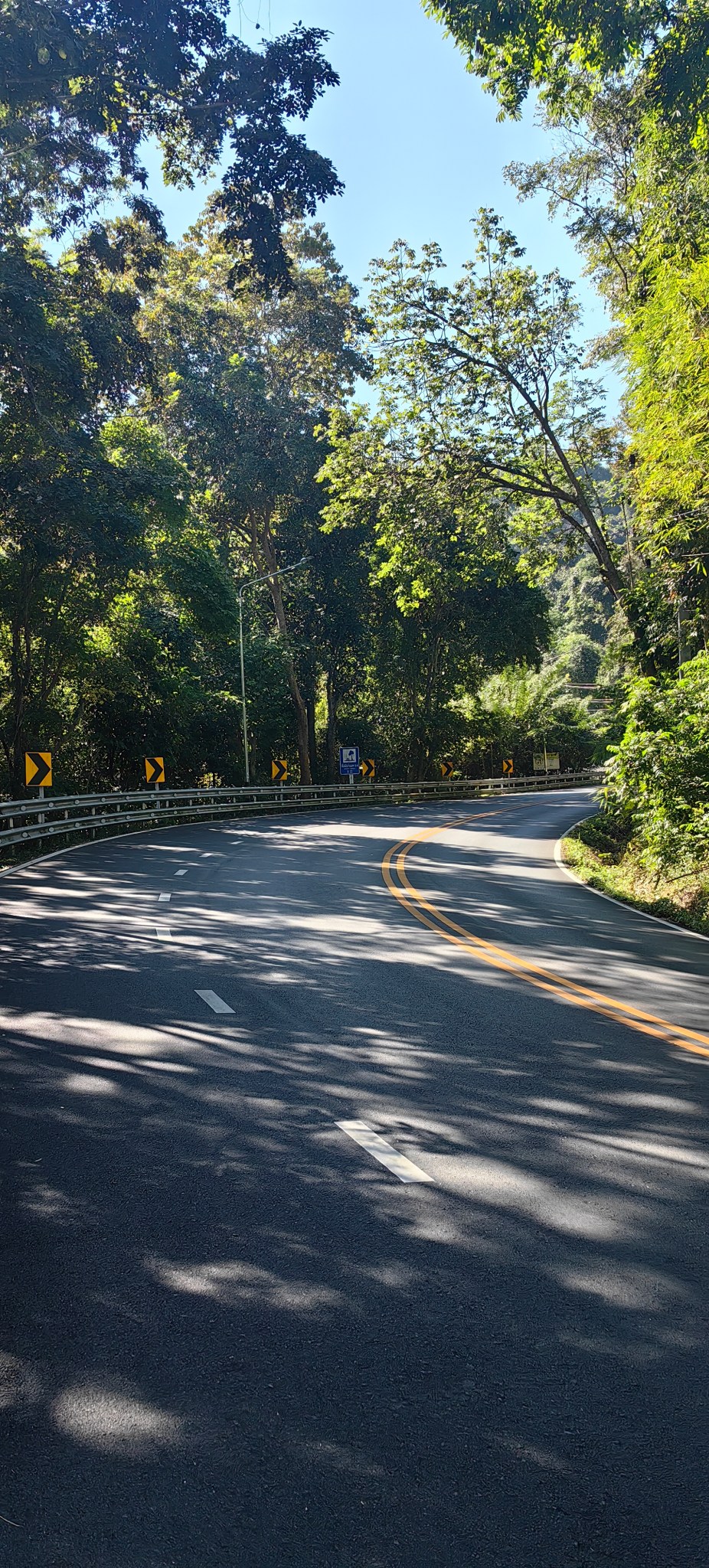
People usually take this road to Doi Suthep, which is known as Route 1004. It is a winding and scenic journey that starts from Chiang Mai university and ascends the mountain toward the famous Wat Phra That Doi Suthep. The road is paved in good condition. The length of the road is around 9km which is a challenge to most hikers especially in such a hot weather. Of course, tourists can choose to take cars up the mountain.
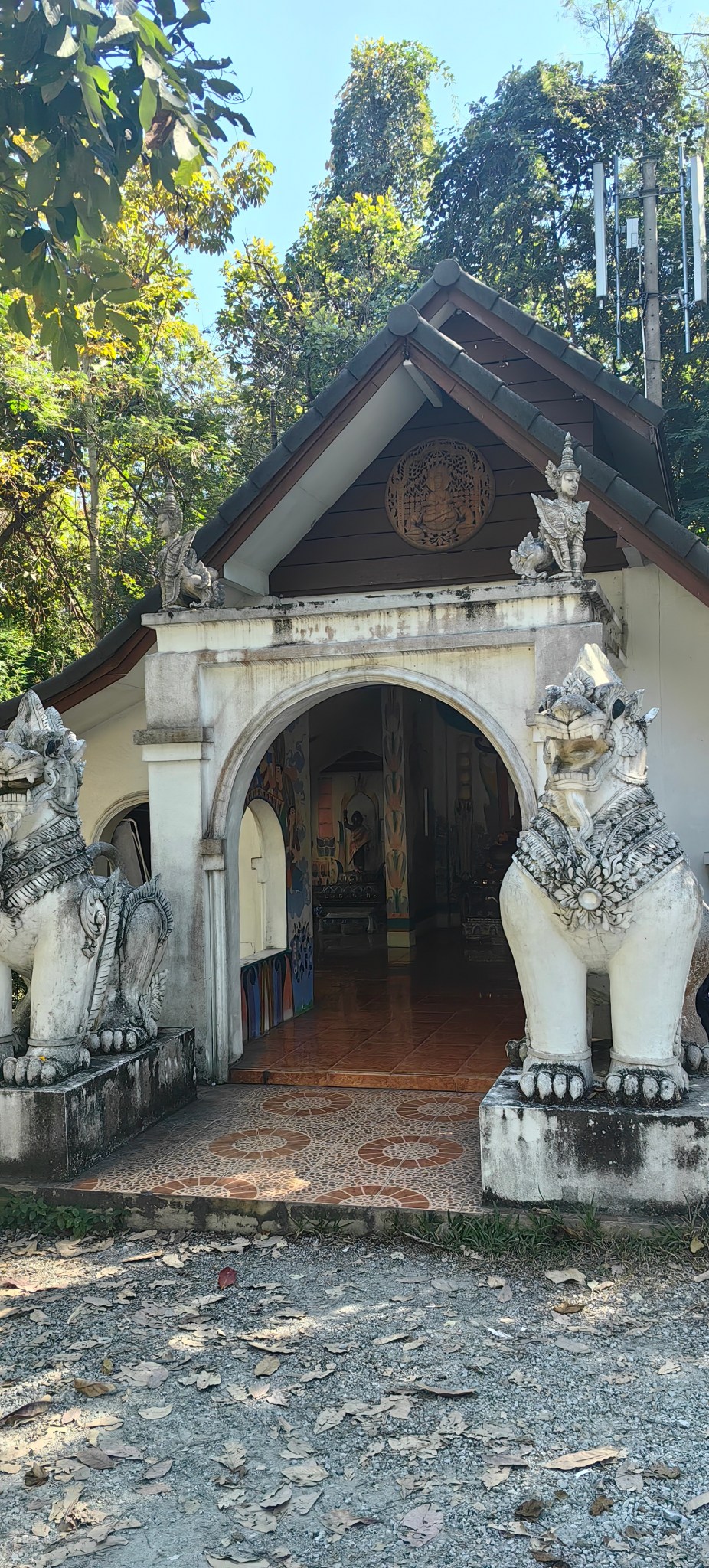
I took around 3 hours to walk to the summit. There are several viewpoints and temples along the road which make the trip no so boring. Wat Sri Soda is a serene Buddhist temple located at the base of Doi Suthep mountain. It is surrounded by greenery, making it a peaceful retreat away from the busier parts of Chiang Mai. It is a wonderful stop for those interested in exploring lesser-known temples in Chiang Mai, as well as for hikers looking to start the scenic trek up Doi Suthep.
我花了大约3个小时步行到山顶。沿路有几处观景点和寺庙,一路游览下来旅途就不会特别无聊。Wat Sri Soda 是一座宁静的佛教寺庙,位于素帖山脚下。它周围绿树成荫,是远离清迈繁华地区的一处宁静的休憩地。对于那些有兴趣探索清迈那些鲜为人知的寺庙以及想要开始徒步攀登素帖山的徒步旅行的徒步旅行者来说,这是一个绝佳的驻足点。
Huay Kaew Waterfall
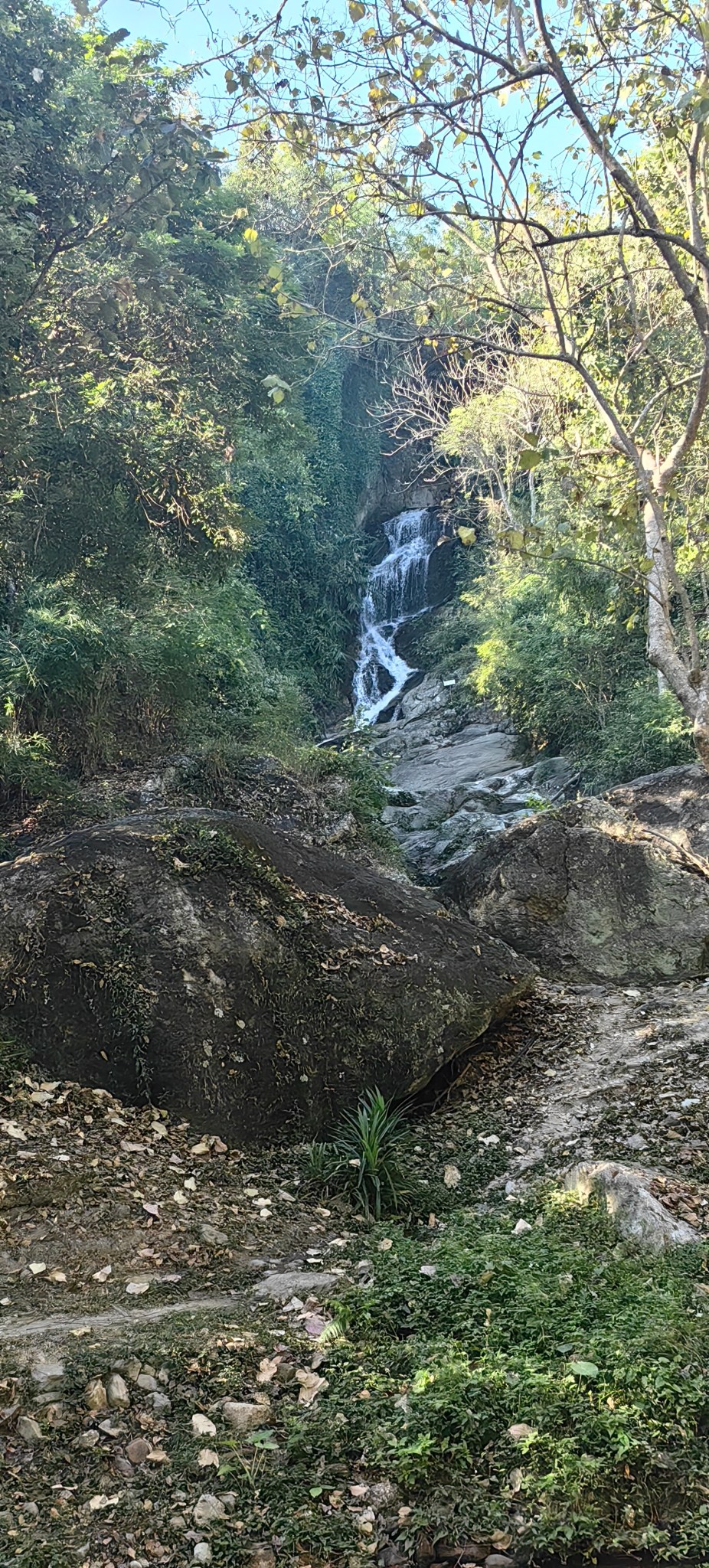
Huay Kaew Waterfall is a delicate and easily accessible waterfall located near the base of Doi Suthep mountain. The waterfall consists of multiple small cascades tumbling over rocks and boulders, with pools of water forming at various points. I could dip my feet in the cool water and relax by the stream. Though not very large, it is tranquil and provides a break from the city’s heat.
The waterfall doesn’t plunge in one dramatic drop but rather consists of several smaller cascades that flow down the rocks, creating a series of small falls. The stream weaves its way down the mountain, and small paths and trails run alongside parts of the watercourse. These pathways without many people are often used by hikers or visitors exploring the nearby area. Huay Kaew Waterfall is also the starting point for some of the more adventurous hikes up Doi Suthep, including the Monk’s Trail, which leads to Wat Pha Lat.
Wat Pha Lat, also known as “Monastery at the Sloping Rock,” was originally built as a resting point for pilgrims making the journey up the mountain to the revered Wat Phra That Doi Suthep. Legend has it that it was one of the spots where a sacred white elephant rested while carrying the Buddha’s relic up Doi Suthep, a significant event that led to the construction of Wat Phra That Doi Suthep at the mountain’s summit.
In my opinion, it was one historic temple really worth a visit. If the tourists took the car directly up towards the summit, they would have no such a chance to visit it. Wat Pha Lat is nestled deep in the jungle, surrounded by towering trees, bamboo groves, and the soothing sounds of a nearby stream. Its hidden location gives it a mystical, peaceful atmosphere that feels far removed from the hustle and bustle of the city.
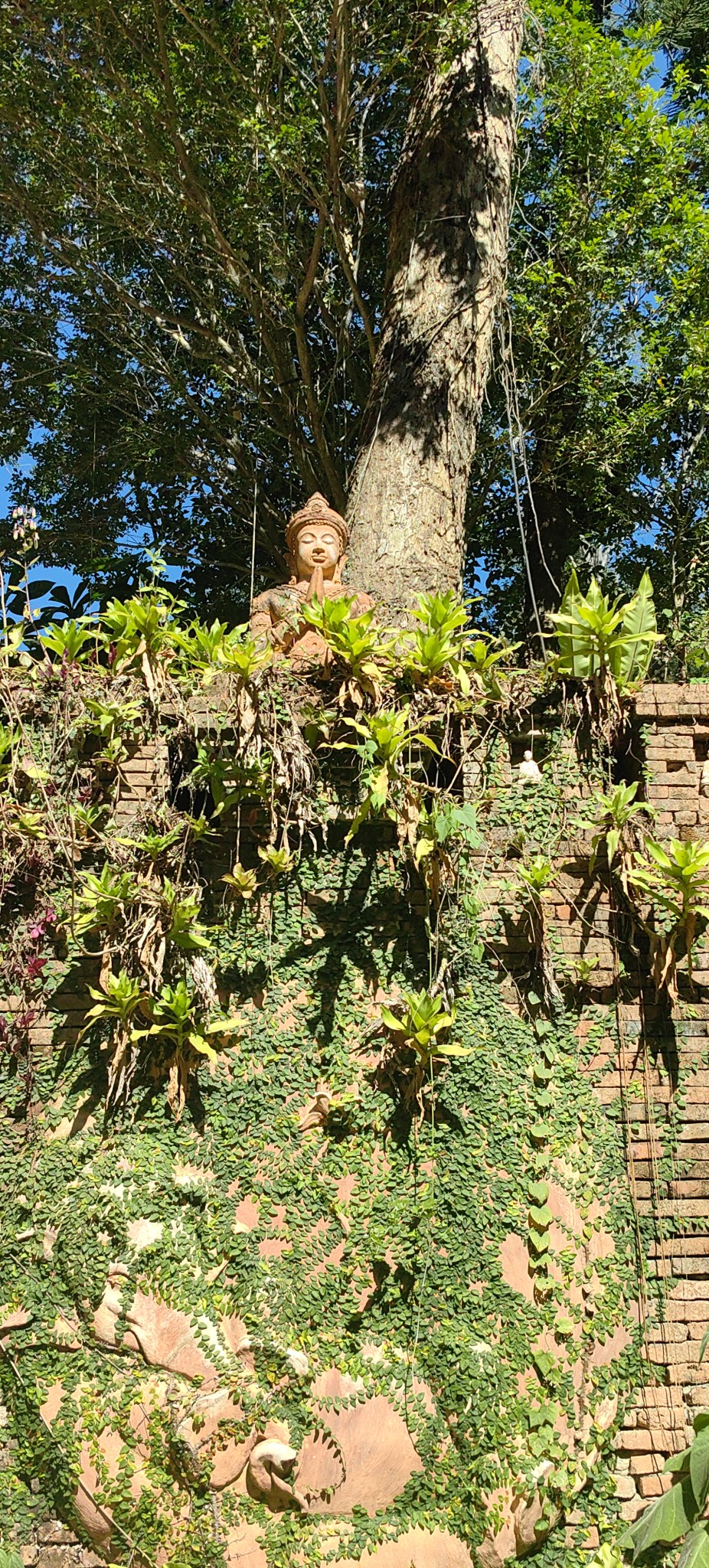
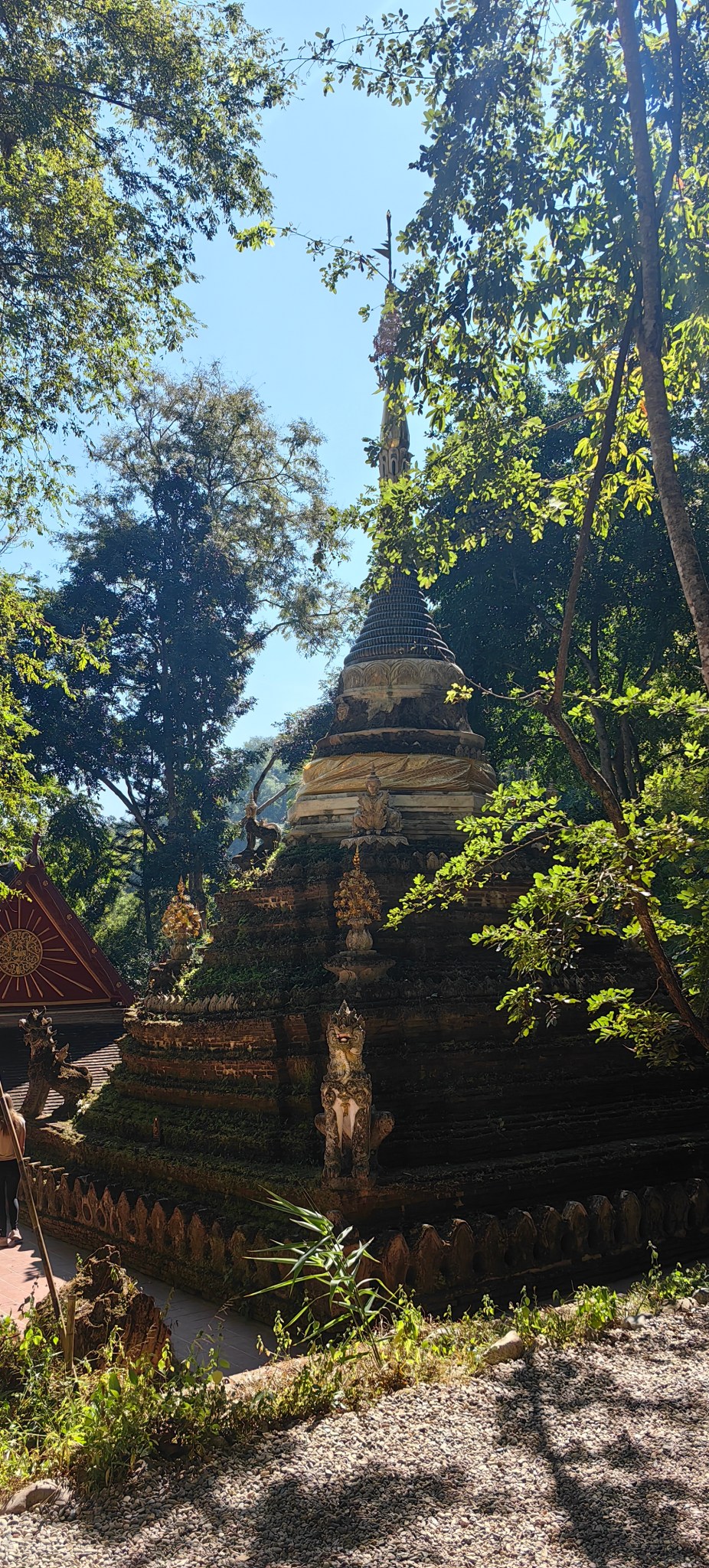
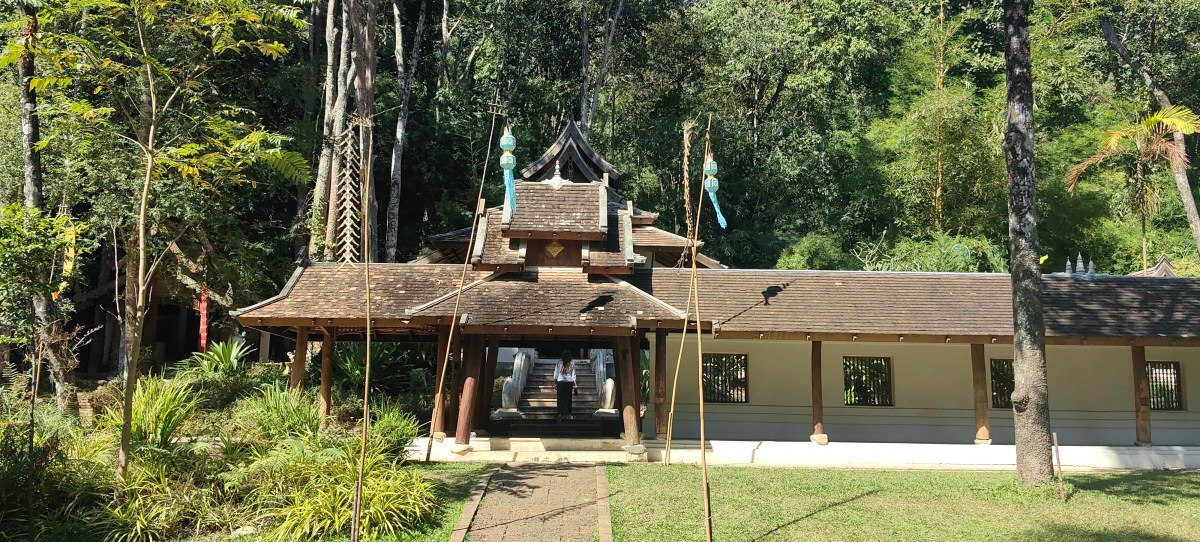
The temple’s architecture blends harmoniously with the natural landscape. Its structures, including a beautiful Buddha statue, meditation pavilions, and a stone chedi (stupa), are scattered along a hillside overlooking the valley below. Many of the temple buildings and shrines are adorned with intricate carvings and statues that have been weathered by time.
Unlike many of the grand and golden temples in Bangkok, the unique Lanna-style architecture in this temple blends harmoniously with the surrounding jungle. The temple grounds are filled with beautiful stone pathways and staircases that wind through the jungle. The use of stone gives the temple a natural, earthy feel. Many of these pathways are lined with Buddhist statues, such as serene Buddhas and mythical creatures like nagas.
Wat Pha Lat features several small pagodas which are typical in Buddhist temple design. These structures are often adorned with delicate carvings and designs, including lotus motifs and floral patterns. Though modest in size, they stand as symbols of spiritual significance and are important elements of the temple’s layout.
Scattered around the temple grounds are open-air pavilions where monks and visitors can sit in quiet reflection. Unlike more monumental temples, Wat Pha Lat’s architecture serves to complement the forested environment, offering a serene space for meditation, reflection, and quiet spiritual practice.
It was an excruciating journey from mountain bottom to the top under a scorching sunlight. Fortunately, there are some viewpoints along the road for visitors to have a short break and get a panoramic view of Chiang Mai city. The blue sky is exceptionally clear which is dotted by white clouds. Some vendors will sell grilled pork or chicken skewers, marinated in a mix of Thai herbs and spices or fried sausages and coconuts at these places. It was really a necessary supply of food and drink for hikers like me after walking more than two hours.
I continued to walk upwards until I saw this waterfall. It was very close to the destination of this journey – Wat Phra That Doi Suthep. Rap Sadet is a beautiful, multi-tiered waterfall with several cascades that flow down rocks and boulders into small pools. The waterfall isn’t very tall but has a gentle and serene flow. It is surrounded by thick forest and lush vegetation, and there are no tourists here. The dense greenery, the sound of the cascading water, and the cooler mountain air make it a refreshing escape from the heat of Chiang Mai.
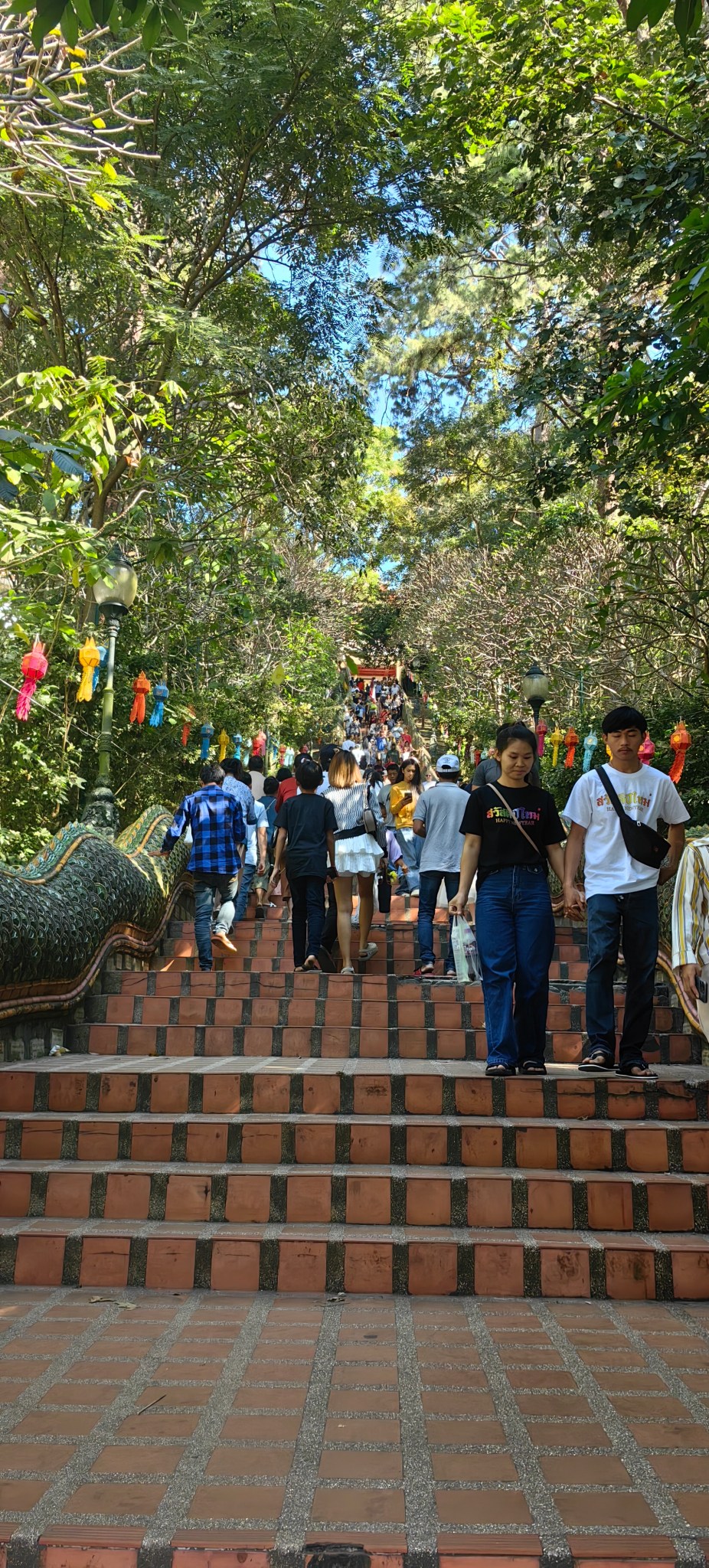
Wat Phra That Doi Suthep is one of the most iconic and revered temples in Thailand. The temple is an important pilgrimage site for Thai Buddhists, particularly during religious holidays. There are so many tourists here. Before visiting it, tourists must climb up this super high steps. The 306-step staircase is lined with intricately decorated naga figures that symbolize protection. It is believed that climbing the staircase is part of the spiritual journey.
The central feature of Wat Phra That Doi Suthep is the golden chedi, which is visible from many parts of Chiang Mai. The chedi is covered in gold leaf and shines brightly in the sunlight, making it a striking symbol of the temple. It enshrines the sacred Buddha relic, and worshippers walk around it in a clockwise direction as part of their prayers.
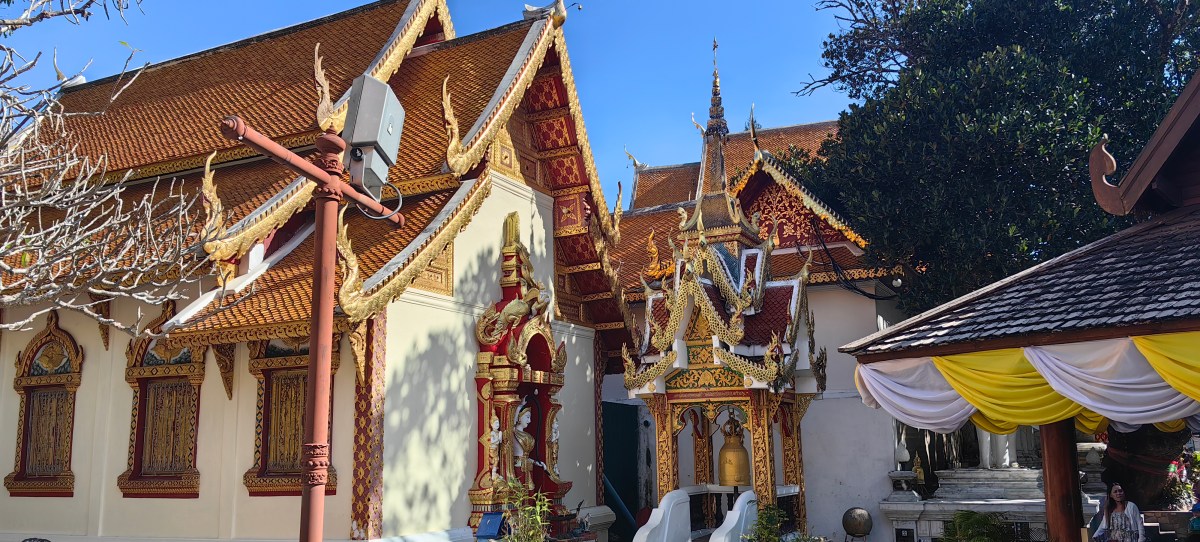
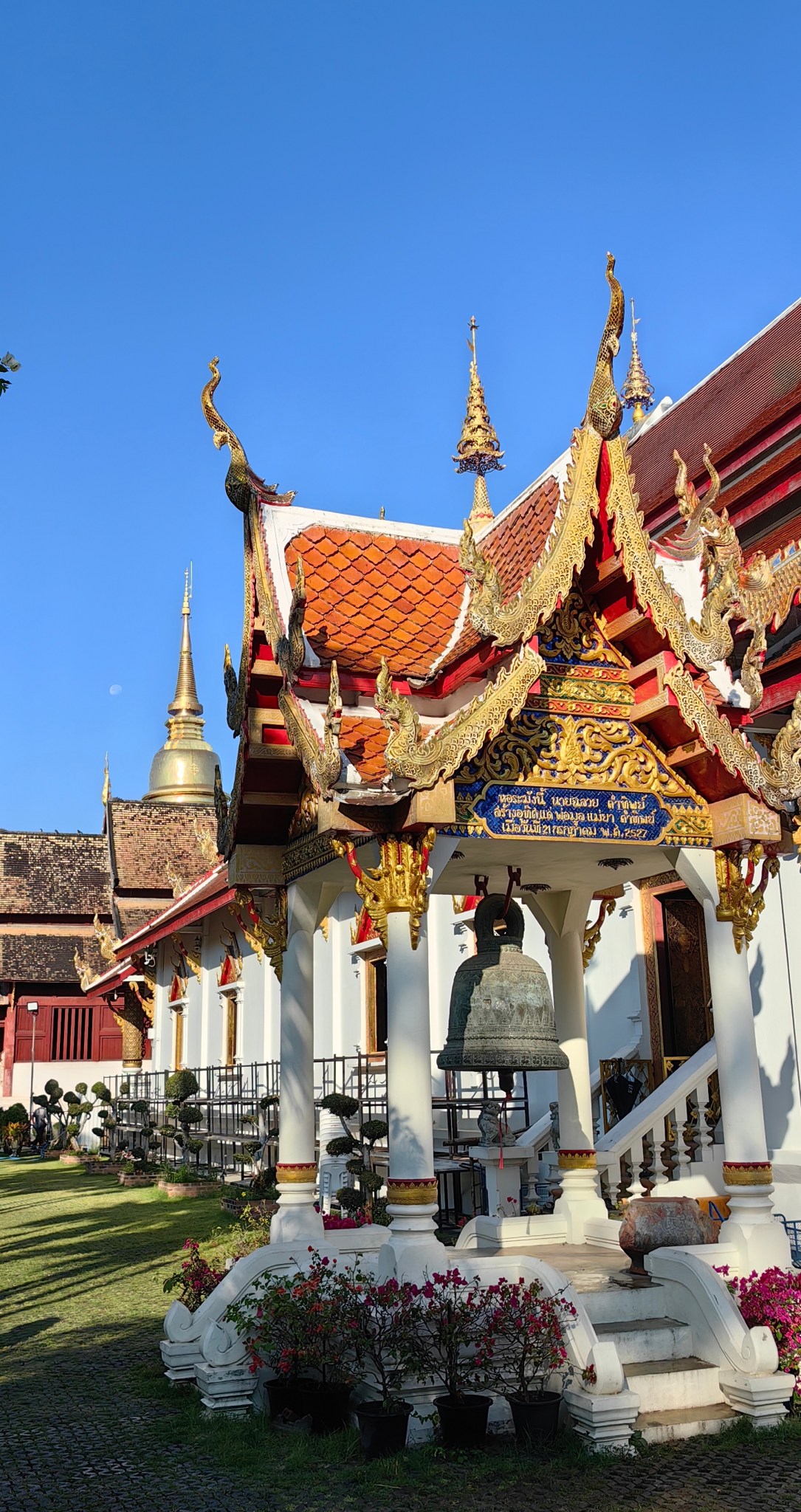
The temple’s architecture is a prime example of Lanna-style design, with intricately carved wooden structures, golden umbrellas, and detailed murals depicting the life of the Buddha. The roofs are adorned with gold and red, typical of Northern Thai temple design. Throughout the temple grounds, I can find statues of Buddha, shrines, and small pagodas, all contributing to the sense of reverence. Large bronze bells are located throughout the temple grounds, which visitors can ring for good luck.
Founded in 1383, Wat Phra That Doi Suthep has a rich history linked to the legend of a sacred white elephant. According to the legend, the elephant carried a holy relic of the Buddha to the top of Doi Suthep and stopped at the site where the temple now stands, indicating that this was the place to build the temple. The relic is said to be enshrined in the temple’s central chedi. Wat Phra That Doi Suthep is a symbol of Chiang Mai’s religious and cultural heritage. It is not only an architectural marvel but also a deeply spiritual site that draws tourists seeking to connect with Thai Buddhist culture.
This temple is not the summit of this mountain. If visitors continue further up the road, they will reach Bhubing Palace, a royal residence known for its beautiful gardens, and eventually Doi Pui Village. After visiting this temple, I took a songthaew (shared taxi) back down to the city since I didn’t have enough energy to continue hiking. As the one day journey to Doi Suthep comes to an end, the golden glow of Wat Phra That Doi Suthep fades into the soft hues of dusk. Such a trip is really exhausting but mentally refreshing. The journey may be over, but the memory of this experience will always linger.
这座寺庙并不是这座山的顶峰。如果游客继续沿着这条路往前走,他们将到达以美丽花园而闻名的皇宫蒲屏宫,并最终到达 Doi Pui 村。参观完这座寺庙后,由于没有足够的精力继续徒步旅行,我只能乘坐双条车(一种共乘的出租车)返回市区。随着前往素帖山的一日游结束,远眺素帖山的金色光芒逐渐消失在黄昏的柔和色调中。这样的旅行躯体着实疲惫,但精神上却很放松。这次旅程也许已经结束,但旅行的经历却将弥留在脑海中永远挥之不去。
In the lush mountainous region of northern Thailand, Chiang Mai is a city that beautifully blends ancient tradition with modern allure. Once the capital of the Lanna Kingdom, this city is known for its rich history, stunning temples, and vibrant cultural scene. With a serene backdrop of misty mountains, Chiang Mai offers a unique charm that captivates travelers seeking both adventure and tranquility.
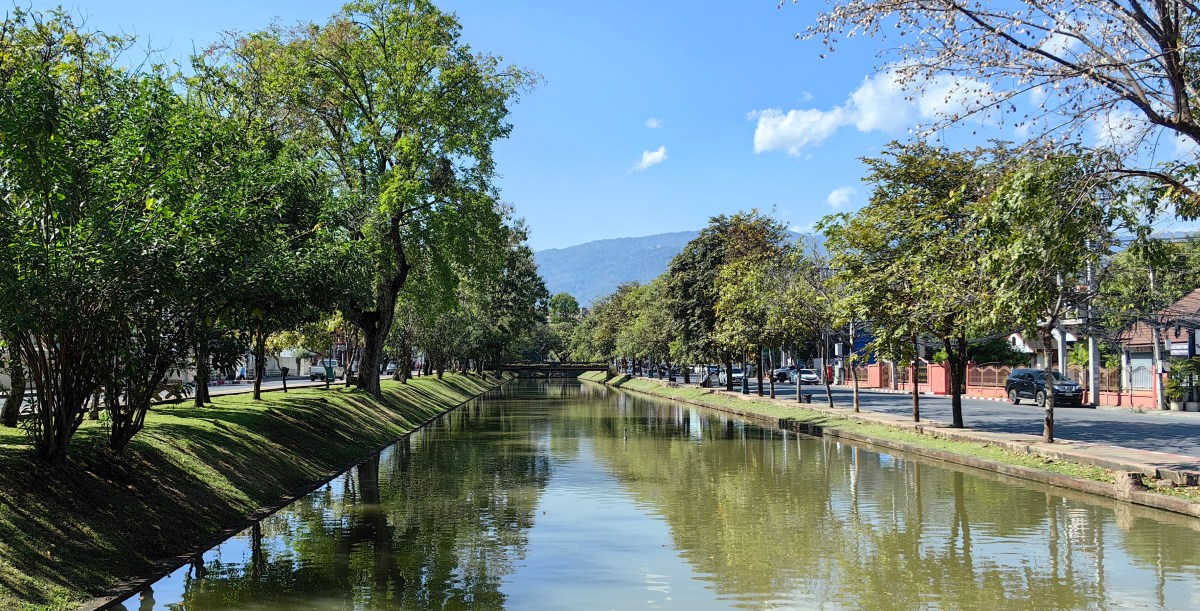
I visited this beautiful city on December 30th,2023 and stayed here for three days. The most attractive site of Chiang Mai is its old city which lies at the heart of Chiang Mai. It is a nearly perfect square that measures about 1.5 kilometers on each side. This area is defined by its ancient walls and moats, which were originally constructed in the late 13th century during the reign of King Mangrai to protect against invasions and rival kingdoms. Originally, the moat served as a defensive barrier, filled with water to deter invaders. Today, it is a tranquil feature that runs alongside the main roads and is lined with trees, providing a scenic backdrop for the hustle and bustle of city life.
The Old City’s walls, although not fully intact, still feature several original and reconstructed sections that mark the perimeter. Four main gates—Tha Phae Gate, Chiang Mai Gate, Suan Dok Gate, and Chang Phuak Gate—serve as entry points and are named after their respective cardinal directions. In any corner of Chiang Mai, I could always see the majestic mountains surrounding the city that create a dramatic and picturesque backdrop. The Doi Suthep in the background rises over 1,600 meters above sea level and is very close to the city center.
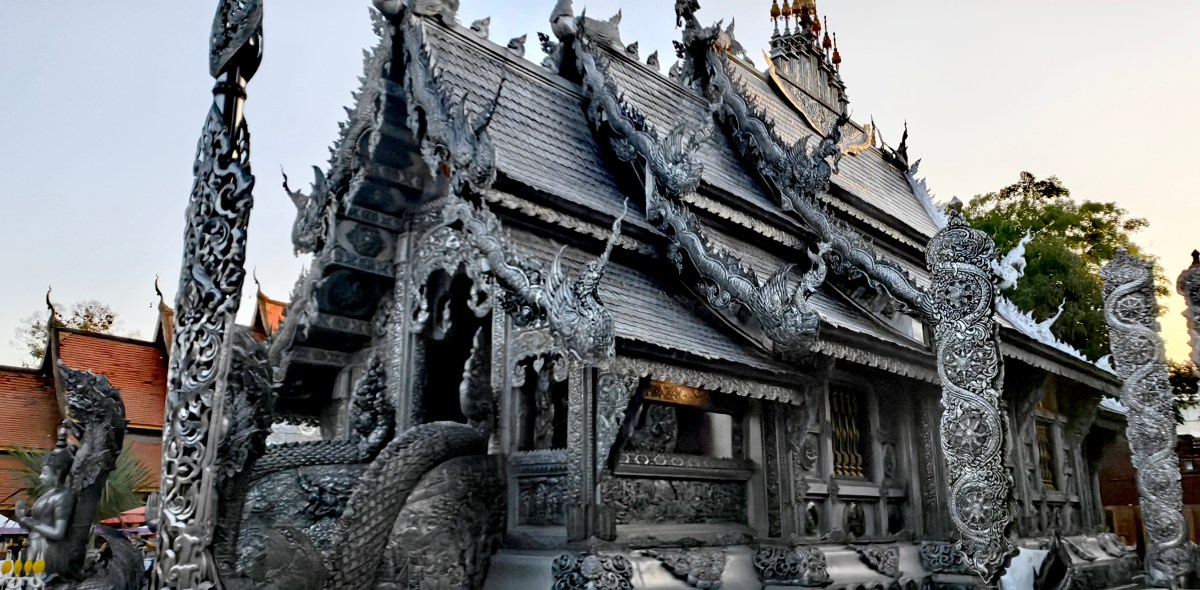
I visited numerous temples from south of the city towards north. Wat Sri Suphan, also known as the Silver Temple, is one of Chiang Mai’s most unique and striking temples. was originally built in 1501 during the reign of King Muang Kaew of the Lanna Kingdom. Over the centuries, it has undergone numerous renovations and expansions. The temple holds great historical significance as it served as a spiritual center for the local community and has been a part of Chiang Mai’s culture for over 500 years.
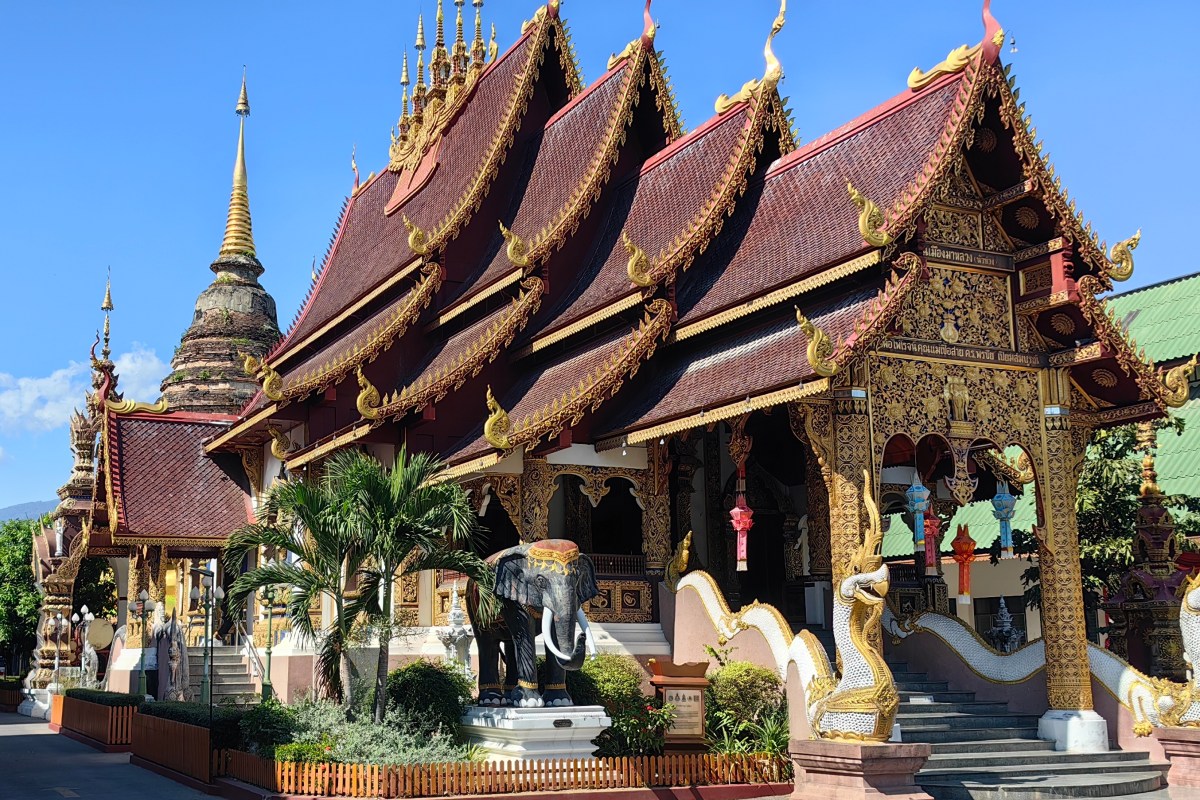
Located in the traditional silver-making district of Wua Lai, this temple is renowned for its intricate silver decorations and artistry. The entire exterior of the ordination hall (ubosot) is covered in silver, aluminum, and nickel alloy panels, meticulously crafted by local artisans. These panels depict intricate designs and scenes from Buddhist mythology, as well as Lanna culture and history. The entrance to the ordination hall is flanked by elaborately carved Naga (mythical serpent) staircases, which are common in Lanna temple architecture and symbolize protection and prosperity.
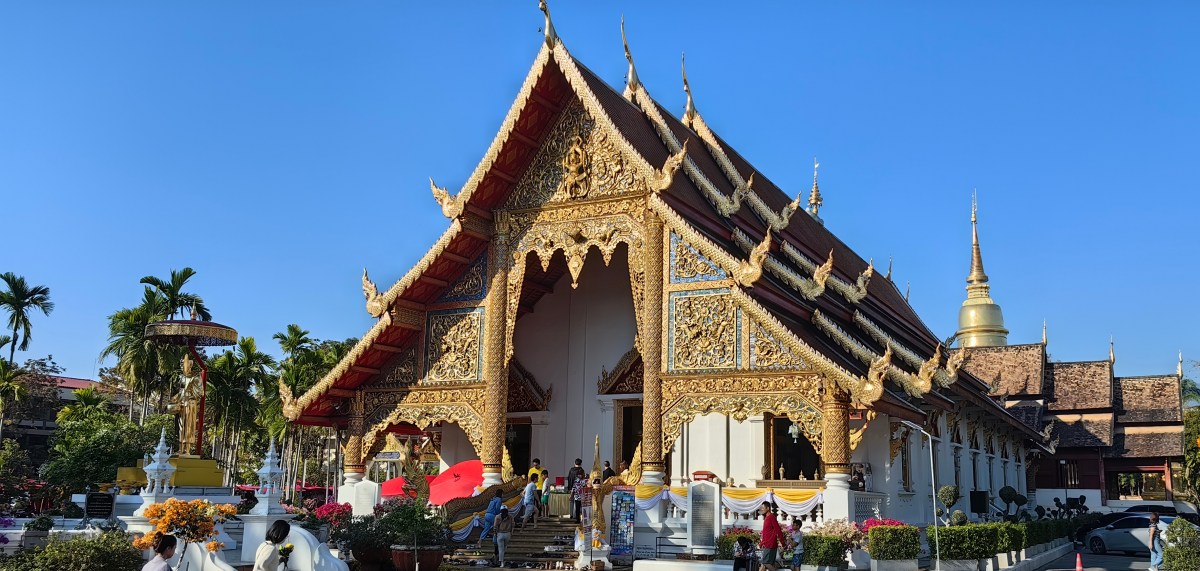
Among numerous temples in Chiang Mai, the most famous one was the Wat Phra Singh which was founded in 1345 by King Phayu of the Lanna Kingdom to house the ashes of his father. The temple complex is a prime example of Lanna architectural style. It is a significant pilgrimage site, especially during the Songkran festival (Thai New Year), when the revered Phra Buddha Singh statue is paraded through the streets of Chiang Mai. The temples in Chiang Mai usually include Viharn Lai Kham, Ubosot, Ho Trai, and Chedi.
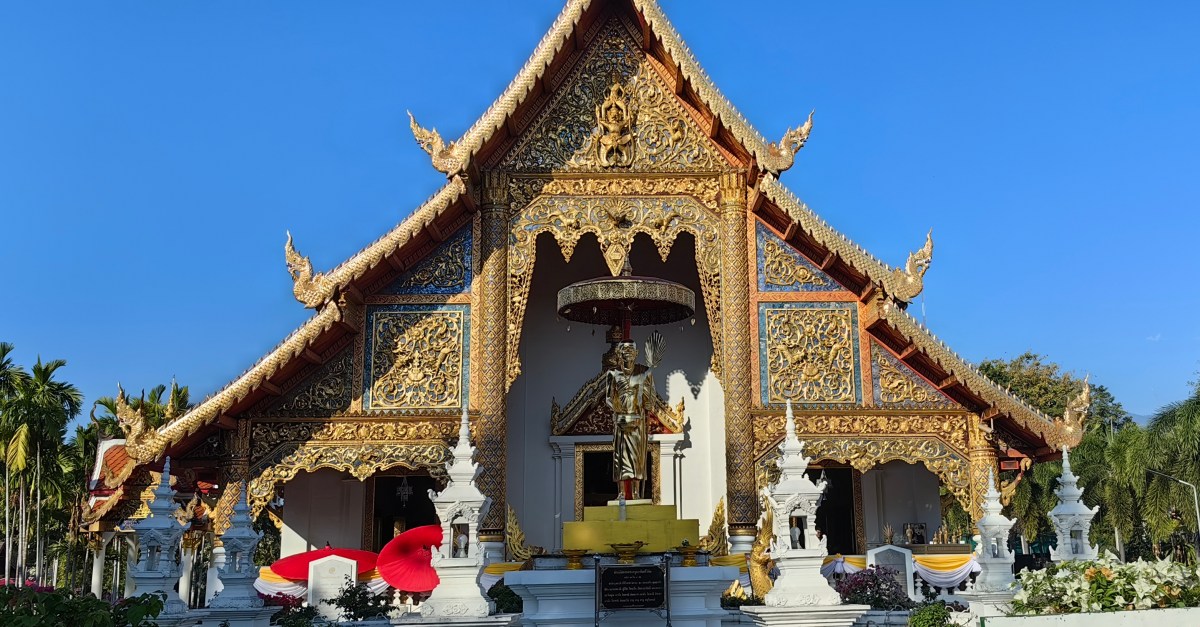
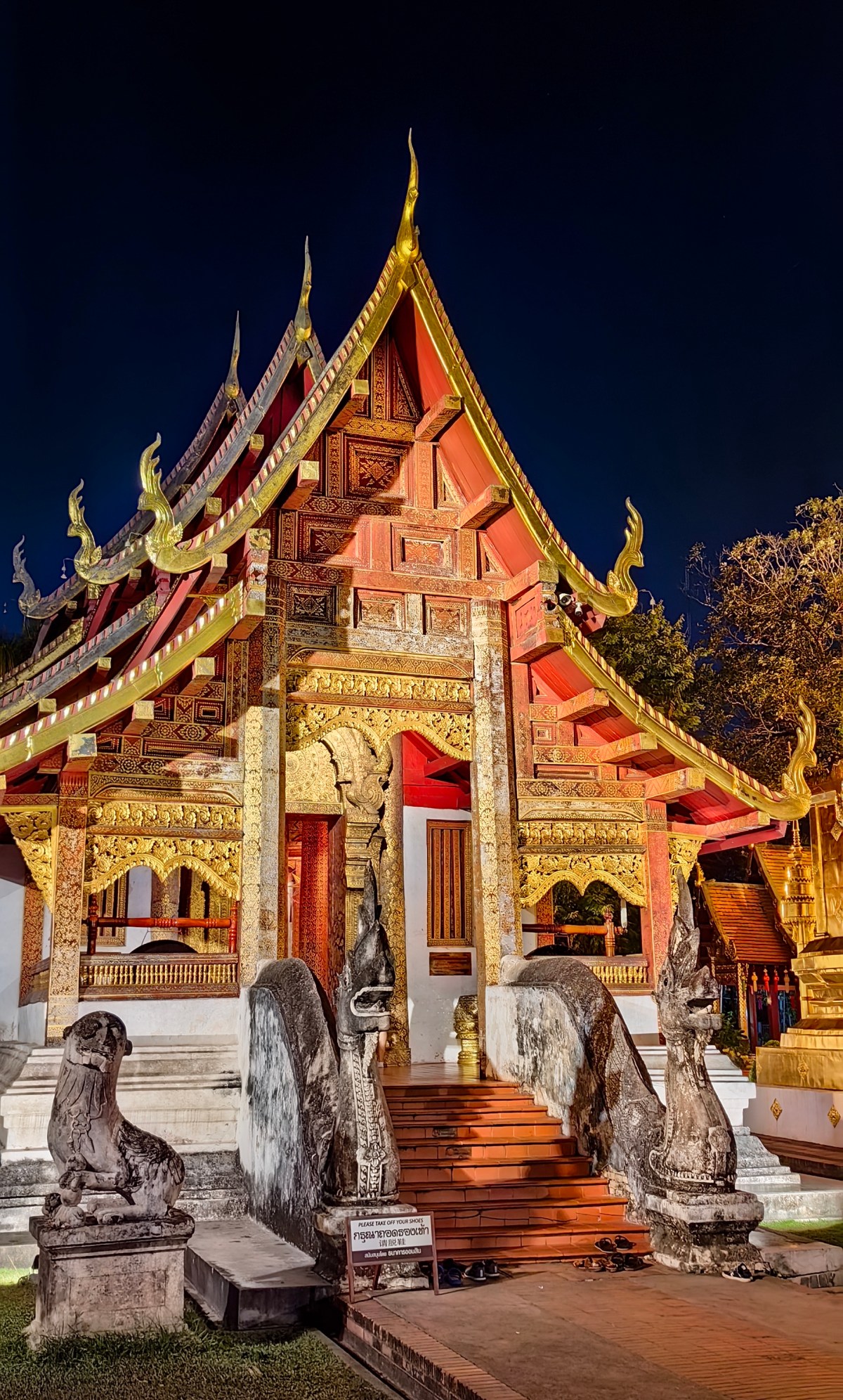
The Viharn Lai Kham or called main chapel is the temple’s most celebrated building, showcasing Lanna architecture. It features a multi-tiered roof, a characteristic element of Lanna temples, which adds to its grandeur. The roof is intricately decorated with gilded naga finials at the ends of each tier, symbolizing protection and fertility. The exterior of the viharn is adorned with exquisite carvings and gilded decorations.
The entrance is particularly striking, with its intricately carved wooden panels depicting mythical creatures and floral motifs. The gable is richly decorated with gold leaf, and the doorways are framed with delicate, hand-carved wood, showcasing the skill of Lanna artisans.
I lived near this temple and had a chance to visit it at night. This temple is illuminated all though the night and looked more splendid. The Ubosot at Wat Phra Singh, where monks are ordained, is a smaller but equally beautiful structure. It features similar Lanna architectural elements, with a steep, multi-tiered roof and intricate wood carvings. The ubosot is slightly elevated, with a platform surrounded by lotus-shaped boundary stones known as “Bai Sema,” which mark the sacred area. In Thailand, visitors must take off shoes before visiting the interior of any buildings of temples so it is better wear slippers to visit these temples.
The Ho Trai, or called scripture library, is another example of classic Lanna architecture. This small, square building is elevated on a stone base, with a wooden upper structure. The stone base is often adorned with stucco reliefs depicting mythical creatures such as Garuda and Naga. Traditionally, the Ho Trai is used to store Buddhist scriptures, safeguarding them from insects and moisture. The wooden structure above is beautifully decorated with intricate carvings, gold leaf, and lacquer work, making it a jewel of Lanna design. On the high wall of the library, I can find many Buddha statues in the Chiang Saen style, characterized by their rounded faces, broad shoulders, and serene expressions.
The most prominent building in this temple must be the large, bell-shaped tower. This tower called chedi, was constructed in the classic Lanna style, and has a square base that gradually tapers into a cylindrical shape, crowned with a golden spire. The base of the chedi is adorned with elephant statues, a common motif in Lanna architecture, symbolizing strength and support. The spire is gilded, catching the sunlight and making it a focal point of the temple complex. The chedi is believed to house relics of the Buddha, making it an important site for pilgrims.
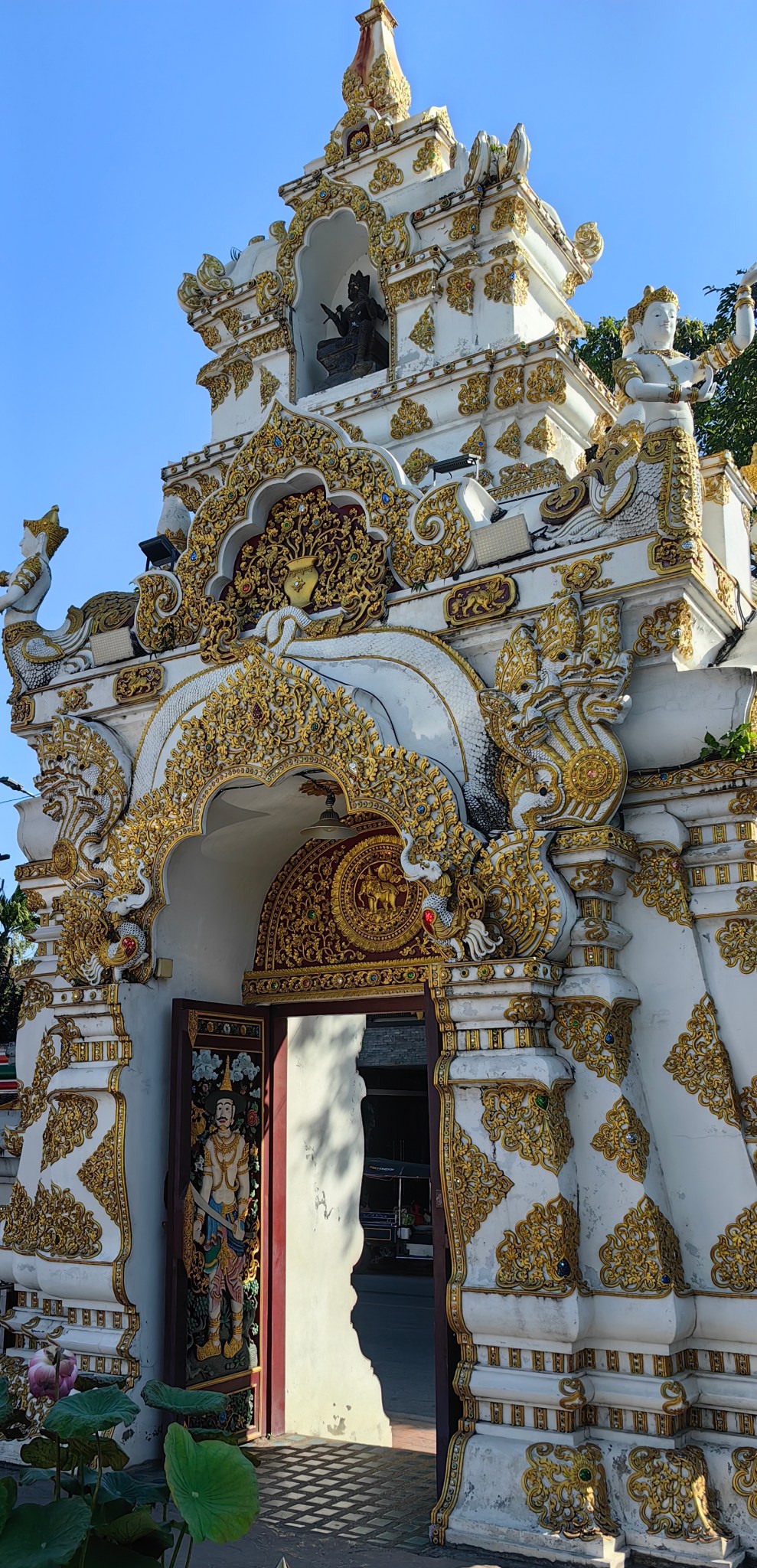
When I walked through the streets of Chiang Mai, I noticed some tower-like gates. These gates, often known as “Pratu” or “Prasat”, marking the entrance to the sacred temple grounds. These structures can range from simple, elegant designs to more elaborate and intricate constructions. The prasat is characterized by its tall, slender form that tapers as it rises, symbolizing the connection between the earthly realm and the heavens. The gates are typically coated in white stucco, which gives them a pristine, ethereal appearance. The white symbolizes purity and the spiritual sanctity of the temple grounds. This white surface is often contrasted by intricate gilded details, which add a sense of opulence and divine radiance. The gold leaf or gilding is applied to carvings of mythical creatures, floral motifs, and sacred symbols that adorn the gate, creating a striking visual effect.
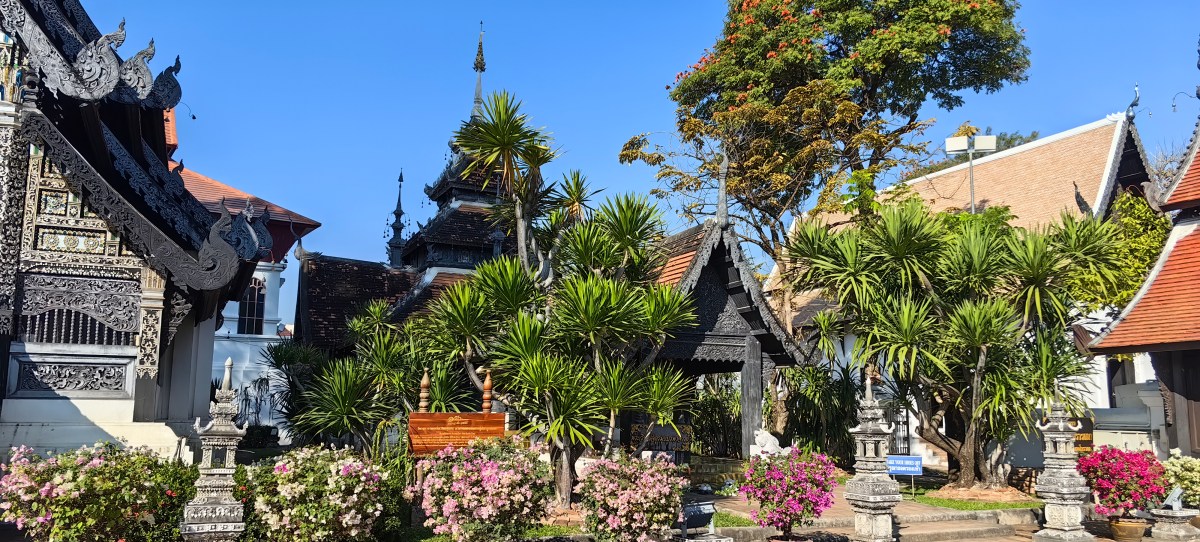
Wat Chedi Luang was another icon monument in Chiang Mai. It was constructed in the 14th century during the reign of King Saen Muang Ma, who intended it to house the ashes of his father. The construction of the chedi took nearly a century, with various additions and renovations made by subsequent rulers. At its peak, the chedi stood at an impressive height of 82 meters, making it the tallest structure in Chiang Mai at the time. However, in 1545, a major earthquake partially destroyed the chedi, reducing its height by almost half.
契迪龙寺是清迈的另一座标志性建筑。它建于14世纪,在国王 Saen Muang Ma 统治时期,他打算将父亲的骨灰安葬于此。这座佛塔耗时近一个世纪才建成,之后的统治者对其进行了多次扩建和翻新。在巅峰时期,佛塔高达82米,是清迈最高的建筑。然而,1545年的一场大地震摧毁了佛塔的部分建筑,使其高度降低了近一半。
When I visited in Thailand, I found some interested cultures. City pillars, known as “Lak Mueang” in Thai, are a kind of sacred pillars found in many cities throughout Thailand. They hold deep cultural and spiritual significance and are considered the spiritual heart of a city. In the corner of this temple, the pillar of Chiang Mai is housed in a small shrine and is a focal point of the annual Inthakin Festival, where locals come to pay respects and make offerings to ensure the city’s prosperity and protection. The shrine itself is a small white and grey colored building in this photo, showcasing ornate Lanna-style carvings and designs.
Like other major tempes, Wat Chedi Luang has the main assembly hall where devotees gather to pray and participate in religious ceremonies. It is a large, open structure featuring a multi-tiered roof, supported by massive teak columns. The roof is adorned with naga finials and other intricate woodwork typical of Lanna architecture.
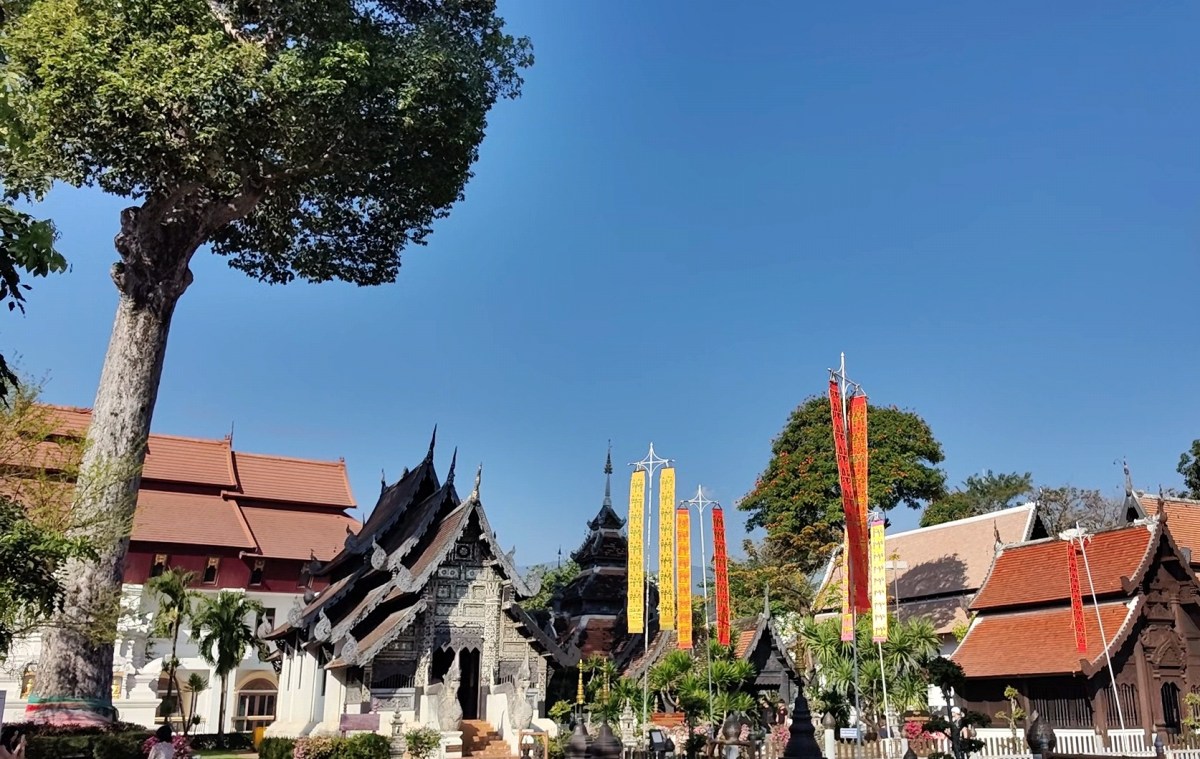
This is one street view of Chiang Mai. The old city is extremely small but there are numerous unknown temples sitting one by one along the street, reflecting the influence of Buddhism to this city. There are several monuments and iconic temples worthy to visit like Wat Chedi Luang, Wat Chiang Man, and Wat Phra Singh. These places are always overcrowded but tourists could still take their free time to visit others.
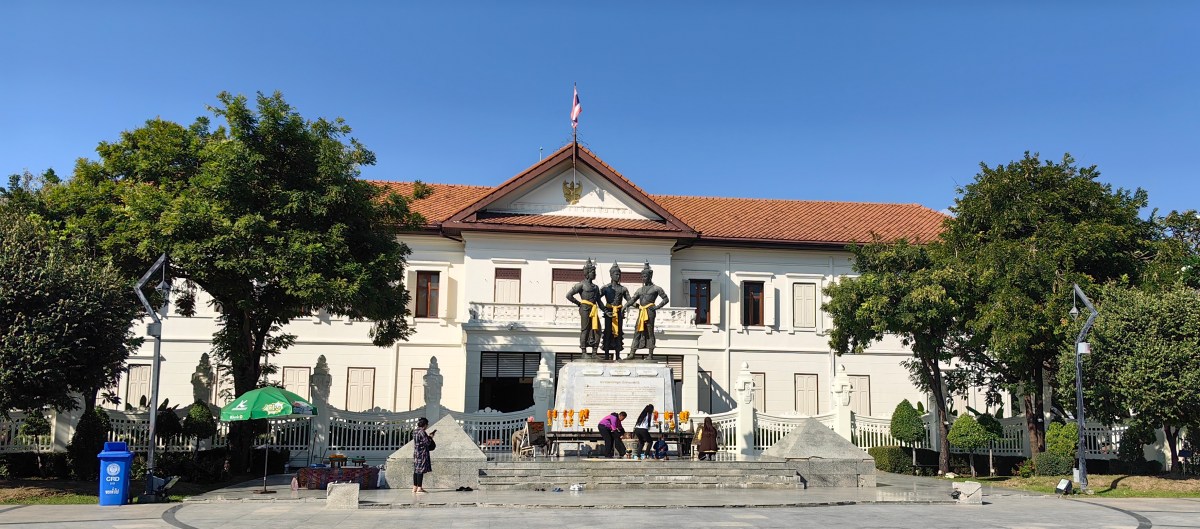
The Monument of the Three Kings, located in the heart of Chiang Mai’s Old City, is one of the most iconic and historically significant landmarks. This monument commemorates the founding of Chiang Mai and honors the three legendary kings who played pivotal roles in its establishment and development. The most prominent of the three, King Mengrai was the founder of Chiang Mai and the first ruler of the Lanna Kingdom. He selected the site for the new capital, Chiang Mai, in 1296, seeking a strategically advantageous location that was well-defended by natural barriers such as rivers and mountains. The ruler of the Sukhothai Kingdom, King Ramkhamhaeng is known for his friendship with King Mengrai. Their alliance strengthened the ties between the Lanna and Sukhothai kingdoms, facilitating cultural exchange. The king of Phayao, King Ngam Muang was another close ally of King Mengrai. The three kings formed a powerful alliance that fostered peace and prosperity in the region. The square where the monument is located is a popular gathering spot for both locals and tourists. It is often used for local festivals and markets.
I travelled from the Wat Phra Singh to the north of the city. Wat Chiang Man is the most beautiful temple among so many temples in Chiang Mai in my mind. It is the oldest temple in Chiang Mai and a significant historical and spiritual site, deeply rooted in the city’s history. Founded in 1296, during the reign of King Mengrai, the temple is not only an architectural treasure but also a repository of some of the most revered and ancient Buddha images in Thailand. It has a small garden, filled with various native plants and flowers, adding to the temple’s tranquil atmosphere.
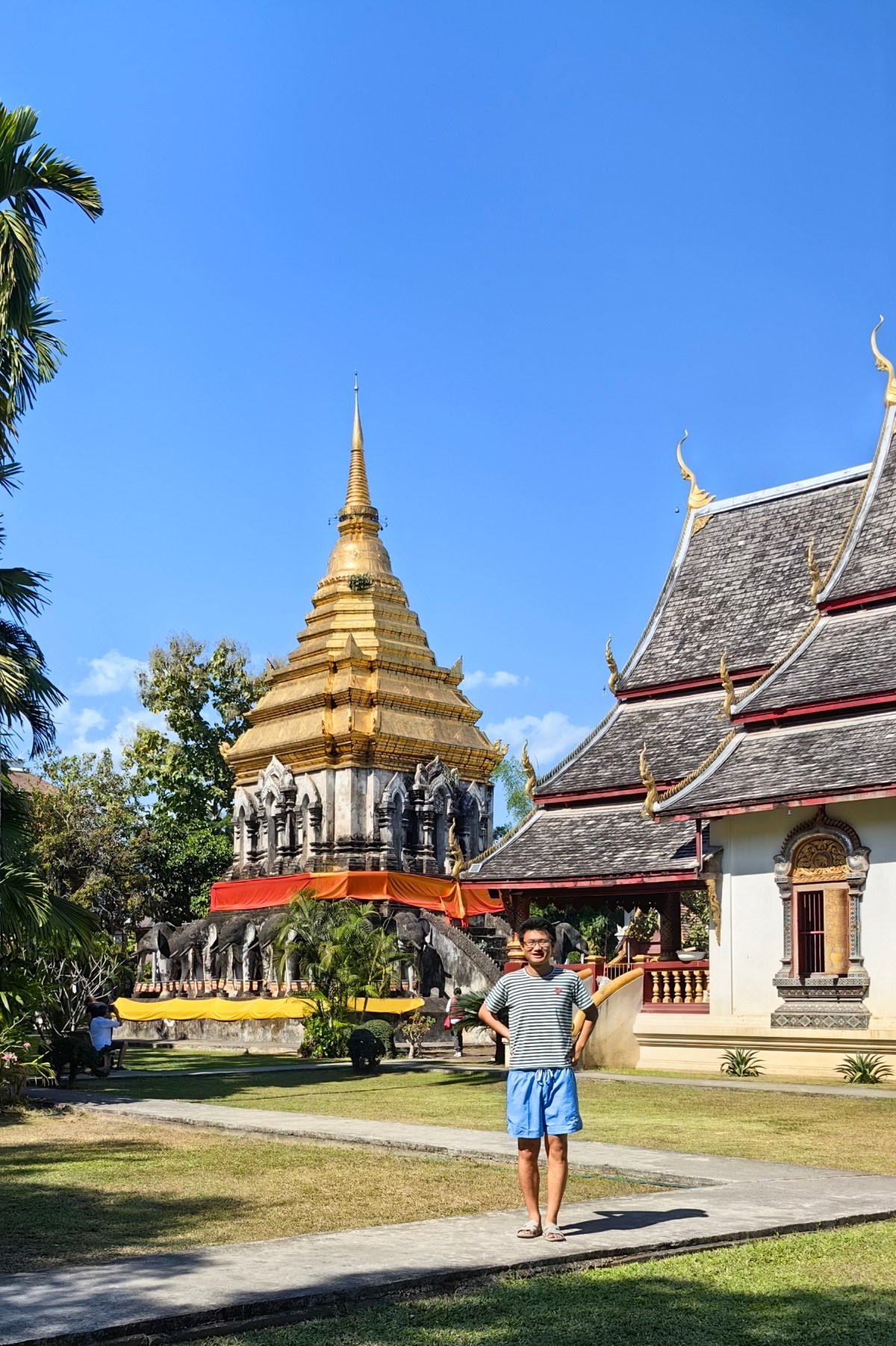
One of the most striking features of Wat Chiang Man is the Chedi Chang Lom, also known as the Elephant Chedi. This chedi is a classic example of Lanna architecture, with a square base adorned with 15 life-sized elephant statues. These elephants, made of stucco, appear to be emerging from the base of the chedi. The upper part of the chedi is gilded, catching the sunlight and creating a stunning contrast with the stone and stucco elephants below. This gilded spire is a hallmark of Lanna-style stupas, symbolizing the connection between the earth and the heavens.
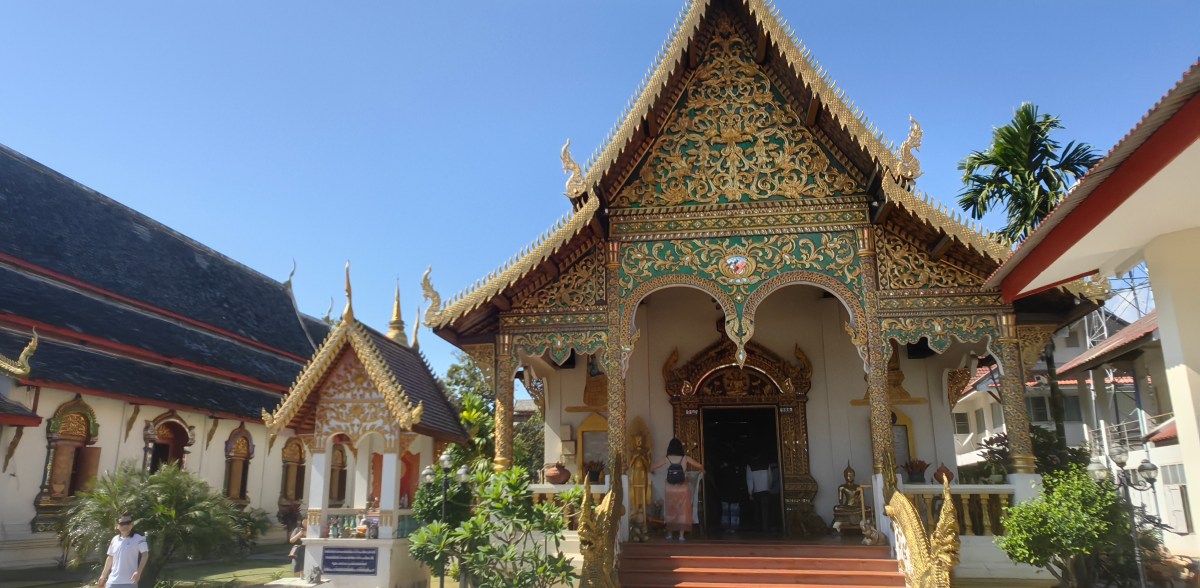
In this temple, green glazed tiles are frequently used on roofs. The green roofs contrast beautifully with the gold and red commonly used in other parts of the temple, creating a visually striking effect that blends with the natural surroundings. Green is often associated with nature, growth, and renewal. In a spiritual context, it can symbolize the idea of life, fertility, and the nurturing aspect of the natural world.
As the first temple built in Chiang Mai, Wat Chiang Man holds a special place in the hearts of the local people. It has been a center of religious and cultural life for centuries, maintaining its importance through various periods of the city’s history. The main assembly hall houses the state of Phra Sae Tang Khamani (Crystal Buddha).The temple is especially important during Thai New Year (Songkran), when it becomes a focal point for religious activities and celebrations.
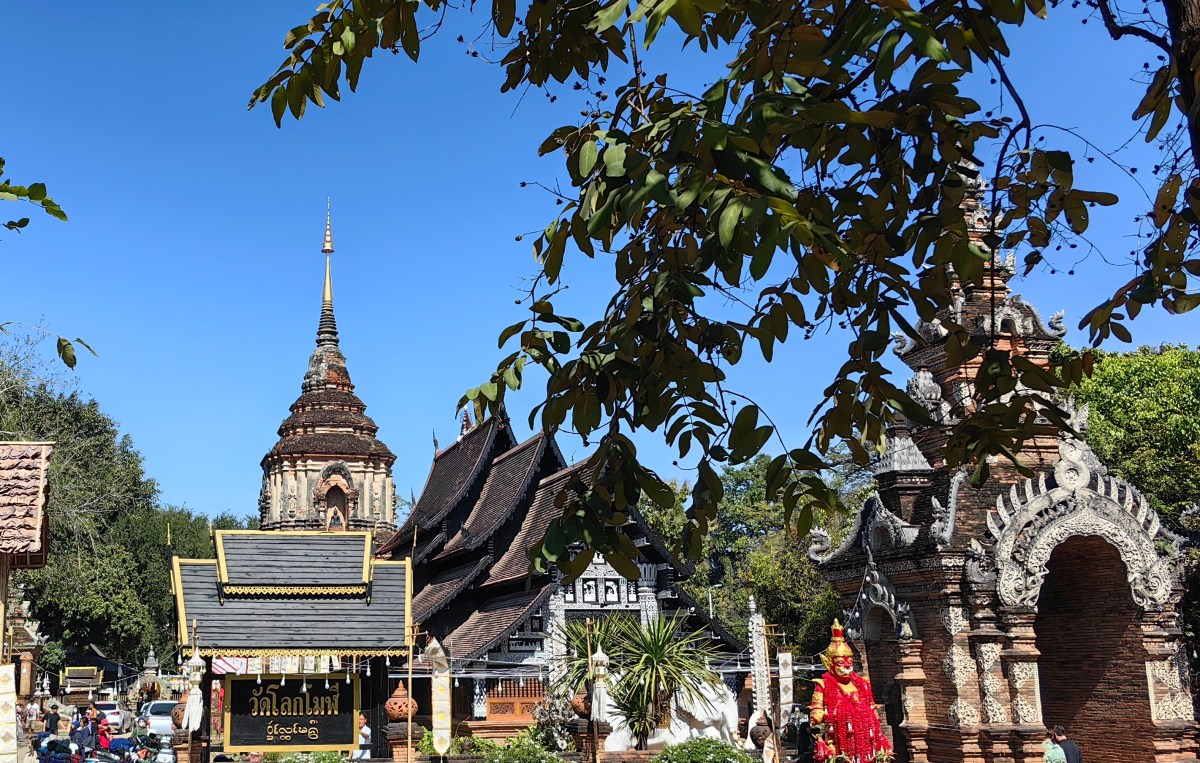
Continuing walking towards north, I arrived at the Wat Lok Moli near the Chang Phuak Gate. Its architecture looked a bit different. Wat Lok Moli built in the 14th century stands out for its connection to the Mengrai Dynasty, which played a crucial role in the history of the Lanna Kingdom. The entrance to Wat Lok Moli left me deep impression. This gate is tower-like and richly decorated, featuring intricate woodwork and symbolic imagery.
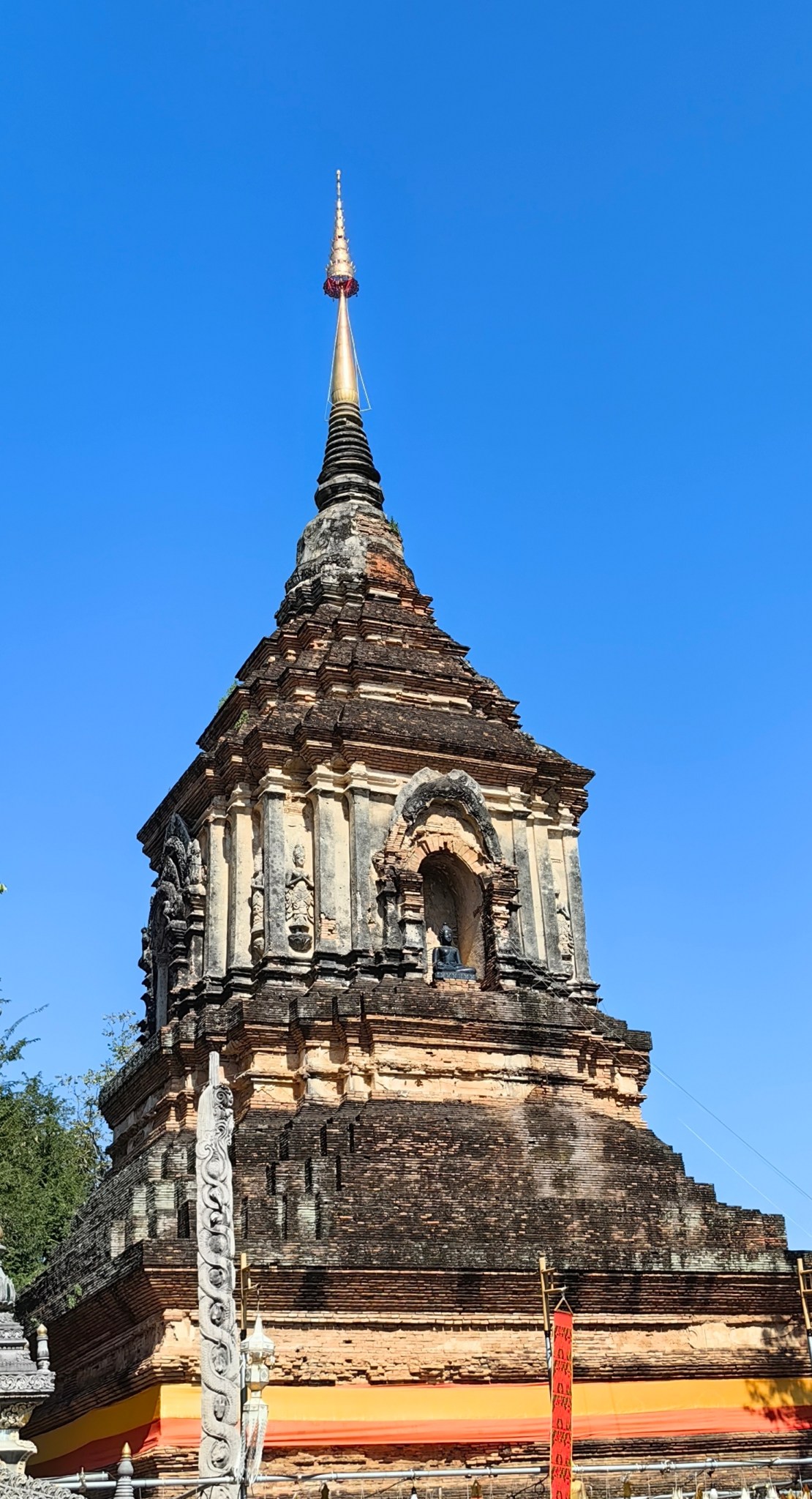
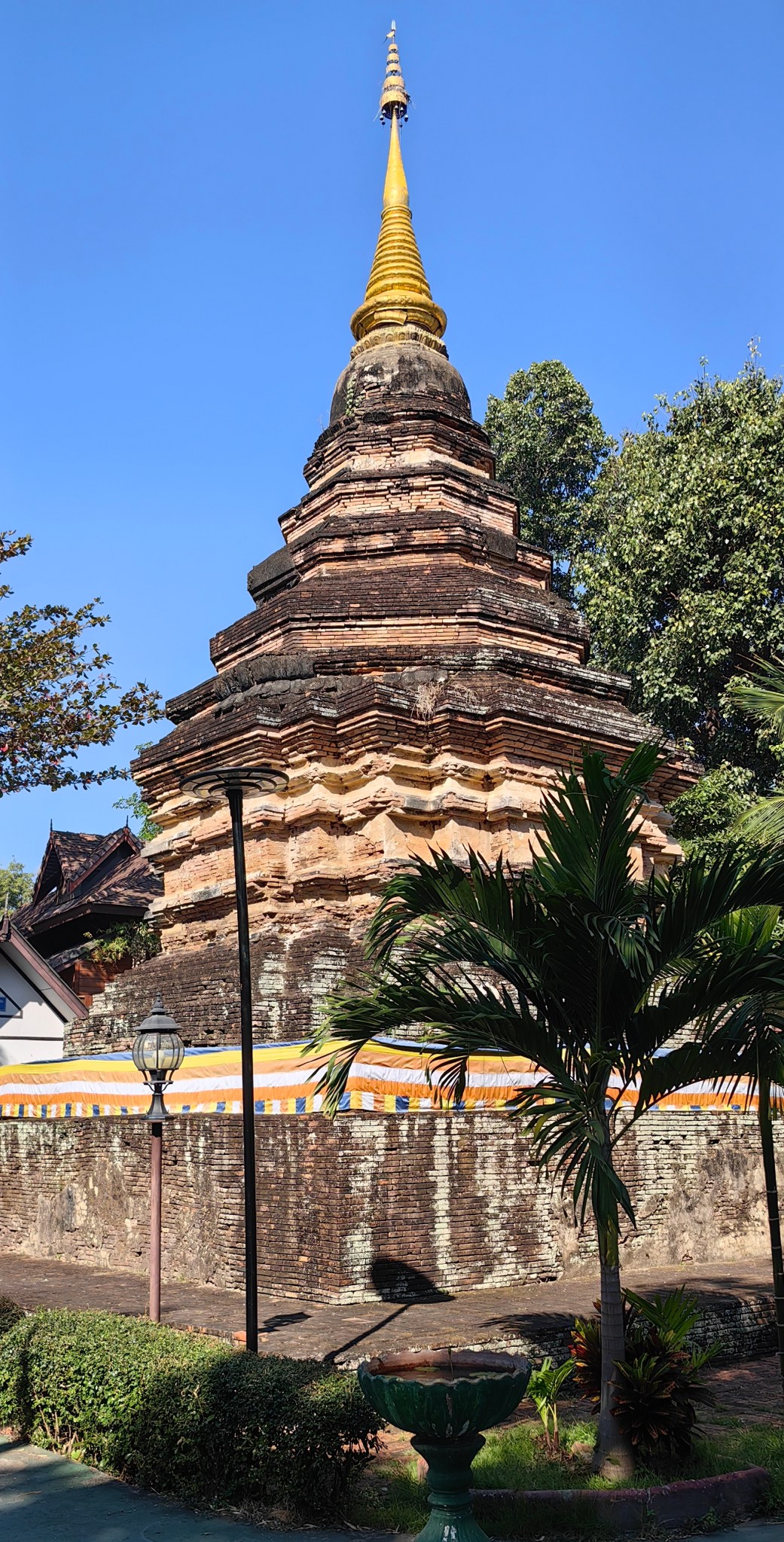
For every temple in Chiang Mai, the most prominent architecture must be the chedi. Unlike other temples, the chedi at Wat Lok Moli has been left largely unplastered, giving it a rustic and ancient appearance. The weathered bricks and the absence of stucco decoration highlight the raw beauty and historical authenticity of the structure.
Except the major tourist attractions, I visited some small temples as well. Wat Umong Mahathera Chan is a lesser-known but historically significant temple located in the heart of Chiang Mai’s Old City. The temple is often overshadowed by more famous sites, yet it holds its own unique charm and importance.
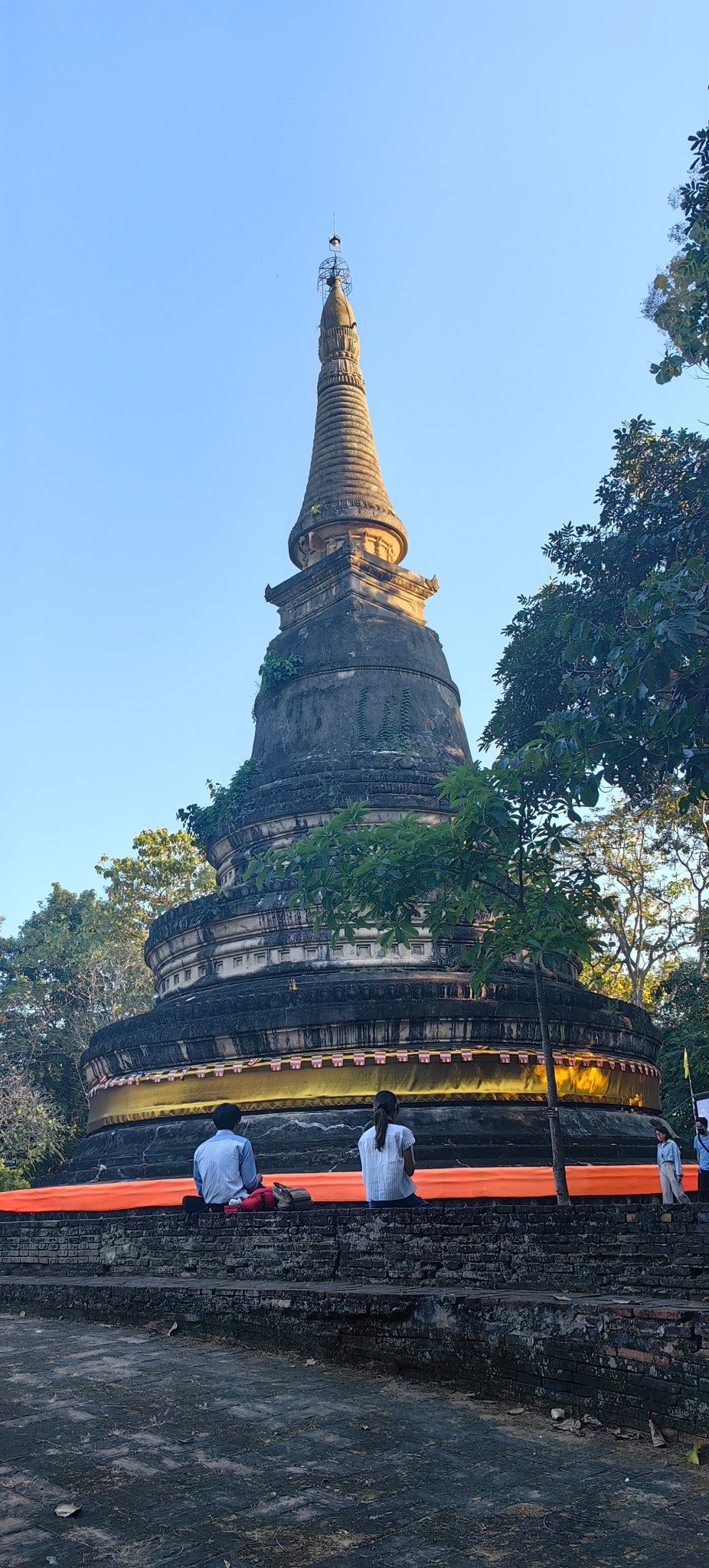
Wat Umong Mahathera Chan is notable for its historical architecture, including several ancient structures that reflect the rich heritage of the Lanna Kingdom. The old chedis at Wat Umong Mahathera Chan are typically constructed in the Lanna style, characterized by a bell-shaped base that tapers into a spire at the top. The chedis are usually built from brick and stucco, with the surfaces often covered in layers of weathered plaster, giving them an aged, venerable appearance.
The base of the chedis is generally square or octagonal, with multiple tiers that create a sense of elevation. Each tier is often adorned with decorative motifs, such as lotus petals, which are common in Lanna architecture. The central part of the chedi, shaped like an inverted bell, is the most prominent feature. This section may be plain or decorated with stucco reliefs, sometimes featuring images of the Buddha, floral patterns, or mythical creatures like Nagas (serpents). The spire, or the uppermost section, tapers gracefully into a pointed tip, symbolizing the Buddhist path to enlightenment. The spire often includes a series of rings or parasol-like structures known as “chatra,” which are emblematic of royalty and spiritual authority.
This kind of water jars, often made of stone or ceramics, are commonly placed around temple grounds as decorative elements. The jars are usually filled with water, and the lotus flowers are planted in them floating on the surface. The purple lotus is a beautiful and symbolic element commonly found in Thai temples. The lotus is a powerful symbol in Buddhism, representing purity, enlightenment, and spiritual rebirth.
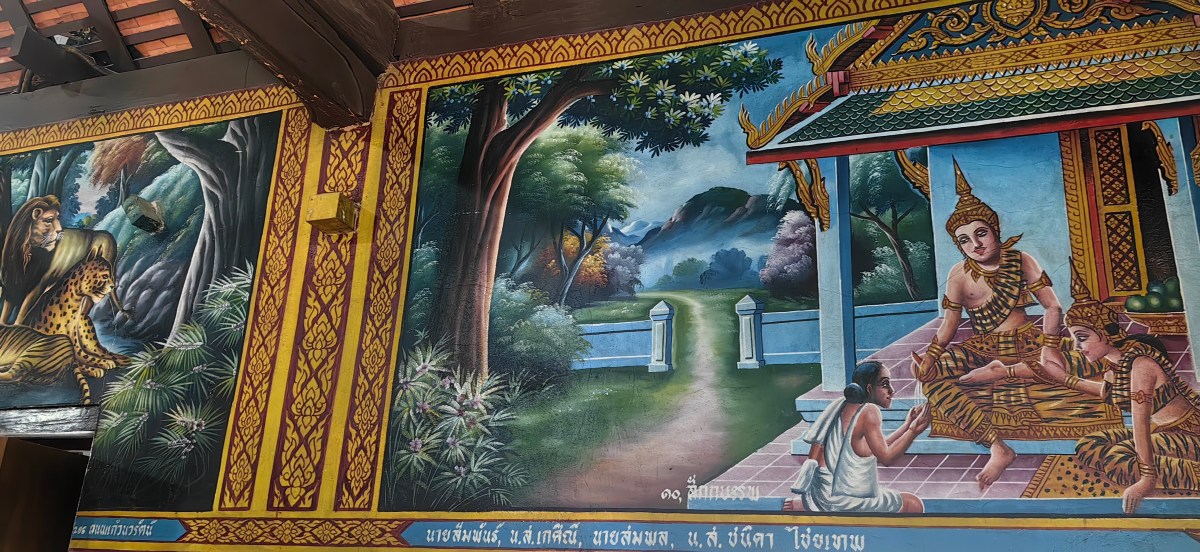
I noticed that there were always interior paintings in the halls of Thai temples, often depicting scenes from Buddhist mythology, the life of the Buddha, and traditional Lanna culture. One of the most common themes in temple murals is the Jataka tales, which are stories of the Buddha’s past lives. These stories are illustrated in a series of panels, each representing different moral lessons, such as compassion, self-sacrifice, and wisdom. Some murals often depict key events in the life of the historical Buddha, Siddhartha Gautama.
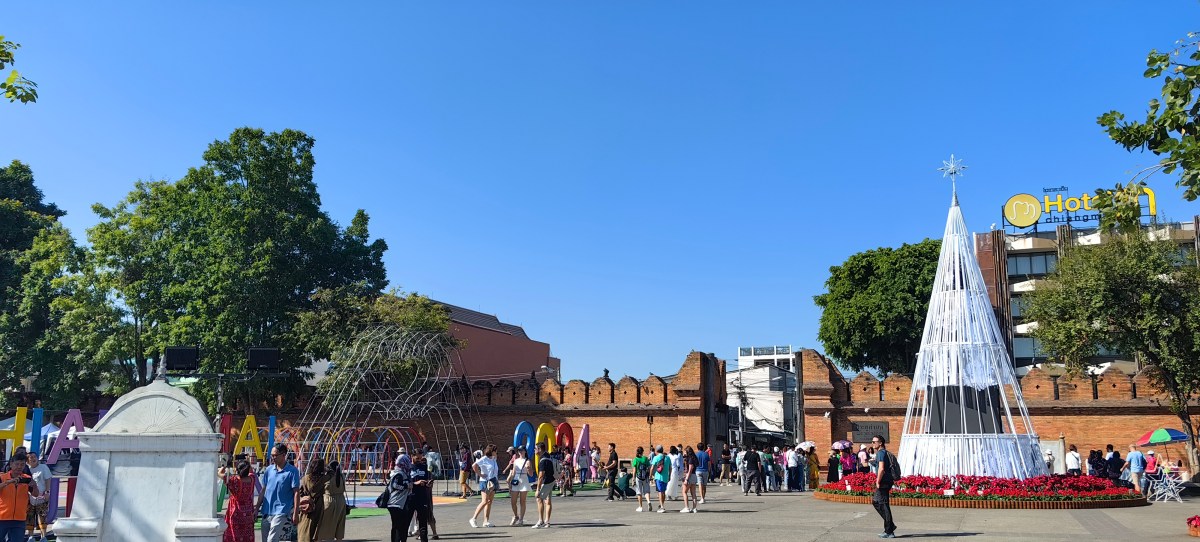
Except the old temples, the remnants of city gate marked the city’s history as well. The Tha Phae Gate is one of the most iconic landmarks in Chiang Mai, serving as a historical and cultural symbol of the city. Located on the eastern side of old city, the Tha Phae Gate is part of the ancient city wall established in 1296 by King Mengrai, the founder of the Lanna Kingdom. The original gate has been restored multiple times over the centuries. The current structure, with its distinctive red brick facade, is a result of renovations done in the 19th and 20th centuries. Today, Tha Phae Gate is more than just a historical structure; it is a vibrant cultural hub. The area around the gate hosts various events and celebrations like the countdown 2024.
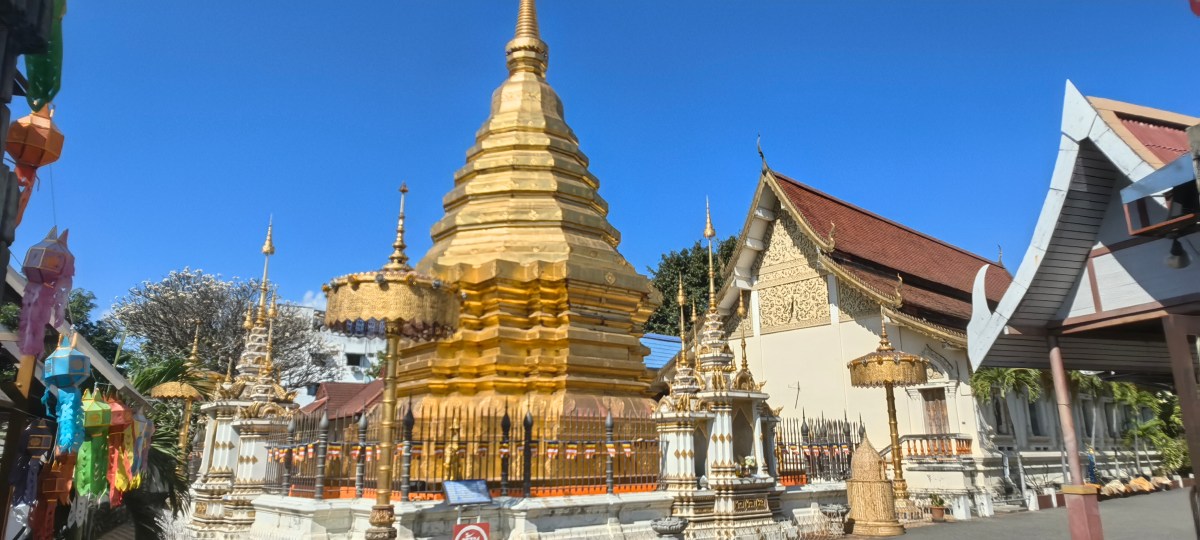
I have visited more than 50 temples in Chiang Mai and cannot list them one by one. Every temple has the chedi of different styles. These are the treasure of this city. This temple in the photo is the Haripunchai style which originates from the ancient Mon kingdom of Haripunchai, predating the Lanna Kingdom in the Chiang Mai region. This style is considered to be an earlier influence on Lanna architecture. Unlike the square bases of Lanna chedis, Haripunchai-style chedis often have a rounded or cylindrical base. These chedis may have a series of diminishing tiers stacked above the base, each decorated with small niches or Buddha images. The use of lotus petal motifs around the base and along the tiers is a distinctive feature of this style.
This is the tower of the Sri Lankan style, also known as Sinhalese or Anuradhapura style, which was introduced to Thailand through Theravada Buddhism. This style is characterized by its simplicity and smooth, rounded forms, representing purity and the Buddhist ideal of simplicity. The chedi is usually a smooth, rounded bell shape with little to no ornate decoration, emphasizing the purity and simplicity of the form. The dome has a simple spire on top. Unlike the more ornate Lanna style, Sri Lankan-style chedis are typically plain, focusing on the form rather than decorative details.
Due to Chiang Mai’s historical connections with Burma, Burmese-style chedis can also be found in the region. These chedis are influenced by the architecture of the Pagan era. Burmese chedis often have a stepped, pyramid-like structure with a series of terraces leading up to the spire. The chedis are typically more ornate than the Sri Lankan style, with intricate carvings and reliefs, often featuring scenes from the Jataka tales. The spire, often crowned with a multi-tiered umbrella, is a key feature, symbolizing the axis of the world in Buddhist cosmology.
Although not as numerous as other styles, Khmer-style chedis can still be found in and around Chiang Mai, showcasing the historical connections between the region and the Khmer civilization. The most recognizable feature of Khmer-style chedis is their prasat, a tower-like structure that resembles the central sanctuary of a Khmer temple. The base of a Khmer-style chedi is usually stepped, with multiple levels or terraces leading up to the central tower. In Chiang Mai, some Khmer-style chedis integrate elements of the local Lanna style, including stupa-like structures that blend the Khmer tower. This fusion creates a unique architectural form that reflects the cultural exchange between the Khmer and Lanna civilizations.
In the evening, I took some time to leisurely stroll around the Nimman Road and experienced the night life here. This road is outside the old city, and it is known for its eclectic mix of cafes, restaurants, boutique shops, and art galleries. Nimman Road is famous for its coffee culture, with a wide array of unique and stylish cafes. When the sun set, it is a place where traditional Thai culture meets modern global influences.
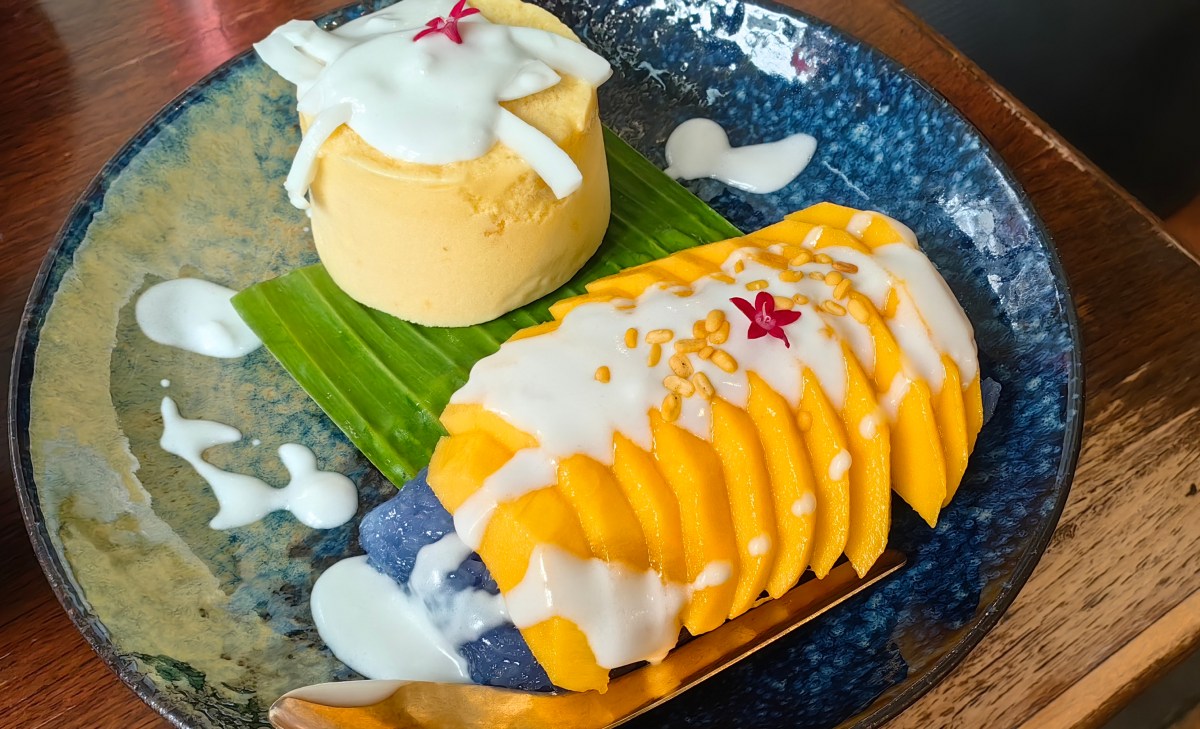
I tasted the Mango sticky rice in one of the stores here. The sticky rice, also known as glutinous rice, is the foundation of this dessert. It’s soaked, steamed, and then mixed with sweetened coconut milk to create a rich, creamy base. The mango adds a natural sweetness and juicy, refreshing texture to the dish, contrasting beautifully with the sticky rice. A key element of mango sticky rice is the coconut milk sauce, which is made by simmering coconut milk with sugar and a pinch of salt until it thickens slightly. The coconut milk sauce is often poured over the rice. This dish is one of Thailand’s most beloved desserts. It perfectly balances the sweet, creamy, and slightly salty flavors.
As my journey through Chiang Mai came to a close, I found myself reflecting on the myriad experiences that have woven together to create a tapestry of memories from the serene temples to the bustling markets. Chiang Mai is a place where the old and the new coexist in harmony. It’s a city that invites you to slow down, to fully relax, to savor the details. As I left Chiang Mai, I carried with me not just souvenirs and photographs, but a deeper appreciation for the Lanna culture of North Thailand.
Ayutthaya, the old capital of the Kingdom of Siam, stands as a testament to the grandeur and historical significance of Southeast Asia’s rich culture. Ayutthaya flourished as a major trading hub from the 14th to the 18th century, drawing merchants from all corners of the world. Today, the city is celebrated for its remarkable ruins and ancient temples, which have been meticulously preserved within the Ayutthaya Historical Park, a UNESCO World Heritage Site. Visitors to Ayutthaya are transported back in that glorious time as they explore the intricately designed wats, towering prangs, and serene Buddha statues that dot the landscape.
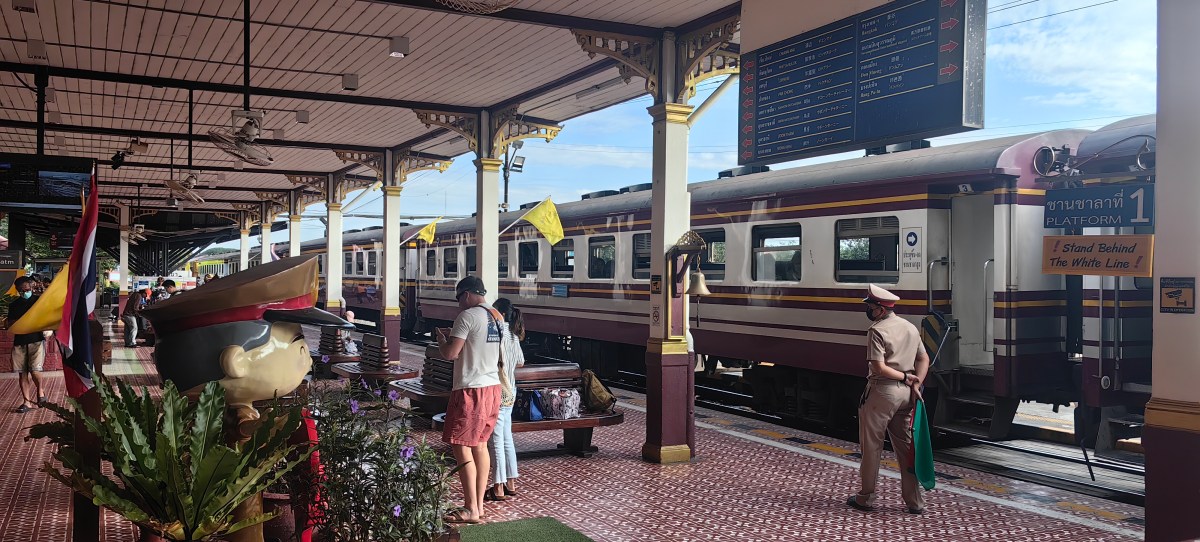
I took the train connecting Bangkok to Chiang Mai from Bang Sue Station in Bangkok to the Ayutthaya train station on December 4th, 2023. There is no highspeed train in Thailand. The speed of train is around 80-90km/ hour and each tram of the train has many open windows for ventilation. It is a short trip taking around 1.5 hours.
我于2023年12月4日从曼谷的Bang Sue 火车站乘坐连接曼谷到清迈的火车抵达大城府火车站。泰国没有高速火车。普通火车的速度约为每小时80-90公里,火车的每节列车都有许多开放式的通风窗口。这是一段大约需要1.5小时的短途旅行。
Ayutthaya train station is very small station. Upon arrival, visitors can easily access the historical sites, either by renting a bicycle, or hiring a tuk-tuk stopped in front of the station. Tuk-tuks are three-wheeled motorized vehicles, usually in green or red colors, and typically open-air. It is a popular and iconic mode of transportation in Ayutthaya, offering a convenient and enjoyable way to explore this historic park.
Ayutthaya Historical Park represents the history of the ancient city of Ayutthaya. Founded in 1350 by King U Thong, Ayutthaya swiftly became the capital of the Kingdom of Siam and one of the most prosperous cities in Southeast Asia. For over four centuries, it thrived as a political, economic, and cultural hub until its destruction by the Burmese army in 1767. After that, the capital was moved to Bangkok. This is the entrance of the park, and the visitors need to pay 200 Baht to visit four major attractions in this park.
Recognized as a UNESCO World Heritage Site in 1991, Ayutthaya Historical Park includes the ruins of this once-magnificent city, offering visitors a glimpse into its storied past. The park covers an area of approximately 289 hectares and includes a multitude of impressive temples, palaces, and monuments, reflecting a blend of various architectural styles influenced by different cultures such as Khmer, Sukhothai, and Lopburi.
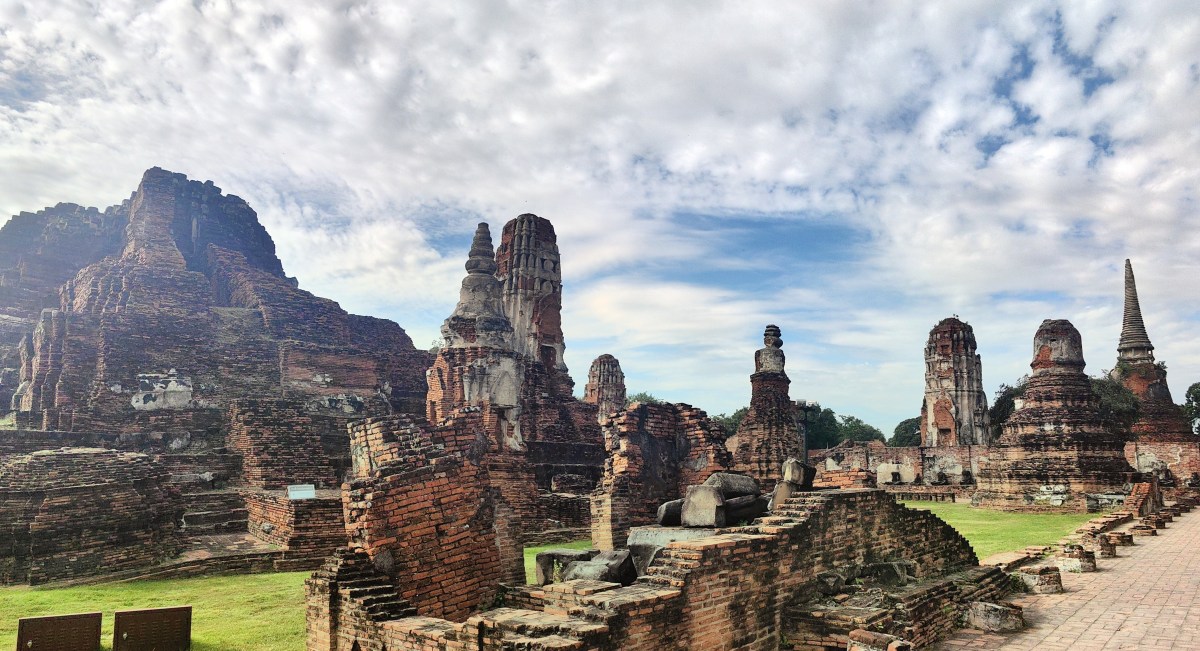
The visual impact of my first sight of these relics was striking. The towering prangs and chedis, though weathered by time, stand majestically against the blue sky, their intricate details still visible despite centuries of exposure to the air. The golden hues of sunlight play on the ancient bricks and stone, casting long shadows that add to the sense of timelessness. I felt that I took a time machine and travelled back to the past.
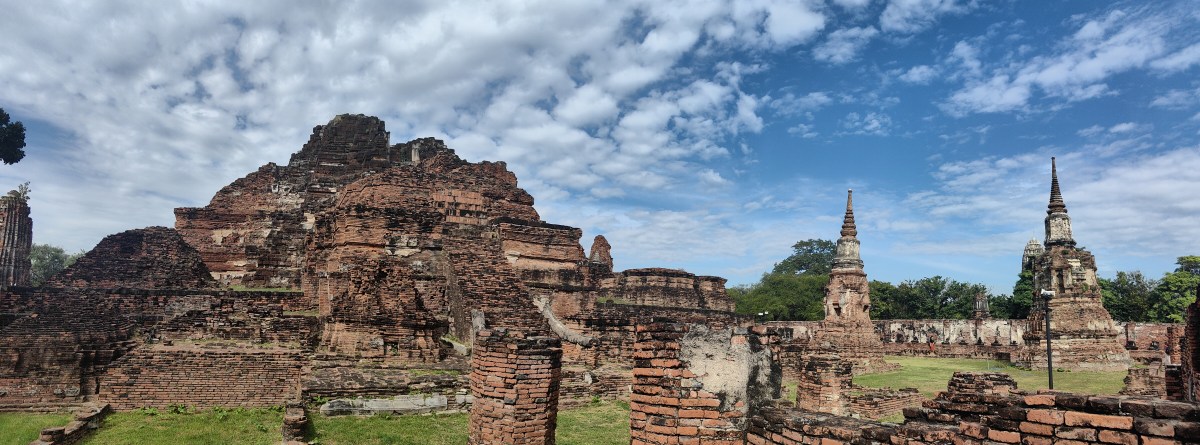
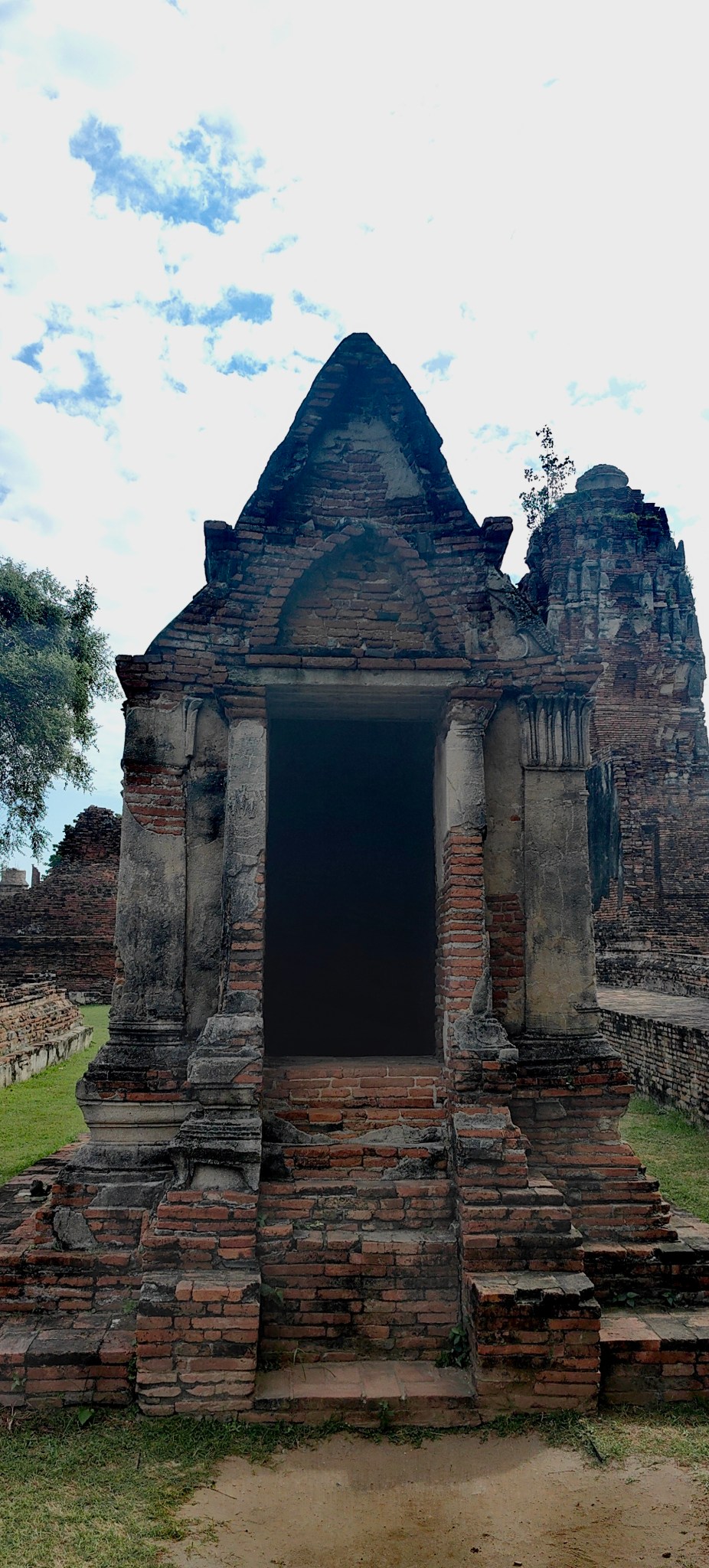
The first place I visited was the Wat Mahathat, also known as the Temple of the Great Relic. It was a royal monastery and one of the most important temples in Ayutthaya. It was established during the reign of King Borommaracha I (1370-1388). It is characteristic of Khmer-style architecture.
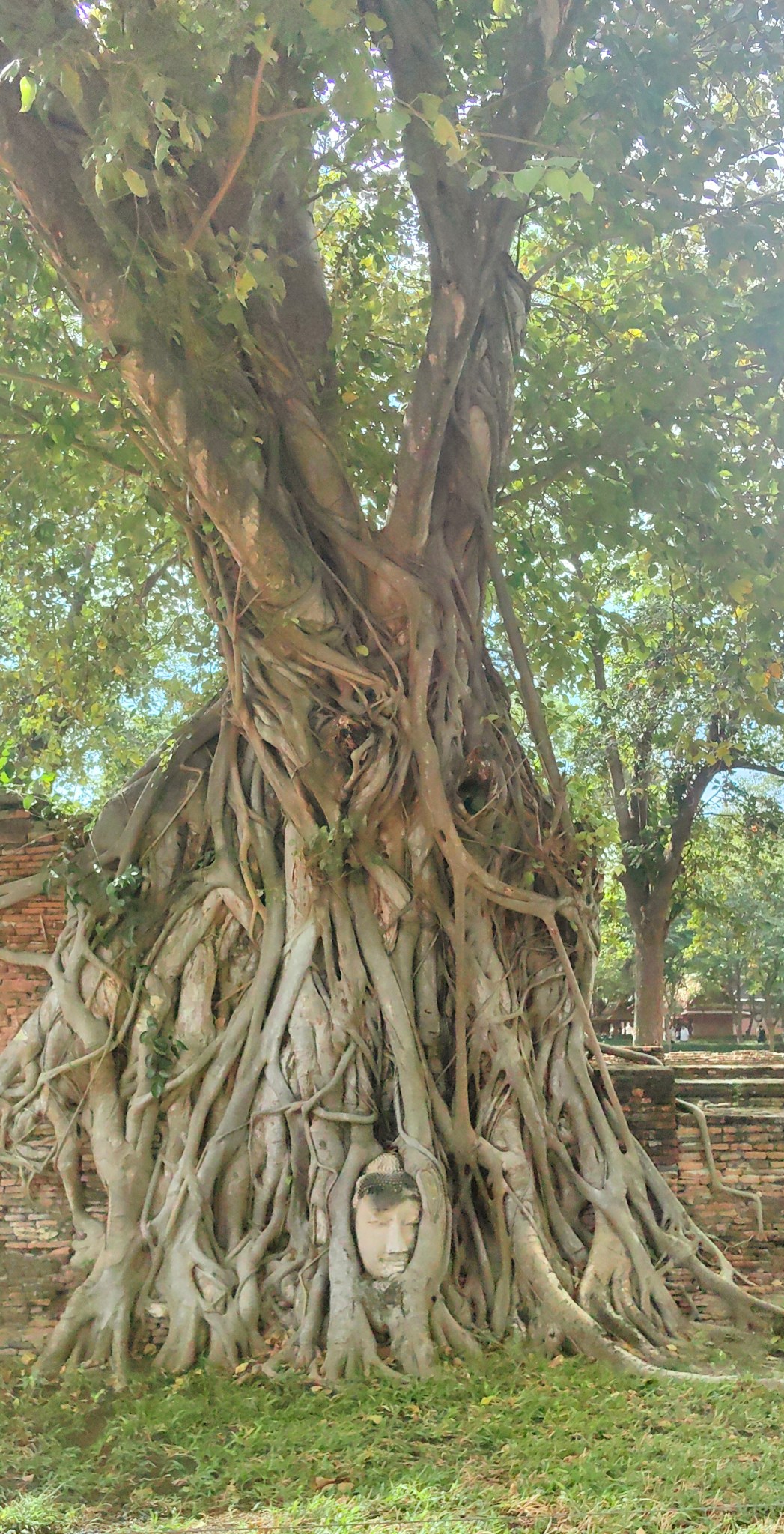
The iconic Buddha head entwined in tree roots at Wat Mahathat caught my eyes immediately, a poignant symbol of the enduring spirit of the place. This unique feature originated during the Burmese invasion when the temple was destroyed, and the head fell to the ground, later embraced by the tree’s roots.
Each Buddha statue scattered throughout Ayutthaya Historical Park tells a story, reflecting different styles, periods, and the deep devotion of the people who created them. Ayutthaya style of Buddha statue combines elements of Sukhothai and Khmer styles. These statues often have a broad, smiling face and a distinctive flame-like finial atop the head. For me, the unique element of Buddhism was the most attractive point to be explored when travelling in Thailand.
The prangs of Ayutthaya are among the most distinctive architectural elements in the ancient city. These prangs are characterized by their tall, tower-like structure, often built on a square or rectangular base. The surfaces of prangs are often decorated with intricate stucco work, featuring floral patterns, mythical creatures, and scenes from Buddhist mythology.
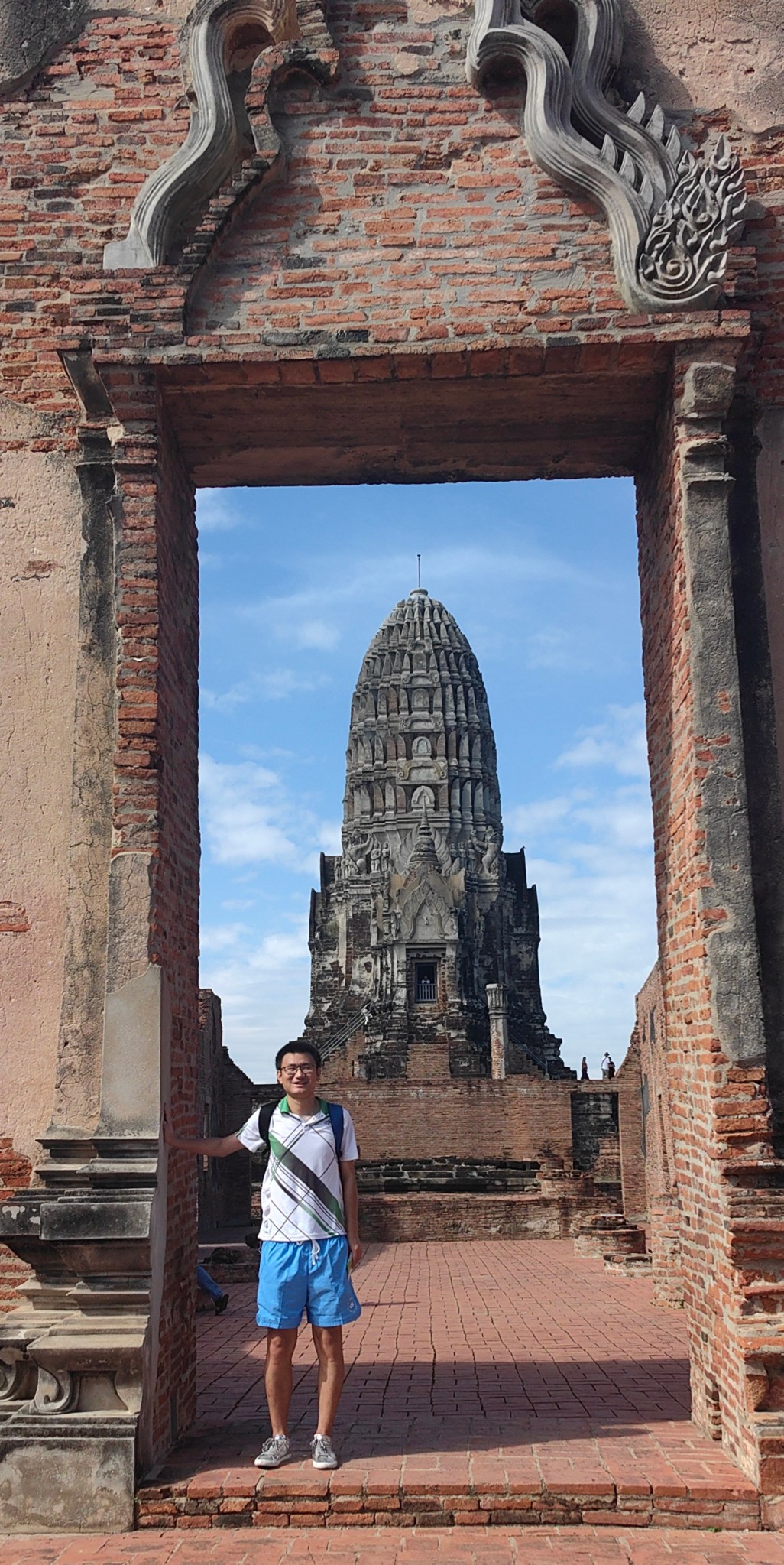
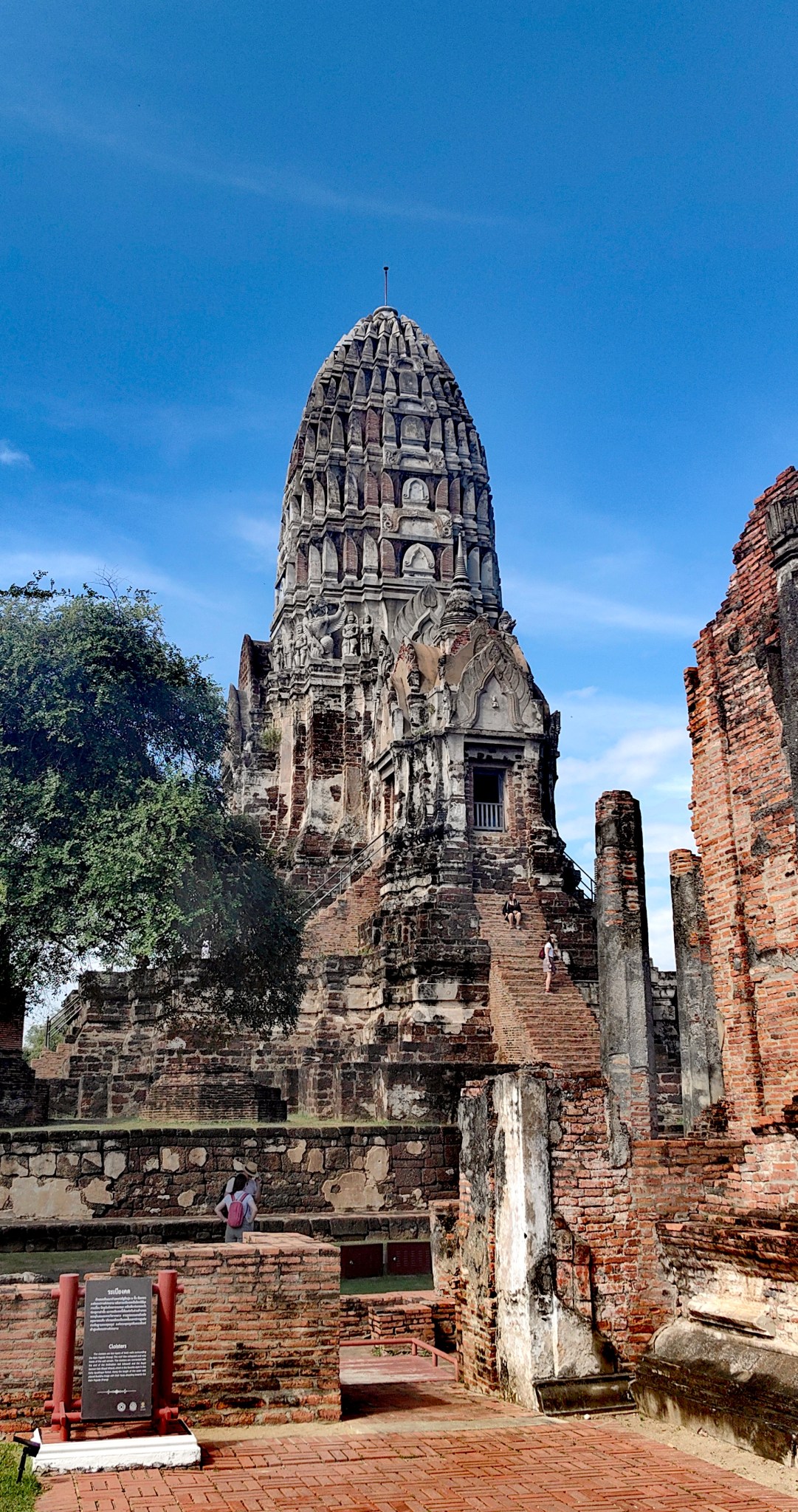
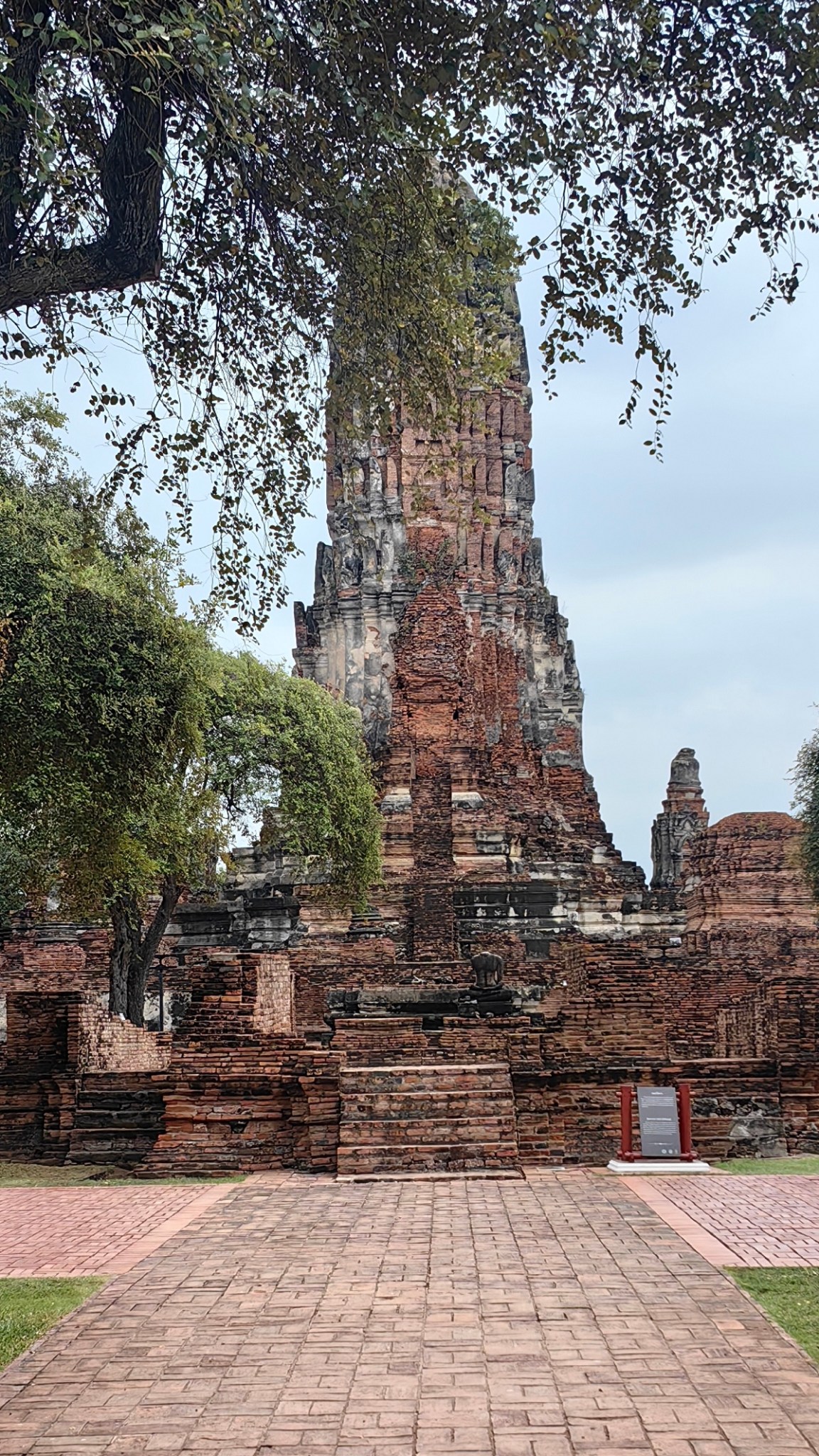
The prangs of Ayutthaya are not just architectural wonders but also reflections of the rich cultural heritage and religious devotion of the Ayutthaya Kingdom. Wat Ratchaburana was one of the most impressive temple in this park. The prang at Wat Ratchaburana is one of the best-preserved in Ayutthaya. Wat Ratchaburana was established by King Borommaracha II in 1424 to honor his two elder brothers, Chao Ai Phraya and Chao Yi Phraya, who died in a duel for the throne.
大城府的高塔不仅是建筑奇观也是一种对Ayutthaya王国丰富文化遗产和宗教崇拜的传承。Ratchaburana寺庙是公园中最具有震撼力的寺庙之一。它的高塔也是这里保存最完好的。它是由Borommaracha 二世于1424年建立的,以纪念为了争夺王位决斗而死的两个哥哥Chao Ai Phraya和Chao Yi Phraya。
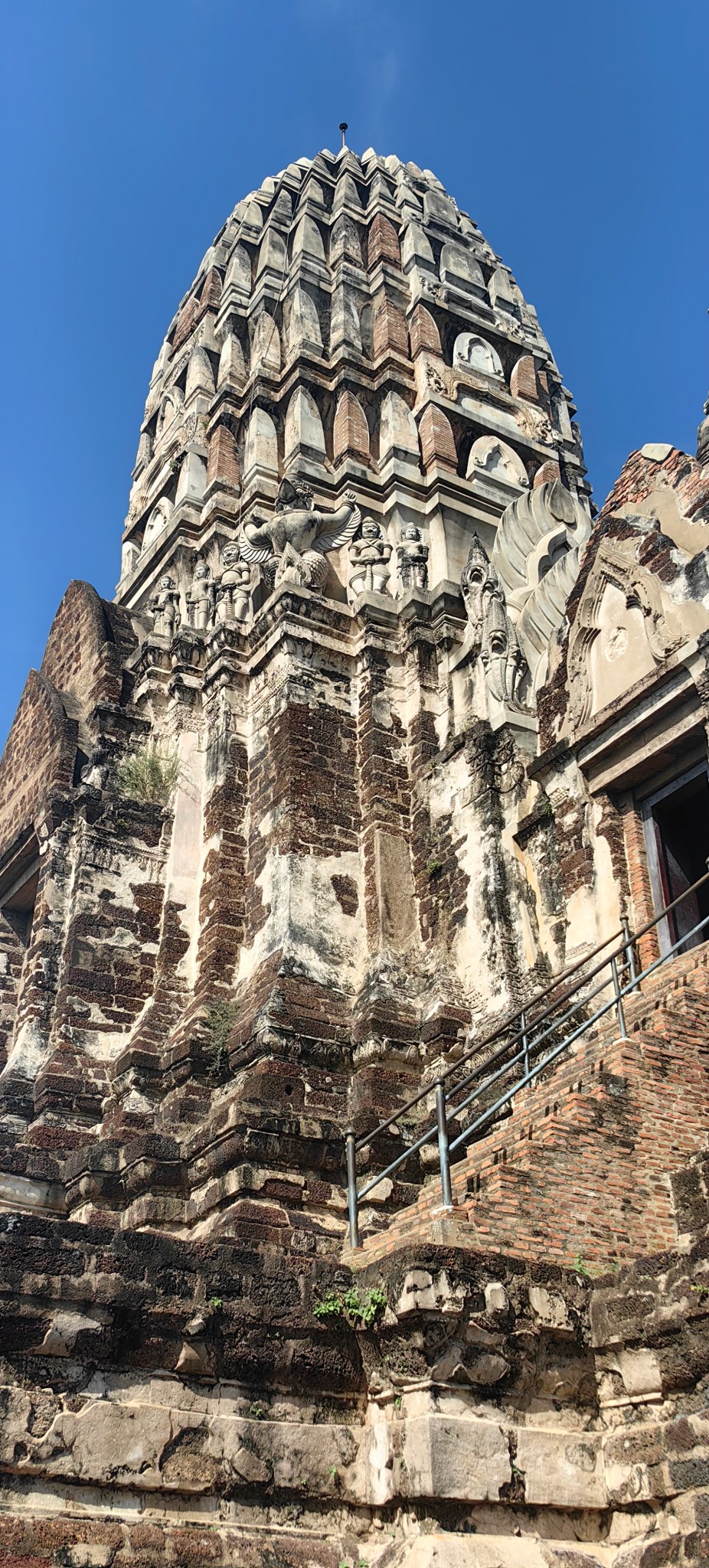
The prang is built in the traditional Khmer style, with a tall, tapering tower rising from a square base. It is adorned with stucco reliefs and ornamental details, showcasing the craftsmanship of the Ayutthayan artisans. The prang represents Mount Meru, the sacred mountain at the center of the universe in Hindu and Buddhist cosmology. It serves as a spiritual axis connecting the earthly realm with the heavens. Standing before this prang, I couldn’t help but feel a sense of awe and reverence. It dominates the landscape and serves as a visual and symbolic connection between the earthly and the divine.
The prang of Wat Ratchaburana is adorned with a multitude of statues and sculptural elements that drew my attention when I climbed up the brick steps. I could see clearly the statues of dvarapalas. These statues are typically depicted in a standing position, holding weapons such as clubs or swords. They serve as protectors of the temple, warding off evil spirits and guarding the sacred space within. There are statues of devatas (deities) and thewada (celestial beings). These figures are often portrayed in elegant, flowing attire, with serene expressions and graceful poses. Devatas and thewadas represent divine beings who inhabit the celestial realms.
Ayutthaya Historical Park is super large. The lake in the center of Ayutthaya Historical Park is a tranquil and adds a natural element to the ancient city’s landscape. Surrounded by lush greenery and dotted with historical ruins, it is a good place to have a rest or stroll.
The Ayutthaya Palace has been destroyed totally in the war. Now I could only see the remnants of Throne Halls and ruins of residential areas. The whole area is covered by weeds. Standing among the ruins of the Ayutthaya Palace, I felt a profound sense of awe at the grandeur and historical transition of the ancient kingdom. The remnants evoke reflections on the speedy passage of time and the cruelty of wars.
The Wat Phra Si Sanphet located within the palace grounds is well conserved fortunately. This temple served as the royal chapel. The temple was a central place for royal religious activities, highlighting the close connection between the monarchy and Buddhism.
位于宫殿区域内的Phra Si Sanphet寺所幸被完整保留。这座寺庙是皇家教堂,也是皇家宗教活动的中心地点,凸显泰国君主制与佛教之间的紧密联系。
Wat Phra Si Sanphet
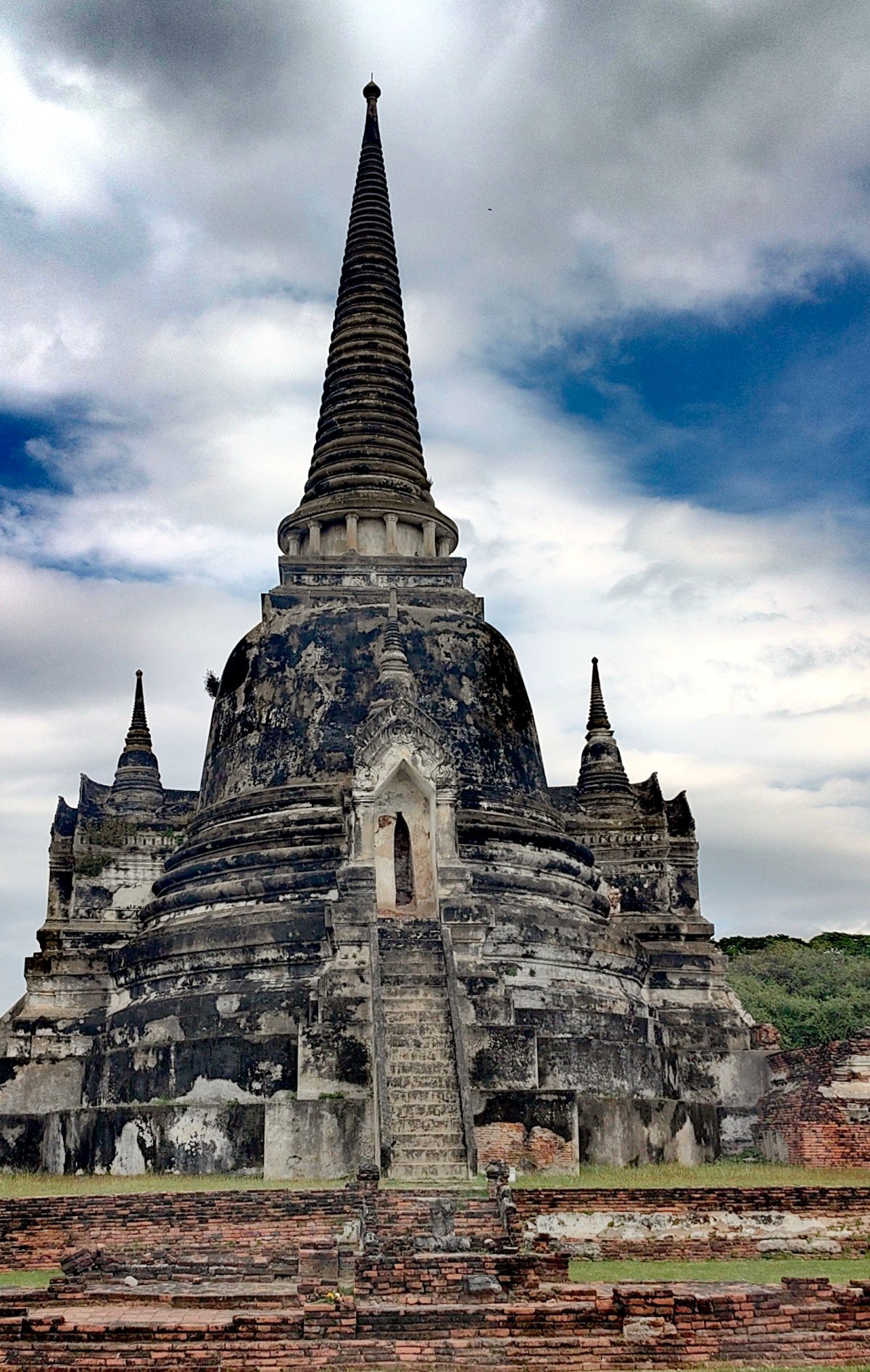
Established in the 14th century during the reign of King Ramathibodi I, it was part of the royal palace complex. Its three large chedis, which still stand today, housed the ashes of three Ayutthayan kings. The three large chedis perfectly aligned is the most impressive and iconic architectures in this historic park. The chedis are bell-shape with intricate stucco reliefs. They are surrounded by smaller stupas and other structures.
The architectural style of Ayutthaya is affected by both Sukhothai and Khmer. The Sukhothai architectures are characterized by the small stupas which are typically bell-shaped or in the form of miniature chedis. These structures mirror the design of the larger chedis but on a more modest scale. The stupas often feature detailed stucco reliefs depicting lotus motifs, mythological creatures, and religious motifs.
Sukhothai is renowned for its elegant Buddha statues, characterized by a flame-like ushnisha (a protuberance on the top of the head symbolizing wisdom) and a serene, meditative expression. Ayutthayan Buddha statues often replicate the Sukhothai style, with smooth, flowing lines and a focus on the spiritual tranquility of the Buddha.
Some small stupas contain niches that once held votive tablets or small Buddha statues. These items were often placed as offerings or to gain spiritual merit. The small stupas are strategically placed around the larger chedis and main temple structures, contributing to the overall harmony and balance of the temple complex.
Visitors were able to take the time to closely inspect the small stupas scattered all around the historical park. Their intricate decorations and architectural details are best appreciated up close. They are typically bell-shaped, a common form in Thai Buddhist architecture. This shape symbolizes the union of heaven and earth. They have an octagonal base, representing stability and the foundation of the spiritual path. Intricate floral motifs, such as lotus flowers and vines, adorn the surfaces. The spire is typically multi-tiered, each tier representing the ascent through the realms of existence towards enlightenment. It often culminates in a small, gilded umbrella-like structure, symbolizing protection and honor.
Wat Phra Ram is another significant temple which was constructed in the late 14th century by King Ramesuan on the cremation site of his father, King U-Thong, the first king of Ayutthaya. The towering central prang is the most prominent feature of Wat Phra Ram. I could see many this kind of Khmer-style tower here. The influence of Khmer architecture on the architecture of Ayutthaya is profound in several key features within the Ayutthaya Historical Park. The Khmer Empire, which flourished in Southeast Asia from the 9th to the 15th centuries, left a lasting impact on the region.
Khmer architects often used sandstone and laterite in their constructions, materials that were also adopted in Ayutthayan architecture. These materials are durable and suitable for intricate carvings and large-scale structures. The stucco reliefs on the prang of Wat Phra Ram and other temples in Ayutthaya feature detailed carvings that echo the artistic style of Khmer bas-reliefs found at Angkor.
There is an artificial lake located adjacent to Wat Phra Ram. The calm waters of the lake create a stunning mirror effect, reflecting the nearby temples towers and greenery. The lake planted with blooming lotus flowers looked like the Western Lake of Hangzhou.
Walking through the trail covered with gravel, I could not help to contemplate the history of Thailand one thousand year ago. The first centralized country Sukhothai Kingdom was founded in 1238 by King Sri Indraditya, marking the beginning of what is considered the first independent Thai kingdom. Sukhothai was a mandala state, where the central power radiated outward, and local rulers paid tribute to the king. Sukhothai became a center for Theravada Buddhism, with the construction of numerous temples in this style.
In 1438, Sukhothai was officially annexed by the Ayutthaya Kingdom. Ayutthaya was founded in 1350 by King U Thong. The kingdom expanded through military conquests and alliances, eventually controlling much of present-day Thailand, Laos, Cambodia, and parts of Myanmar. Ayutthaya continued to promote Theravada Buddhism. Ayutthaya engaged in numerous conflicts with neighboring states, particularly Myanmar. These wars were a source of eventual downfall. In 1767, after years of intermittent warfare, Burmese forces captured and sacked Ayutthaya, leading to the kingdom’s collapse. The whole city was destroyed, and many buildings were ruined.
Wat Nok is one of the lesser-known temples in Ayutthaya. It has a quieter presence, often overlooked by the mainstream tourist trail. Unlike other temples, its main building is well conserved. It is enclosed by a wall, with a gate serving as the entrance. It includes a courtyard and a tranquil garden area. Visitors could know how the complete temple of Ayutthaya looked like after visiting it.
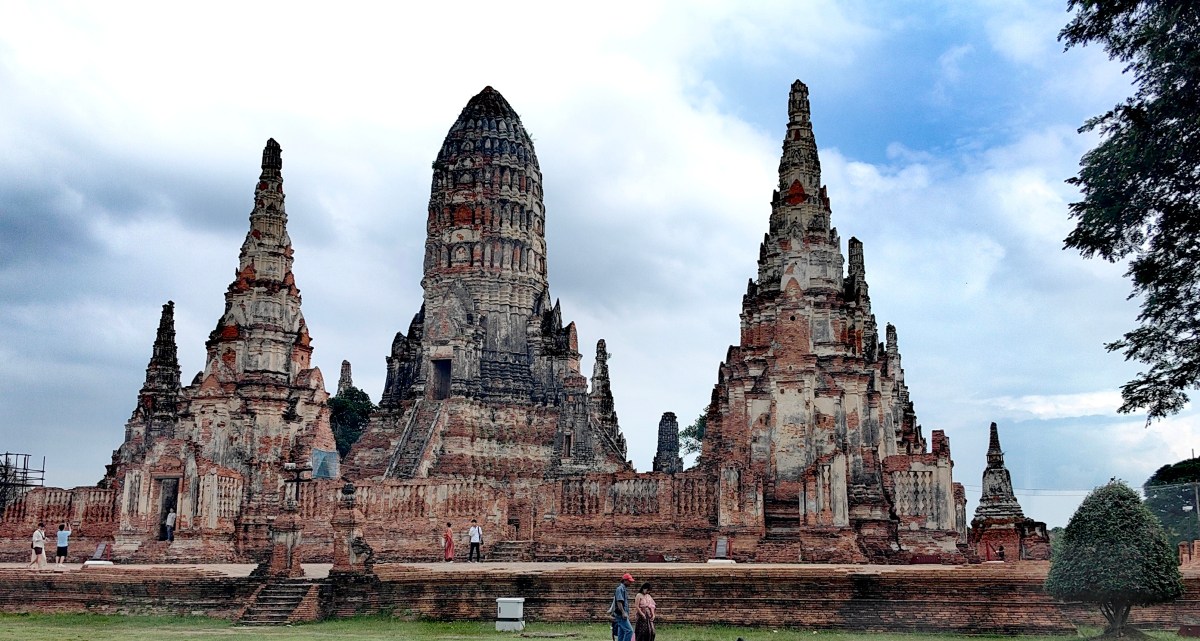
The last site visited was the Wat Chaiwatthanaram, which was built in 1630 by King Prasat Thong. It was constructed in honor of his mother and to commemorate his victory over the Khmer kingdom. It is a monument similar to the Arc de Triomphe and symbolizes the power and influence of the Ayutthaya Kingdom. Like the design of many temples in Ayutthaya, the central prang stands at 35 meters and is the most prominent feature of Wat Chaiwatthanaram. It is surrounded by smaller prangs and chedis. The three towers, standing majestically against the sky, inspired my appreciation for the historical and cultural achievements. There is a large piece of lawn behind the temple providing excellent panoramic photography opportunities, especially during sunset when the light enhances the details and colors.
Surrounding the central prang is a rectangular gallery lined with numerous Buddha statues. Most of the stuccos, bas-reliefs and architectures are well conserved. Continuous restoration and preservation efforts are undertaken by Thai government to maintain the structural integrity and aesthetic beauty of this temple. Such an impressive cultural heritage really needs people to protect it well in the long run.
My trip in Ayutthaya historic park lasted a whole day. As the sun dipped low, casting golden hues across ancient stones, Ayutthaya this mystical land seemed to whisper tales of old stories and, kings and temples. Through ruins vast where echoes of history resided, I returned back to train station in wonder. Beneath tall and grand prangs, I felt the pulse of this sacred land. The memories of this journey will linger and always be etched in my mind.
Bangkok is the capital city of Thailand which a bustling metropolis but also a spiritual heartland for Buddhists. Before I traveled in this city, Bangkok is known to have numerous magnificent temples, or called “wats,” that reflect the city’s deep-rooted Buddhist heritage. The different culture of Buddhism attracted me to this country.
I visited this city on 2nd December 2023 and spent three days here. When I arrived at the city center from the Suvarnabhumi Airport, the sun has set, and evening came silently. The Grand Palace transformed into an enchanting spectacle, illuminated by a golden glow. The body of palace stood majestically against the night sky. Its intricate architecture was highlighted by the glaring lighting. The shimmering spires and rooftops, adorned with delicate carvings created a mesmerizing silhouette.
As I strolled around the perimeter, the reflections of the illuminated structures danced on the tranquil waters of nearby fountains. The surrounding gardens and temples, bathed in the gentle light, offered a serene contrast to the bustling city beyond the palace walls. Wandering through the tranquil streets at night, my eyes were always attracted by these illuminated temples and their golden spires.
The iconic skyline of Bangkok, dominated by towering skyscrapers and the Chao Phraya River, sparkled with countless lights. Viewed from any bar across the river, the sight of the famous temple Wat Arun at night is truly breathtaking. The Wat Arun, known as the Temple of Dawn, is a beacon of elegance as its spires reflected on the Chao Phraya River. The lights transform the temple adorned with colorful porcelain into a luminous masterpiece.
Khao San Road, located in the heart of Bangkok, is renowned for its vibrant nightlife. The road is lined with a variety of street bars and clubs. The atmosphere is lively and energetic, with neon lights and colorful signs creating a festive ambiance. Amidst the nightlife buzz, street food vendors set up stalls offering different kinds of Thai delicacies from pad thai and mango sticky rice to grilled skewers.
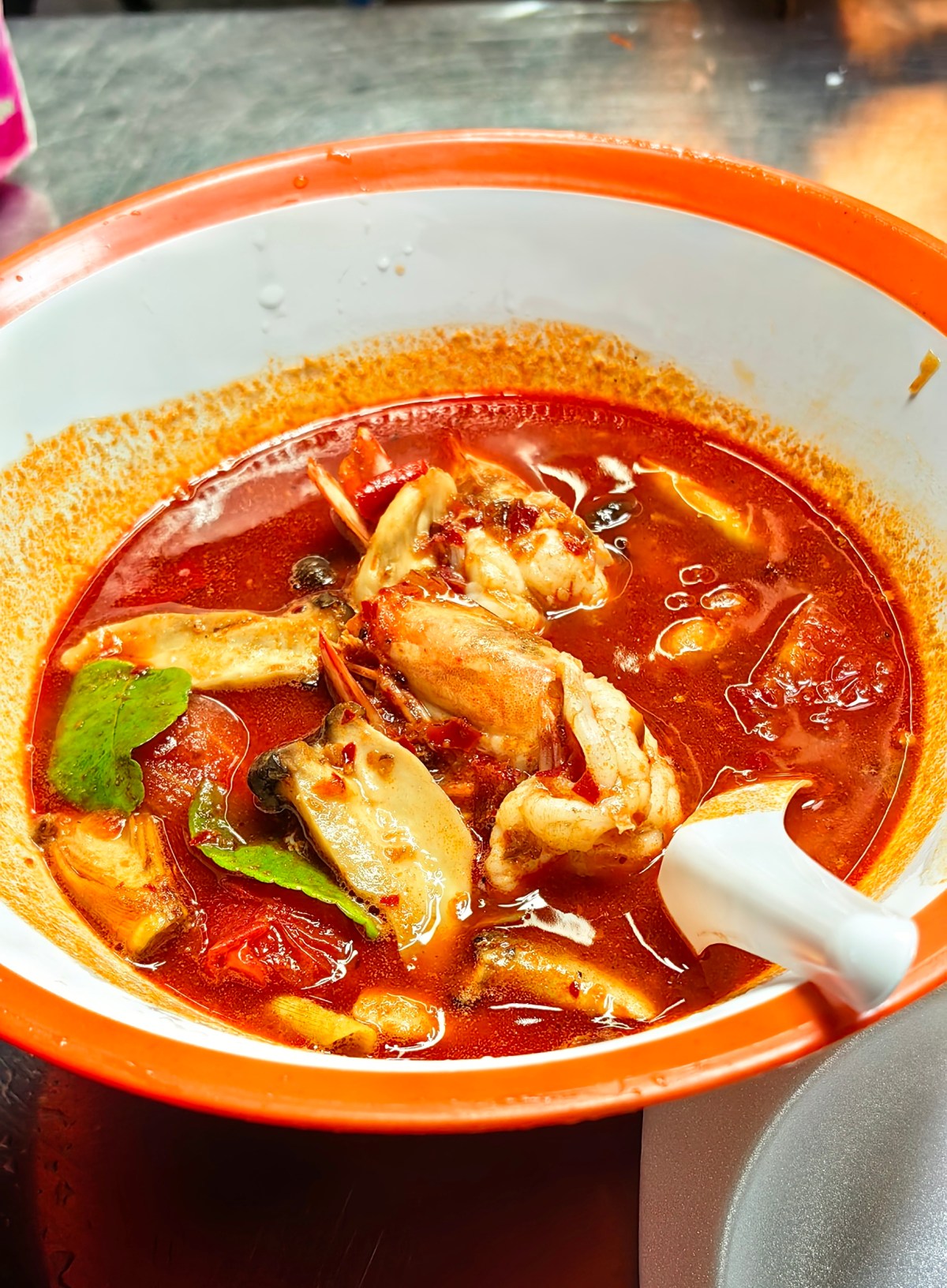
I tried Tom Yum Soup in one of the stalls of this street. It is a famous Thai soup known for its spicy, sour, and aromatic taste. The soup is usually made with a clear broth (often chicken or shrimp-based) that forms the foundation of its flavor. Lemongrass, galangal (similar to ginger but with a more peppery flavor), and kaffir lime leaves are essential aromatics. Some chili pastes are added to give the soup its characteristic spiciness. Fresh lime juice or tamarind paste provides the special sour element. The soup often includes mushrooms, tomatoes, and shrimps. I really liked spicy food so Thai cuisine suite my taste well.
My trip started from the early morning in the next day. My first place to visit was the Wat Pho which is one of the oldest and largest temples in Bangkok. It is famed for its stunning architecture, historical significance, and as the birthplace of traditional Thai massage. In the early morning, there are not so many tourists, it was quite a nice trip.
The architecture style of Wat Pho is a perfect example of traditional Thai temple architecture, characterized by intricate details and vivid colors. Thai temples often include ornate wood carvings, golden statues, ceramic tiles, and glass mosaics depicting religious motifs, mythical creatures, and floral patterns. The use of gold leaf symbolizes spiritual richness and devotion. This kind of architecture can be seen in many temples of Thailand.
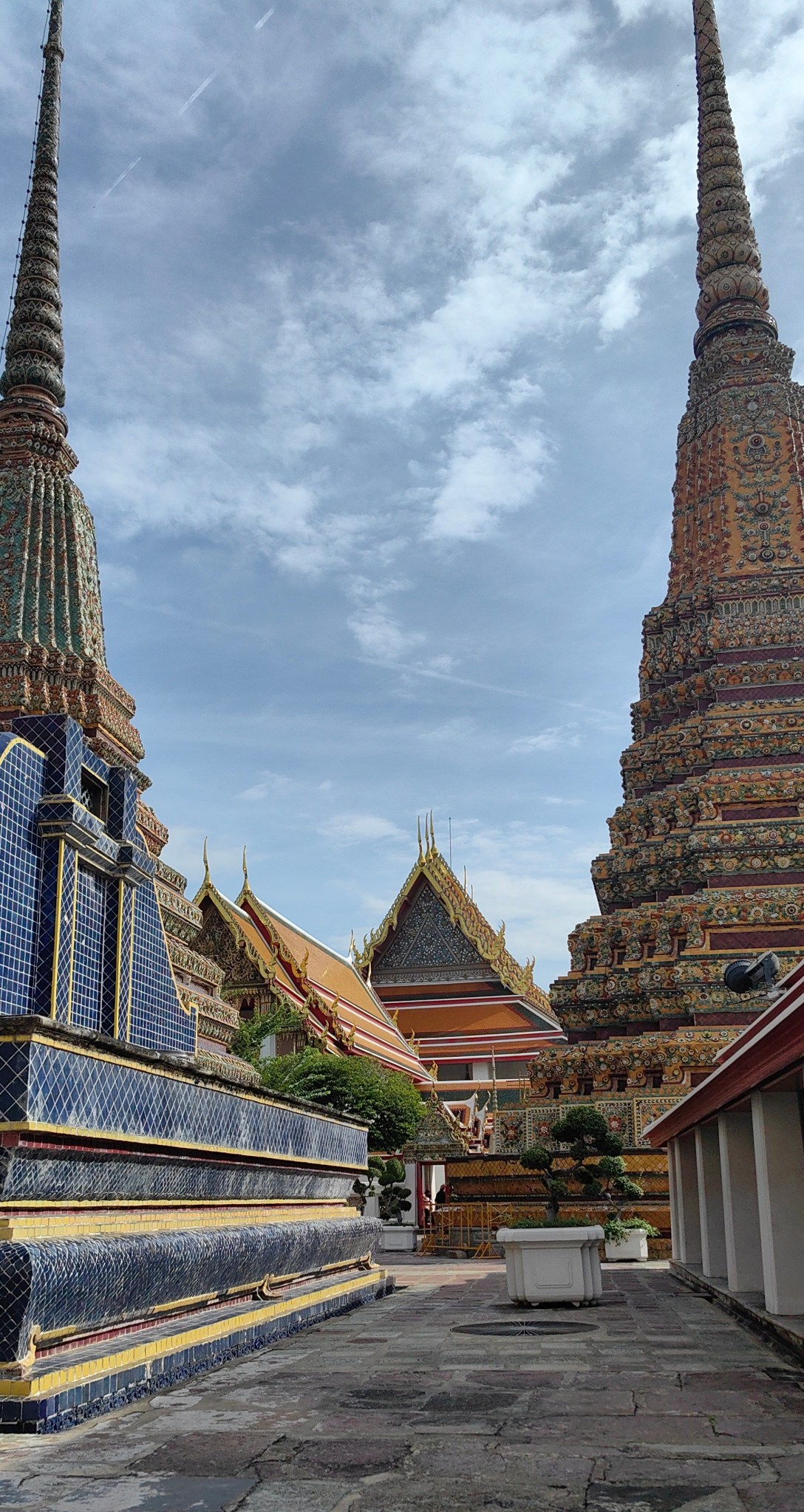
Throughout Wat Pho, I could always find these groups of smaller stupas known as “Chedi Rai.” These chedis contribute to the temple’s grandeur and serve various religious and symbolic purposes. Each chedi is adorned with ceramic tiles, floral patterns, and ornamental details that reflect traditional Thai craftsmanship. The tiered structure typically tapers gracefully towards the top, crowned with a spire.
The Chedi Rai at Wat Pho enshrine relics of the Buddha or important religious texts. They serve as focal points for worship, symbolizing the presence of the Buddha’s teachings and the spiritual aspirations of the devotees. These Chedi Rais are strategically placed around the main structures of Wat Pho, including the central chedi and the ubosot (ordination hall).
The surfaces of the Chedi Rai are often covered with colorful glazed tiles and decorated with intricate floral motifs, reflective of both Thai and Chinese artistic influences. The use of vivid colors like yellow and orange enhances the visual appearance of these chedis, making them standout features within the temple complex. The exterior surfaces are covered also with stucco and painted in bright colors.
One typical example of them is the Phra Maha Chedi Sri Sanphetdayarn constructed in the reign of King Rama I. The Chedi was lacquered with green glazed china mosaic tiles as green represents Wednesday, the birthday of King Rama I. It was decorated with Singha and lotus. In Buddhism, the Singha is lion which symbolizes strength, courage, and protection; and lotus represents purity and spiritual awakening. This Chedi is 16 meters long and 42 meters high.
这种佛塔的典型例子是图中拉玛一世时期修建的 Phra Maha 塔。这座佛塔用绿色釉面瓷质马赛克瓷砖覆盖表面,绿色代表拉玛一世的生日星期三。佛塔上装饰着 狮子和莲花。在佛教中狮子象征着力量、勇气和保护;莲花代表纯洁和精神觉醒。这座佛塔长16米,高42米。
The ubosot is the main prayer hall where important religious ceremonies and rituals take place. It typically features a multi-tiered roof with intricate gables adorned with mythical creatures and decorative elements. The interior houses the principal Buddha image and is often embellished with murals depicting scenes from the Buddha’s life or Buddhist teachings.
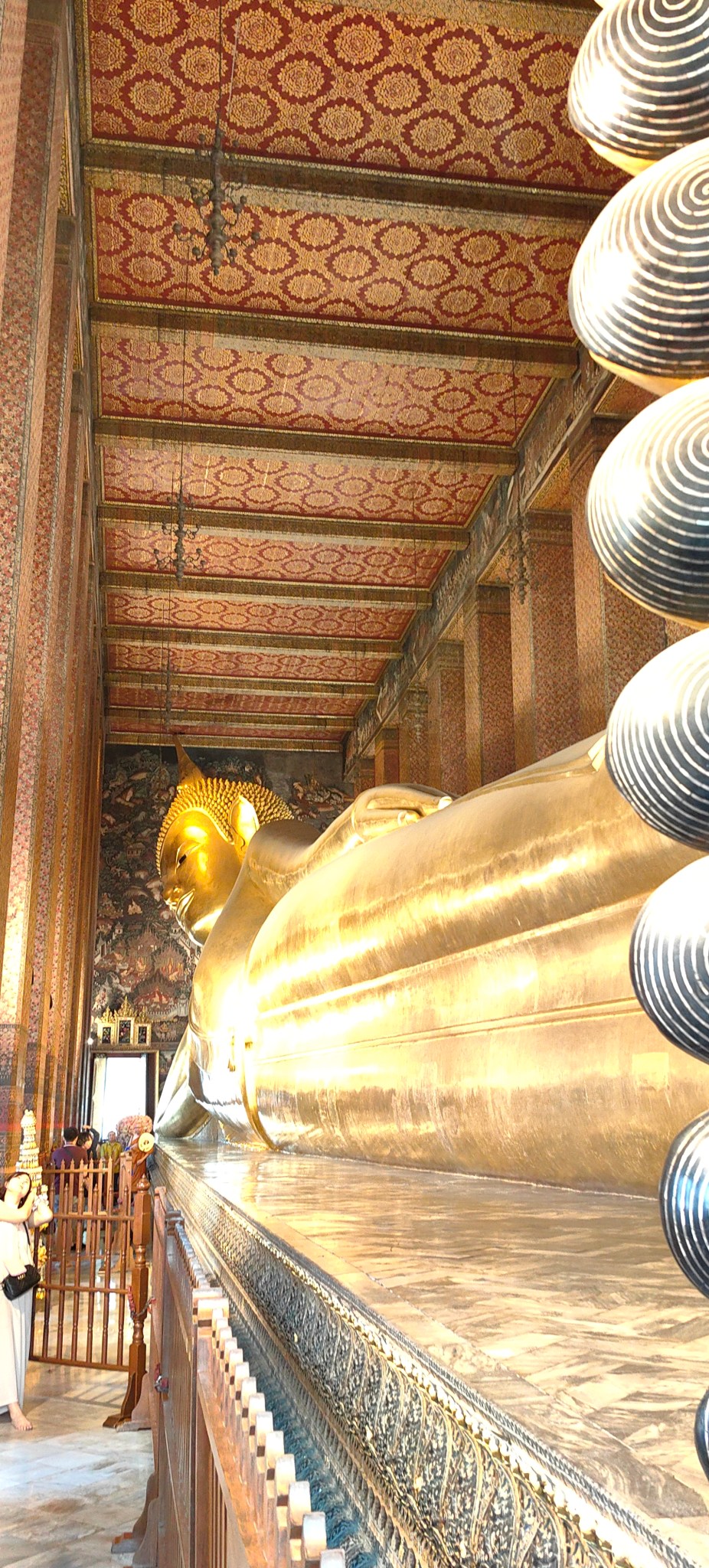
The Reclining Buddha is one of the most iconic attractions of Bangkok. It is an immense statue measuring 46 meters in length and 15 meters in height. The statue is primarily made of brick and stucco and is covered in gold leaf, giving it a radiant appearance. The reclining posture represents the Buddha’s final moments before entering Parinirvana, a state of ultimate liberation and release from the cycle of birth, death, and rebirth. The statue is housed in a specially constructed viharn surrounded by many chedis, and other smaller Buddha statues.
Next, I continued to walk towards the grand palace which is not far from the Wat Pho. It is one of Thailand’s most famous landmarks. Constructed in 1782, the Grand Palace served as the official residence of the Kings of Siam for over 150 years. It was also the administrative and religious center of the country. This is the entrance of the palace. It is required to dress trousers when visiting the Grand Palace.
The Grand Palace complex covers an area of over 218,000 square meters and is surrounded by walls built in 1782. The complex is divided into several courtyards and buildings, including the Outer Court, Middle Court, and Inner Court. The Temple of the Emerald Buddha is located at the Outer Court and it is considered the most sacred Buddhist temple in Thailand. It houses the Emerald Buddha, a highly revered statue carved from a single block of jade.
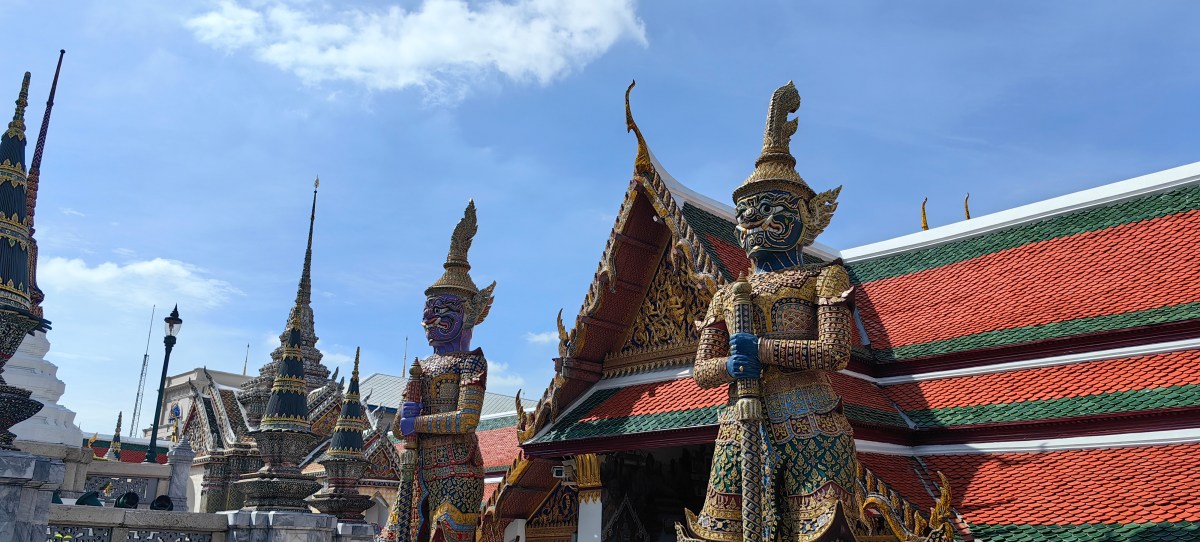
At the entrances of the temple, visitors are greeted by imposing yakshas. These statues are typically depicted with fierce expressions, large eyes, and ornate armor. Each yaksha stands over six meters tall and is brightly colored with intricate designs. They often hold a mace or a club. The yakshas are believed to protect the temple from evil spirits and ensure the sanctity of the Emerald Buddha.
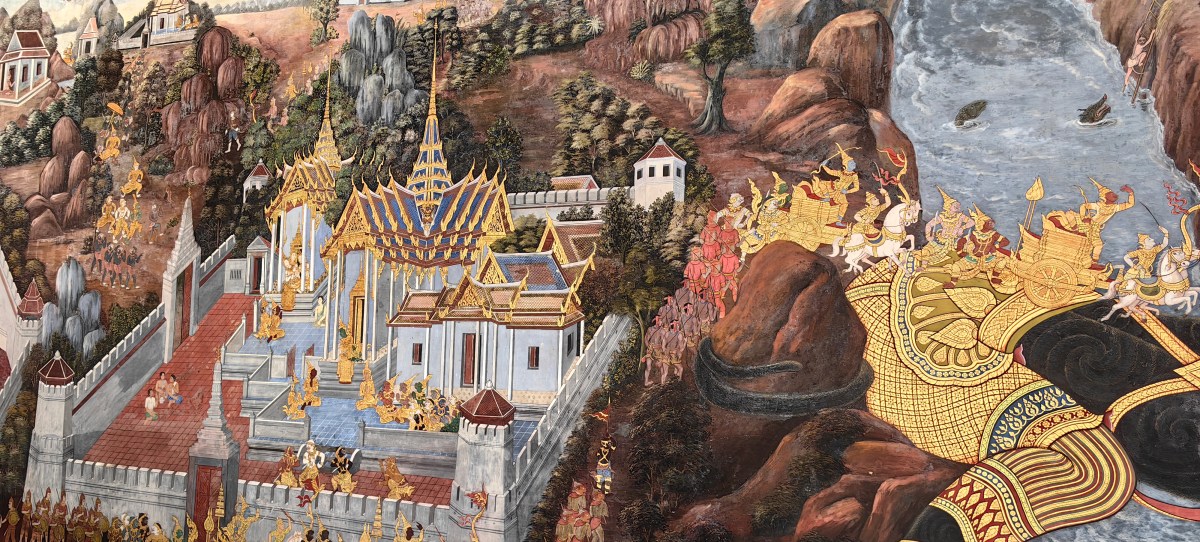
The frescoes of the Temple of the Emerald Buddha (Wat Phra Kaew) are among the most exquisite and detailed artworks in Thai religious architecture. They adorn the interior walls of the temple’s cloister, narrating historical, mythological, and religious stories. The frescoes prominently depict scenes from the Ramakien, the Thai version of the Indian epic Ramayana. This series of murals narrates the story of Prince Rama, depicting his adventures and battles against the demon king Ravana. The frescoes are arranged in a sequential manner, allowing visitors to follow the stories as they walk along the cloister.
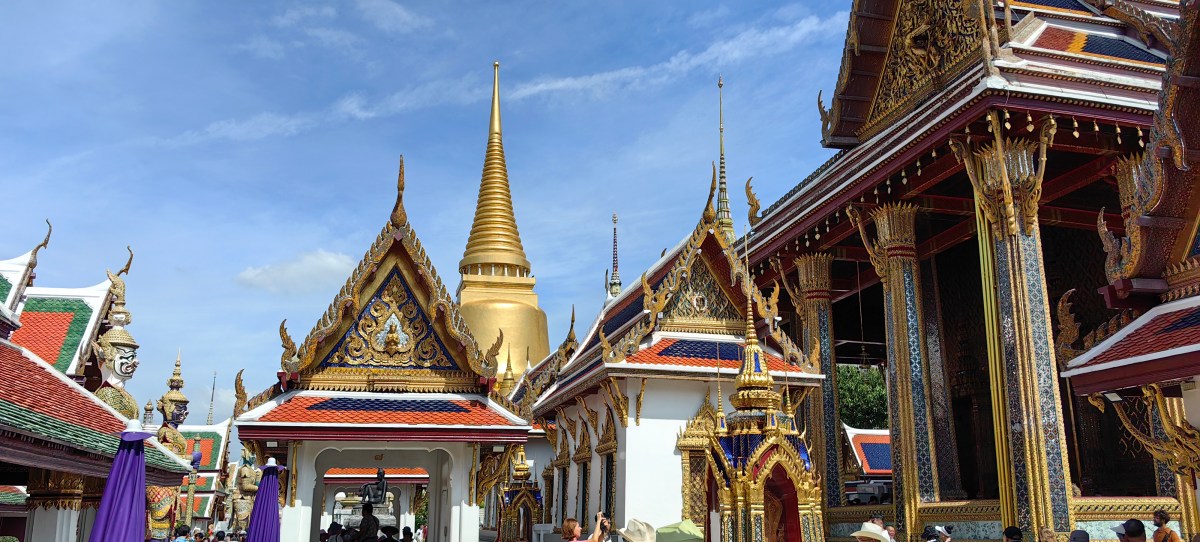
The Phra Ubosot is the main hall and the most sacred building in the temple. It is where the Emerald Buddha is housed. The hall is surrounded by eight boundary stones that demarcate the sacred area for ordination ceremonies. The roof is adorned with multi-tiered layers, featuring elegant chofahs (finials) at the gable ends, resembling the shape of a bird’s tail. The outer walls are decorated with intricate gold leaf patterns and colorful glass mosaics that shimmer in the sunlight. The whole body is really impressive, like a golden treasure.
There are some huge golden stupas in the temple. It is a prominent feature within the temple complex, representing the Buddha’s enlightened mind. It is built in the Sri Lankan-style, with a bell-shaped dome and a spire that reaches towards the sky. The stupa is entirely covered in gold tiles, giving it a radiant appearance that symbolizes purity and spiritual wealth. It is surrounded by mythical guardian statues, ensuring its sanctity and reverence. The golden statue in this photo is Kinaree which is mythical creature with the body of a bird and the torso of a human. It represents beauty, grace, and the harmony between the earthly and heavenly realms.
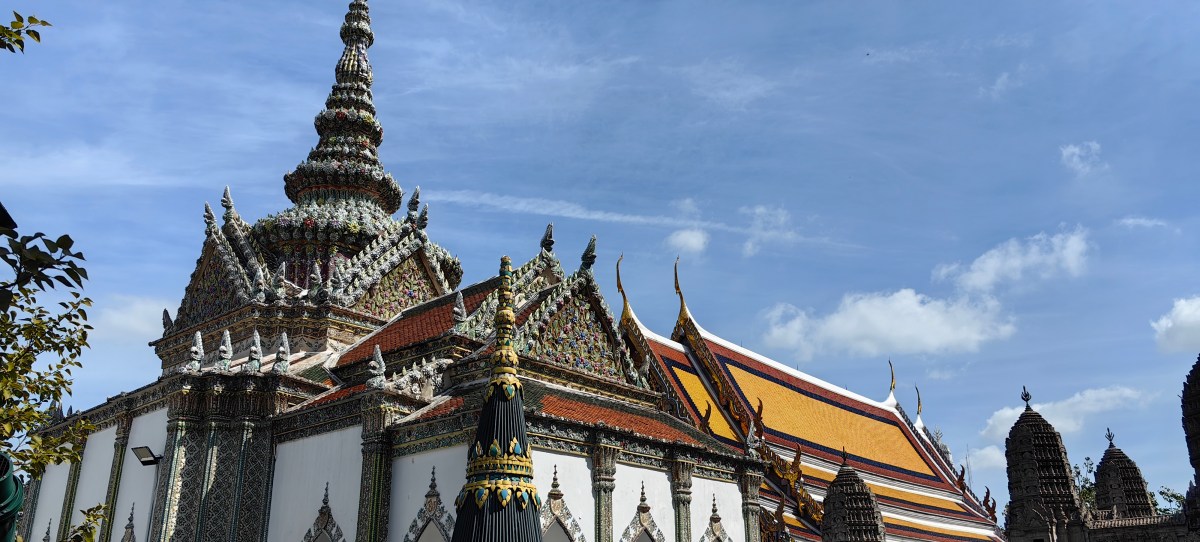
The Royal Pantheon is really impressive, it is a tall, elegant well decorated building with a central spire, surrounded by smaller spires, embodying the traditional Thai architectural style. It serves as a shrine for statues of past kings from the Chakri dynasty. The structure is richly adorned with intricate carvings, golden ornaments, and vibrant glass inlays.
In this temple, I could see many statues of garudas, nagas (serpents), and other mythological beings, each symbolizing different meanings. Garuda is a mythical bird-like creature that appears in both Hindu and Buddhist mythology. It is often depicted as having the body of a bird with human features. It has large wings with a powerful beak, and human-like arms and legs. In Buddhism and Hinduism, Garuda is known as the mount of Lord Vishnu. In Thai culture, Garuda is a symbol of the monarchy and is often seen in royal emblems.
The ticket of Grand Palace is 500 Baht, and it is worthy to visit it. Most of the time is spent in the temple of the Emerald Buddha It is a real masterpiece of Thai architecture, where each structure and decorative element contributes to the temple’s sacred atmosphere and historical significance. The unique architecture style is absolutely different from what I have seen in Europe and China.
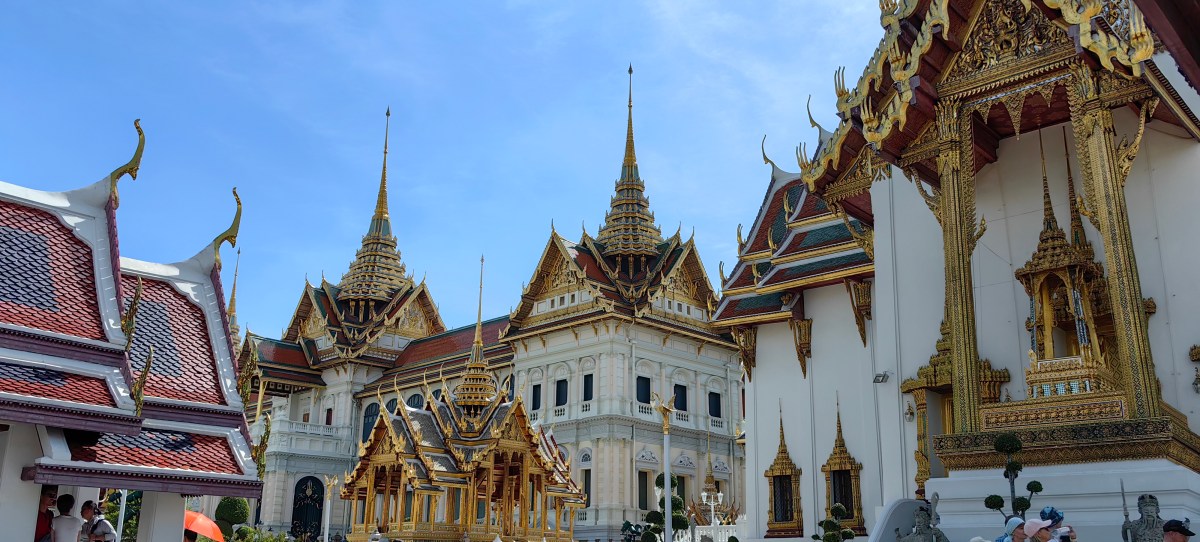
The Middle Court is the heart of the Grand Palace, where the king’s official residences and important state buildings are located. It was the primary area for royal ceremonies and state functions, including coronations and official banquets. The Chakri Maha Prasat Throne Hall is a remarkable structure blending Thai and Western architectural styles. It was commissioned by King Rama V and built between 1876 and 1882. It served as a venue for the king to receive foreign dignitaries and host important state functions. Its facade is designed in the Renaissance and Neo-Classical styles, characterized by columns, arches, and symmetrical layouts. The roof is adorned with intricately decorated gables and chofahs, which are bird-like ornaments commonly found in Thai architecture.
The Phra Thinang Dusit Maha Prasat at the right side of the photo was commissioned by King Rama I in 1790, soon after the establishment of Bangkok as the new capital of Thailand. Originally built as a throne hall for various royal ceremonies, it is also used for the lying-in-state of deceased members of the royal family, where the body is displayed for public homage before the royal cremation. It is a classic example of Rattanakosin architectural style, characterized by its elevated platform, multi-tiered roof. The exterior walls are adorned with intricate stucco reliefs and gilded ornaments, showcasing traditional Thai craftsmanship.
这张照片右侧的 Phra Thinang Dusit Maha Prasat 是1790年曼谷成为泰国新首都后不久,由拉玛一世下令修建的。它最初是作为各种皇家仪式的王座大厅而建,也用于安放已故皇室成员的遗体,在皇家火葬之前,遗体会在这里供公众瞻仰。它是拉达那哥欣建筑风格的经典范例,其特点是高台、多层屋顶。外墙装饰着复杂的灰泥浮雕和镀金装饰,展现了泰国传统的工艺。
The area in the background is the Inner Court which was the residential area for the king’s consorts, daughters, and female attendants. It was a highly private and restricted area. The gardens of the Grand Palace are meticulously designed and maintained. Lush and well-maintained lawns are interspersed with flowerbeds. The extensive use of topiary, with various plants and shrubs carefully trimmed into shapes such as animals, mythical creatures, and geometric patterns add varieties of colors to this palace.
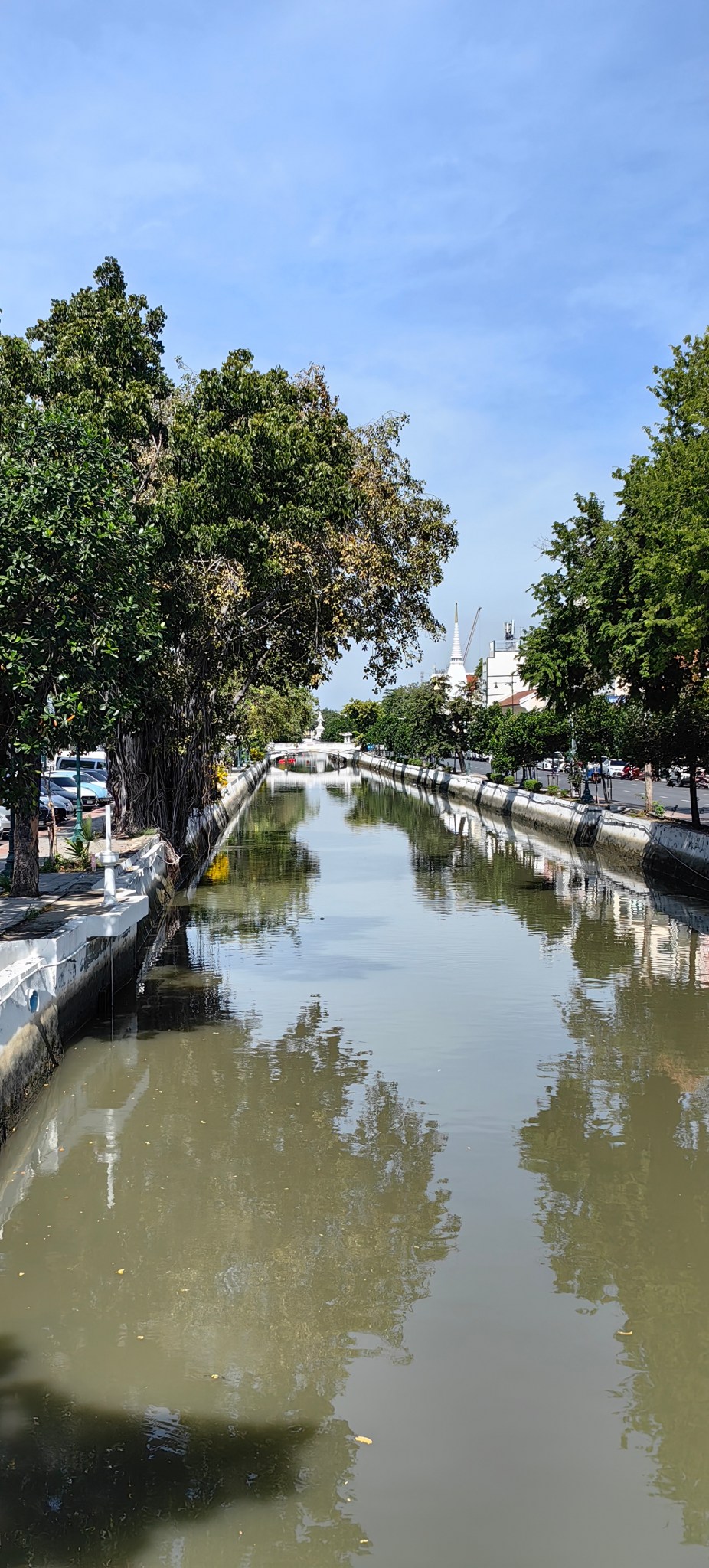
After I quitted the Grand Palace, I took some time to take some street view of Bangkok. This city often referred to as the “City of Water,” is a metropolis interwoven with an extensive network of canals, known locally as “khlongs.” The network of canals play a vital role in transportation.
There are some charming public parks that offer a tranquil retreat from the hustle and bustle of the city. Saranrom Park was originally part of the Saranrom Palace, built in the mid-19th century during the reign of King Rama IV. The palace served as a residence for royal family members. The surrounding gardens were later transformed into a public park, opened to the public in the early 20th century during the reign of King Rama V.
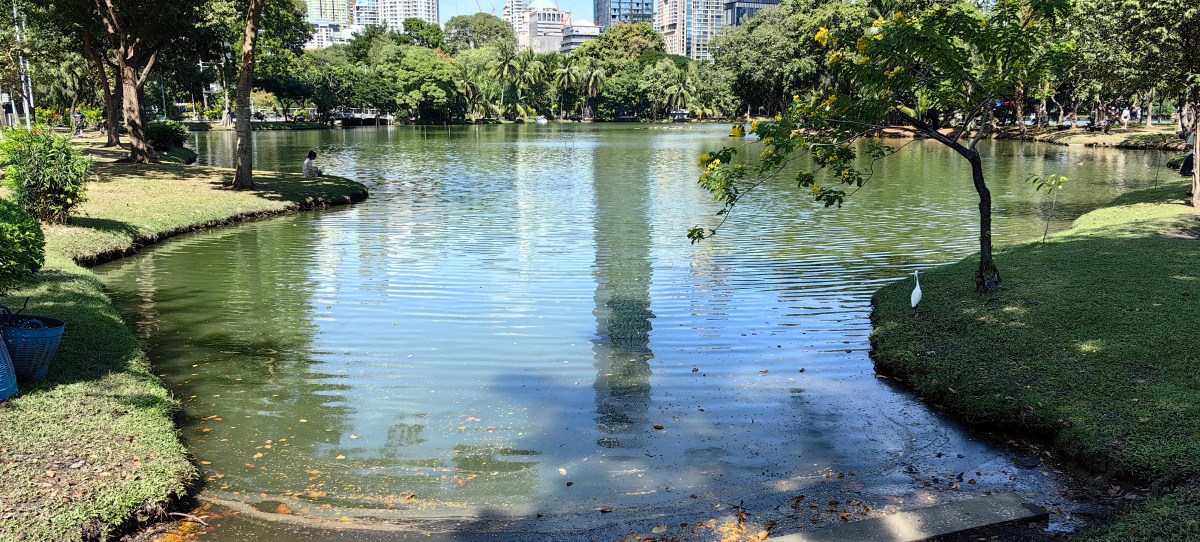
The afternoon of Bangkok was scorching and not suitable for travel. I took the metro to the Lumphini Park and had some short rest here before back to hotel. The monument of King Rama VI is a prominent landmark situated at the entrance of Lumphini Park. The statue of King Rama VI is a bronze sculpture that depicts the king in full military uniform, symbolizing his role as a modernizer and a leader of the nation. King Rama VI, who reigned from 1910 to 1925, is celebrated for his efforts to modernize Thailand, promote education, and support cultural development.
Lumphini Park, often referred to as the “green lung” of Bangkok, is one of the largest public parks in the city. The park spans over 142 acres, offering vast lawns, tree-lined pathways, and a variety of plant species. It has a large artificial lake where visitors can rent paddleboats and rowboats. The park is home to various wildlife species, including lizards, turtles, and numerous birds.
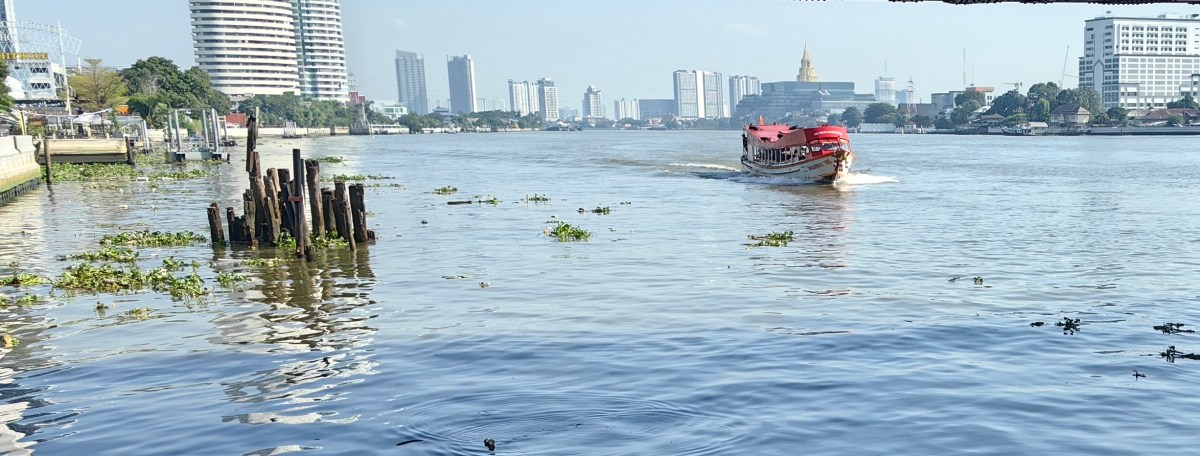
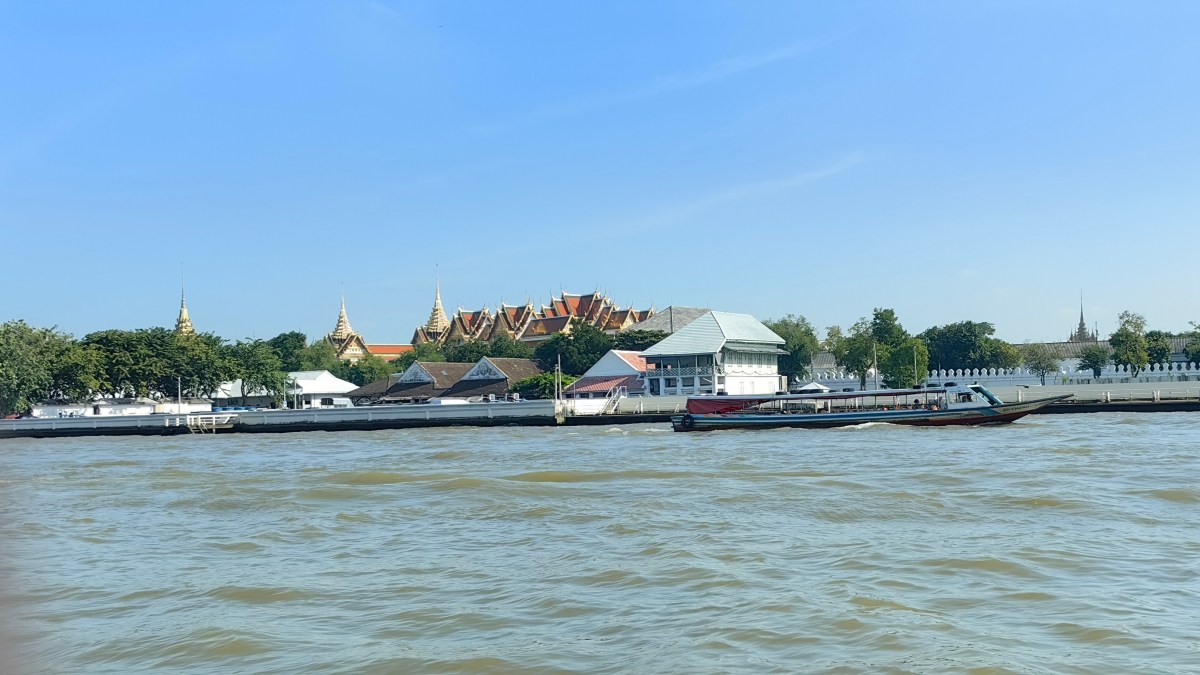
After a night’s rest, I started the trip of second day. My hotel is located at a pier. Similar to Venice and Rotterdam, Bangkok has a public transport system of boats which play a crucial role in navigating the city’s extensive network of waterways, offering both locals and tourists a convenient and scenic way to travel between various destinations. The Chao Phraya Express Boat is one of the most popular modes of public transport in Bangkok. It operates on the Chao Phraya River and has several routes that connect different parts of the city.
On the boat I could get a panoramic view of the city. The landscape along the Chao Phraya River offers a blend of modern skyscrapers, historic temples, bustling markets, and traditional Thai architecture. Such a boat trip is really a relaxing activity that relieved my fatigue of work.
Along the Chao Phraya River, I could see the facade of Phra Sumen Fort easily. The fortress is an octagonal structure made of brick. It has three levels with battlements and embrasures designed for cannons and other defensive artillery. It was constructed in 1783 during the reign of King Rama I, the founder of the Chakri Dynasty. The fort was strategically located along the Chao Phraya River to guard the city against naval attacks and to control river traffic. Tourist could explore a piece of Bangkok’s past by visiting it.
As Bangkok has developed rapidly in the 20th century, modern skyscrapers have emerged along the banks of the Chao Phraya River. Areas such as IconSiam and Sathorn feature sleek office towers, shopping malls, and residential complexes that reflect the city’s rapid economic growth and urbanization these years. The scenery here is similar to the Singapore river.
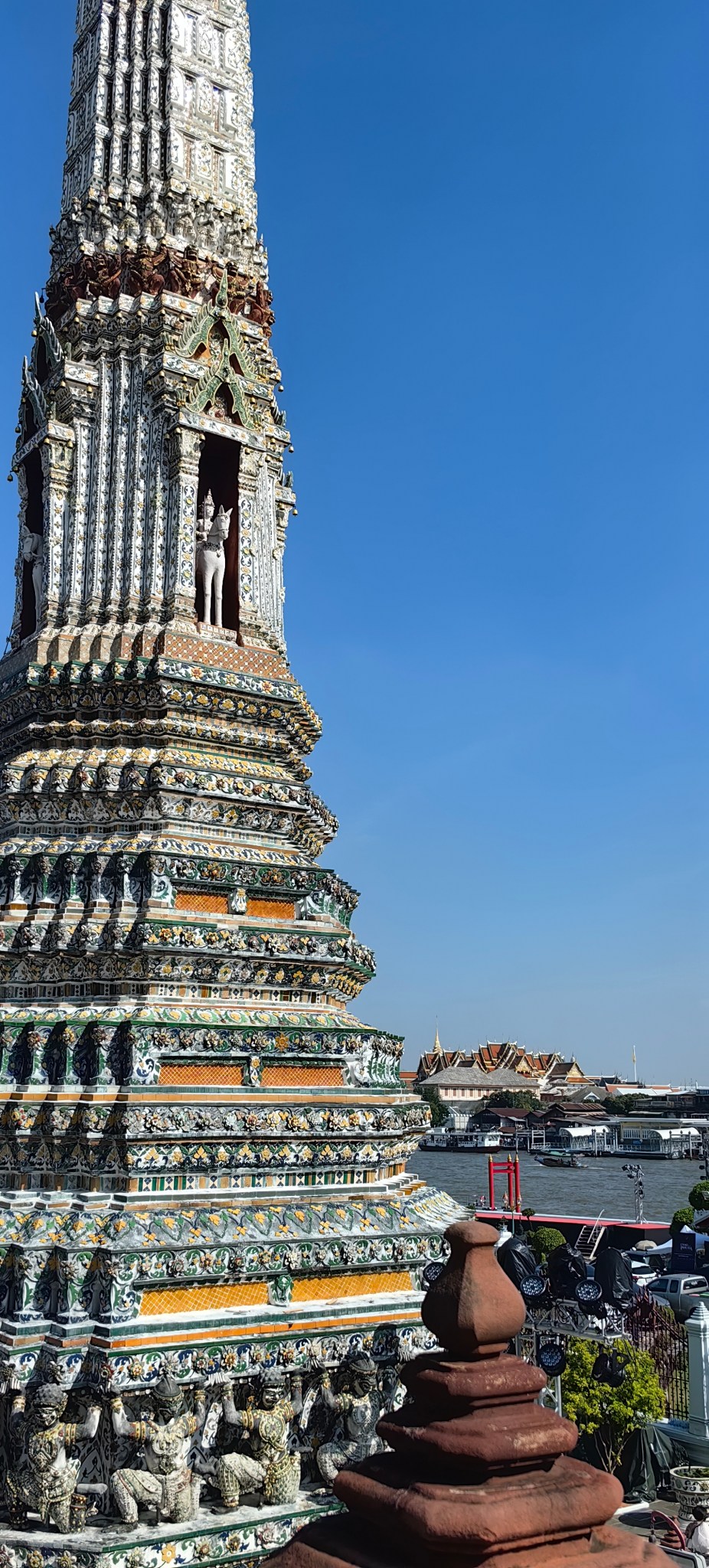
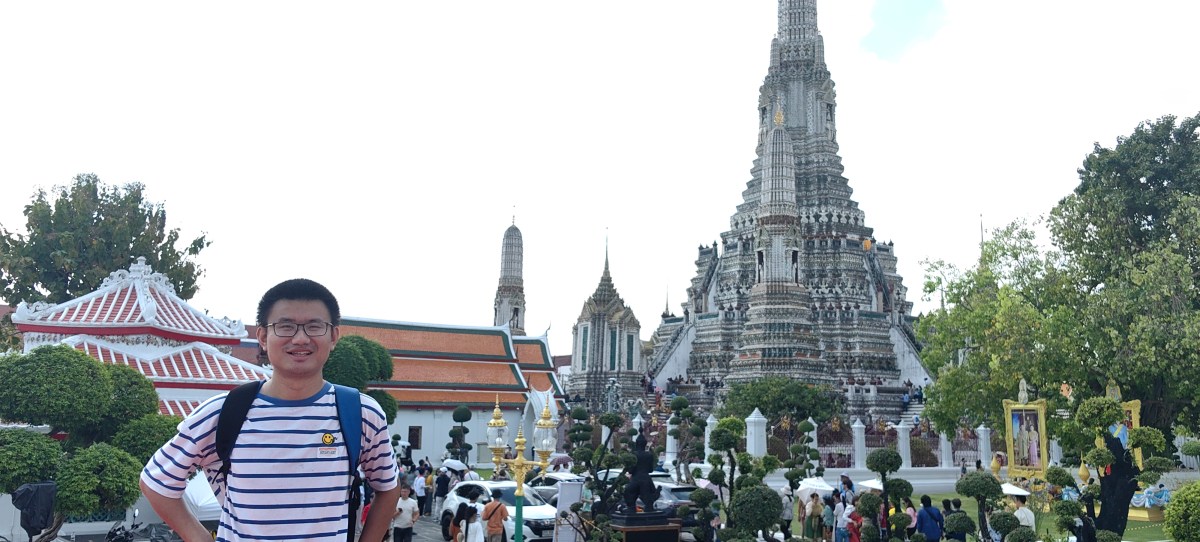
The Chao Phraya River is lined with some of Bangkok’s most famous temples including Wat Arun. Wat Arun, also known as the Temple of Dawn, is one of Bangkok’s most iconic landmarks and a significant cultural and religious site. It is believed to have been founded in the 17th century during the Ayutthaya period, but major renovations and expansions took place during the reign of King Rama II and King Rama III of the Rattanakosin Kingdom. The temple’s name translated to “Temple of Dawn,” is named after Aruna, the Hindu god of dawn.
The most distinctive feature of Wat Arun is its central prang, a towering spire that rises over 70 meters high. The prang is decorated with intricate ceramic tiles and fragments of Chinese porcelain, giving it a shimmering appearance. The prang is surrounded by four smaller satellite prangs, each adorned with ornate sculptures and colorful patterns that depict mythical figures and stories from Buddhist cosmology.
One of the most striking features of Wat Arun’s prang is the use of colorful ceramic tile mosaics. These tiles are arranged in floral patterns and intricate designs, incorporating shades of blue, green, yellow, and white. The tiles form a shimmering surface that catches the sunlight, giving the prang its distinctive appearance observed from faraway. The ceramic tiles also depict symbols and stories from Thai mythology such as heavenly beings, mythical creatures, and scenes from the life of the Buddha.
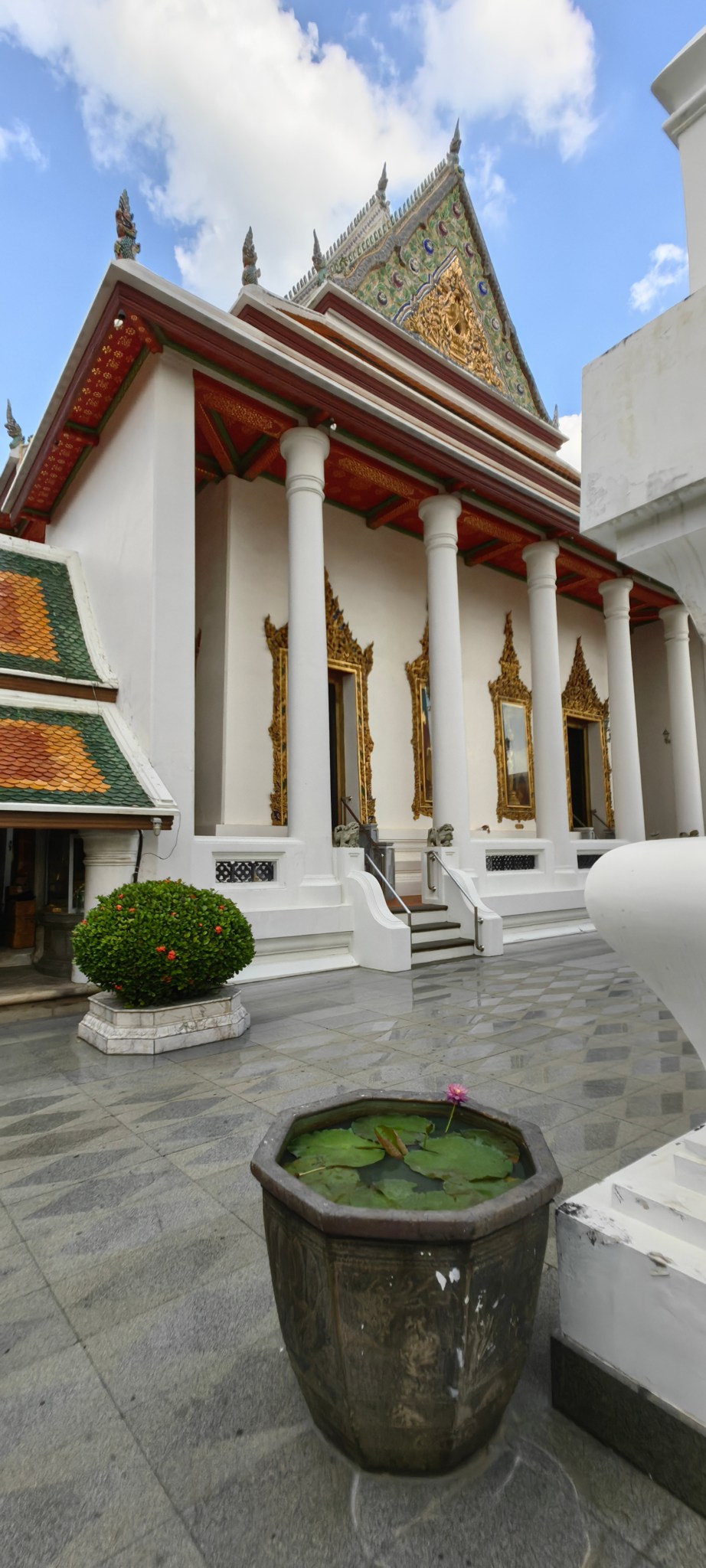
The temple complex includes an ubosot, or ordination hall, where religious ceremonies and rituals are conducted. It follows traditional Thai temple architecture, characterized by its rectangular shape and multi-tiered roof structure. The roof is adorned with intricate gables (chofah) and tiered finials (lud khan mai). Similar to the prang, the ubosot is constructed primarily of brick and covered with stucco. The exterior walls are embellished with delicate floral and geometric patterns rendered in stucco relief.
Surrounding the central prang are various smaller structures, pavilions, and small towers called Phra Prang which is a Khmer-style tower built to house relics of the Buddha. Wat Arun has long been associated with the Thai monarchy. It has received royal patronage over the centuries, highlighting its importance in Thai cultural and religious life. This temple and the Grand Palace are the two most famous sites in Bangkok, overcrowded by tourists from different countries.
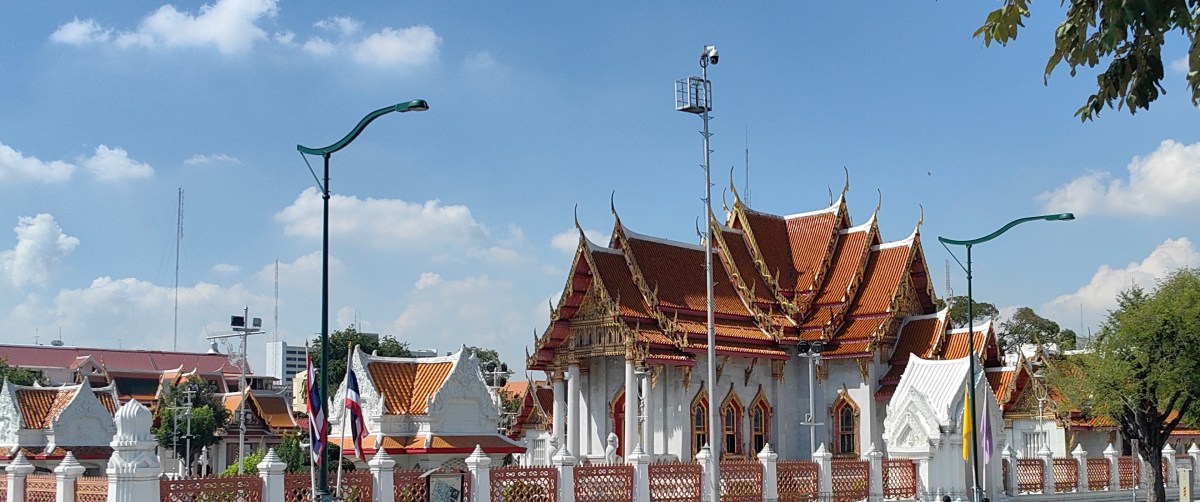
On the street of Bangkok, I can always see many temples and Buddhism related building. In Thai culture, temples are more than just places of worship. They serve as community centers where people gather for festivals, and ceremonies. The Thai monarchy has historically been a strong patron of Buddhism. Many temples in Bangkok were built under royal sponsorship.
In many temples of Bangkok, I could find lotus planted in a large water jar. According to Buddhist lore, when the Buddha was born, lotus flowers bloomed wherever he stepped. This association makes the lotus an especially sacred flower in Buddhism. In Buddhist teachings, the lotus is not only a decoration but represents spiritual purity, resilience, and enlightenment.
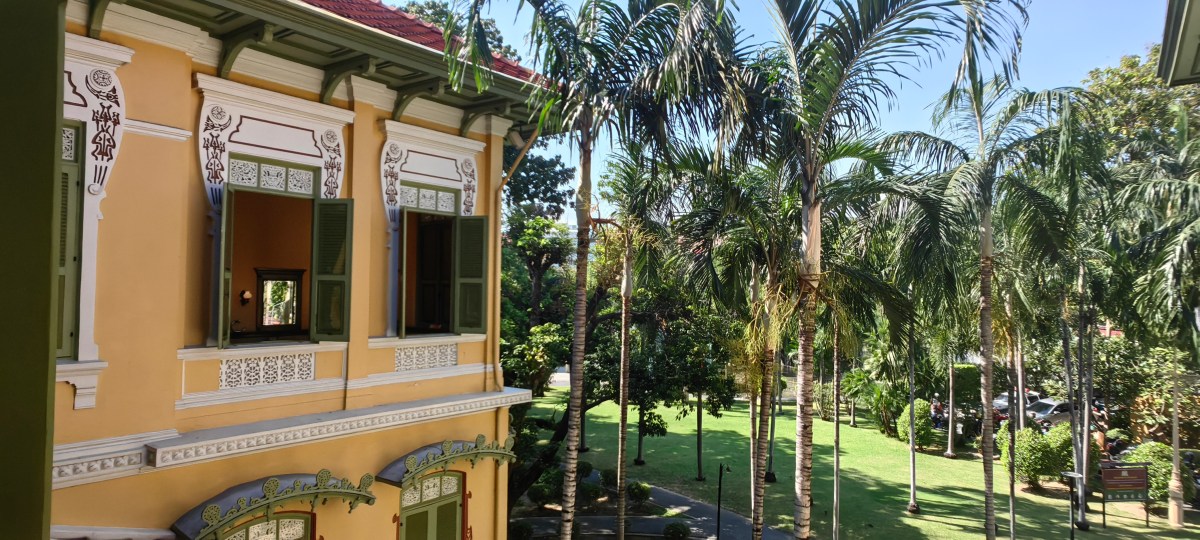
Apart from the temples, I have visited some historic sites and landmarks. This Parutsakawan Palace has played an important role in Thai history and politics. It is not so well-known for the tourists, and I was the only visitors on that day. It was constructed in 1904 during the reign of King Chulalongkorn (Rama V). The palace served as the residence of Prince Paribatra and his family. Following the 1932 Siamese Revolution, which transitioned Thailand from an absolute monarchy to a constitutional monarchy, Parutsakawan Palace was confiscated by the government. The palace was repurposed for various governmental uses and has since housed different government offices and institutions.
The architecture of Parutsakawan Palace reflects a blend of European and Thai styles, which was common during the reign of King Chulalongkorn. The design incorporates elements of neoclassical and Renaissance architecture, which were popular in France at the time.
The palace is a symbol of the transition from absolute monarchy to constitutional monarchy and the associated socio-political transformations. Today, it serves as a cultural and educational resource. It is a site where visitors can learn about Thailand’s history, architecture, and cultural heritage.
Despite the European influence, the palace also incorporates traditional Thai architectural elements. These include the use of traditional Thai rooflines, decorative motifs, and intricate woodwork. The integration of Thai and European styles reflects the cultural exchange and modernization efforts of King Chulalongkorn.
Opposite to the palace is the Plaza of King Chulalongkorn. The plaza was established to honor King Chulalongkorn’s legacy and his contributions to the nation. The centerpiece of the plaza is a grand equestrian statue of King Chulalongkorn which was created by the French sculptor Georges Saulo and erected in 1908. The plaza is surrounded by important governmental buildings, which could not be visited by tourists.
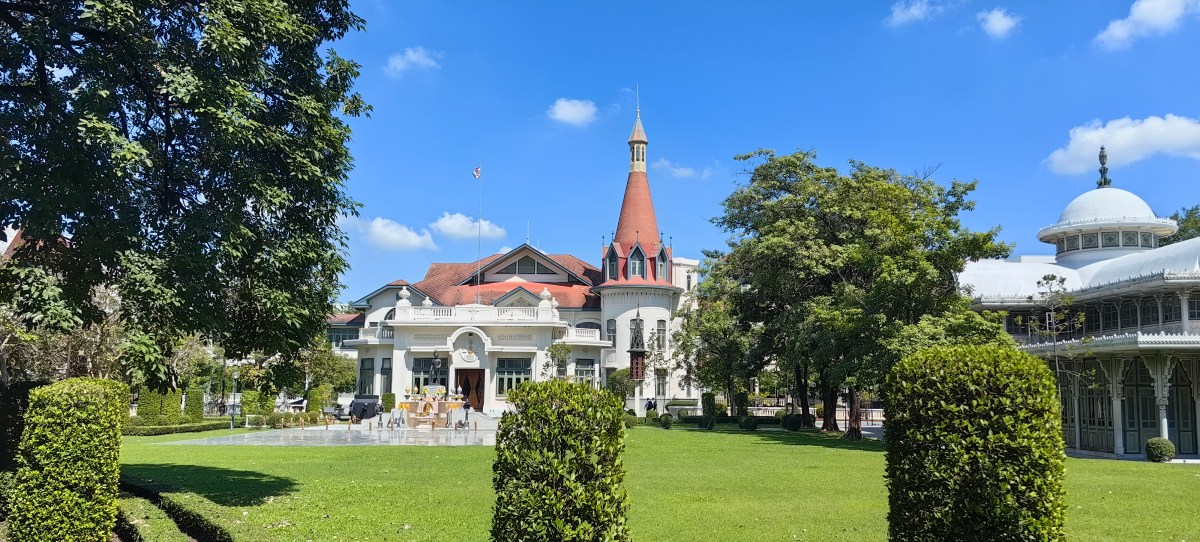
Another historical site with significant cultural, architectural, and historical value is the Phaya Thai Palace. It was built in 1909 during the reign of King Chulalongkorn. It showcases a blend of European and Thai architectural styles as well which is a symbol of Thailand’s transition into the modern era. There is a beautifully landscaped gardens in front of the main buildings, which include ornamental plants, fountains, and pathways. Today, Phaya Thai Palace serves as a cultural and educational site. It offers visitors insights into Thailand’s royal history.
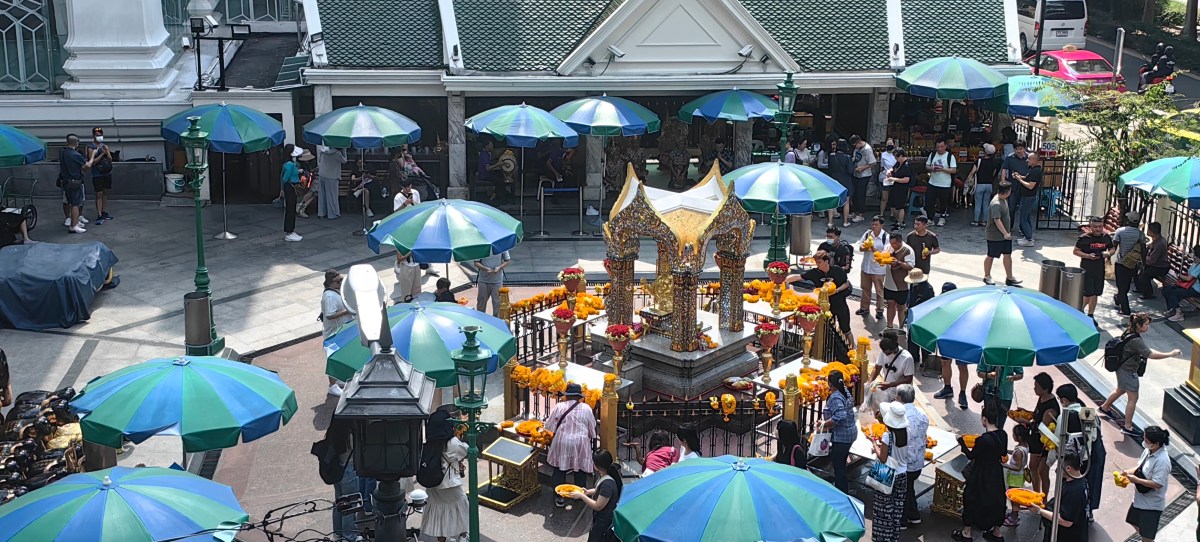
Before I left Bangkok, the last place to visit was the Erawan Shrine. It is one of Bangkok’s most famous religious landmarks. Located near the bustling shopping Central World, this shrine is dedicated to Phra Phrom, the Thai representation of the Hindu god Brahma. The Erawan Shrine features a statue of Phra Phrom (Brahma) with four faces, each representing different aspects of life: peace and health, good fortune, prosperity, and protection against evil. The statue is adorned with intricate gold leaf and is positioned in a small, open-air pavilion that allows worshippers to walk around it and make offerings from all sides. Visitors from all over the world came here to pray for good fortune, success, and health.
CentralWorld in Bangkok is one of the largest shopping malls in Thailand and Southeast Asia. It has hosted numerous events, including concerts and fashion shows. On the day of my visit, there are many Pikachus that attracts fans of all ages. Before I took Metro to the airport, I had a lunch here. I really enjoyed the Thailand food with spicy and sour taste.
Green Papaya Salad (Som Tum) is a classic Thai dish known for its mixing flavors and refreshing taste. It’s a popular street food and is often enjoyed as a side dish. The salad is a perfect blend of spicy, sour, sweet, and salty flavors. Its spicy taste is from the bird’s eye chilies. The sour taste is from the fresh lime juice. The sweet taste is from the palm sugar. The salty taste is from the fish sauce. It is a must-try dish for anyone interested in experiencing authentic Thai cuisine.
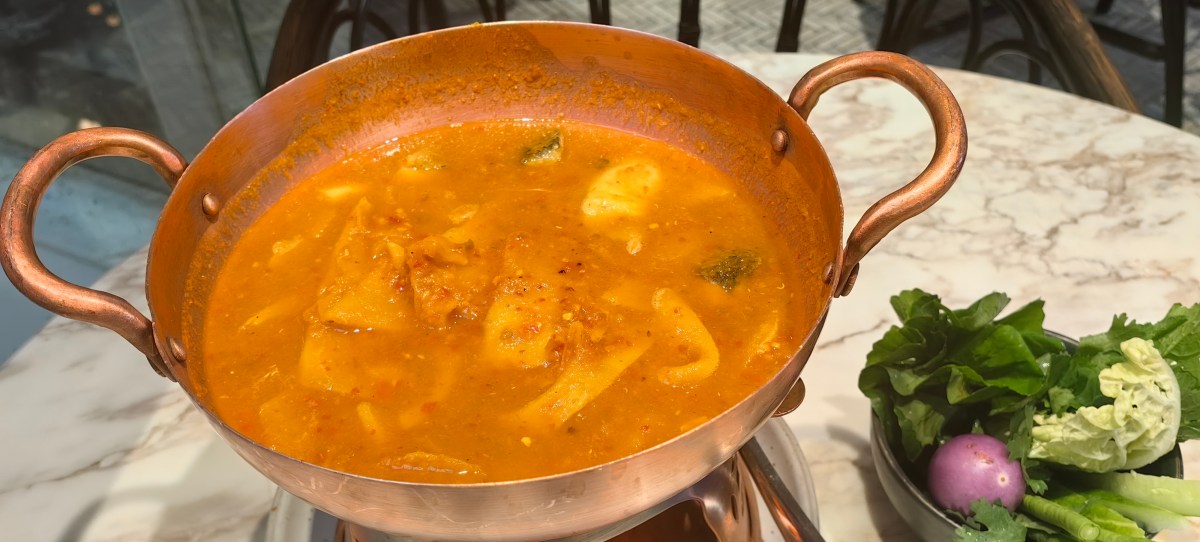
Yellow Curry Fish( Kaeng Kari Pla) is a Thai dish with tender fish fillets like cod, snapper, or tilapia simmered in a rich and aromatic yellow curry sauce. Yellow curry is made from a blend of turmeric, coriander, cumin, lemongrass, galangal, garlic, and shallots. Coconut milk is used to add richness and creaminess to the curry. Vegetables like potatoes, bamboo shoots, carrots, and onions are used as additions. Yellow curry is less spicy compared to red or green Thai curries and suitable for most people.
黄咖喱鱼(Kaeng Kari Pla)是一道将鳕鱼、鲷鱼或罗非鱼等嫩鱼片放入浓郁芳香的黄咖喱酱中炖煮的经典泰国菜。黄咖喱由姜黄、香菜、小茴香、柠檬草、高良姜、大蒜和青葱混合制成。椰奶则用于增加咖喱的浓郁和奶油味。土豆、竹笋、胡萝卜和洋葱等蔬菜可作为配料。与红咖喱或绿咖喱相比,黄咖喱的辣味较淡,适合大多数人。
As my journey through Bangkok drew to a close, I could find that this city is a tapestry woven with cultural treasures, bustling street life, and culinary delights. From the tranquil temples to the busy markets, every corner of this city reveals a new adventure. The city’s modern skyline seamlessly blends with its historical roots, creating a dynamic contrast that mirrors Thailand’s journey from past to present. Whether navigating the maze of waterways in a traditional longtail boat on the Chao Phraya River or savoring the explosion of spicy flavors in dishes, Bangkok offers me an immersive experience that is worthy and unforgettable.


























































 Gone like the wind