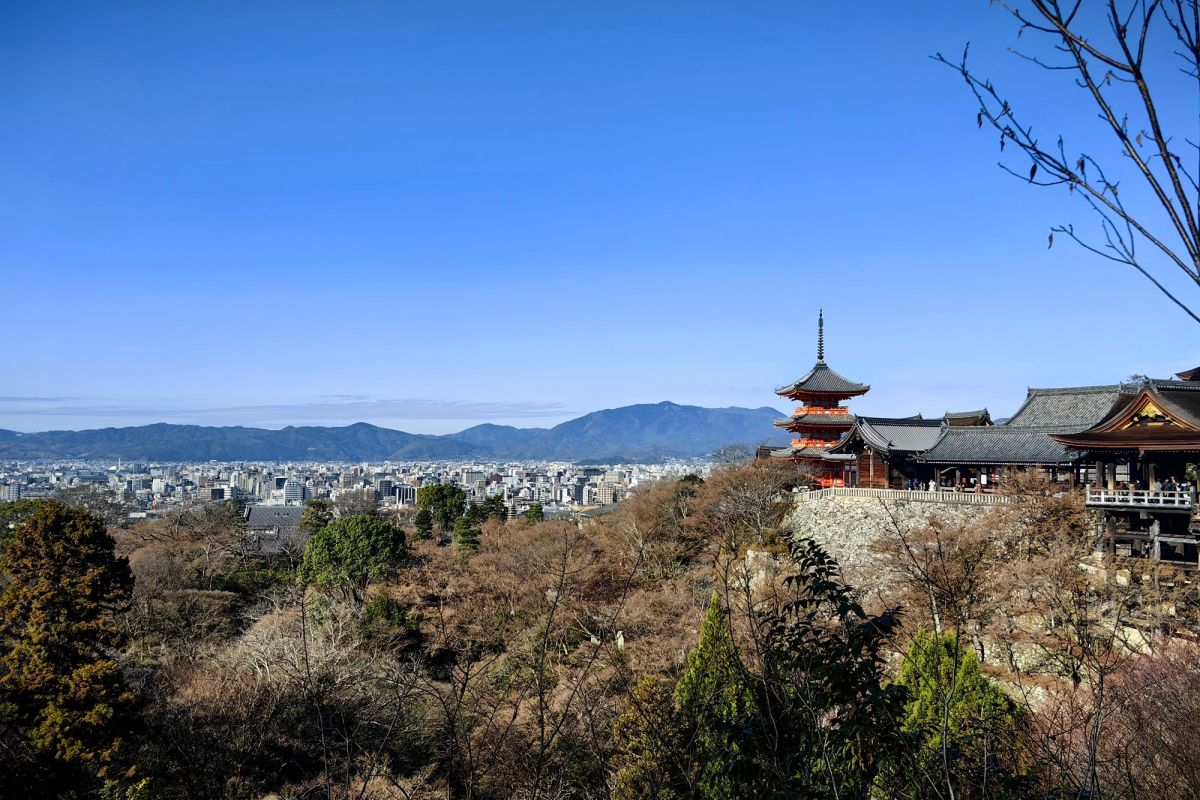
As someone who has always been fascinated by history, Kyoto was the city that I had wanted to visit for the longest time. More than simply another destination, it seemed to me like a place where the history of Japan could still be encountered in the landscape itself. Modern Kyoto grew from Heian-kyō, the imperial capital founded in 794, and for more than a thousand years the city remained at the heart of Japan’s courtly and cultural life. Although the imperial capital eventually moved to Tokyo, the old capital never completely disappeared. This was what fascinated me most about Kyoto. To walk through Kyoto, therefore, was in some sense to walk through layers of Japanese history, from the imperial court of Heian-kyō to the Buddhist temples and samurai culture of later centuries, and finally to the modern city that exists today. After having read and imagined so much of this history, I was finally able to see it with my own eyes.
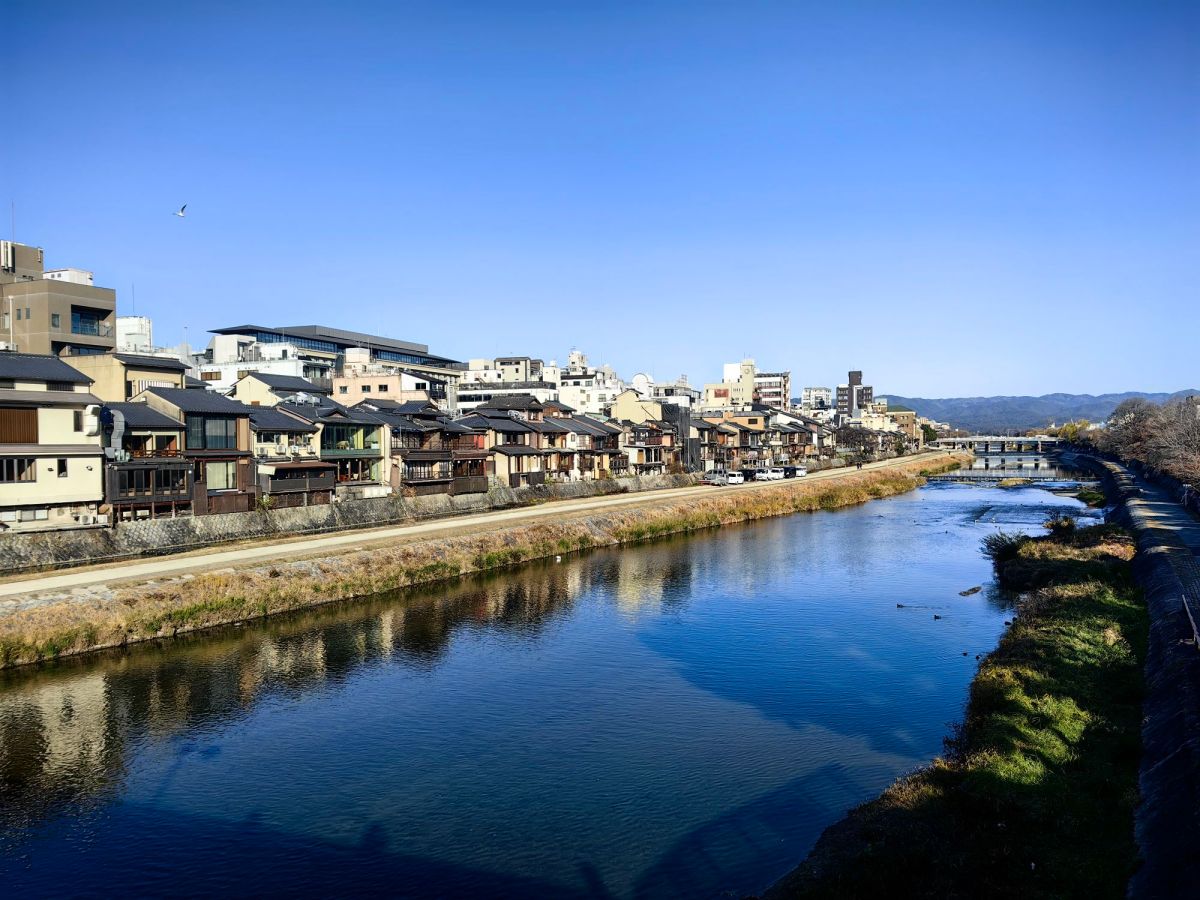
My first stop in Kyoto was the Kamo River, just a short walk from where I was staying near Shijō. After stepping away from the busy streets, the city suddenly seemed to open up. The river flowed quietly through the heart of Kyoto, its broad banks creating a long strip of sky, water, and greenery between the buildings on either side. In the distance, the mountains surrounding Kyoto formed a gentle backdrop. Along the riverbanks, people walked, cycled, jogged, or simply sat beside the water, while birds moved across the shallow currents. The contrast was striking: behind me was the lively commercial center of Kawaramachi, filled with shops, restaurants, and traffic; in front of me was the calm, open landscape of the Kamo River.

Standing there, I began to understand something about Kyoto that I had previously known only from history. The Kamo River was not merely a river running through a modern city. It had been part of Kyoto’s landscape since the days of Heian-kyō, flowing past the ancient capital for more than a thousand years. The Sanjō bridge behind me was famously used as a public execution ground. It has a remarkably dark historical side related to Ishida Mitsunari. After Toyotomi Hideyoshi’s death, Mitsunari emerged as one of the principal leaders opposing Tokugawa Ieyasu. His Western Army was defeated at Sekigahara in 1600. Mitsunari was eventually captured and brought to Kyoto. On 6 November 1600, he was executed at Rokujō-gawara and his head was subsequently displayed at Sanjō-gawara near Sanjō Bridge.
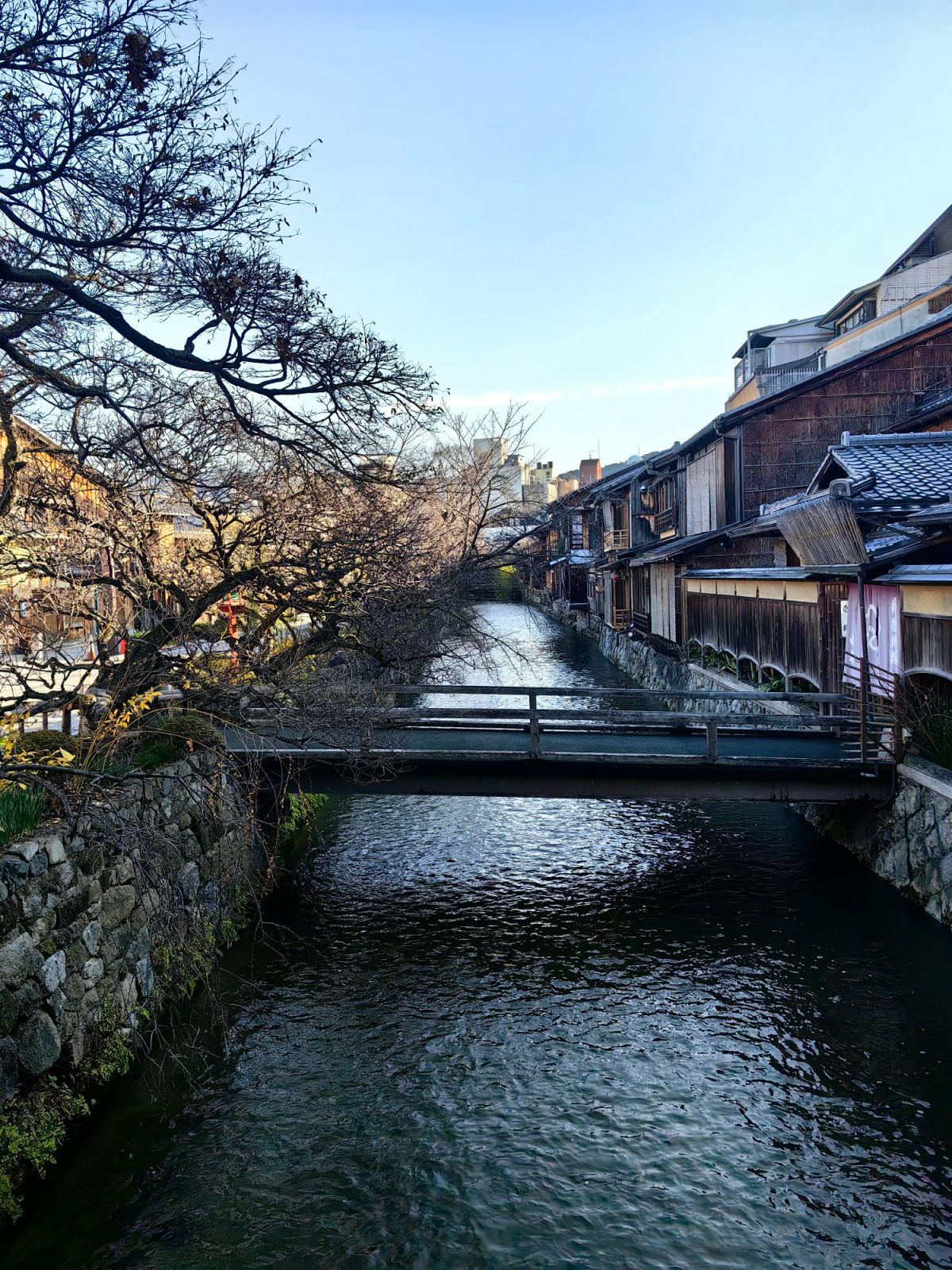
Yasunari Kawabata is a famous Japanese writer. His novel ‘ Kyoto’ had a detailed description of the landscape which really impresses me. “For such a large city, the color of the leaves in Kyoto was beautiful. The groves of pines in Gosho and the imperial villa of Shugakuin and the trees in the expansive gardens of the old temples all caught the eye of the traveler, as did the rows of willows in the center of the city, along the banks of the Takase River.”
{ 京都は大都会としては、木の緑が美しかった。修学院離宮や御所の松林、古寺の広い庭の木々はもちろん、市内の木屋町や高瀬川畔、五条や堀川の柳並木も、旅人の目をひいた。それはほんとうの柳であった。緑の枝が地にとどくほど垂れて、しなやかであった。}
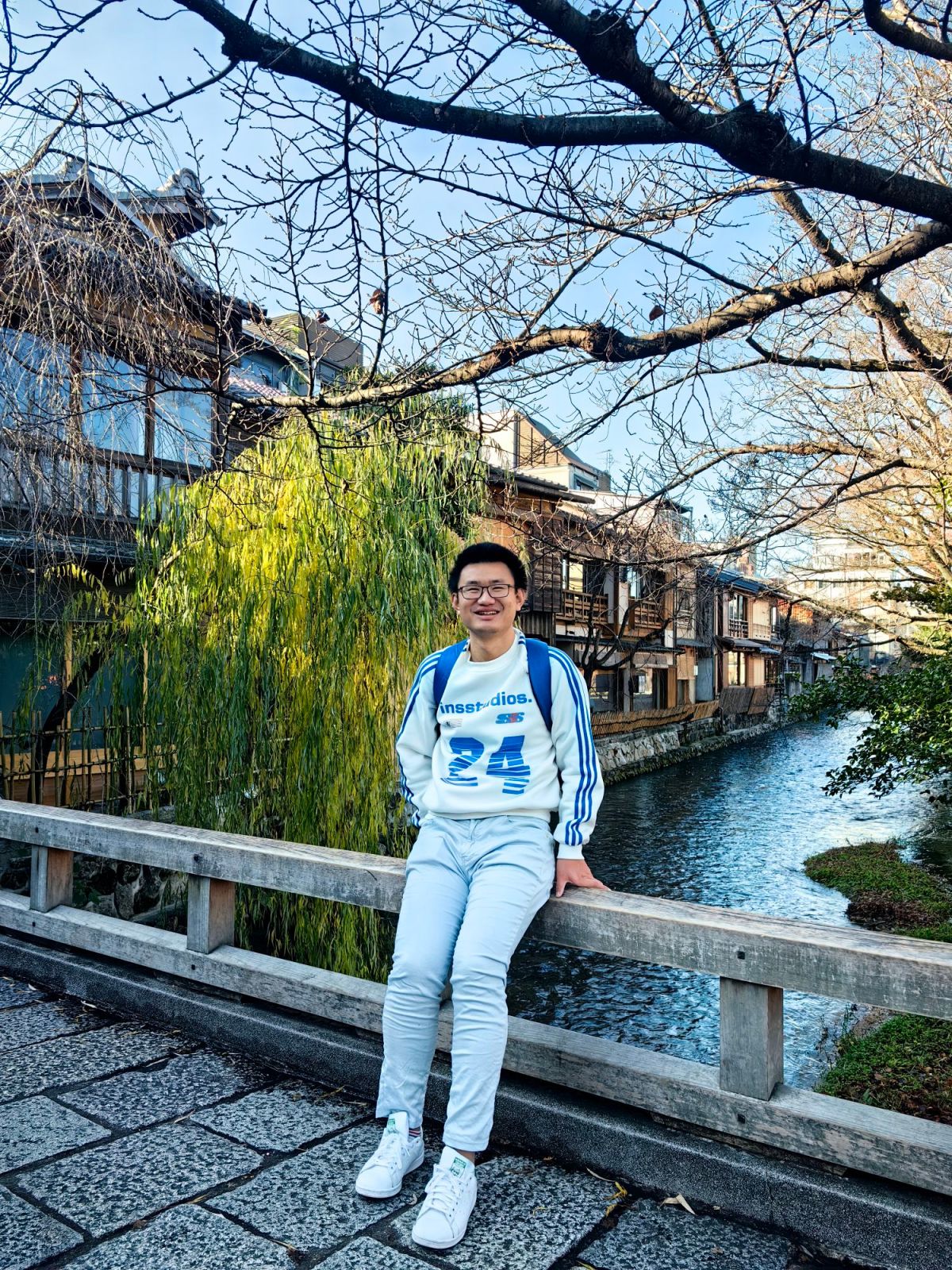
Kawabata Yasunari’s description of Kyoto in The Old Capital had long shaped my imagination of the city. His words painted a picture of a metropolis where greenery and historical scenery existed in quiet harmony, where ancient temple gardens, graceful willows along the rivers, and the wooded mountains beyond the city formed an inseparable part of Kyoto’s character. This literary image became my first impression of Kyoto even before I set foot there. When I finally arrived, I was eager to explore the places he had described, to walk along the rivers and through the old streets, and to discover for myself the landscape that had inspired his words.
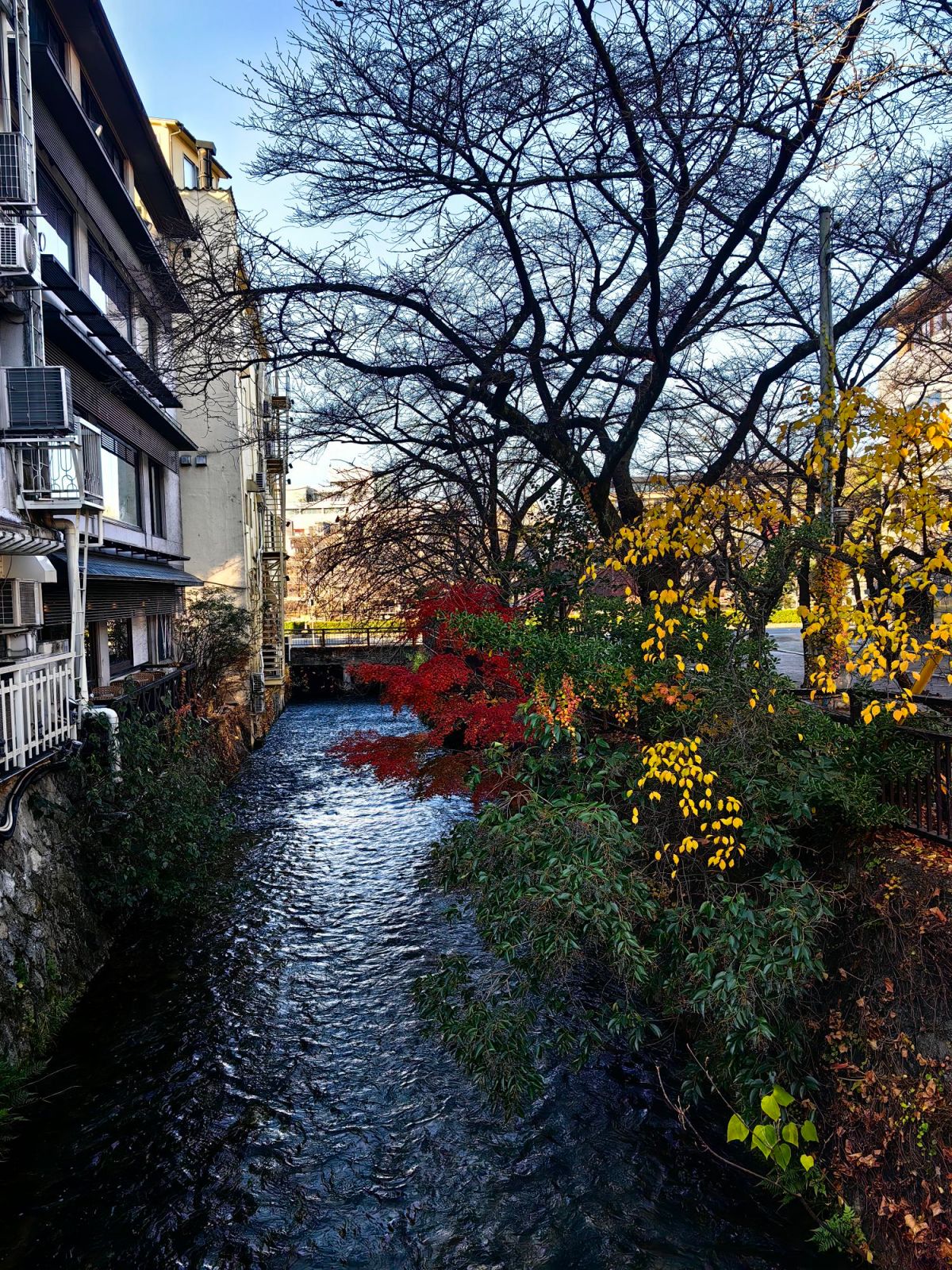
The Shirakawa Canal was one of those places in Kyoto where the charm of the old capital seemed to reveal itself in the smallest details. A narrow stream of clear water flowed gently between stone banks, its surface reflecting the branches of willows and the wooden facades of traditional houses that stood quietly along its course. Small stone bridges crossed the canal at intervals, connecting the narrow lanes on either side, while the branches of trees leaned over the water as though they had been watching over this little corner of Kyoto for centuries.
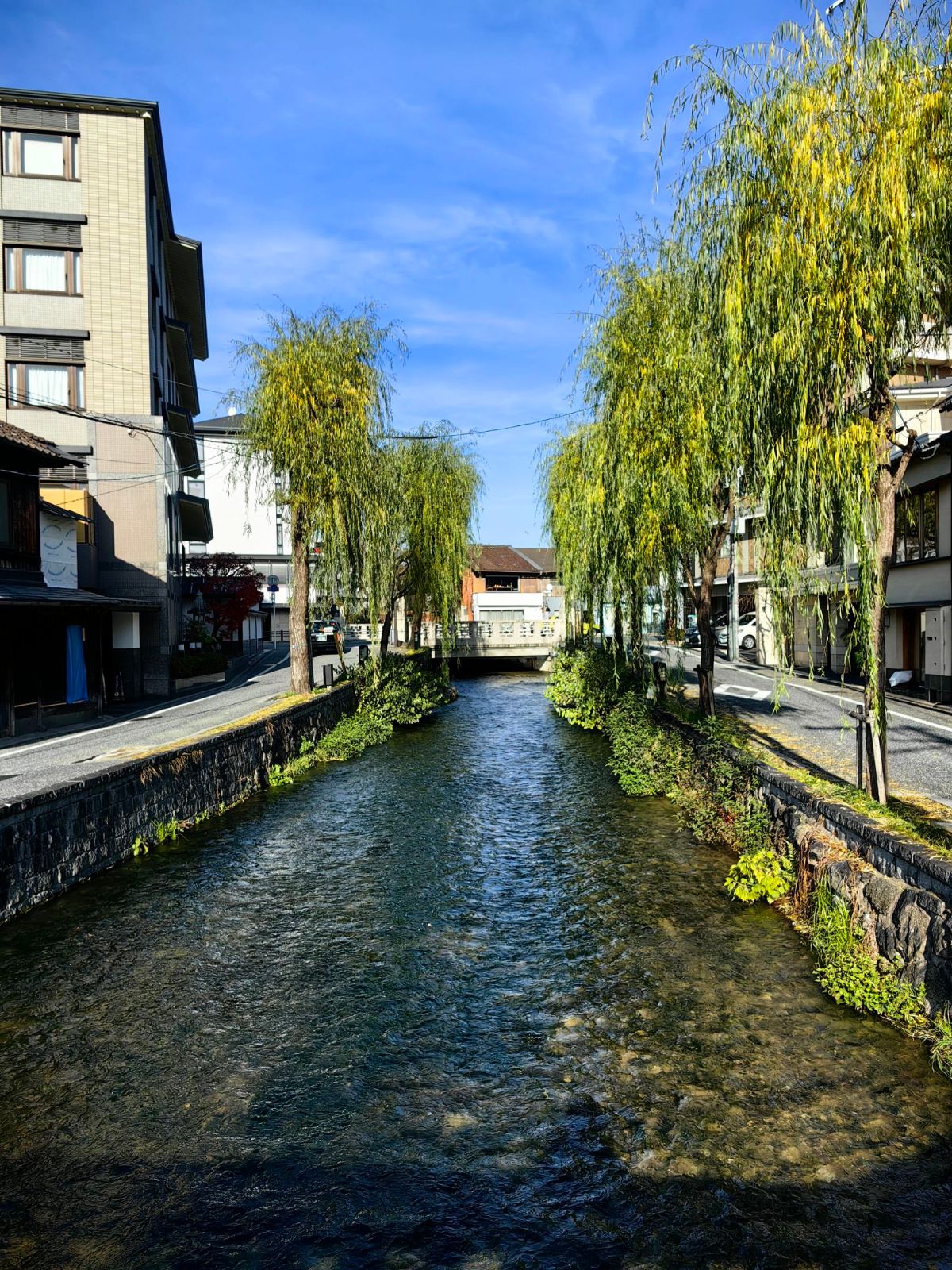
There was something particularly graceful about the scene. Unlike the grand temples and imposing gates that often draw visitors to Kyoto, the small canal possessed a more intimate beauty, one that revealed itself slowly to those willing to wander without a particular destination. The soft murmur of flowing water, the delicate green of the overhanging leaves, and the weathered textures of wood and stone created a landscape that felt removed from the haste of the modern world.
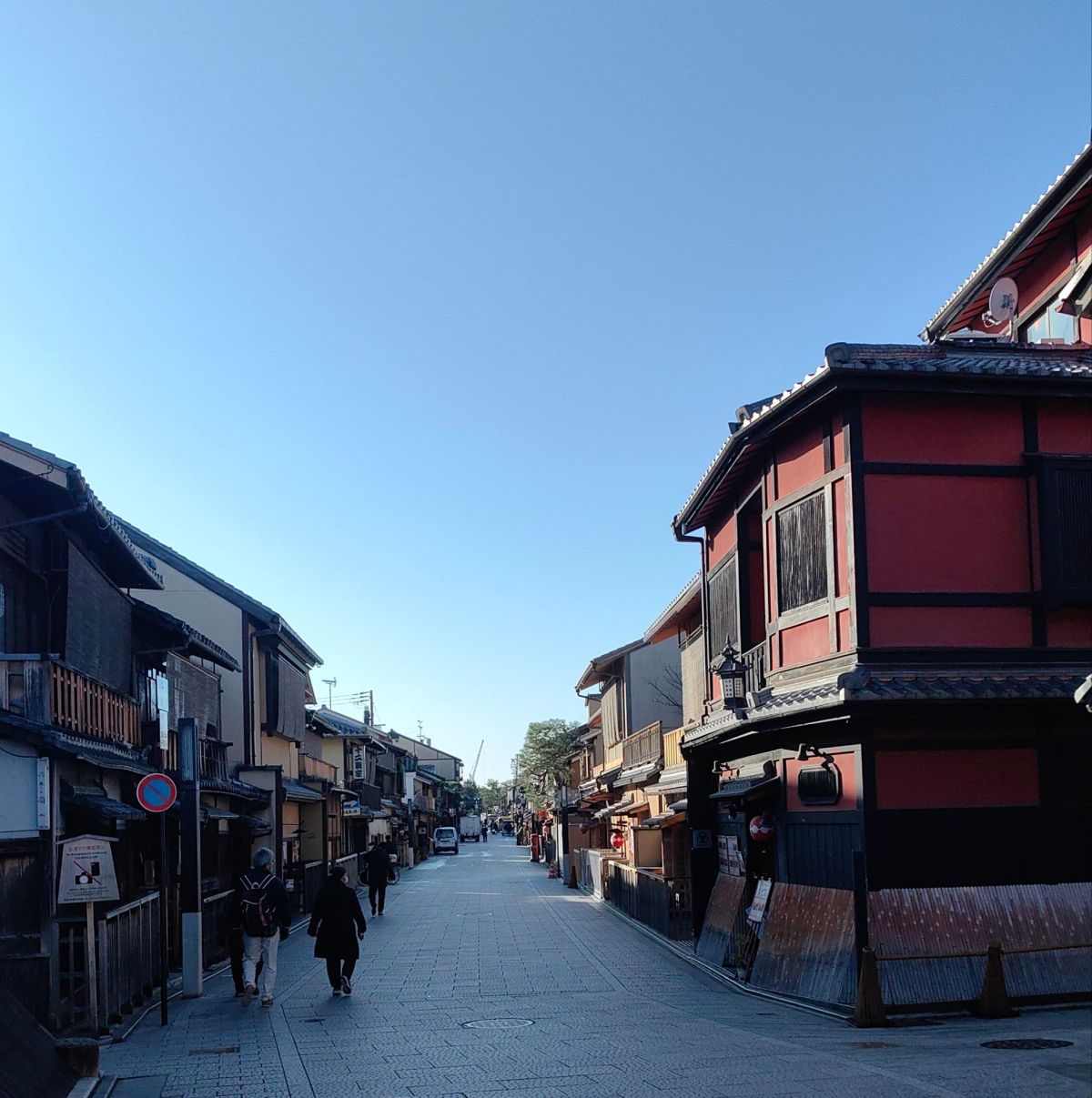
From the quiet waters of the Shirakawa Canal, I continued toward Hanamikoji Street, in the heart of Gion, one of Kyoto’s most celebrated traditional districts. The atmosphere gradually changed as I entered its narrow streets, where rows of old wooden townhouses stood close together beneath dark tiled roofs. Their latticed windows, timber facades, and understated entrances seemed to preserve the elegance of another age. Here and there, discreet signs marked traditional restaurants and teahouses, some hidden behind wooden doors and curtains that offered only a glimpse of the world within.
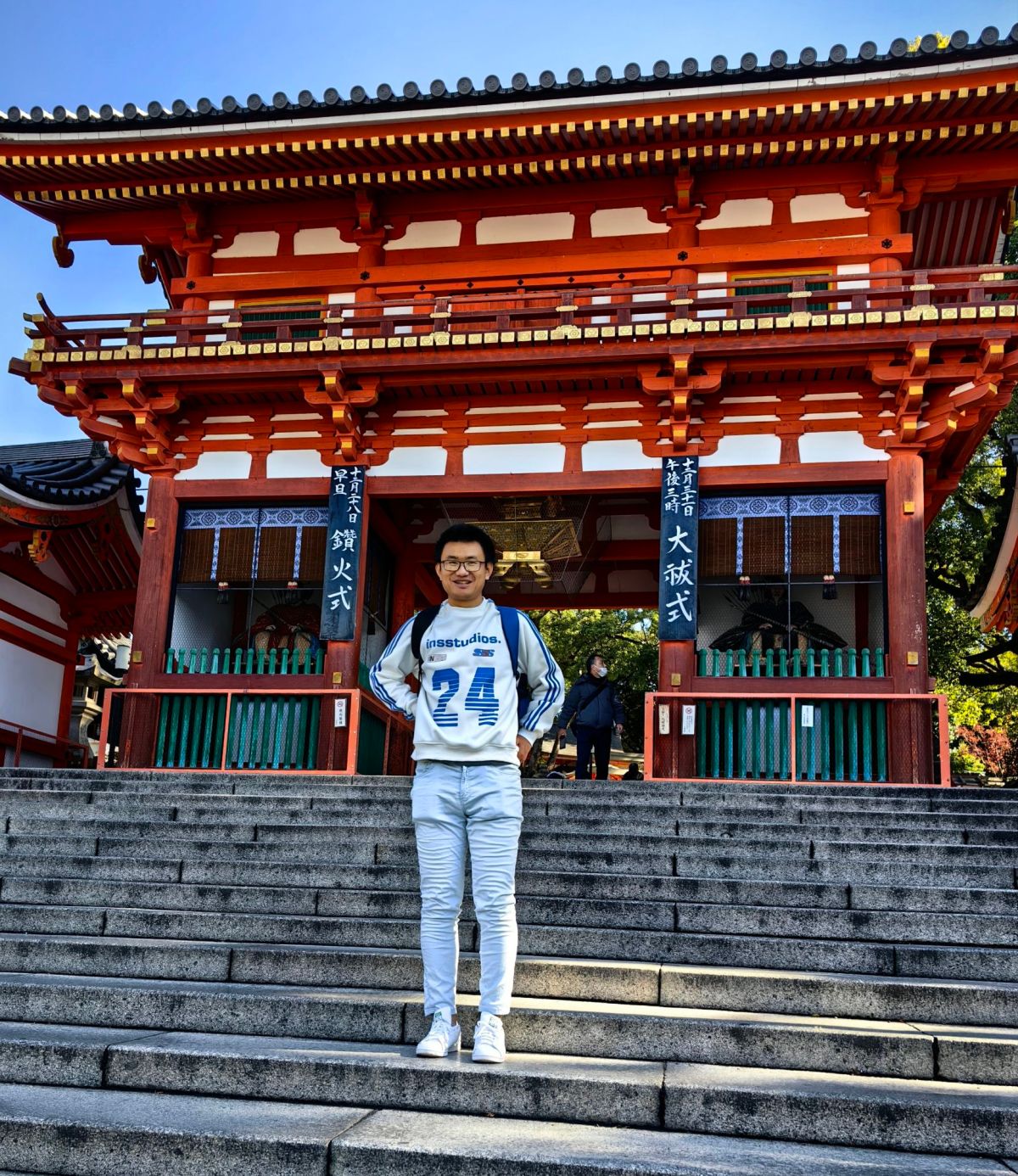
Hanamikoji was particularly captivating for its association with Kyoto’s geisha culture. Behind these unassuming facades lay a centuries-old tradition of music, dance, conversation, and hospitality, cultivated in the exclusive teahouses of Gion. The district had developed during the Edo period around Yasaka Shrine, serving visitors who came to worship and gradually becoming one of the city’s most renowned entertainment quarters. Even today, its streets retain an atmosphere distinct from the modern commercial districts nearby. What fascinated me was the way the traditional and contemporary existed side by side.
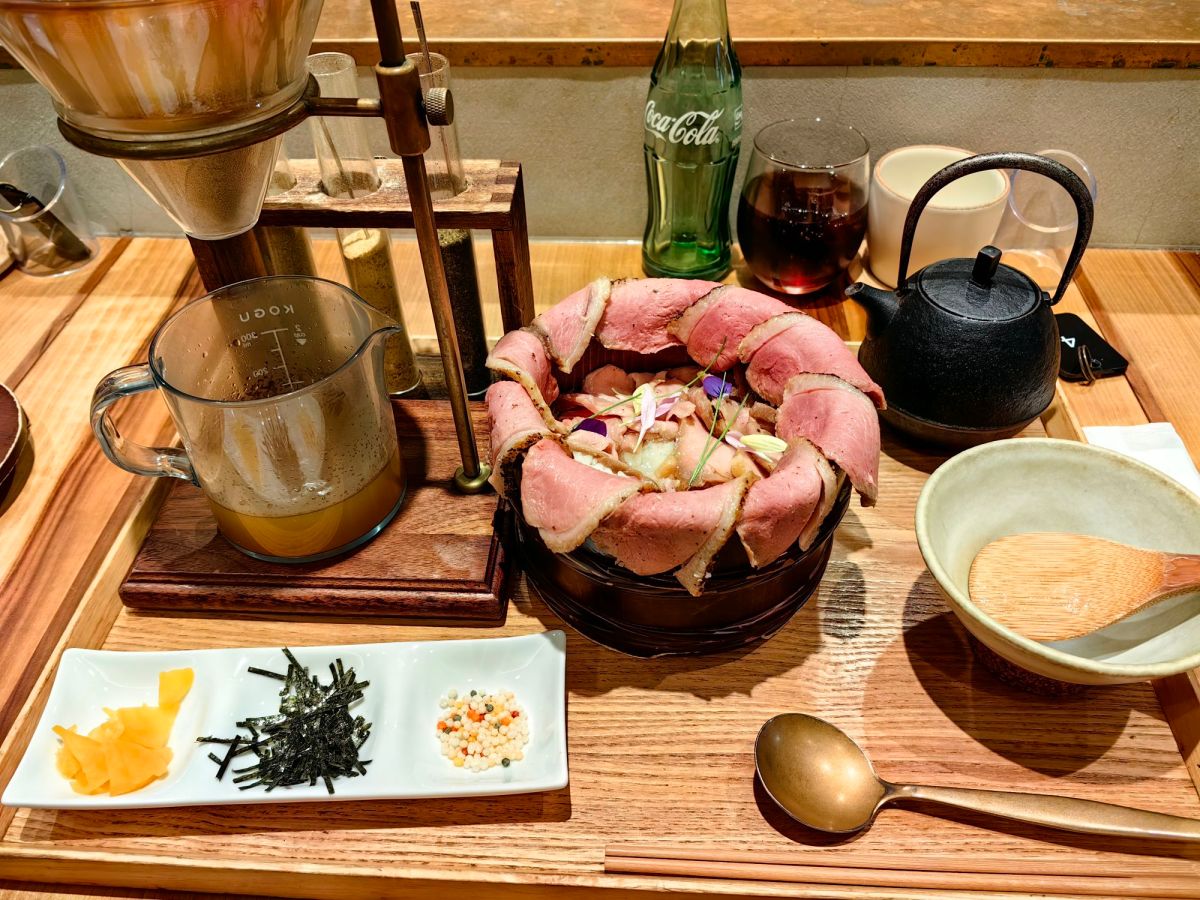
Near Yasaka Shrine, Gion is a wonderful place to experience Japanese food. The Gion Duck Rice I tasted was not just a meal, but a unique culinary experience. What made it truly special was its creative presentation, with small test tubes used in a chemistry laboratory. The dish combined the rich, savory flavors of duck rice with a touch of modern Japanese creativity. The test-tube-like containers made the food feel like a scientific experiment, turning an ordinary dining experience into something playful, artistic, and memorable. It was a wonderful example of how Japanese cuisine brings together tradition, innovation, and attention to detail.
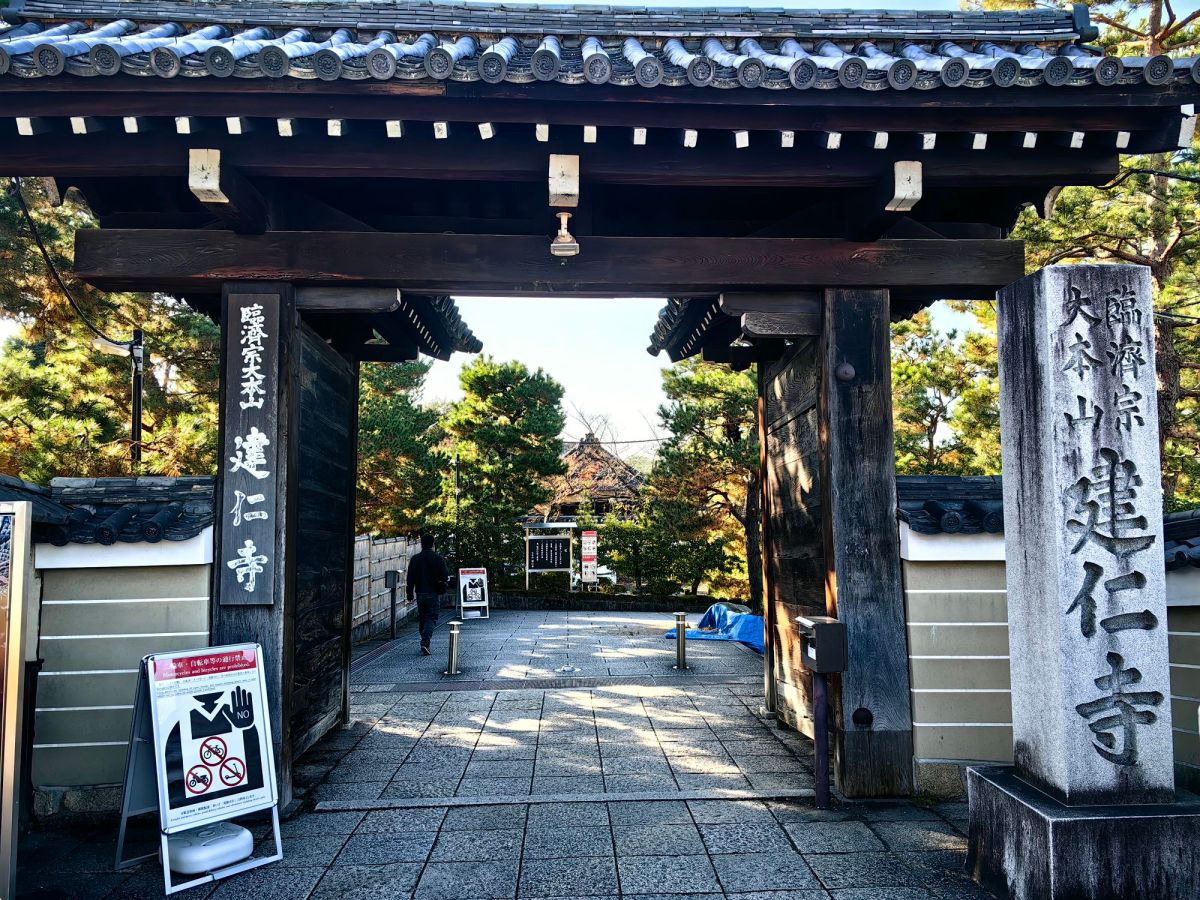
At the southern end of Hanamikoji Street, it is Kennin-ji, a Zen temple founded in 1202, during the early years of the Kamakura shogunate. After walking through the traditional streets of Gion, I found myself entering a different world, one shaped by the quiet discipline of Zen Buddhism and the long history of Japanese religious culture. Every temple in Kyoto has an interesting history for visitor to explore.
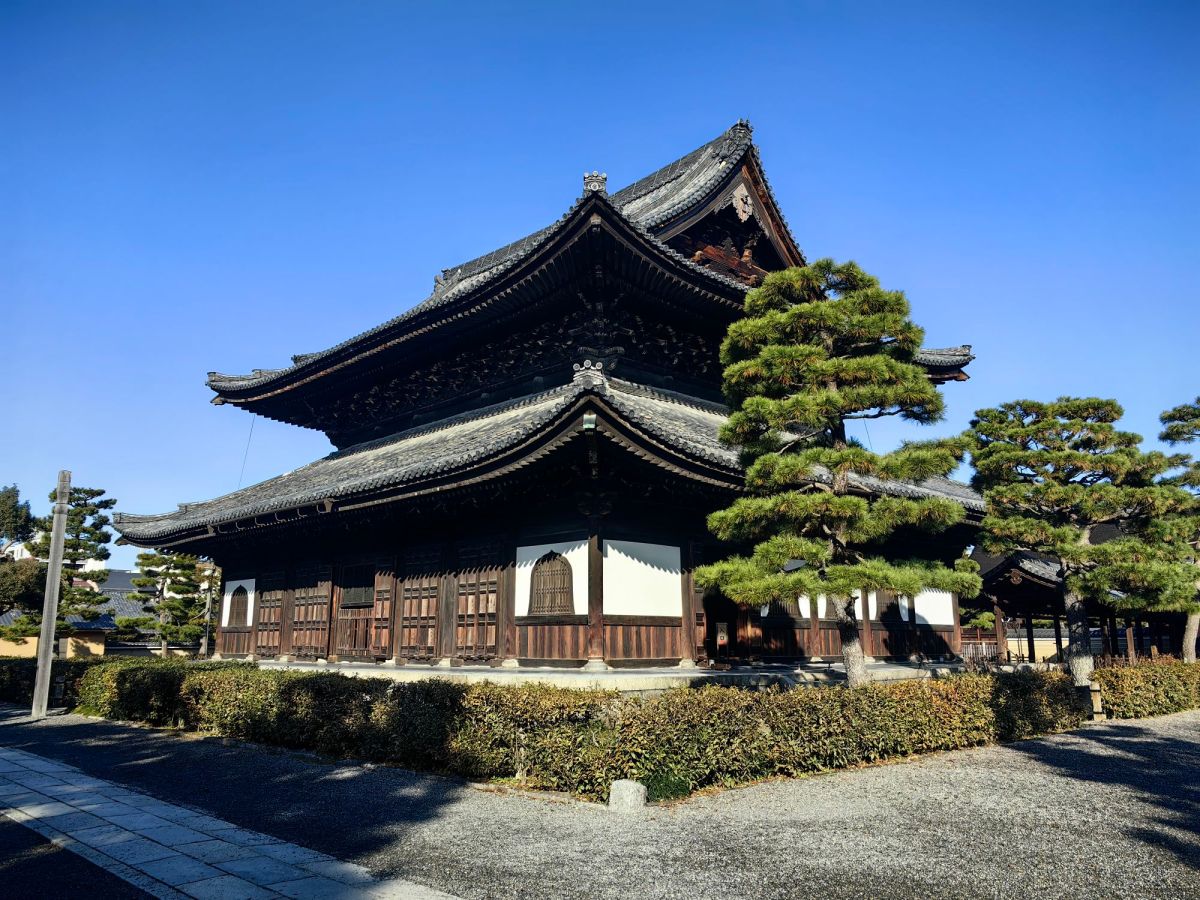
Kennin-ji was established by Eisai, the Buddhist monk who helped introduce Zen teachings from China and encouraged the cultivation and drinking of tea in Japan. Its history belongs to a period when the old imperial capital was undergoing profound changes. Political authority was shifting toward the samurai, while Zen Buddhism was gaining the patronage of the warrior class. Temples such as Kennin-ji became important meeting places for religious thought, Chinese learning, and the cultural traditions that would eventually shape so much of Japanese life.
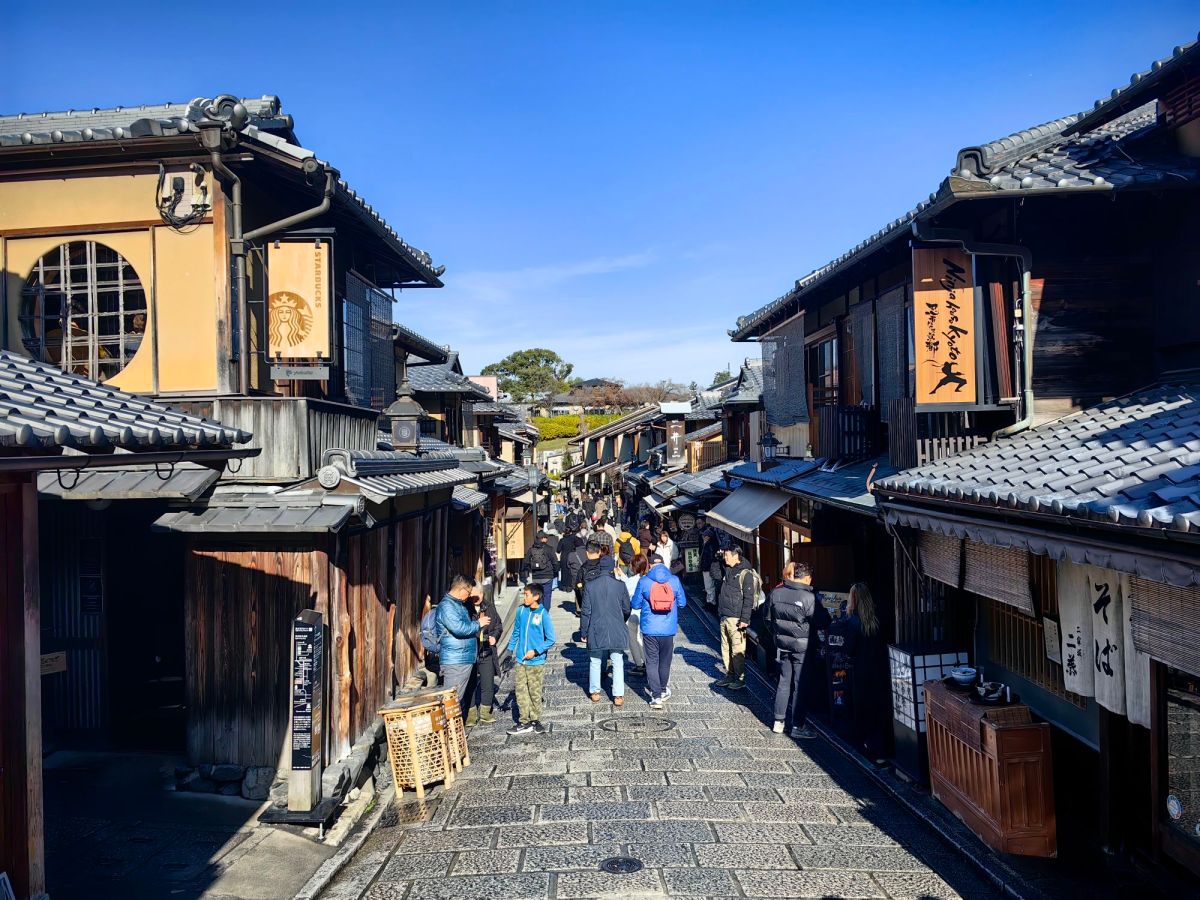
From Gion, I continued eastward into the Higashiyama district and arrived at Ninenzaka, one of the most famous streets in Kyoto. The narrow stone-paved street was filled with visitors moving slowly up and down the slope, stopping in front of shops, taking photographs, and admiring the traditional buildings. Ninenzaka was undoubtedly beautiful, but it was also one of the busiest places I had encountered in Kyoto. The street itself climbed gently along the hillside, its uneven stones worn smooth by generations of footsteps. On both sides stood rows of traditional wooden townhouses with dark timber facades, tiled roofs, lattice windows. Teahouses, confectionery shops, restaurants, and souvenir shops occupied the old buildings, bringing a lively commercial energy to what was once a much quieter approach to the temples of Higashiyama.
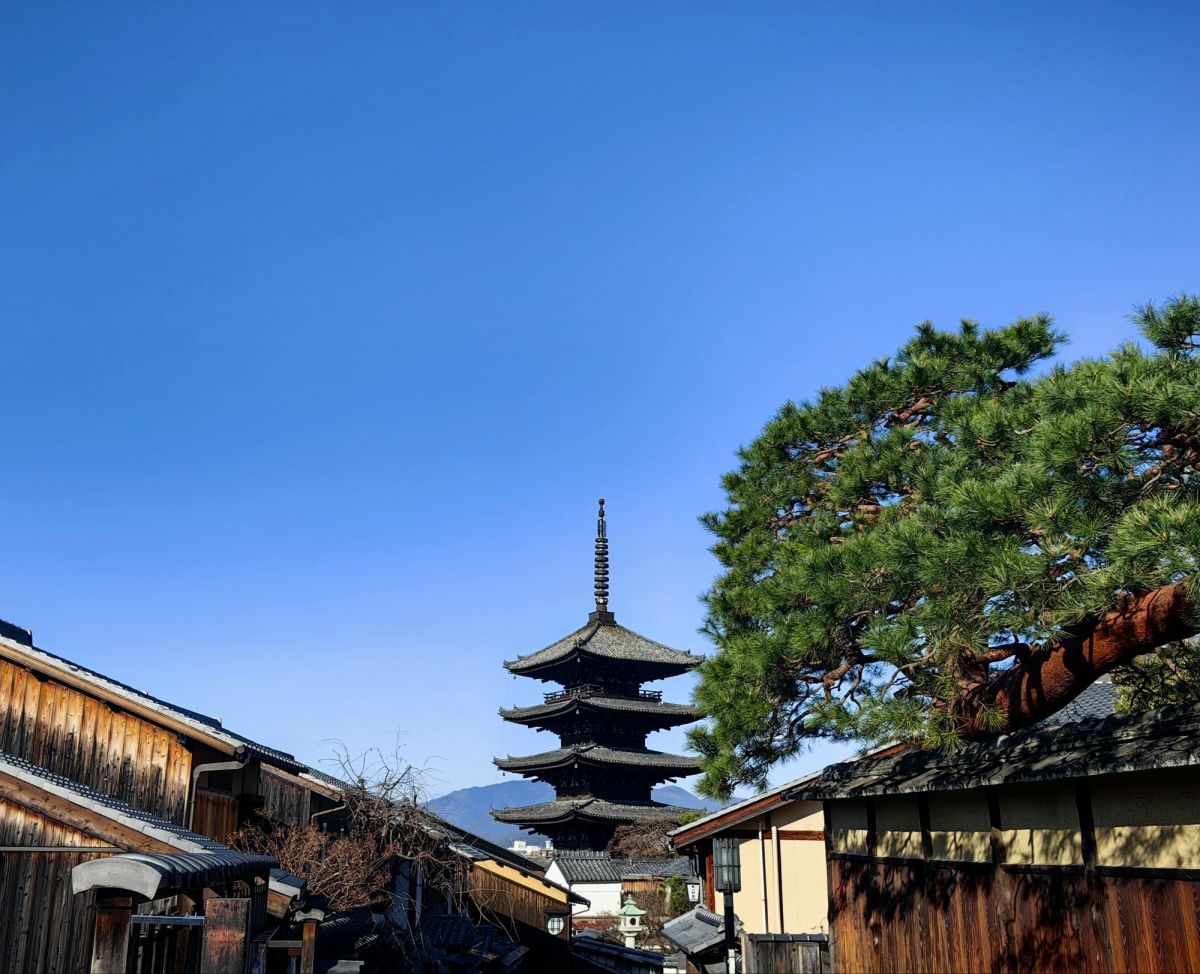
Among the many scenes of Ninenzaka, one image stayed with me more than any other. Looking down the narrow stone-paved lane, the old wooden shops stood closely along both sides, their dark timber facades and tiled roofs forming a continuous frame around the street. At the far end, rising above the rooftops, stood the slender dark silhouette of the Yasaka-no-Tō Pagoda. The five-story pagoda seemed almost perfectly placed at the end of the lane, as if the entire street had been arranged to lead the eye toward it. The contrast was beautiful: the deep tones of the weathered wood and pagoda against the clear blue of the sky and the fresh green of the trees.
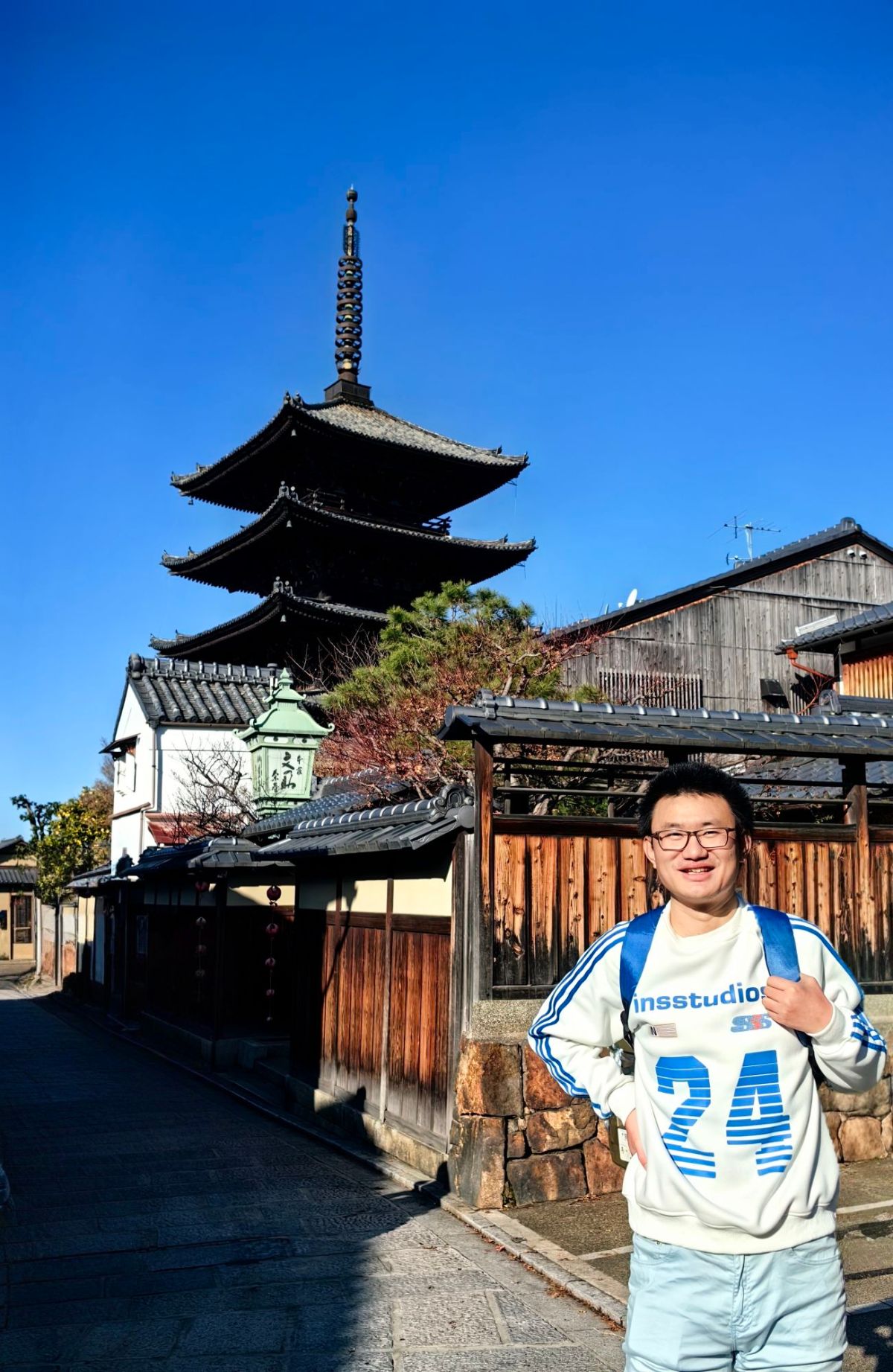
I stopped for a while to take in the view. Perhaps this was why Ninenzaka had become such a famous image of the city. It was not simply one beautiful street; everything seemed to come together in a single composition. As I continued along the slope, I realized that experiencing Kyoto meant accepting both sides of the city: the quiet ancient capital I had dreamed about, and the living, crowded city that exists today. Ninenzaka showed me that history does not always survive in silence.
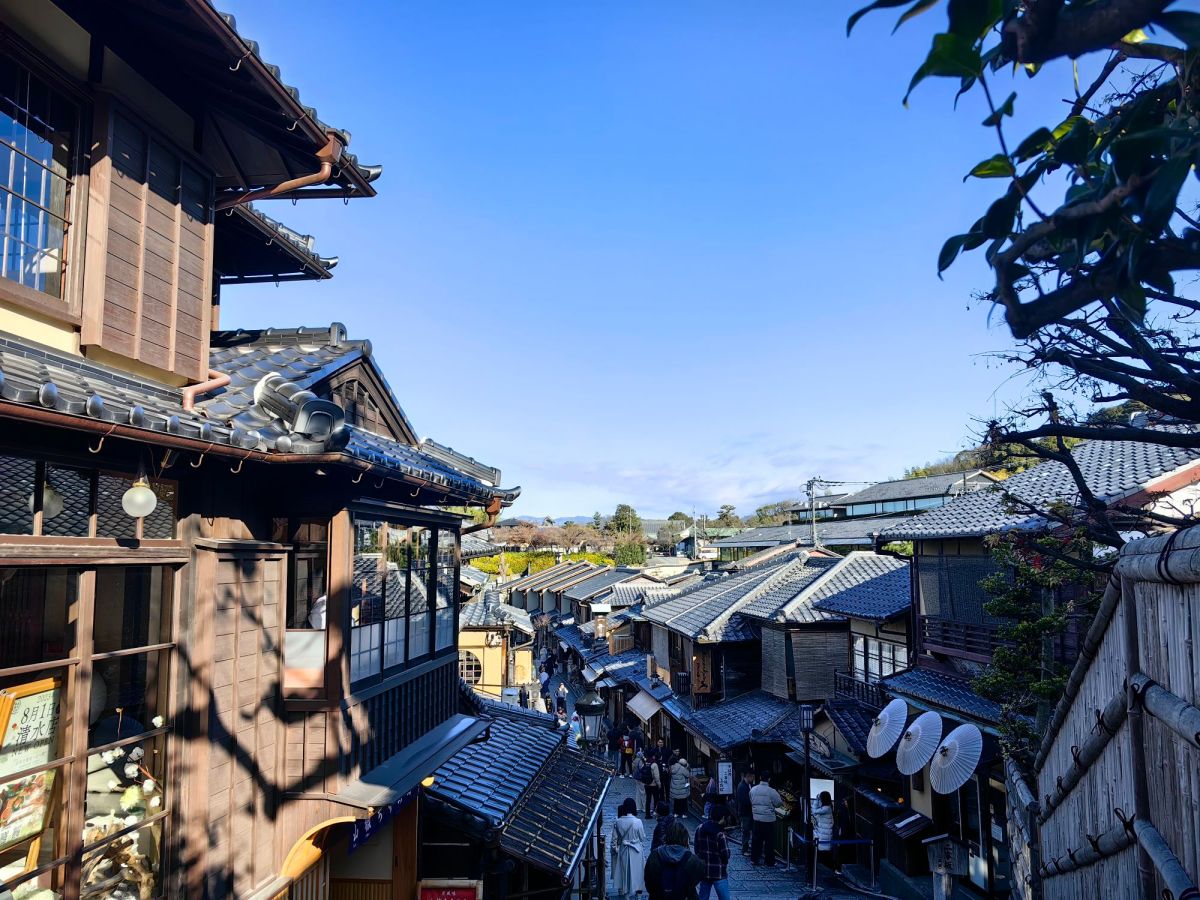
I continued climbing the slope toward Sannenzaka, where the street became another beautiful scene of old Kyoto. The stone pavement rose gently between rows of traditional wooden shops; many decorated with colorful Japanese umbrellas that added a delicate touch of color to the monotonous grey tones of timber and tiled roofs. Small shops displayed sweets, ceramics, handicrafts, and other traditional goods, while the narrow street remained lively with visitors making their way uphill toward Kiyomizu-dera.
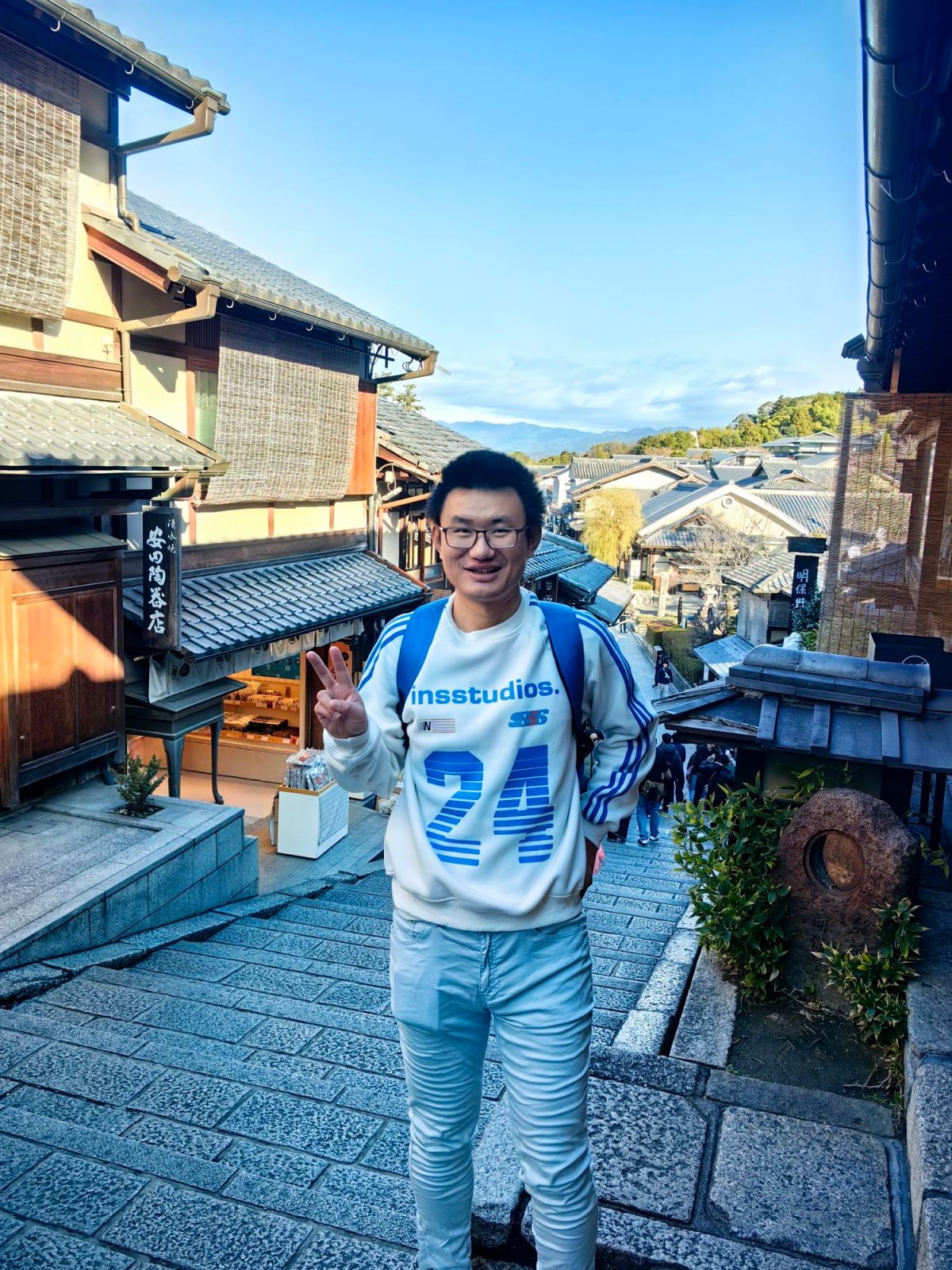
What caught my attention most was the Japanese girls dressed in traditional clothing. Many wore elegant kimono or yukata, their bright colors and intricate patterns standing out beautifully against the old wooden buildings. Some wore their hair in carefully arranged traditional styles, while others carried small handbags or walked together with friends, stopping occasionally to take photographs. Their presence made the historic street feel even more vividly connected with Japanese tradition. As I climbed higher, the street became a meeting point between past and present. The buildings and stone steps recalled the old capital, while the crowds, shops, cameras, and smartphones belonged to modern Kyoto.
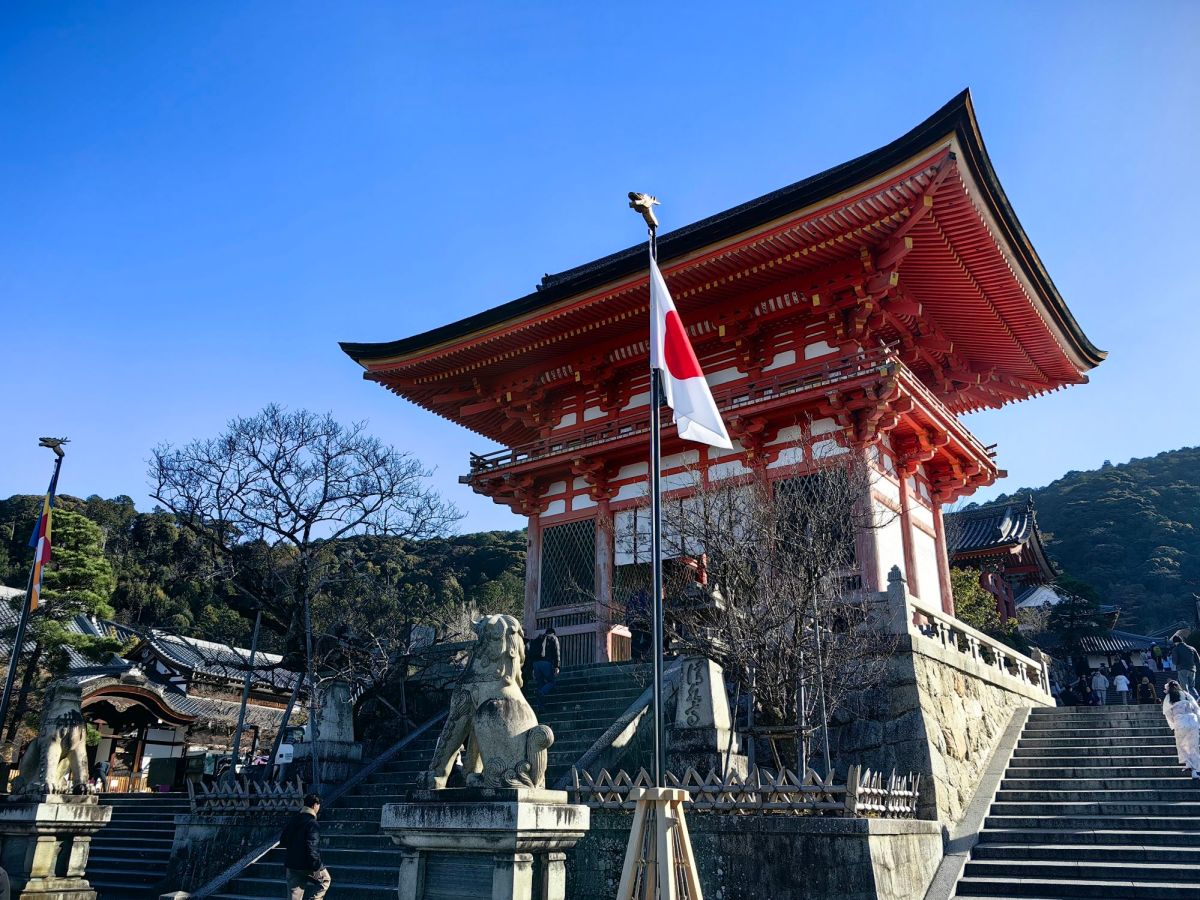
After climbing the winding lanes, I finally arrived at Kiyomizu-dera, one of Kyoto’s most celebrated Buddhist temples. Standing before me was a magnificent vermilion gate, its brilliant red pillars and beams glowing against the blue sky. The vivid color contrasted beautifully with the dark wooden structures and the surrounding greenery, making the entrance appear both imposing and welcoming. A long flight of stone steps led up toward the gate, drawing visitors gradually toward the temple grounds. Two stone lions stood guard in front of the gate, one on either side of the approach. With their heads held proudly and their bodies carved in a firm, imposing posture, they seemed to watch over everyone ascending the steps.

The Nio-mon Gate of Kiyomizu-dera stood proudly at the entrance to the temple grounds. The deep red of the timber, the dark roof tiles, and the white walls and decorative details like the traditional plague left me deep impression. Despite its vivid colors, the gate possessed a solemn character. Its name, Nio-mon, refers to the guardian gate traditionally associated with the fierce Nio protectors of Buddhist temples. These powerful figures stand watch over the entrance, symbolically guarding the sacred grounds against evil and impurity.
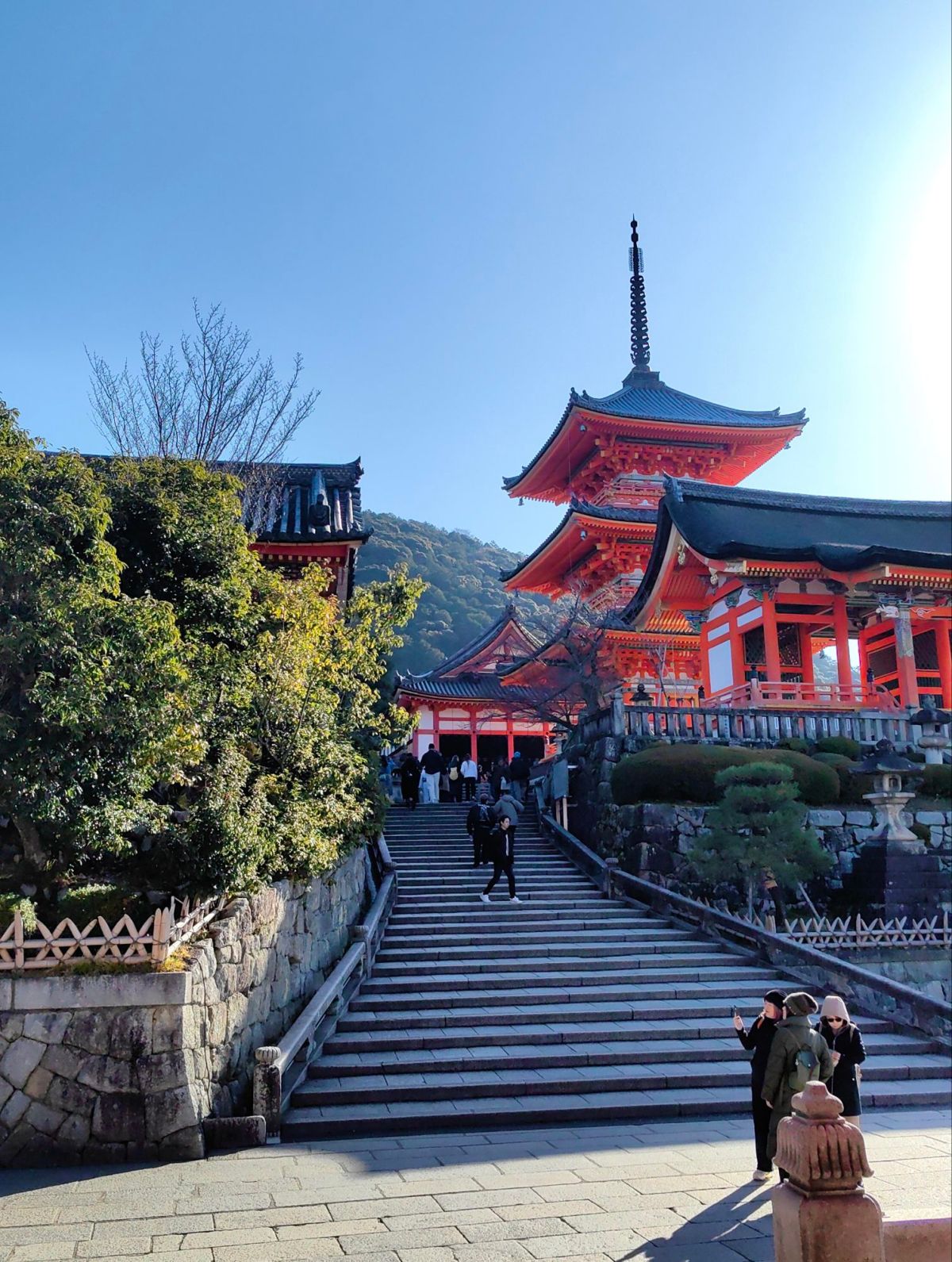
At the top of the steps, the brilliant vermilion Sanjū-no-tō came into my view. Rising against the blue sky above the temple grounds, its vivid red walls and dark, gently curving rooflines created one of the most striking images of Kiyomizu-dera. The vermilion color made it especially vivid against the natural landscape, while the intricate details beneath the eaves revealed the craftsmanship of traditional Japanese architecture. After passing through the crowded streets of Sannenzaka and climbing steadily uphill, the pagoda felt like a visual reward at the end of the ascent. It was one of those scenes I had seen many times in photographs before coming to Kyoto, yet seeing it in person made it feel entirely different.
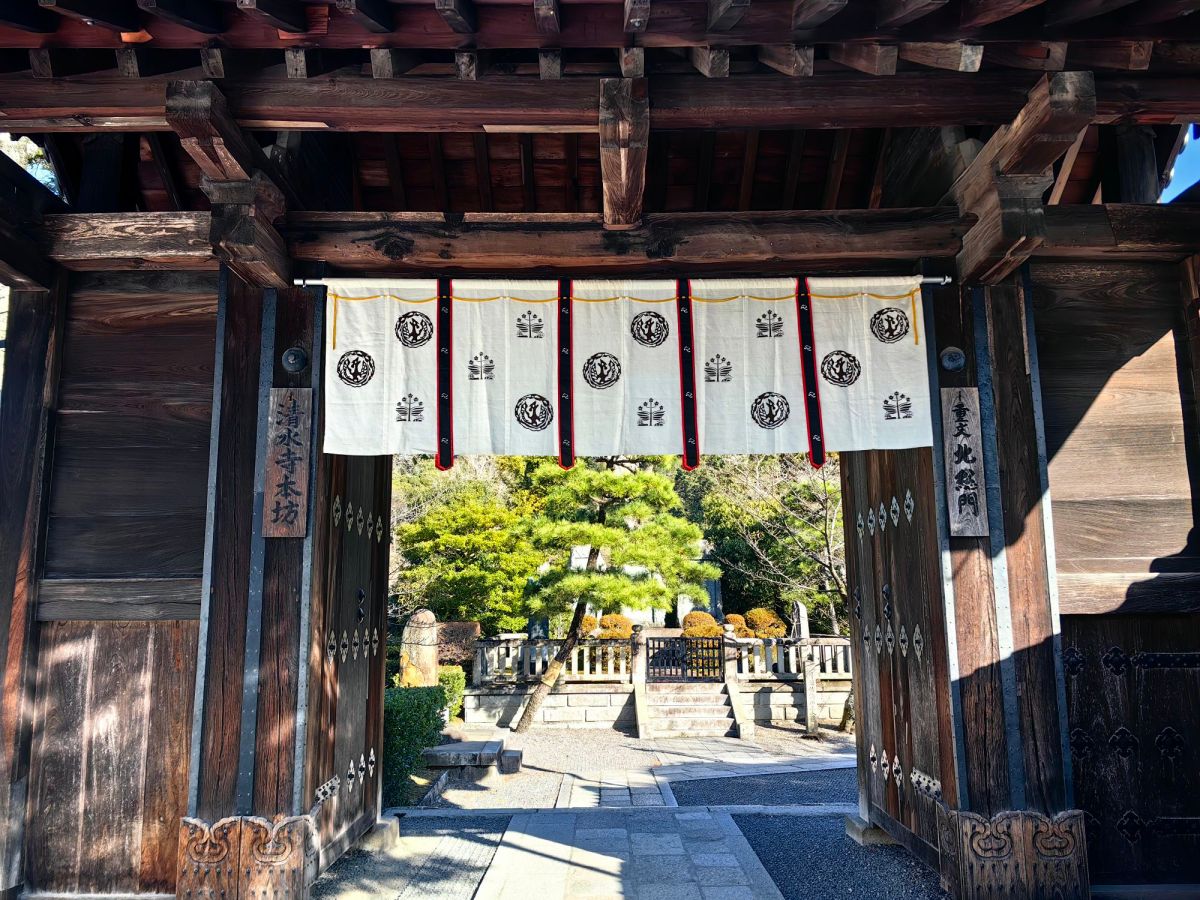
I noticed one old gate in the temple complex. Beneath the heavy wooden beams of this gate hung a white ceremonial curtain, its fabric patterned with repeated black emblems. I had noticed similar curtains throughout Japan, but here I began to appreciate that they were more than decoration. This curtain is kadomaku, a larger ceremonial curtain used at temple gates. The large circular black motifs appear to be mon (紋) which is heraldic emblems or crests. It identifies the institution and marked the character of the space. The stylized plant like emblem is another heraldic motif related to Sakanoue no Tamuramaro. the military commander associated with the early history of Kiyomizu-dera, encountered deer while hunting in the area. The legend says that he later became involved with the establishment of the temple and that the deer were buried nearby.
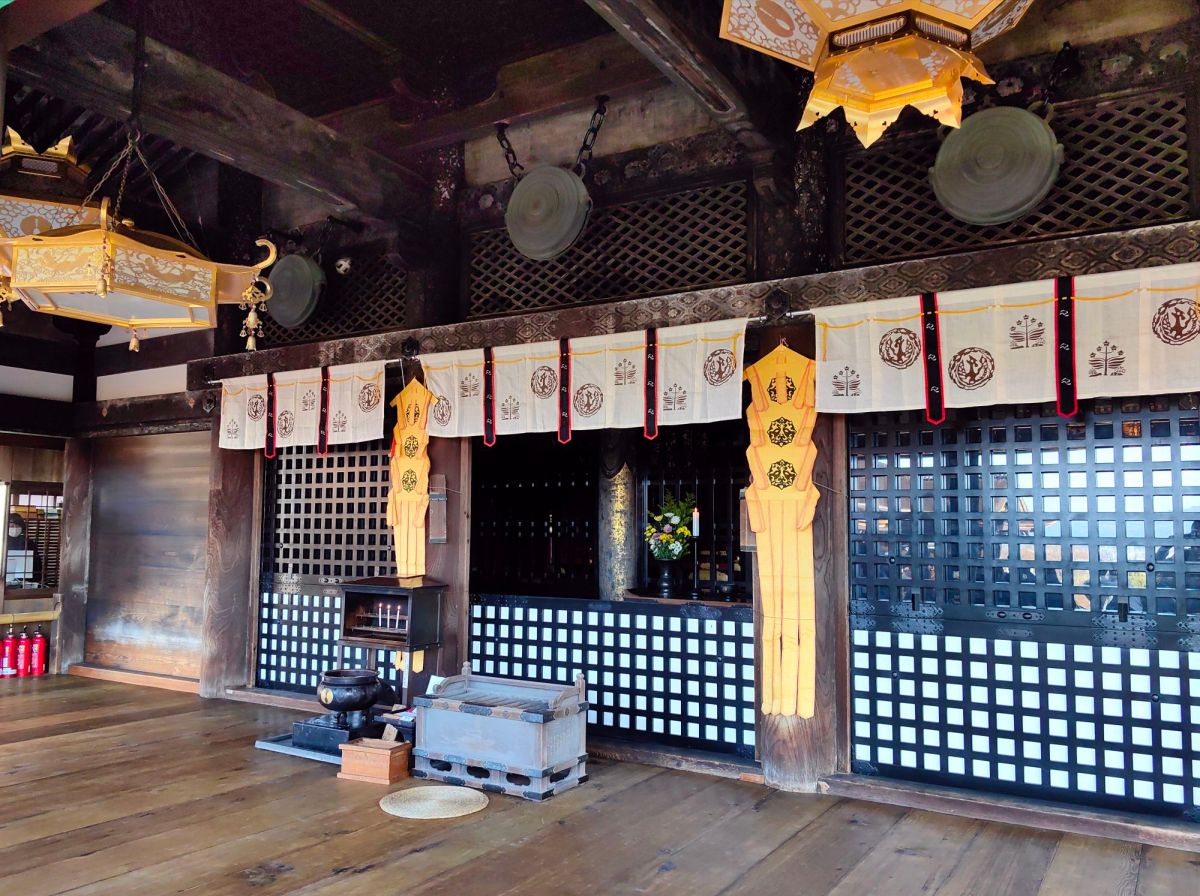
This kind of motifs can be observed in the main as well. At the heart of the hall is the Eleven-Headed, Thousand-Armed Kannon Bodhisattva, the object of worship that has drawn pilgrims to Kiyomizu-dera for more than a thousand years. The statue itself is kept within the innermost sanctuary and is not normally visible to visitors. Instead, worshippers stand in the outer sanctuary at the point closest to the Kannon, facing inward toward the sacred space. It is a super famous travel site and crowded by travelers from the world.
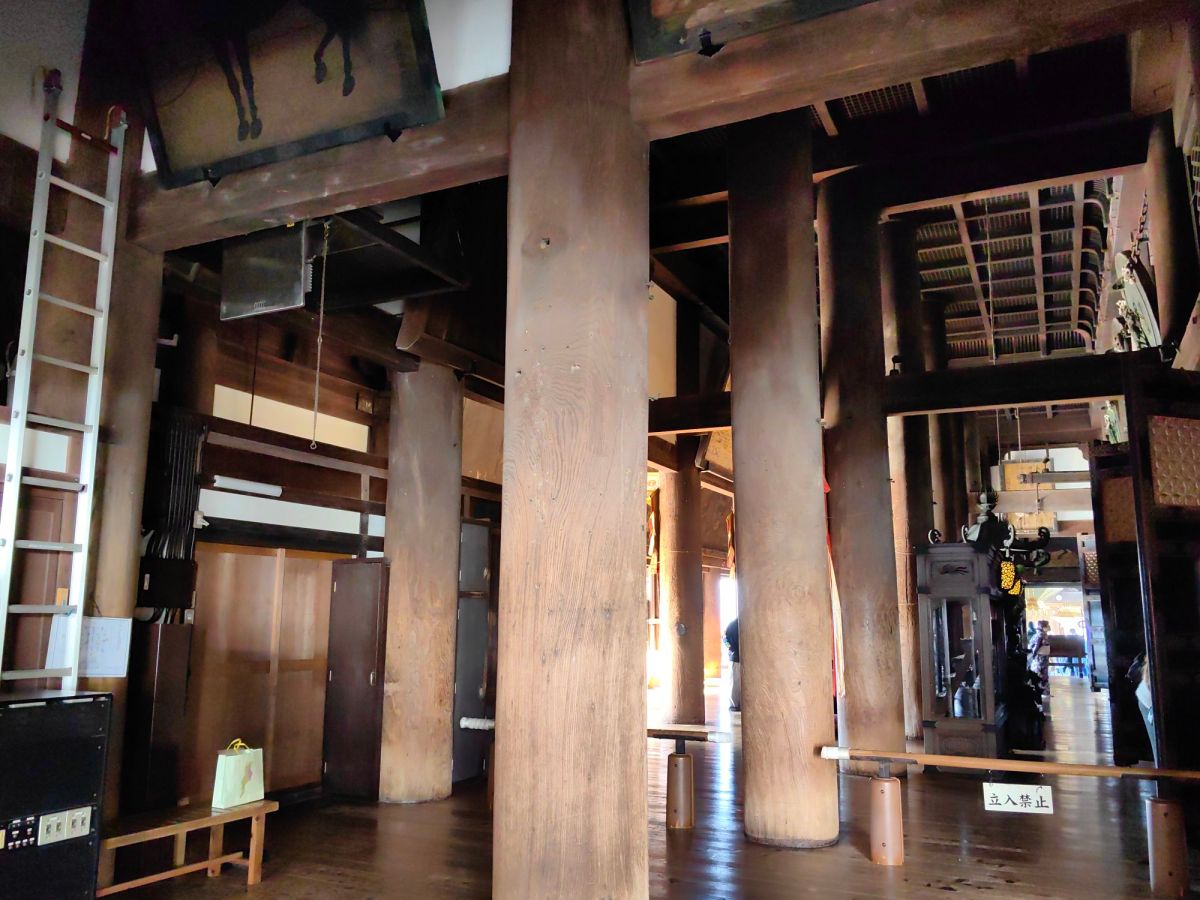
Inside the Main Hall, I found myself in a space much quieter and darker than the brilliant landscape outside. The enormous wooden structure was divided into several layers by massive round pillars, creating a gradual transition from the world of visitors to the sacred world of the temple. Worshippers are not allowed to enter, and they stand in the outer sanctuary at the point closest to the Kannon, facing inward toward the sacred space. The ritual is simple: make a slight bow, offer some money, and quietly put both hands together before Kannon.
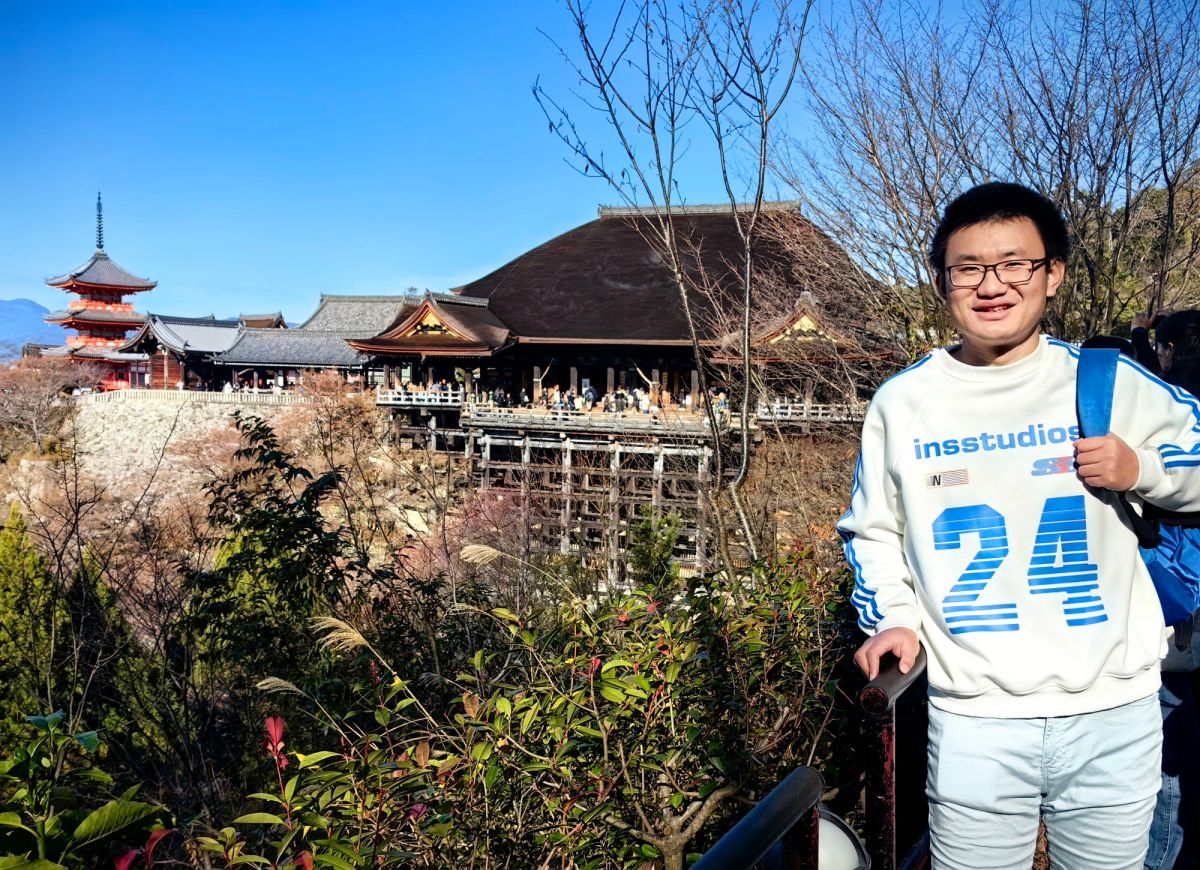
The wooden stage of Kiyomizu-dera must be the most familiar views of Kyoto. The great veranda stretched out above the forested hillside, its weathered wooden floor opening toward the vast landscape beyond. From here, Kyoto seemed to unfold gradually beneath me. The green slopes of Higashiyama in the foreground, the dense city spreading across the basin, and the distant mountains forming a quiet boundary around the ancient capital. Everyone around me seemed to be doing the same thing: stopping, turning toward the city, and raising a phone or camera to capture this famous view.
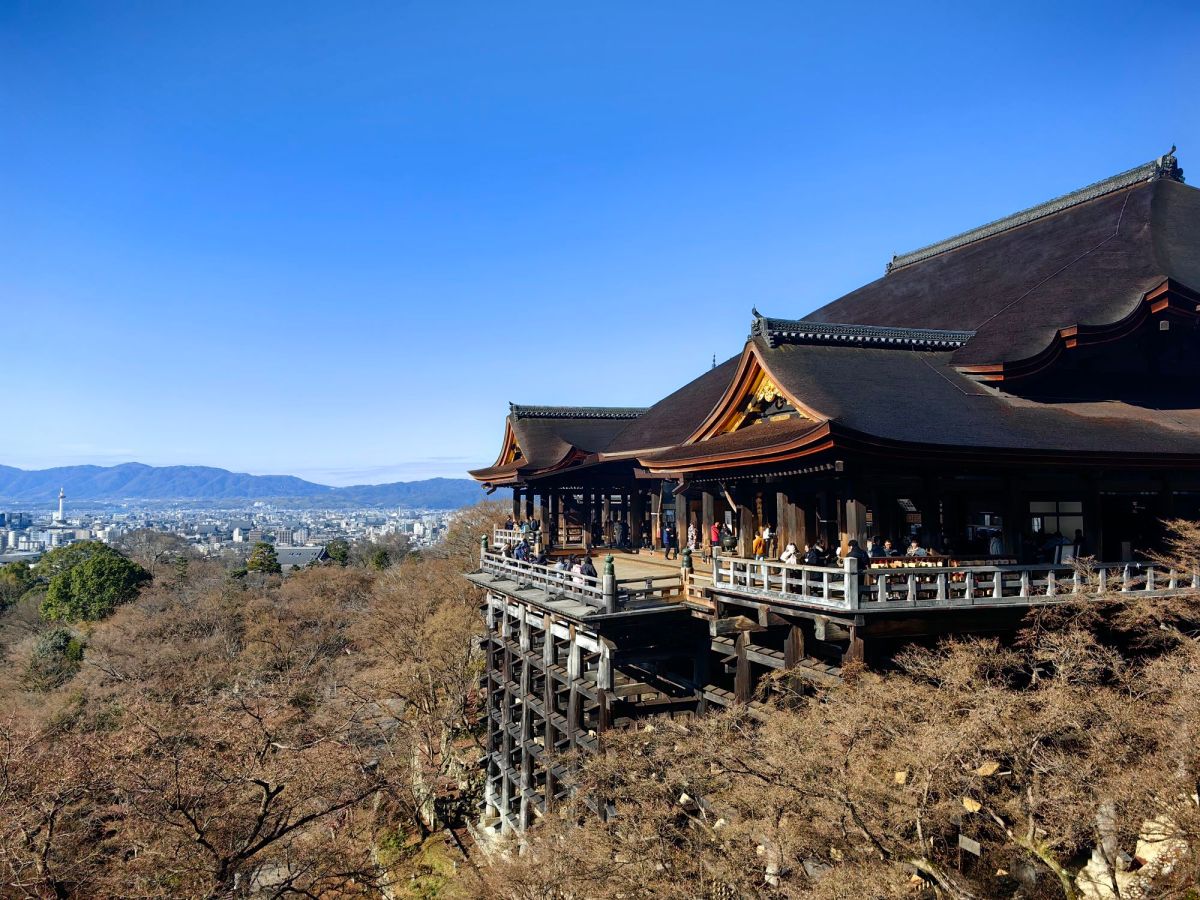
The stage itself was almost as impressive as the view. Its enormous wooden pillars descended into the steep valley below, creating the extraordinary impression that the entire structure was suspended above the trees. Standing there, I could finally understand why the Kiyomizu Stage had become such an enduring symbol of Kyoto. The temple’s present stage was reconstructed in 1633 and rises about thirteen meters above the slope, supported by eighteen great zelkova pillars and a complex framework of interlocking timber.
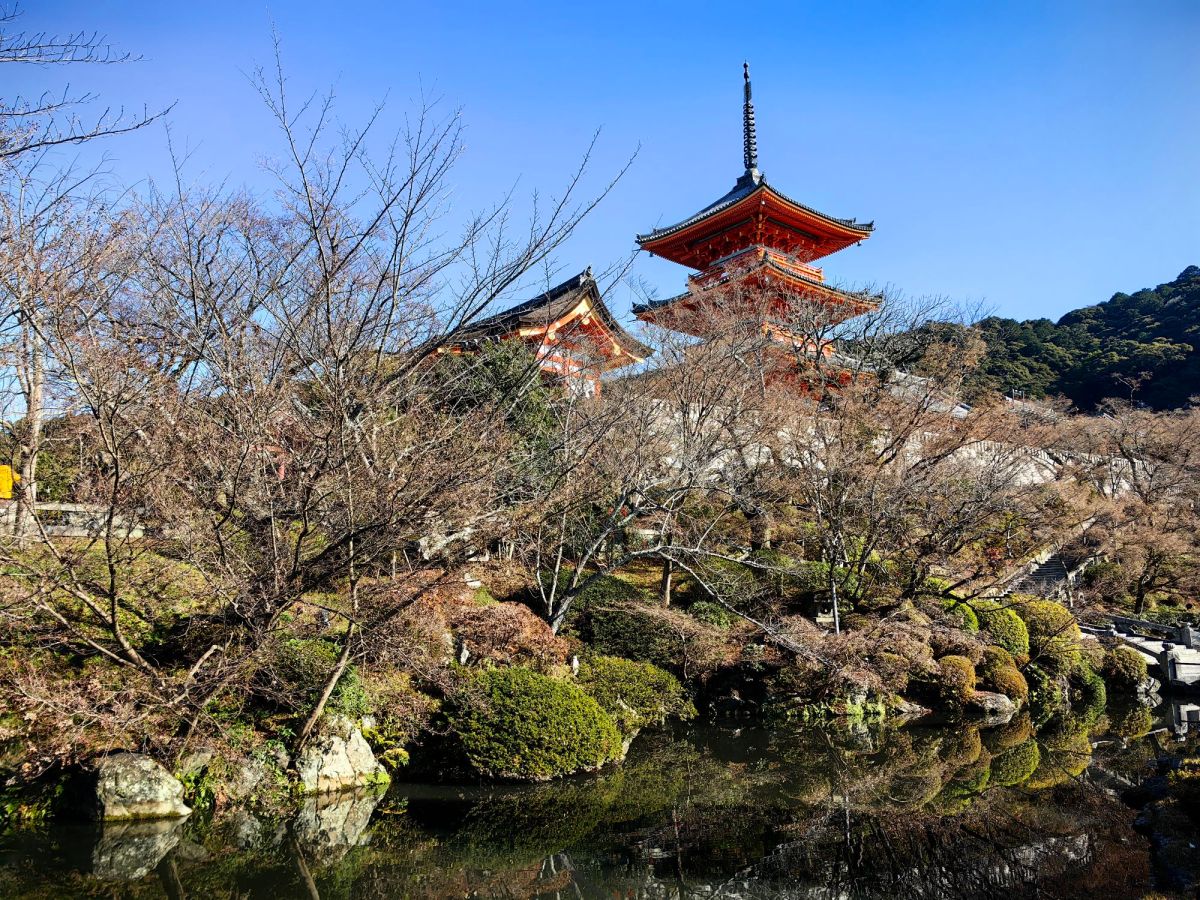
Beneath the slopes of Mount Otowayama, I came across a small Japanese-style garden, where the carefully arranged greenery and quiet landscape offered a moment of peace away from the crowds. Looking across the garden, I could still catch a glimpse of the red pagoda rising above the surrounding trees, its vivid colour standing out against the soft greens of the landscape.
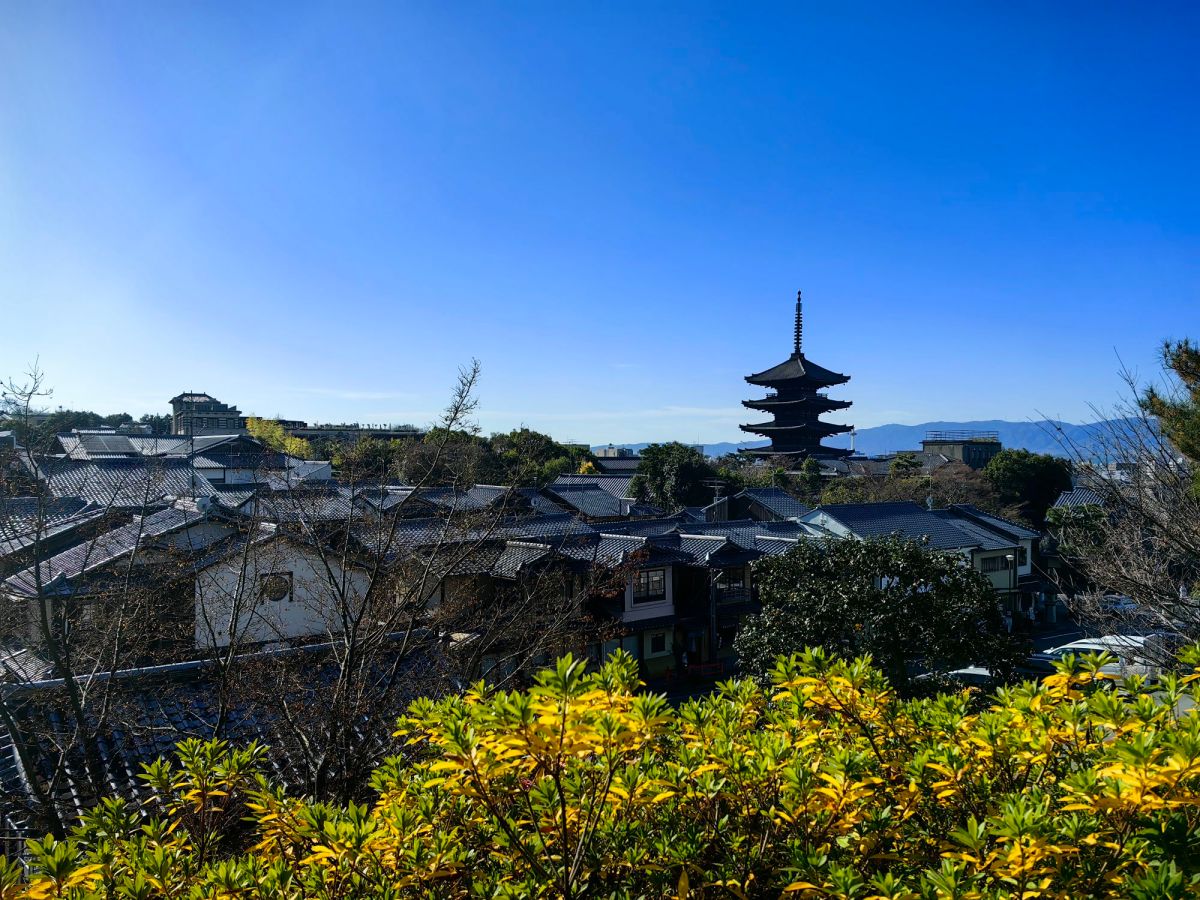
The Kiyomizu area was the first place I visited in Kyoto, and it left a deep impression on me. I was captivated by the lush greenery covering the surrounding mountains, the old temples and their pagodas rising above the trees, and the dark tiled roofs of traditional houses and temple buildings that lined the narrow streets. Together, these elements formed a landscape in which nature, architecture, and history seemed to exist in perfect harmony. Even as I made my way towards my next destination, I could still feel the atmosphere of Kiyomizu lingering in my mind, as though I had carried a small piece of old Kyoto with me.
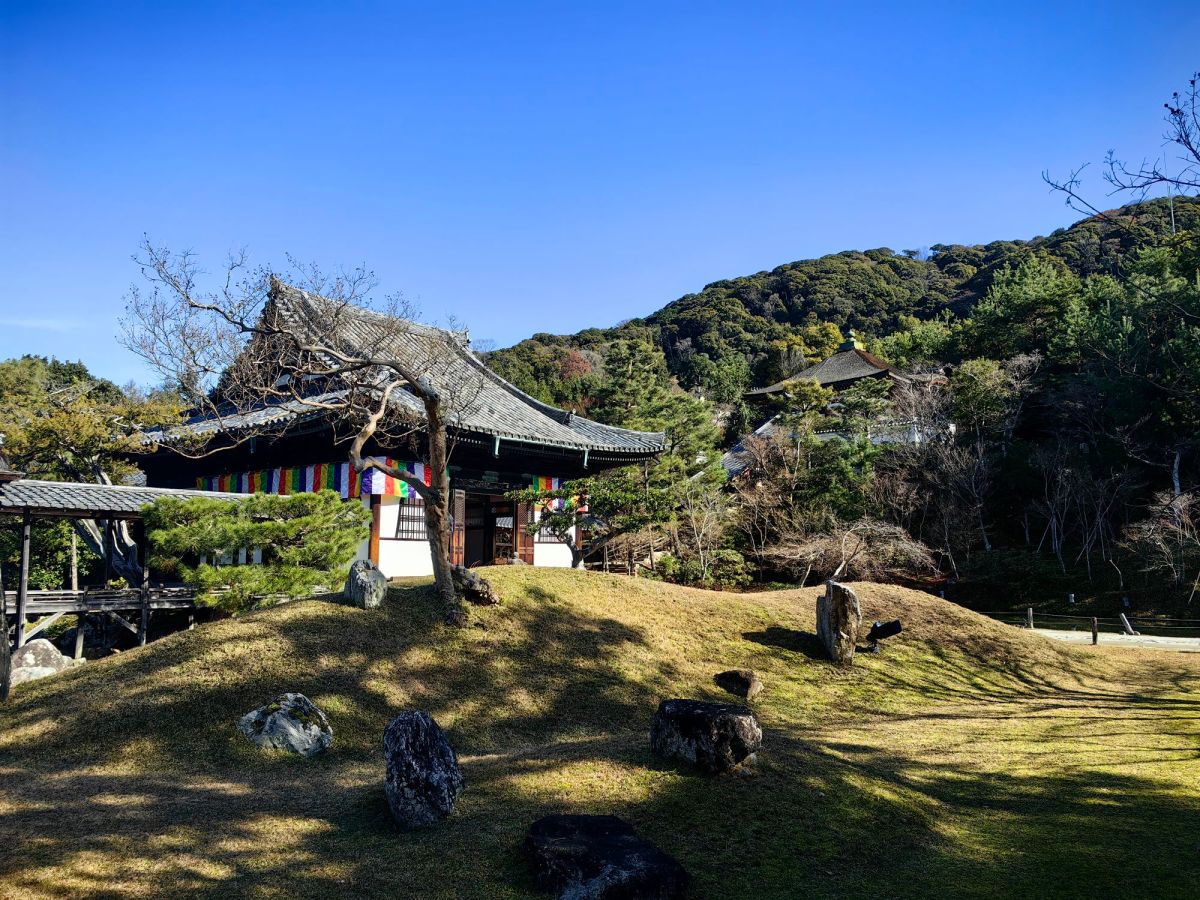
I continued move northwards to the Kōdaiji Temple. It is one of the city’s most enchanting places to experience traditional Japanese beauty. It is a place where elegant wooden architecture, carefully composed gardens, moss-covered stones and whispering bamboo create an atmosphere of serenity that feels far removed from the busy streets beyond its gates. It was founded in 1606 by Nene, the wife of Toyotomi Hideyoshi. When Hideyoshi died in 1598, Nene was deeply affected by his loss. She became a Buddhist nun and, in 1606, established Kōdai-ji Temple to pray for his soul. The Toyotomi family eventually lost its political power, and Hideyoshi’s legacy was overshadowed by the rise of the Tokugawa shogunate. Nene lived through these changes until her death in 1624. She was buried at Kōdai-ji, the temple associated with her name and devotion to her husband.
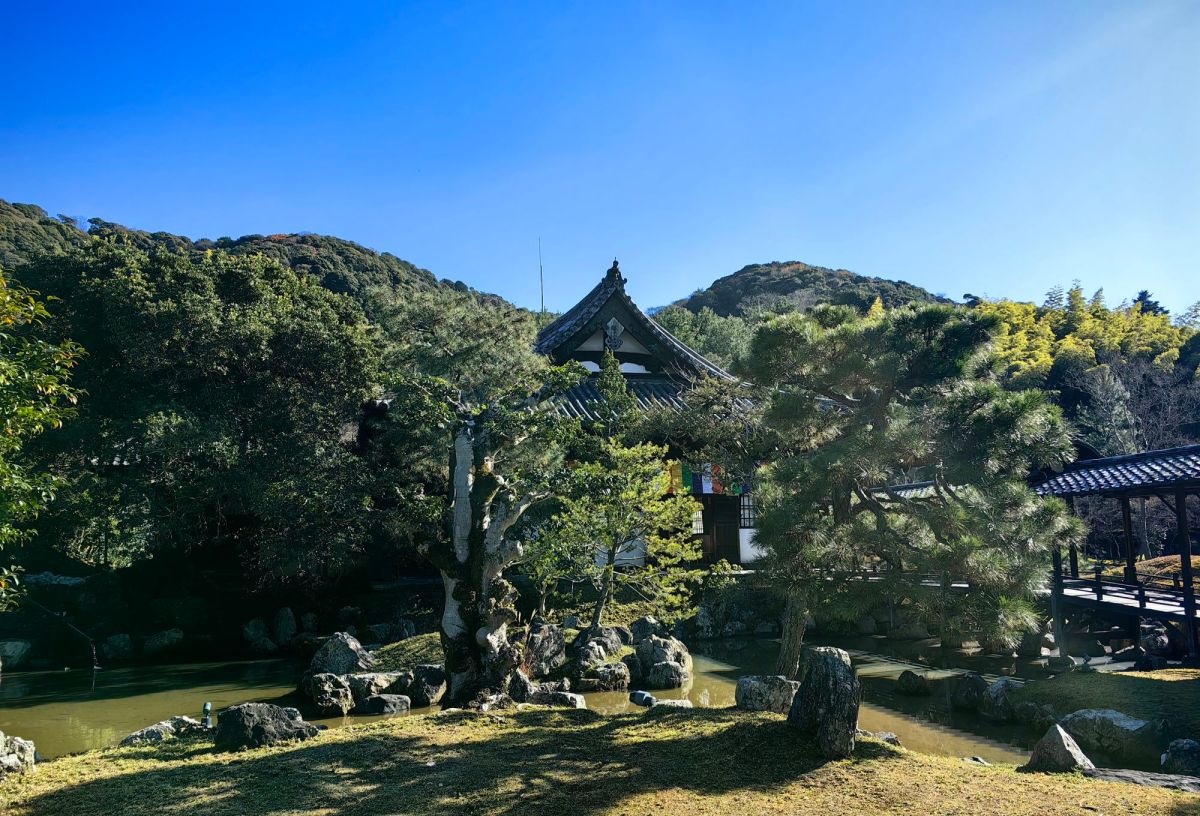
The gardens at Kōdaiji are among its greatest treasures. Designed in the tradition of Japanese landscape gardening, they combine water, stone, trees and open space into scenes that feel both natural and meticulously composed. Reflective ponds mirror the surrounding maples, pines and temple buildings, creating especially beautiful scenes in winter. Stone arrangements and raked gravel evoke the simplicity and symbolism of Zen-inspired garden design.
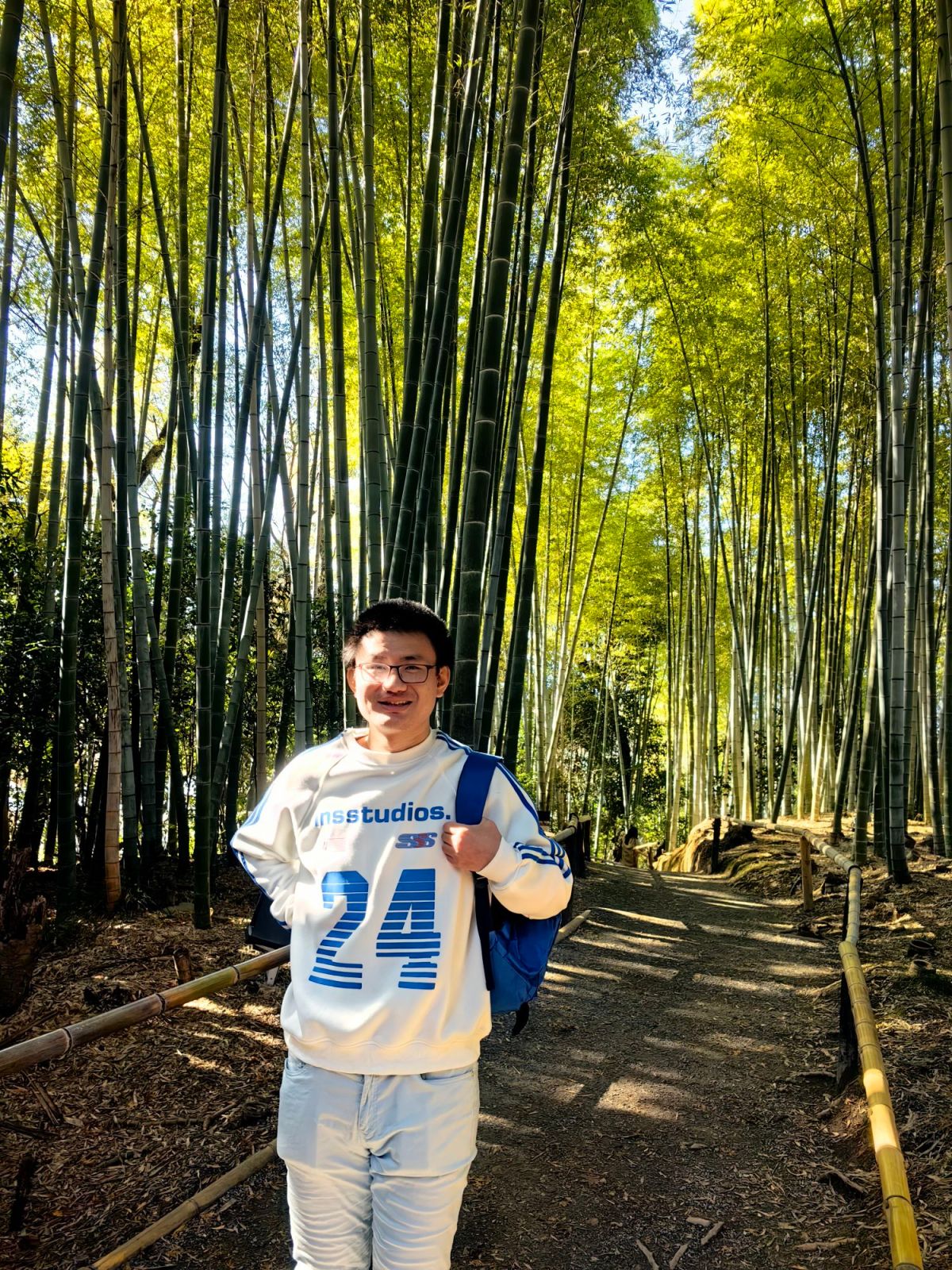
One of the most memorable features of Kōdaiji is its small bamboo grove, tucked into the hillside behind the main temple buildings. Unlike the vast, often crowded bamboo forest in Arashiyama, this is a more intimate and sheltered place, where a narrow path winds between tall, slender bamboo stalks. The bamboo rises gracefully on either side, its green stems reaching towards the sky while delicate leaves form a soft canopy overhead. Sunlight filters through the foliage, illuminating patches of the path and casting shifting patterns of light and shadow. It is a lovely place to pause, breathe deeply and appreciate the understated elegance of Japanese landscape design.
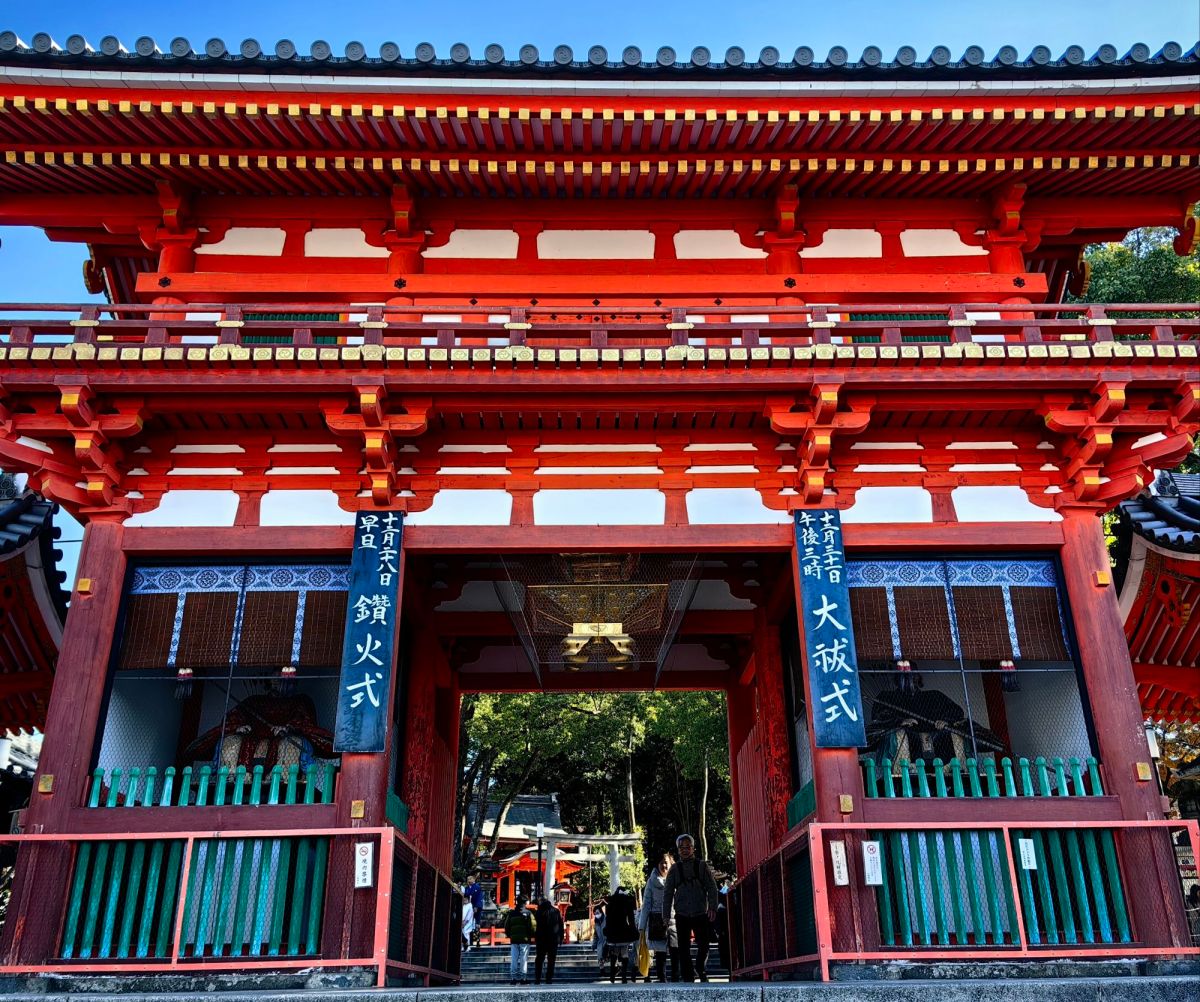
As I continued northwards, I arrived at the famous Yasaka-jinja. Known for its brilliant vermilion architecture, glowing lanterns and centuries-old traditions, it offers a wonderful glimpse into Kyoto’s cultural heritage. The striking Nishiromon Gate is the shrine’s entrance in the western side of the grounds. With its bold red pillars, elegant roof and commanding position above the surrounding streets, the gate is one of Gion’s most recognizable landmarks. The vivid red-orange timber stands out against the traditional tiled roof and the surrounding cityscape.
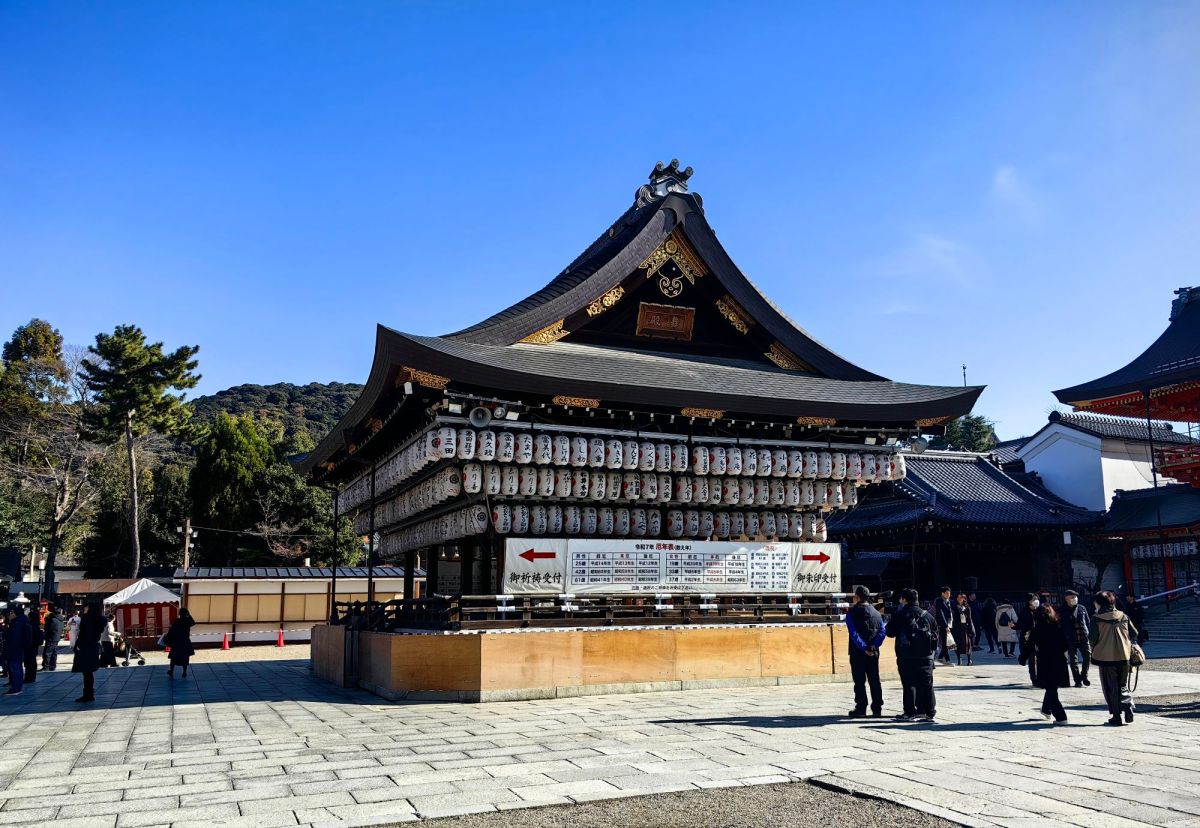
The Buden inside is a traditional Japanese shrine pavilion known for its beautiful architecture and numerous traditional lanterns hanging from its wooden structure. It serves as a sacred space for religious ceremonies, traditional dances, and cultural performances dedicated to Shinto deities. The warm glow of the lanterns creates a peaceful and enchanting atmosphere, especially in the evening, while the wooden pillars and elegant roof reflect the beauty of traditional Japanese craftsmanship.
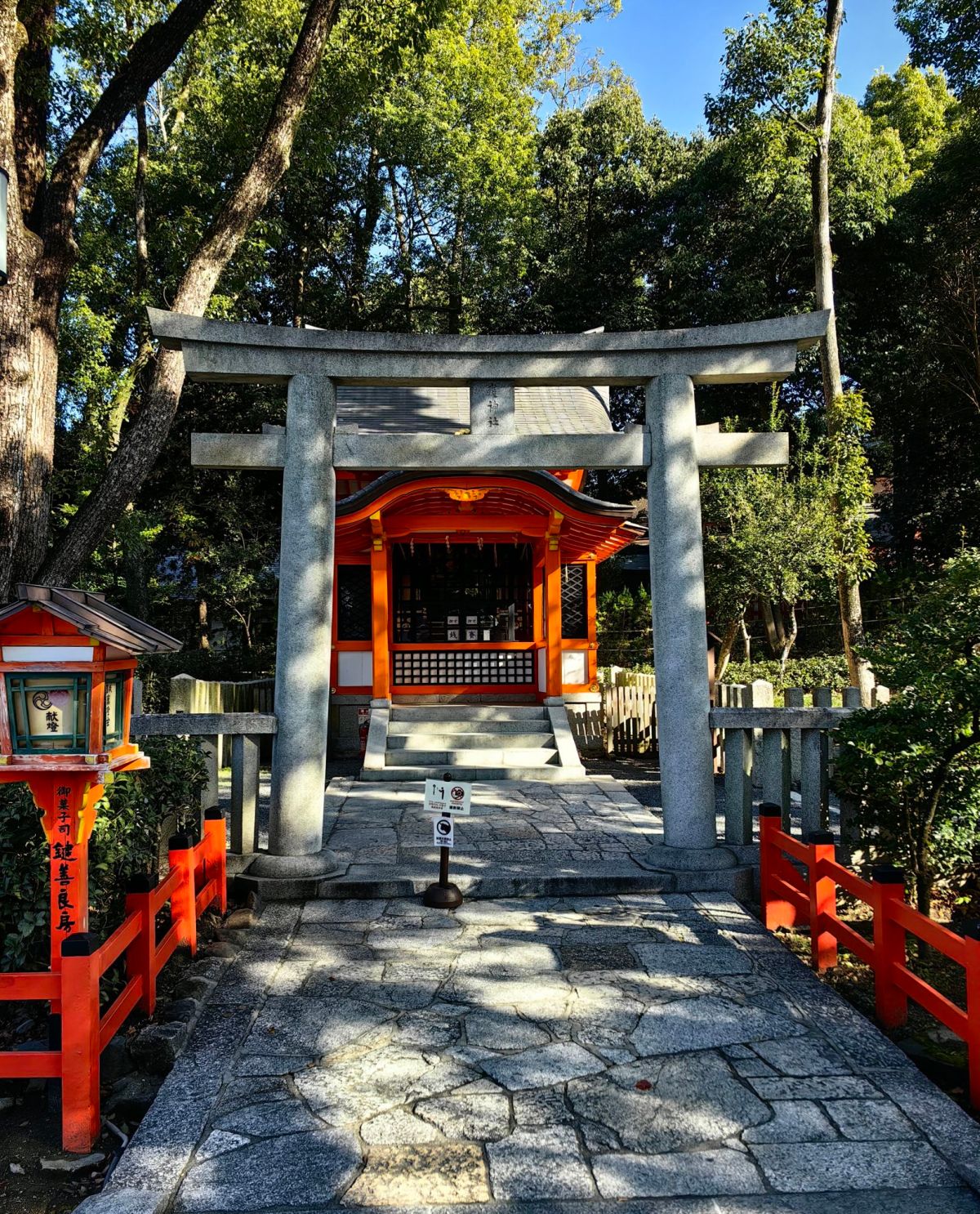
Yasaka-jinja in Kyoto has many small shrines within its grounds because each one is dedicated to a different Shinto deity and serves a particular spiritual purpose. These are known as subsidiary shrines, and they allow visitors to pray for different blessings beyond those associated with the main shrine. For example, Eki Shrine is associated with protection against epidemics and illness, while Utsukushi-gozen-sha is linked to beauty and Okuninushi-sha is associated with good relationships and marriage. Together, these smaller shrines reflect the Japanese Shinto belief that different deities can offer different forms of protection and blessings.
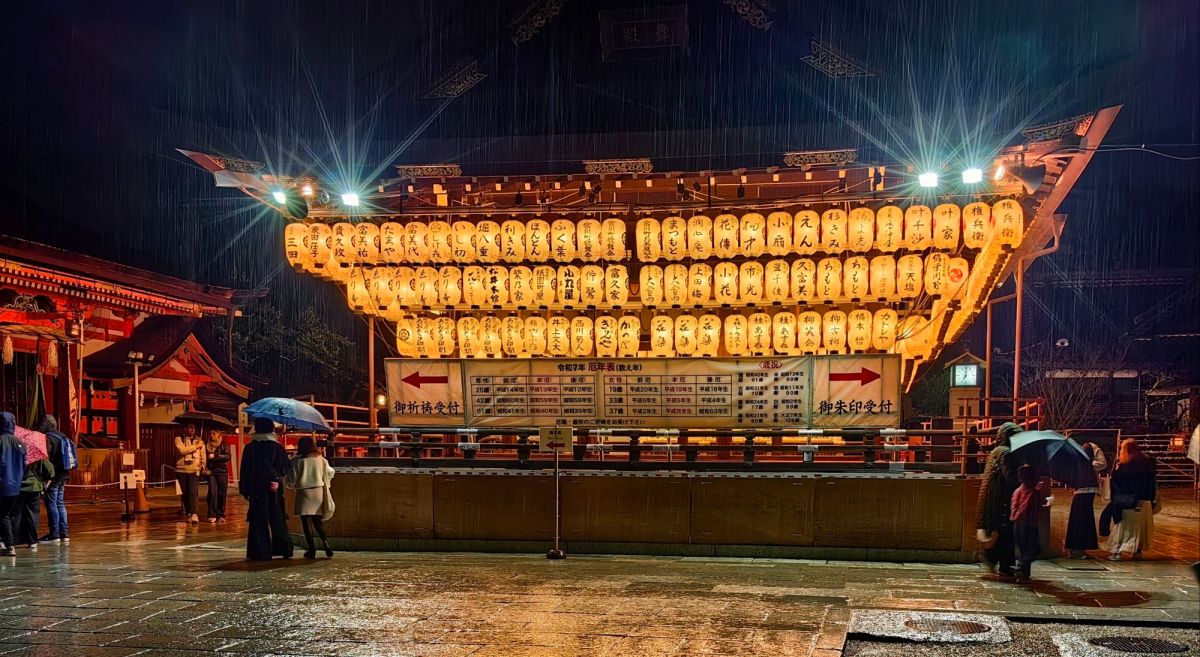
Yasaka-jinja founded in 656 AD and has a long history of protecting people from epidemics and misfortune. Many local people come here to pray at night. Its most distinctive feature is the dance stage decorated with hundreds of lanterns, many bearing the names of local businesses that donated them to the shrine. These lanterns are illuminated, creating a beautiful and peaceful scene.
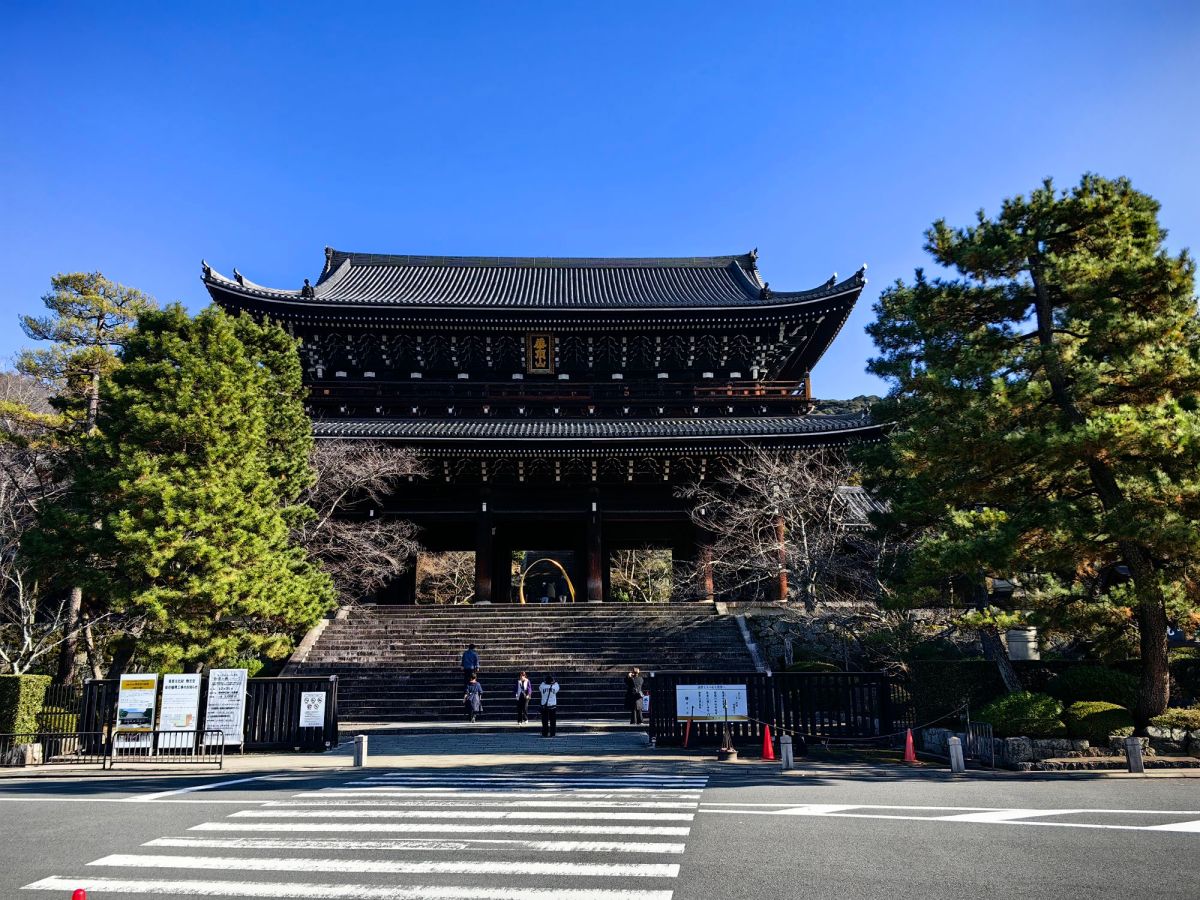
The area surrounding Yasaka-jinja reflects Kyoto’s historical urban design, where a series of temples, shrines, and traditional streets form a connected cultural landscape. Nearby temples such as Chion-in, Shōren-in, and Kōdai-ji represent different periods of Japanese religious and architectural history. I walked all the ways northwards and visited them one by one. This layout shows how Kyoto developed around its eastern foothills, where religious institutions, gardens, parks, and traditional streets grew together over centuries. This photo was taken at the enormous Sanmon gate of Chion-in Temple, which stands about 24 metres tall and 50 metres wide. The gate’s history can be traced back to 1621 under the Tokugawa shogunate.
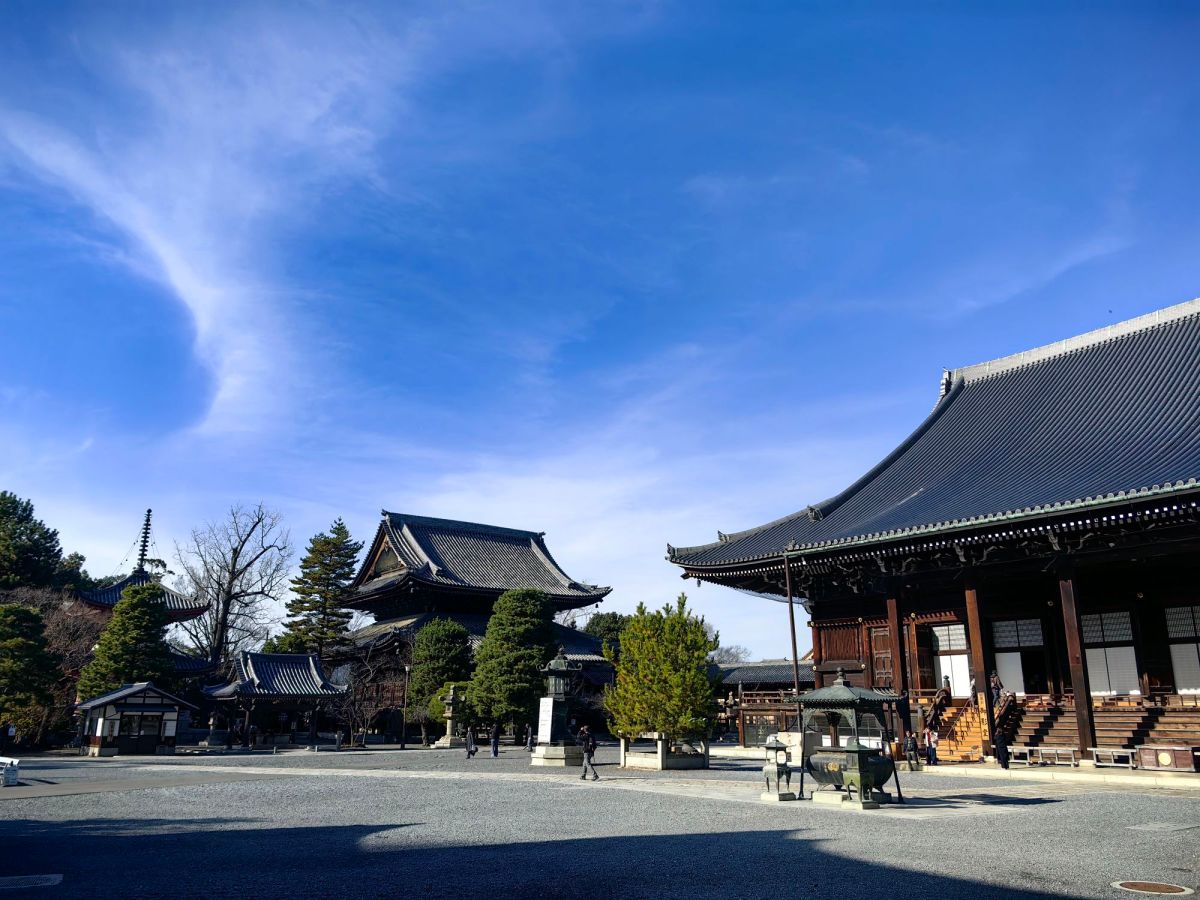
Chion-in Temple is the head temple of the Jōdo (Pure Land) school of Buddhism. Its origins date to 1175, when the Buddhist priest Hōnen began teaching here, and the temple was formally established by his disciples in 1234. Inside the spacious grounds, visitors can explore the grand Mieidō hall, traditional gardens, and a massive bronze bell weighing approximately 70 tonnes. The temple’s large wooden structures, stone stairways, and carefully arranged buildings reflect the influence of Buddhist beliefs and the patronage of the Tokugawa shogunate during the Edo period.
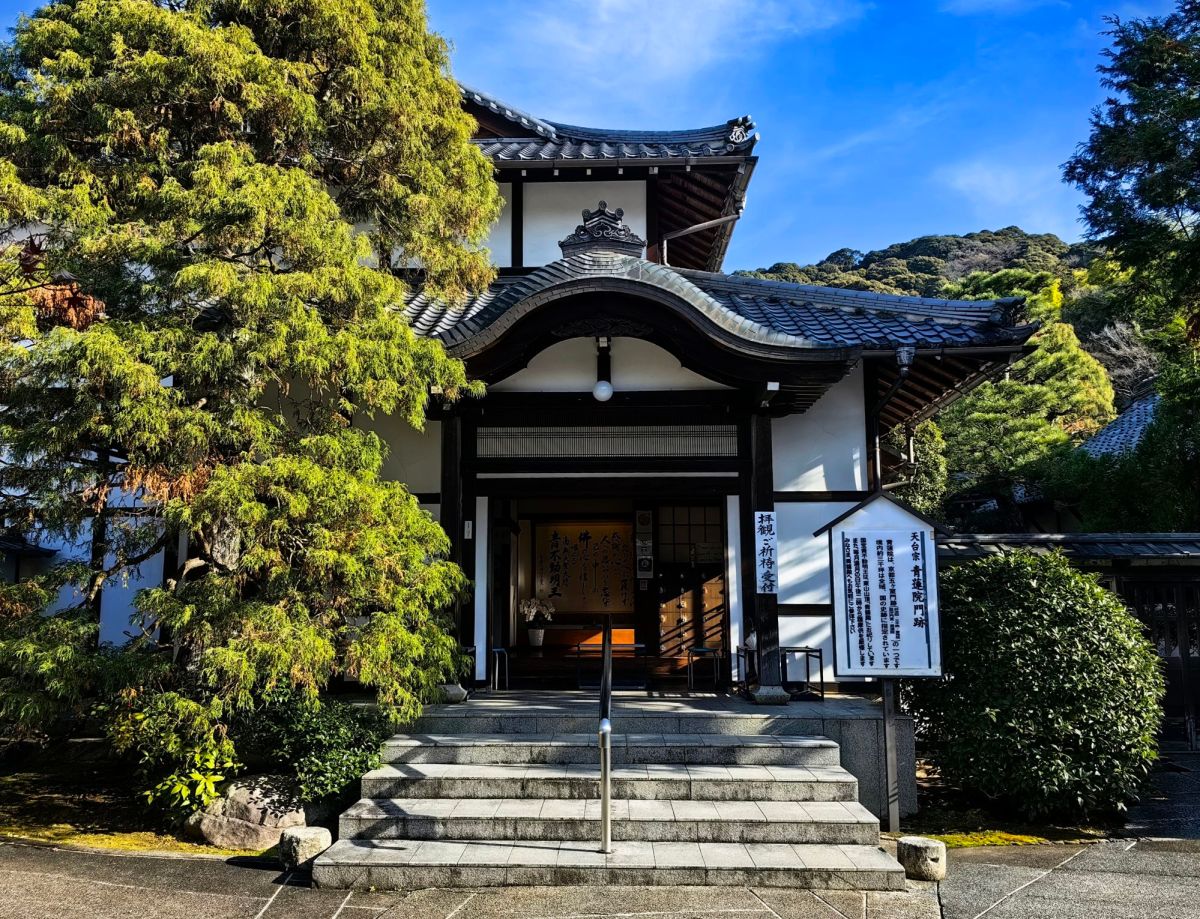
Near Chion-in Temple, it is the Shōren-in established in the 12th century under the patronage of the retired Emperor Toba. It is particularly notable for its close relationship with Japan’s imperial family. Shōren-in was one of Kyoto’s prestigious monzeki temples, where the head priests traditionally came from the imperial families. It served as a temporary imperial residence after a great fire destroyed Kyoto’s Imperial Palace in 1788. It is therefore also known as Awata Gosho, meaning the Awata Imperial Palace.
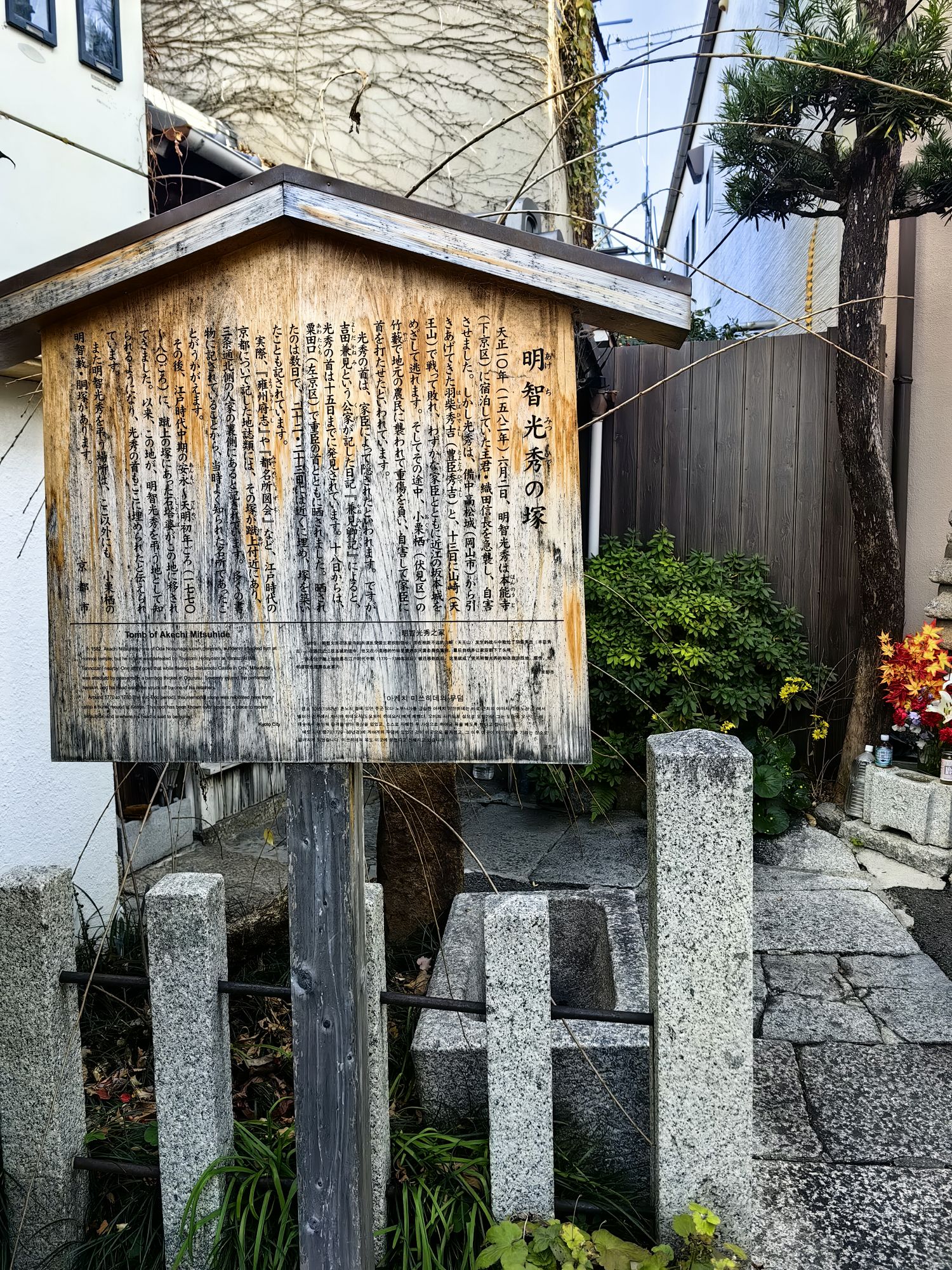
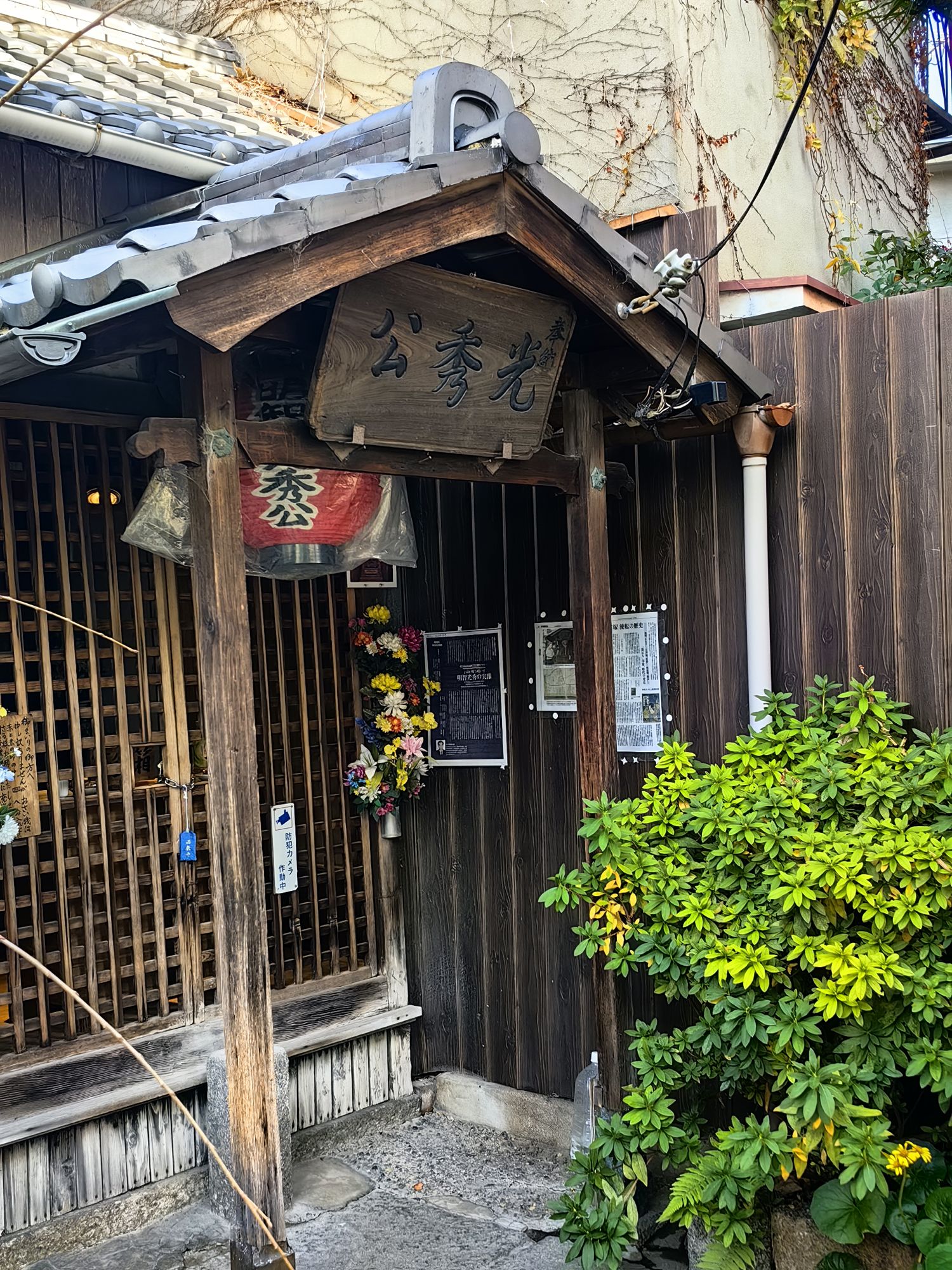
Kyoto is an interesting place for a history lover like me because I could somehow meet a famous name or a historical place accidentally when I wandered around the small streets on my way to my next destination. Tomb of Akechi Mitsuhide is hidden in a small corner near the Shirakawa canal. Mitsuhide is best known for the Honnō-ji Incident of 1582, when he turned against his lord, Oda Nobunaga, and attacked him at a temple in Kyoto. Nobunaga died during the attack, dramatically changing the course of Japan’s struggle for unification. However, Mitsuhide’s victory was short-lived: just 11 days later, he was defeated by Toyotomi Hideyoshi at the Battle of Yamazaki. This tomb preserves the story of his tragic downfall.
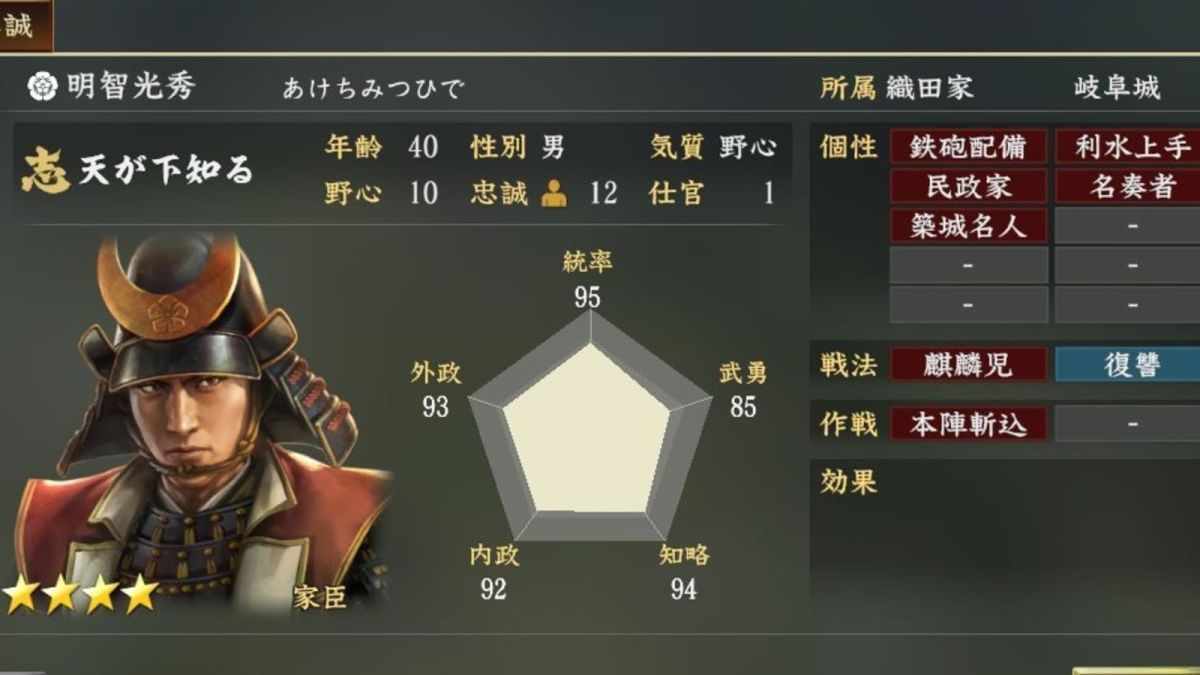
I like playing strategic games like Nobunaga’s Ambition and Akechi Mitsuhide must be a familiar character for me. I think his decision to turn against Oda Nobunaga is one of the great unsolved mysteries in Japanese history. One theory suggests that Mitsuhide had grown resentful of Nobunaga’s harsh treatment and humiliations. Other theories propose that Mitsuhide acted with encouragement from political figures, such as the imperial court, the former shogun Ashikaga Yoshiaki, or even Nobunaga’s rival Toyotomi Hideyoshi. These theories are intriguing and left me continue to think when I travel in Kyoto.
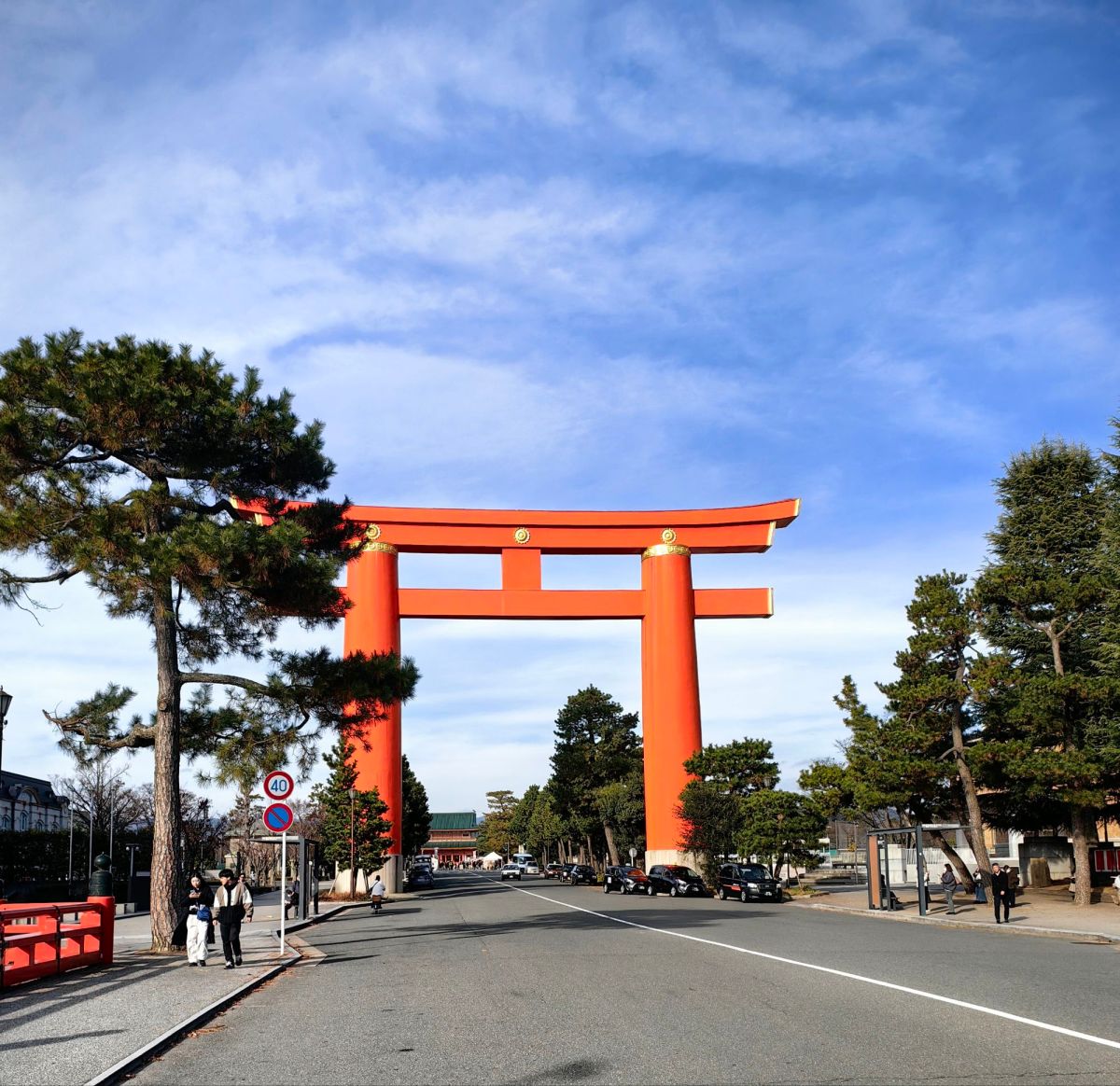
Kyoto was Japan’s imperial capital from 794 until the capital moved to Tokyo in 1868. Its history is best experienced through a combination of ancient temples, Shinto shrines, former imperial residences and old streets that still preserve the atmosphere of traditional Kyoto. Heian-jingū is a special building that celebrates Kyoto’s history as Japan’s imperial capital. It was established in 1895 to commemorate the 1,100th anniversary of the founding of Heian-kyō, the former name of Kyoto when it became the capital in 794. The huge vermilion gate is a landmark. Walking towards the shrine from the south gave me a wonderful sense of scale.
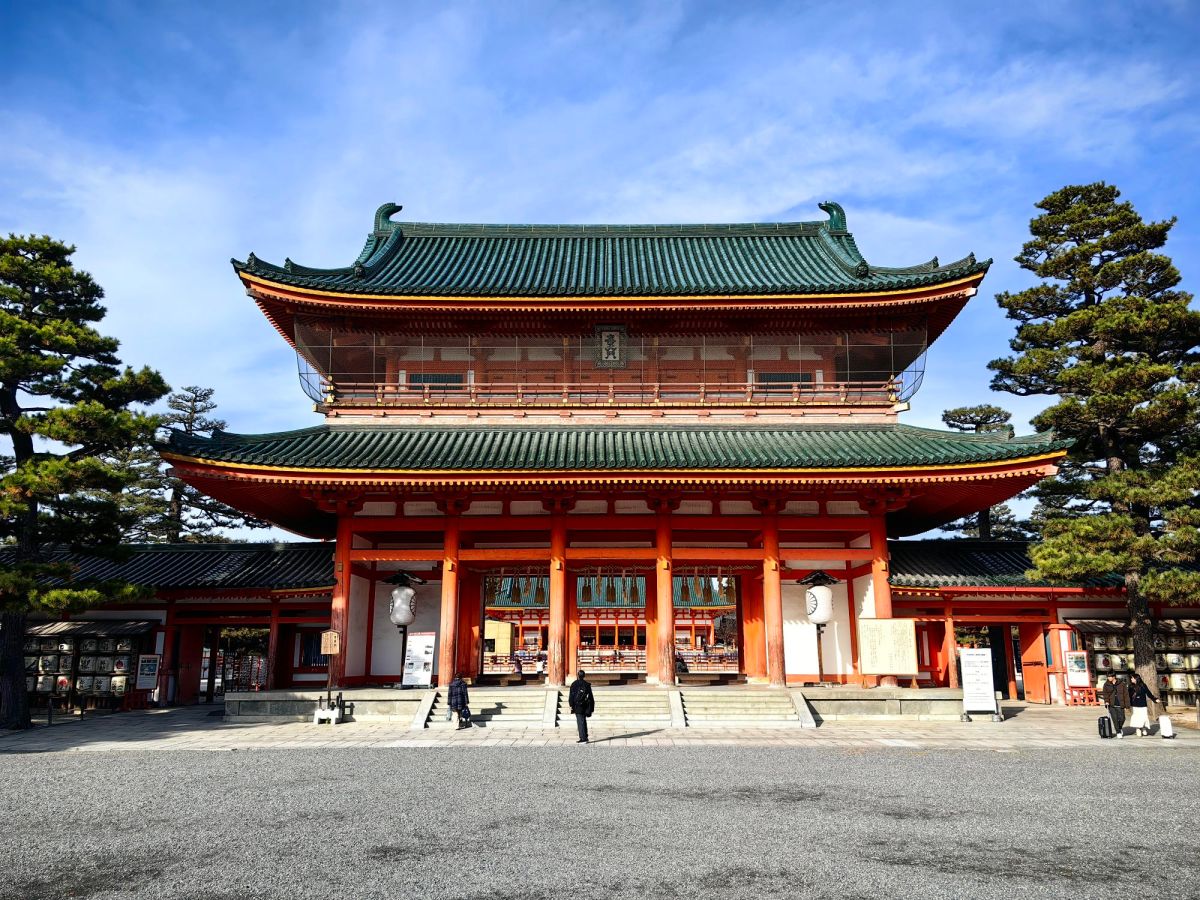
It is a place where I can experience both the grandeur of Japan’s imperial heritage. The Ōtenmon Gate is an impressive two-storey entrance to the shrine courtyard. The contrast of red, green and white makes the complex particularly striking in photographs.
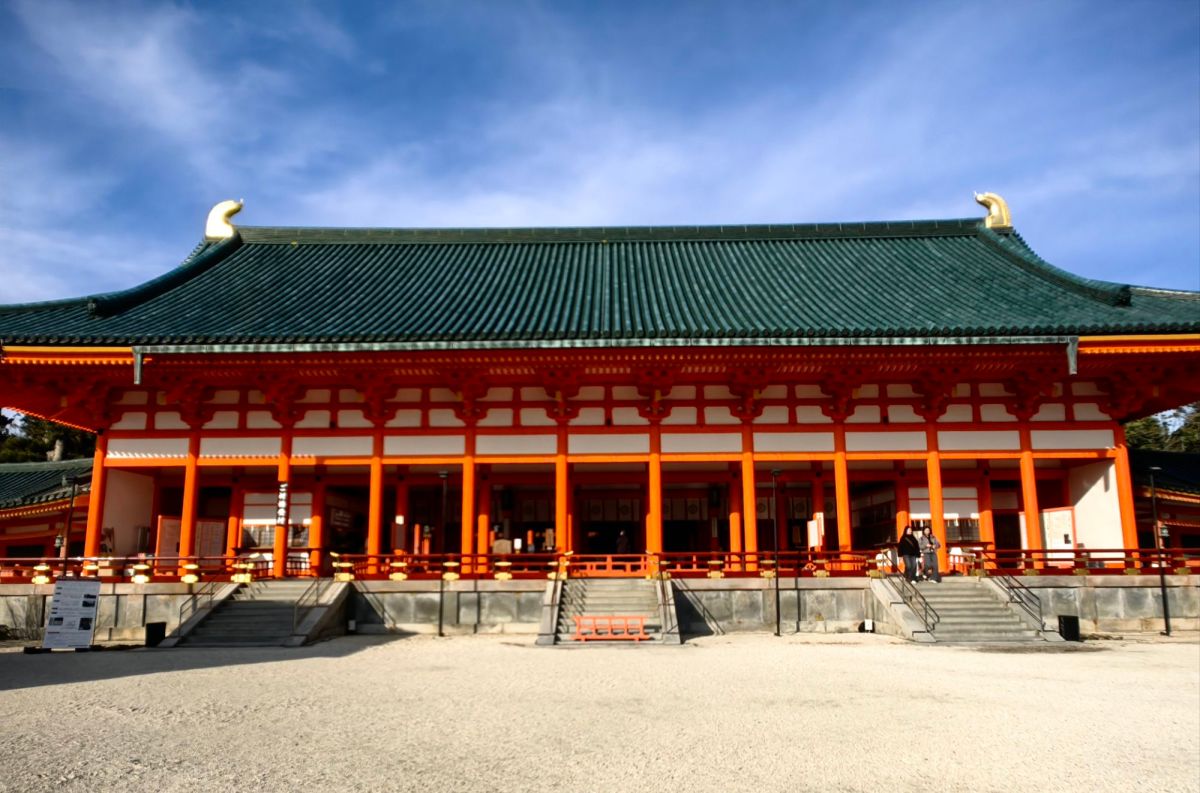
The shrine’s main complex is modelled on the State Hall of the ancient Imperial Palace, built at five-eighths of its original scale. This is the Outer Oratory, officially known as Daigoku-den which is the magnificent main hall at Heian-jingū. It is one of the shrine’s most important buildings. The arrangement of its buildings evokes the formal ceremonies and political life of Japan’s imperial court. The shrine enshrines two emperors associated with Kyoto’s imperial history. Emperor Kanmu is the emperor who established Heian-kyō as the capital in 794 and Emperor Kōmei is the last emperor to rule from the old imperial capital before the move to Tokyo. This building represents the long history of this period.
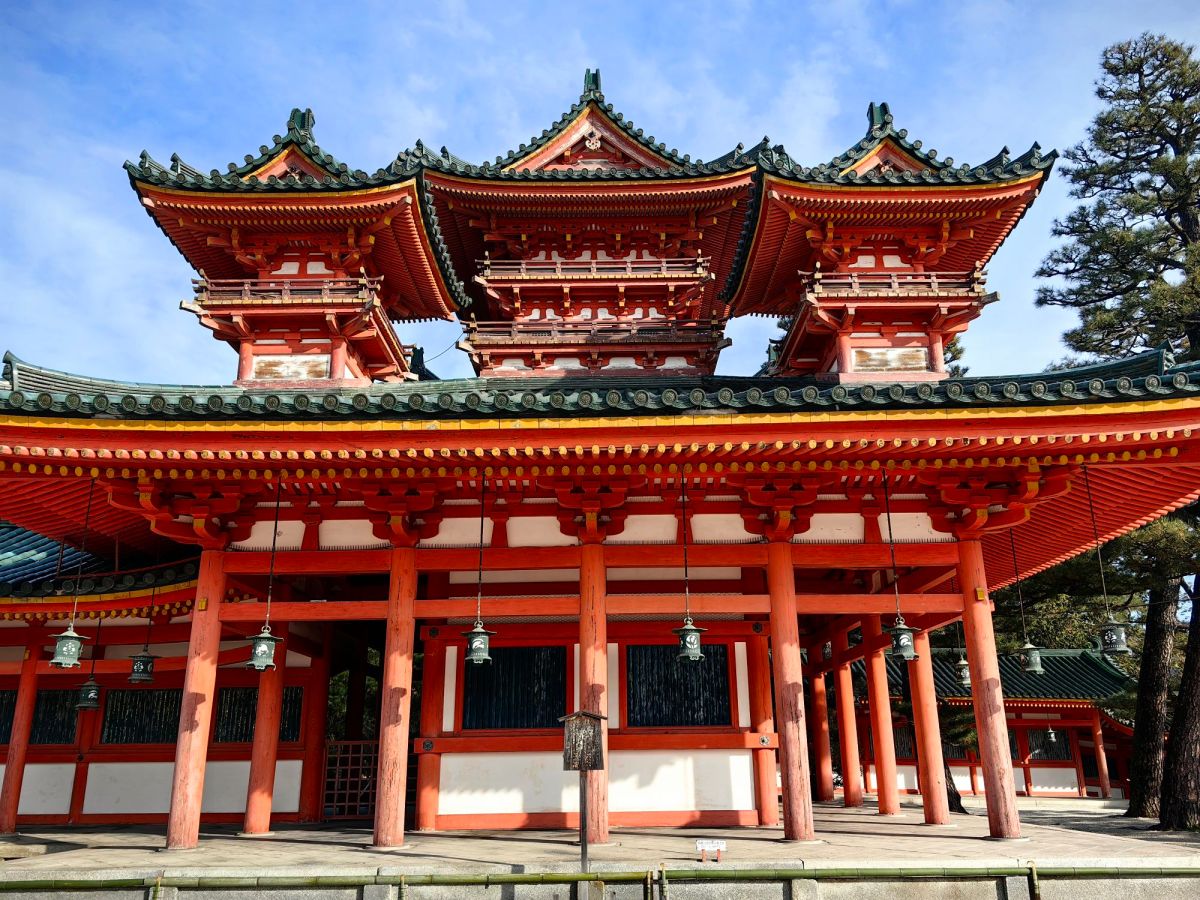
The Sōryūrō Tower is one of the two elegant towers flanking the main ceremonial hall at Heian-jingū. Its name means “Azure Dragon Tower” . With its vermilion pillars, pale walls, layered green roof and gracefully sloping eaves, it contributes to the shrine’s symmetrical, imperial-palace appearance. It balances the opposite Byakkorō, or White Tiger Tower, framing the main hall and creating the impression of an orderly imperial complex. In ancient Chinese cosmology, the Azure Dragon was the celestial guardian of the East. It was one of four mythical guardians associated with the cardinal directions: Azure Dragon — East; White Tiger — West; Vermilion Bird — South; Black Tortoise — North. These ideas influenced the planning of Heian-kyō, Kyoto’s ancient capital, including its relationship to Chinese cosmology and geomancy.
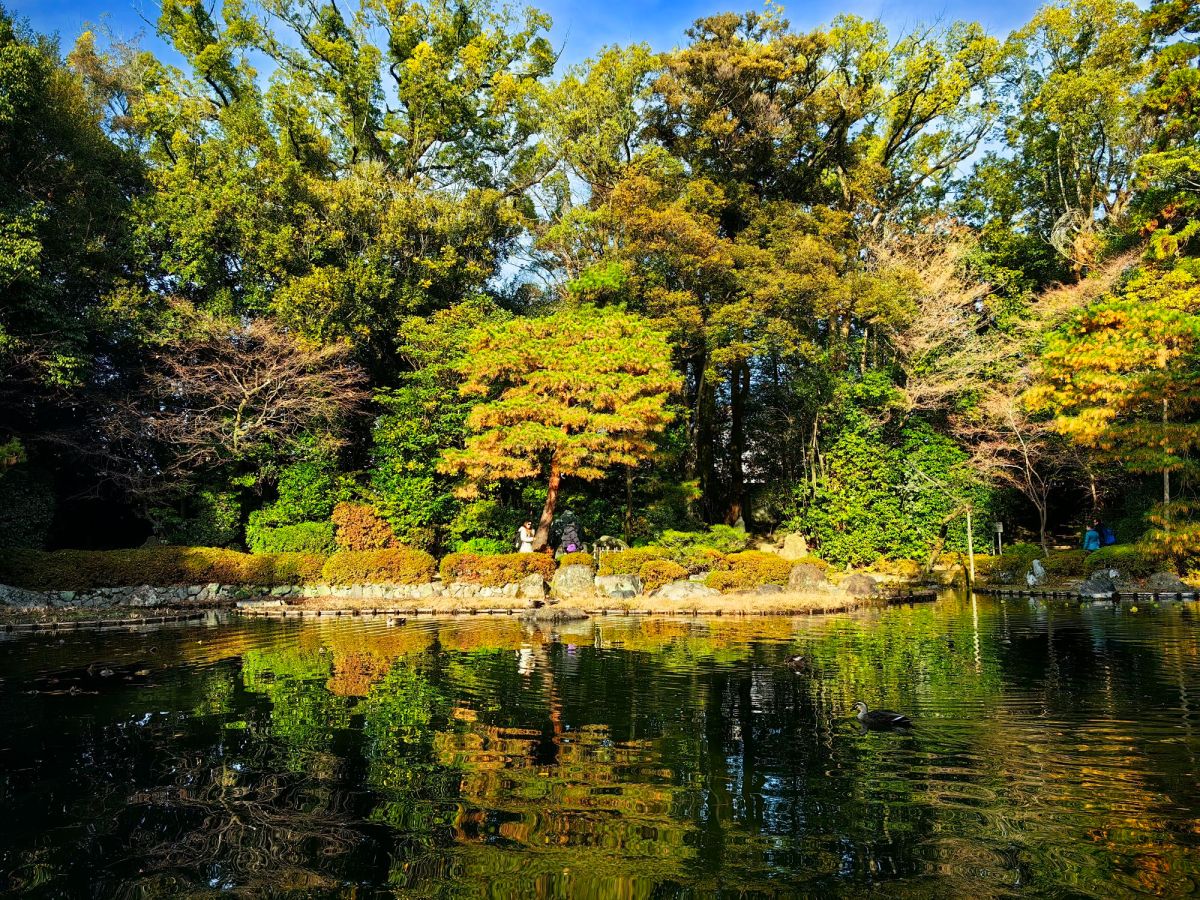
Behind the grand vermilion buildings of Heian-jingū lies a beautiful hidden world called Shin-en. This garden feels like a completely different Kyoto: quiet ponds, winding paths, elegant bridges, flowering trees and reflections that change with the seasons. The West Garden is a tranquil waterscape with a large pond, carefully positioned rocks, irises and water lilies give this garden a peaceful, contemplative character.
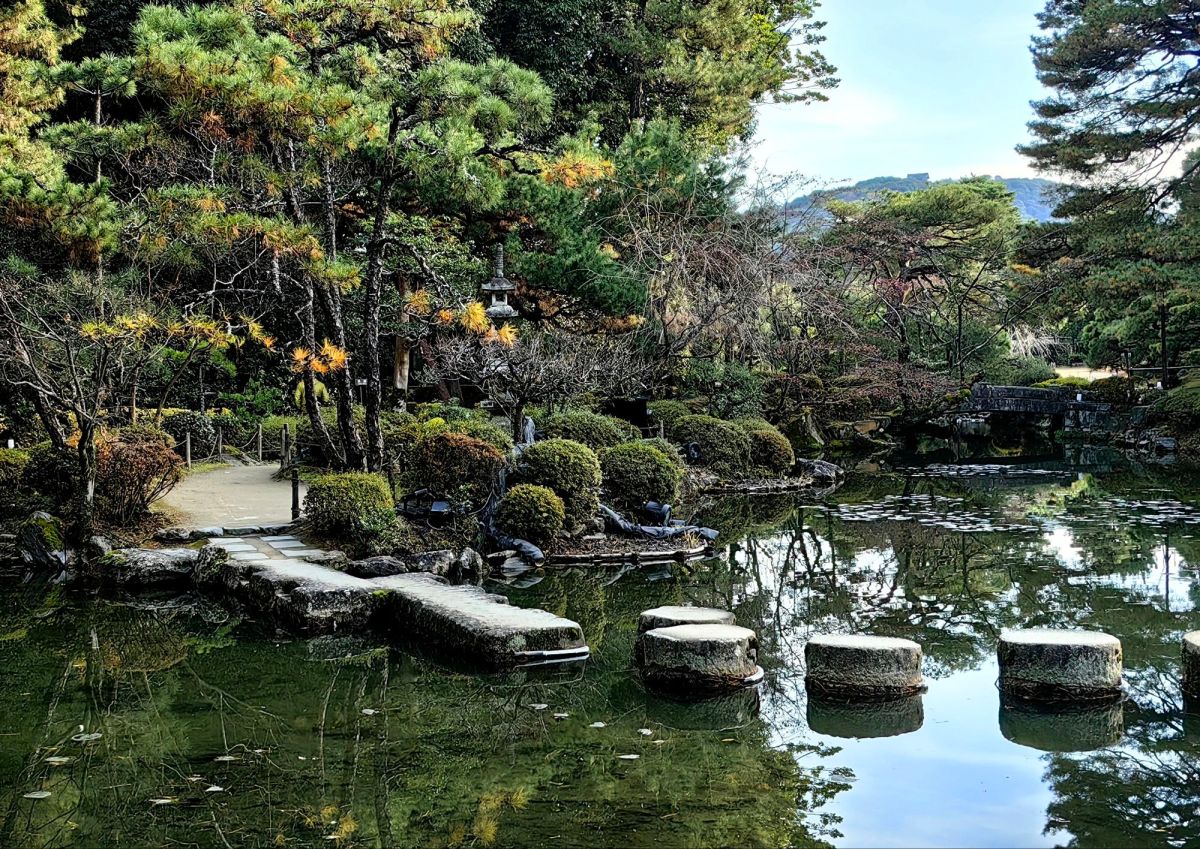
The middle garden displays irregular stepping stones cross the pond, leading my eyes across the water towards a small island and rustic teahouse. The garden reflects the Japanese aesthetic of wabi-sabi: finding beauty in simplicity, imperfection and the passing of time.
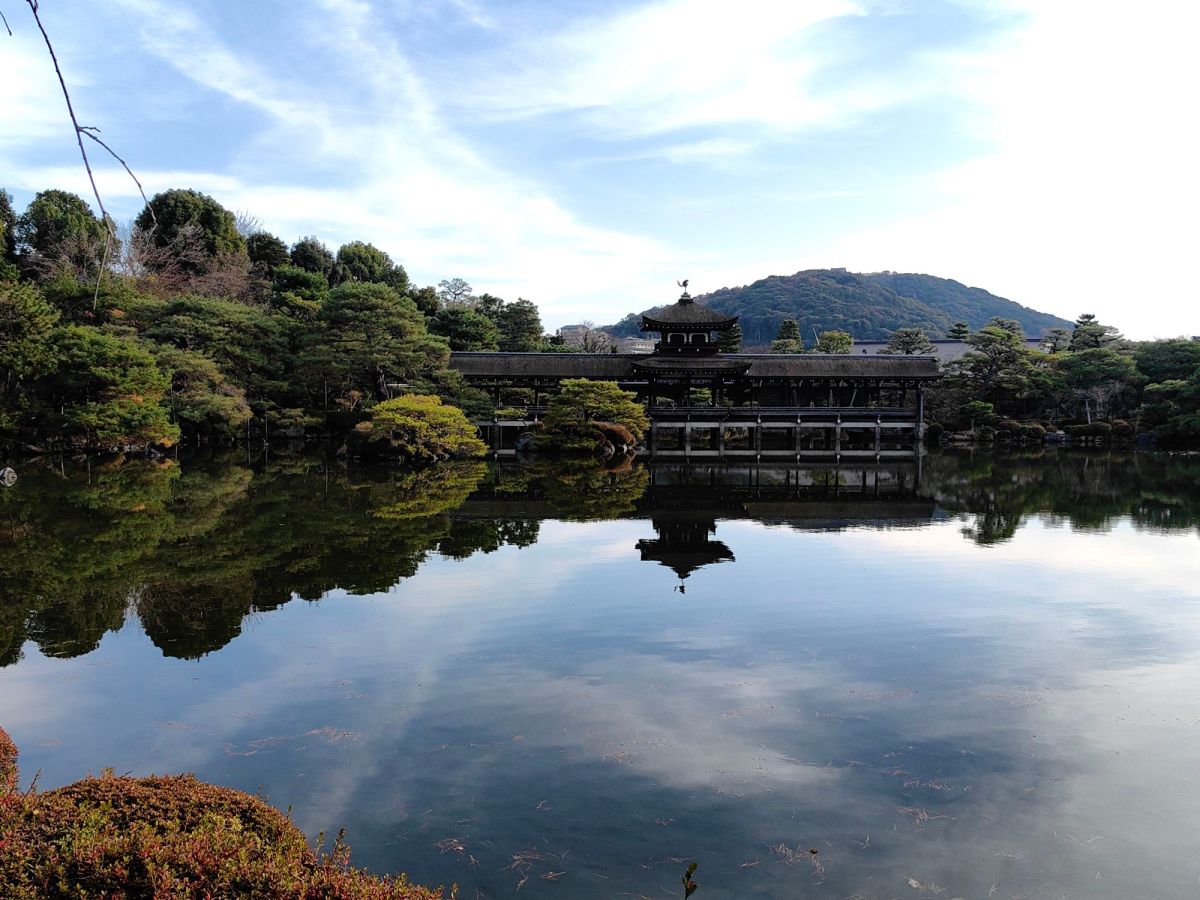
The eastern garden is the largest of the three gardens and it centres on a spacious pond surrounded by trees and elegant historic wooden structures. Its highlight is Taiheikaku, a roofed bridge pavilion originally associated with the Kyoto Imperial Palace. I could stand here and enjoy the garden view without rushing. It offers a softer expression of Japanese culture: patience, balance, and quiet appreciation of nature.
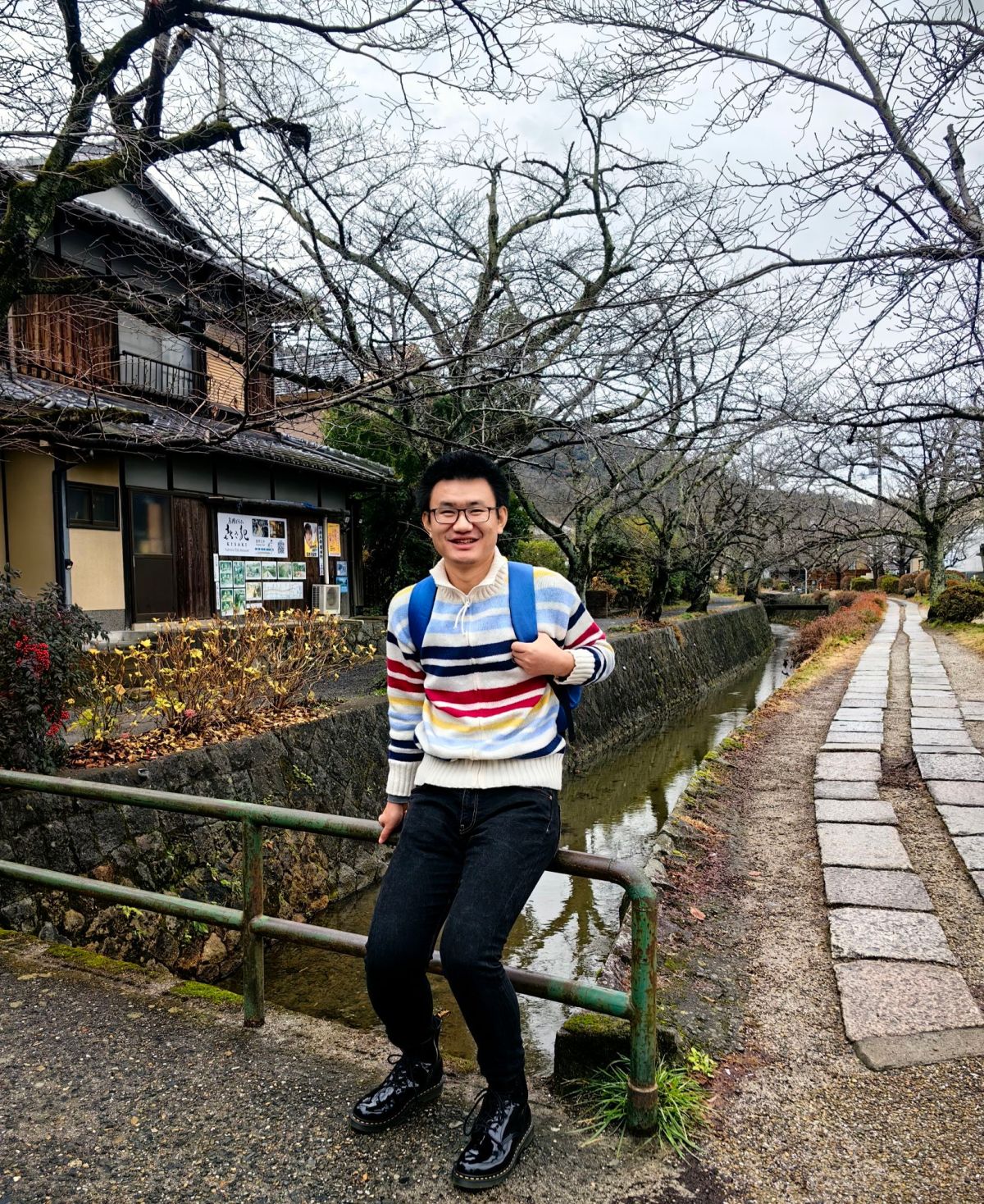
My first day’s trip around the area of Gion is a straight line from the Kiyomizu-dera to the Heian-jingū Shrine. The second day trip is along the famous Philosopher’s Path. On the eastern side of Kyoto, beneath the wooded slopes of the Higashiyama mountains, runs this Philosopher’s Path in the photo, a quiet walking route following a small canal between Ginkaku-ji and Nanzen-ji. The path takes its name from the philosopher Nishida Kitarō, who was said to walk here regularly while reflecting on his ideas. But for me, its deeper attraction was the way it connected so many of Kyoto’s temples with the natural landscape of the eastern mountains.
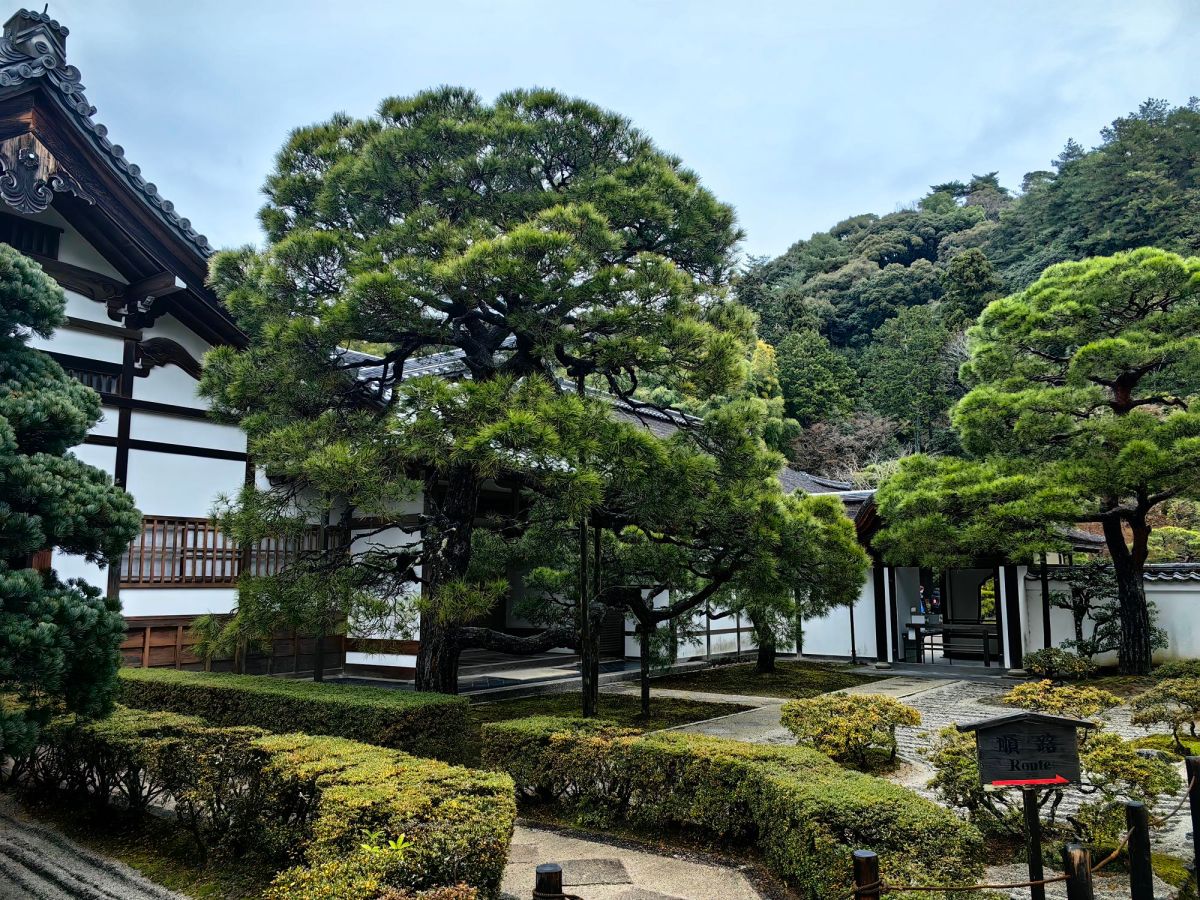
Walking along the path, I could feel that the temples of Higashiyama were not isolated monuments scattered around the city. They seemed to form a continuous spiritual landscape beneath the mountains. Ginkaku-ji, Honen-in, Nanzen-ji, and many smaller temples and sub-temples are tucked among trees, stone walls, gardens, and narrow lanes branching away from the canal. The continuous trees and temple walls made the city almost disappear.
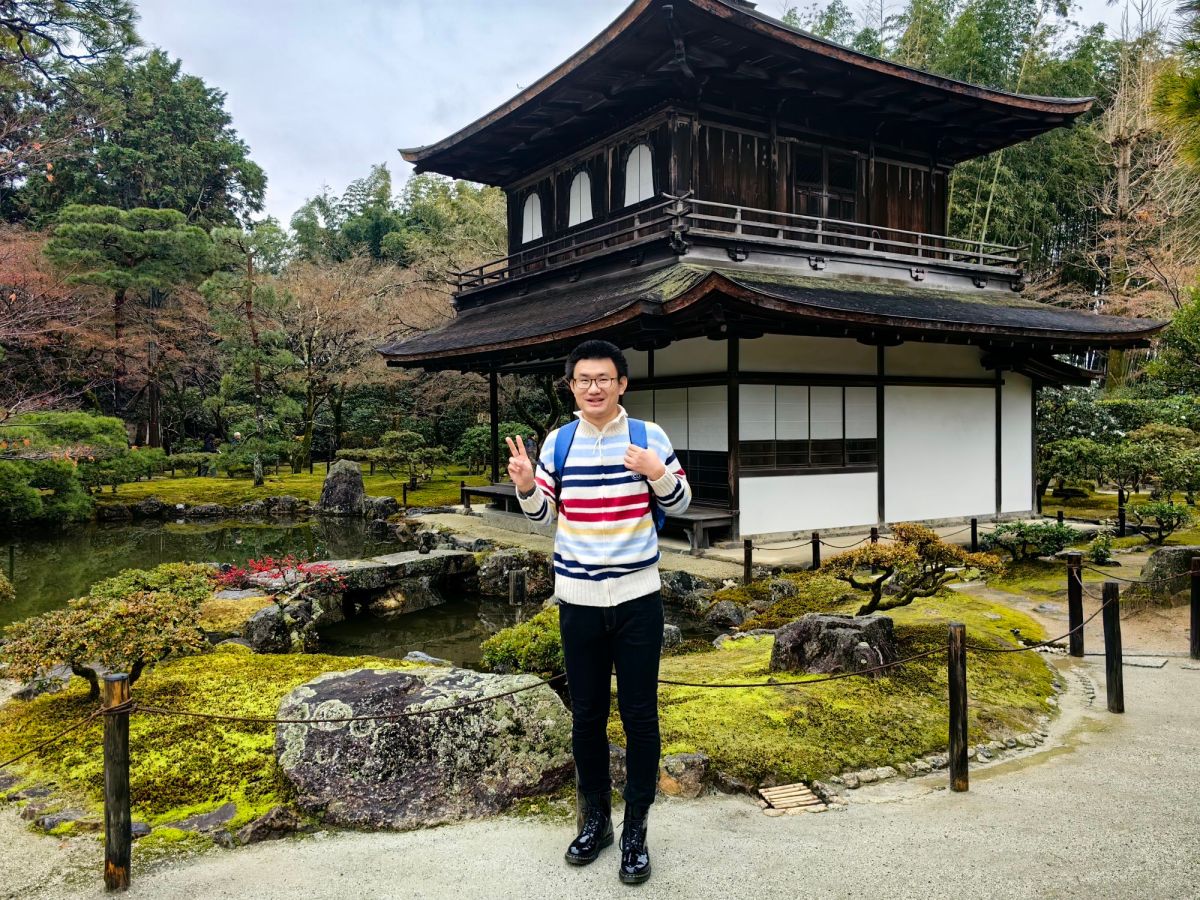
Ginkaku-ji, commonly known as the Silver Pavilion, was one of the most famous temples along the Philosopher’s Path. Originally built in the late fifteenth century as the retirement villa of Ashikaga Yoshimasa, the eighth shogun of the Ashikaga shogunate, it was later converted into a Zen temple. Although Yoshimasa had intended to cover the pavilion with silver foil, as a counterpart to his grandfather Ashikaga Yoshimitsu’s Golden Pavilion, this plan was never realised.
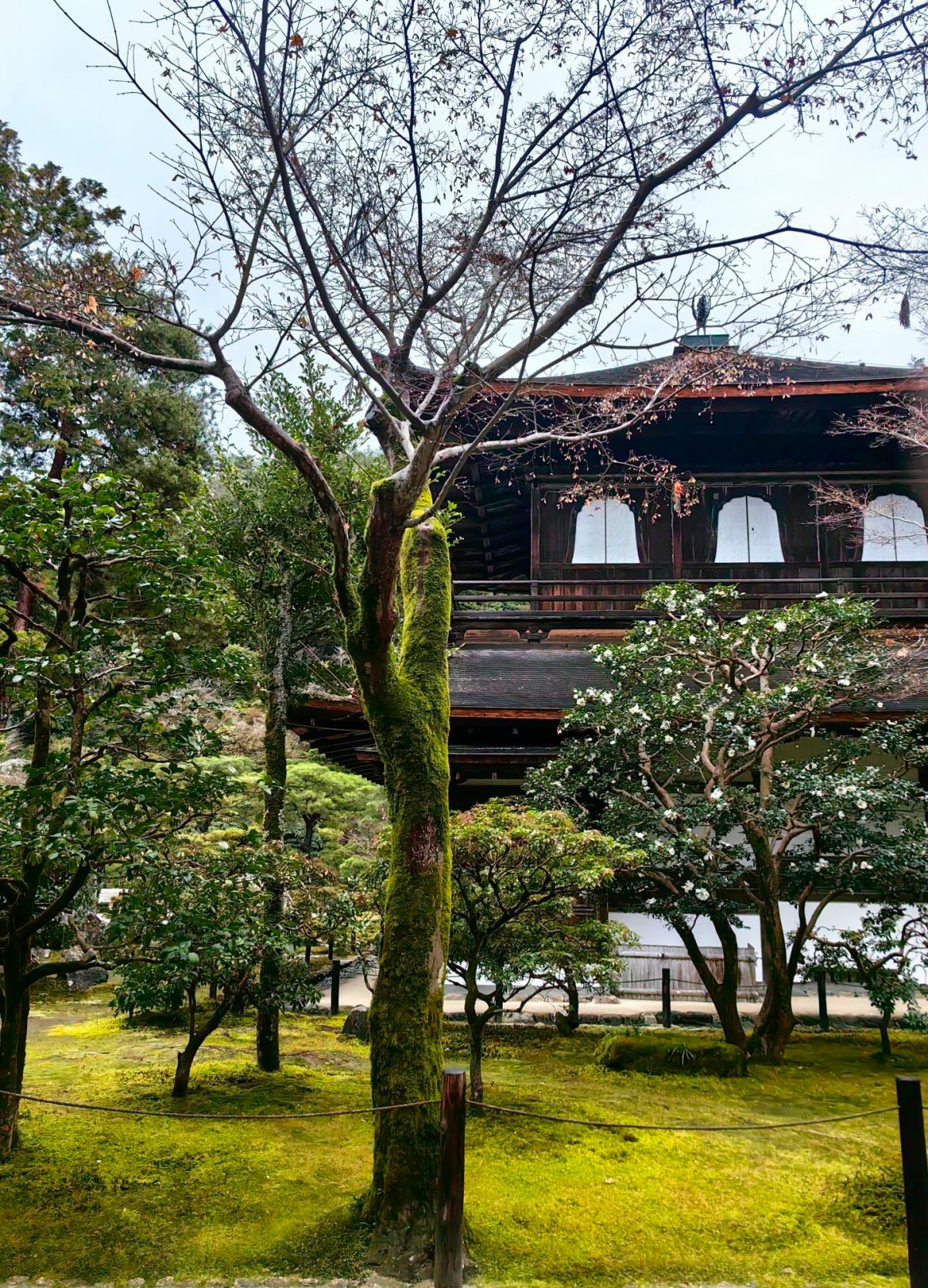
The building retained its natural wooden appearance, weathered by centuries of time. Perhaps this is precisely what gives Ginkaku-ji its distinctive character: instead of dazzling visitors with gold or silver, it expresses beauty through simplicity, restraint, and the passage of time.
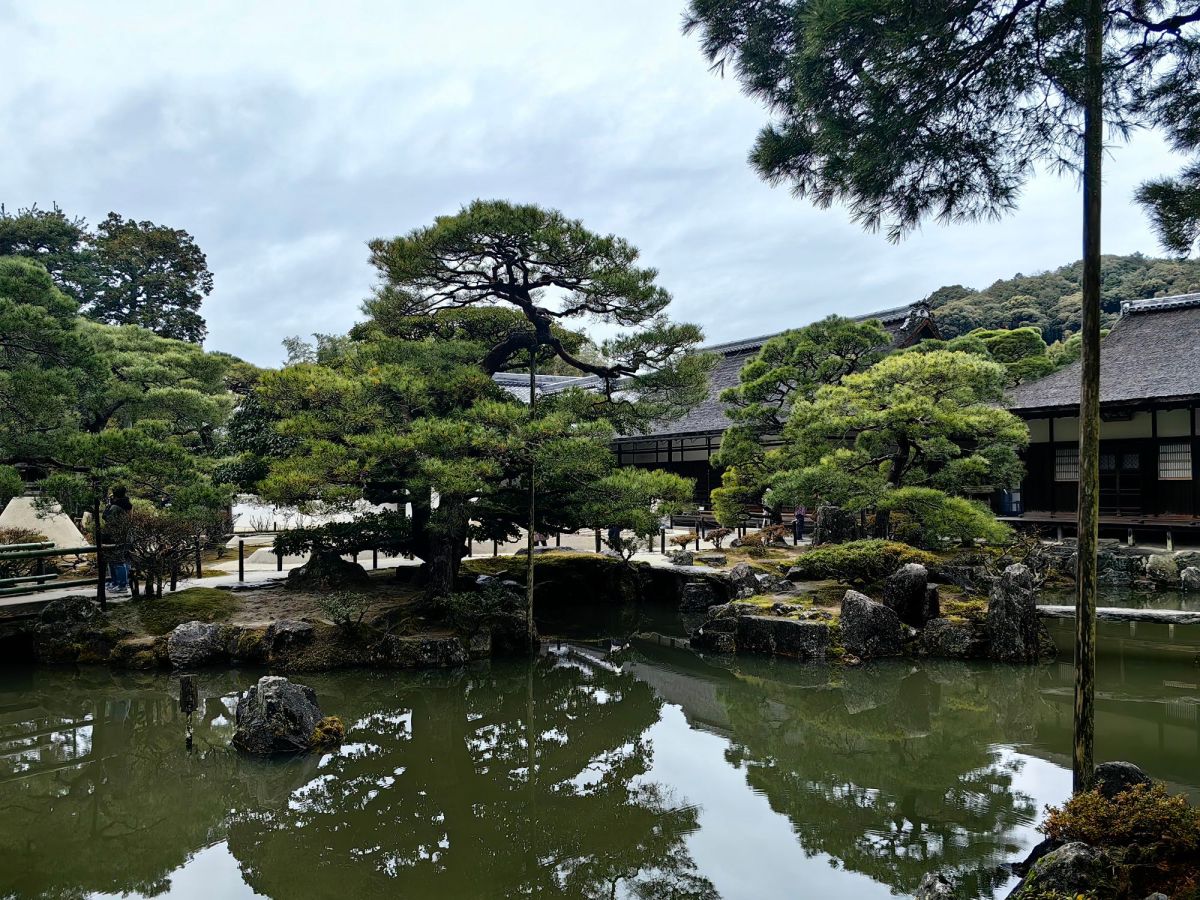
The temple grounds are equally remarkable. In front of the pavilion lies the famous sand garden, with its carefully raked white gravel forming patterns that resemble waves on the surface of the sea. Two features immediately catch the eye: the broad, flat Ginshadan, often called the Sea of Silver Sand, and the carefully shaped Kogetsudai, a large conical mound of sand said to resemble Mount Fuji. It reflects the cultural world of Ashikaga Yoshimasa, whose retirement years helped shape the Higashiyama culture.
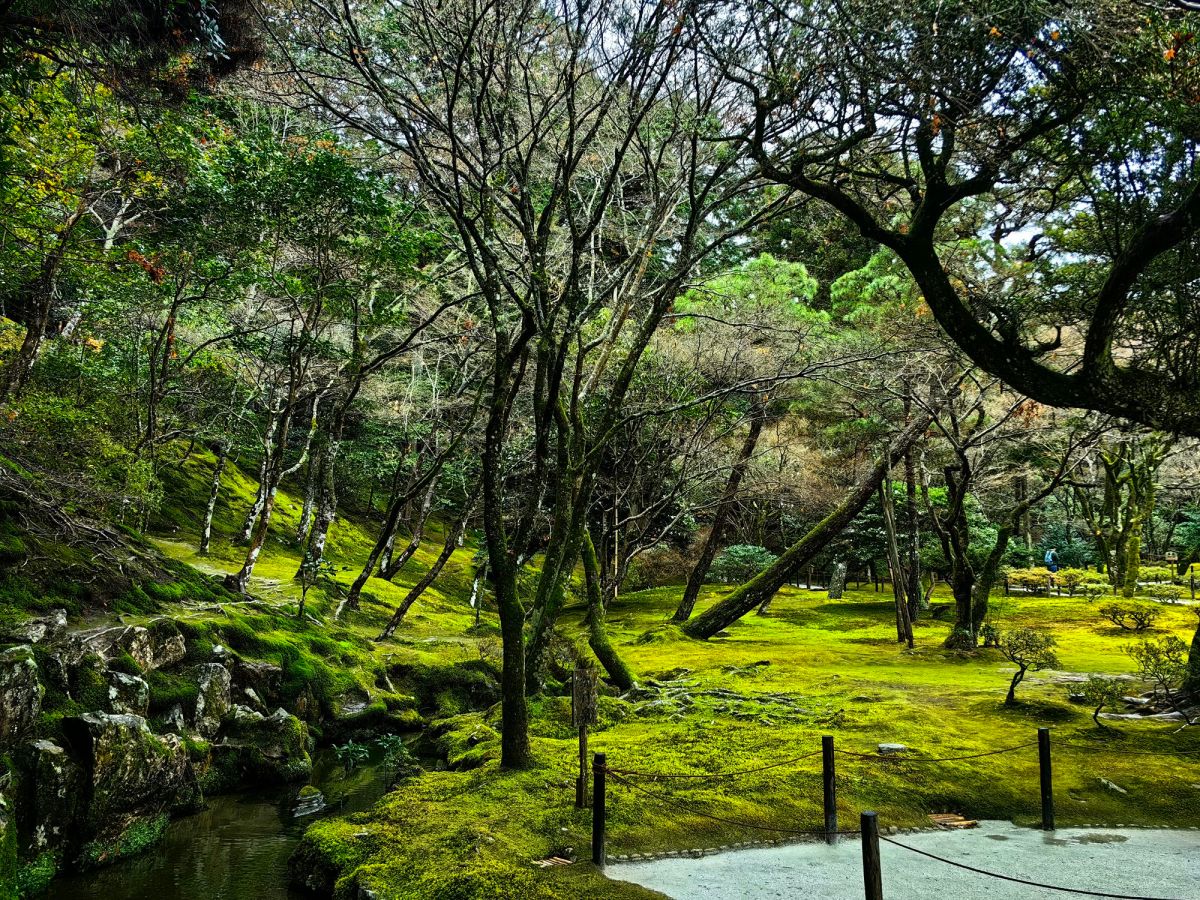
Beyond the sand garden, a beautiful moss garden spreads beneath the trees, with small ponds, stone paths, bridges, and carefully arranged greenery. Walking through the garden, I could appreciate how the Japanese landscape tradition turns even simple materials such as sand, moss, stones, and water into an expression of harmony and contemplation.
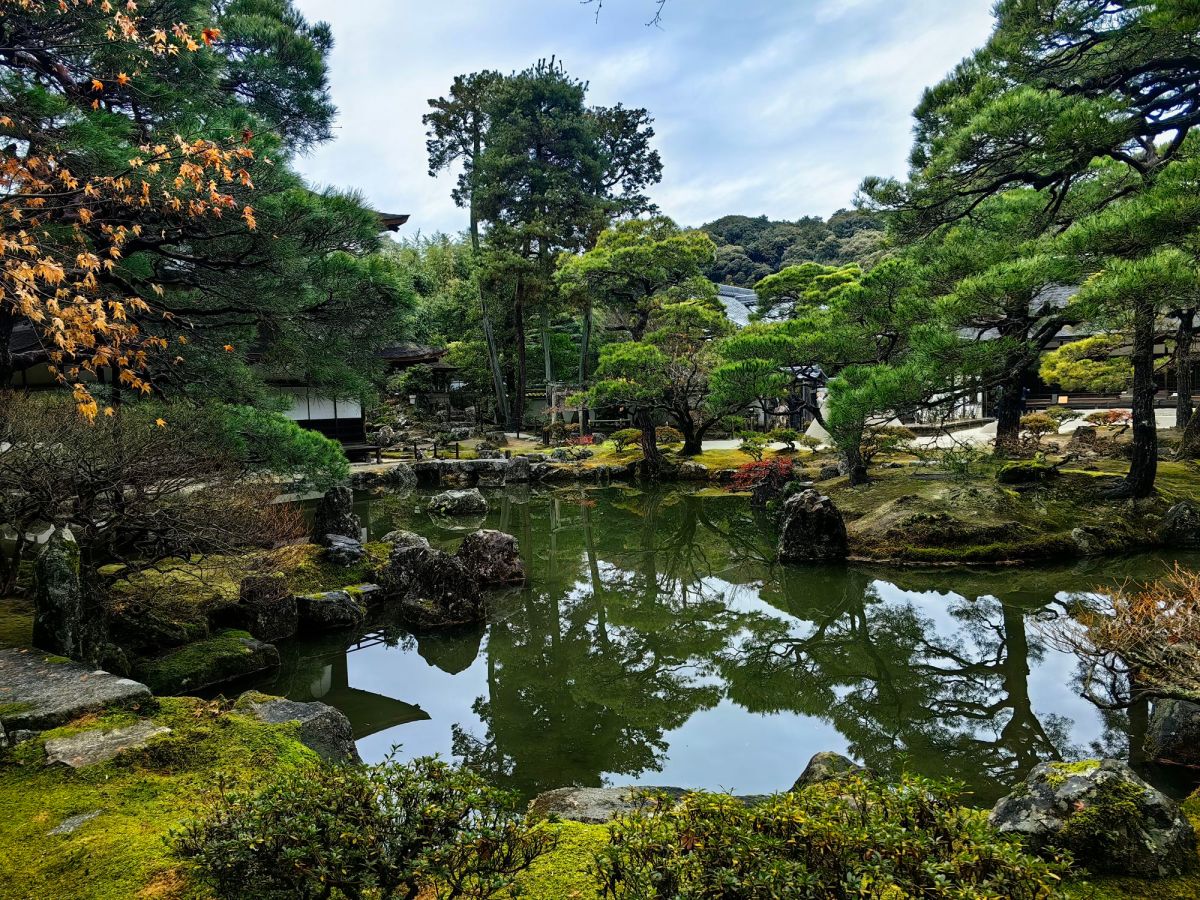
Ginkaku-ji also carries the cultural spirit of the Higashiyama period, when Yoshimasa’s patronage helped nurture the development of Japanese arts, including tea ceremony, flower arrangement, ink painting, and garden design. Its beauty is closely associated with wabi-sabi (an appreciation of simplicity, imperfection, and the quiet elegance of things shaped by time). Standing among its wooden buildings and carefully maintained gardens, I felt that Ginkaku-ji represented a very different side of Kyoto from the brilliant architecture I had seen elsewhere.
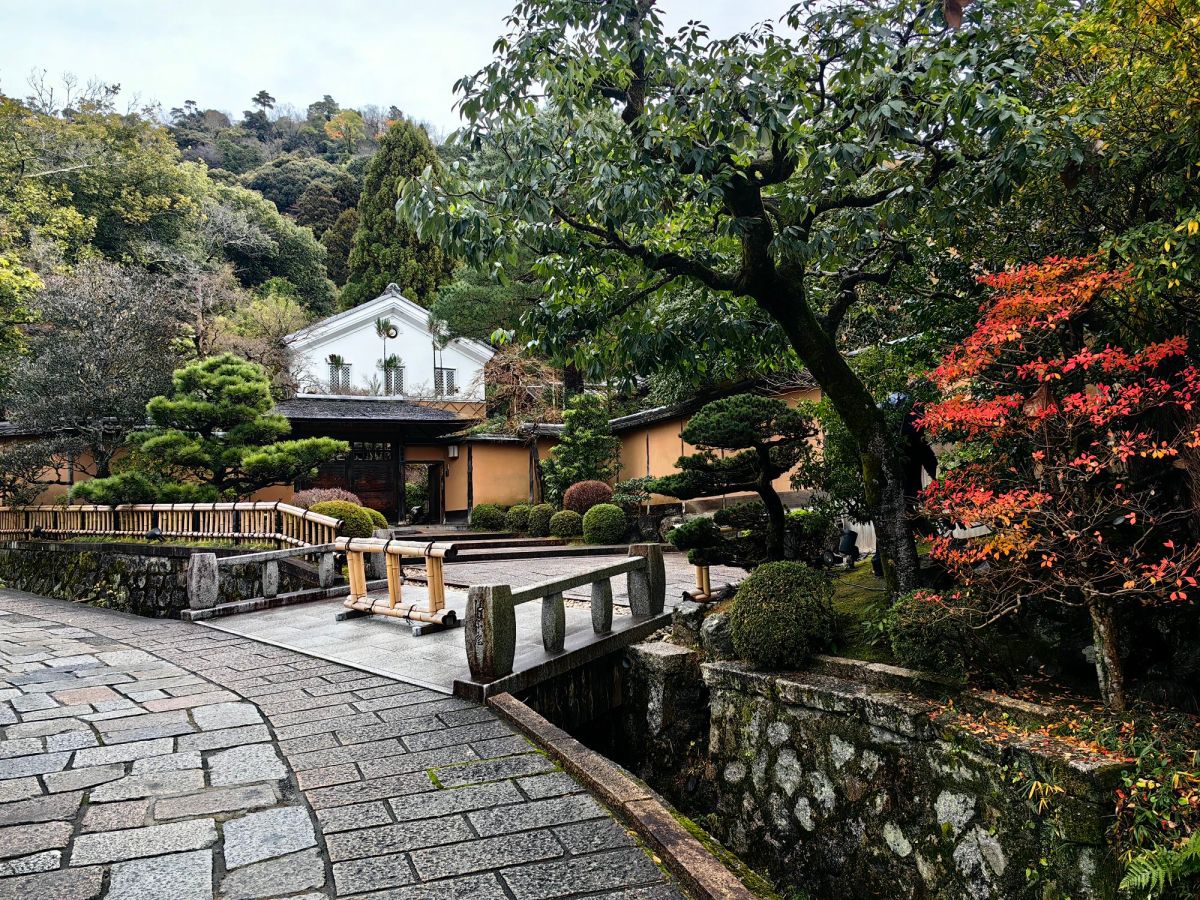
Walking along the Philosopher’s Path after a light rain was one of those quiet moments when I could fully appreciate the beauty of Kyoto. The narrow canal flowed gently beside the path, while small stone bridges appeared one after another, allowing me to cross from one side to the other. The stone surfaces were still damp from the rain, and the surrounding trees seemed fresher, their colors more vivid against the soft winter light.
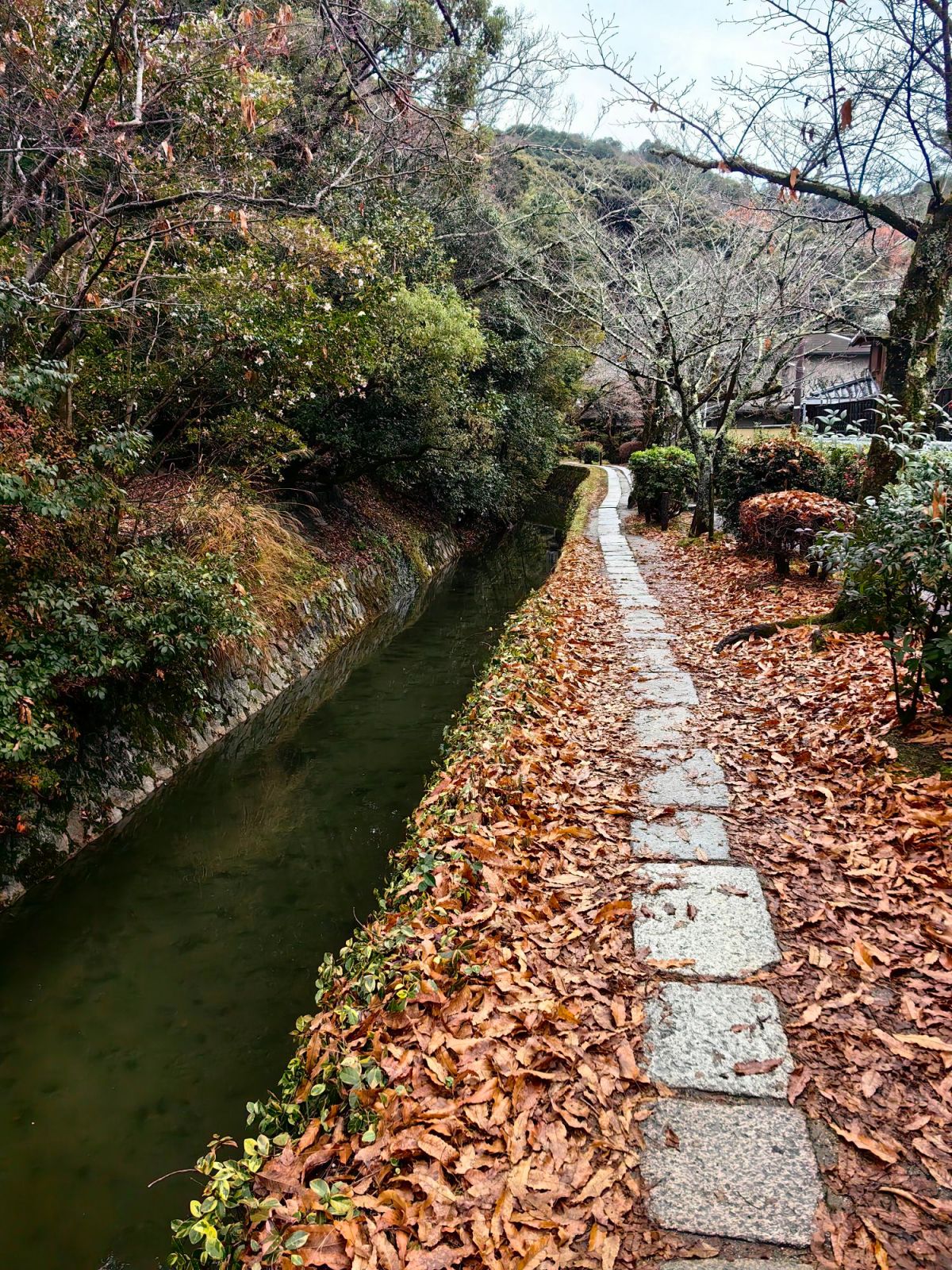
Along banks of the canal, fallen red leaves had gathered in scattered clusters, covering the ground and occasionally floating on the surface of the water. Their deep colors contrasted beautifully with the dark, rain-soaked stones and the gentle movement of the stream. As I passed over the little bridges, I could pause and look along the canal, watching the leaves drift slowly with the current. There was something almost poetic about the scene: the rain had quietened the surroundings, the crowds seemed distant, and the whole path felt wrapped in a peaceful atmosphere.
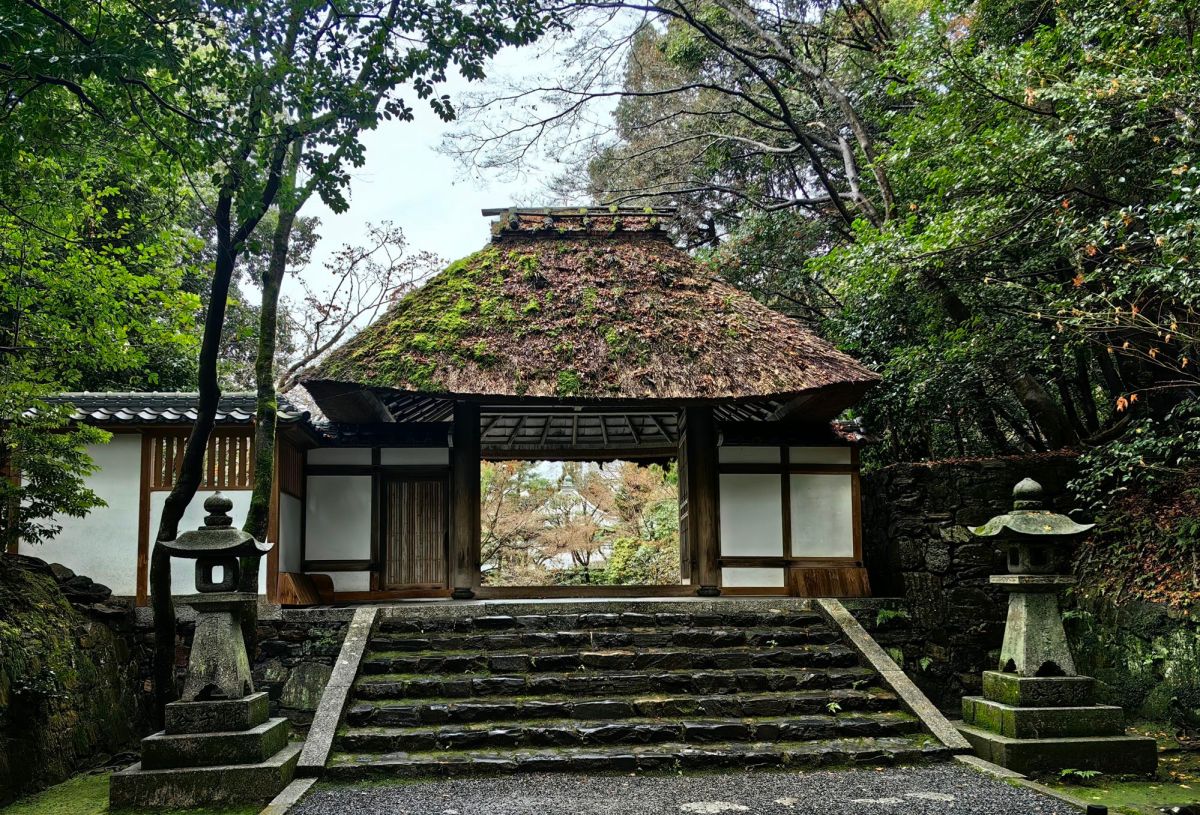
As I continued along the Philosopher’s Path, I came across several small temples tucked quietly among the trees and old houses. Some were almost hidden behind wooden gates and stone walls, with narrow paths leading into their peaceful grounds. I occasionally stepped away from the canal to explore these unexpected places. Their ancient entrances, framed by old trees and covered with fallen autumn leaves, seemed to hold a quiet charm of their own.
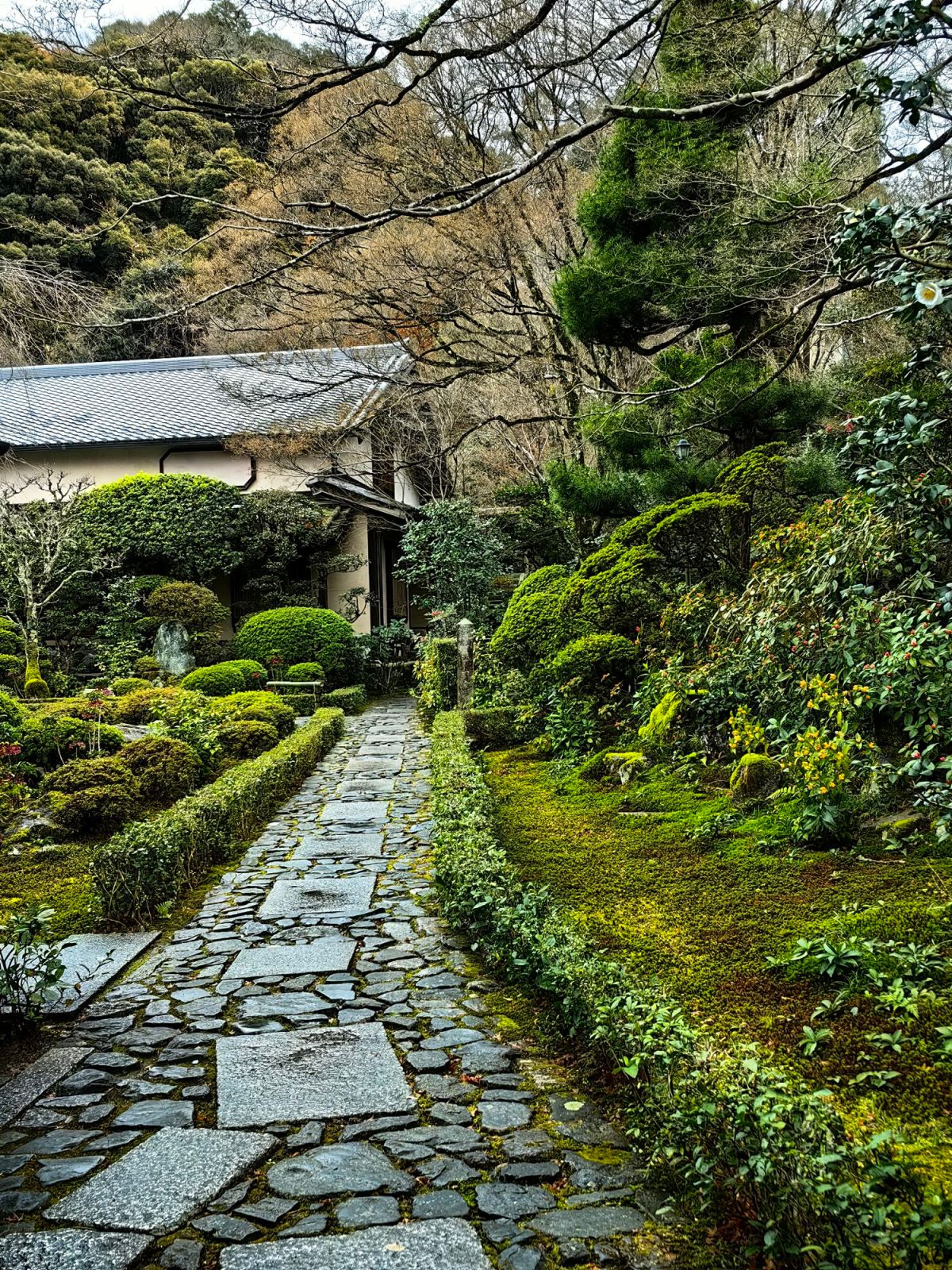
Hōnen-in is one of the most tranquil temples. Its beauty lies not in magnificent buildings or elaborate decorations, but in its natural surroundings, moss-covered landscapes and tranquil atmosphere. Approaching the temple along a narrow woodland pathway, surrounded by tall trees and dense greenery, I gradually felt as though I was entering a quiet sanctuary hidden within the mountains. The temple is named after Hōnen, the Buddhist priest who founded the Pure Land school of Buddhism in Japan. Although the site is associated with his religious teachings in the twelfth century, the present temple was established in 1680 to preserve his legacy.
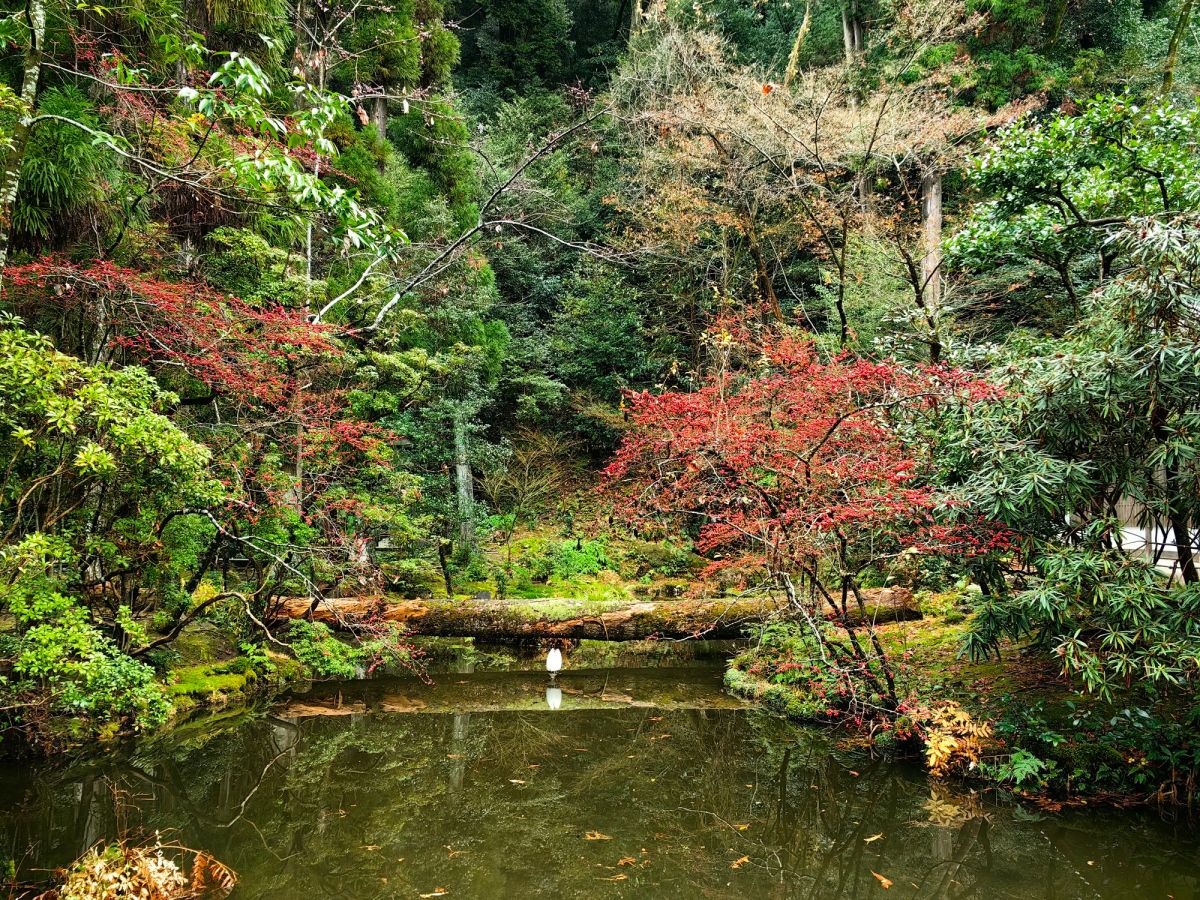
What I particularly enjoyed about Hōnen-in was its quiet and unpretentious beauty. There were no spectacular buildings competing for attention; instead, moss-covered pathways, a small pond, wooden bridges and shaded gardens create a beautiful natural landscape that left me deep impressions.
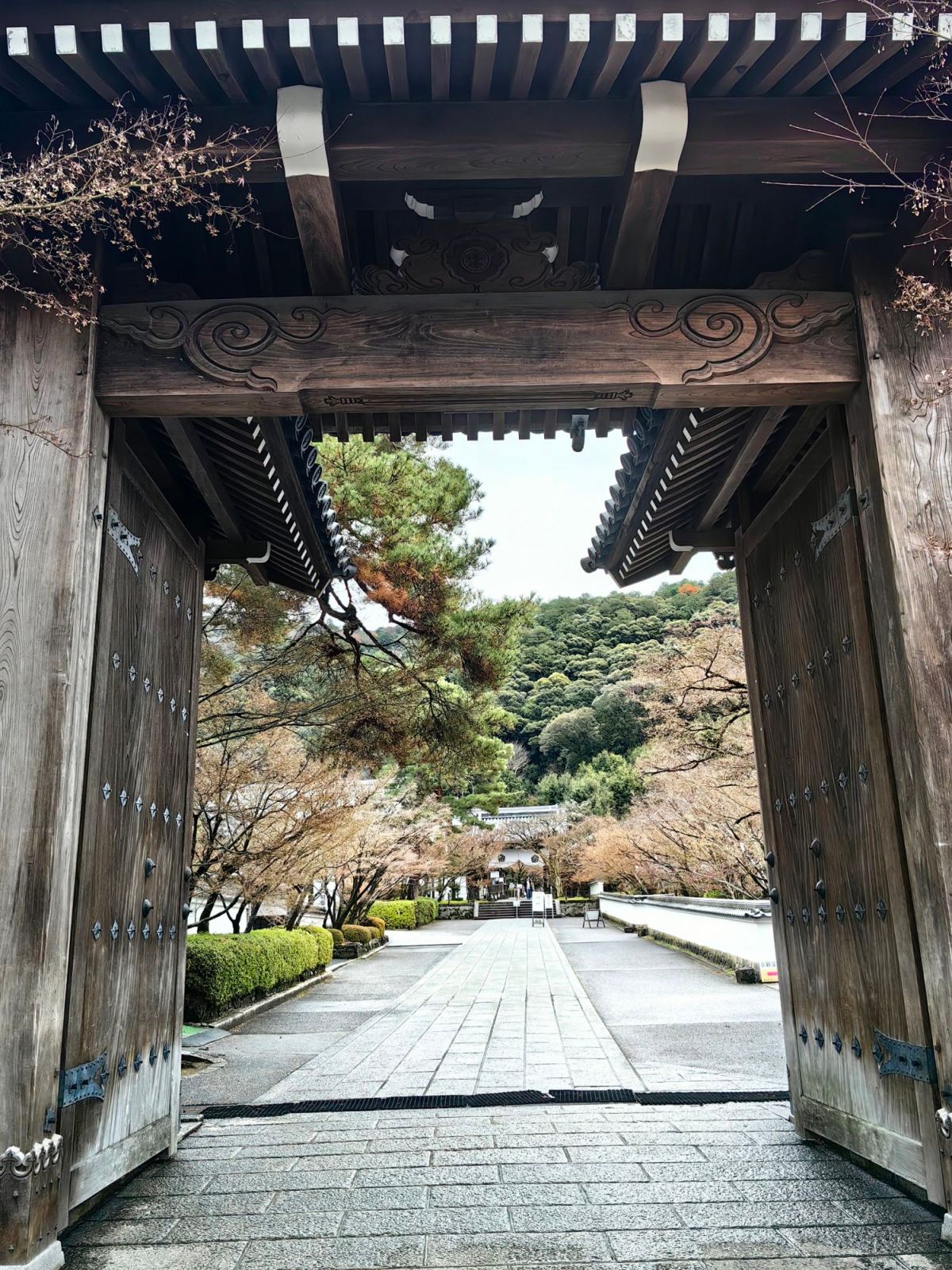
After following the Philosopher’s Path, my next destination was Eikandō, one of the most celebrated temples in Kyoto’s eastern mountains. Unlike the smaller temples I had encountered along the canal, Eikandō had a much larger and more elaborate temple complex, with traditional wooden buildings, gardens, and corridors extending toward the wooded hillside. Its history stretches back to the Heian period, and over the centuries it became an important centre of Pure Land Buddhism. As I entered the temple grounds, I came across the Chūmon, or Middle Gate, a traditional wooden entrance with a gently curved tiled roof. Although its architecture was relatively modest, it possessed a quiet elegance that seemed perfectly suited to the surroundings. Built in 1744, the gate had witnessed centuries of changing seasons and generations of visitors.
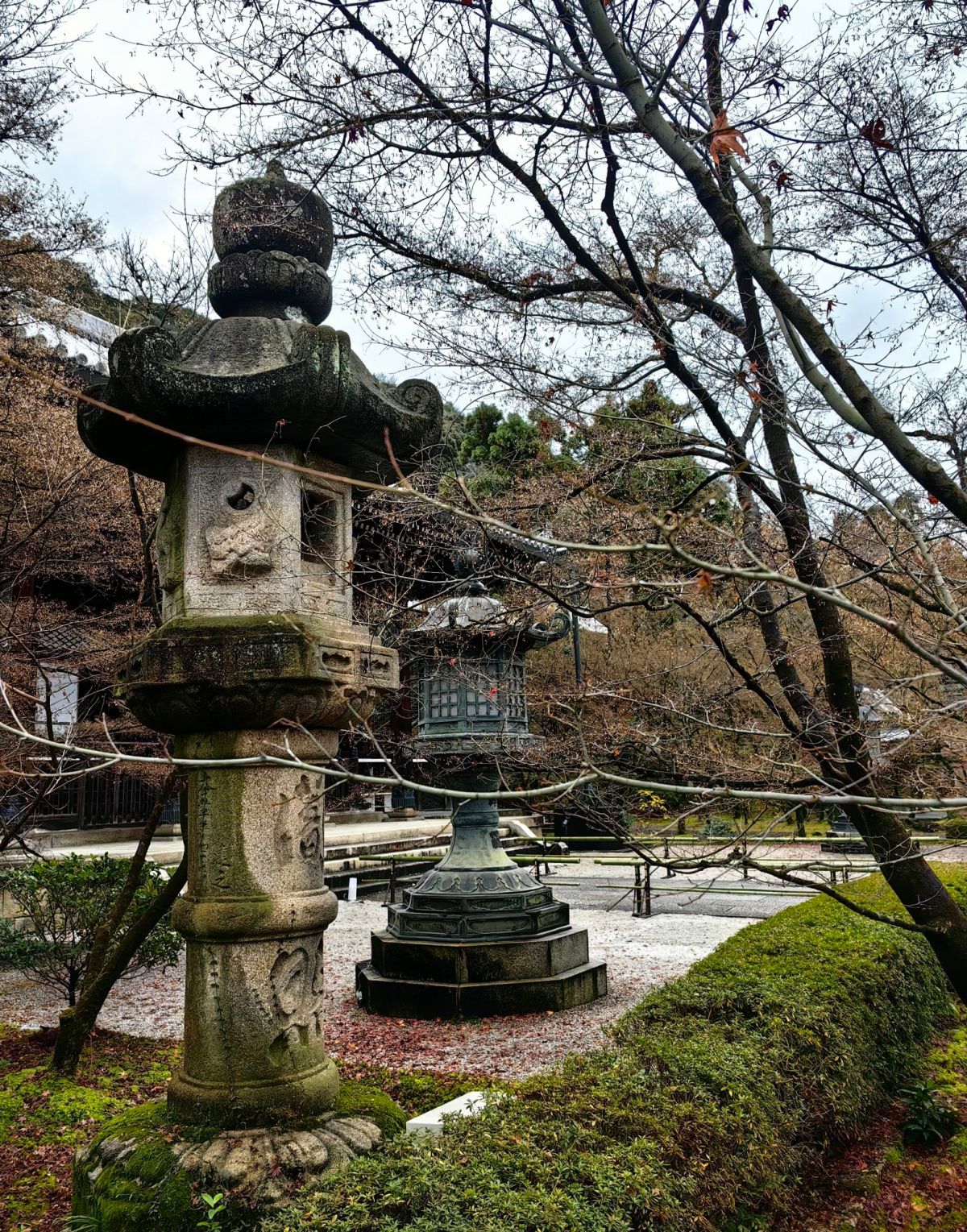
Beyond the Chūmon, I gradually discovered that Eikandō was much more than a single temple building. Its extensive grounds spread along the foothills of the eastern mountains, with traditional wooden halls, covered corridors, gardens, and pagodas arranged at different elevations. Walking through the complex, I passed several temple buildings, including the Shakadō, Miei-dō, and Amida-dō, each with its own religious significance. As I continued exploring this area, I was increasingly attracted to the smaller details of its gardens. Scattered among the trees and pathways were traditional stone lanterns, their weathered surfaces darkened by age and covered in places with soft green moss. Some stood quietly beside the stone paths, while others were partially hidden among the shrubs and trees.
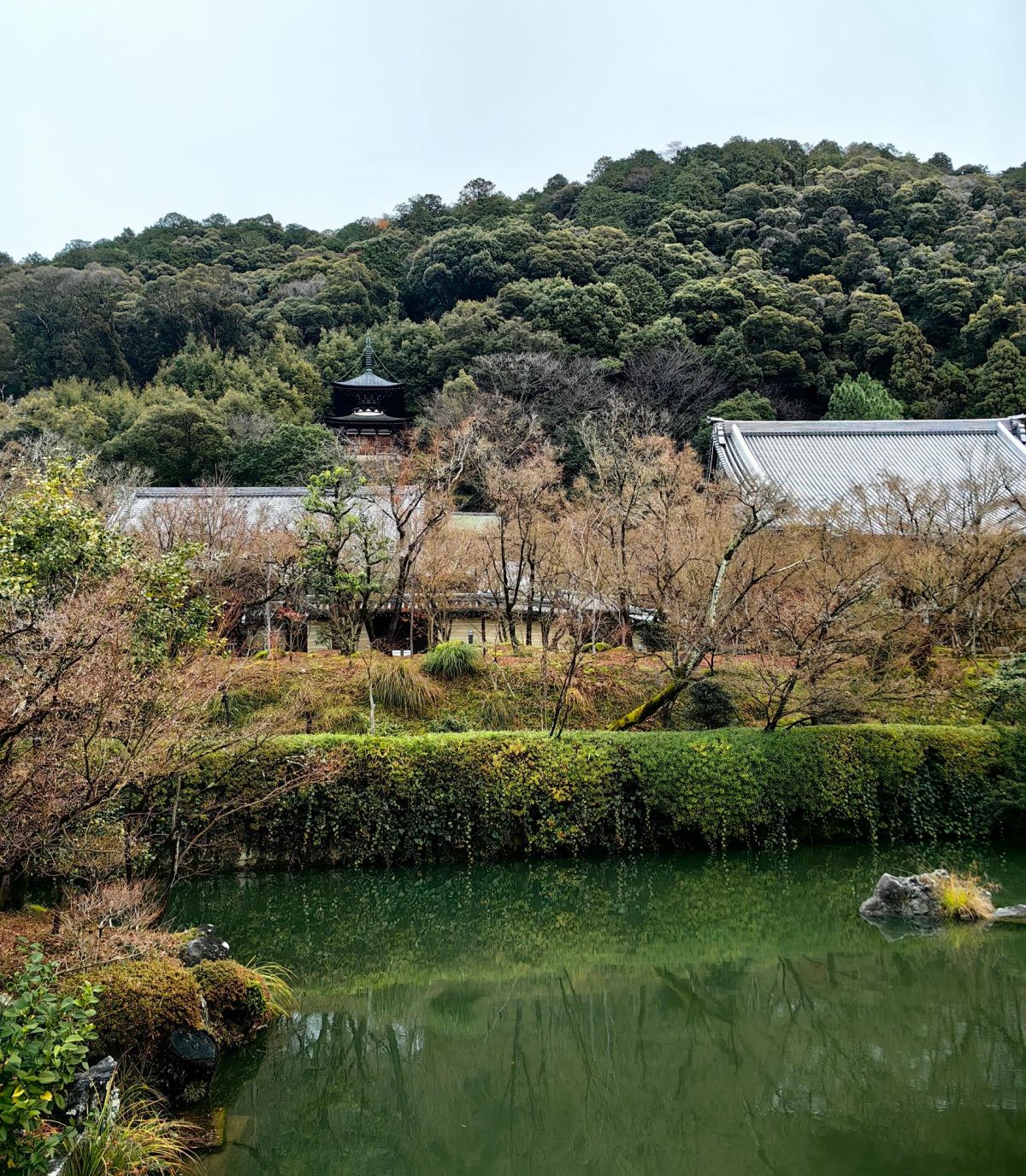
One structure that particularly caught my attention was the Tahōtō Pagoda, standing among the trees on the hillside above the main temple buildings. Its distinctive shape, with a square lower level and a rounded upper section, made it look quite different from the more familiar five-storey pagodas I had seen elsewhere in Japan. I followed the uphill path toward it, gradually leaving the main temple complex behind.
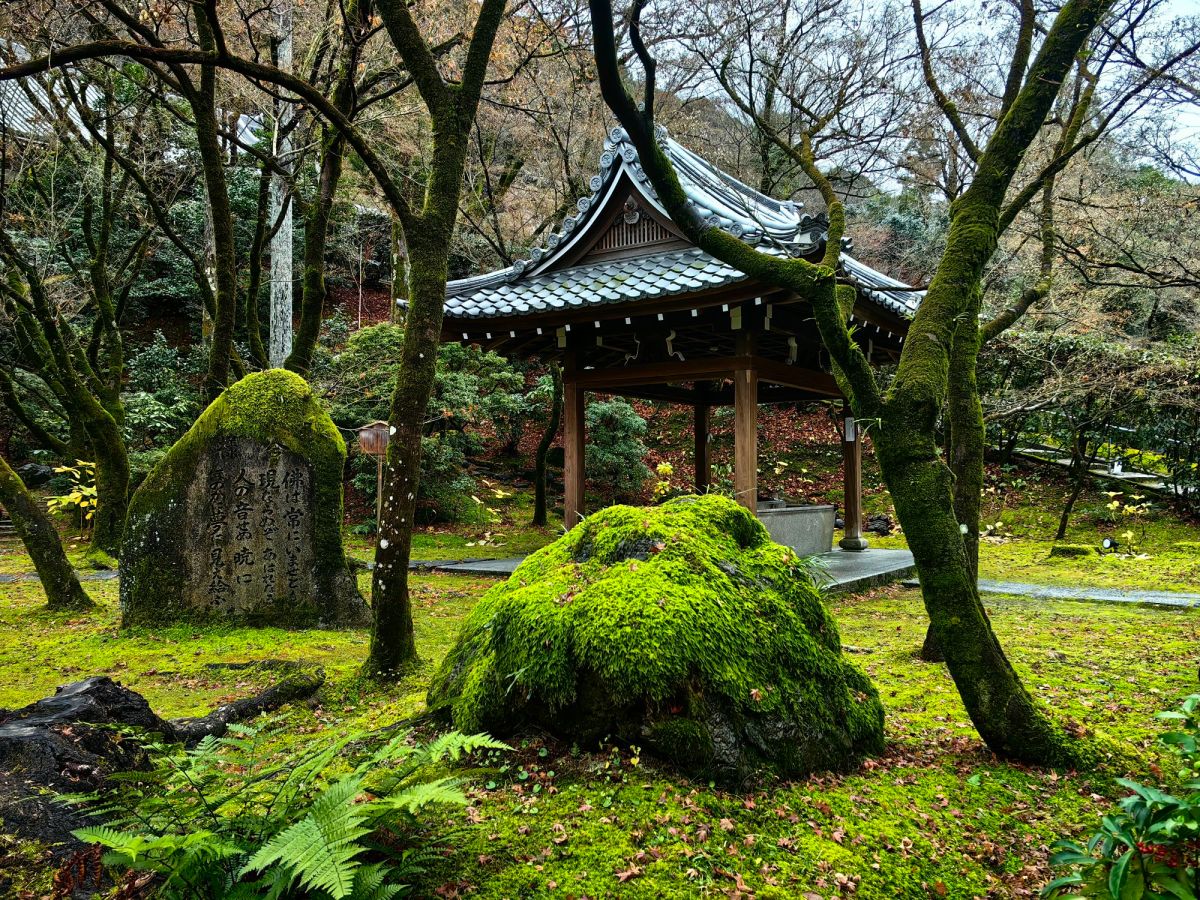
The gardens themselves were equally beautiful. A carpet of green moss spread beneath the trees, surrounding carefully arranged stones and small shrubs. Narrow pathways led through the greenery, occasionally opening onto quiet corners where I could pause and appreciate the simplicity of the surroundings. There was something particularly appealing about the way the garden combined natural elements without making them appear overly arranged. The stones, moss, trees, and fallen leaves seemed to exist in harmony with one another.
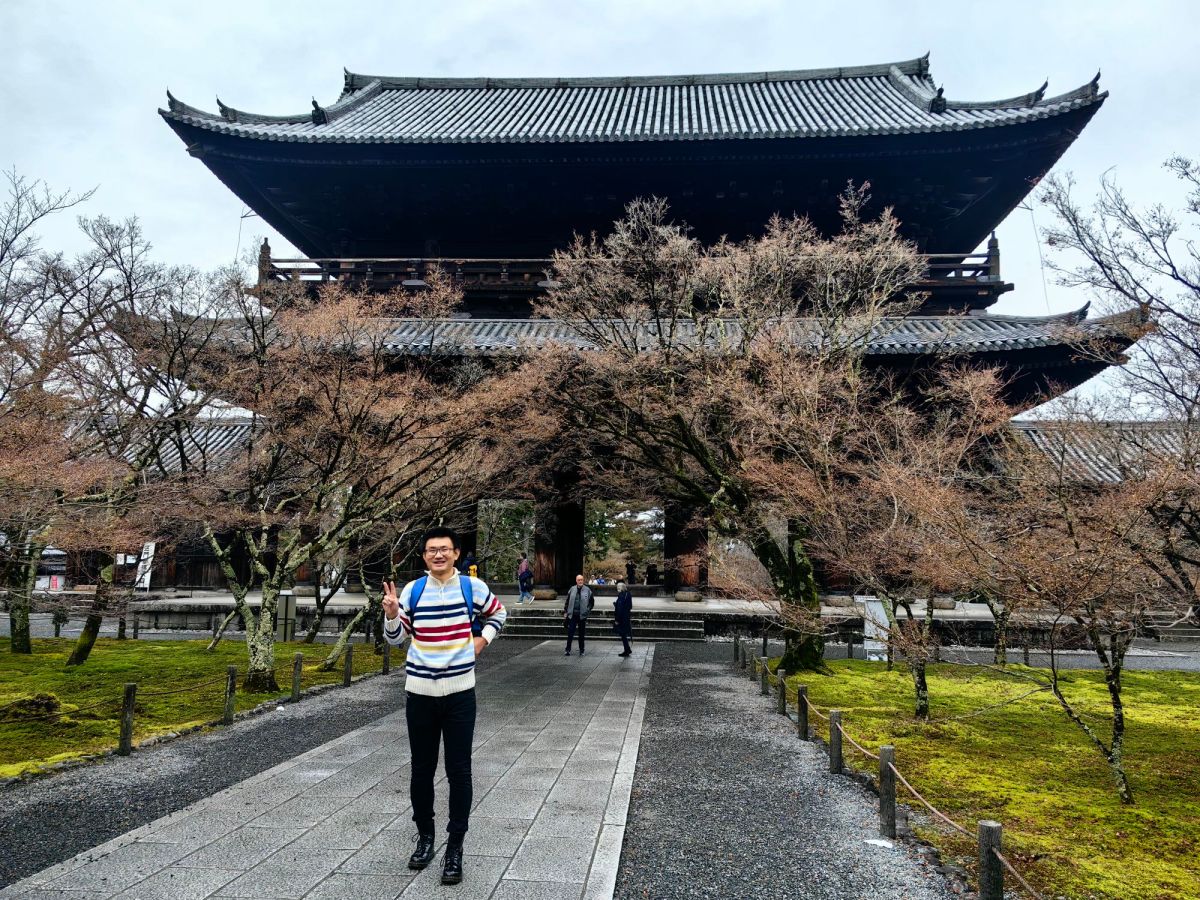
One thing I particularly appreciated about the temples along the Philosopher’s Path was their shared sense of tranquility and their beautiful green landscapes. Although each temple had its own history, architecture, and religious significance, they seemed to share the same quiet character. Surrounded by wooded hills, ancient trees, moss-covered gardens, and peaceful ponds, they felt naturally connected to the greenery of the Higashiyama mountains. Unlike some of Kyoto’s more crowded landmarks, these temples offered spaces where I could slow down, walk quietly, and enjoy the scenery at my own pace.
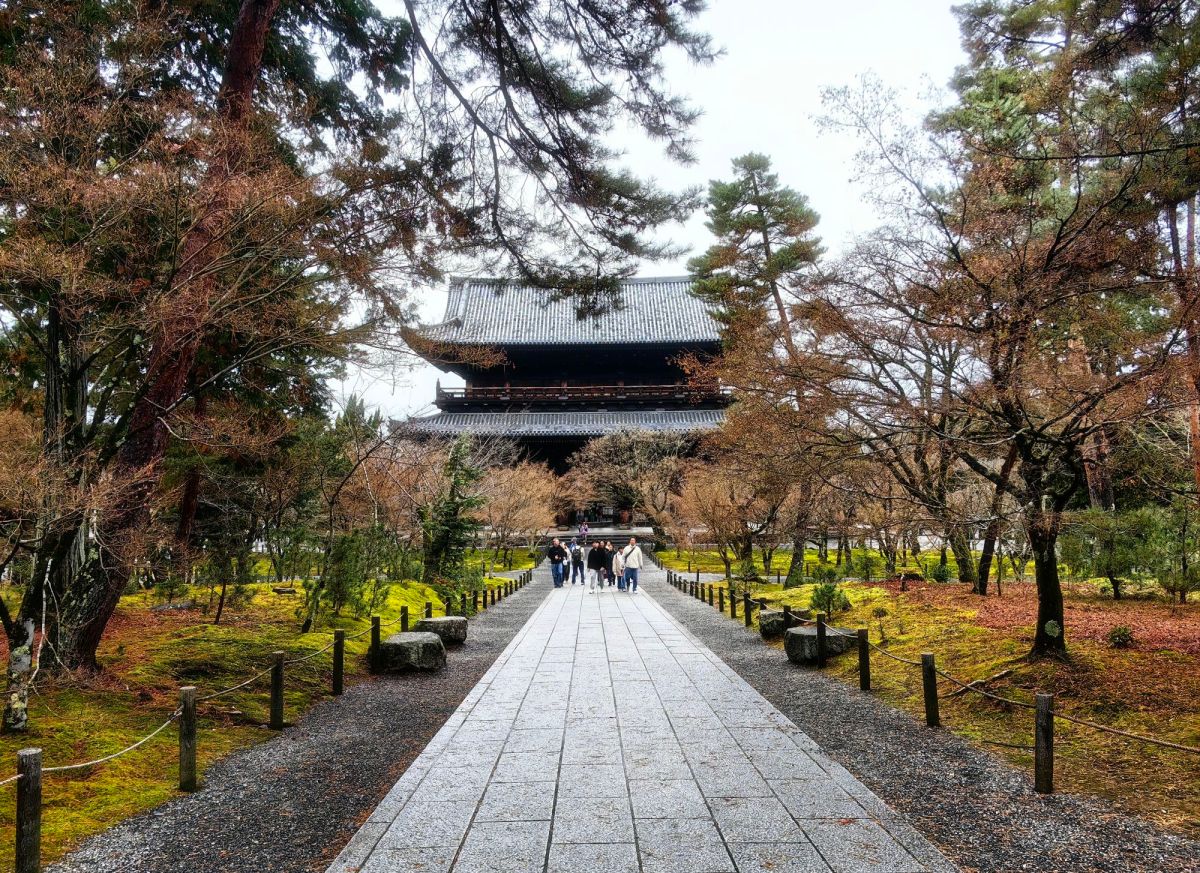
At the southern end of the Philosopher’s Path, I finally reached Nanzen-ji. After spending the day walking among the smaller temples, quiet gardens, and wooded paths of Higashiyama, I found Nanzen-ji particularly impressive because of the scale of its temple grounds and the grandeur of its architecture. Its history dates back to the late thirteenth century, when Emperor Kameyama converted his former imperial residence into a Zen temple. The enormous Sanmon Gate immediately caught my attention. Its massive wooden pillars and imposing structure made it look almost like the entrance to an ancient fortress.
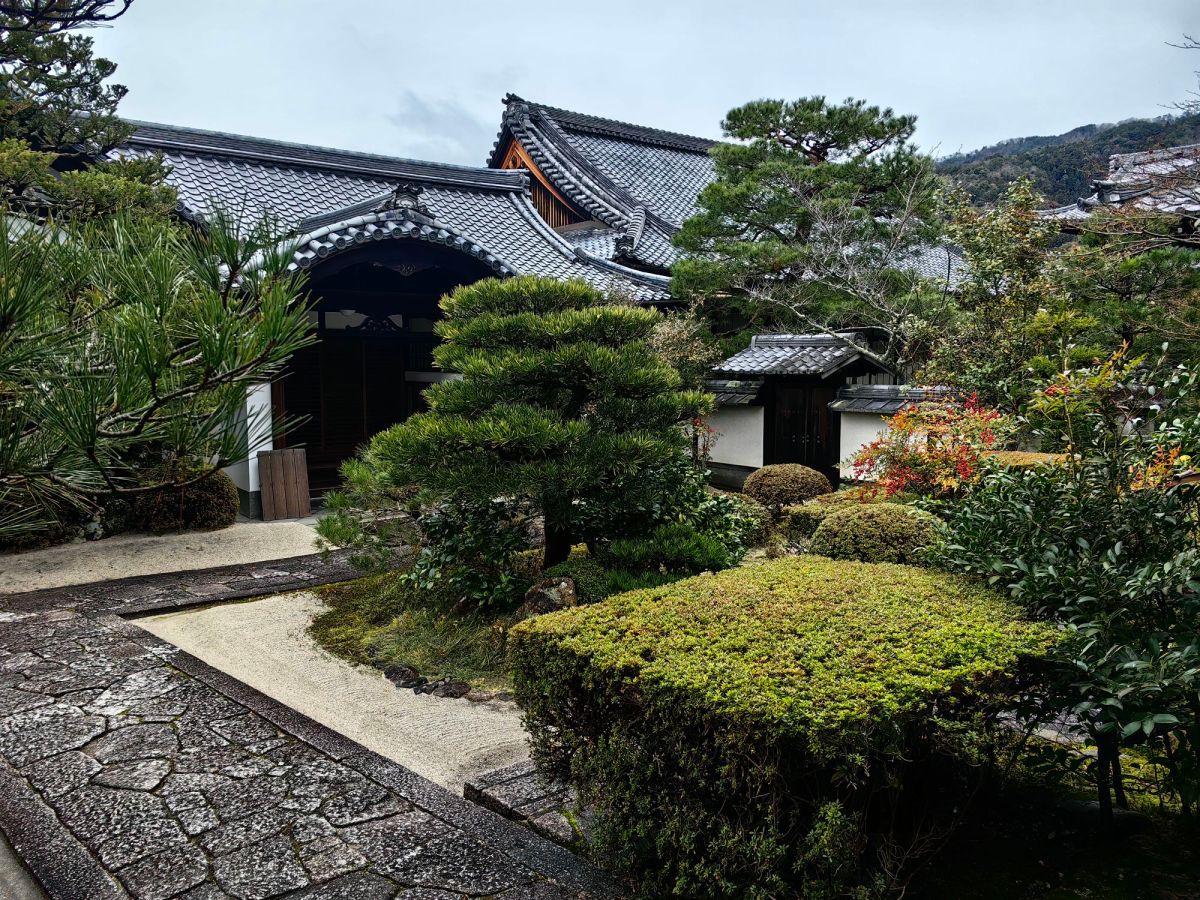
Nanzen-ji is a large temple complex. It was long been admired not only by monks and visitors, but also by poets and writers who found inspiration in its landscape. During the Edo period, the poet Rai San’yō wrote about the temple’s pine trees and the mountains of Higashiyama, capturing the scenery that had attracted visitors for generations. Reading about these descriptions made me feel that I was experiencing something that had moved people long before my arrival. The buildings might have changed, and generations of visitors might have passed through its gates, but the relationship between the temple, the mountains, and the surrounding greenery remained.
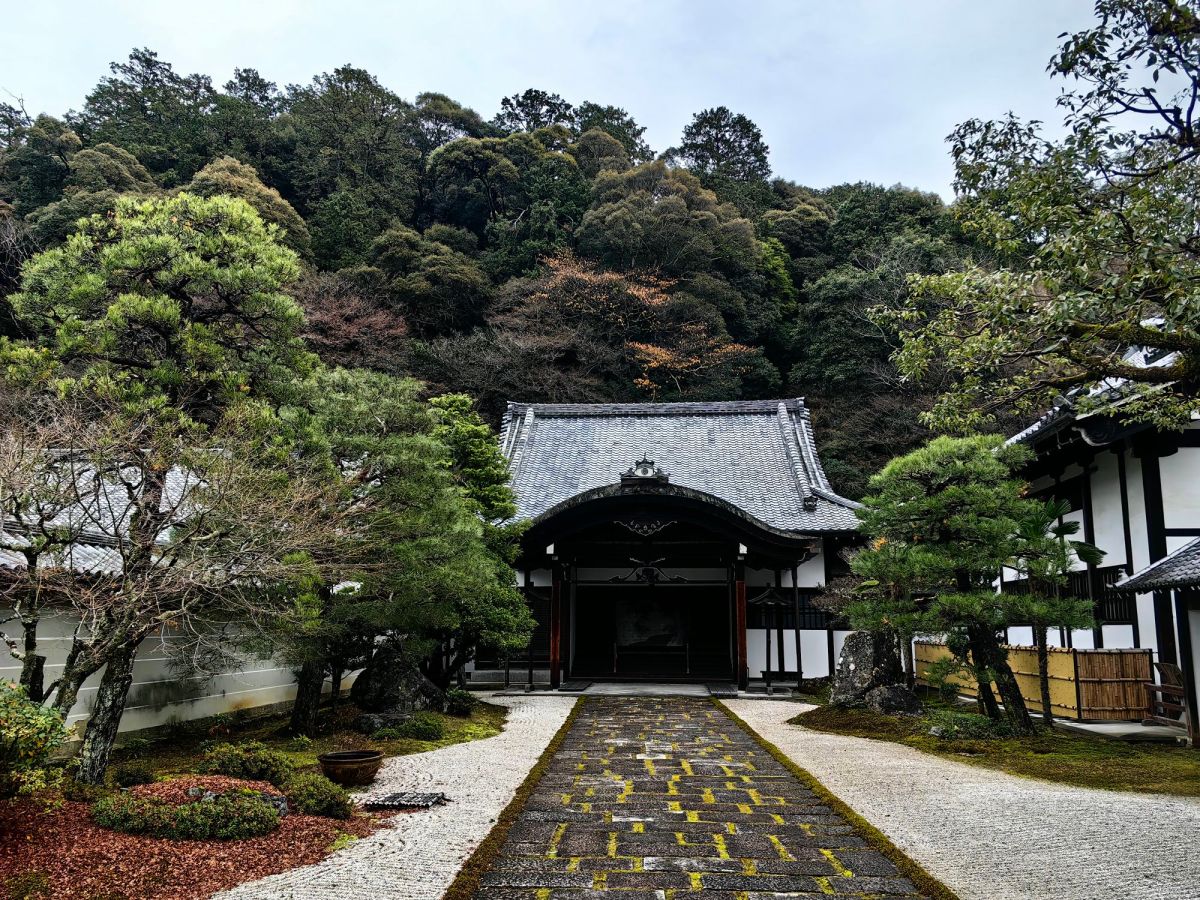
Looking back on my walk from Ginkaku-ji through the Philosopher’s Path, I felt that Nanzen-ji brought the journey to a satisfying conclusion. Throughout the day, I had encountered temples of different sizes and histories,and enjoyed the atmosphere of the quiet pathways, the gardens after rain, the fallen autumn leaves, and the feeling of moving through a landscape where nature and history had remained intertwined for centuries.
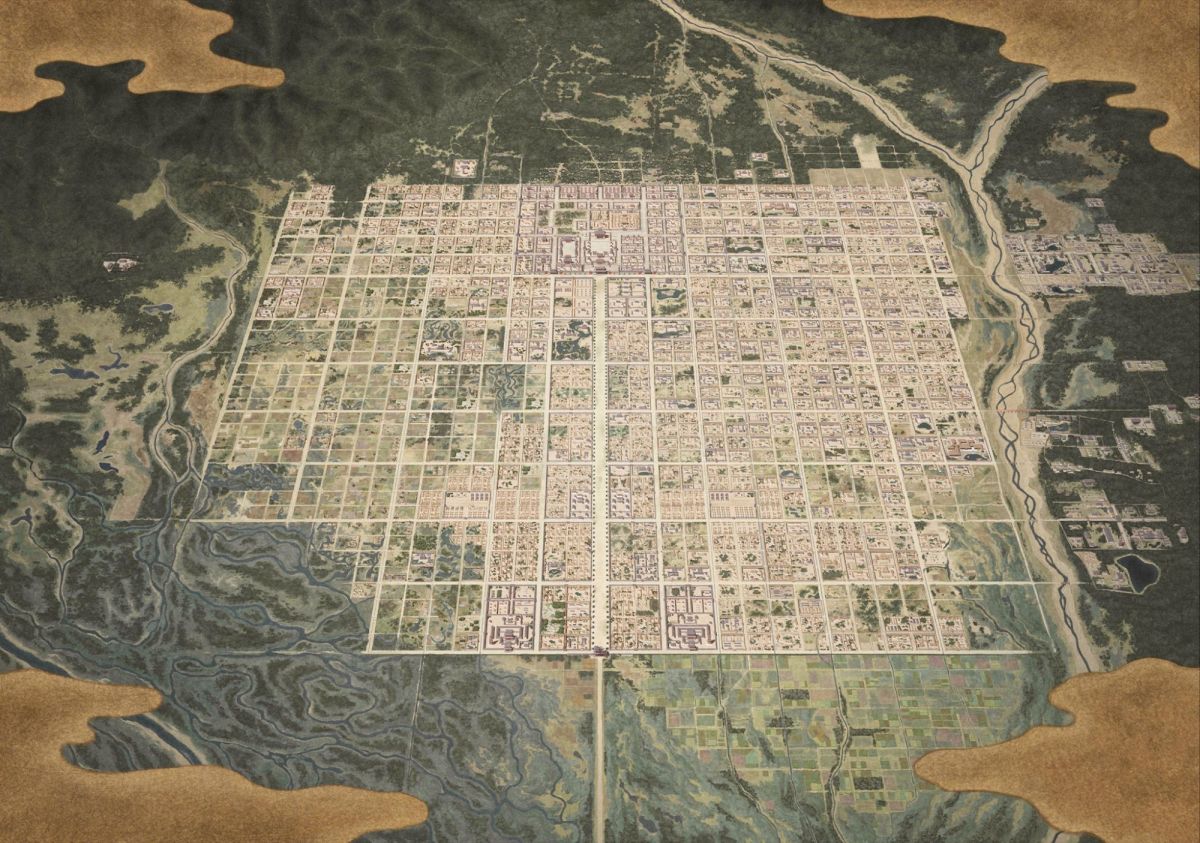
This is the map of Ancient Heian-kyō which was laid out on a planned grid inspired by the Chinese capital city model. Similar to Heijō-kyō (Nara), Heian-kyō (Kyoto) transforms Tang Chinese urban ideas to Japan. Chang’an was the major model for this north–south, east–west grid tradition. Its broad avenues regularly arranged streets and clearly defined palace district reflected the political ideals of the imperial court. I stayed in the street called Shijō which means “Fourth Avenue.” The name preserves the numbering system of the old capital’s east–west avenues. Other familiar Kyoto street names, such as Nijō, Sanjō and Gojo, carry the same historical legacy. There are so many ancient historical sites well conserved and I stayed in this city for 8 days to visit them in 5 major areas (Higashiyama, City center, North mountain, Arashiyama, and Fushimi).
I have always been fascinated by the history of Japan, and among its many periods, the Sengoku period has held a particular fascination for me. It was an age of fractured power, rival warlords, shifting alliances and almost constant warfare. The next day’s journey was planned around the people and events of the Sengoku era. Instead of simply visiting famous sights, I wanted to trace the places like the castles and temples where these figures had once lived, fought, negotiated and, in some cases, met their final fate.
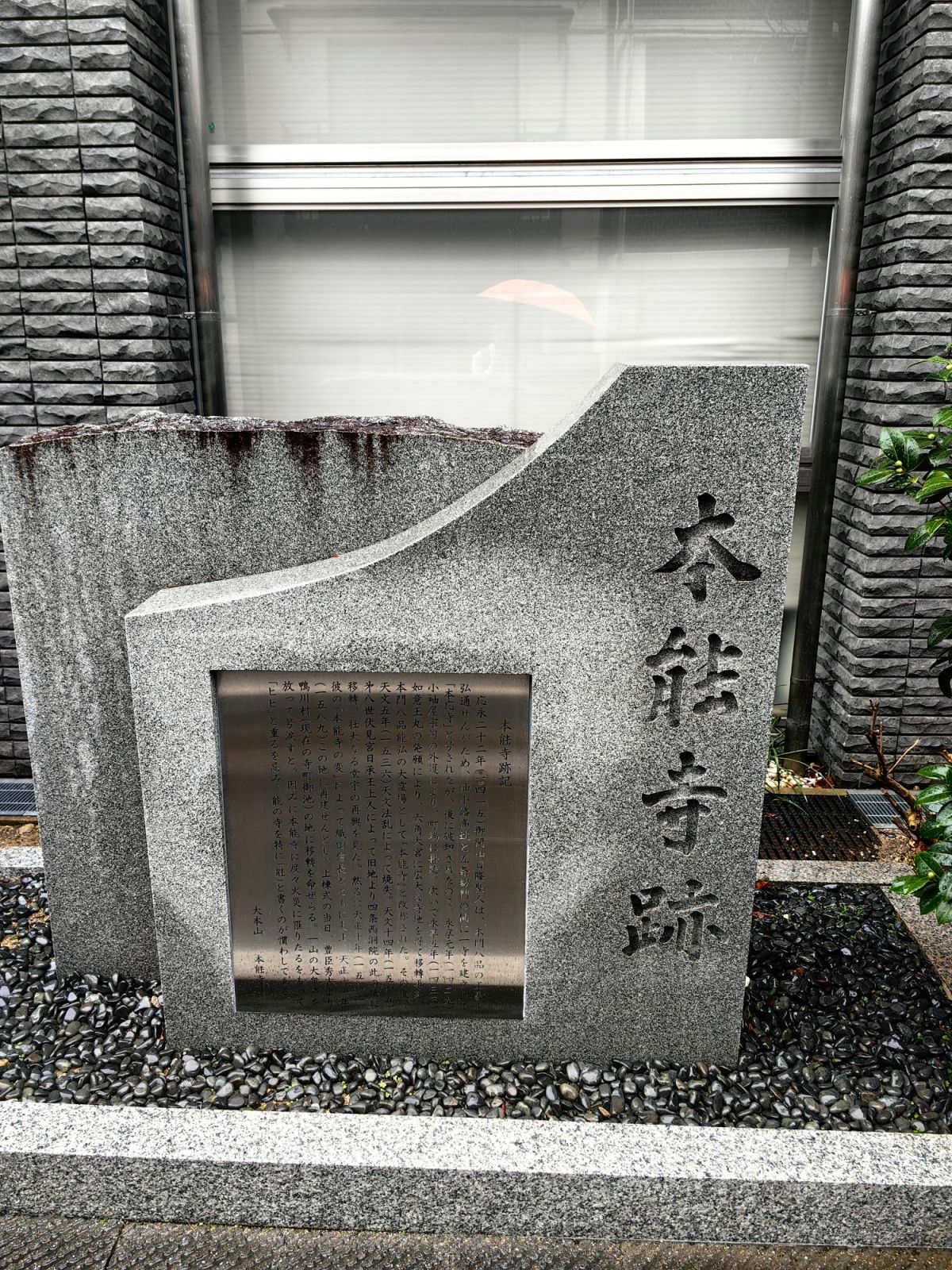
The former site of Honnō-ji is a place that today looks almost insignificant: only a stone monument remains amid the ordinary streets near my hotel. It was difficult to link this quiet neighborhood with the events that had taken place here. In 1582, this was the Honnō-ji where Oda Nobunaga died there. On the morning of June 2, Nobunaga’s trusted general, Akechi Mitsuhide, suddenly turned against him. Mitsuhide brought a large force toward Kyoto and surrounded Honnō-ji. Nobunaga had only a small number of men with him. What began as an ordinary stay at the temple became a desperate battle. Standing beside the stone marker, I tried to imagine the scene that had unfolded here more than four centuries ago: the sudden arrival of soldiers in the early morning, the sound of fighting within the temple walls, the buildings catching fire, and Nobunaga realizing that the world he had spent his life trying to unify was collapsing around him.
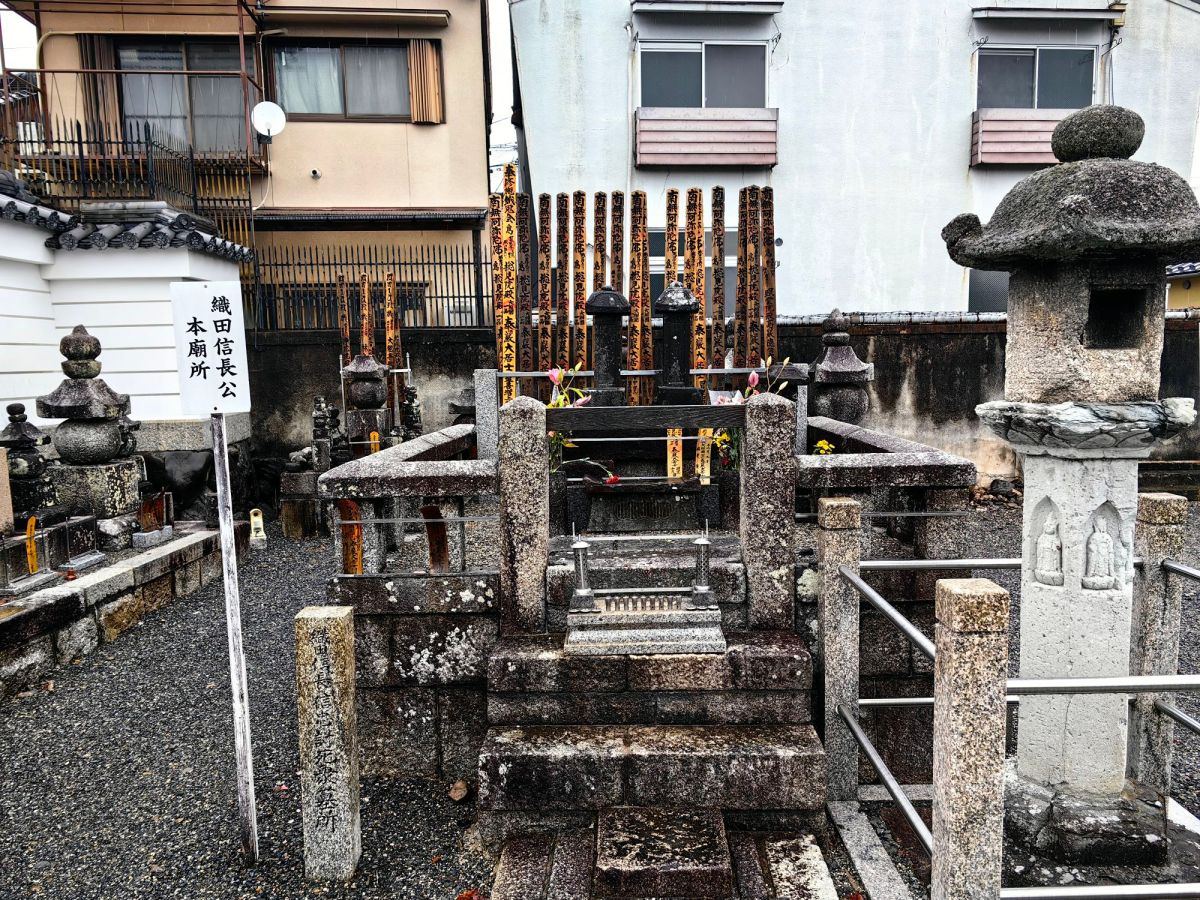
At the gravesite of Oda Nobunaga in the Amidaji Temple, I reflected on the Sengoku period. Nobunaga was the first of the three great unifiers of Japan, followed by Toyotomi Hideyoshi and Tokugawa Ieyasu. His ambition was to bring the fragmented country under a single political authority. After Nobunaga’s death, Hideyoshi moved rapidly back from western Japan, defeated Mitsuhide at the Battle of Yamazaki, and eventually took over much of Nobunaga’s political inheritance. Ieyasu would later complete the process of unification and establish the Tokugawa shogunate. So the Honnō-ji Incident was not simply the death of one warlord. It was a turning point in the chain of events that transformed Sengoku Japan into unified early-modern Japan. Standing before his grave, I was struck by the irony that a man who came so close to reshaping Japan completely never lived to see the country he sought to unite.
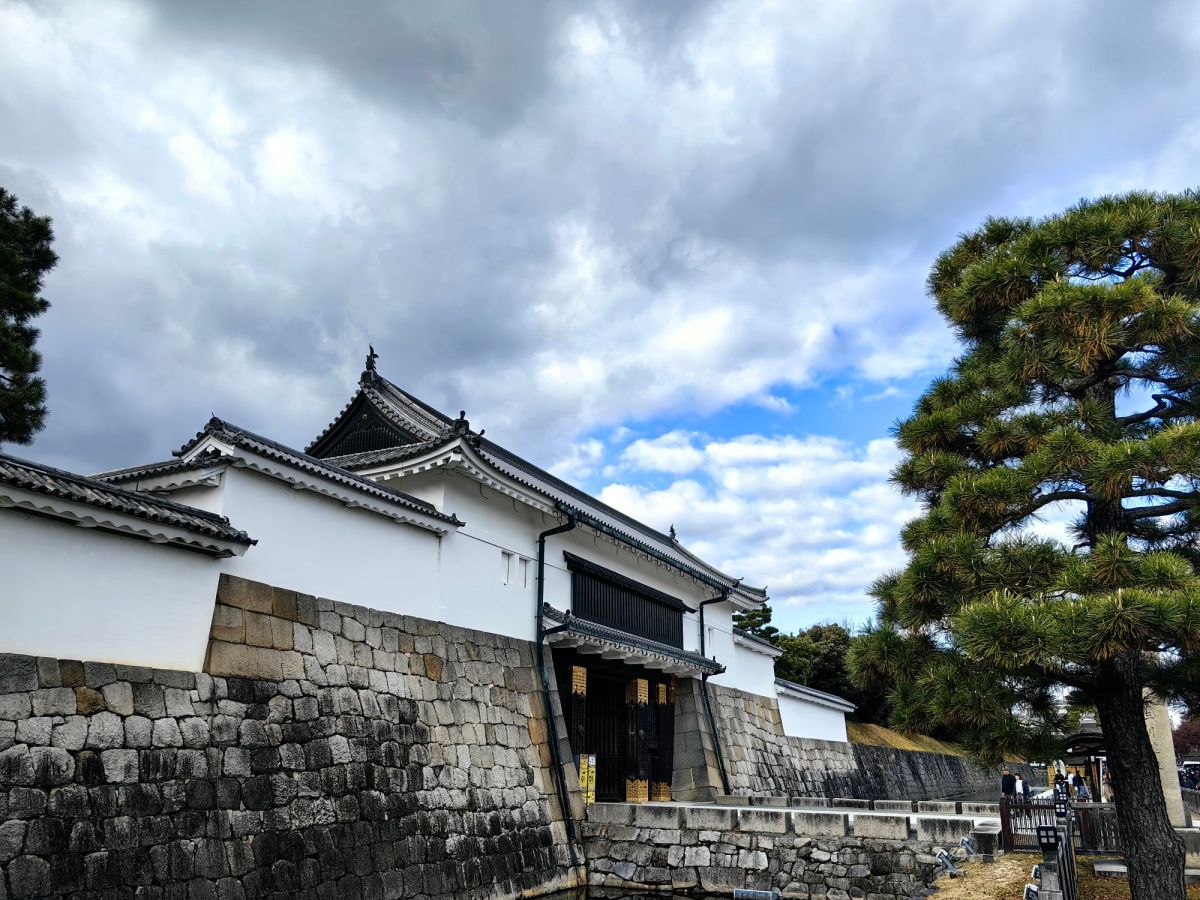
Nijō Castle stands in the heart of Kyoto as a remarkable witness to the rise and fall of shogunate governments. Although it was built in 1603, just as the country emerged from the turmoil of the Sengoku period, its history is closely connected to the great unification of Japan under Tokugawa Ieyasu. His victory at the Battle of Sekigahara in 1600 paved the way for the establishment of the Tokugawa shogunate in 1603. It was in this historical context that Nijō Castle was constructed. Commissioned by Ieyasu, it served as his residence when visiting Kyoto, the imperial capital, and as a powerful symbol of the new military government’s authority. The castle was not simply a defensive stronghold; it was also a political statement that the age of competing warlords was giving way to a new order under Tokugawa rule.
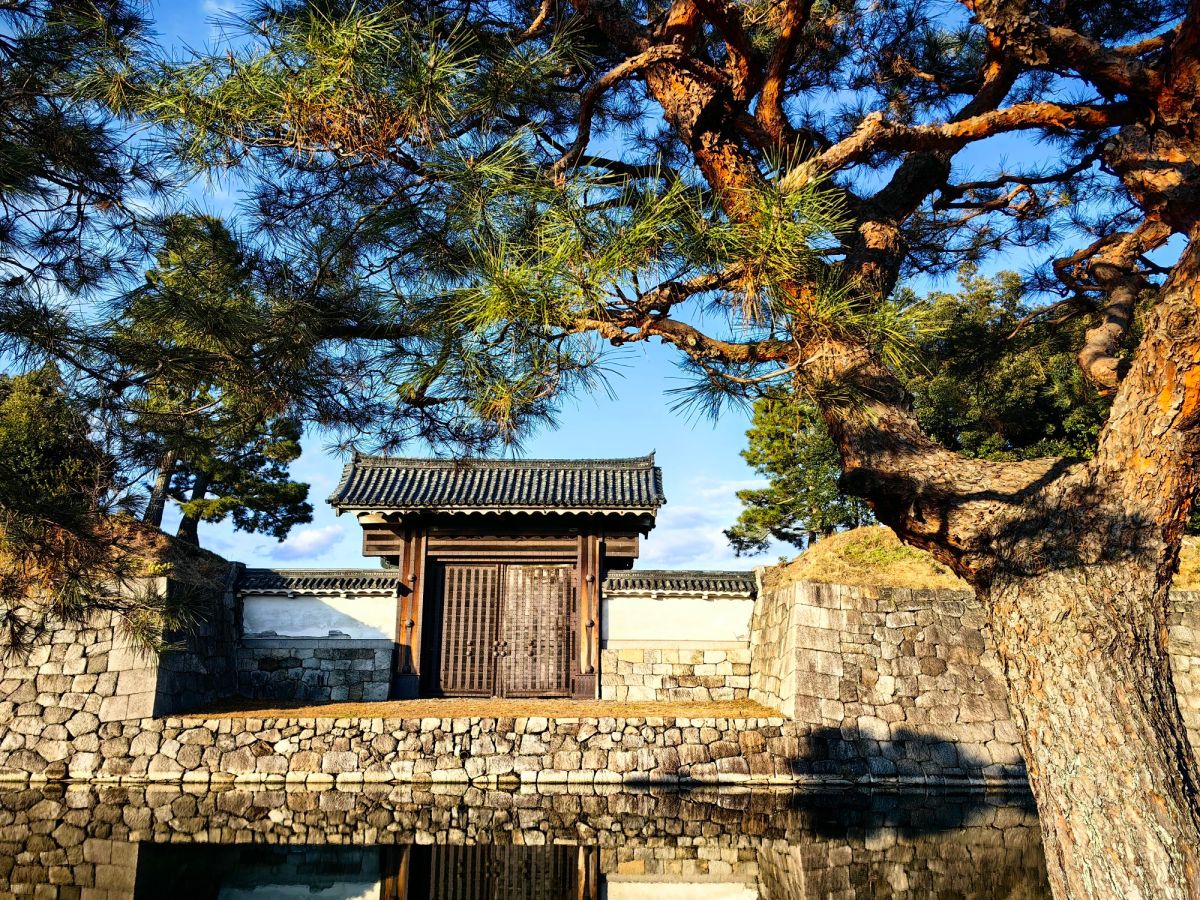
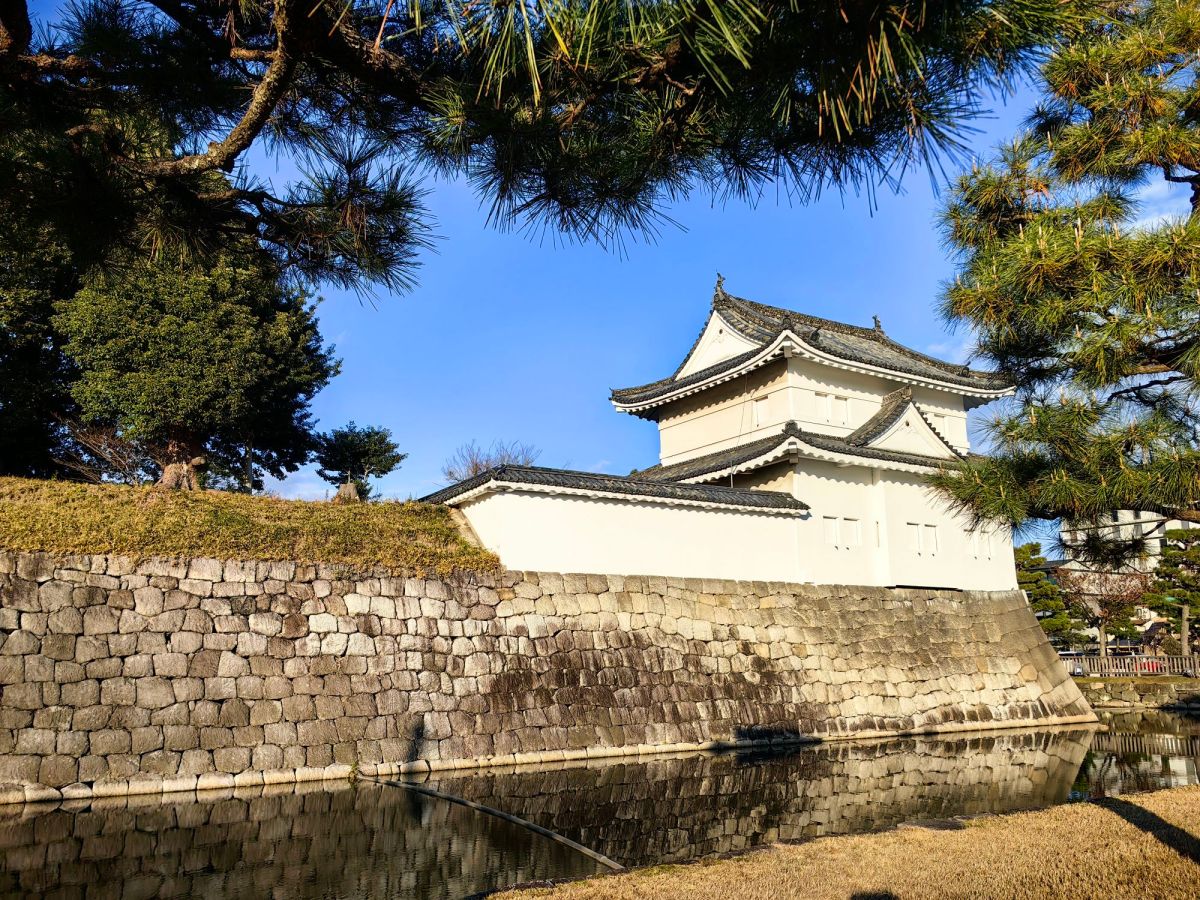
Around the castle, I first encountered its broad moats, massive stone walls and imposing gates. These features evoke the military character of the castles in the Sengoku age, when fortifications were essential to survival of each daimyo.
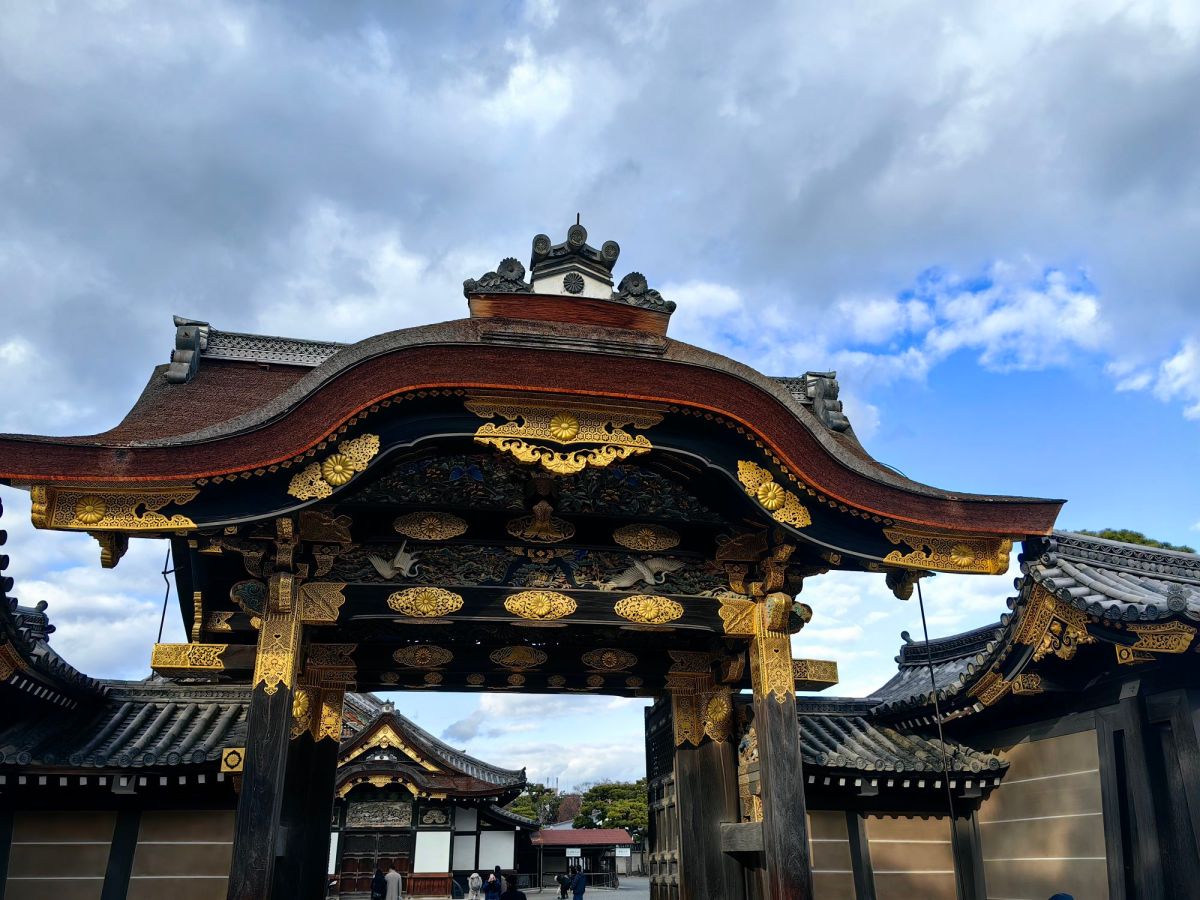
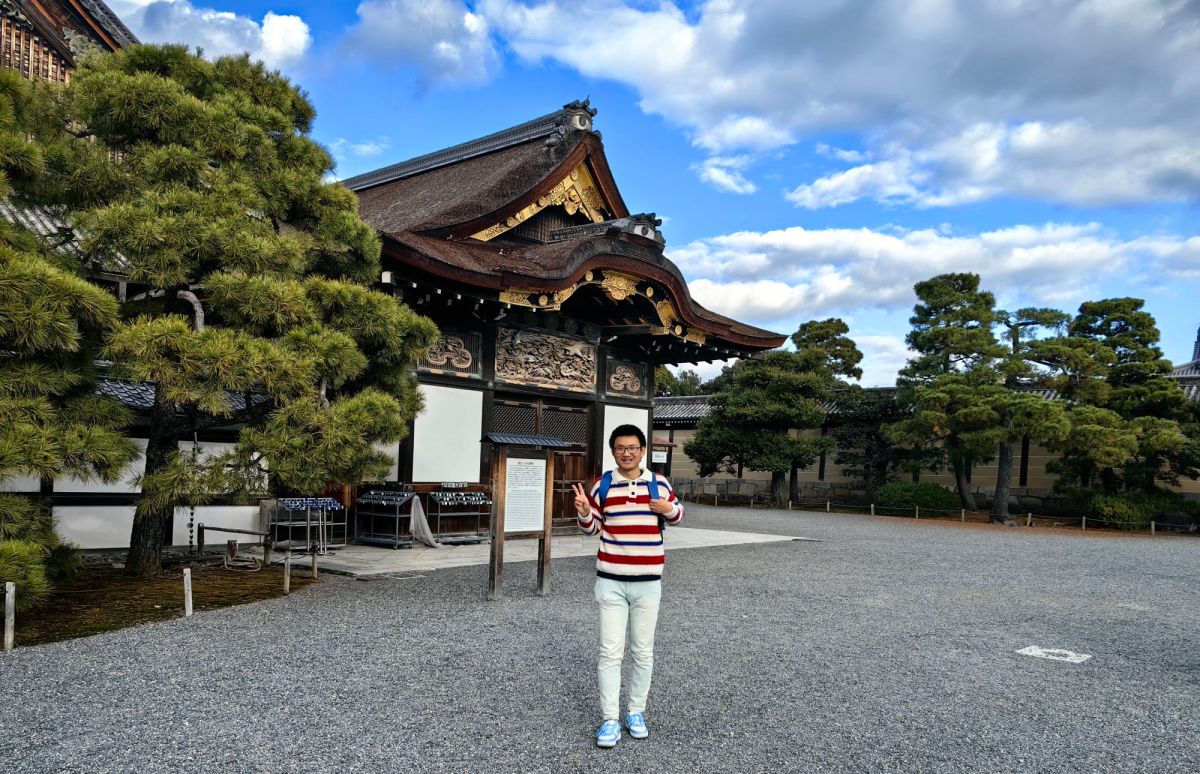
Passing through the entrance, it was the stylish Karamon Gate. It immediately stood apart from the austere, heavily fortified gates often associated with Japan’s Sengoku-era castles. Its gracefully curved karahafu roof, dark wooden framework, golden fittings, and intricate carvings of flowers, birds, and mythical creatures give it an unusually elegant and lavish appearance. Rather than expressing power through sheer military strength, the gate conveys the prestige and refinement of the Tokugawa shogunate through craftsmanship, ornament and ceremony. As the grand entrance to the Ninomaru Palace, it was not simply a functional gateway but a carefully designed statement of authority.
The Ninomaru Palace is the heart of Nijō Castle and one of the finest surviving examples of early Edo-period palace architecture. The palace consists of a series of interconnected wooden buildings, with long corridors leading through rooms decorated with gold-leaf sliding doors, elaborate painted screens, carved transoms and magnificent images of pine trees, birds, tigers and other auspicious motifs.
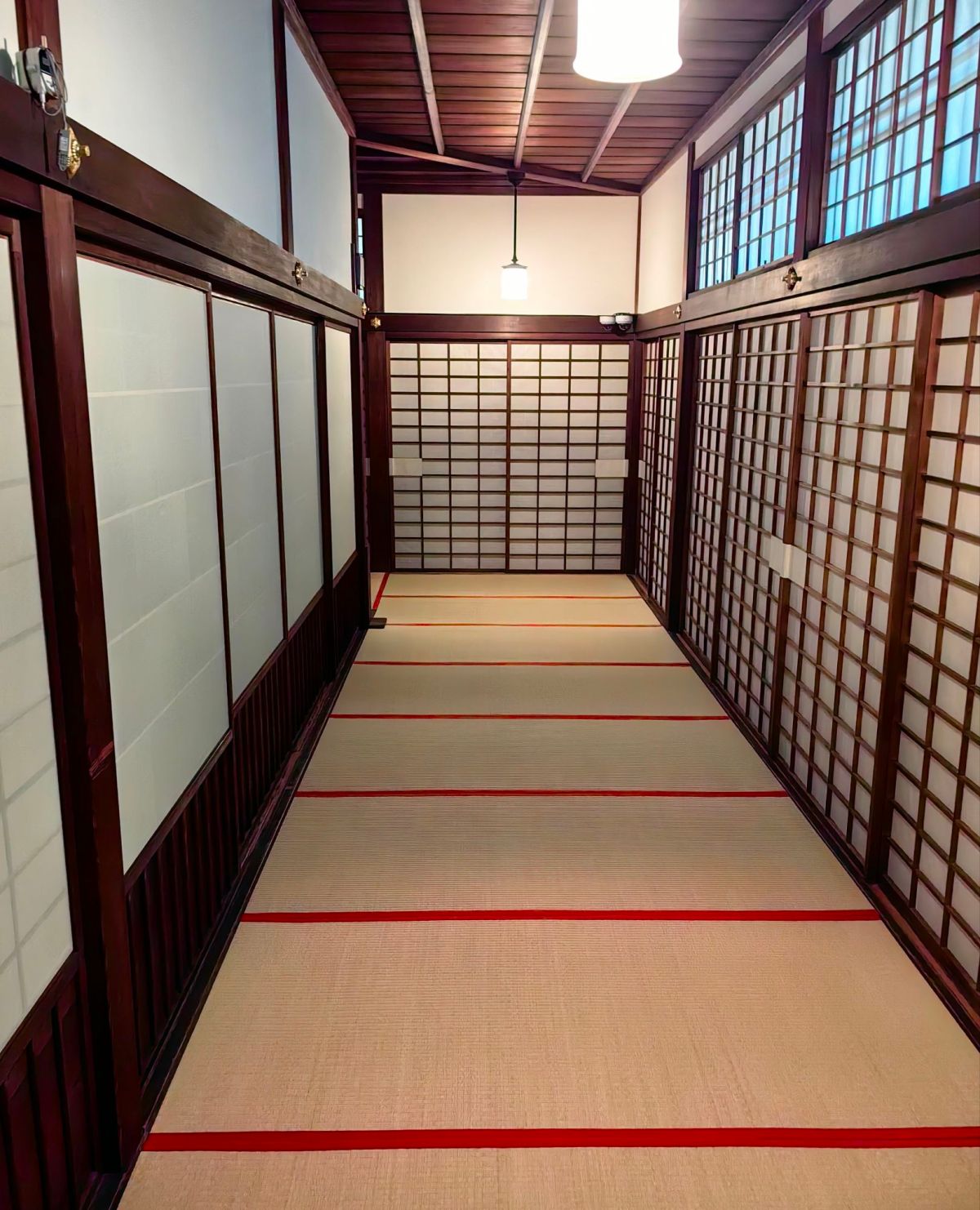
The interiors become progressively more formal with many reception rooms where the shogun received important visitors and conducted political affairs. Visitors must take off shoes to visit them. One of the most memorable features is the nightingale floor, whose wooden boards produce a characteristic squeaking sound when walked upon. Originally serving as a practical security measure, it also gives the palace a distinctive atmosphere: even in the quiet corridors, the building seems to respond to your footsteps.
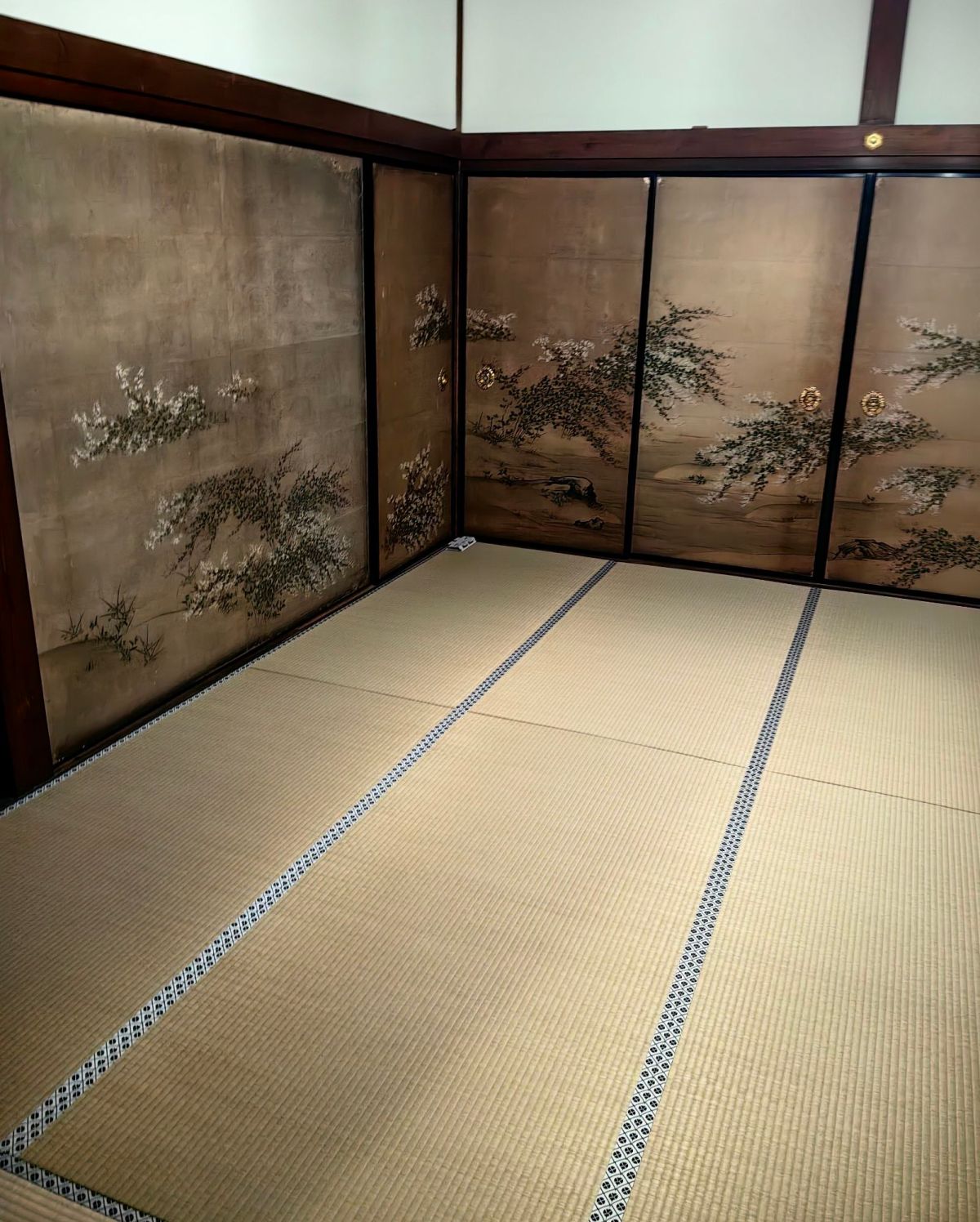
The rooms are richly decorated in a style that reflects refined taste of the Tokugawa shogunate. The walls are covered with gold-leaf sliding doors and painted screens, creating a warm, luminous atmosphere, while large compositions of pine trees, bamboo, plum blossoms, tigers, hawks, and other auspicious subjects unfold across the panels. The paintings were largely produced in the Kanō-school tradition, characterized by bold forms, strong outlines, and carefully controlled compositions that could be appreciated from across the spacious rooms.
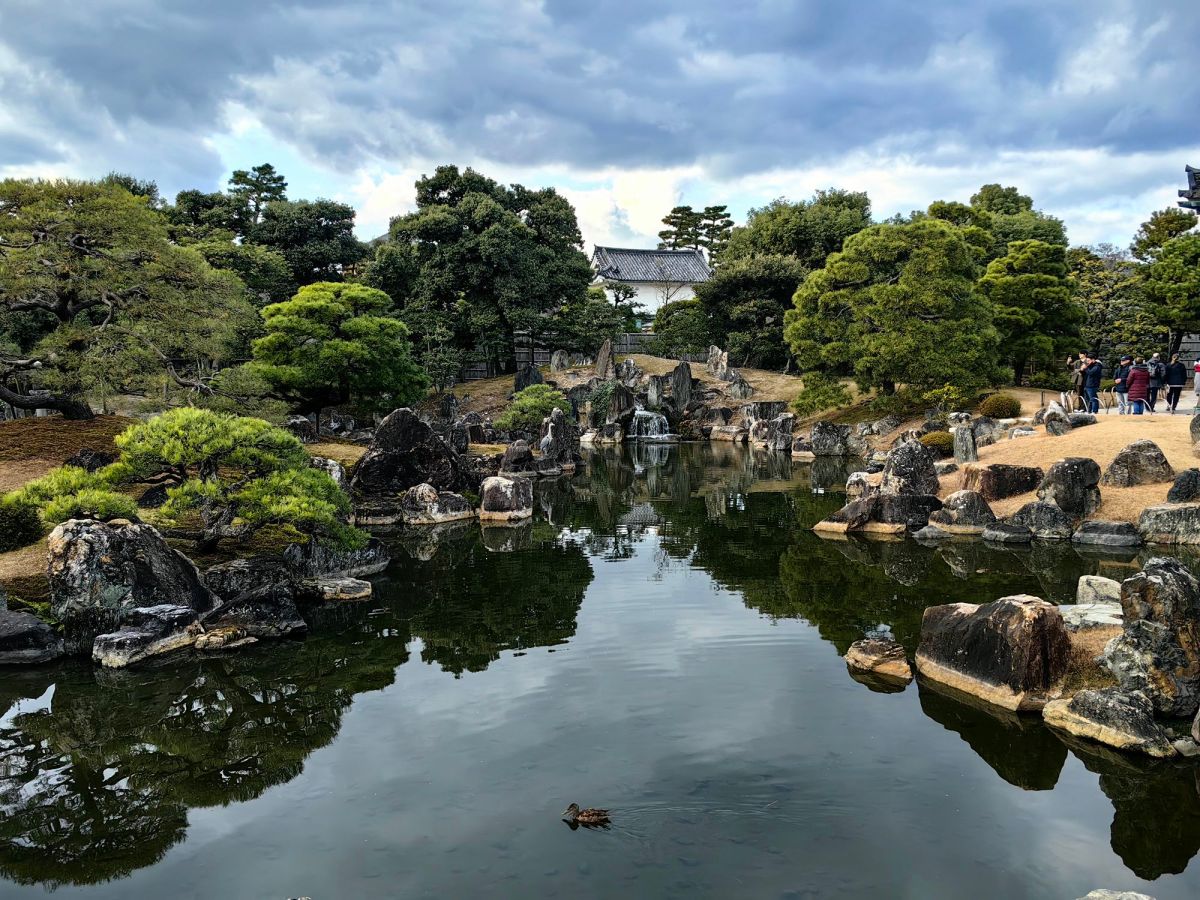
The Ninomaru Garden lies beside the Ninomaru Palace. Designed in the shoin-style garden tradition, it centres on a large pond scattered with carefully placed islands and rocks, surrounded by old pine trees, stone lanterns, and precisely arranged vegetation. From the palace, the garden unfolds as a carefully composed landscape rather than a natural wilderness: every rock, tree, and curve of the shoreline has its place. What I found especially beautiful was the balance between formal design and natural scenery.
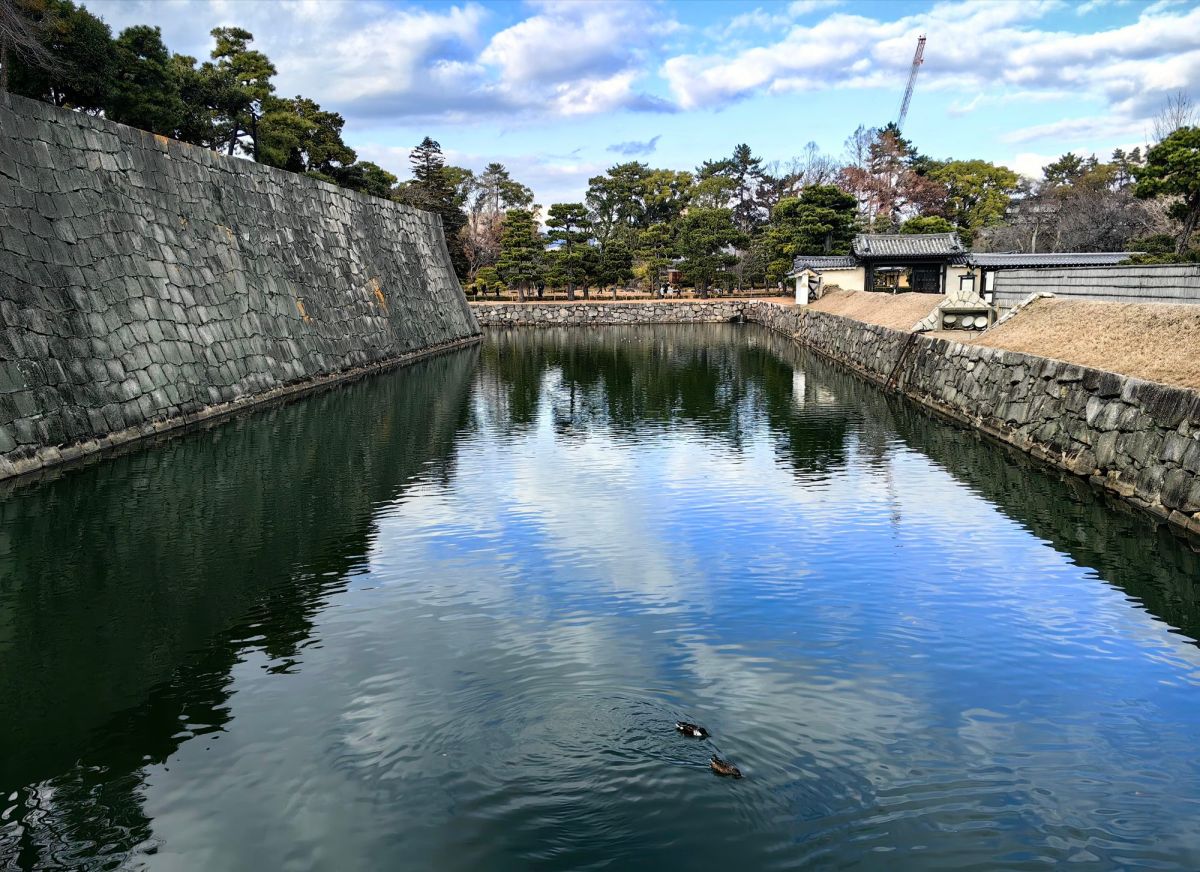
Most Japanese castle includes structures like Ninomaru, Honmaru, and Tenshukaku. Honmaru literally means “main circle/enclosure.” It was generally the most important and most heavily protected part of the castle, including the lord’s main residence and important administrative spaces. Ninomaru means “second enclosure.” It surrounded or protected the Honmaru and often had a mixture of residential, administrative, ceremonial and defensive functions. The Tenshukaku, usually called the castle keep is generally a tall, heavily fortified structure located within the Honmaru. Its functions included observation and defense. In this photo, the Honmaru is protected by successive walls and moats which separate it from Ninomaru.
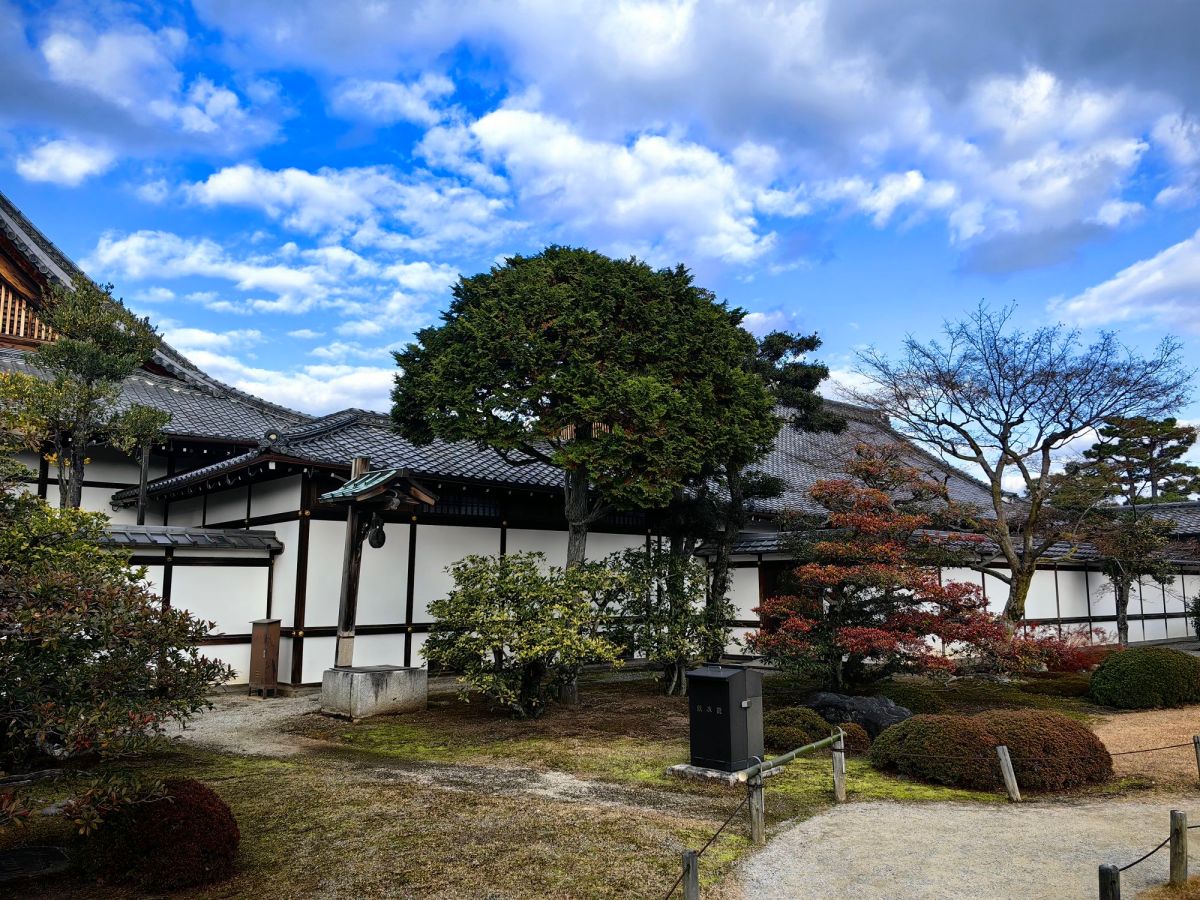
I think the Honmaru Garden offers a quieter landscape than the grander Ninomaru Garden. Located within the castle’s innermost enclosure, the garden is characterized by its open lawns, carefully arranged trees, gently undulating ground. Rather than centering on a large ornamental pond filled with islands and bridges, it has a more spacious, restrained appearance, allowing the greenery and surrounding architecture to define the scenery. Today, the garden feels less like a battlefield stronghold and more like a peaceful retreat within the historic castle grounds, where trees, open space and architectural remnants quietly recall the transformation of Japan from the age of the Sengoku warlords to the modern era.
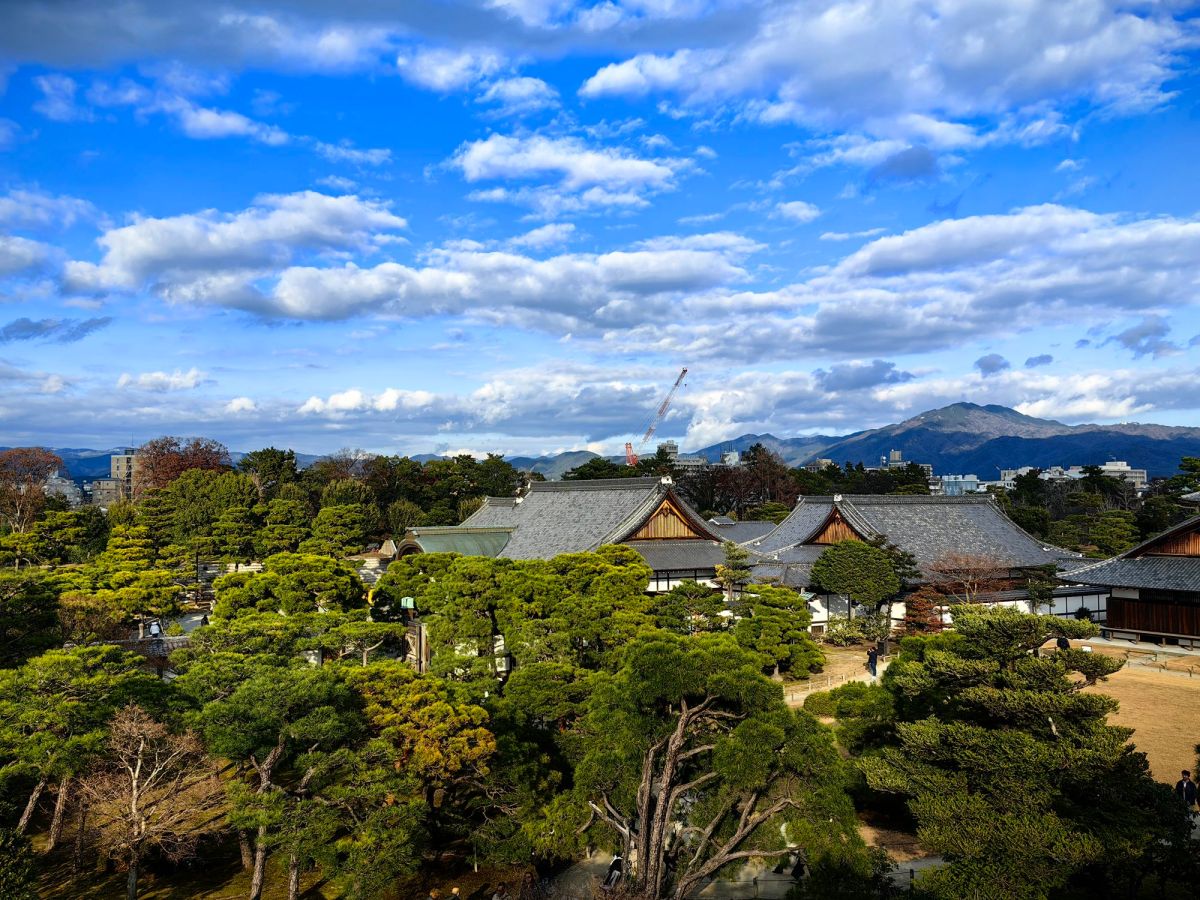
Standing atop the Ruins of the Tenshukaku, I was rewarded with a fantastic panoramic view of the Honmaru grounds. From this elevated vantage point, the inner enclosure unfolded below me, with its spacious greenery, carefully arranged trees, and traditional buildings set against the surrounding cityscape.
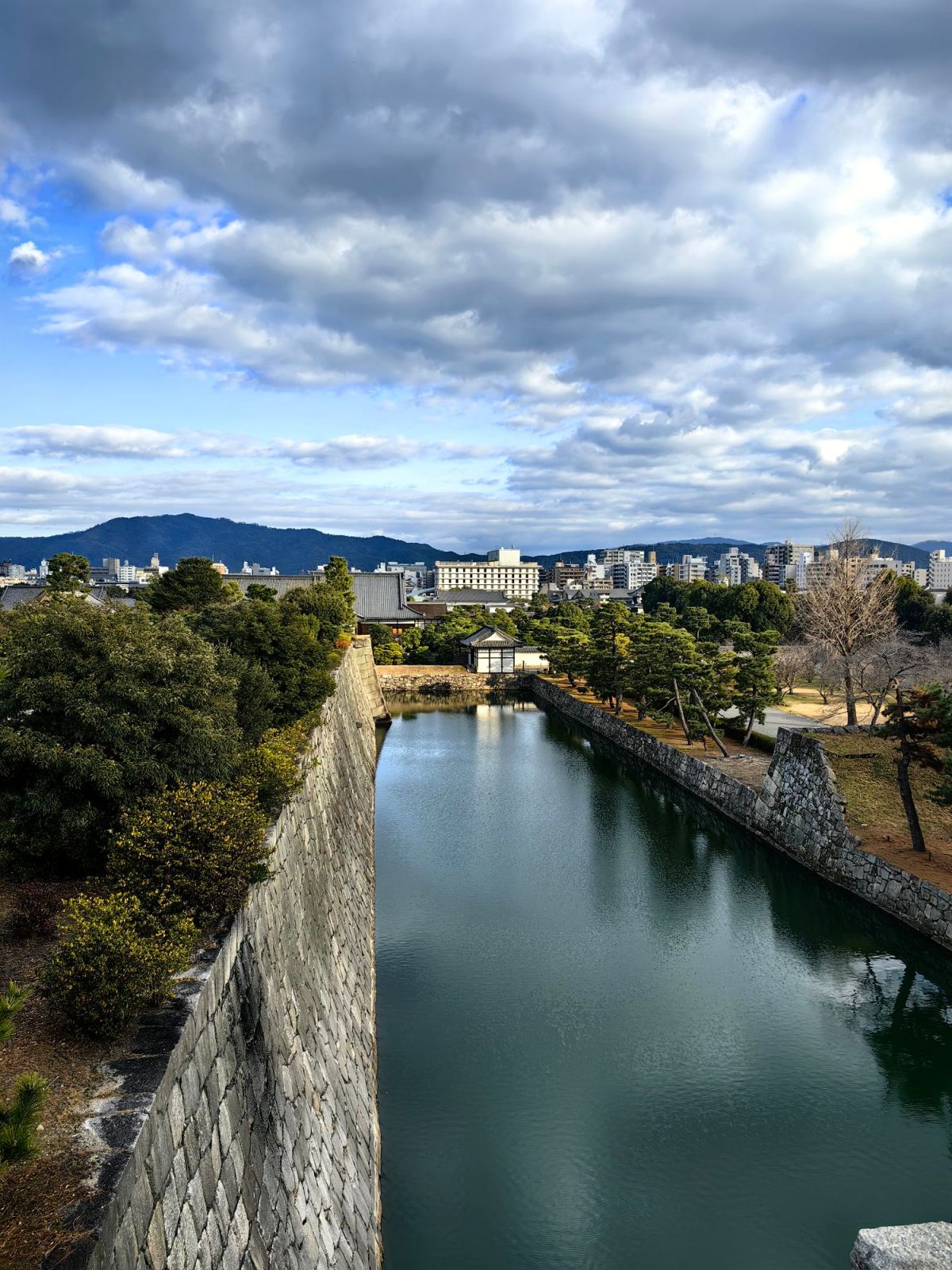
The contrast between the tranquil castle grounds and the urban landscape beyond the walls was particularly striking, as if two different eras of Kyoto existed side by side. It was easy to imagine how this elevated position once served as a strategic observation point, allowing the castle’s defenders to survey the surrounding area. Today, however, the view offers something quite different: a chance to appreciate the scale and layout of Nijō Castle from above, and to reflect on its history. Although the original Tenshukaku no longer stands, the remaining stone foundation preserves the memory of the castle’s former grandeur. Looking out across the Honmaru, I could almost trace the layers of history embedded in the landscape, from the turbulent age of the Sengoku period to the peaceful centuries of Tokugawa rule.
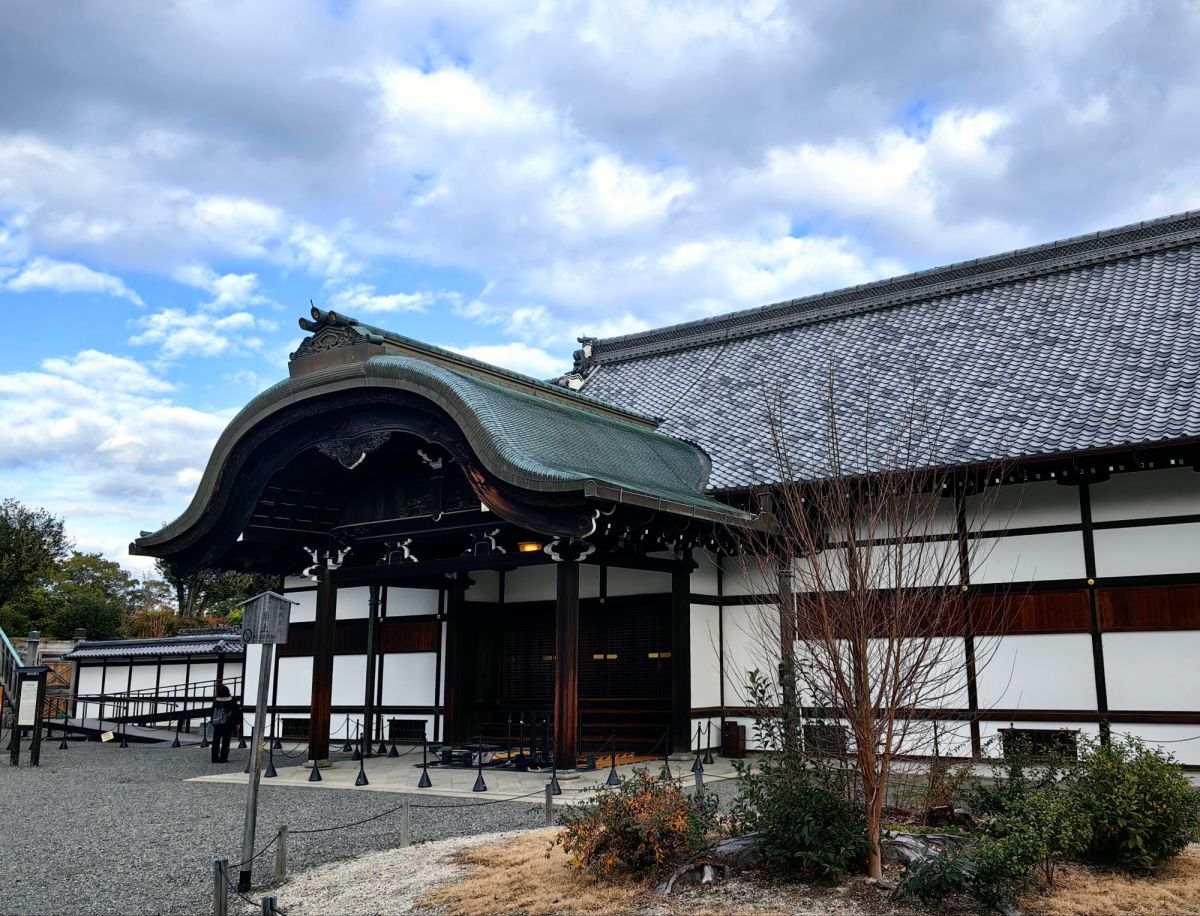
The Honmaru-goten Palace which is the most important building however looks surprisingly modest compared with the magnificent Ninomaru Palace. Its understated appearance, characterized by traditional wooden walls, tiled roofs and simple architectural lines, gives it the feeling of a quiet Japanese aristocratic residence rather than an imposing shogun’s palace. The present building was originally part of the Kyoto Imperial Palace before being transferred to Nijō Castle. Its relatively restrained design reflects the refined residential architecture associated with the imperial court, rather than the overt display seen in the Ninomaru Palace.
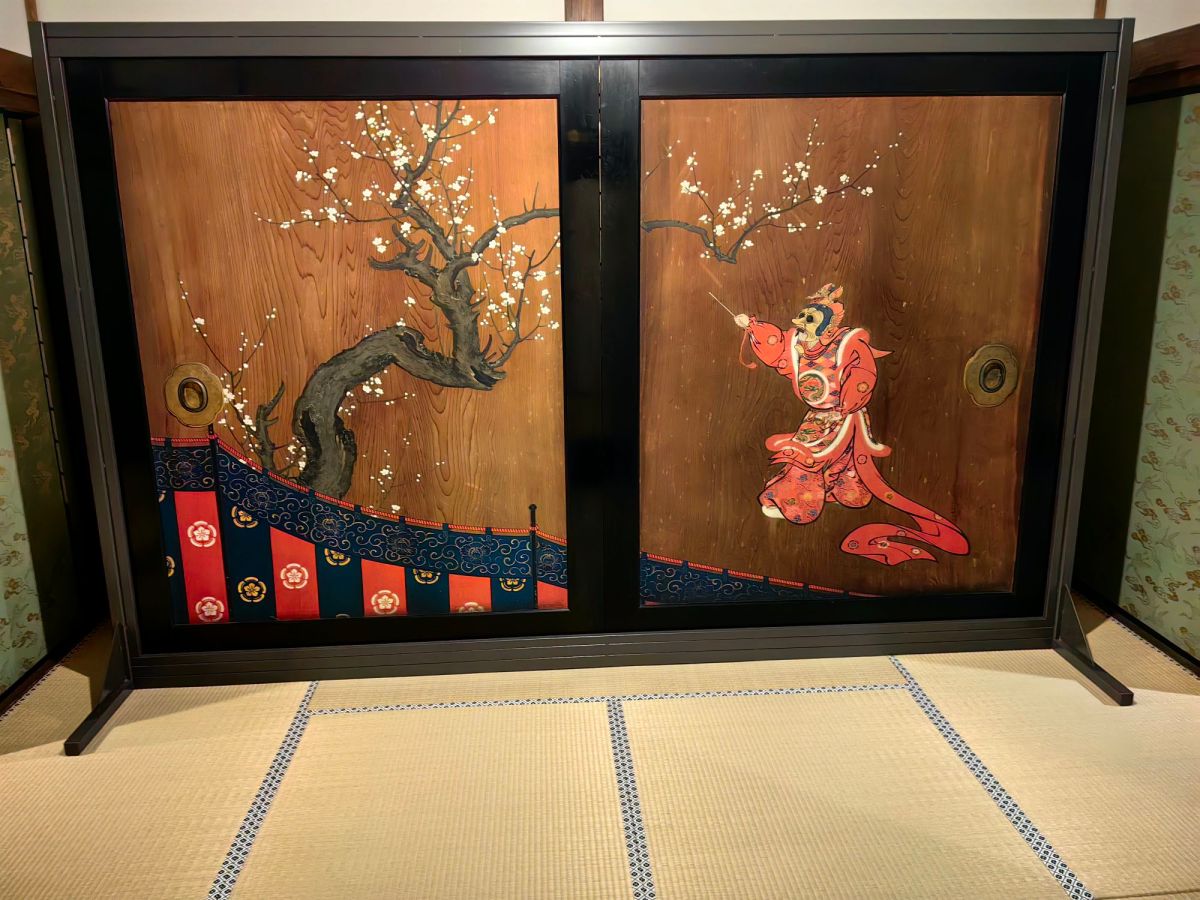
The rooms inside the Honmaru-goten Palace are characterised by a restrained elegance. Traditional tatami mats cover the floors, while wooden frames and sliding fusuma doors divide the rooms into flexible living and reception spaces. This simplicity gives the rooms a calm, residential atmosphere, reflecting the palace’s origins as part of the Kyoto Imperial Palace.
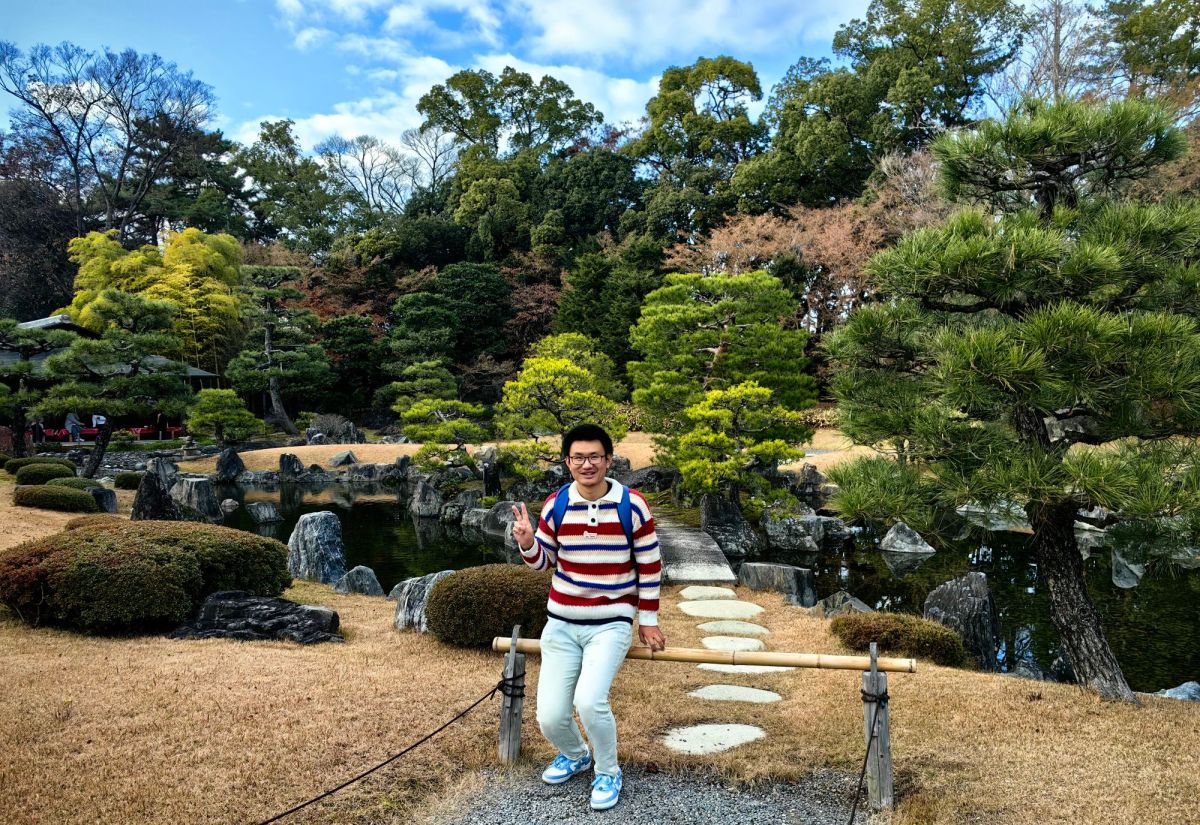
Before I left the castle, I visited the Seiryu-en Garden. Created in 1965, it combines traditional Japanese garden design with elements of a Western-style landscape, bringing together a tranquil pond, carefully arranged rocks, stone lanterns, trees and open lawns. Two historic tea houses lend the garden a sense of understated elegance, while stepping stones and winding paths invite visitors to explore the landscape at a leisurely pace.
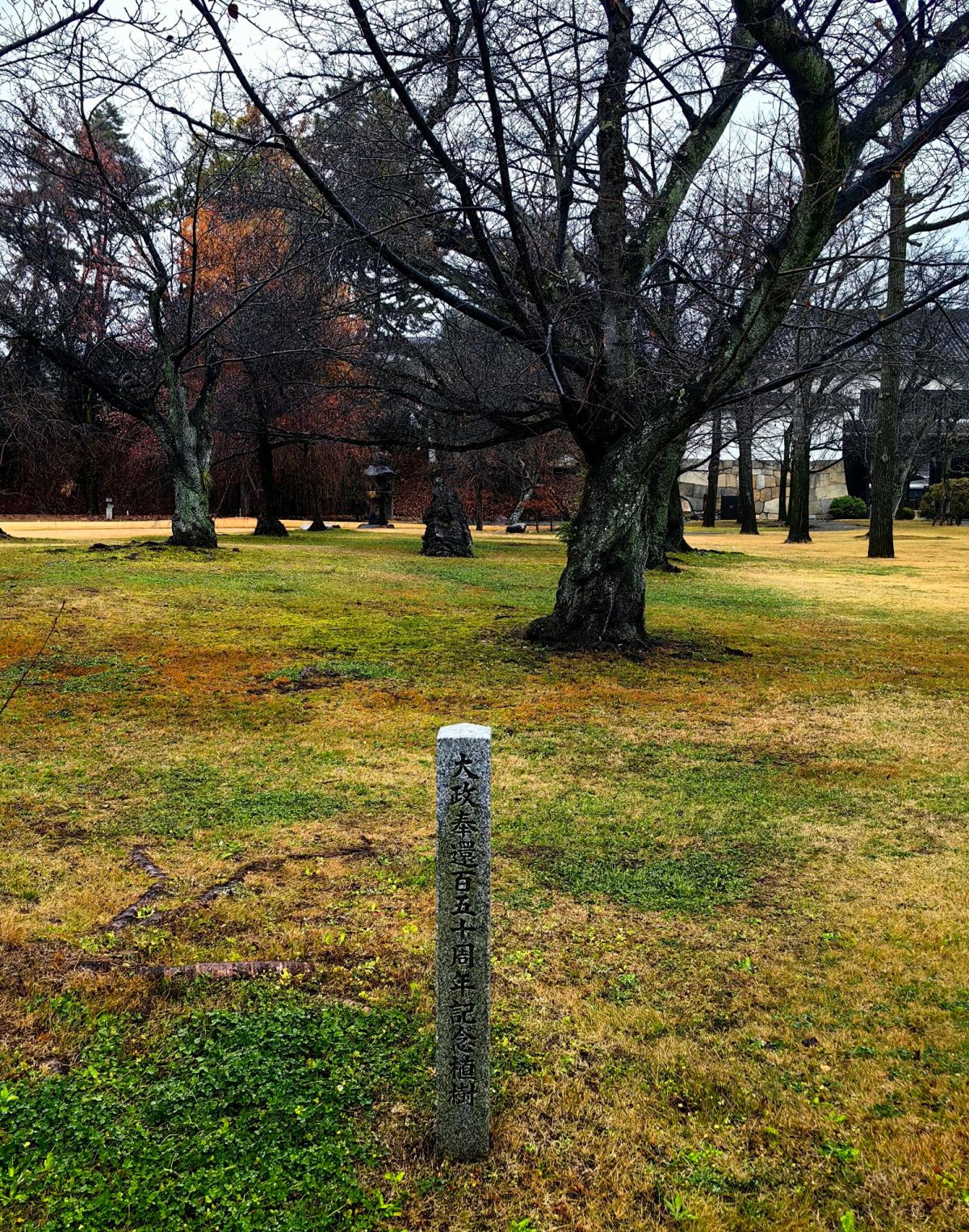
Inside the garden, I found a commemorative tree in the garden recalling Taisei Hōkan, the historic event of 1867 when Tokugawa Yoshinobu, the fifteenth and final Tokugawa shogun, announced his decision to return political authority to the imperial court. The event took place in the Ninomaru Palace and marked a decisive turning point in the decline of the Tokugawa shogunate, bringing to a close more than two and a half centuries of Tokugawa rule. The tree serves as a quiet living reminder of this momentous transition, connecting the peaceful garden with the political upheaval that reshaped Japan. Standing beneath its branches, it is striking to reflect on how Nijō Castle, once a symbol of the shoguns’ power after the Sengoku period, also witnessed the end of their government.
To me, Nijō Castle is an excellent place to understand the history of the Tokugawa shogunate and the lives of the powerful rulers who governed Japan during the Edo period. It is a historical landmark where the rise, glory, and eventual decline of the Tokugawa shogunate can be traced through the buildings and landscapes that remain today.
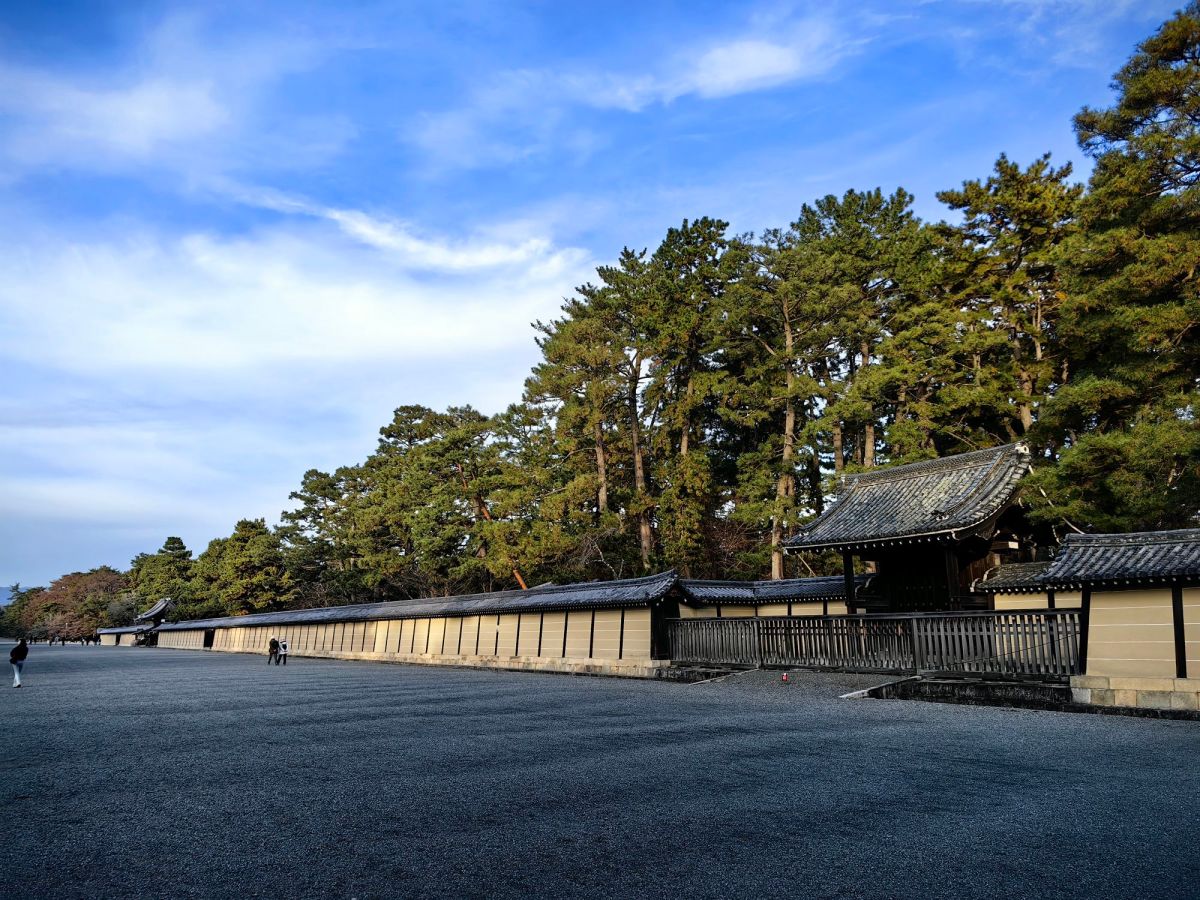
In the north of Nijō Castl, it is the Kyoto Imperial Palace. After Emperor Kanmu moved the capital to Heian-kyō in 794, Kyoto then became the home of the imperial court for over a thousand years. The present site became the permanent imperial residence in 1331 until Emperor Meiji travelled to Tokyo in 1868. Nowadays this is a very large area like a city garden surrounded by walls. Behind the long earthen walls stretched an expansive landscape of gravel courtyards, enormous pine trees, quiet gardens and traditional wooden buildings. Everything seemed spacious and dignified.
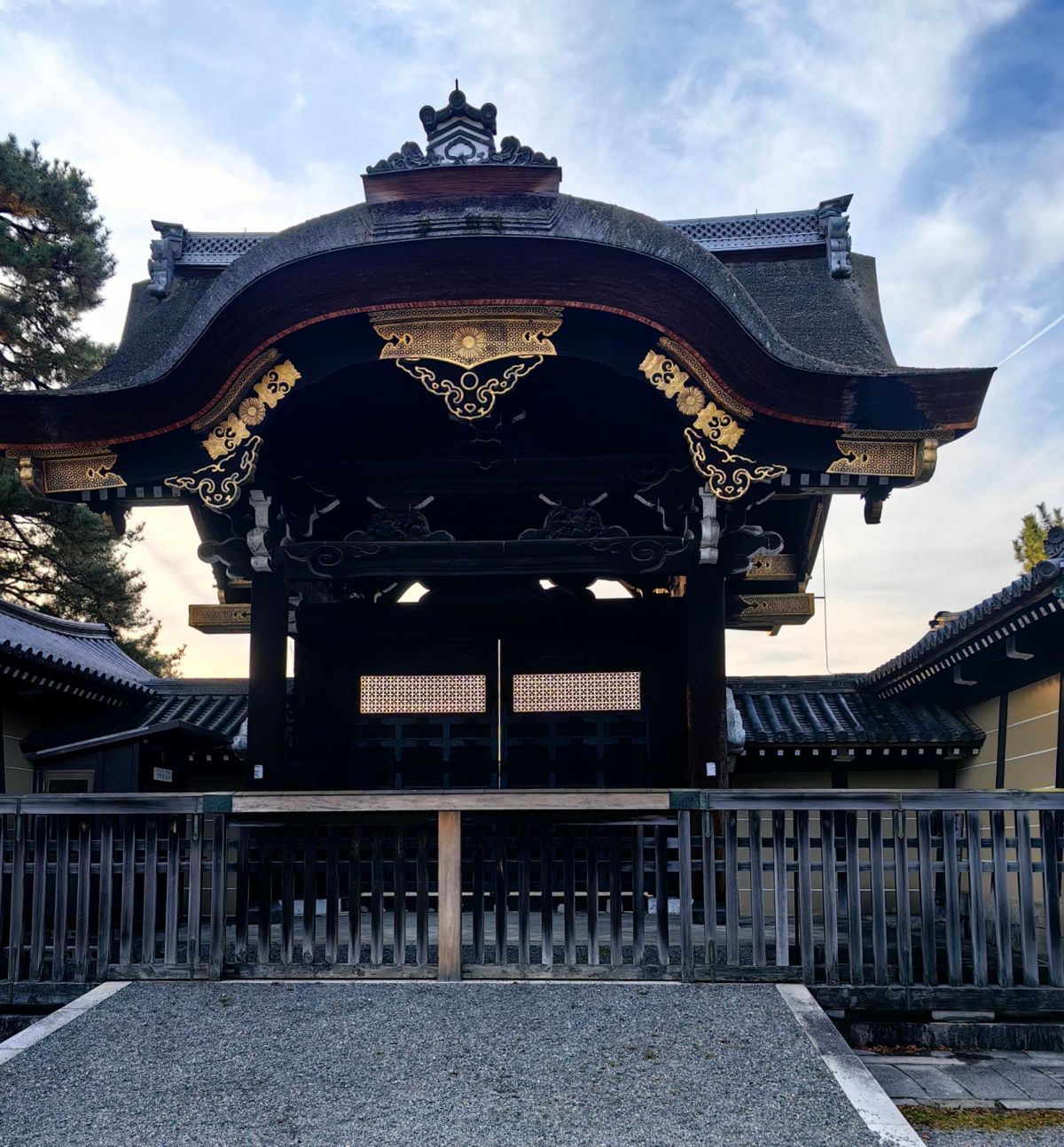
The imperial palace is free to visit. Before the visit, the first thing that caught my attention was the imposing dark wooden gate. Its massive timber frame and deep black-brown color stood in sharp contrast to the surroundings. The broad tiled roof curved gently downward at the edges, giving the gate a martial appearance. From a distance, it almost reminded me of a traditional samurai helmet, with its wide brim and dark, protective form. It was the gateway to the world of the Imperial Court. The heavy wooden doors, carefully proportioned roof and restrained decoration conveyed authority without the need for elaborate ornament.
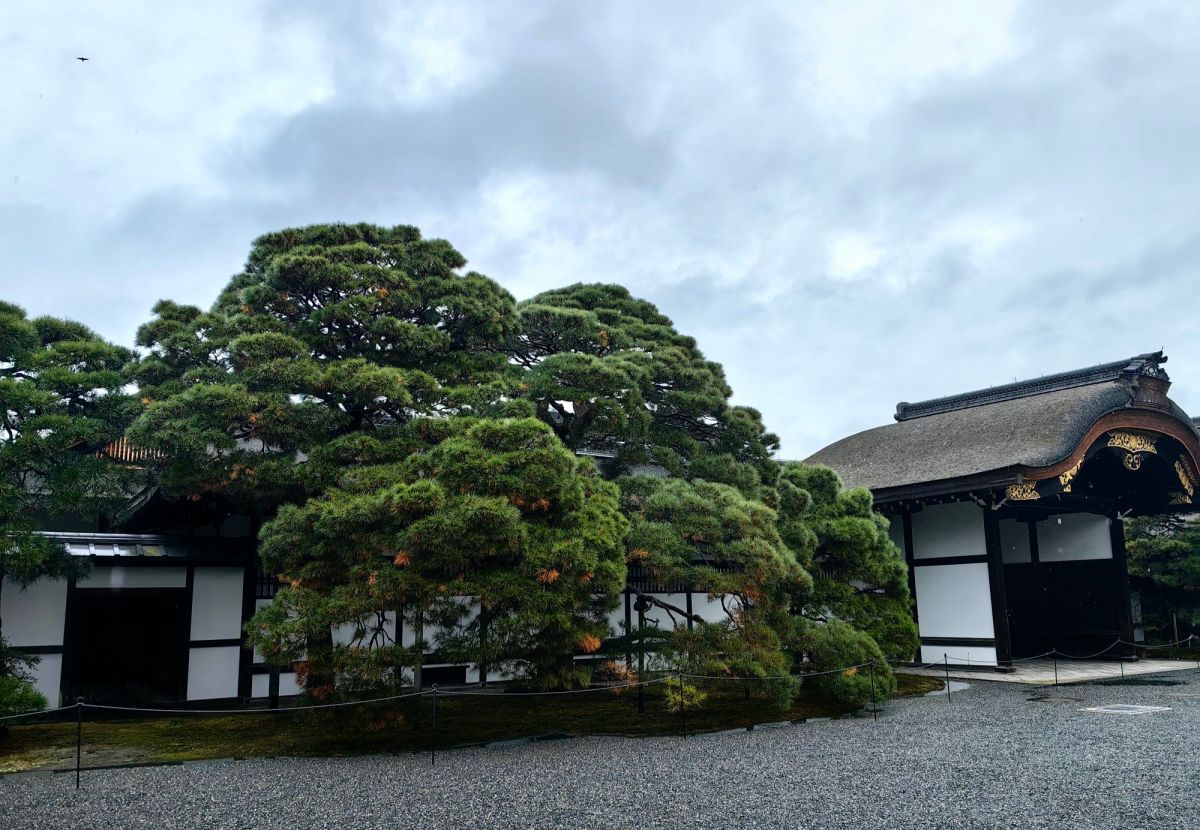
I followed the visitor route deeper into the Kyoto Imperial Palace. The atmosphere immediately became more formal. Broad gravel courtyards opened between long wooden buildings, while carefully maintained pine trees and gardens softened the strict geometry of the palace grounds. Unlike a European palace filled with grand rooms and elaborate furnishings, the Kyoto Imperial Palace revealed its character largely through its architecture, courtyards and gardens.
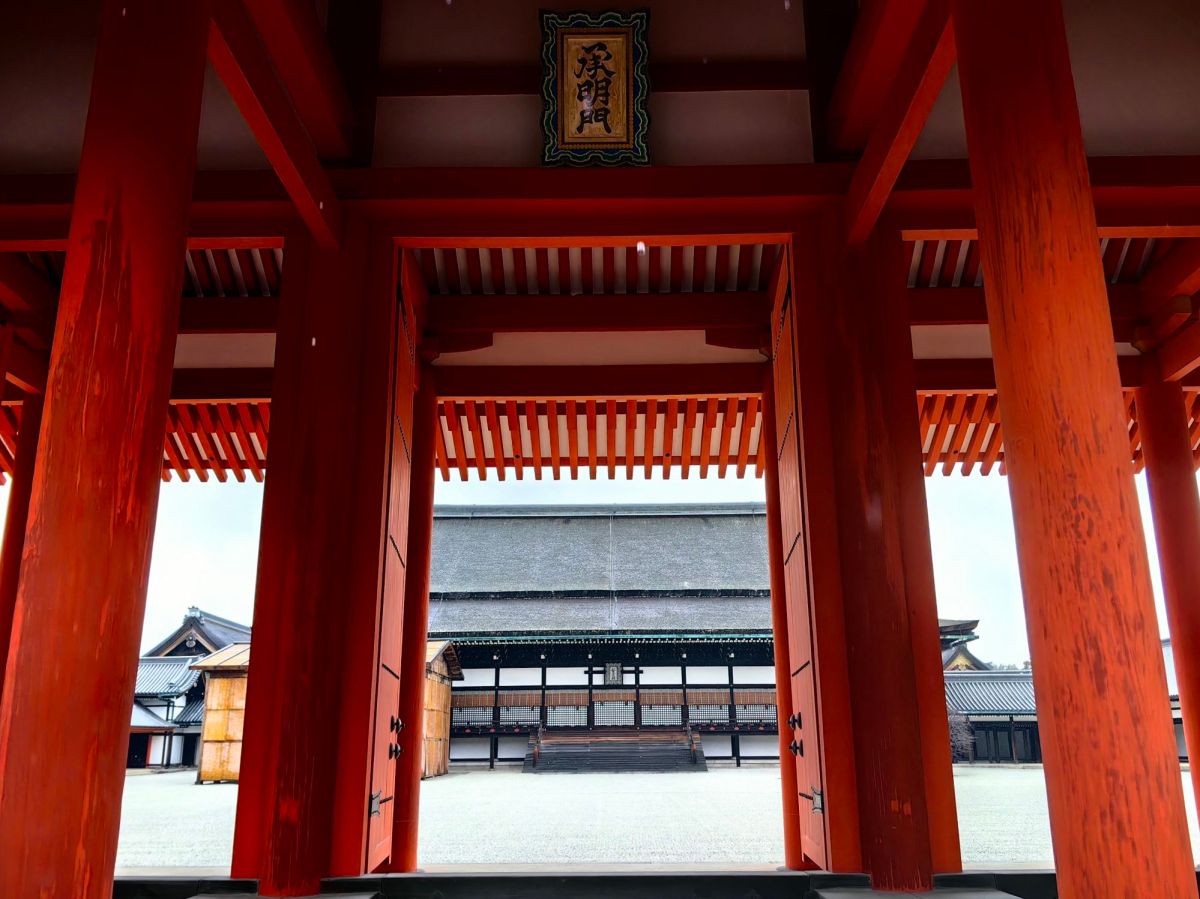
The first important area was the Shishinden, the Hall for State Ceremonies. Standing before its broad wooden façade, I could imagine the formal ceremonies of the imperial court taking place here. The enormous gravel courtyard in front of the hall created a remarkable sense of space and ceremony. From the visitor path, I could look towards the building from the Jomei-mon Gate but could not simply walk inside; the interiors remain largely closed to ordinary visitors.
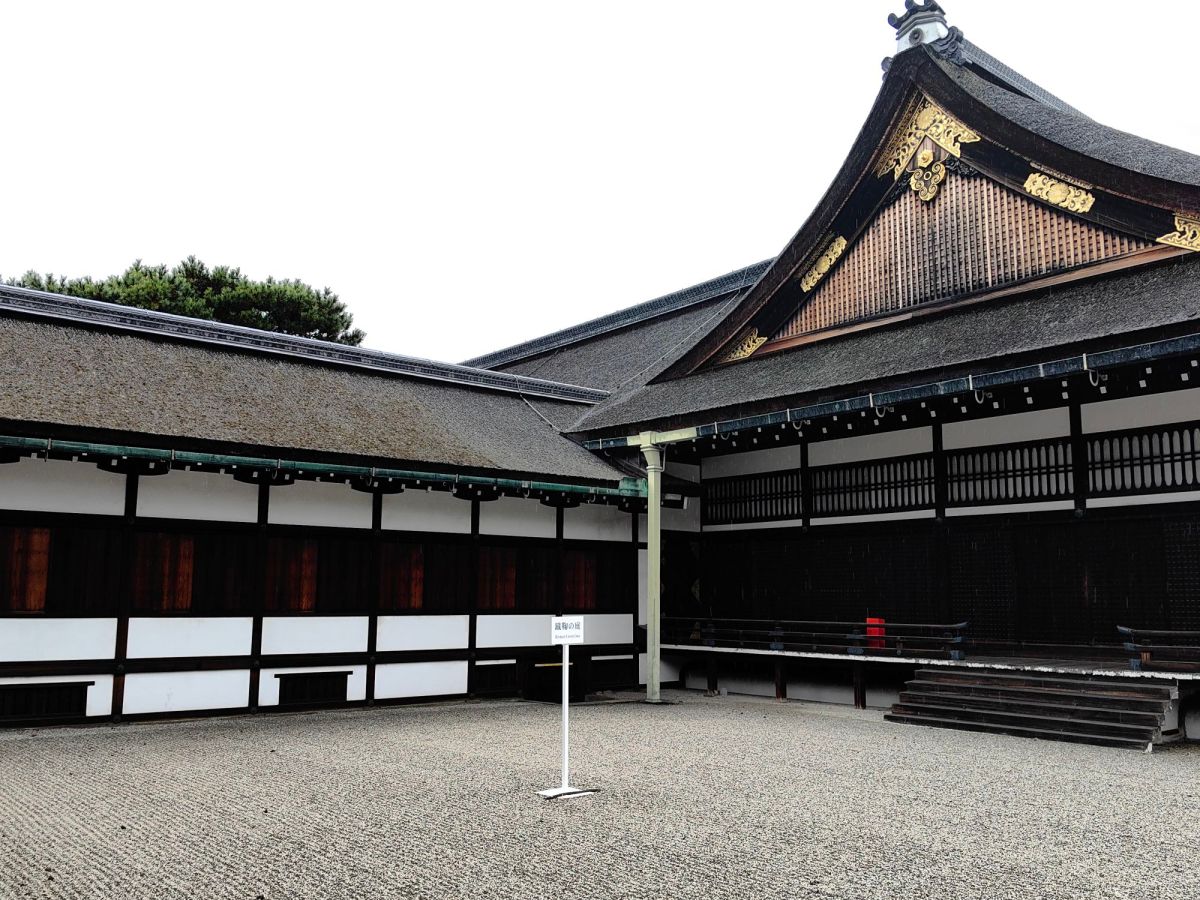
The route then continued toward the Seiryōden, historically the emperor’s principal residence and one of the most important buildings within the palace. Its architecture reflects the different functions of the imperial residence. Along the way, the visitor path passed through a succession of gates, courtyards and wooden buildings, each giving another glimpse into the carefully ordered world of the Imperial Court. It is like an open museum. Visitors experienced the palace from the outside, following designated paths and looking through open spaces toward the buildings.
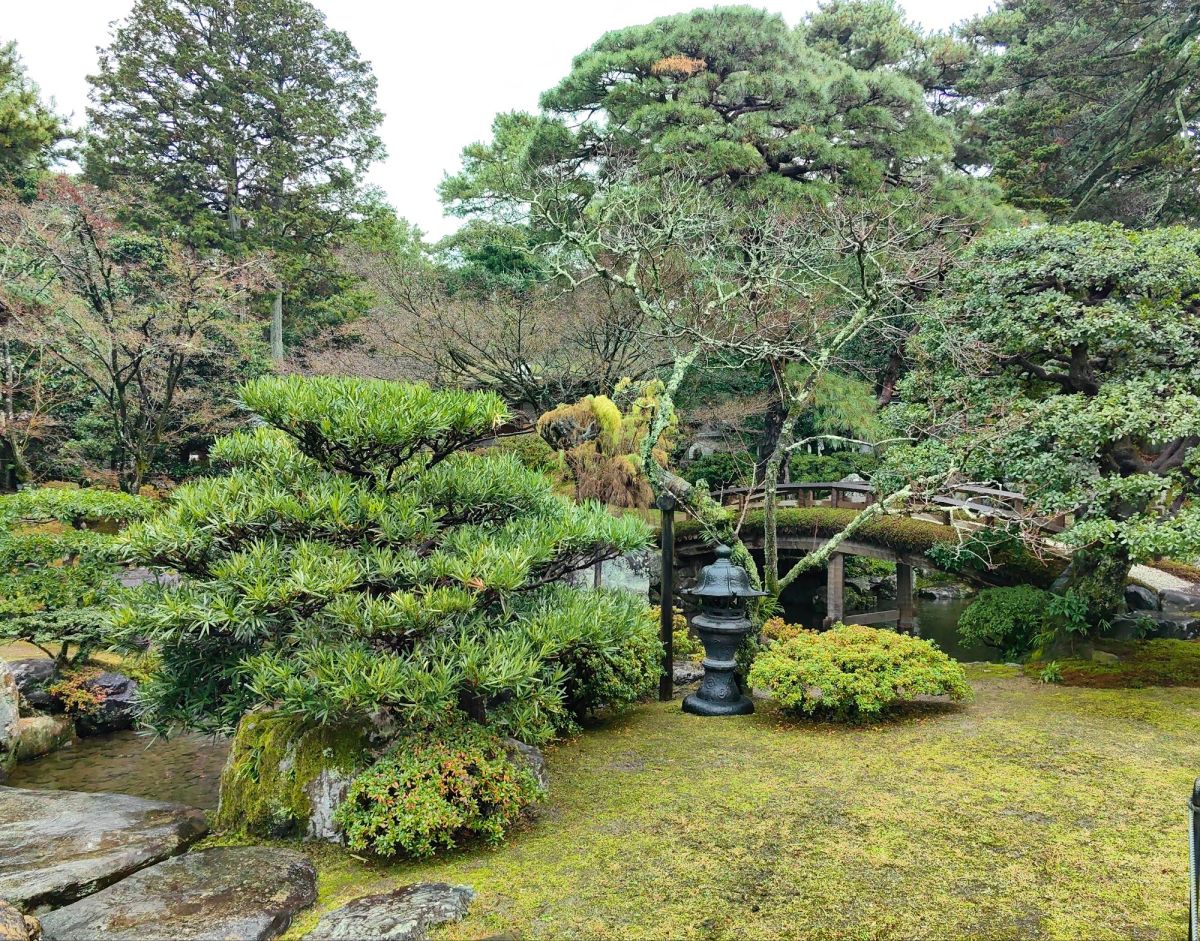
Eventually, the route opened into the Imperial Garden, where the atmosphere became much more relaxed. Ponds, streams, bridges, stones and enormous trees replaced the formal gravel courtyards. The Oike-niwa Pond Garden was particularly beautiful, with its tranquil water and carefully arranged landscape. Here, the strict ceremonial character of the palace gradually gave way to the quieter aesthetics of a Japanese garden.
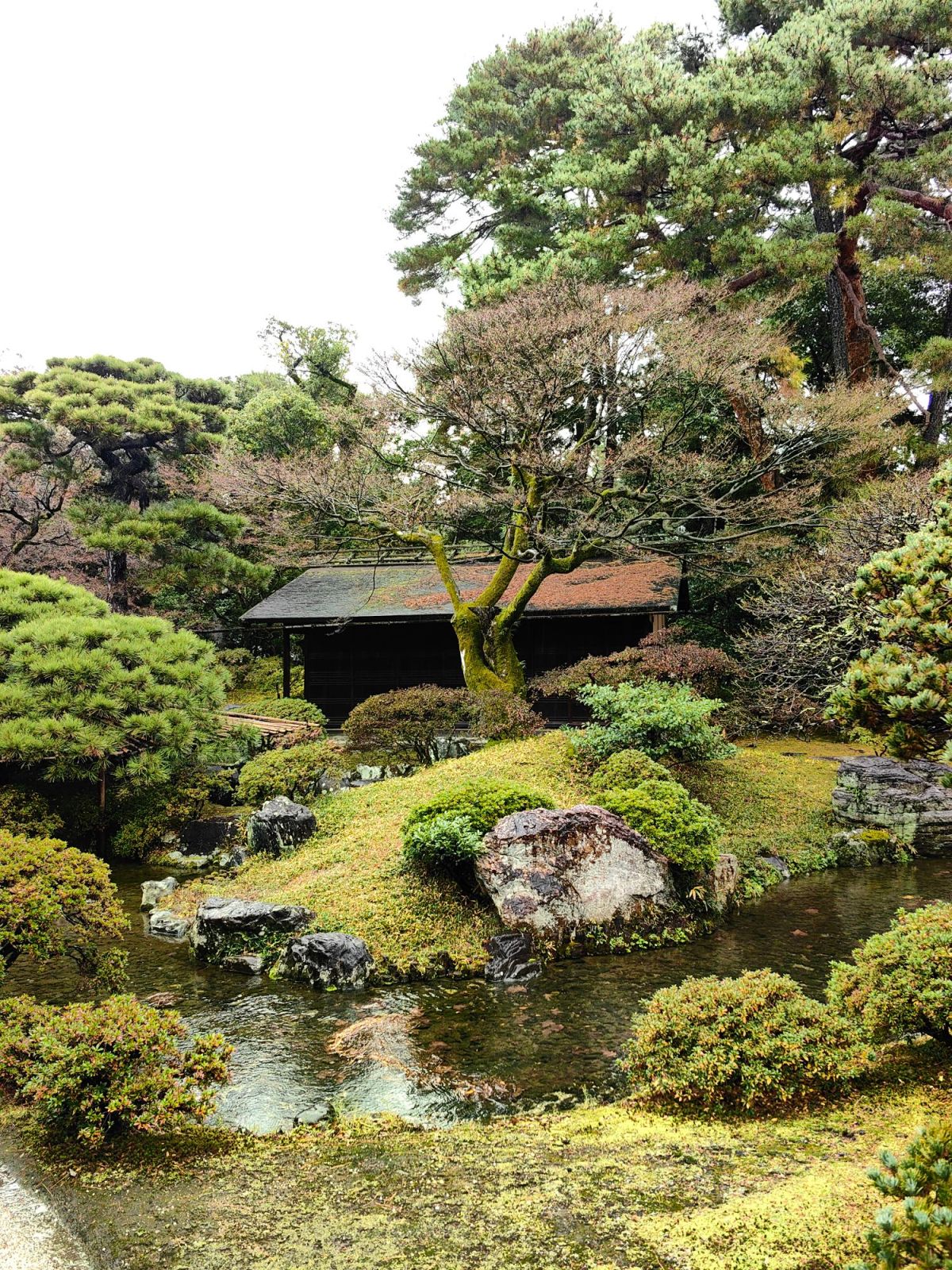
I think it was an interesting visit here. The scene was gradually moving from the formal world of imperial ceremony into the quieter world of court life and gardens. Even though most of the palace interiors remained beyond the visitor’s reach, the arrangement of the buildings and the landscape gave enough clues to imagine the life of emperor that once unfolded here.
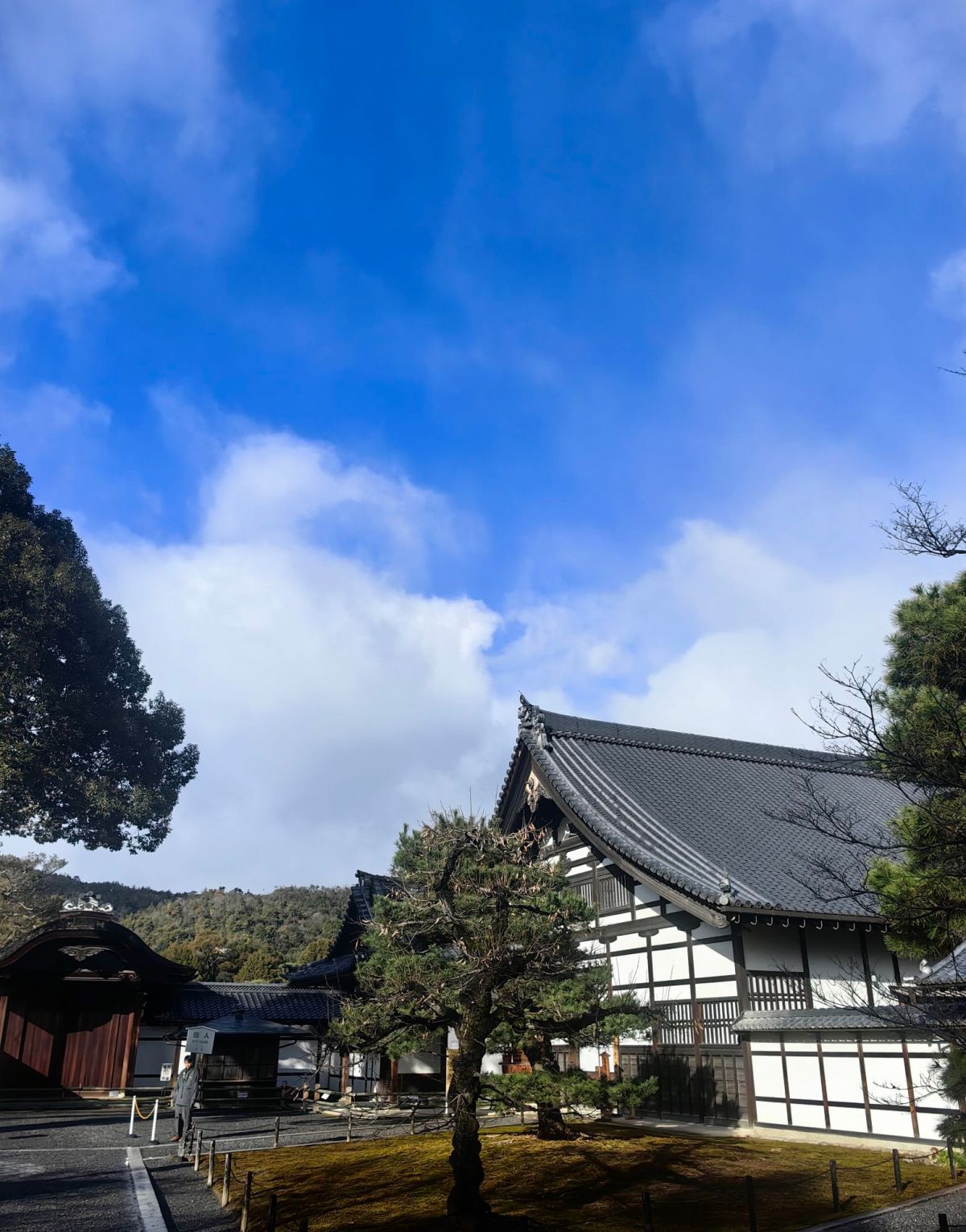
Kyoto is a city shaped by its mountains. Rising along the eastern and northern edges of the basin, they have always formed a natural boundary around the ancient capital. It was in these wooded foothills that generations of monks built temples, gardens, and places of retreat, turning the mountains into an inseparable part of Kyoto’s spiritual landscape. After spending time among the temples of Higashiyama in the east, I began to follow the mountains northward. The scenery gradually changed: the streets became quieter, the crowds thinner, and the temples seemed increasingly surrounded by forests rather than by the city.
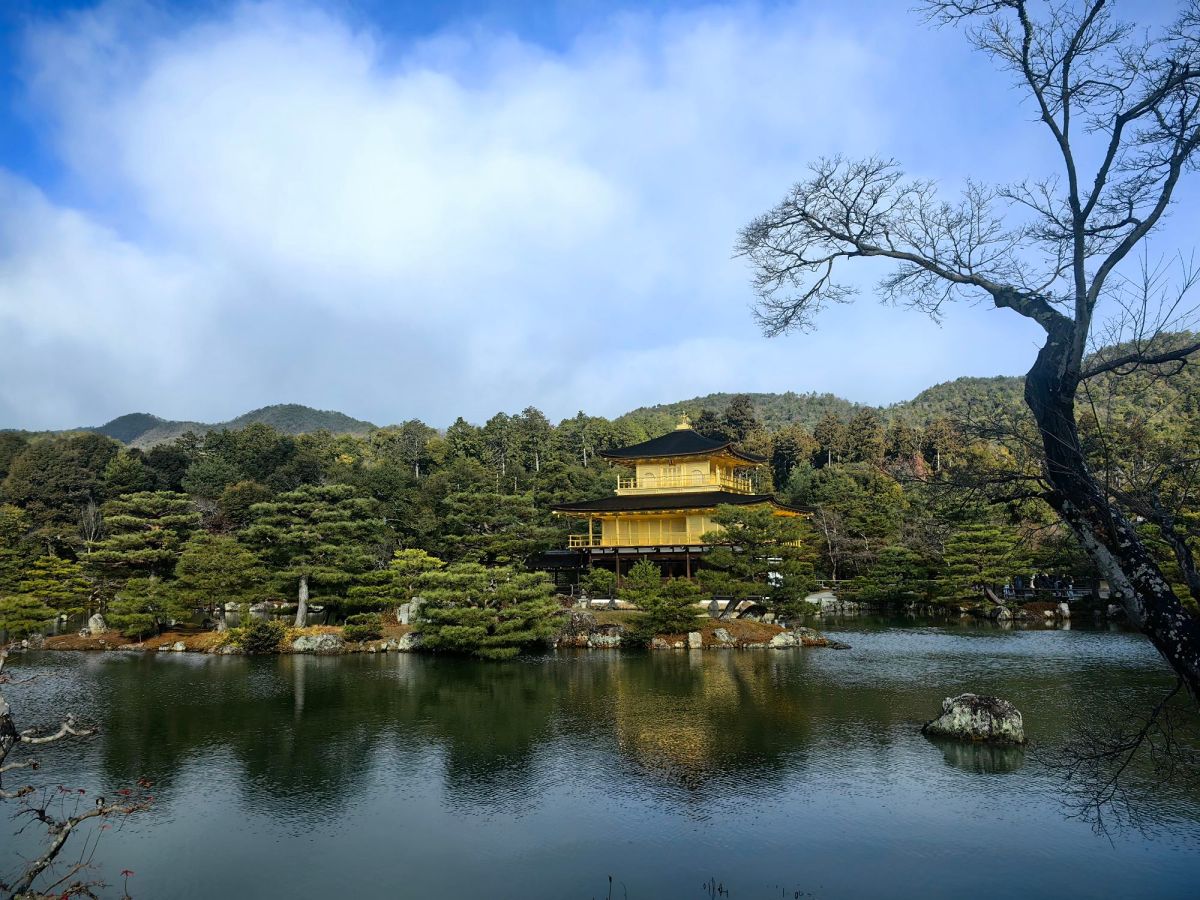
Among these temples, Kinkaku-ji is undoubtedly the most famous and iconic. Unlike many of Kyoto’s ancient temples, whose beauty lies in their weathered wooden halls and quiet simplicity, Kinkaku-ji captivates my eyes with its brilliant golden exterior, which seems to glow against the surrounding greenery. Standing beside a tranquil pond, the three-storey pavilion reflects the changing colors of the sky and the trees, creating a scene in which architecture and nature appear perfectly united.
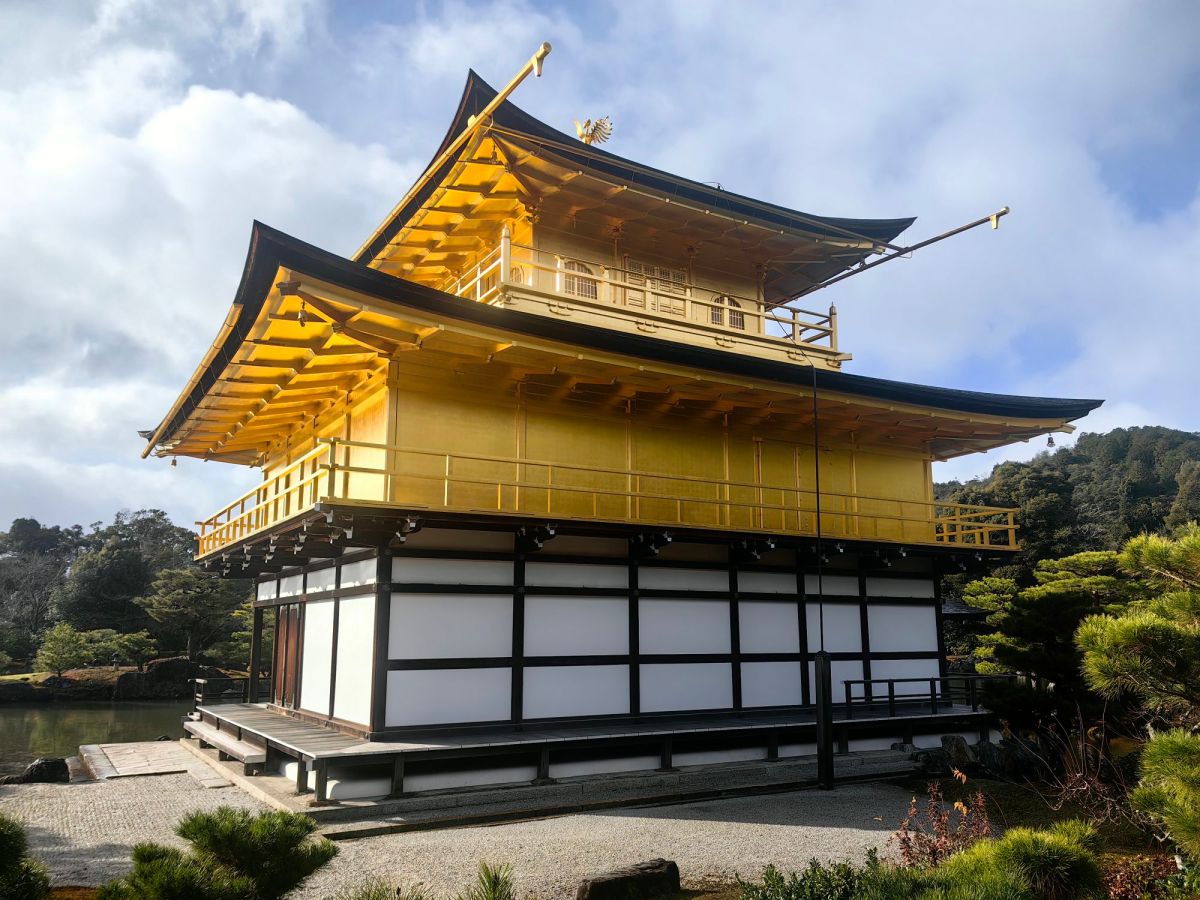
As I approached it, I could find its top is decorated with a golden bird. Against the sky, the golden figure stood as a striking crown above the three-storey building. Originally built in the late fourteenth century as the retirement villa of the shogun Ashikaga Yoshimitsu, it was later converted into a Zen temple after his death. Although the original pavilion was destroyed by fire in 1950 and subsequently rebuilt, its image has endured as one of the defining symbols of Kyoto.
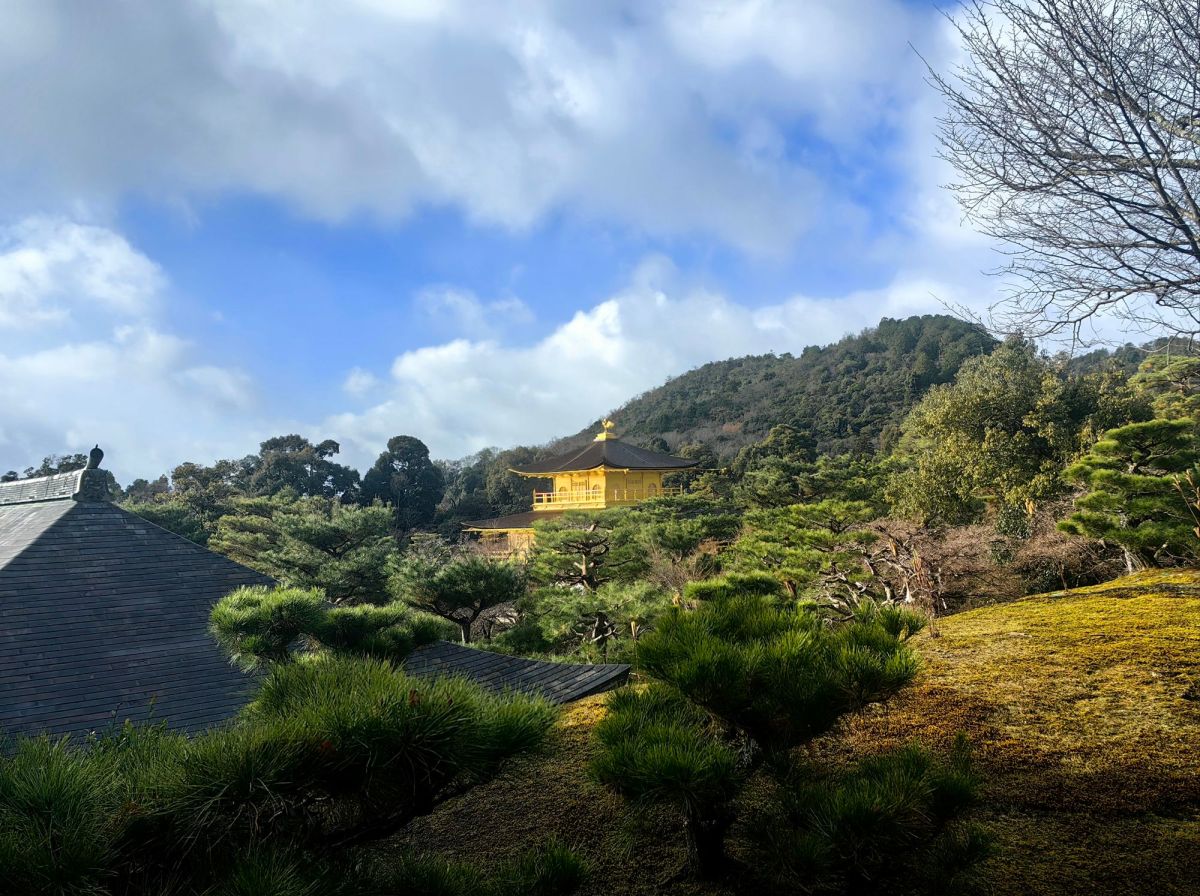
Yukio Mishima’s famous novel The Temple of the Golden Pavilion, published in 1956, was inspired by the real incident in 1950 when a young monk set fire to the temple and destroyed the pavilion. Through the story of a young acolyte named Mizoguchi, Mishima transformed this historical tragedy into a profound exploration of beauty, obsession, and the destructive side of human nature. Knowing this literary background gave me another way of looking at Kinkaku-ji when I stood before it and made me think of life philosophically.
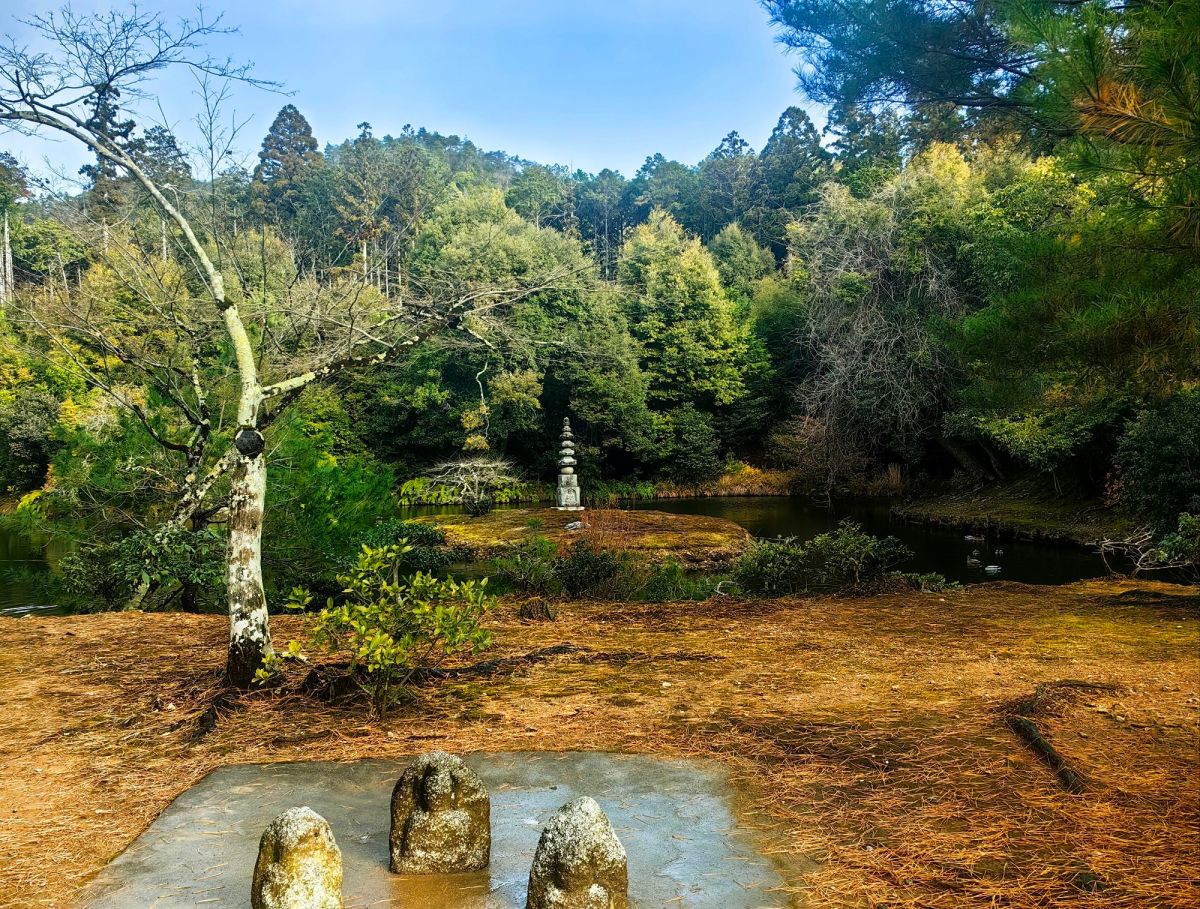
Although Kinkaku-ji is the main attraction, the temple grounds extend beyond the Golden Pavilion into a small but beautifully arranged Japanese garden. Winding paths lead through clusters of trees, moss-covered ground, and carefully placed stones. As I continued walking through the grounds, the scenery gradually shifted from the dazzling reflection of gold upon the pond to the softer beauty of trees, rocks, and shaded pathways. The garden was not particularly large, yet its carefully composed landscape offered a glimpse of the Japanese appreciation for nature.
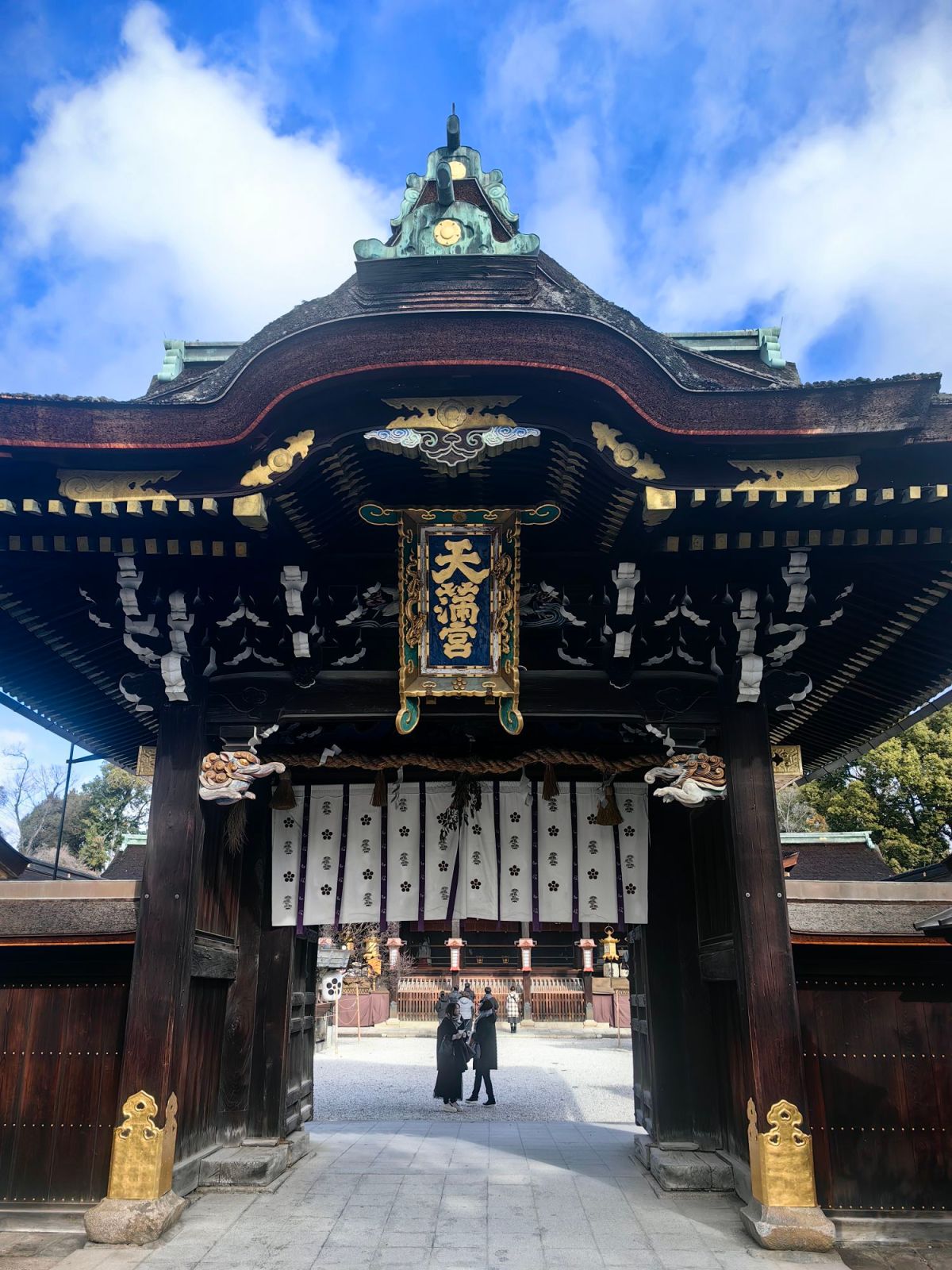
On my way toward the temples of northern Kyoto, I happened to pass Kitano Tenmangū, just south of Kinkaku-ji. I had not planned to visit the shrine, so at first it was simply another unexpected landmark along my route. Yet its imposing and broad door soon caught my attention. Behind the entrance stood a large shrine complex surrounded by old trees, stone lanterns, and wooden buildings, giving the place a very different atmosphere from the Zen temples I had been visiting.
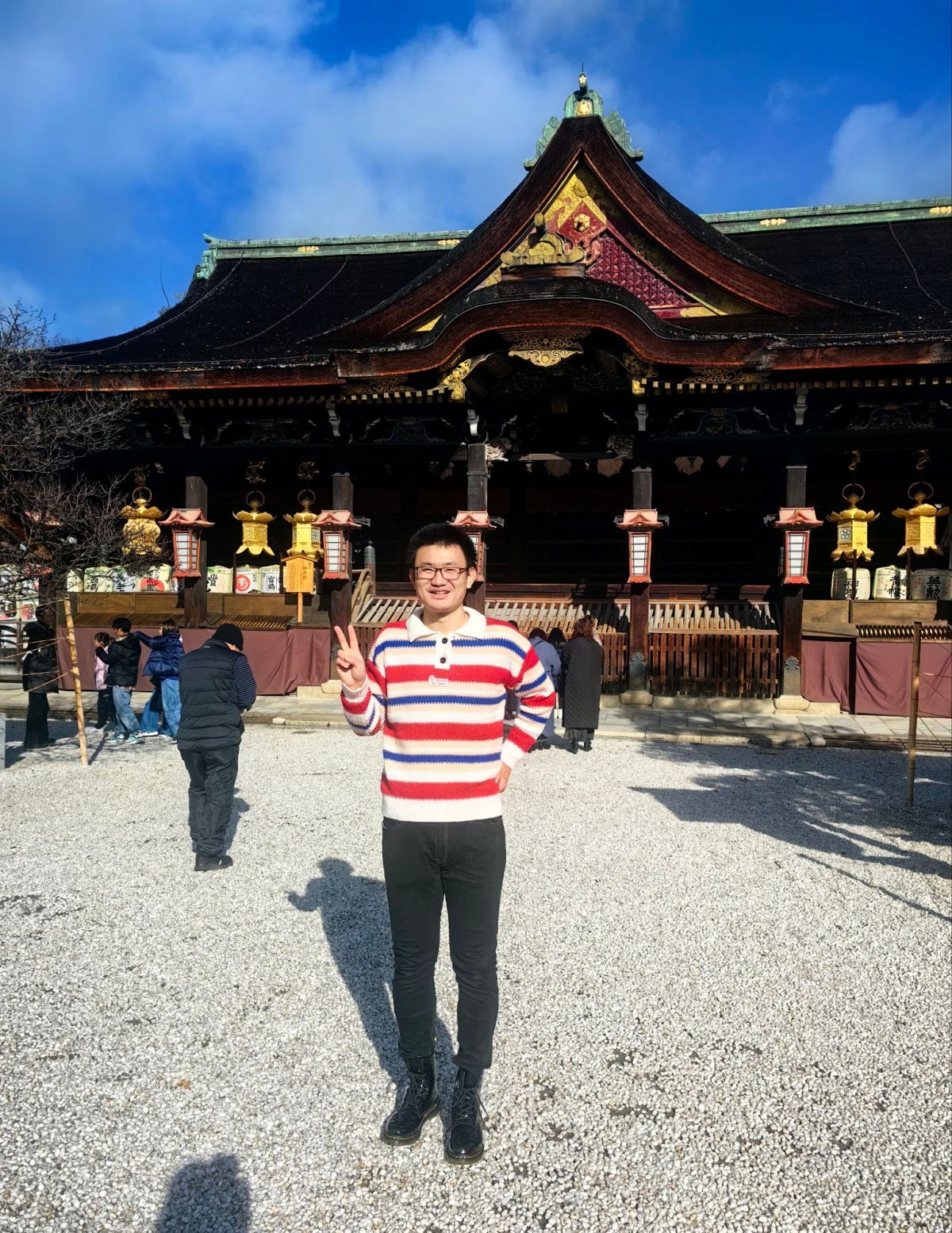
Kitano Tenmangū is dedicated to Sugawara no Michizane, the Heian-period scholar and statesman who was later revered as Tenjin, the deity of learning. The shrine was founded in 947, and its long association with scholarship explains the many students who come here to pray for success in their studies. I found it interesting that, without deliberately seeking it out, I had once again encountered another layer of Kyoto’s long history. The city seemed to reveal its history naturally along the way, not only through the famous destinations I had planned to see.
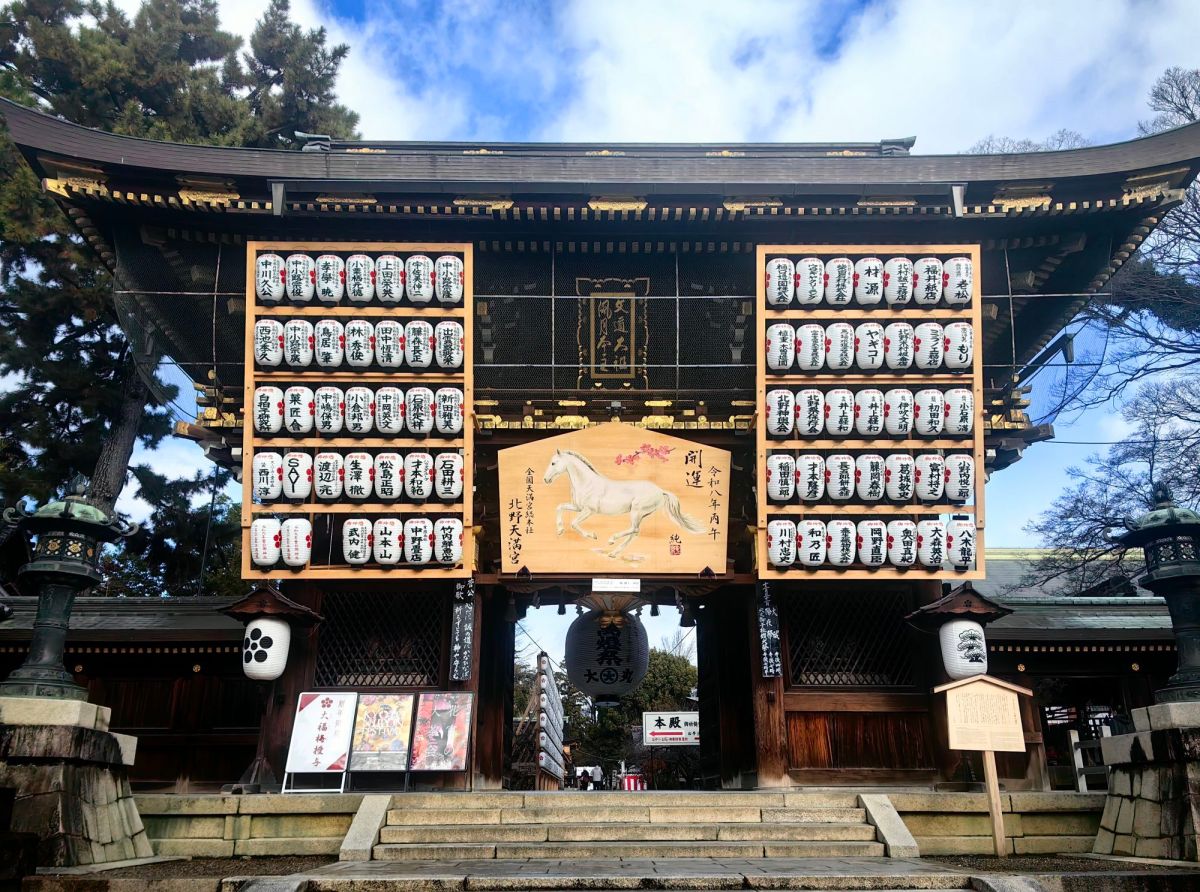
Passing through Kitano Tenmangū, I was drawn to its imposing Rōmon Gate, whose black structure was decorated with rows of hanging lanterns. Each lantern carried a name, quietly recording the people, families, or groups who had contributed to the shrine. Above the entrance, in the upper centre of the gate, hung a large painted plaque featuring a magnificent white horse. It immediately caught my attention because it represented the Year of the Horse, corresponding to the traditional East Asian zodiac. Beside it was the inscription 令和八年, the eighth year of the Reiwa era (2026). The horse, the zodiac system, and the traditional calendrical ideas all ultimately trace their origins to ancient Chinese culture, revealing how deeply Japan had absorbed and transformed cultural traditions that had travelled across East Asia centuries ago.
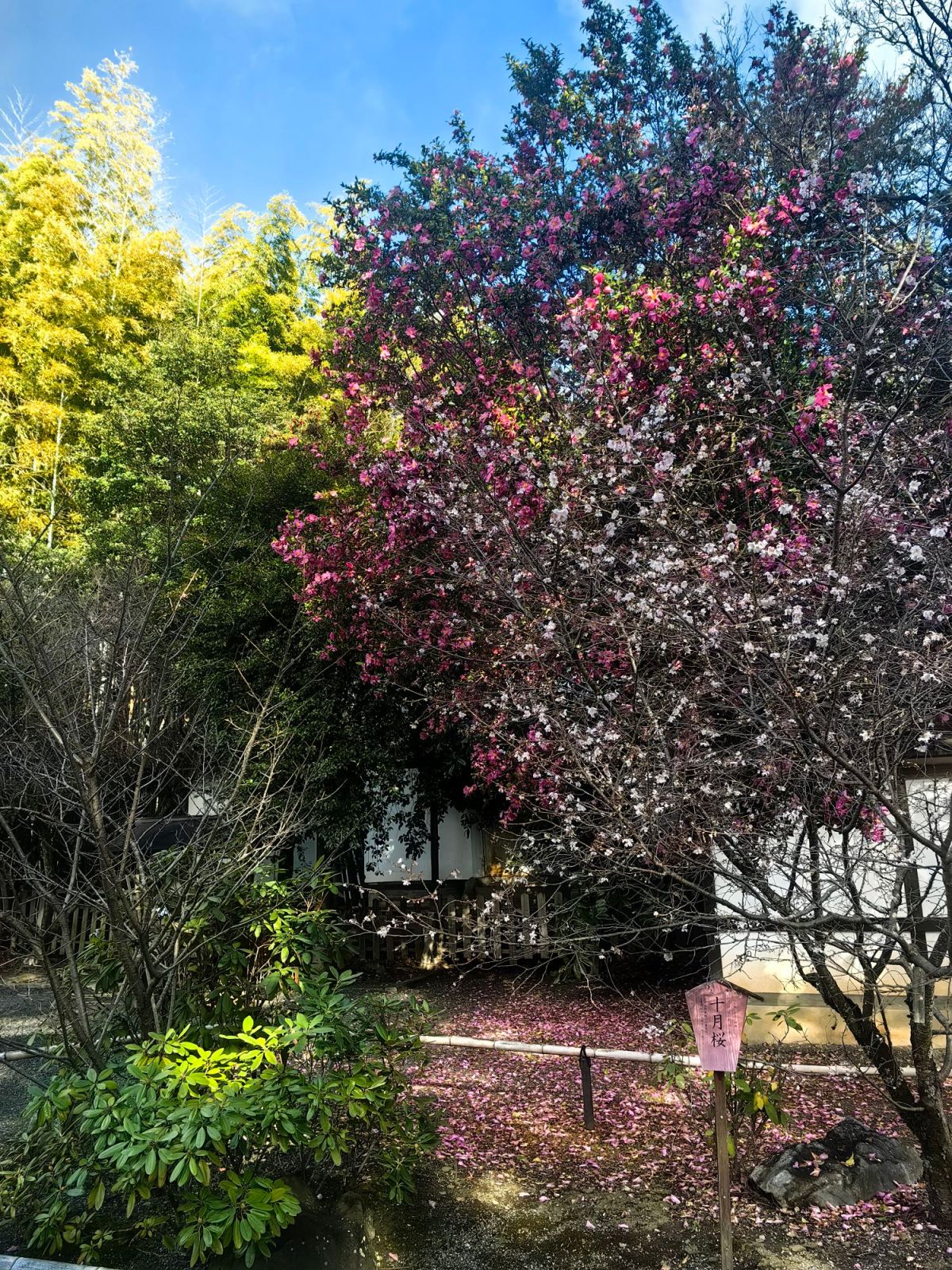
Inside the courtyard of Kitano Tenmangū, I came across a beautiful cherry tree in full bloom. Its soft pink blossoms stood out against the darker wooden buildings and the muted tones of the shrine grounds, bringing a gentle touch of colour to the ancient surroundings. In Japanese, sakura refers specifically to the blossoms of cherry trees, a flower that has come to symbolize the beauty and transience of life. Their brief flowering season makes them especially meaningful in Japanese culture: beautiful precisely because they do not last.
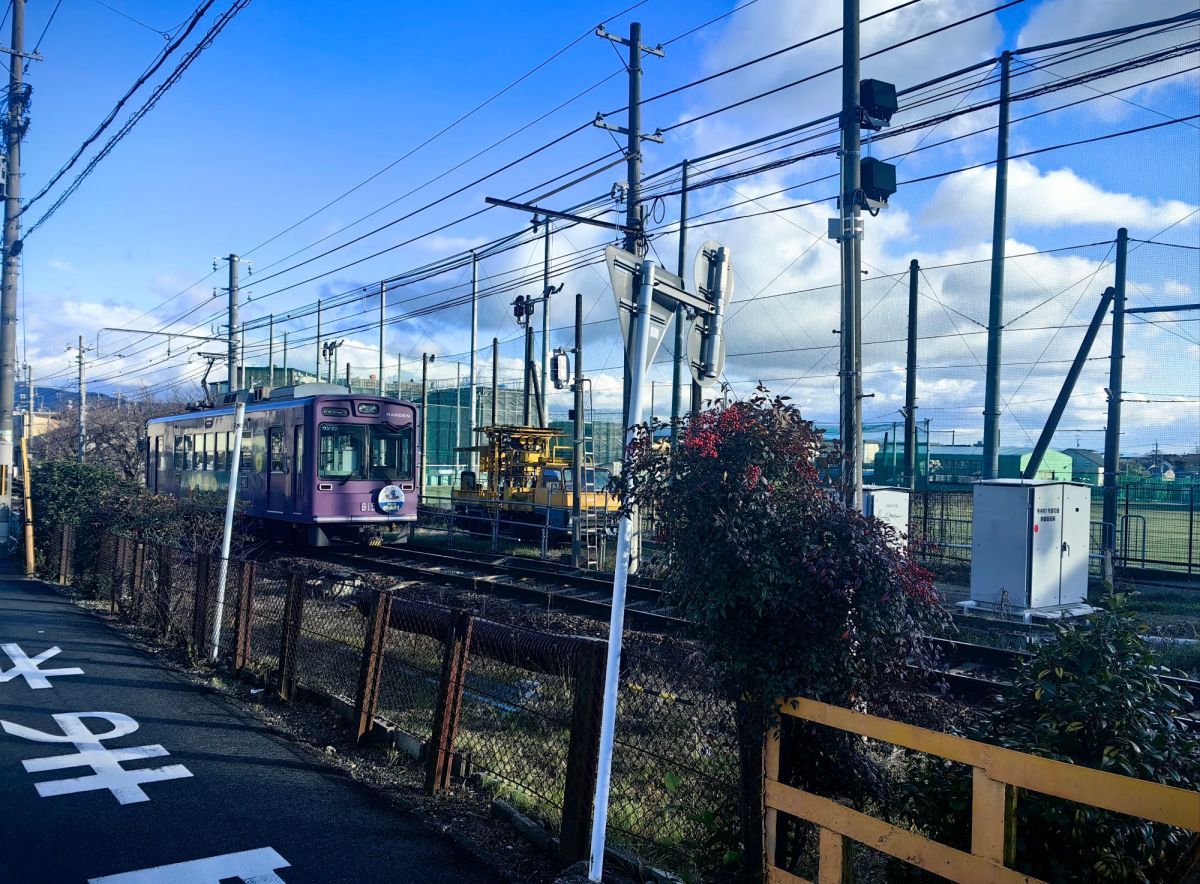
Kyoto is a city particularly well suited to travelling alone. Its extensive public transportation network like subways, trains, buses, and the tram make it easy to move around the city, while the many different routes give me the freedom to choose my own way. I enjoyed this sense of independence. I did not have to follow a fixed itinerary or wait for anyone else, but could simply decide where to go next. After my unexpected stop at Kitano Tenmangū, I continued north-westward toward my next destination by tram. My next stop was Ninna-ji, another ancient temple nestled the mountains of northern Kyoto.
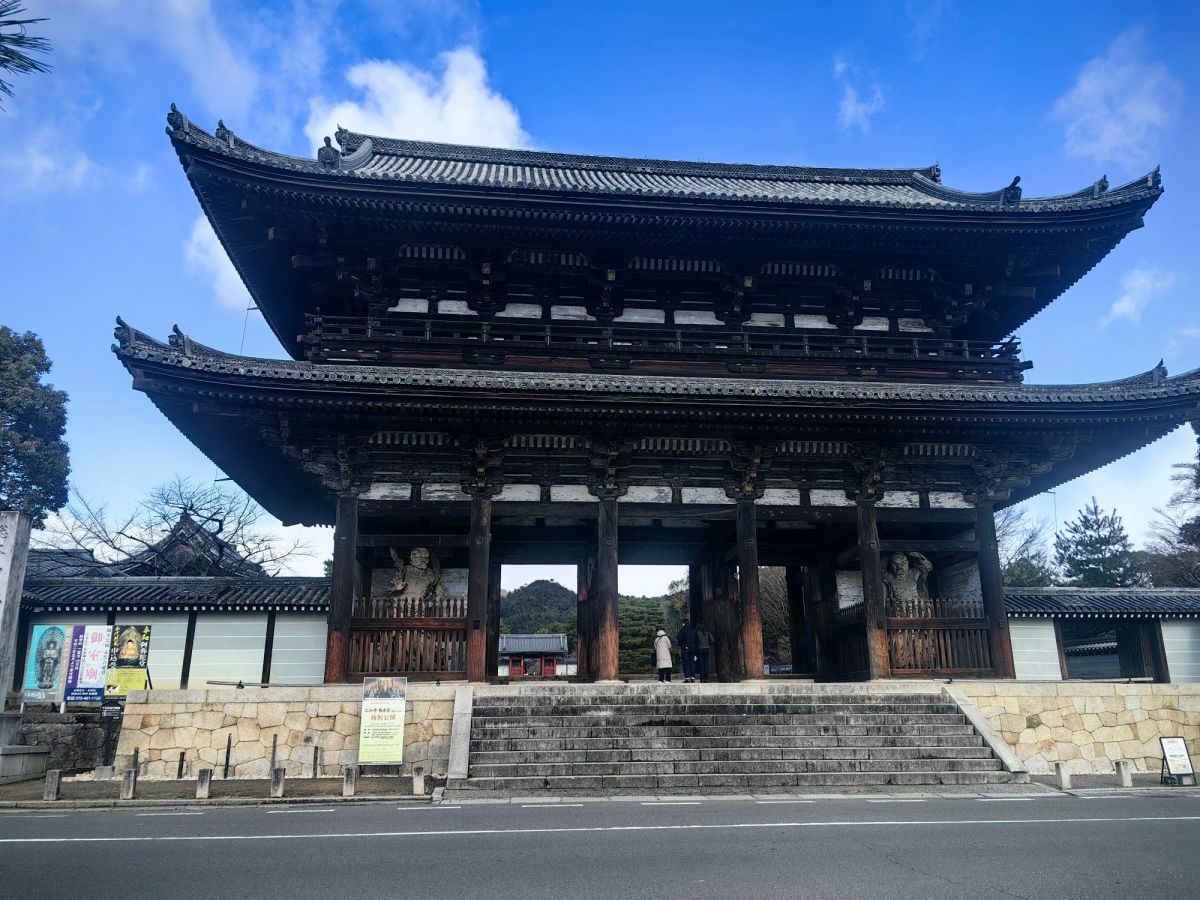
Nio-mon Gate is one of the most impressive structures at Ninna-ji. Standing at the entrance to the temple grounds, this magnificent two-storey wooden gate immediately gave me a sense of the temple’s historical dignity and grandeur. Its imposing structure features a broad, dark-tiled roof with gracefully curved eaves, supported by massive wooden pillars. The weathered timber and traditional architectural details give the gate a sense of age, while its substantial proportions reflect the importance of Ninna-ji as one of Kyoto’s major Buddhist temples. On either side of the entrance stand the fierce guardian statues known as the Nio, whose powerful expressions and imposing postures are intended to protect the Buddhist sanctuary from evil spirits.
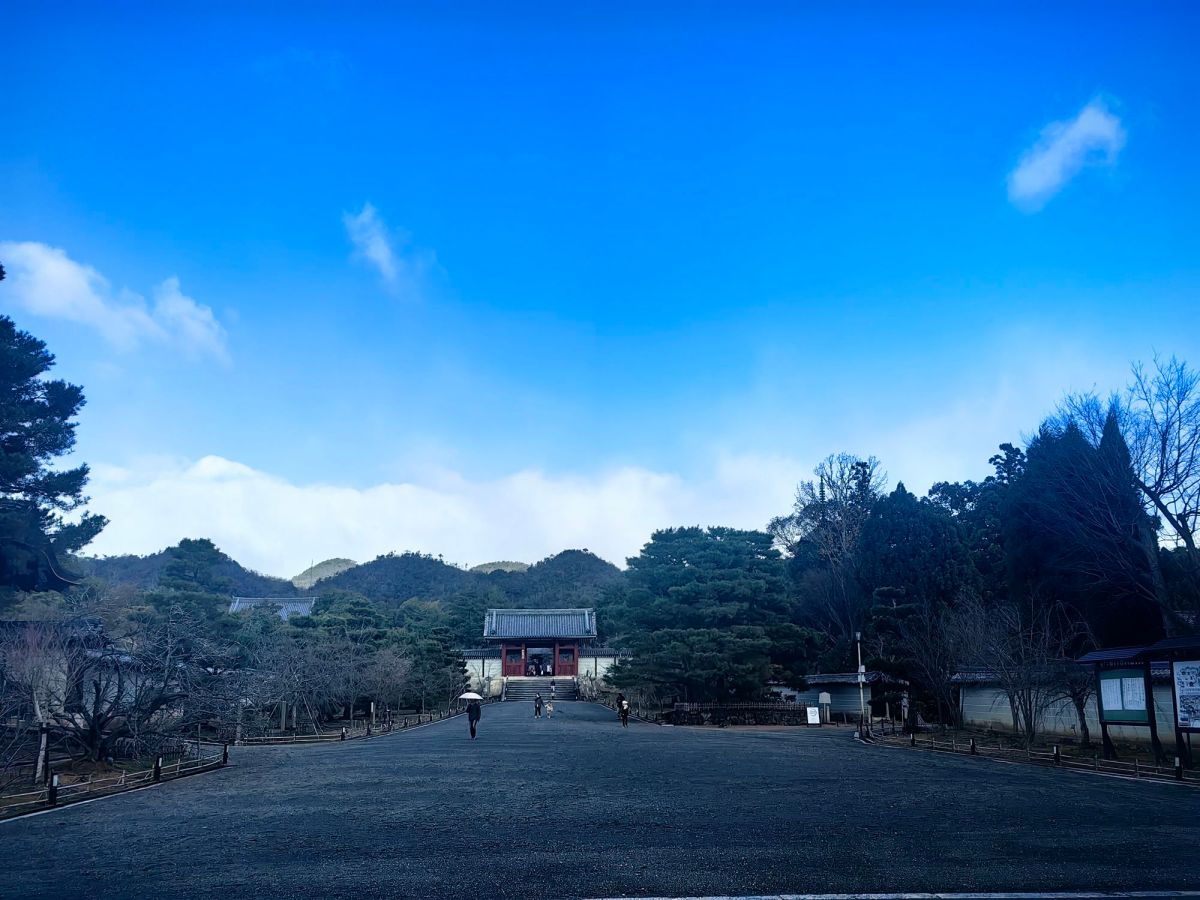
The UNESCO World Heritage property of Historic Monuments of Ancient Kyoto, inscribed in 1994, comprises 13 Buddhist temples,3 Shinto shrines and 1 castle. Together, they represent more than a thousand years of Japanese religious, architectural and cultural history, from the ancient Heian period to the era of the shogunate. Among them, along the northern and western foothills of Kyoto’s mountains. Kinkaku-ji, Ryōan-ji, and Ninna-ji form a remarkable group, each offering a distinctive expression of Japanese Buddhist architecture and garden design. mountains. From the spacious courtyard of Ninna-ji, I could see the gentle silhouettes of the mountains rising in the distance beyond the temple grounds. Under the open sky, the courtyard felt particularly expansive and peaceful, allowing my eyes to wander from the ancient wooden structures towards the distant mountain ridges.
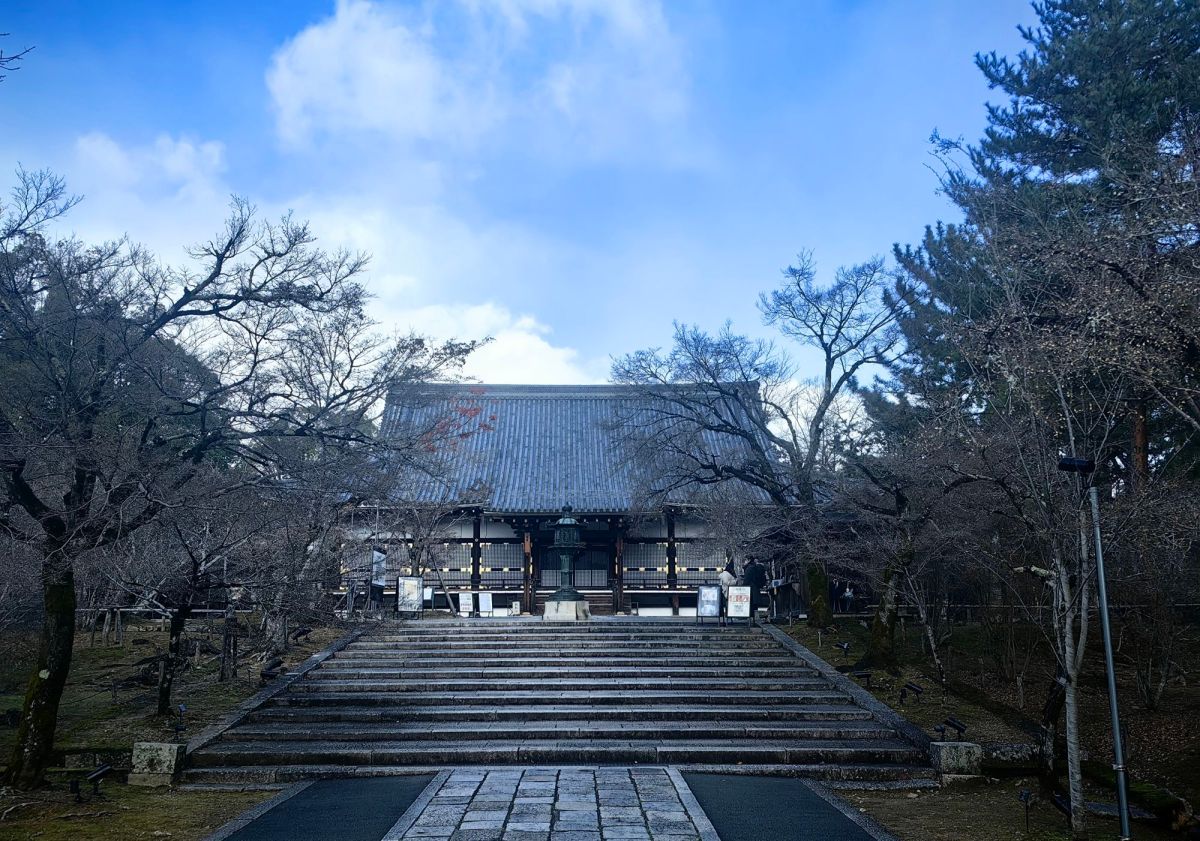
Inside, several traditional wooden buildings are scattered across the temple compound, each reflecting the architectural elegance and historical significance of this ancient Buddhist institution. Among them, the Golden Hall (Kondō) is the most important. Originally constructed as an imperial palace building during the early Edo period, it was later transferred to Ninna-ji and converted into the temple’s main worship hall.
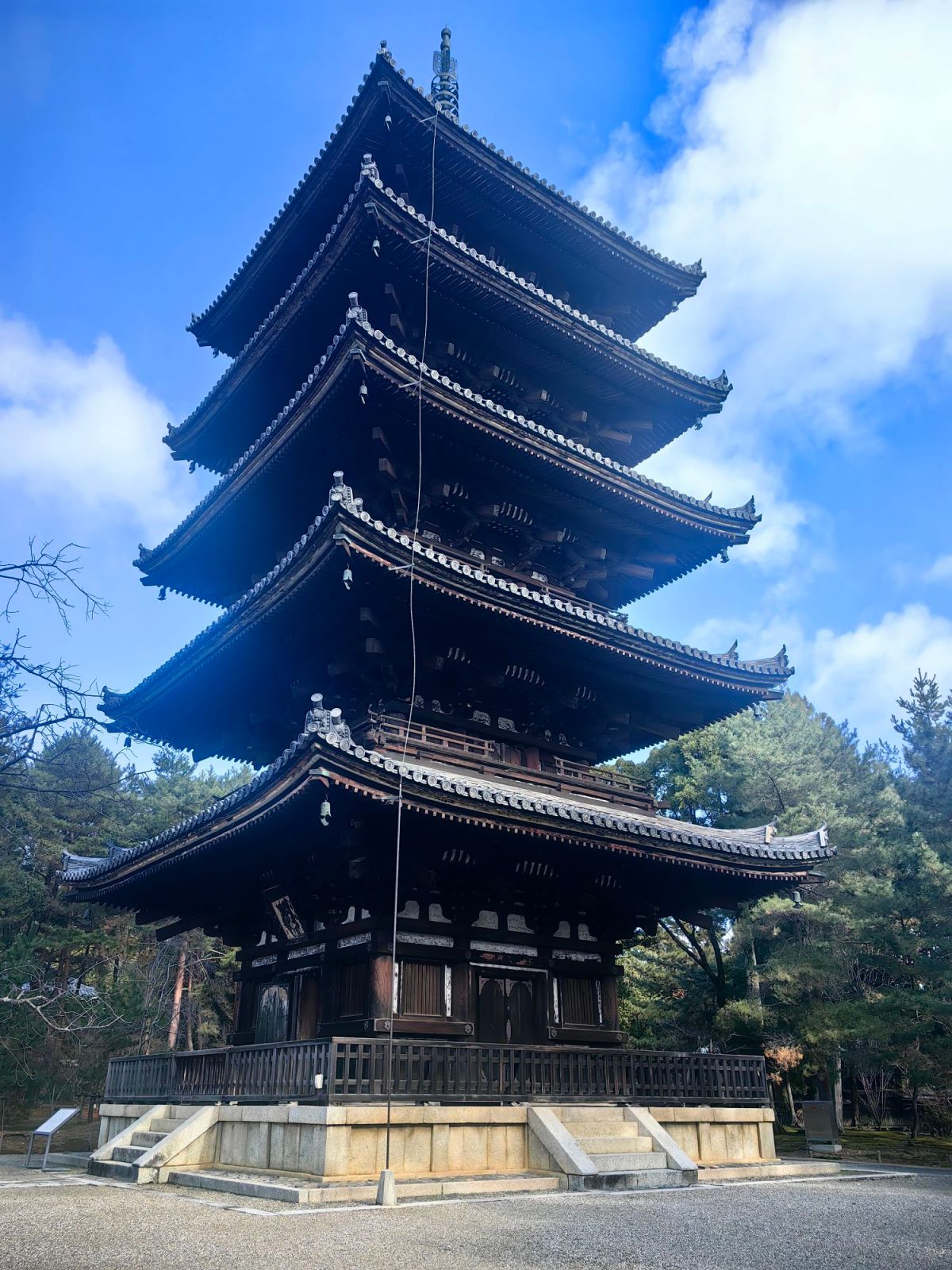
Nearby stands the Five-Story Pagoda, one of the most recognisable structures within the temple grounds. The history of Ninna-ji is closely connected with the Japanese imperial family and the development of Buddhism in Kyoto. Founded in 888 AD during the Heian period, it was established by Emperor Uda, who played an important role in its creation and later became its first imperial abbot. This gave Ninna-ji a special status among Japanese Buddhist temples, as it became the head temple of the Omuro branch of the Shingon school of Buddhism.
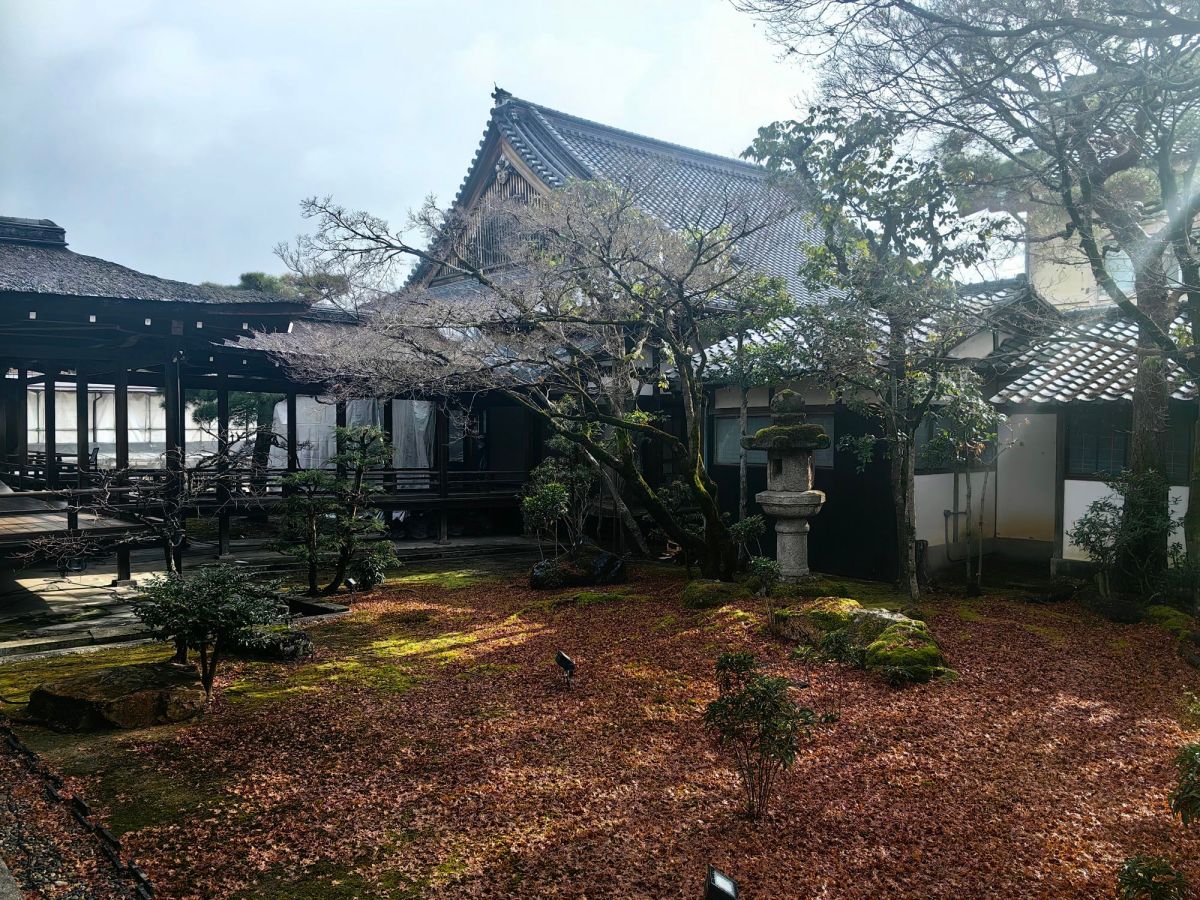
The temple’s origins can be traced to the reign of Emperor Kōkō, who initially planned to establish a Buddhist temple at this location. However, he passed away before the project could be completed. His successor, Emperor Uda, continued the undertaking, and the temple was finally completed in 888. It was named Ninna-ji after the era name Ninna, during which it was established. It has close relationship with the imperial household. In 899, after abdicating the throne, Emperor Uda entered Buddhist priesthood and took up residence at the temple, becoming its first imperial abbot. Thereafter, for centuries, Ninna-ji was traditionally led by members of the imperial family or aristocracy. The Ninna-ji Palace Garden (Goten) is undoubtedly the must-see attractions since it was originally the residence of the temple’s head priests, many of whom came from the imperial family. The complex offers a more intimate glimpse into the refined lifestyle of Japan’s imperial household.
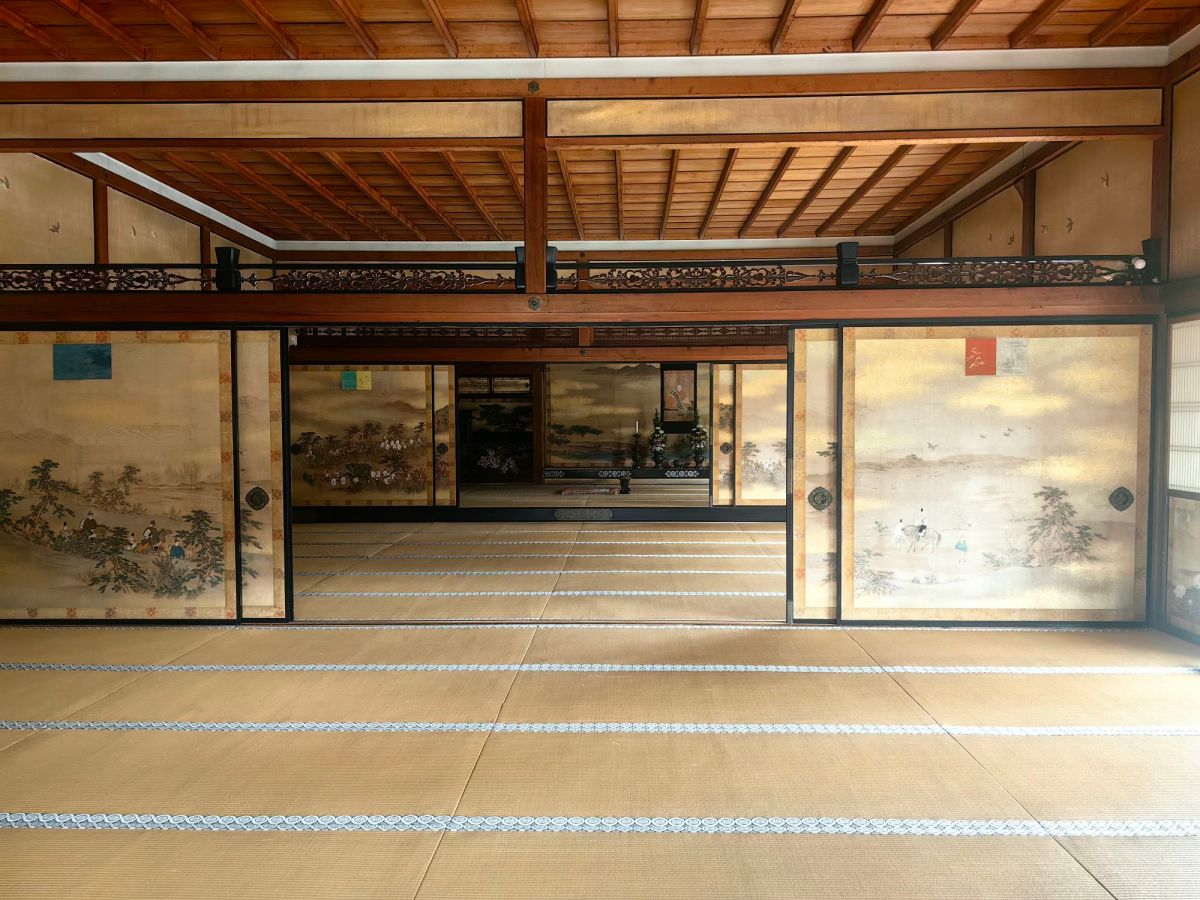
As I entered, I was immediately attracted by the beautiful paintings decorating the sliding doors, known as fusuma-e. These paintings cover the wooden partitions with delicate depictions of flowers, trees, birds and seasonal landscapes. Some feature colourful blossoms and flourishing vegetation, while others portray natural scenery in more subdued tones. What makes them particularly fascinating is that they are not displayed as independent artworks but are incorporated directly into the architecture. The sliding doors themselves become enormous paintings, transforming the interior rooms into artistic spaces.
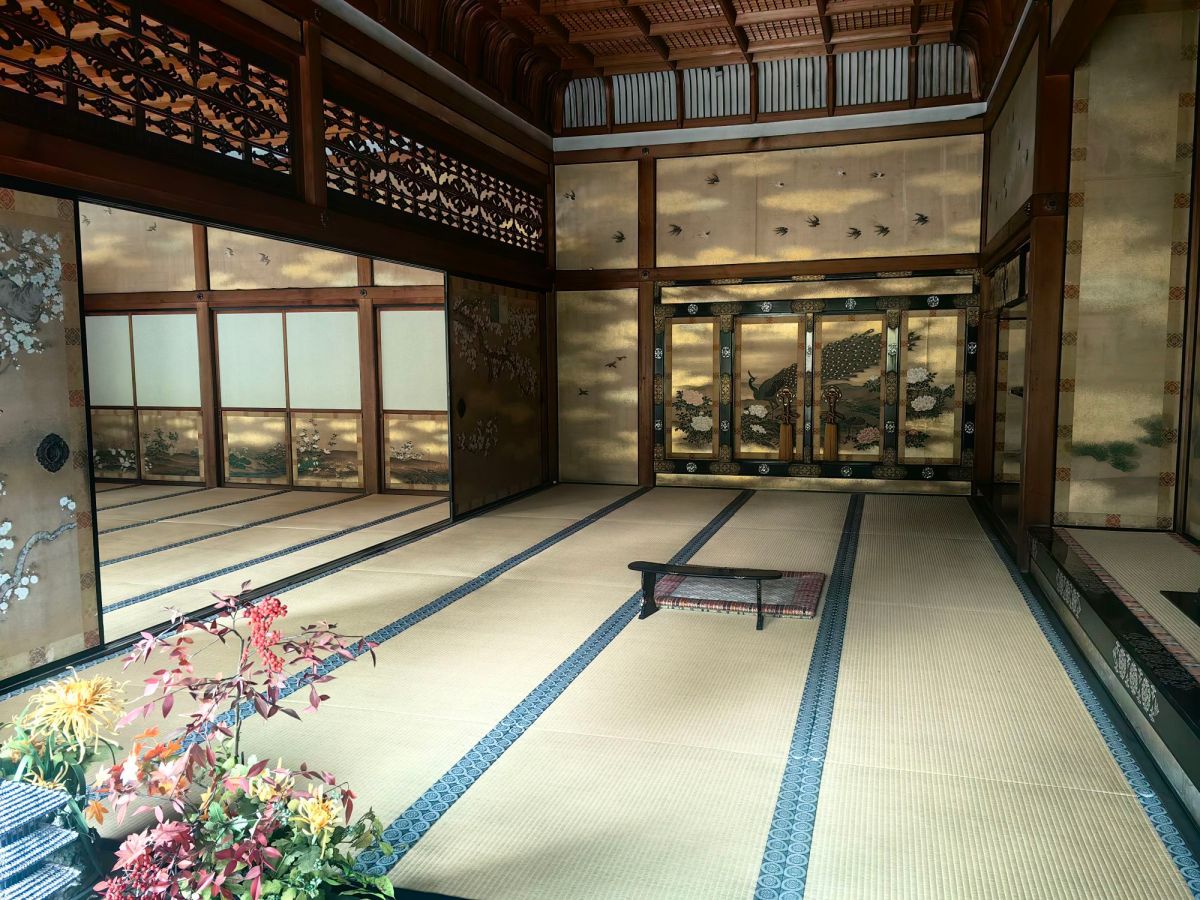
The Shinden Hall, the main ceremonial building of the palace, is particularly noteworthy for its elegant architecture and decorative paintings. Its traditional wooden structure, tatami-covered floors, decorative alcoves and sliding partitions create an atmosphere of understated sophistication. The rooms are connected by covered wooden corridors, with open verandas overlooking the surrounding gardens. Walking through these spaces, I could appreciate how traditional Japanese architecture creates a seamless relationship between indoor and outdoor environments. Rather than completely separating the rooms from nature, the sliding doors and open corridors allow the gardens to become part of the interior scenery.
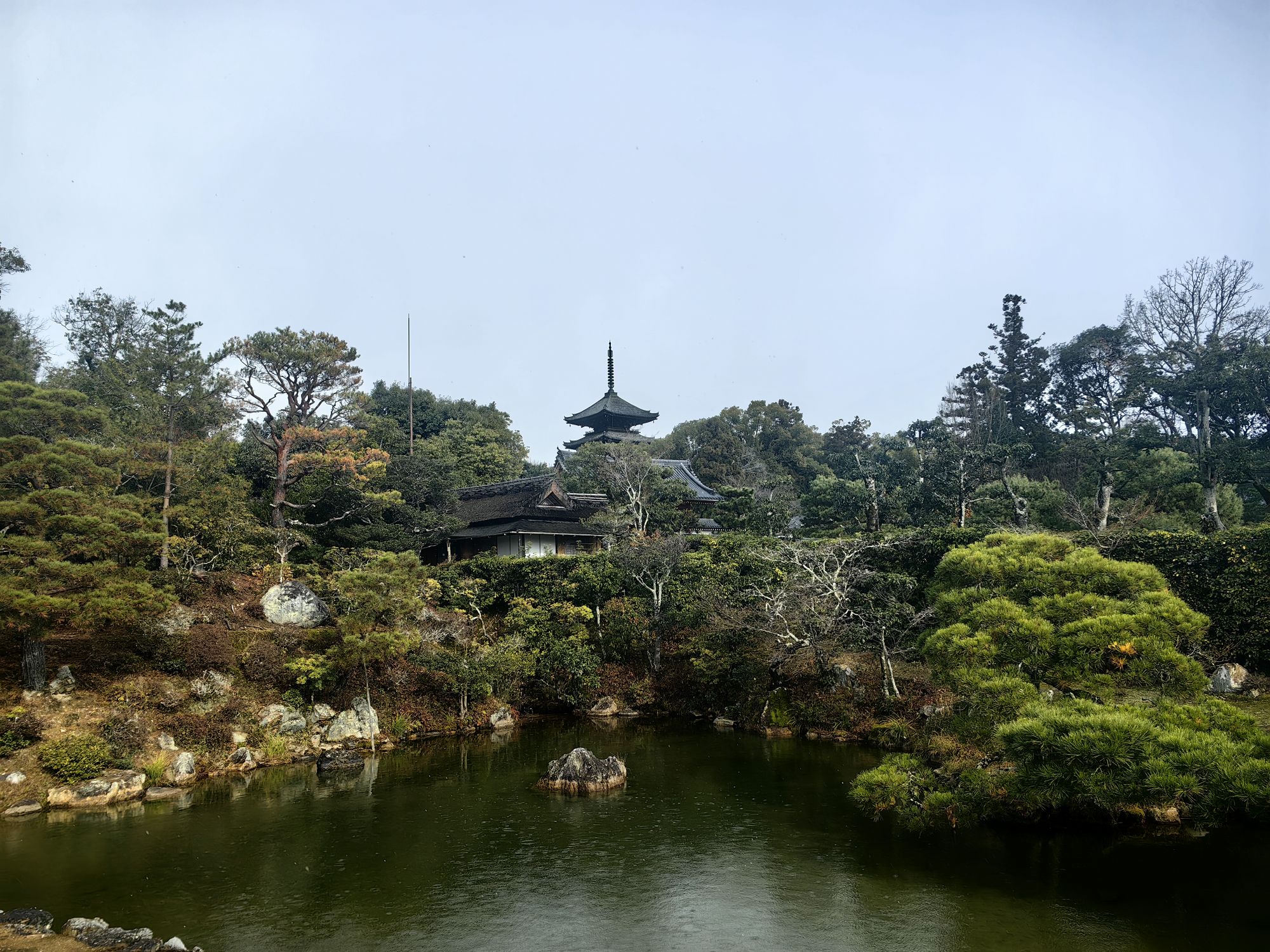
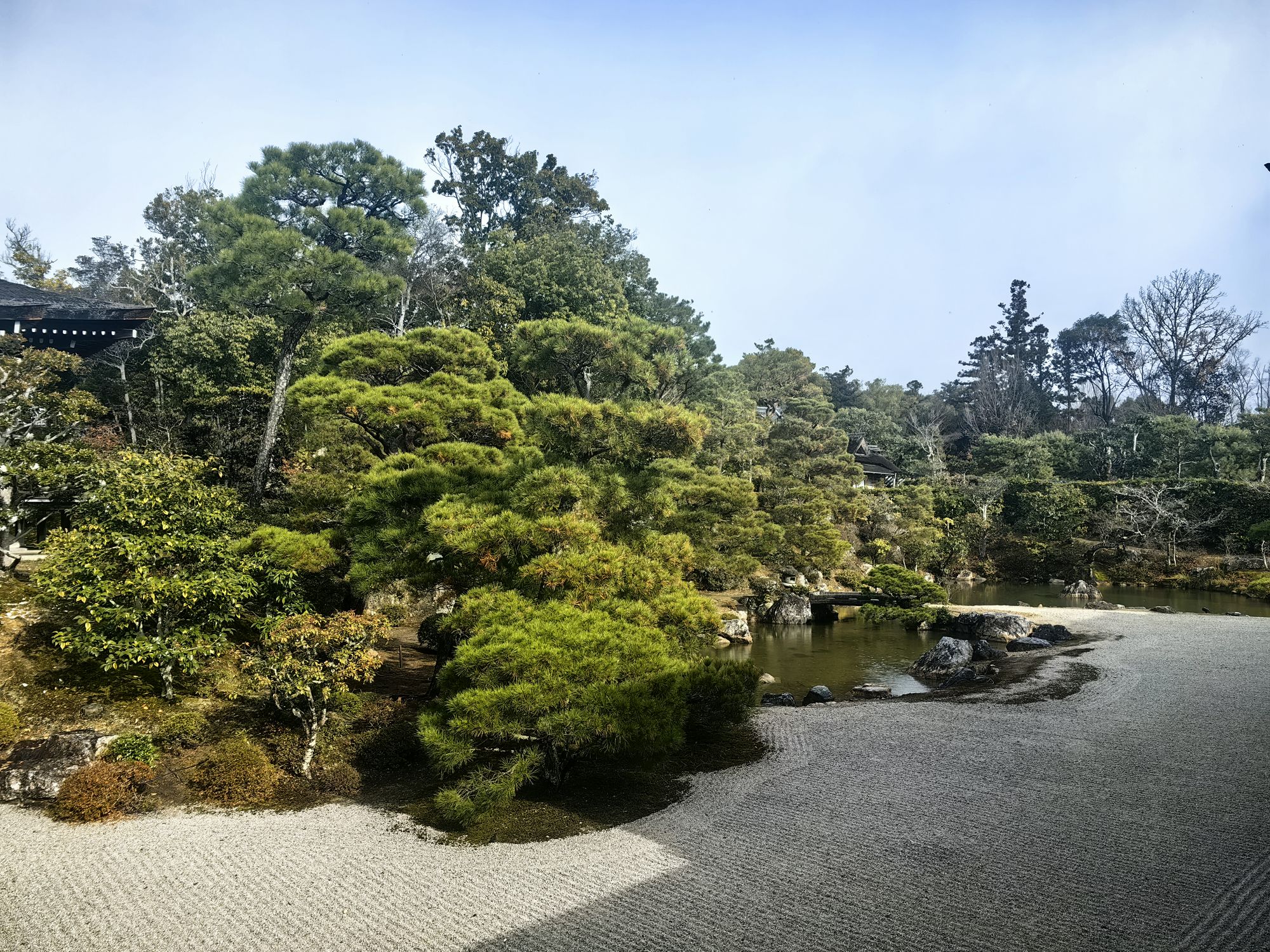
It contains two distinctive gardens, each with its own character. I could view them quietly under the corridor. The South Garden is relatively simple and restrained, featuring carefully arranged white gravel, pine trees and traditional landscaping. Its minimalist composition creates a sense of order and tranquility, reflecting the aesthetic principles of Japanese garden design. The North Garden, by contrast, is more elaborate and naturalistic, with a beautiful pond, a small waterfall, an artificial hill covered in greenery and a traditional teahouse. From my viewpoints, the Five-Story Pagoda can also be seen rising above the surrounding trees, creating a particularly picturesque composition.
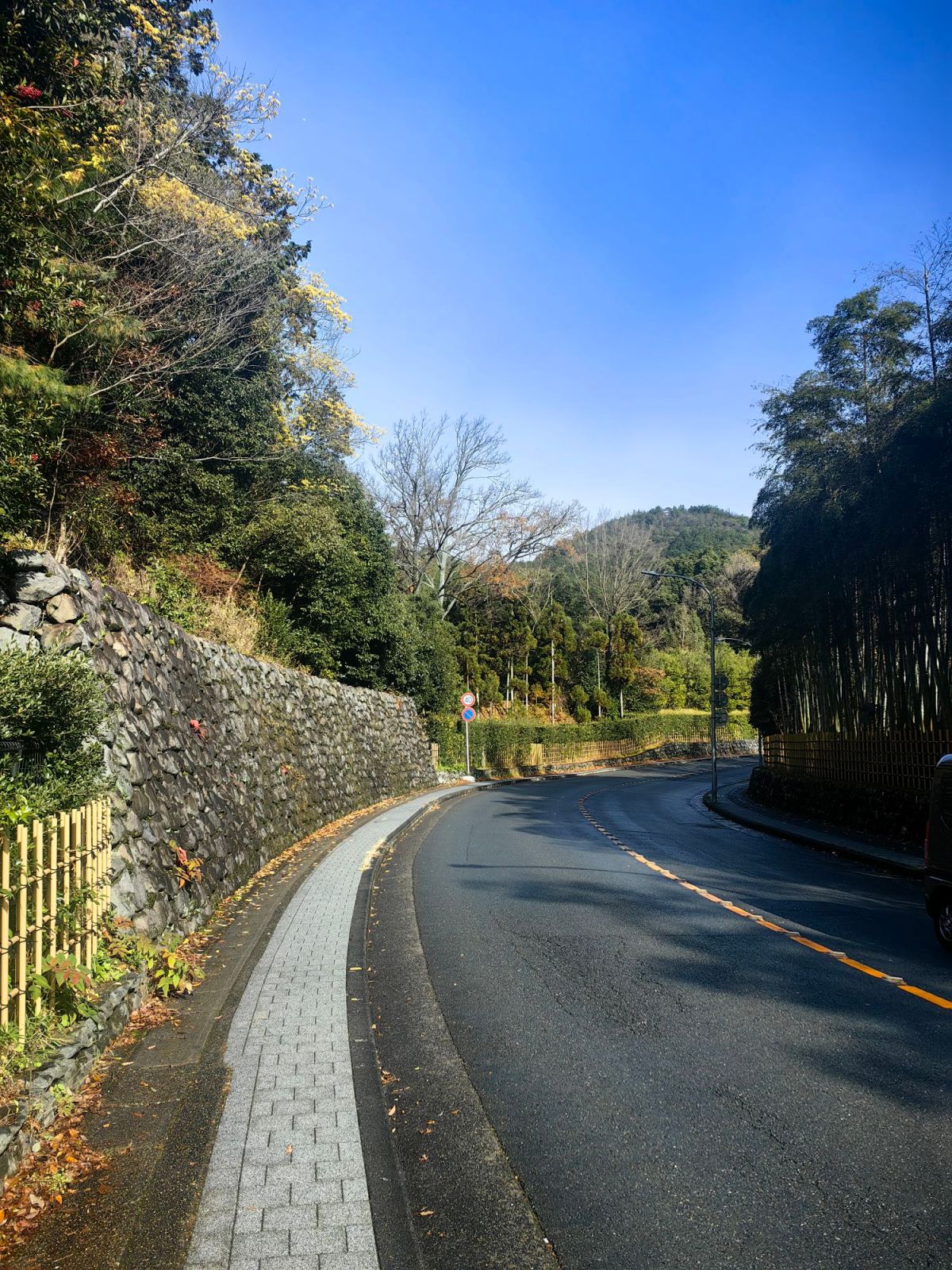
After leaving Ninnaji, I jogtrotted on the way to Ryoan-ji. It was like wandering through a living poem, along the northern foothills of Kyoto, where towering trees embraced the winding paths and bamboo groves whispered gently in the breeze. Sunlight filtered through the lush canopy, casting delicate shadows across the forest floor, while the tranquil mountain scenery unfolded with every step. For me it was a peaceful encounter with Kyoto’s timeless beauty, where every tree, every leaf, and every whisper of the wind told a story of serenity.
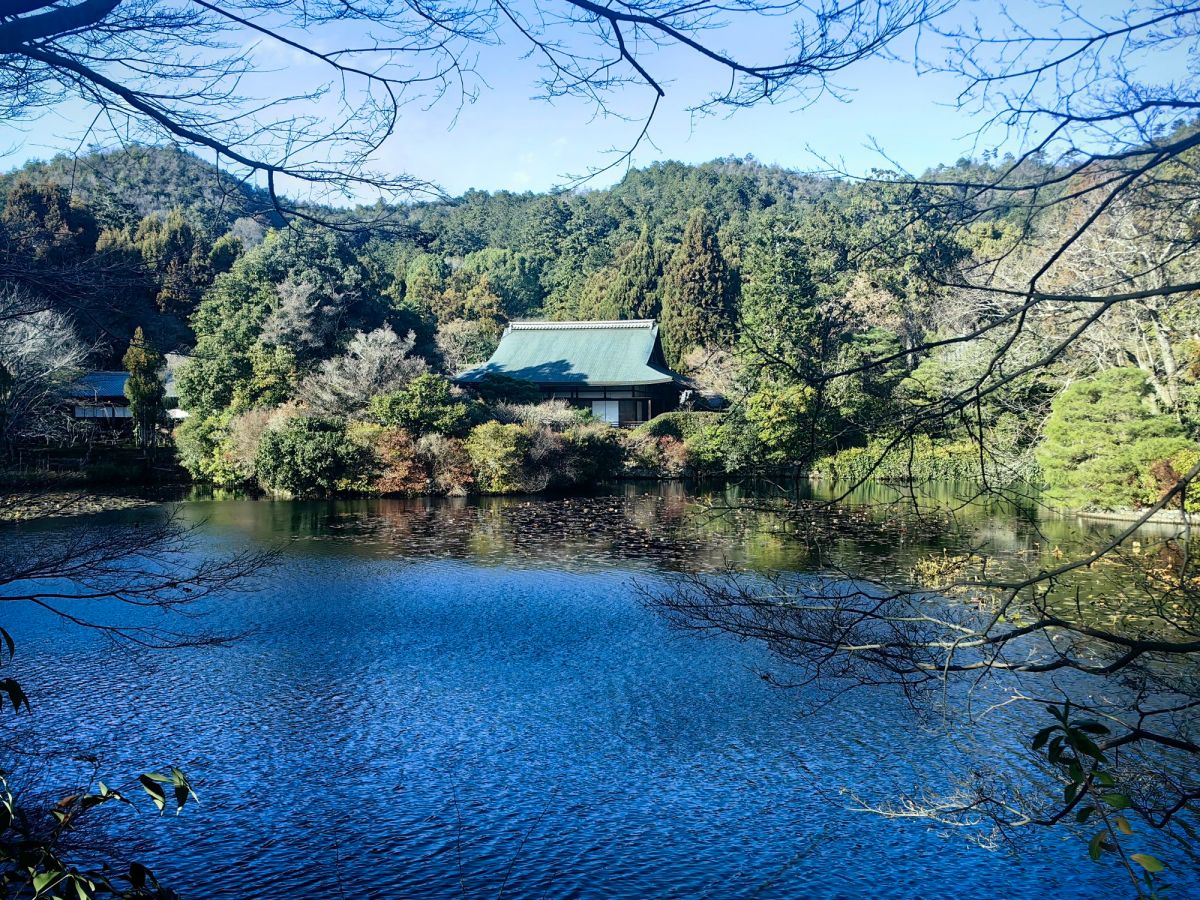
Ryoan-ji reveals its stunning beauty around Kyoyochi Pond, where nature unfolds in a more enchanting landscape. The tranquil pond mirrors the surrounding trees, lush greenery and distant seasonal colours, creating a beautiful tapestry of reflections that shifts gently with the breeze. Graceful branches stretch over the water, while delicate ripples ripple across its surface, as though nature itself were painting a living masterpiece.
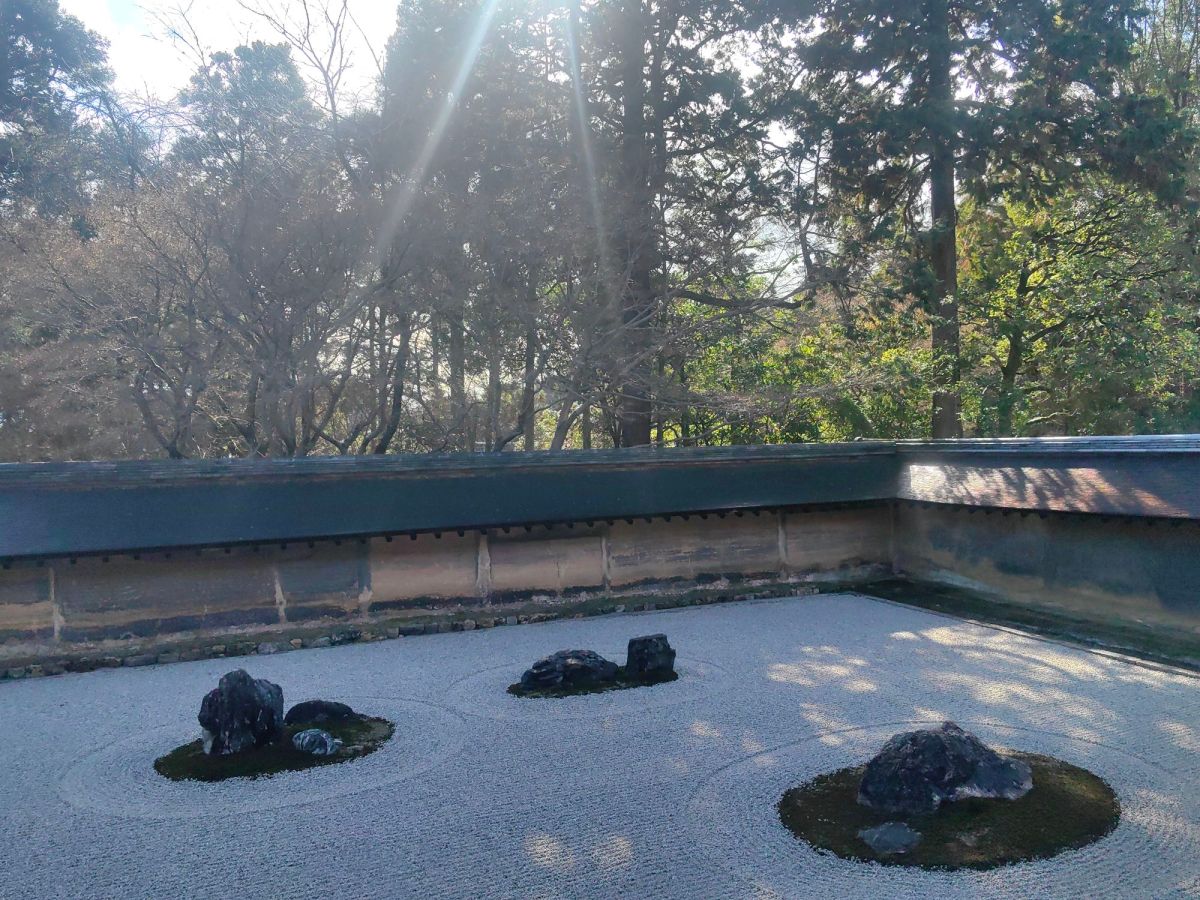
The Zen rock garden of Ryoan-ji is a masterpiece of simplicity, embodying the Japanese aesthetic of Karesansui (枯山水), or dry landscape gardening, where nature is recreated not through flowing water and lush vegetation. Fifteen stones of different shapes and sizes rest upon a sea of white pebbles, their arrangement suggesting islands scattered across an endless ocean, or mountains emerging from a misty landscape. The fine patterns raked into the gravel evoke the gentle movement of waves, giving the illusion of water flowing through a landscape that is entirely dry. Yet what makes this garden so profound is its expression of Wabi-sabi (侘寂) . It is the beauty of imperfection, simplicity and impermanence. The weathered stones, uneven shapes and deliberate emptiness remind us that beauty does not need to be perfect, symmetrical or extravagant to be meaningful. Interestingly, the fifteen stones are arranged so that one is always hidden from view, suggesting that our perception is never complete and that perfection may forever remain beyond our reach.
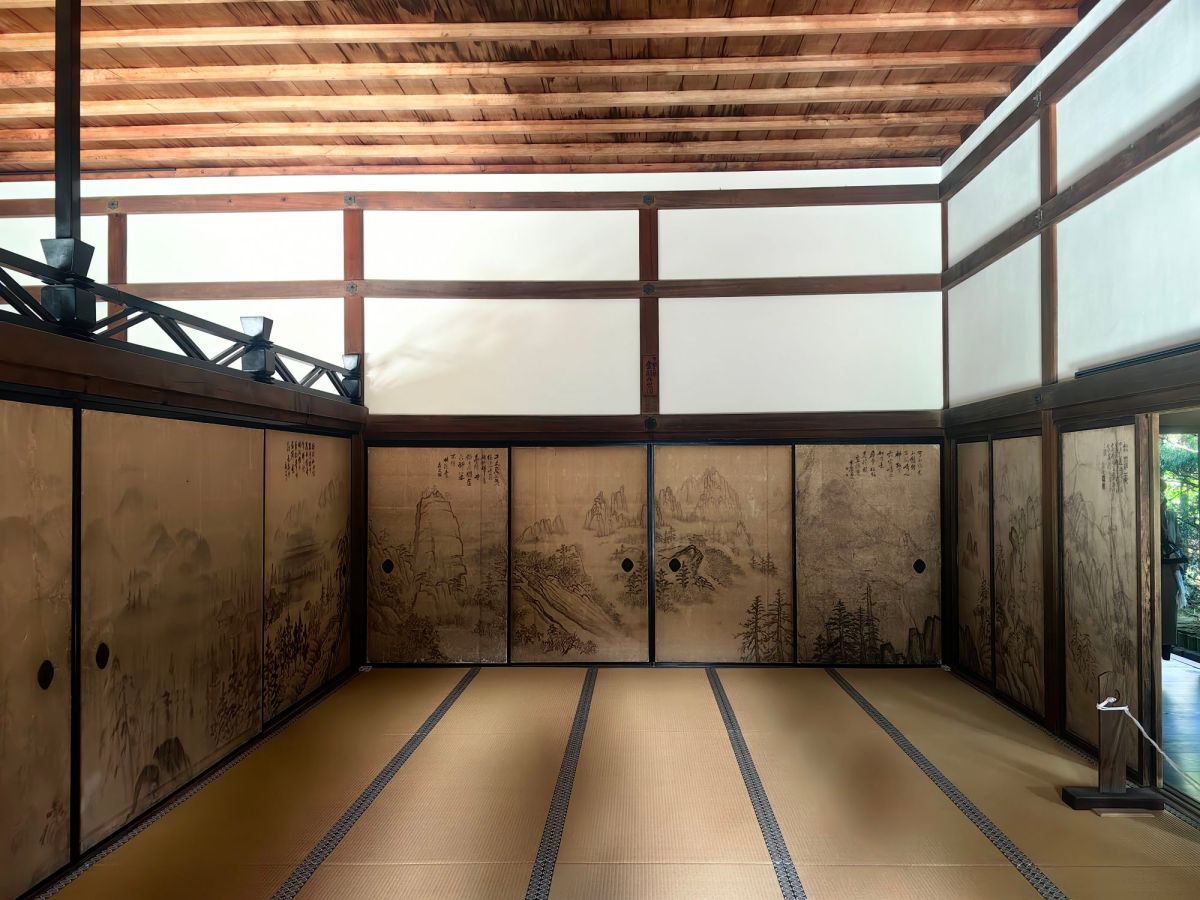
There is a sitting area outside the main hall for visitors to appreciate this special Japanese culture. Sitting quietly before this minimalist composition, I began to appreciate that its beauty lies not in what is present, but also in what is absent: the silence, and the empty spaces. It is a garden that asks for no admiration, yet rewards those who take the time to look beyond its simplicity. In the spirit of Zen, it teaches us that sometimes less is more, and that true beauty can be found in stillness, imperfection and the art of letting go.
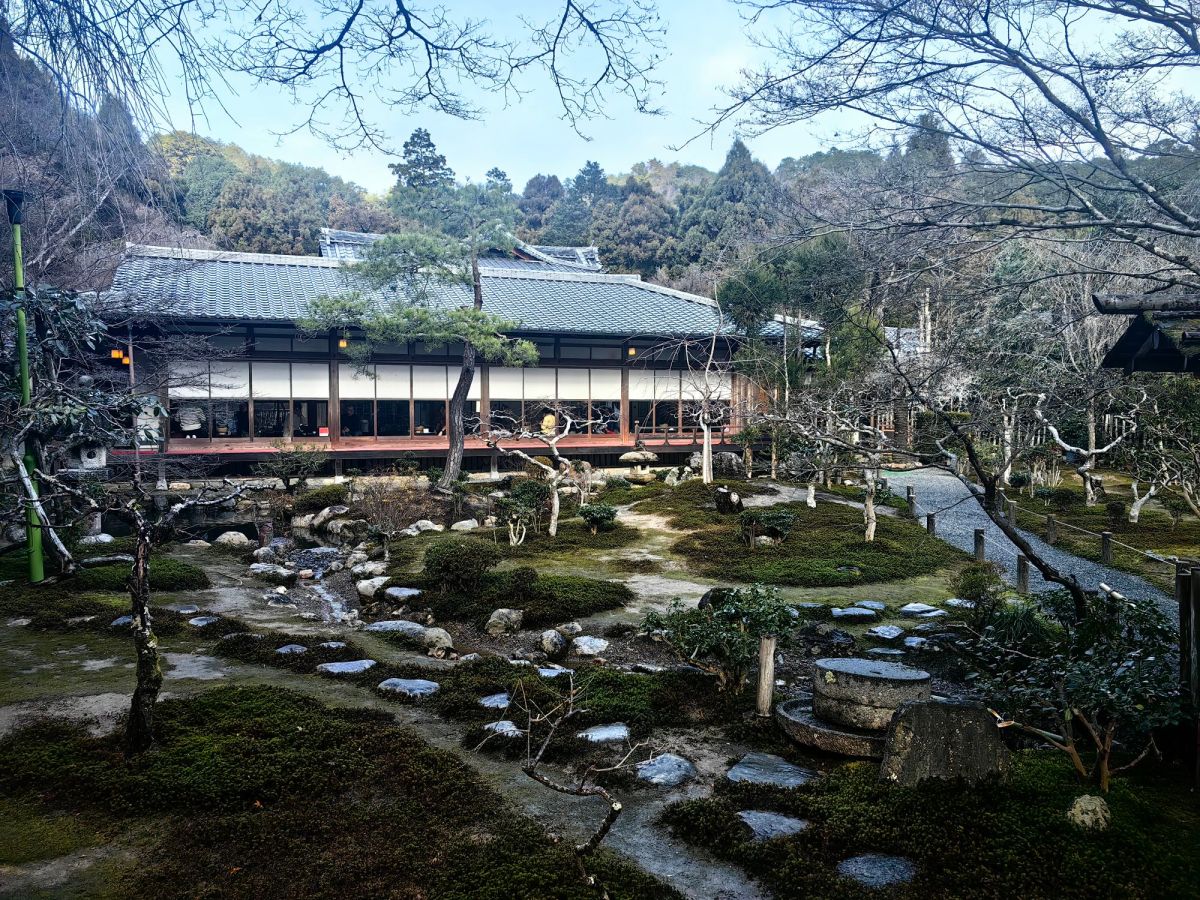
Amid the tranquil surroundings of Ryoan-ji, I discovered a little haven of warmth and comfort at Seigen-in, where a traditional Japanese hot tofu meal offered the perfect respite from the winter chill. This restaurant is surrounded by traditional Japanese landscapes.
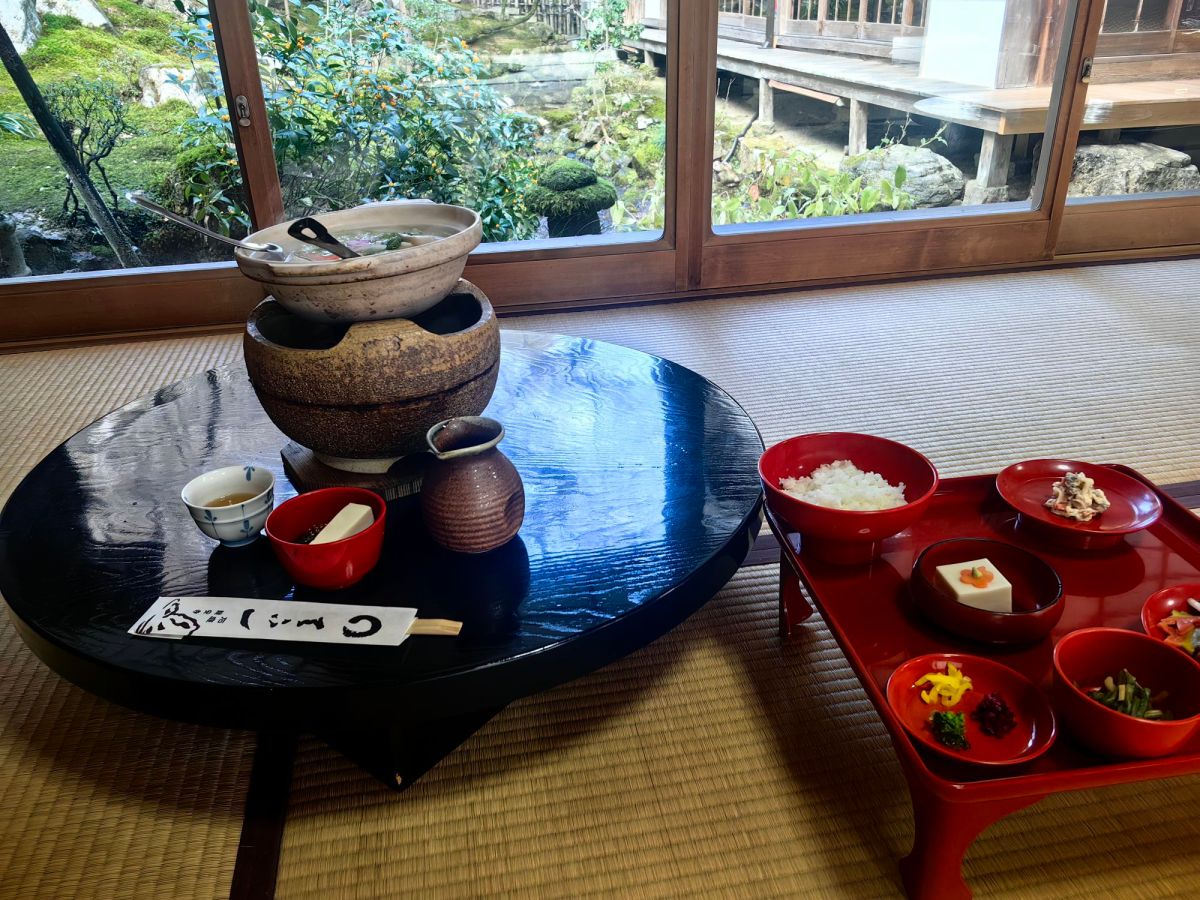
As the gentle steam rose from the pot of silky, delicate tofu, I savoured the simple yet exquisite flavours of Yudofu, accompanied by traditional Japanese delicacies. Through the window, a beautiful garden landscape unfolded like a living painting, with lush trees, tranquil greenery and the quiet elegance of nature. Outside, the winter air whispered through the branches, while inside, the warmth of the meal and the peaceful surroundings wrapped me in a feeling of contentment. A little warmth on a cold winter’s day, a beautiful view beyond the window, and really a moment to treasure long after the journey ends.
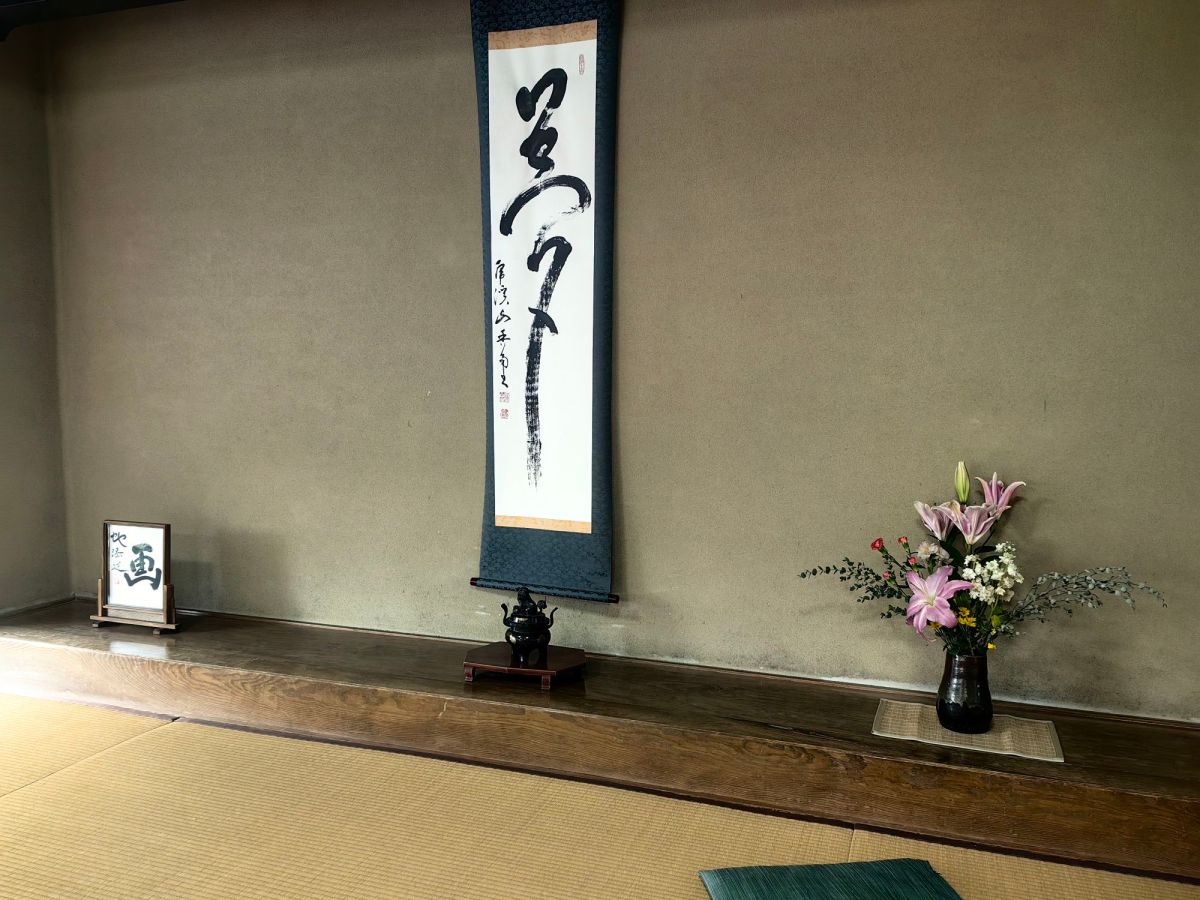
What made the experience even more unforgetable was the traditional Japanese atmosphere that embraced every corner of the restaurant. I particularly loved its inside decorations, from the beautiful calligraphy displayed on the walls to the warm wooden interiors and the delicate tatami flooring, each reflecting the elegance and simplicity of Japanese culture. Before entering the dining area, guests are invited to remove their shoes, a lovely custom that adds a sense of intimacy and respect for the traditional space.
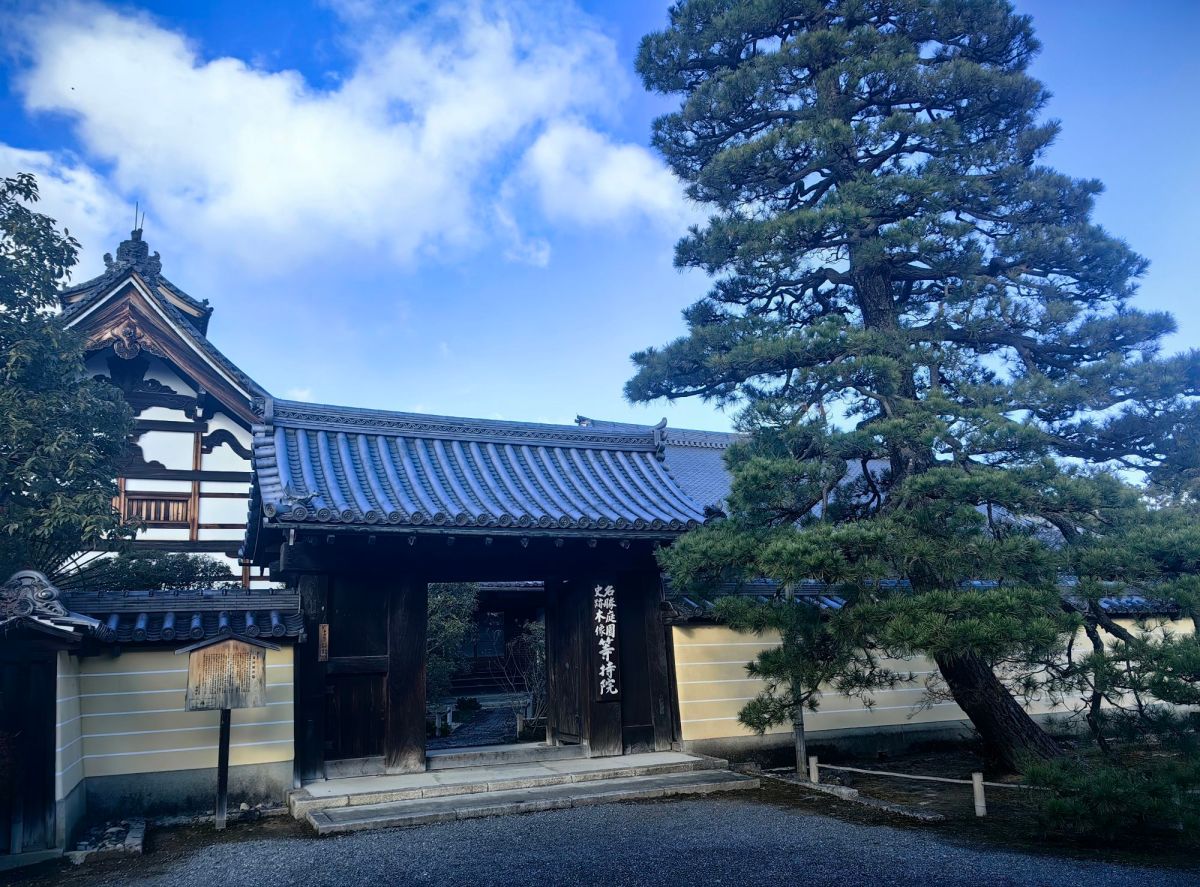
Just south of Ryoan-ji lies Tōji-in, a hidden treasure of Kyoto that became one of the most memorable discoveries of my journey. It was not in my travel plan and I visited it by accident. Founded in 1341 by Ashikaga Takauji, the first shogun of the Ashikaga shogunate, this tranquil Zen temple carries a rich history, yet its greatest enchantment, to me, lies in its magnificent Kaiyūshiki Teien, a traditional Japanese strolling garden.
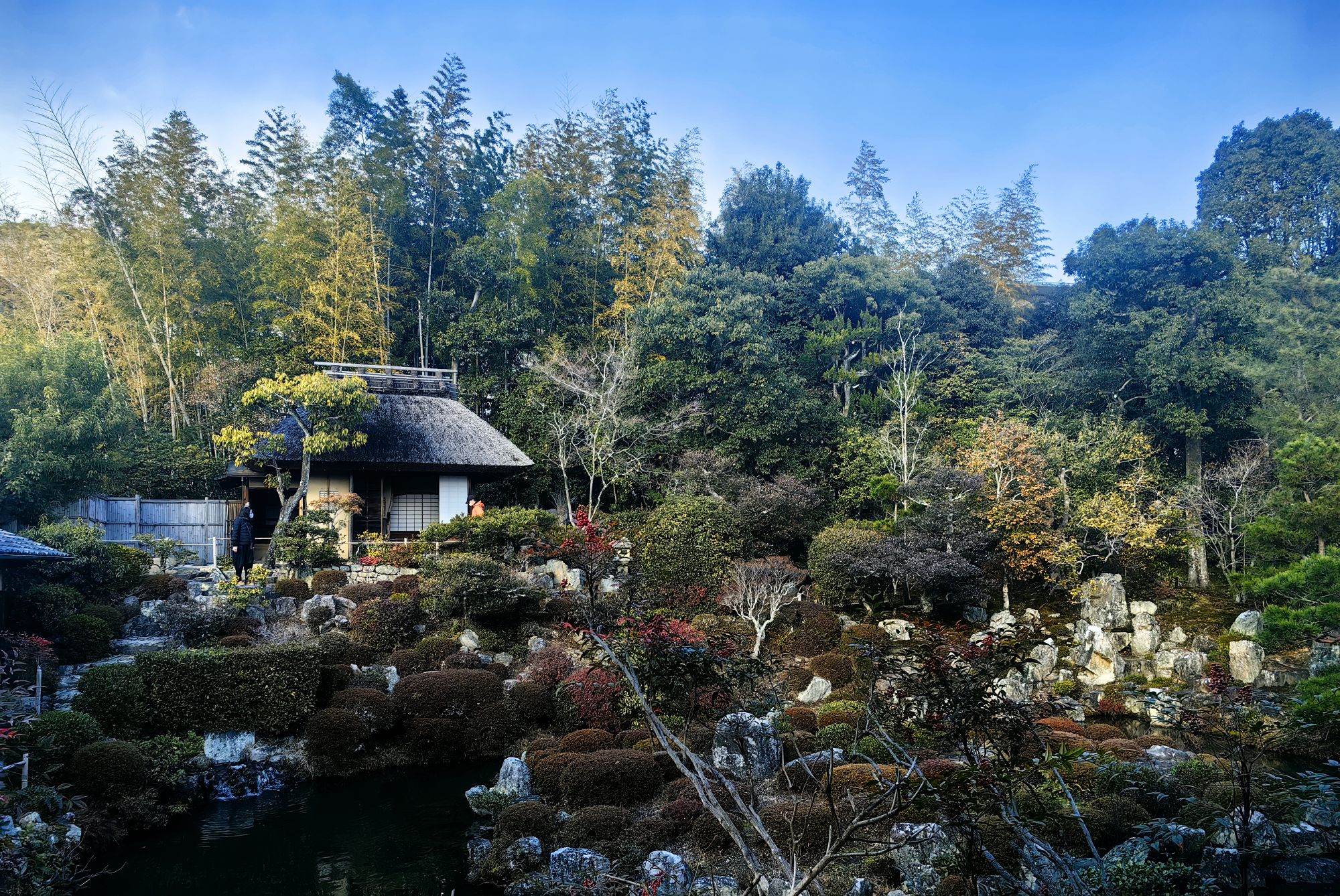
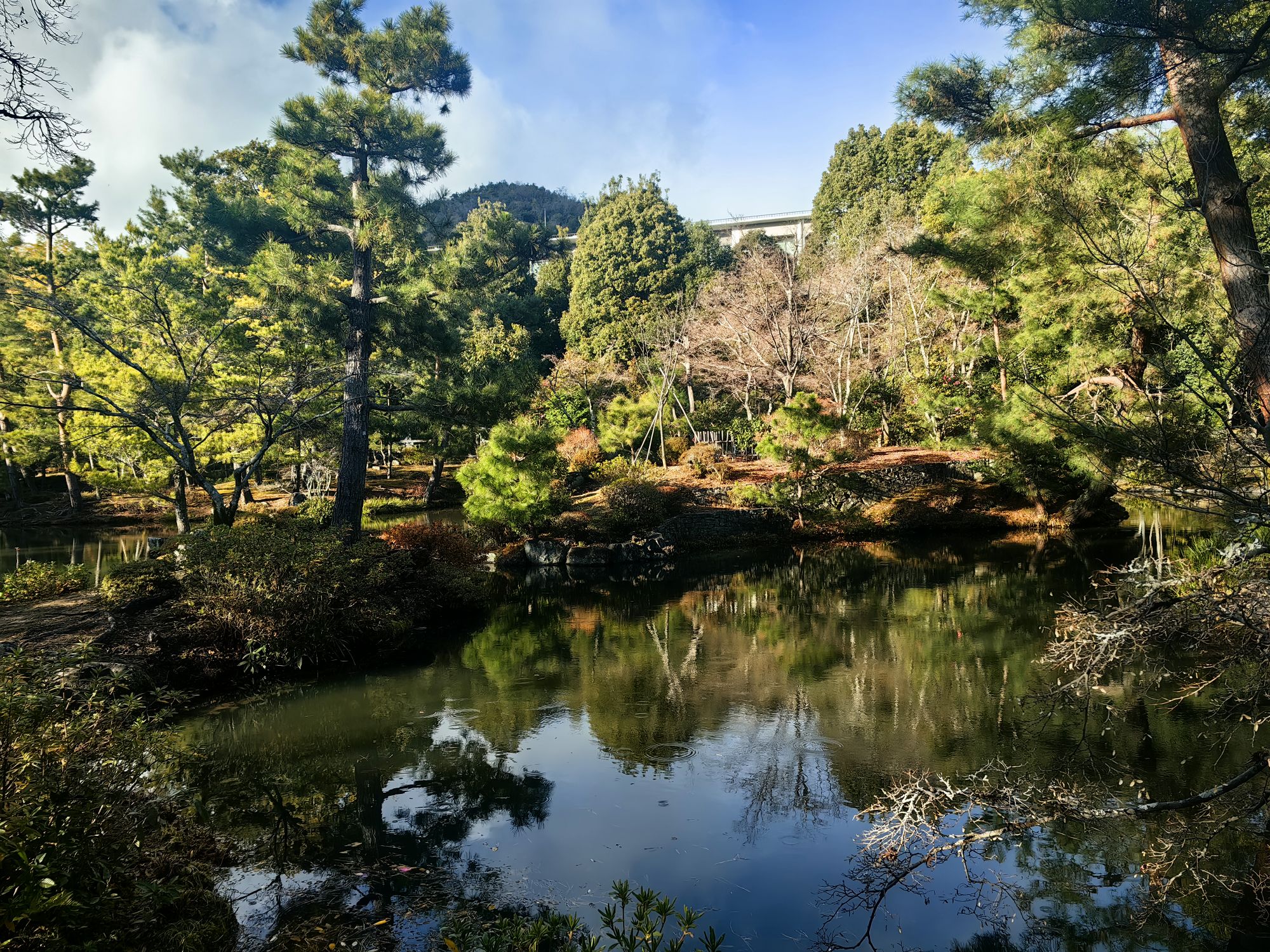
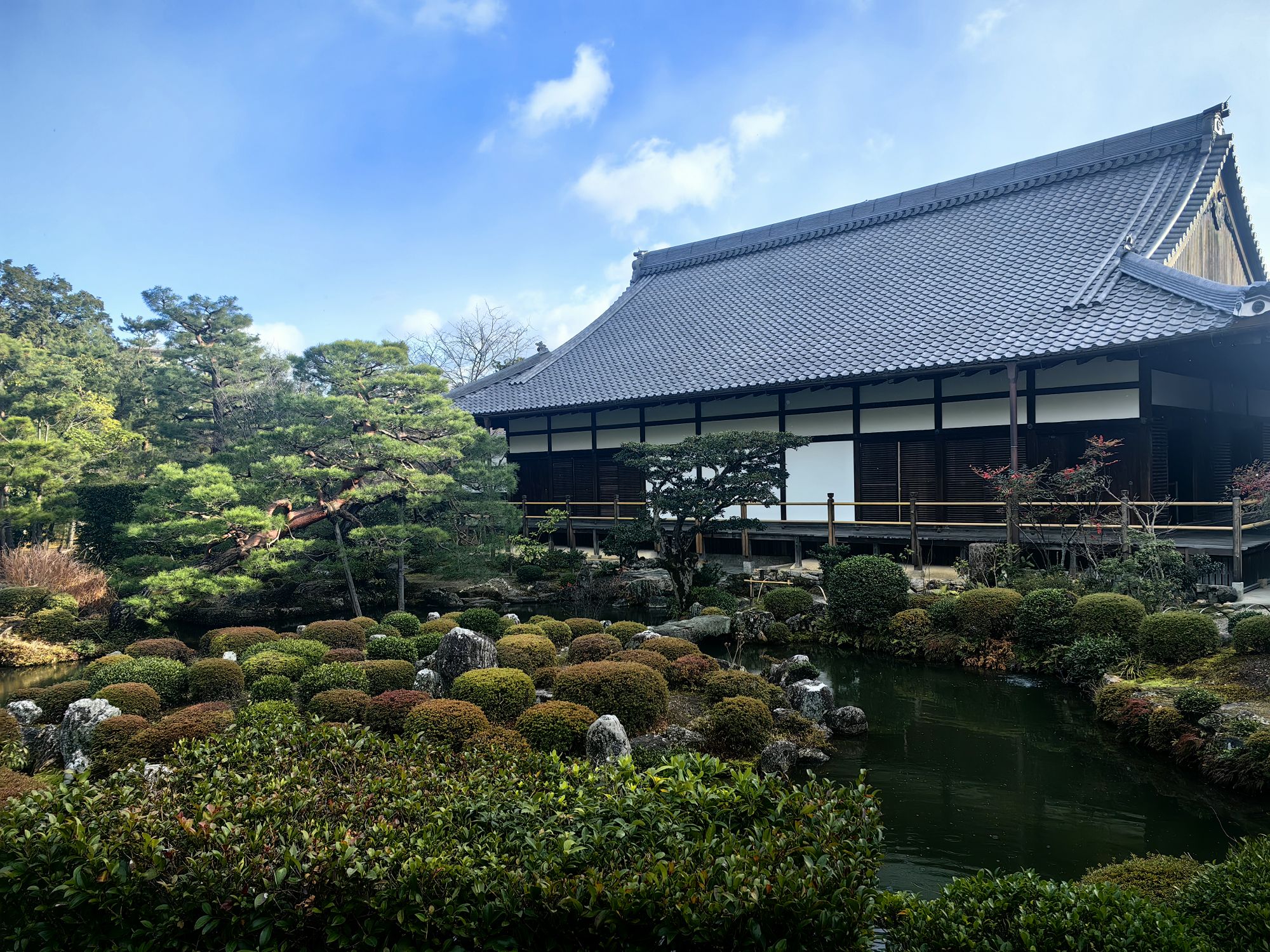
Beautifully designed around tranquil ponds, the garden brings together graceful trees, carefully arranged rocks, lush greenery and delicate seasonal flowers in a harmonious composition. As I wandered along its winding pathways, every turn revealed a new perspective . Sometimes a serene pond reflecting the surrounding foliage, sometimes an elegant bridge or a picturesque view framed by trees. The gentle interplay of water, light and greenery creates an ever-changing landscape, inviting me to slow down and savour each moment. Unlike the minimalist Zen rock garden, this strolling garden celebrates the richness and diversity of nature. I prefered this kind of beauty, the peaceful reflections on the water and the feeling of being immersed in a world untouched by time. Of all the gardens I visited in Kyoto, Tōji-in’s garden may well be my favourite, a place whose quiet beauty has left an especially lasting impression on my heart.
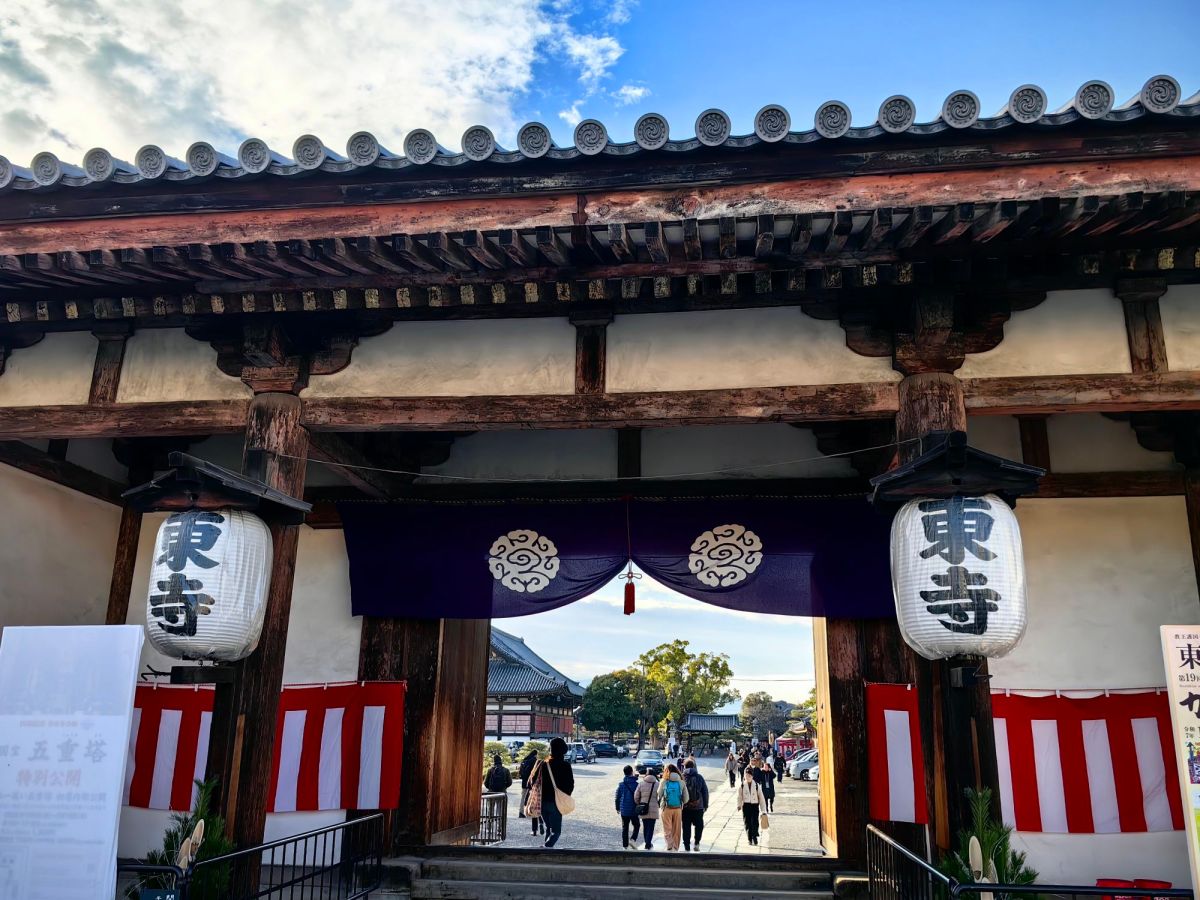
Kyoto has more temples in the north and east mainly because of its geography and historical development. When Kyoto became Japan’s capital in 794, it was designed as a symmetrical city, but the western half was low-lying, damp and marshy, making it less attractive for settlement. The eastern side, with its scenic Higashiyama foothills, attracted aristocrats, wealthy families and Buddhist institutions, leading to the construction of numerous temples. The northern mountains, particularly Mount Hiei, also became important centres of Buddhist learning and spiritual practice. In contrast, the south and west remained relatively less developed, although they still have important temples such as Tō-ji.
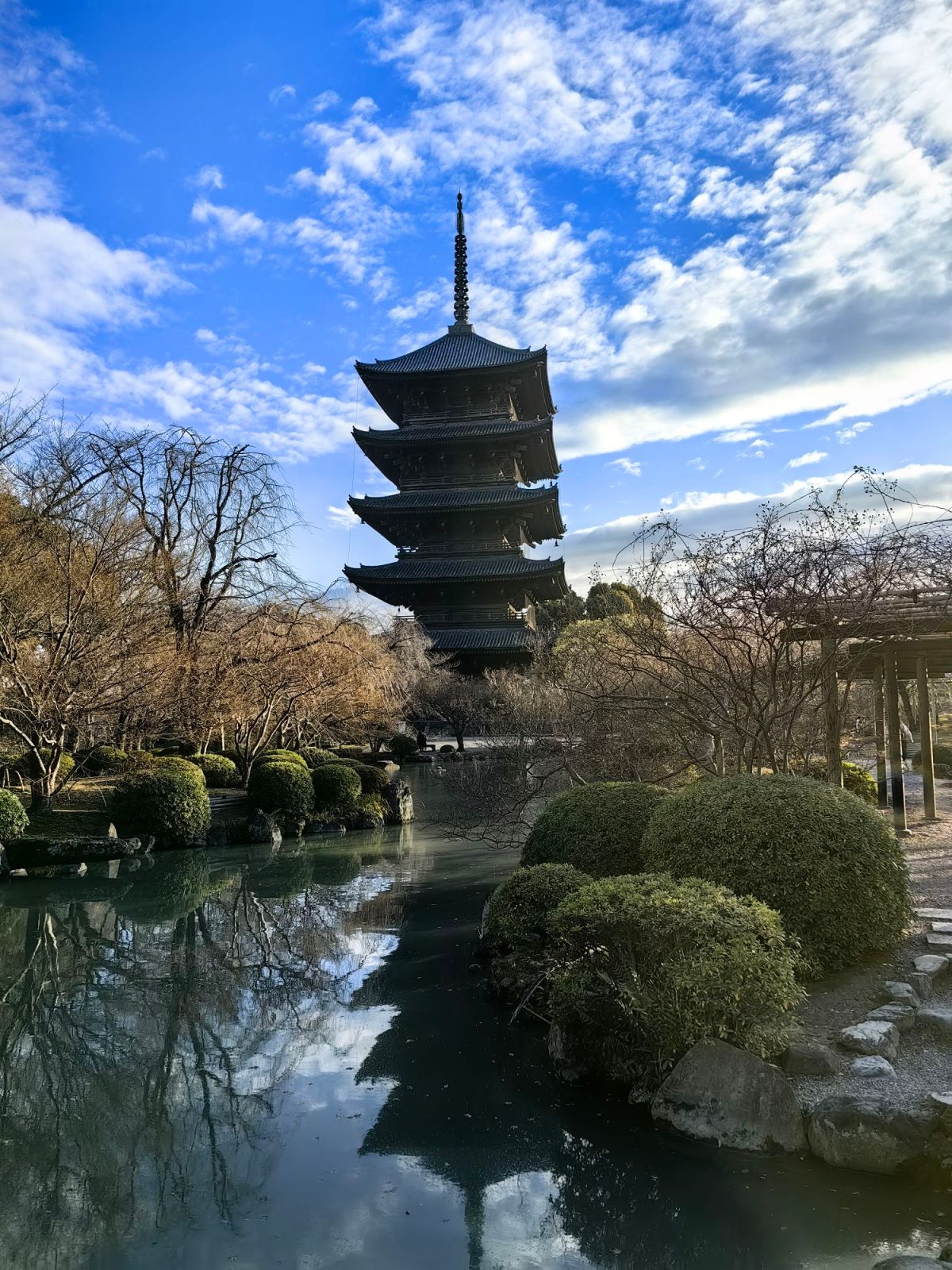
Tō-ji is one of Kyoto’s oldest and most historically significant Buddhist temples, founded in 796, shortly after Kyoto became Japan’s capital. In 823, it was entrusted to the Buddhist monk Kūkai, who established it as an important centre of Shingon esoteric Buddhism. The temple is best known for its magnificent five-storey wooden pagoda, standing 55 metres tall and recognised as Japan’s tallest wooden pagoda. In Japenese culture, each storey symbolises one of the five Buddhist elements: earth, water, fire, wind and space, representing the structure of the universe. Built using traditional Japanese timber construction techniques, the pagoda stands without a central supporting pillar carrying the entire weight of the building in the modern sense; its distinctive central column, known as shinbashira, is an important feature of its earthquake-resistant design.
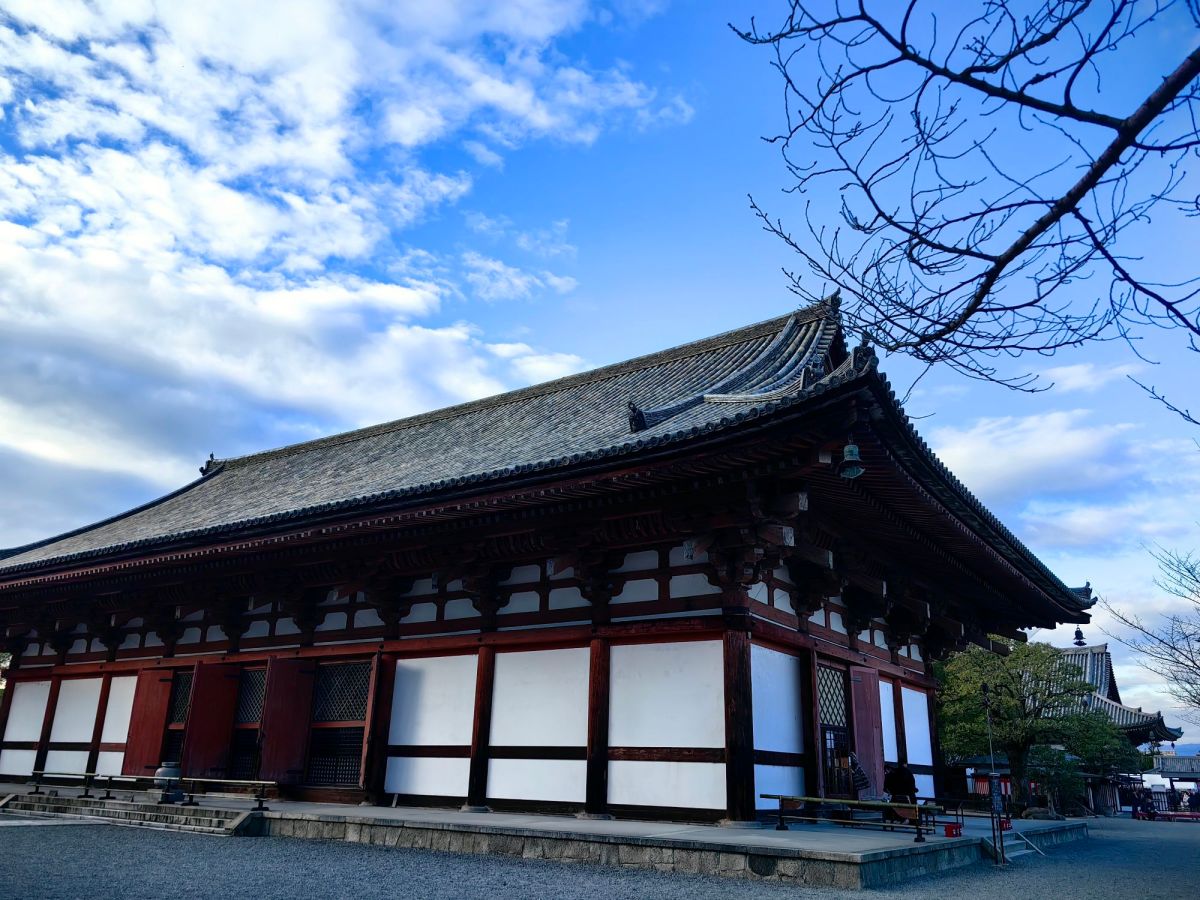
Its Lecture Hall houses an impressive collection of 21 Buddhist statues arranged to represent the Buddhist universe. The statues, many dating from the 9th century, are masterpieces of Japanese Buddhist sculpture and reflect the teachings of Shingon esoteric Buddhism introduced by the monk Kūkai. Unlike many of Kyoto’s temples situated in the northern mountains or eastern hills, Tō-ji stands on flat land in southern Kyoto, reflecting its original role as a guardian temple at the entrance to the imperial capital.
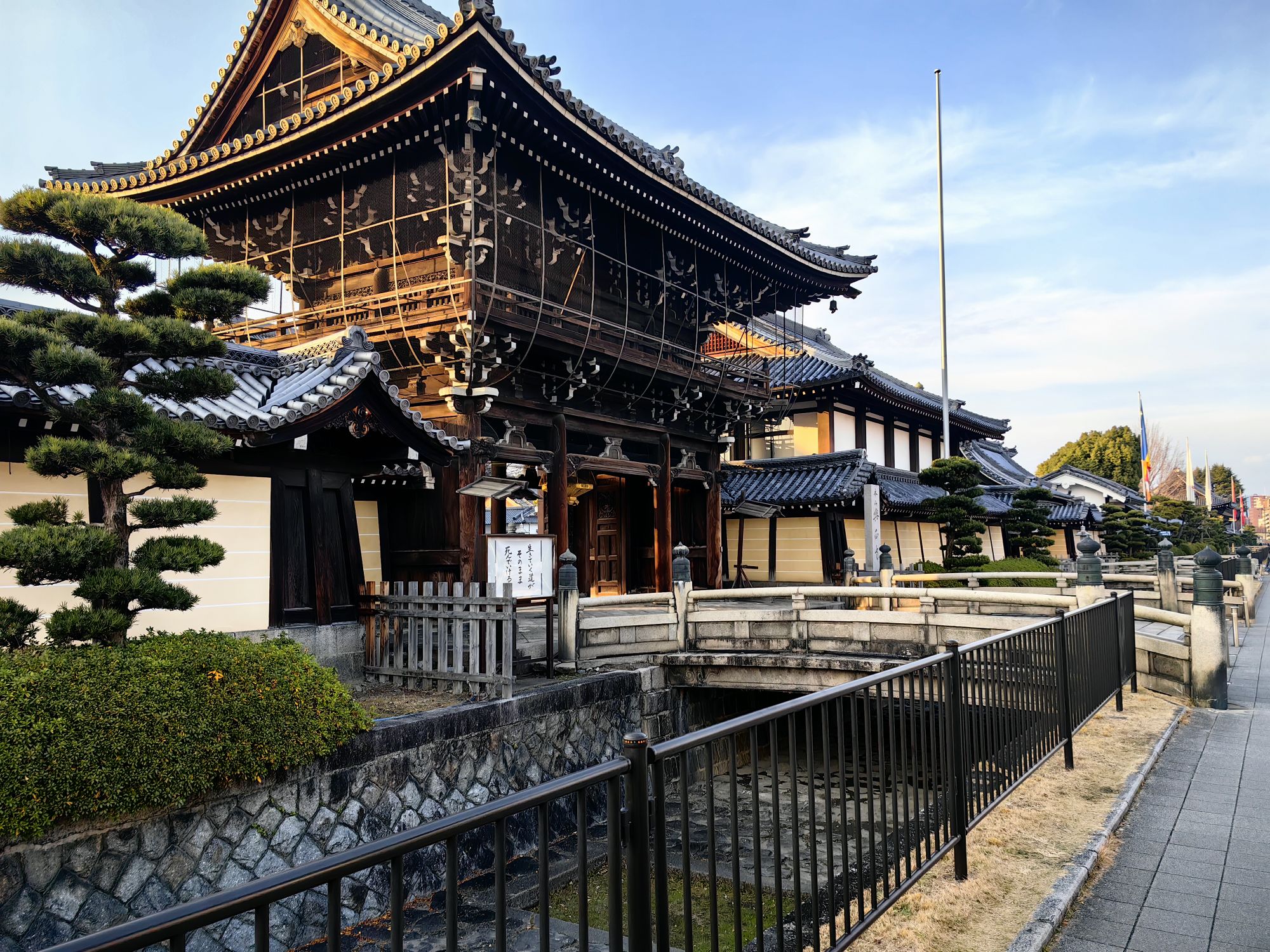
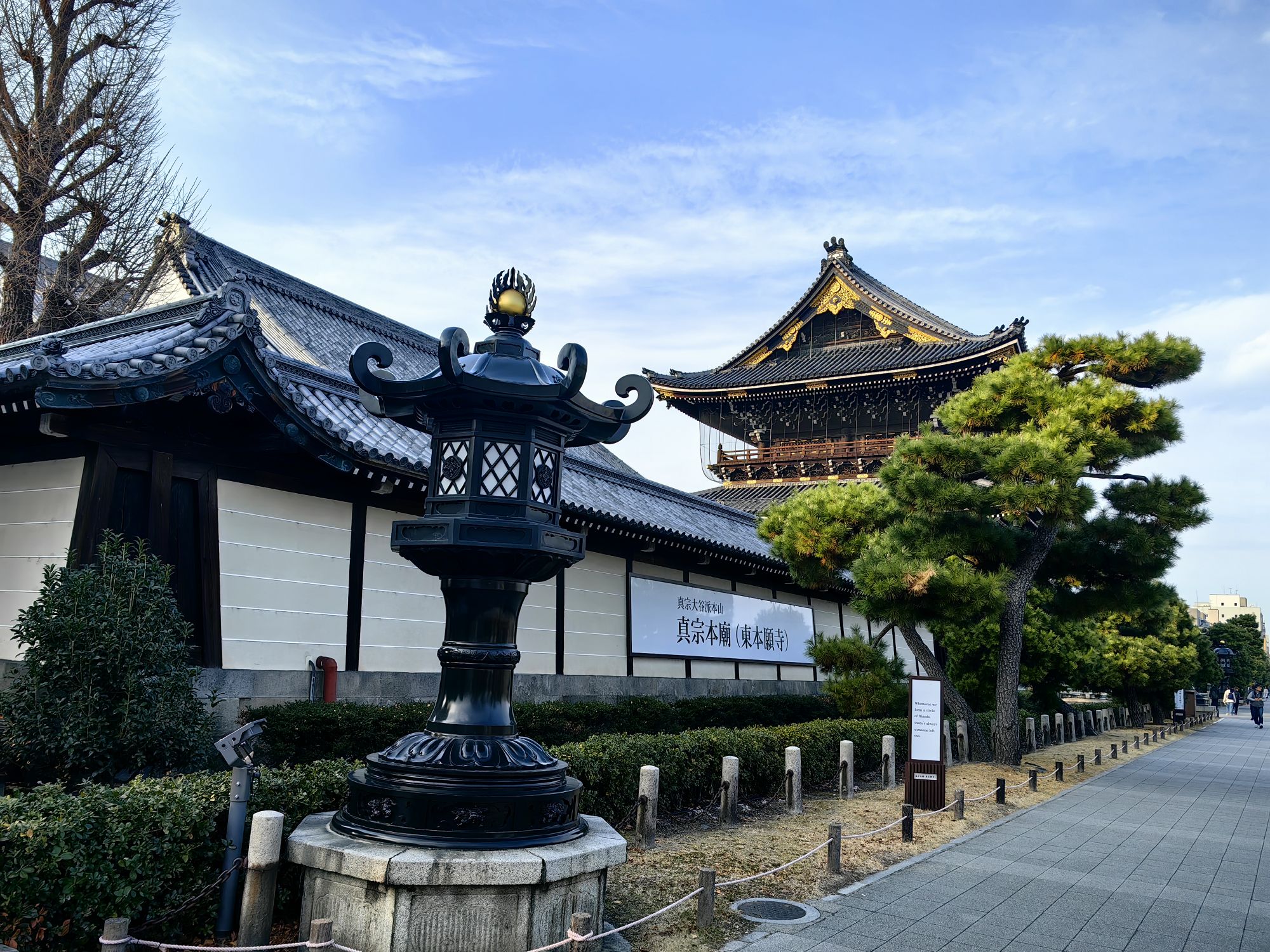
Before I left Tokyo, I visited the two temples with similar names and similar layouts near the train station. Higashi Hongan-ji and Nishi Hongan-ji are two major Buddhist temple complexes in central Kyoto, belonging to separate branches of Jōdo Shinshū (True Pure Land Buddhism). Both trace their spiritual origins to Shinran (1173–1263), whose teachings emphasise faith in Amida Buddha and the aspiration for rebirth in the Pure Land. Originally, there was only one Hongan-ji, but a succession dispute between Shinran’s descendants led to its division. In 1602, Tokugawa Ieyasu supported the establishment of Higashi Hongan-ji to the east, while the original temple became Nishi Hongan-ji to the west. This division also served the shogunate’s political interests by reducing the influence of a powerful Buddhist institution.
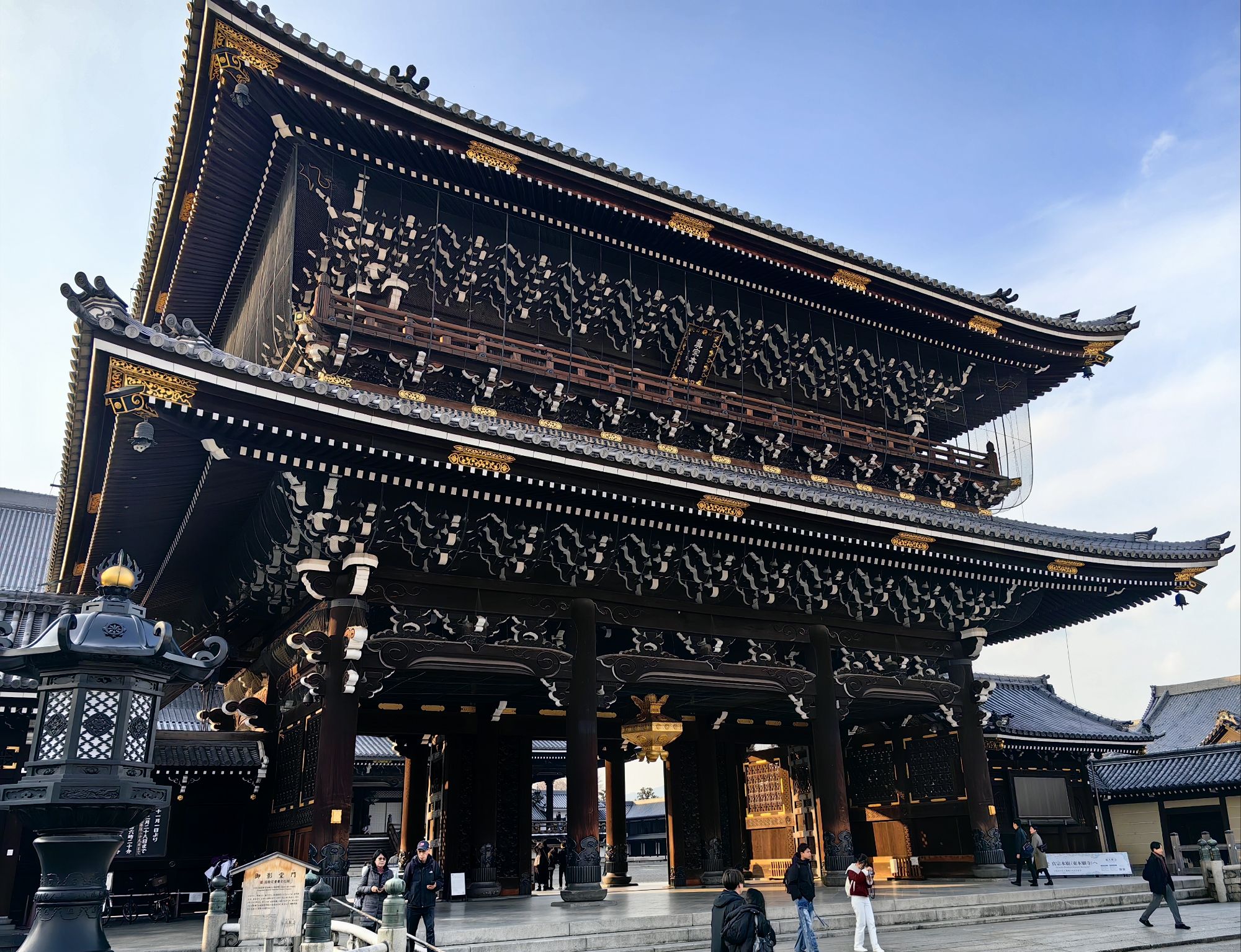
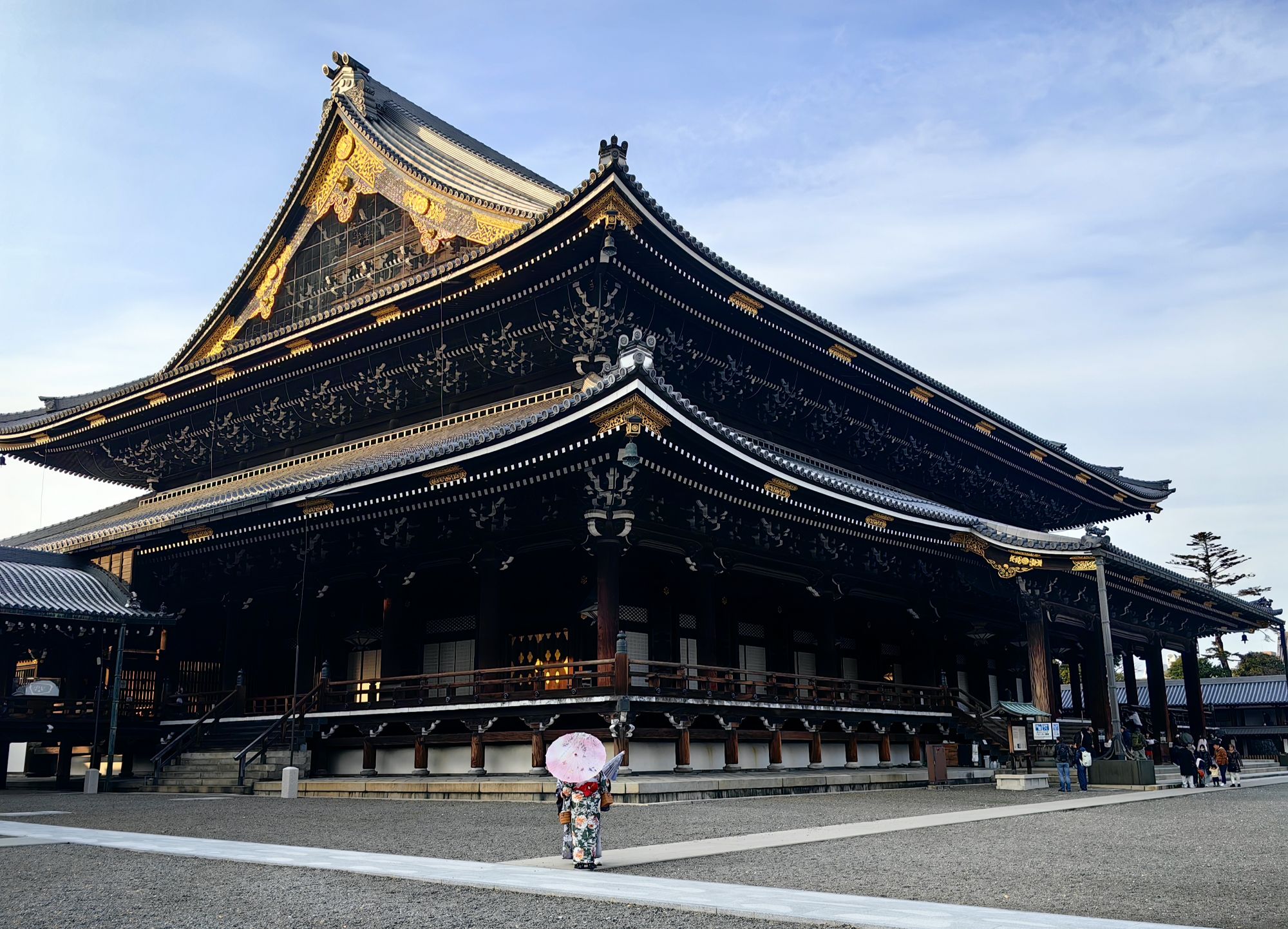
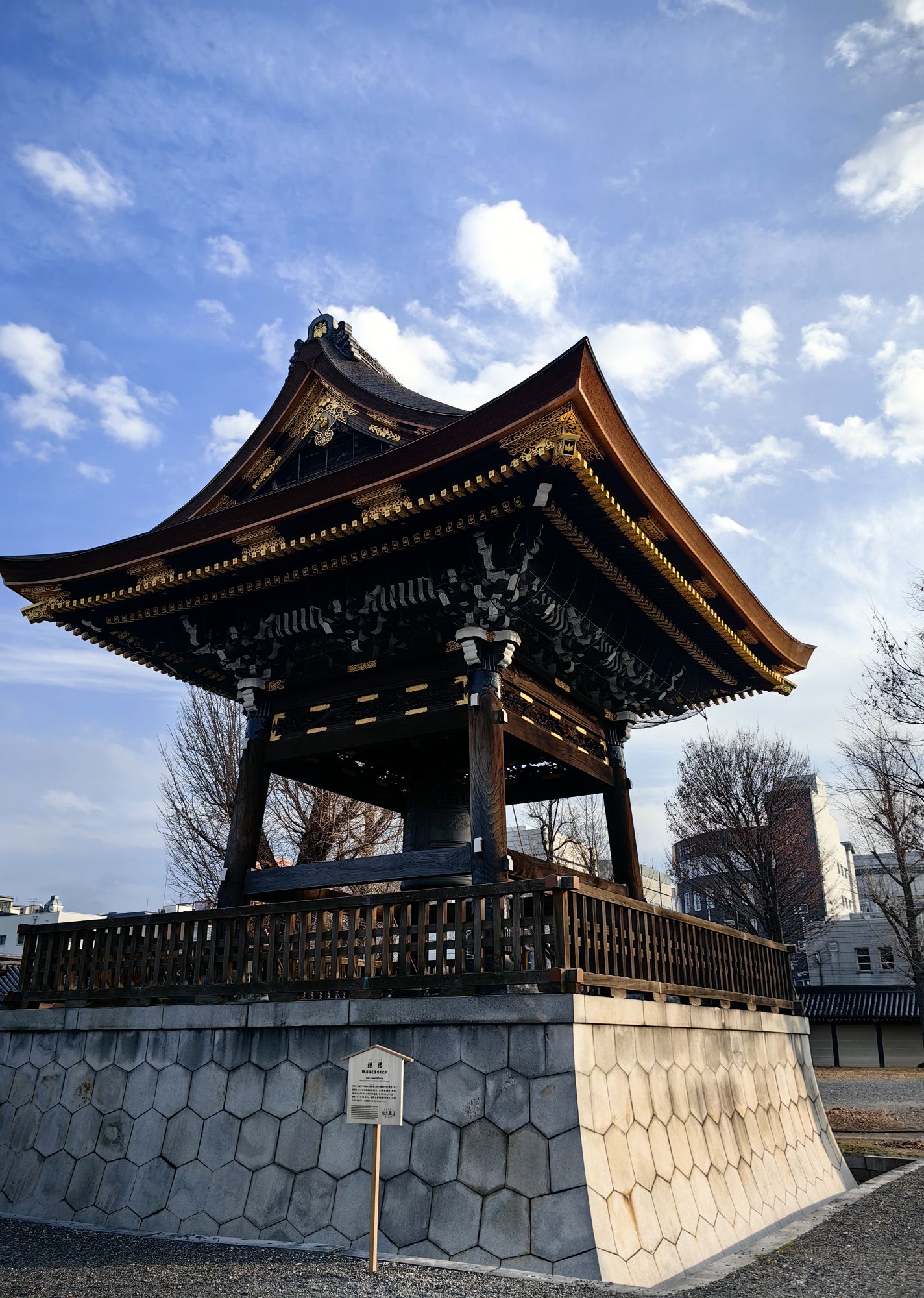
The two temples looked really similar for me. Both have two enormous main halls with same colour and decorations. The Founder’s Hall and Amida Hall are positioned side by side with same layout. Both have impressive ceremonial gates, bell towers, and large open courtyards. Although both temples use similar architectural arrangement, but they are not symmetrical or exact mirror images.
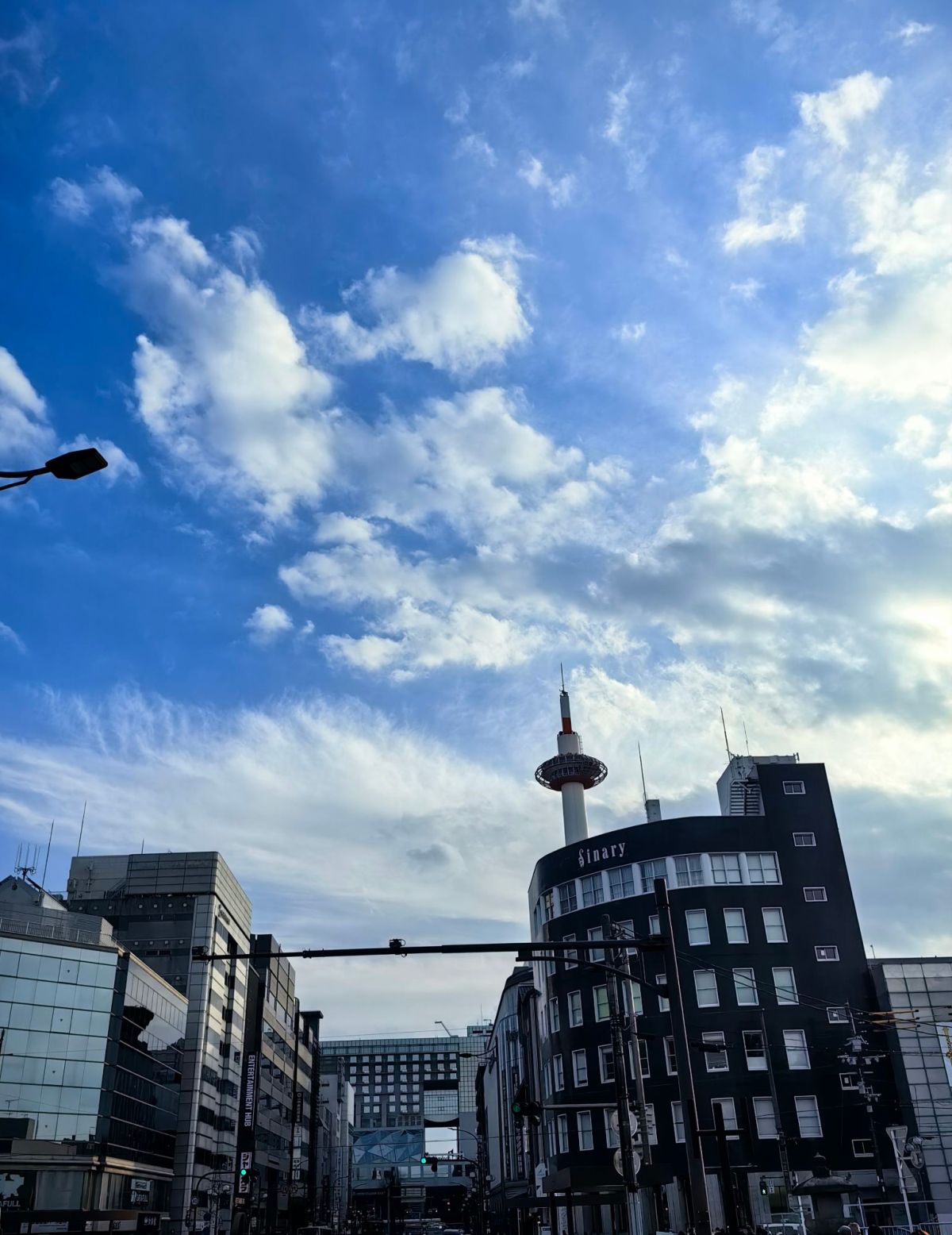
Among the many photographs I have taken of Kyoto’s ancient temples, shrines, traditional streets and historical architecture, this is perhaps the only one that captures its modern face. Taken in front of Kyoto Station, with the towering Kyoto Tower rising prominently in the background, it offers a glimpse of a different Kyoto, a modern, vibrant city that has evolved with the times while preserving its remarkable historical heritage. Two contrasting faces of Kyoto, both equally fascinating.
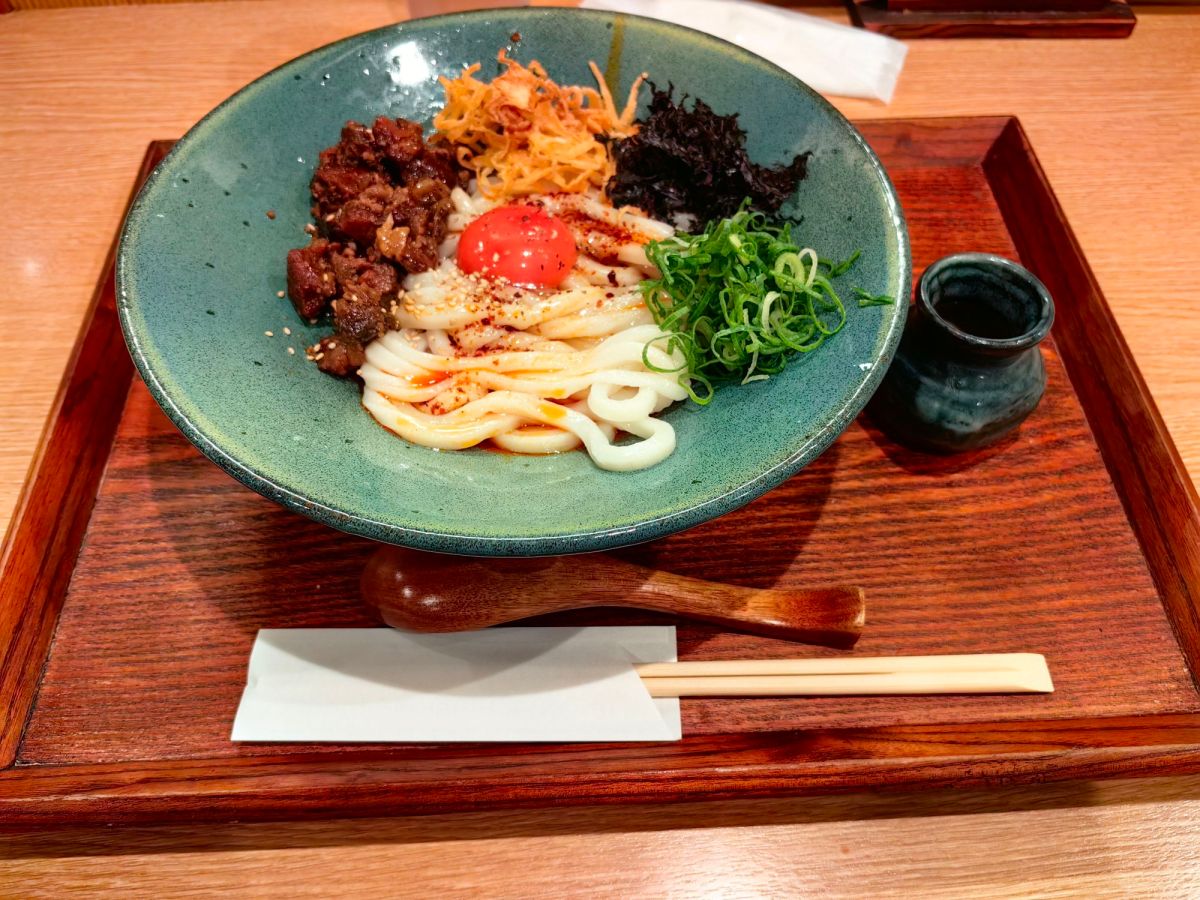
During my trip in Kyoto, I have tasted many traditional Japanese food. Among them, I still remember the udon I enjoyed in Gion. It looked like the Chinese dry mixed noodles and was served without soup, with the freshly boiled noodles drained and tossed in a savoury sauce until evenly coated. The thick, chewy udon noodles absorbed the rich flavours of the sauce and were topped with chopped green onions, minced meat and vegetables, adding freshness, texture and a satisfying savoury taste. Unlike the more familiar udon served in a hot broth, this dry-style preparation allowed the flavours of the sauce and toppings to shine through, making it a comforting and hearty meal after a day of exploring Kyoto’s historic streets and temples.

The yakitori I enjoyed in a small local restaurant in Japan left a particularly deep impression on me. Unlike dining in a formal restaurant, the experience was wonderfully intimate and authentic. The chef grilled the skewered chicken and other ingredients right in front of me, carefully turning them over the hot charcoal until they were beautifully cooked, lightly charred and infused with a smoky aroma. As each skewer was ready, the chef would pass it directly to me, allowing me to enjoy it piping hot and fresh off the grill. The simple preparation, delicious flavours and personal interaction made the meal especially memorable. It was not just about the food, but also about experiencing the warmth, simplicity and charm of everyday Japanese dining in a neighbourhood restaurant.
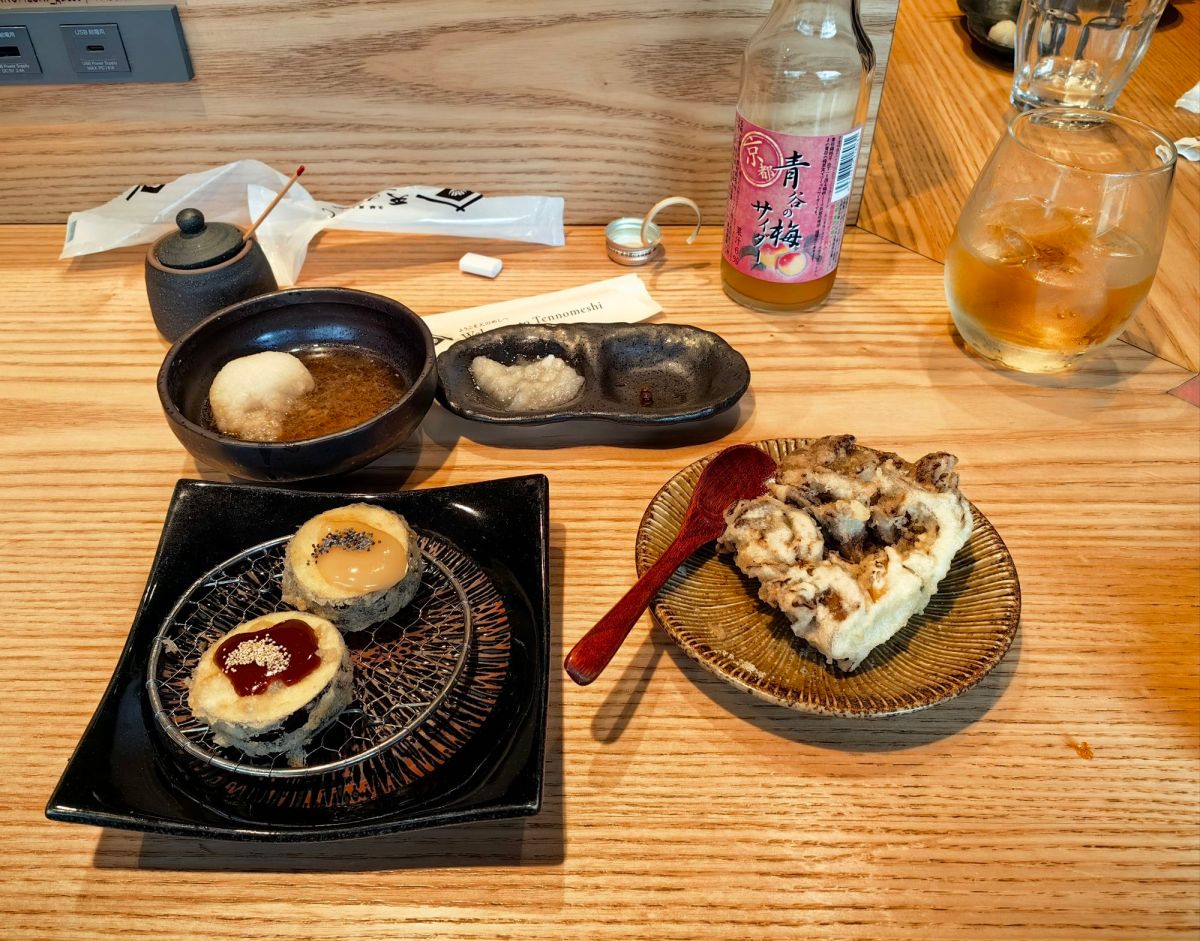
For the formal dinner, it was a delightful experience to taste a set menu of freshly prepared Japanese tempura. Rather than serving everything at once, each piece was deep-fried and presented individually, allowing me to appreciate the delicate batter, crisp texture and natural flavours of the ingredients while they were still hot. Ingredients used for making tempura include shrimp, squid, mushrooms, sweet potatoes, pumpkin, eggplant, and zucchini. The tempura was accompanied by a specially prepared white carrot-based dipping sauce, which was surprisingly refreshing and complemented the light, crispy coating beautifully. The meal was further enhanced by a glass of Japanese umeshu, whose gentle sweetness provided a lovely accompaniment to the tempura.
I think an interesting trip to Japan would not be complete without experiencing both its humble street food and more formal dining. The small local eateries offer an authentic taste of everyday Japanese life. On the other hand, a formal Japanese dinner introduces a different dimension of its food culture, with carefully prepared dishes, artistic presentation, seasonal ingredients and attentive service.
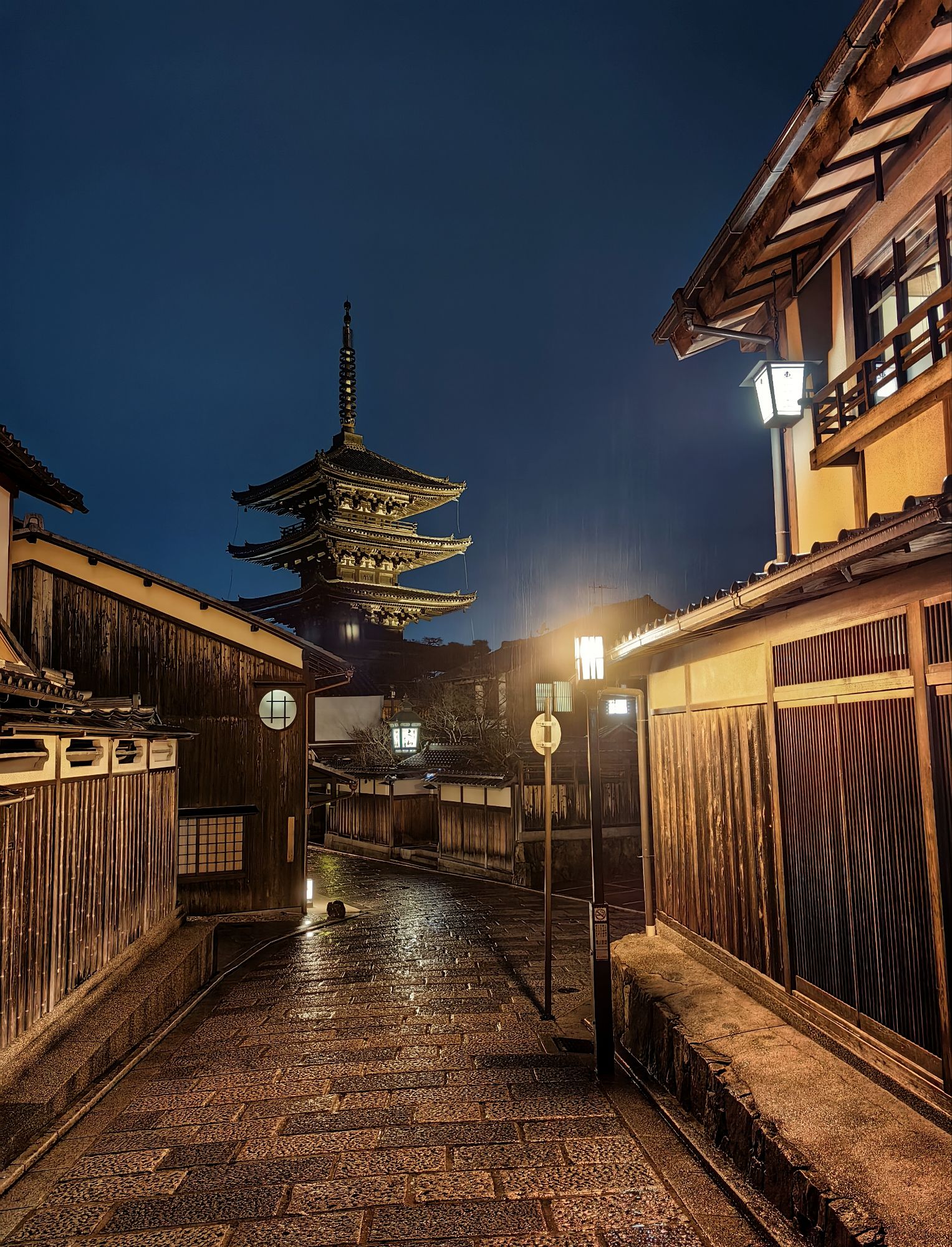
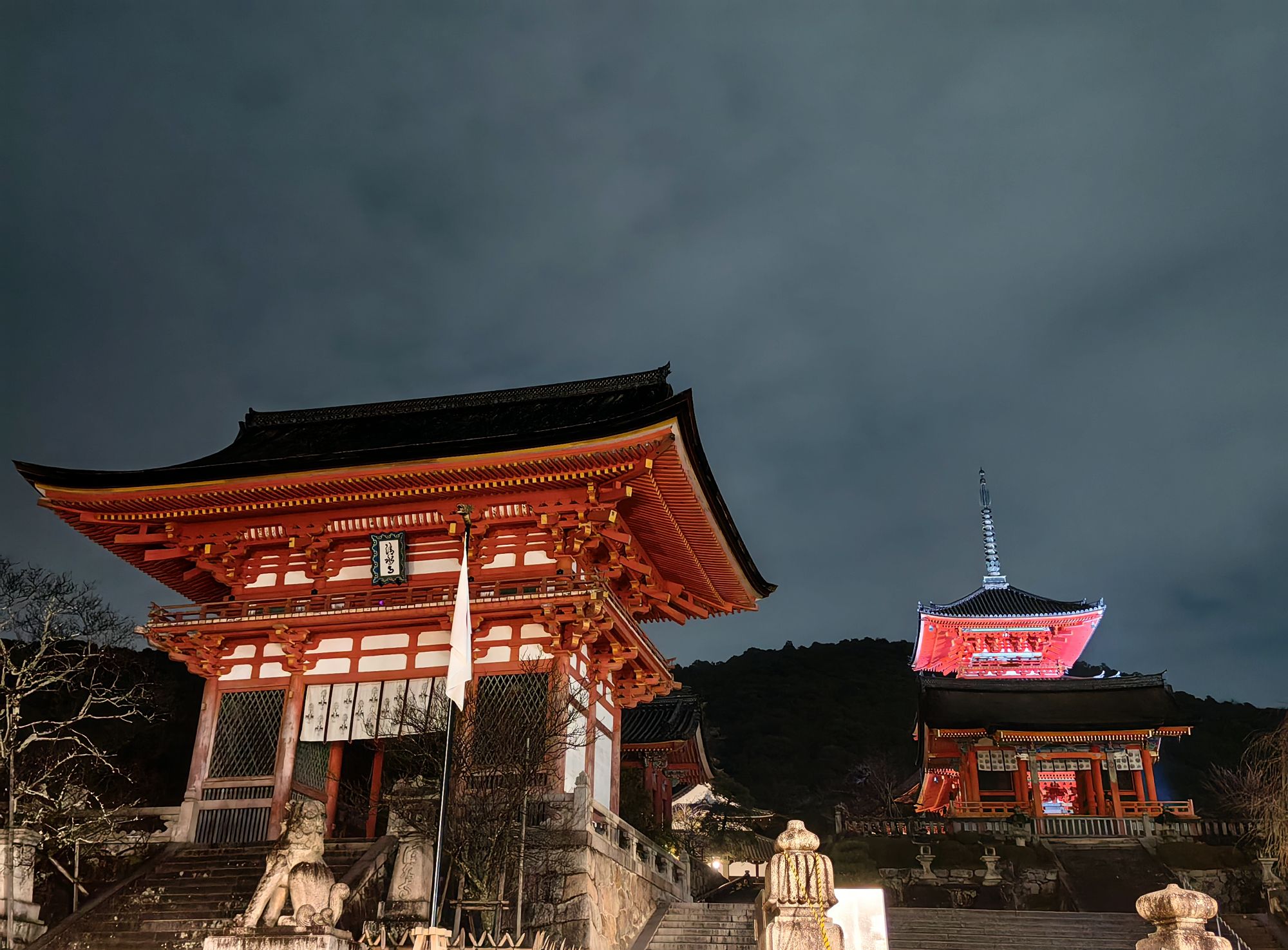
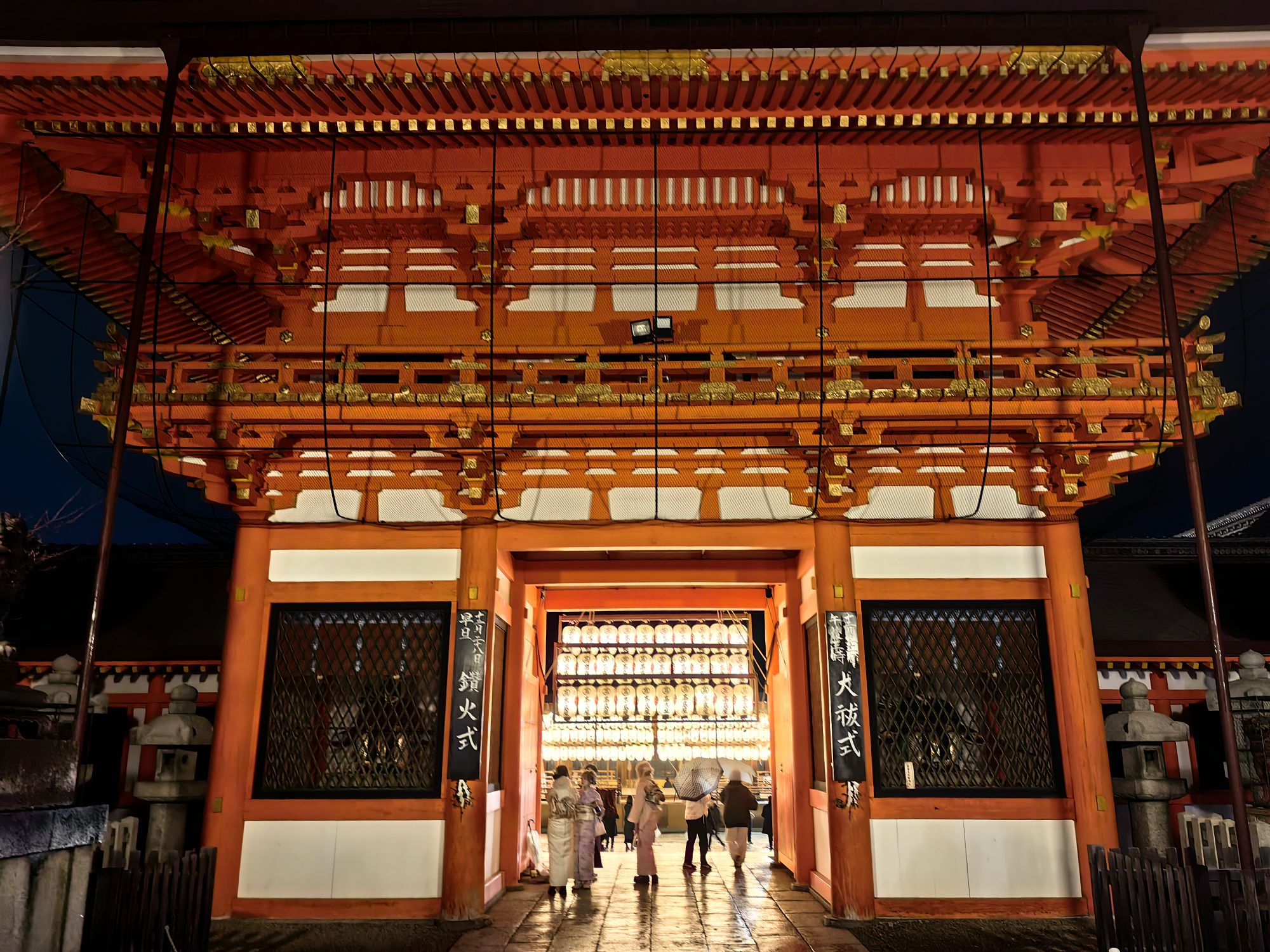
Most of my photographs of Kyoto were taken during the daytime, when the temples, shrines, gardens and historic streets were filled with visitors. Yet I found the city equally extraordinary after nightfall. As darkness settled over Kyoto, the streets gradually became empty, and the temples and traditional buildings seemed to return to their original atmosphere. Without the crowds, the familiar streets took on a completely different character. The quiet lanes, old wooden houses, tiled roofs and softly illuminated temples revealed a more intimate side of the ancient capital, allowing me to imagine what the city might have looked like in another time. I took these nighttime photographs shortly before leaving Kyoto. Looking back, they became my final impressions of the city, and perhaps some of the most memorable ones.
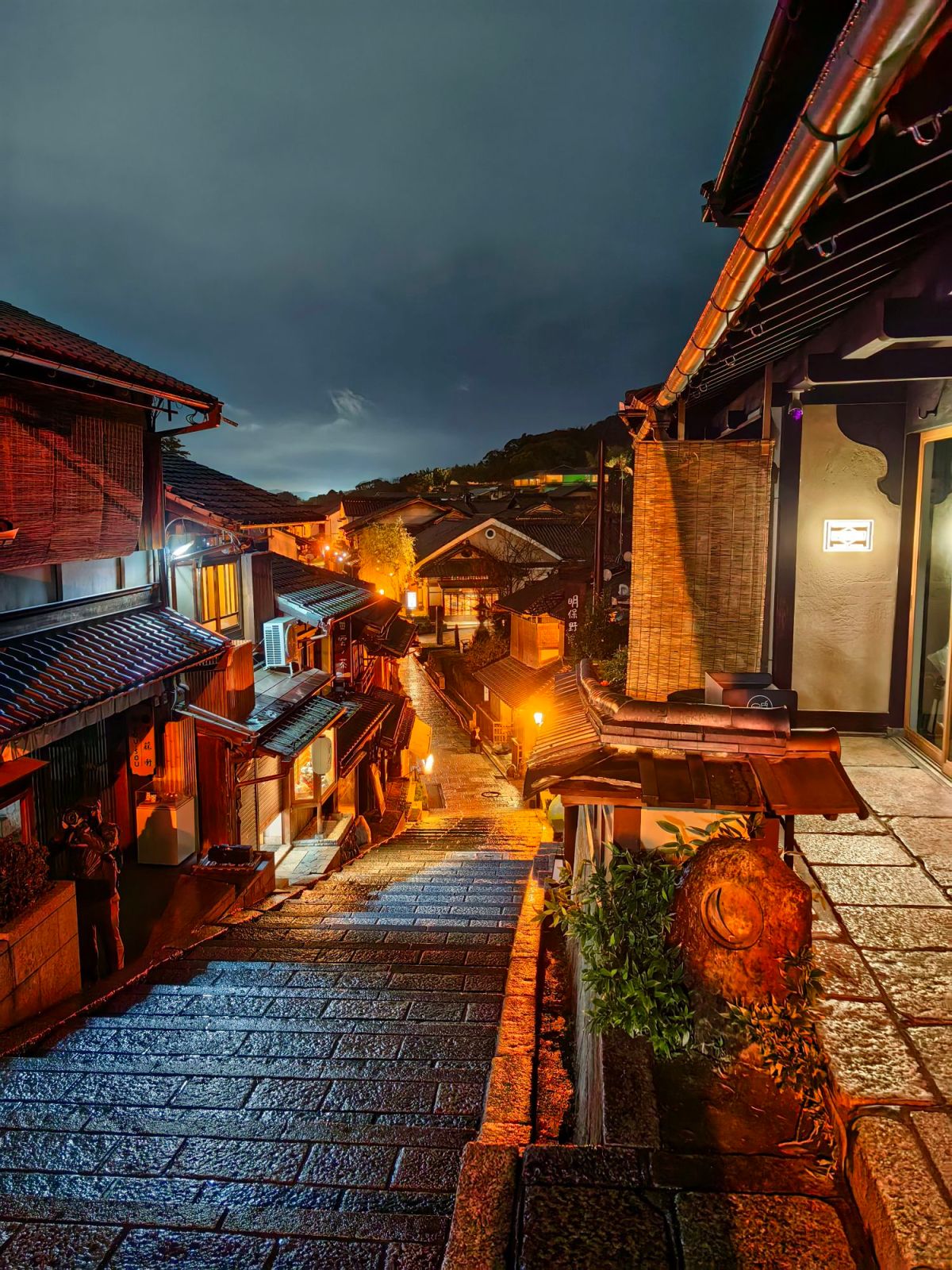
Among all the places I visited in Japan, Kyoto remains the city that, to me, most fully represents traditional Japanese culture. Its temples and shrines preserve centuries of religious history; its gardens express a distinctive appreciation of nature and simplicity; its wooden townhouses, narrow streets and traditional architecture retain the atmosphere of an older Japan. At the same time, Kyoto is not simply a city frozen in the past. Modern life continues alongside these historical surroundings, creating a remarkable continuity between tradition and the present. It had given me a deeper appreciation of Japanese history, aesthetics and cultural identity. Those quiet nighttime streets were the last images I carried away with me, and they made saying goodbye to this ancient city all the more difficult.

