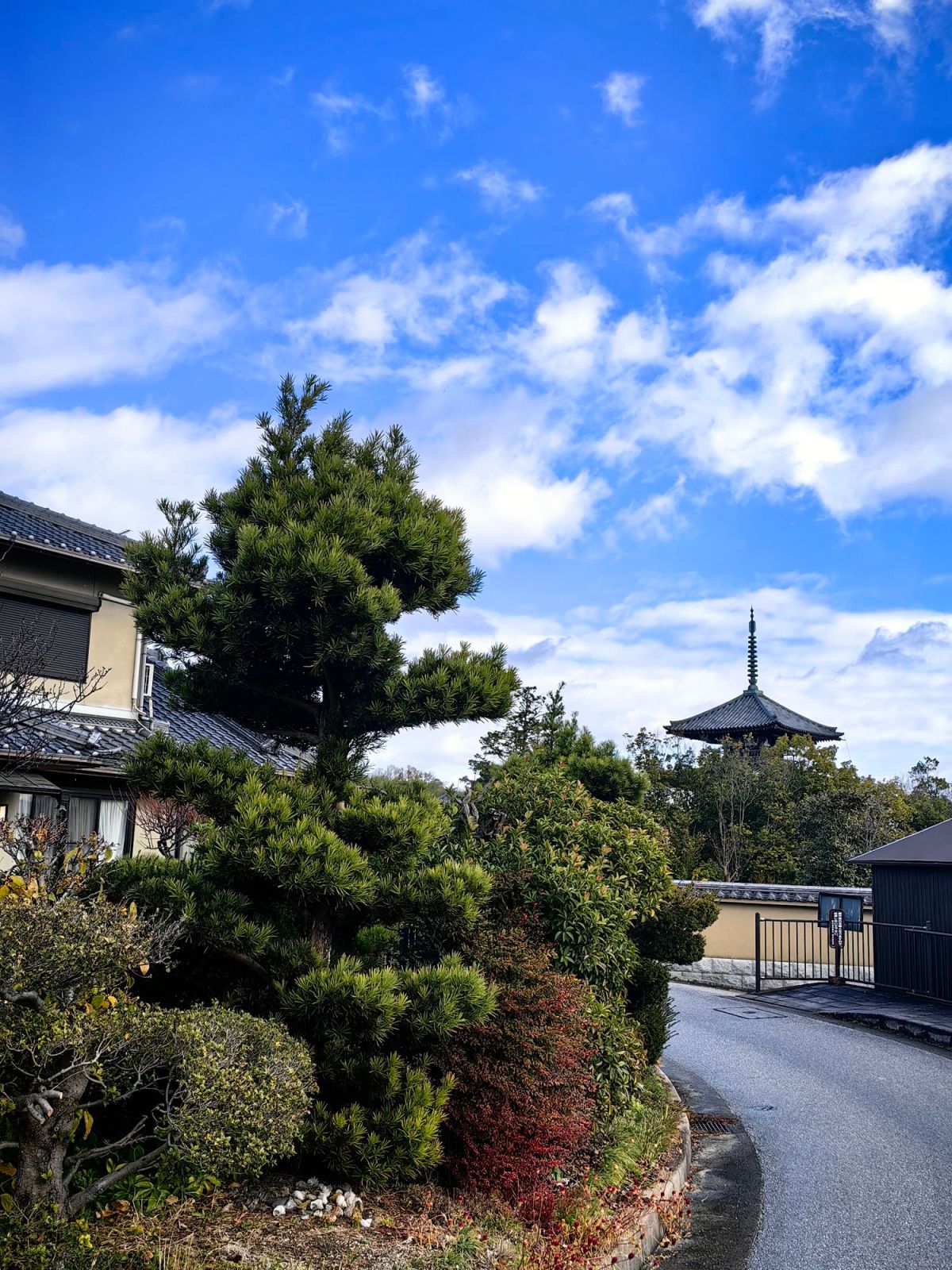
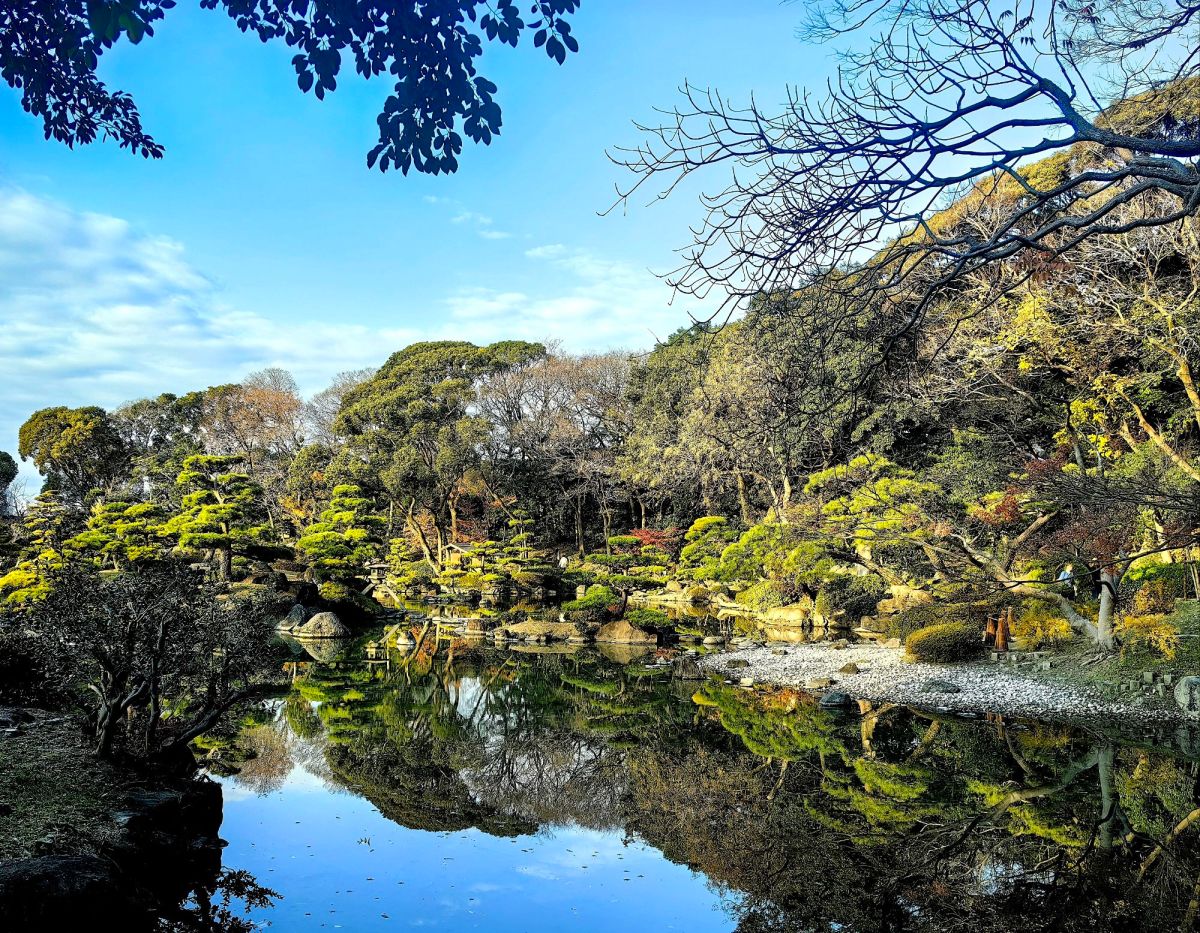
Ikaruga is a historic town near Nara, known for its important role in the early development of Buddhism and Japanese culture. The town is home to Hōryū-ji, one of Japan’s most significant ancient Buddhist temples. Founded in the early seventh century and closely associated with Prince Shōtoku, Hōryū-ji preserves some of the oldest surviving wooden structures in the world. In 1993, the Buddhist Monuments in the Hōryū-ji Area were inscribed on the UNESCO World Heritage List. The site was recognized for its exceptional wooden architecture, its importance in the history of Buddhism in Japan, and the way its buildings demonstrate the adaptation of Chinese Buddhist architectural traditions to Japanese culture.
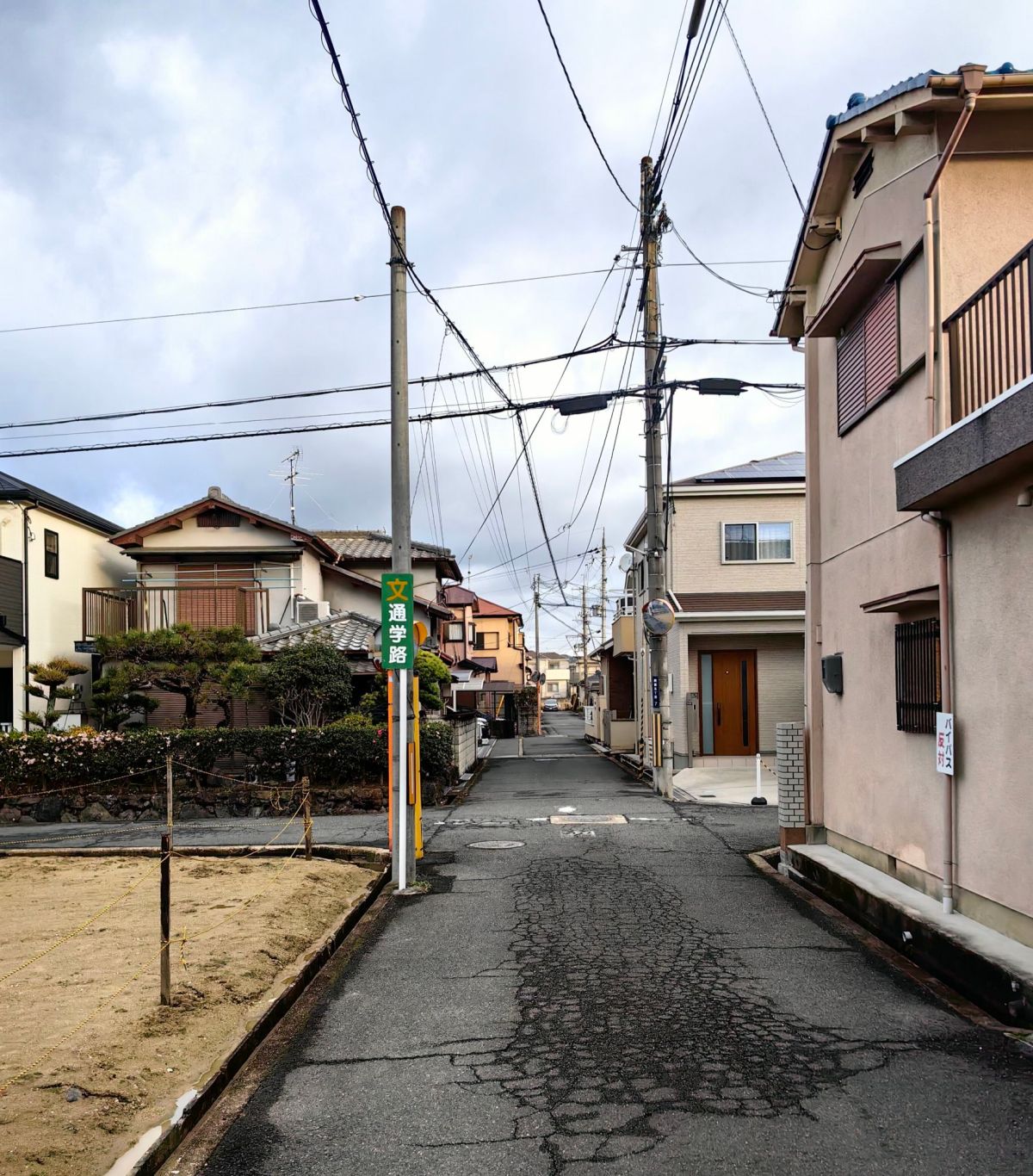
I travelled to Ikaruga in the early morning of December 2025, arriving while the town was still wrapped in the quietness of the beginning of the day. Unlike the busy streets of Osaka, Ikaruga felt almost completely removed from the rhythm of a modern tourist city. There were few people on the streets, little traffic, and hardly any of the noise. The town itself was modest and unassuming. Small, individually built houses stood closely along narrow streets, their tiled roofs and weathered walls softened by the pale winter light. Some houses had small gardens enclosed by low walls or wooden fences.
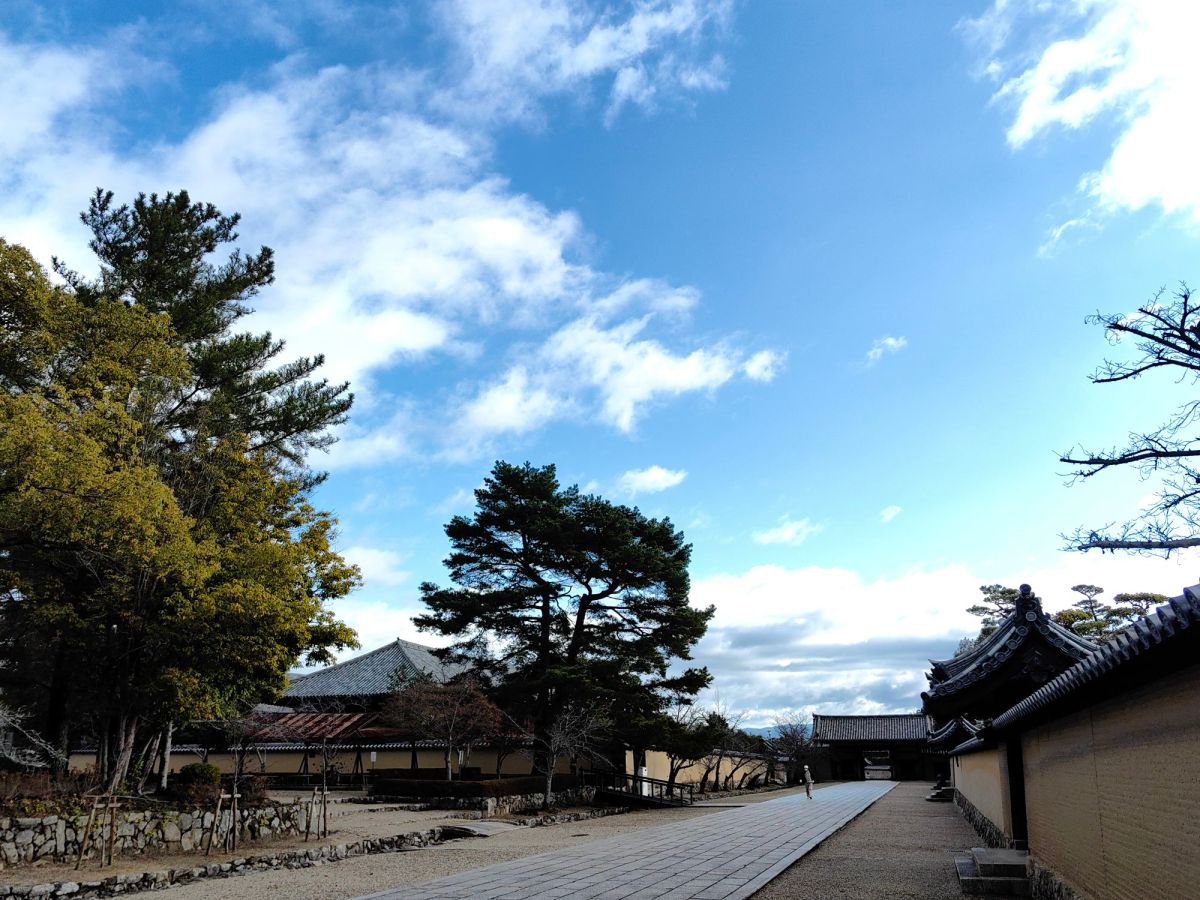
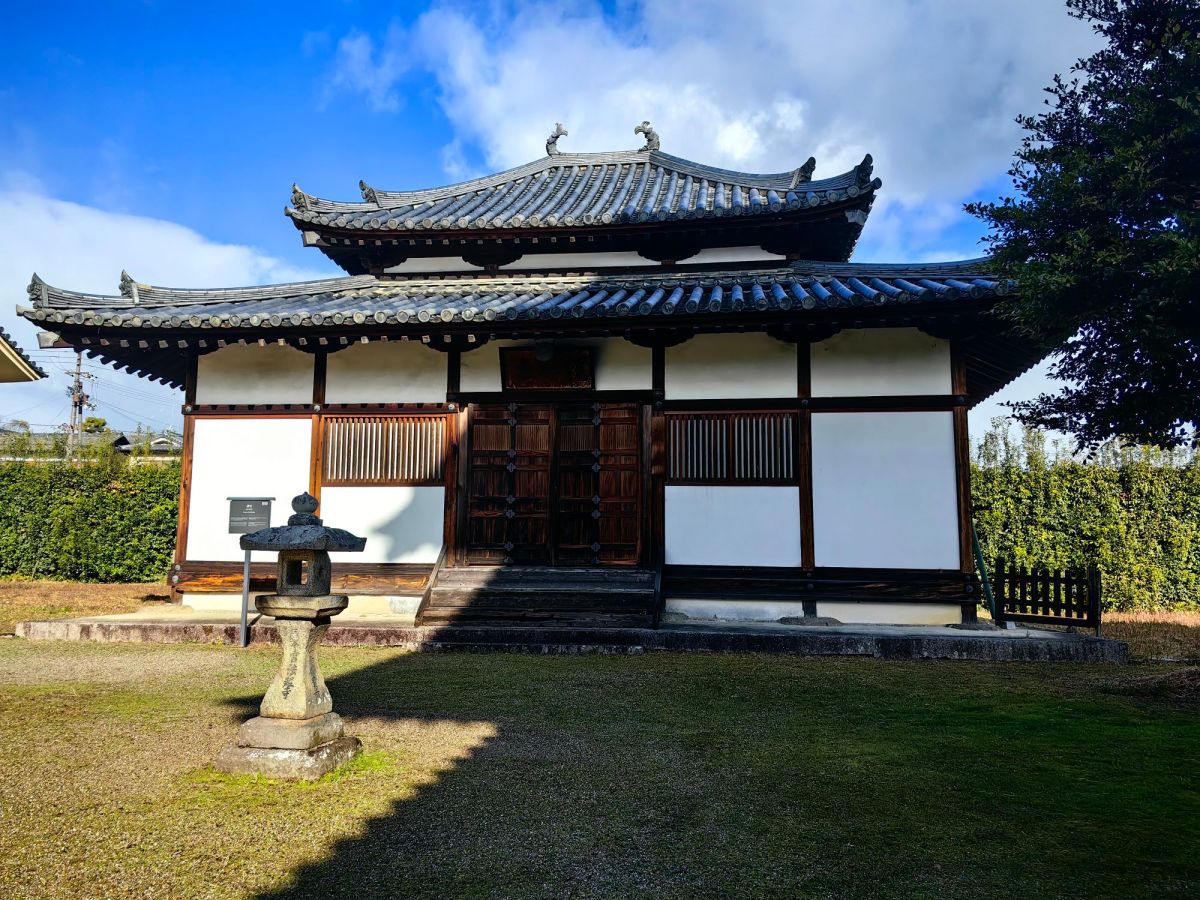
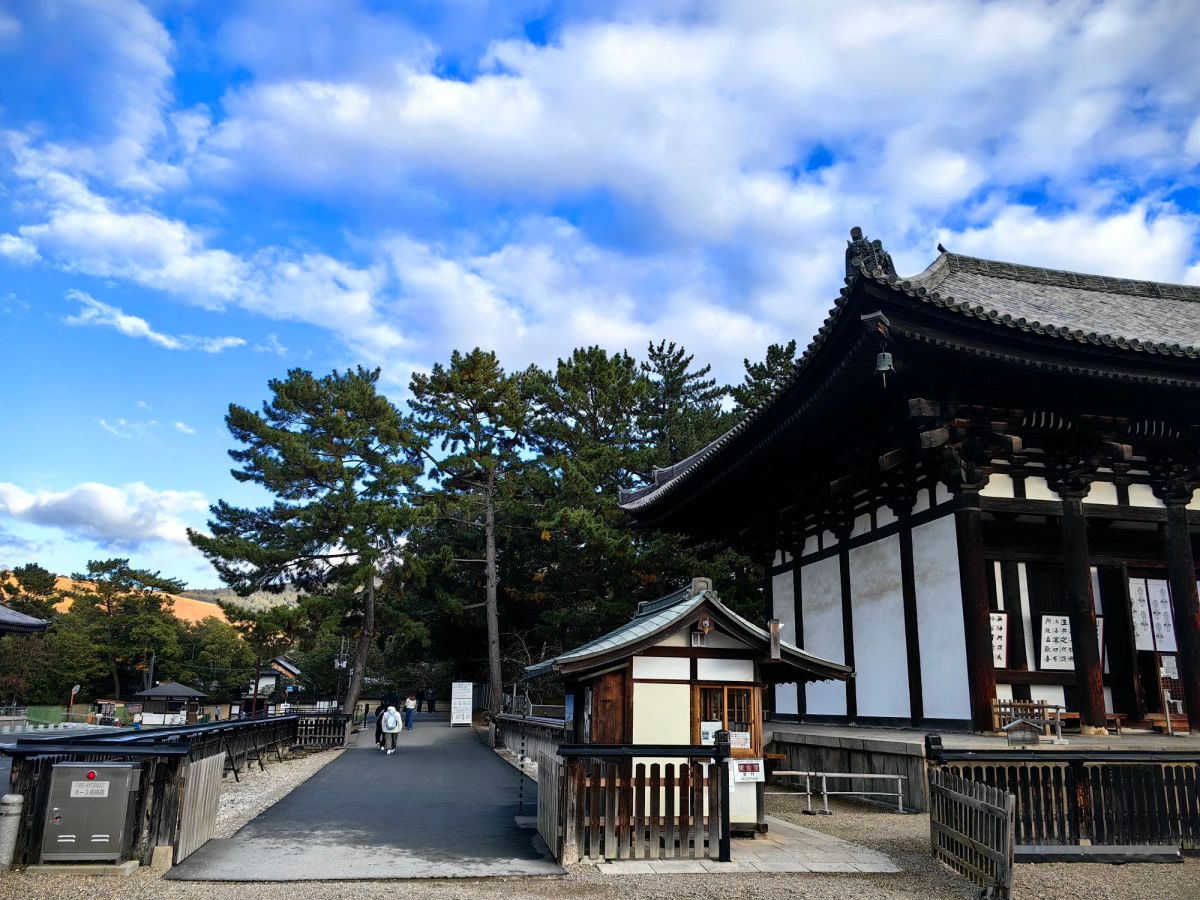
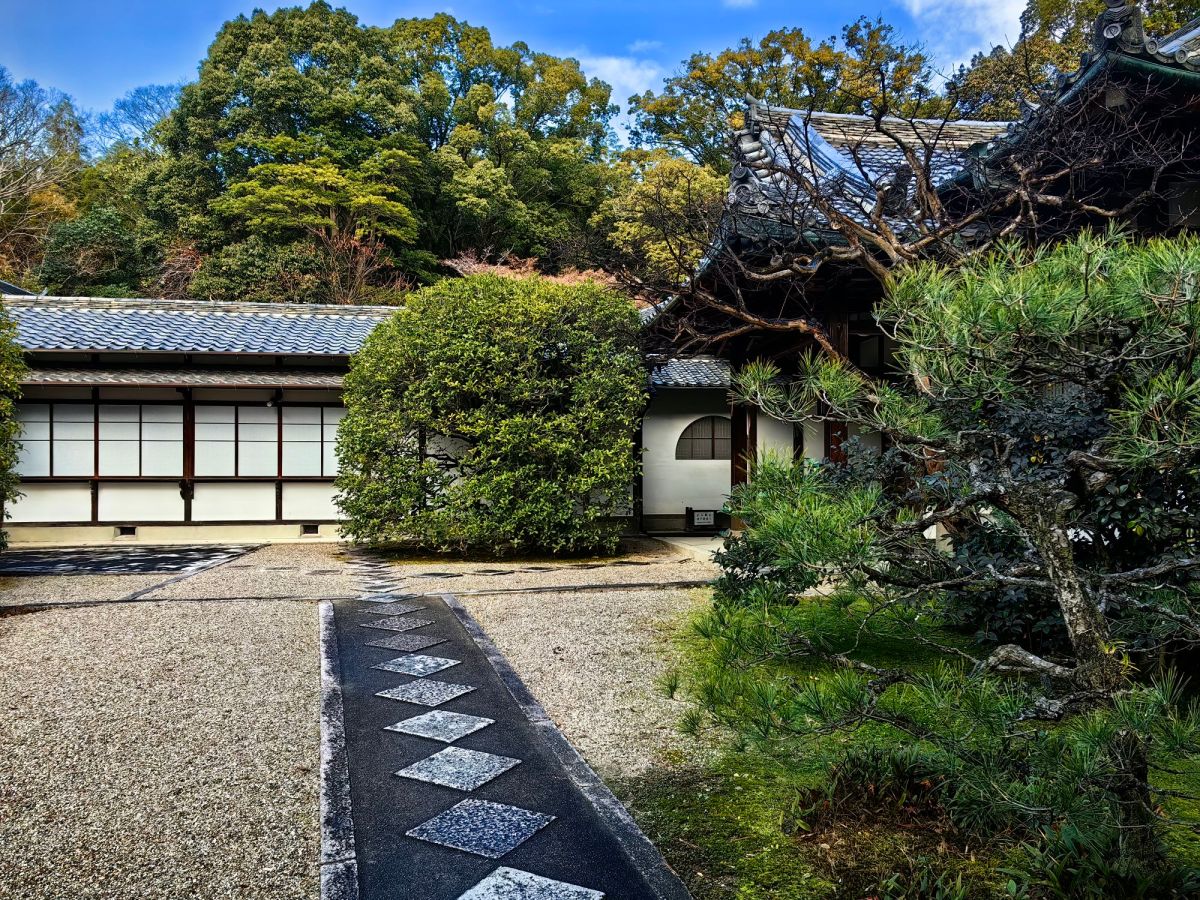
Chumon
Rather than broad roads leading dramatically towards Hōryū-ji, there were small residential streets and narrow lanes, turning gently between houses and disappearing from view. The December morning air was cool and clean. The trees had largely lost their leaves, leaving bare branches silhouetted against a soft winter sky, while patches of evergreen remained around gardens and temple grounds. The low morning sunlight fell gently across the walls and rooftops. The temple was not immediately revealed in some grand approach. Instead, the route seemed to unfold gradually through the town.
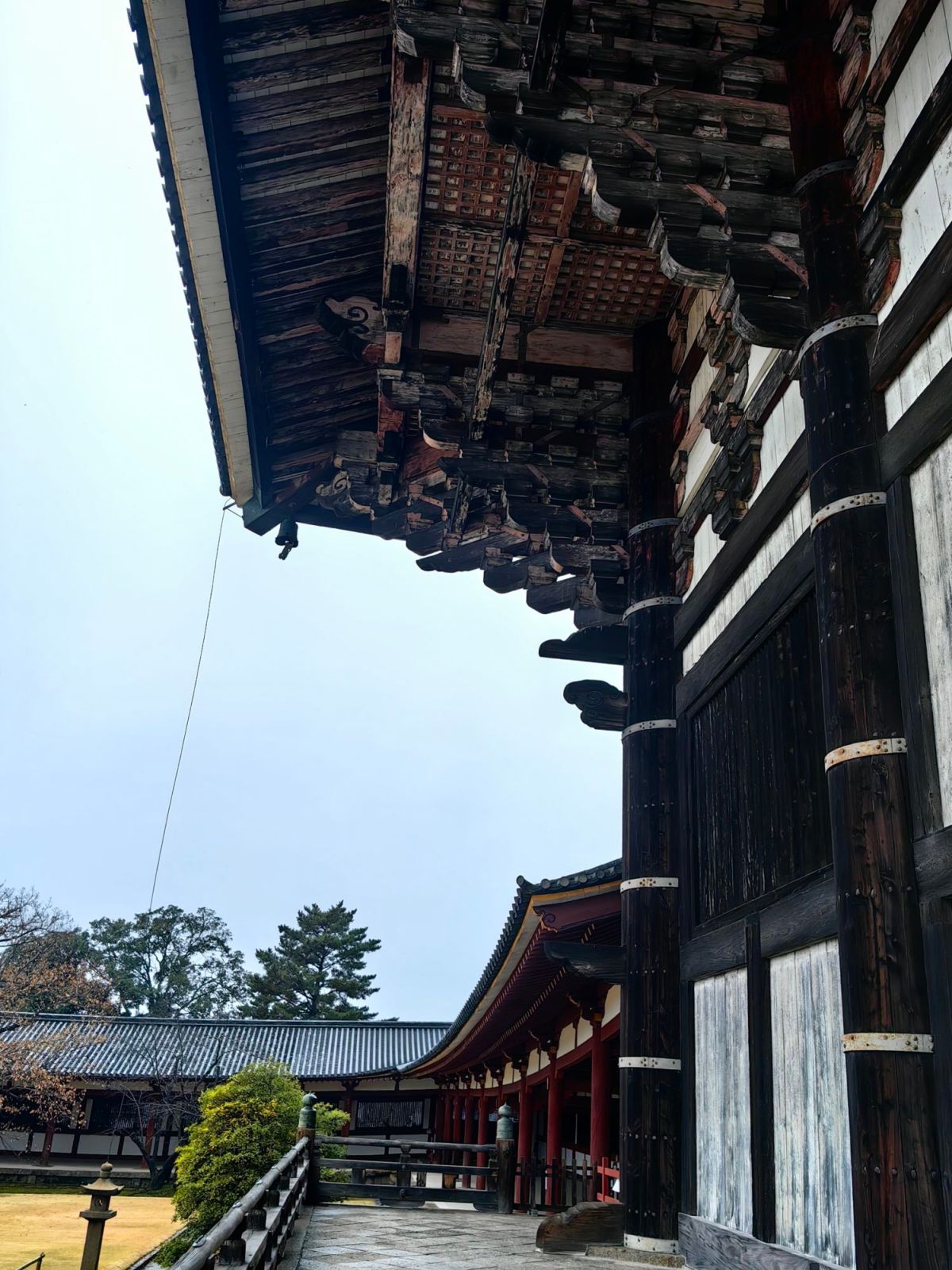
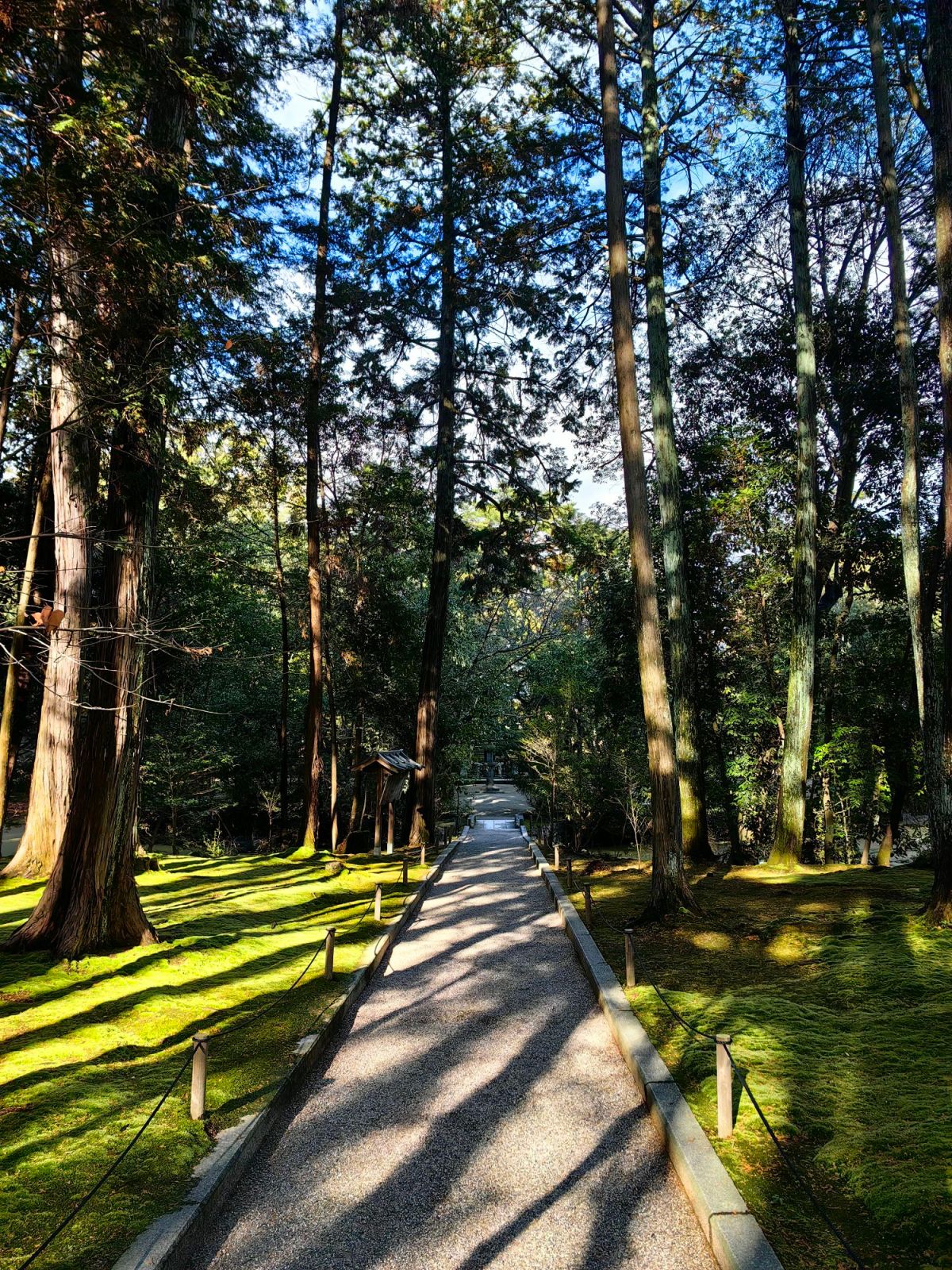
There was something beautiful about approaching Hōryū-ji in this way. At the end of the quiet road, the South Gate of Hōryū-ji suddenly came into view. After walking through the small residential lanes of Ikaruga, the sight of the great wooden gate felt almost like crossing a threshold into another age. It was imposing yet remarkably graceful. Its dark, weathered timber had been softened by centuries of exposure to sun, rain and wind, giving the wood a deep brown color and a texture that seemed to carry the weight of time. The massive wooden pillars rose firmly from the stone pavement, supporting the broad tiled roof whose gently curved eaves extended outward in the characteristic manner of traditional Japanese temple architecture.
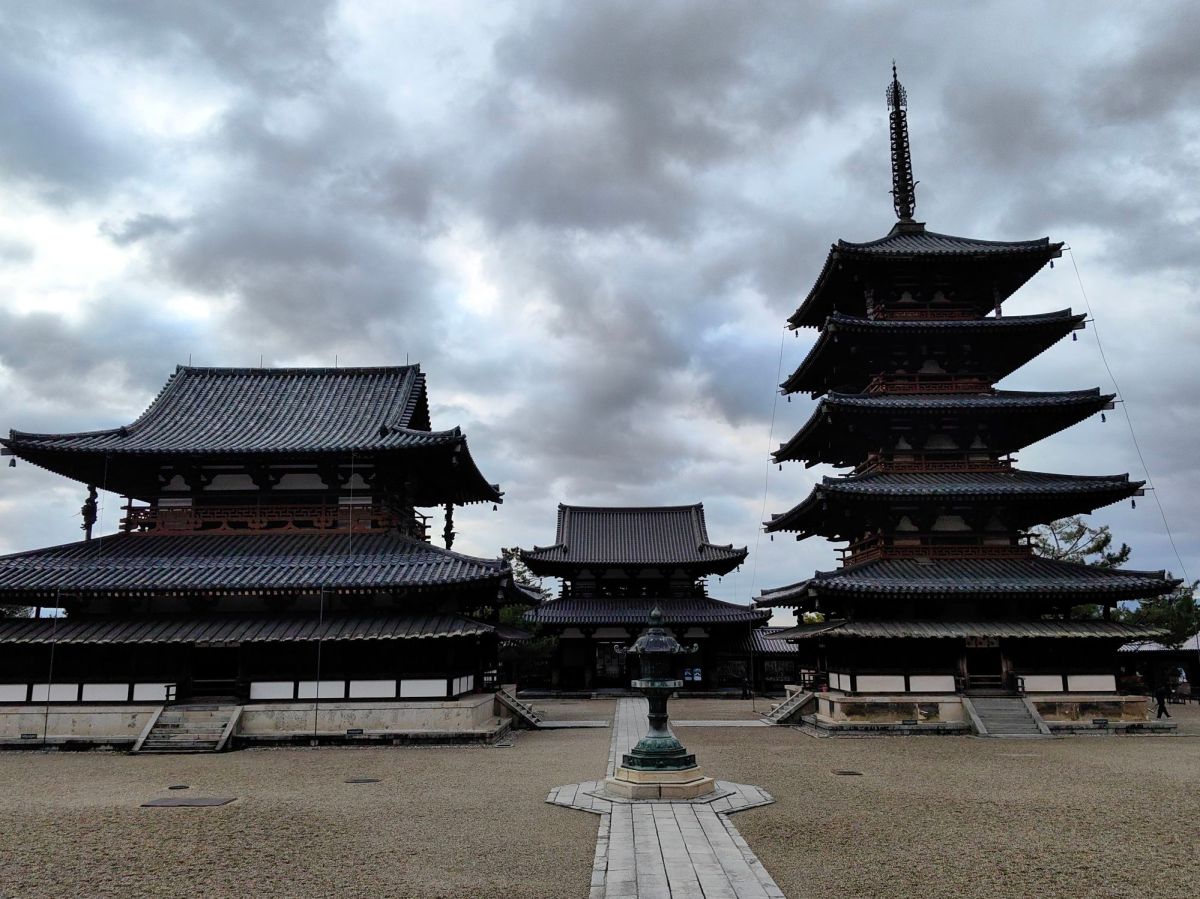
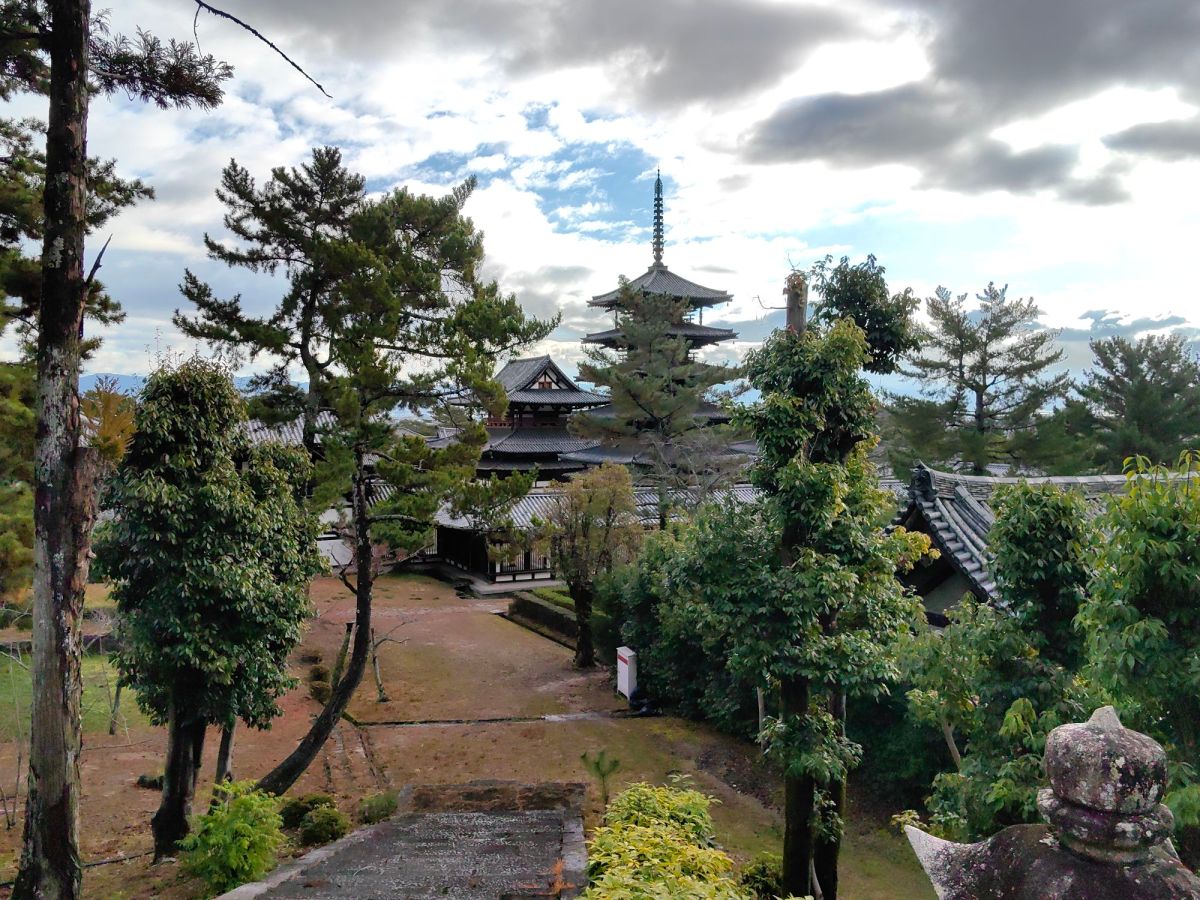
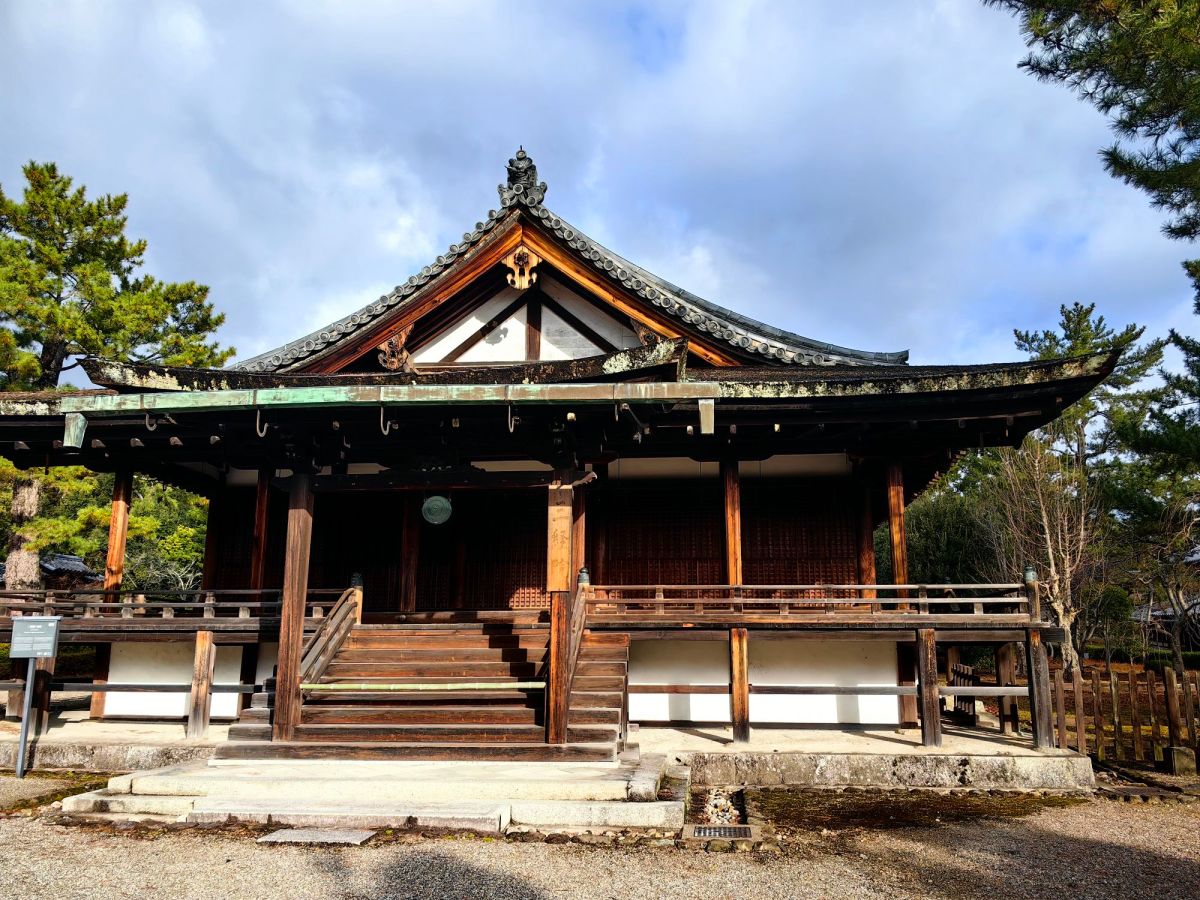
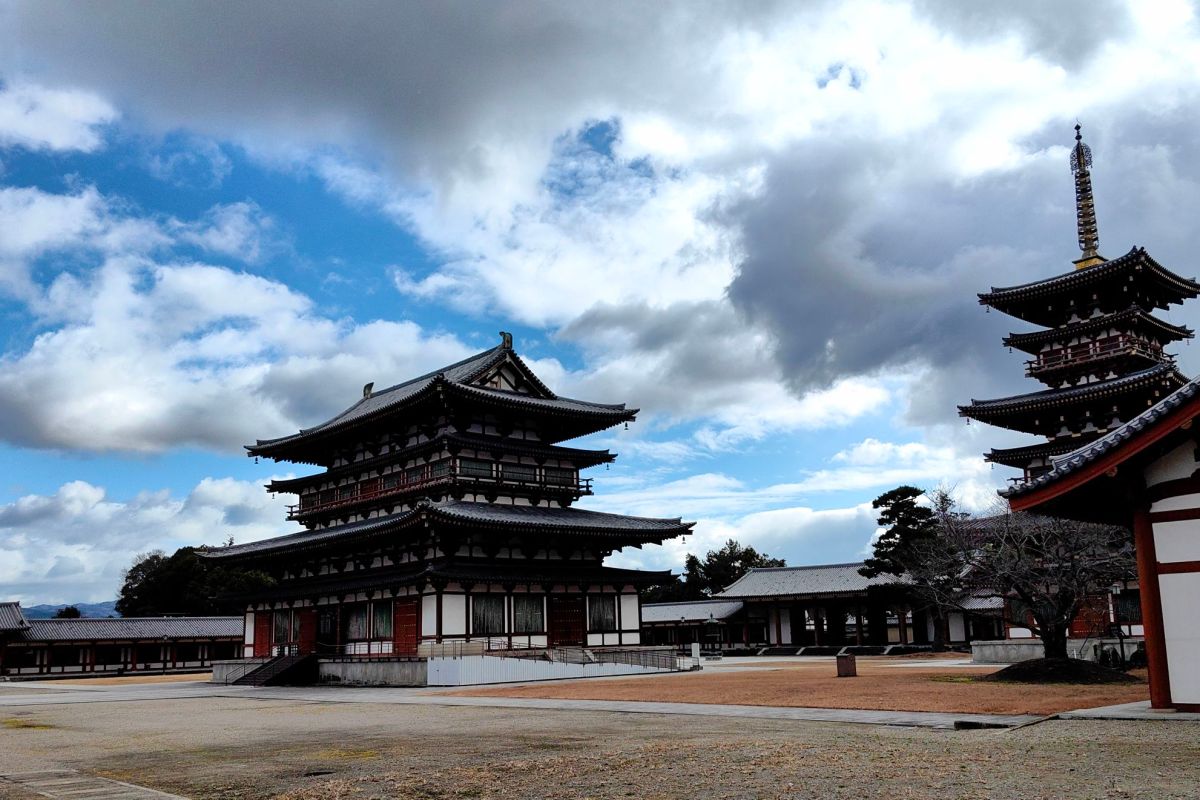
Kondo and Gojunoto
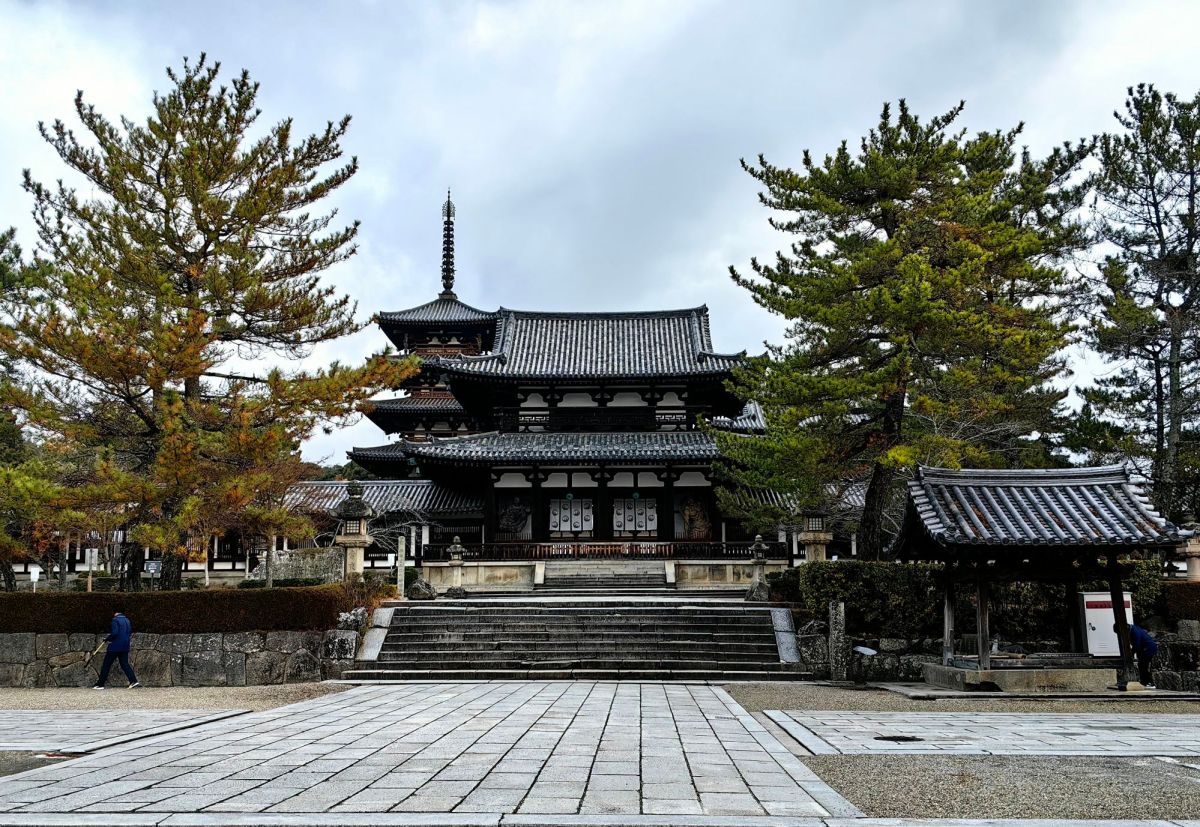
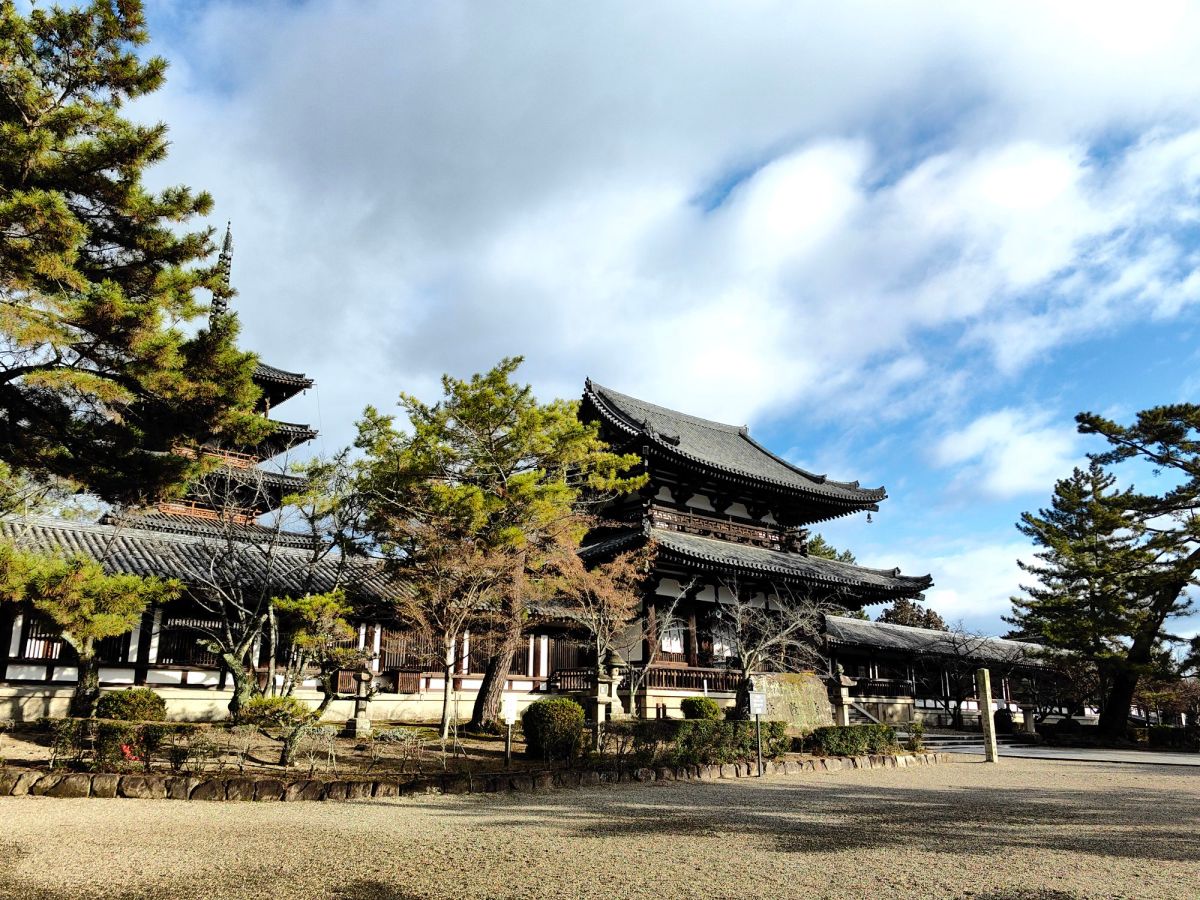
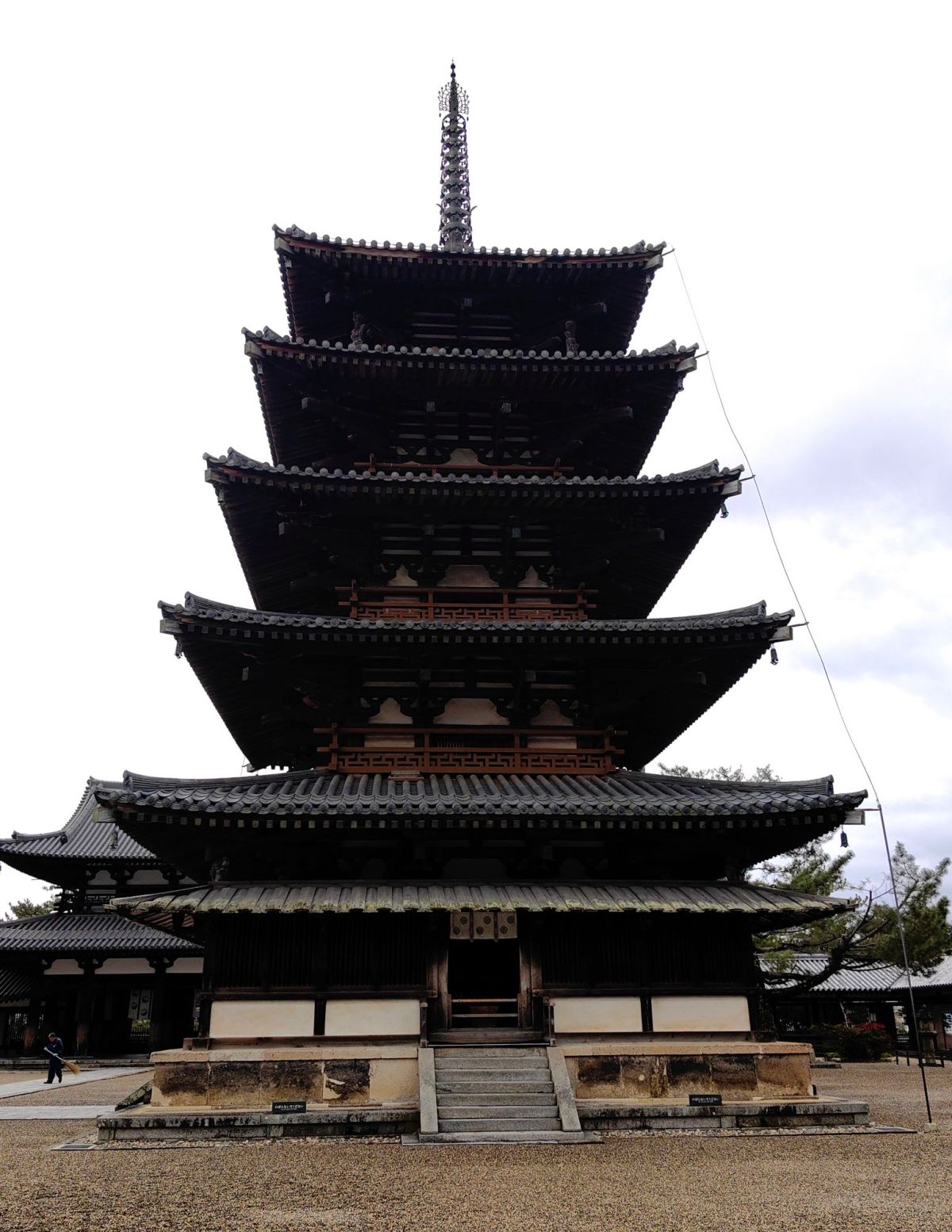
Beyond the gate, my first glimpse of Hōryū-ji opened gradually. The Five-Story Pagoda rose prominently in the distance, its dark wooden tiers becoming smaller and smaller as they climbed towards the sky. Its silhouette was remarkably elegant—five carefully balanced roofs stacked one above another, each projecting outward beneath the next. Beside it stood the Main Hall (Kondō), lower and broader, with its own sweeping tiled roof and rows of ancient wooden columns.
What struck me most was the pagoda under the pale winter sky. It was not brightly coloured or freshly polished. Their surfaces had been naturally darkened by age, and the weathered timber seemed almost black from a distance. Yet this subdued appearance made the architecture feel even more ancient. The courtyard was spacious and remarkably quiet that morning. The stone pavement, the aged timber, the tiled roofs and the towering pagoda formed a composition of extraordinary simplicity. I seemed to be the first visitor to arrive at Hōryū-ji that morning. The temple grounds were almost completely empty. A few monks were already at work.They moved quietly across the temple grounds, each holding a simple broom of straw and slowly sweeping the stone paths and courtyard. The gentle, rhythmic sound of the bristles brushing against the ground was almost the only sound in the morning.
For a moment, its history was not only preserved in ancient timber, tiled roofs or priceless Buddhist sculptures. It was also preserved through small actions repeated day after day: opening the gates, sweeping the paths, tending the grounds, and beginning another morning in the same sacred place. Perhaps this was one of the most beautiful things about arriving so early. Before the temple became a destination for visitors, it was simply a temple beginning another day. There were no crowds and no voices around me. Only the soft sound of the brooms moved across the stone accompanied by the faint winter air.
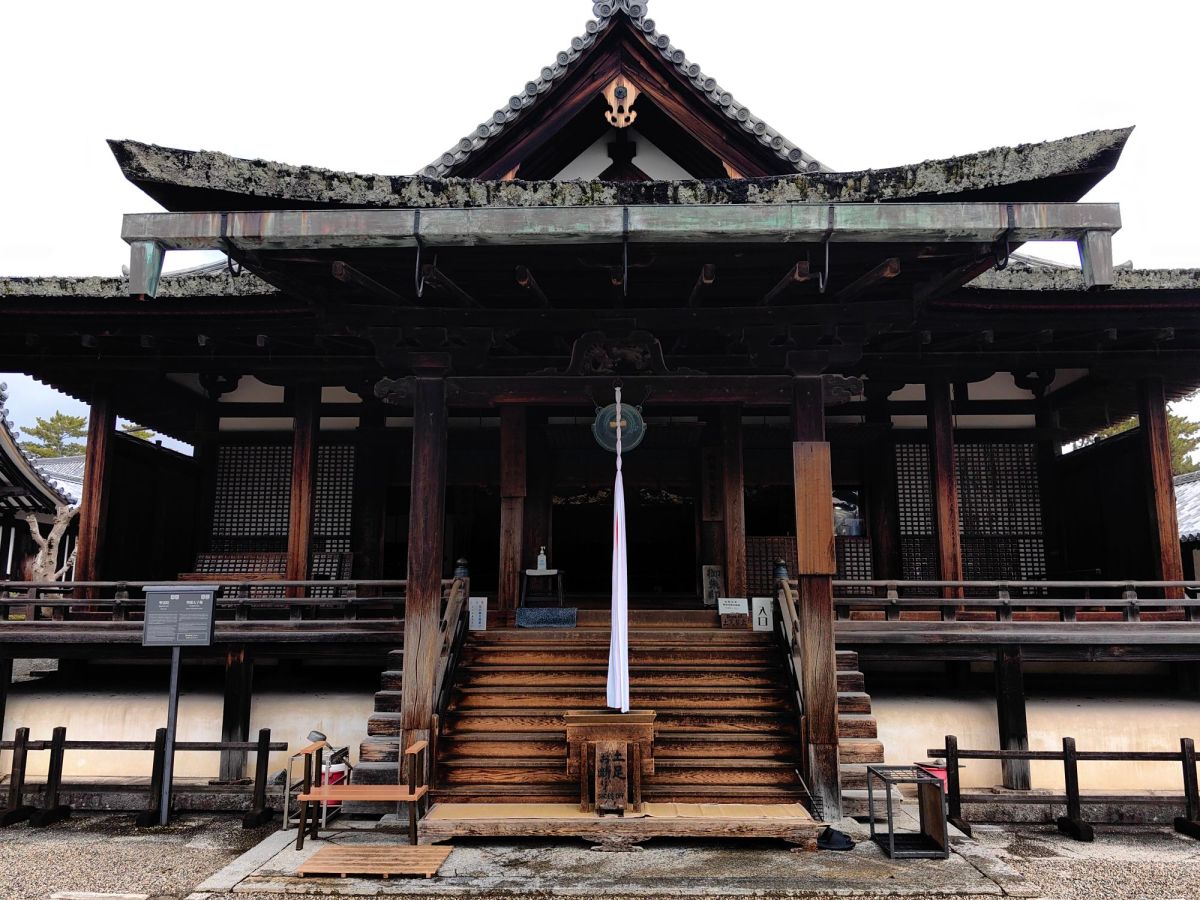
Daikodo
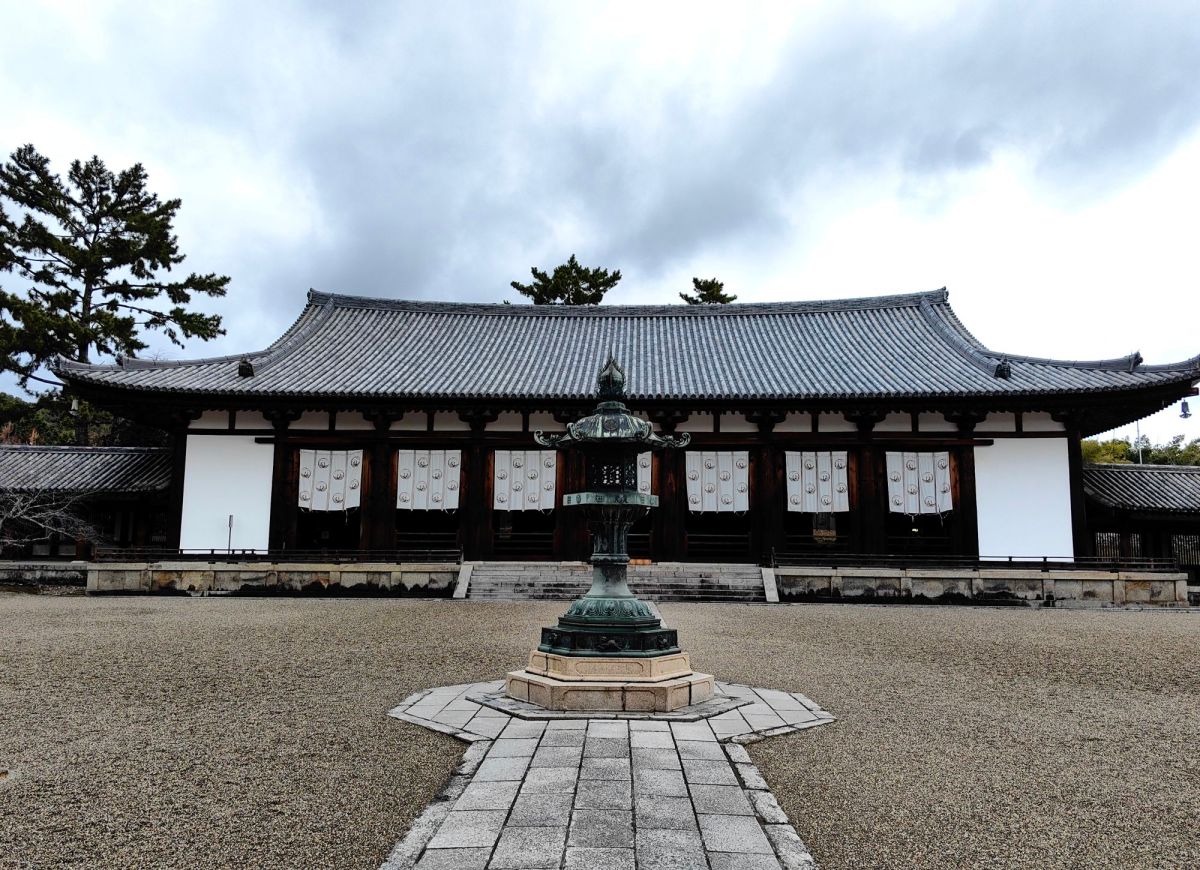
The Daikōdō stands at the northern end of Hōryū-ji’s central courtyard, its broad horizontal form creating a striking contrast with the towering Five-Story Pagoda. With its deep tiled roof, gently curved eaves, and dark, weathered wooden columns, the hall has a dignified yet peaceful appearance. Traditionally associated with Buddhist teaching and study, it was a place where monks gathered to learn and contemplate Buddhist teachings. Inside, the tranquil wooden interior houses Yakushi Nyorai, the Buddha of healing, accompanied by attendant bodhisattvas.
Outside the main temple buildings, Hōryū-ji opened into a much wider and more tranquil landscape outside the courtyard. The atmosphere here was completely different from the enclosed courtyards. Green trees were scattered throughout the grounds, their foliage standing out against the muted colors of the December landscape.
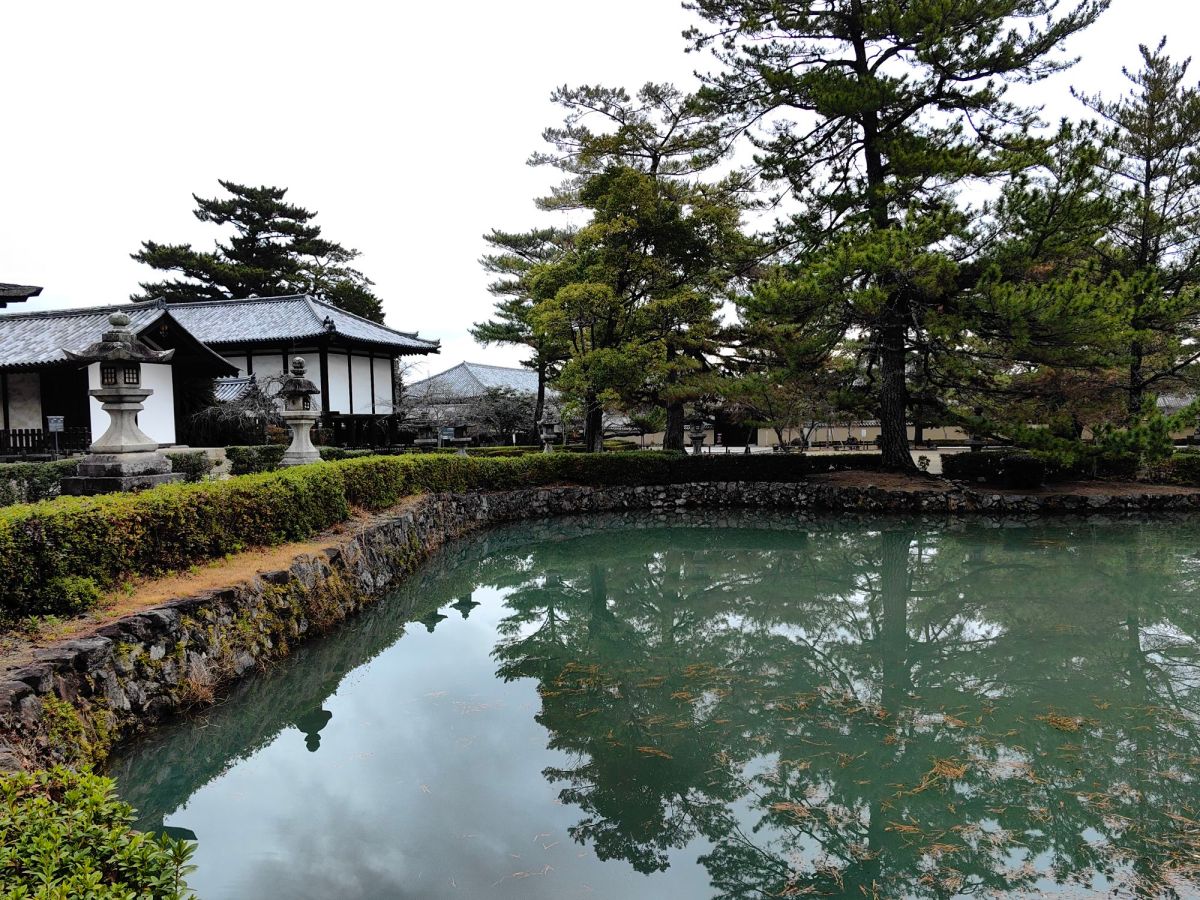
Small ponds appeared among the trees, their still surfaces reflecting fragments of the sky, branches and surrounding greenery. The wide paved paths stretched gently between the trees and temple buildings, leaving plenty of open space. Walking there alone, I felt no need to hurry from one attraction to another. The peaceful surroundings invited me simply to slow down, wander and stay for a while.
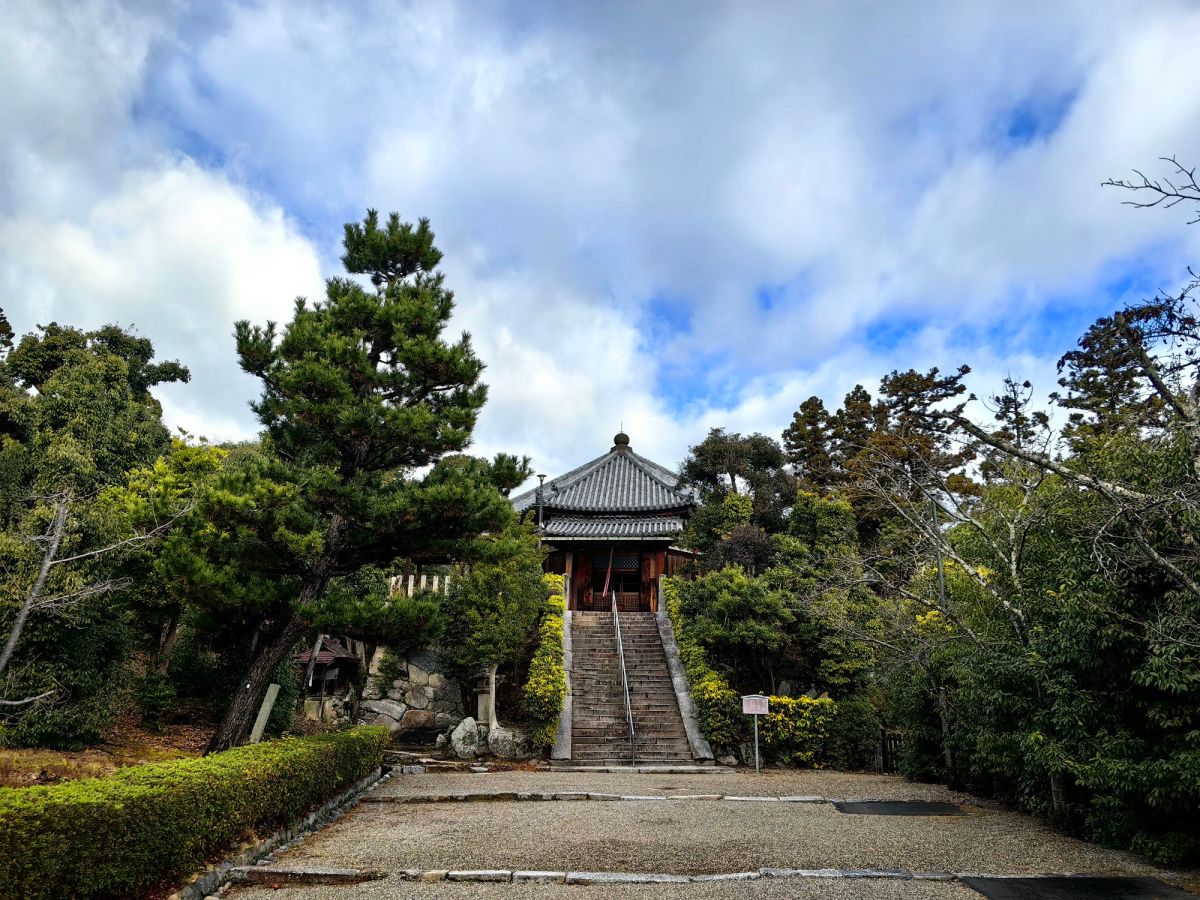
Saien-do
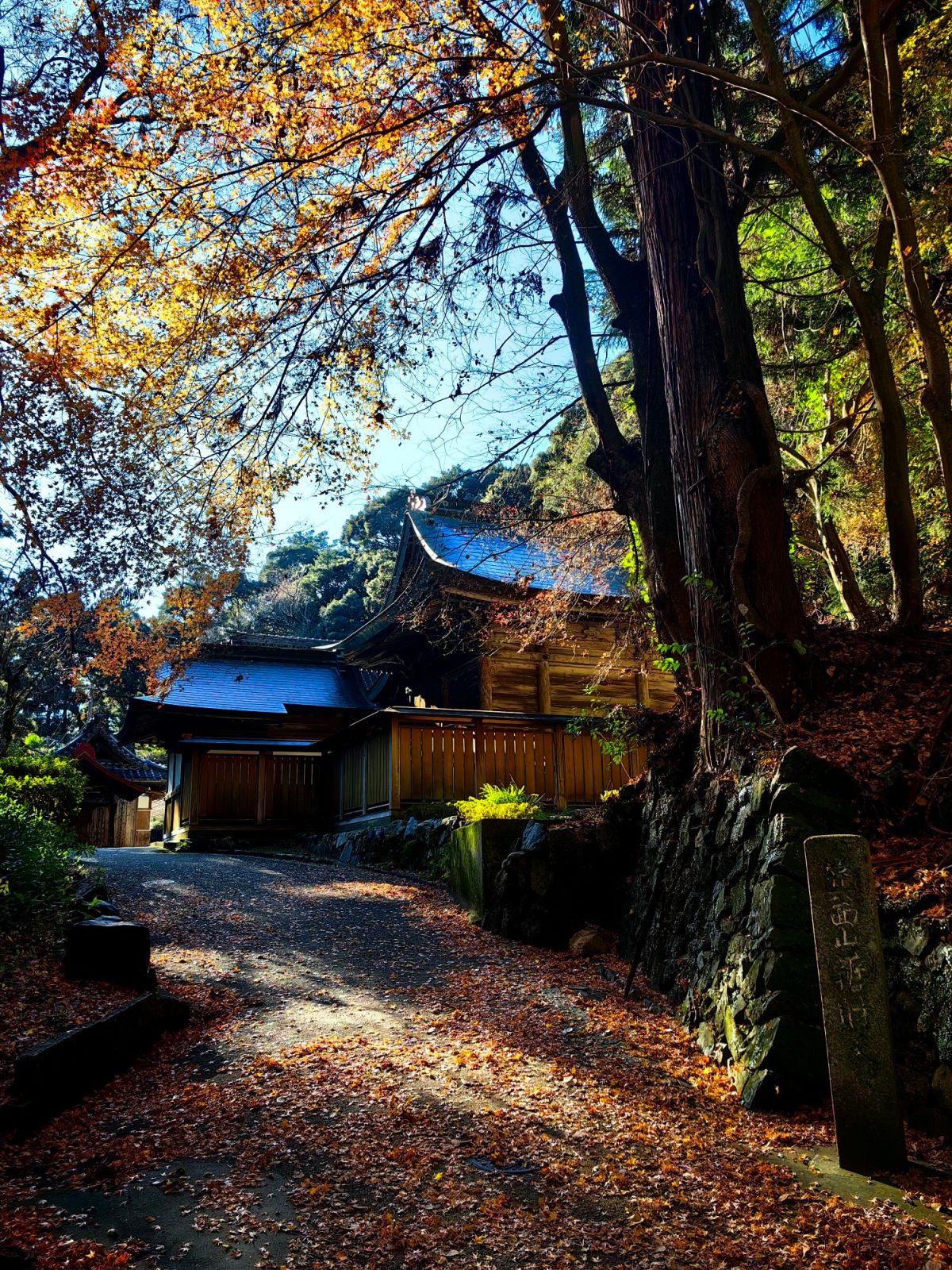
On the western side of Hōryū-ji, away from the more famous Five-Story Pagoda and Main Hall, I came to the Saien-dō, a smaller and more secluded temple hall standing quietly among the trees. The approach itself felt different from the grand central precinct. Instead of arriving at another monumental gate or an imposing courtyard, I followed a quieter path that gradually led upward through the greenery. Saien-dō has a much more modest presence than the great buildings of Hōryū-ji. Its circular form and gently curved tiled roof give it an unusual appearance among the predominantly rectangular halls of the temple complex.
Standing before it, I found myself surrounded by the aged wooden surfaces, the ancient roof tiles, the wooden railings and the shadows cast beneath the eaves. The surrounding trees added greatly to its atmosphere. Their branches framed the roof against the winter sky, while fallen leaves lay scattered along the ground. The December landscape had a subdued beauty, with patches of green remaining among the bare branches and the soft light filtering through the trees.
Nishimuro
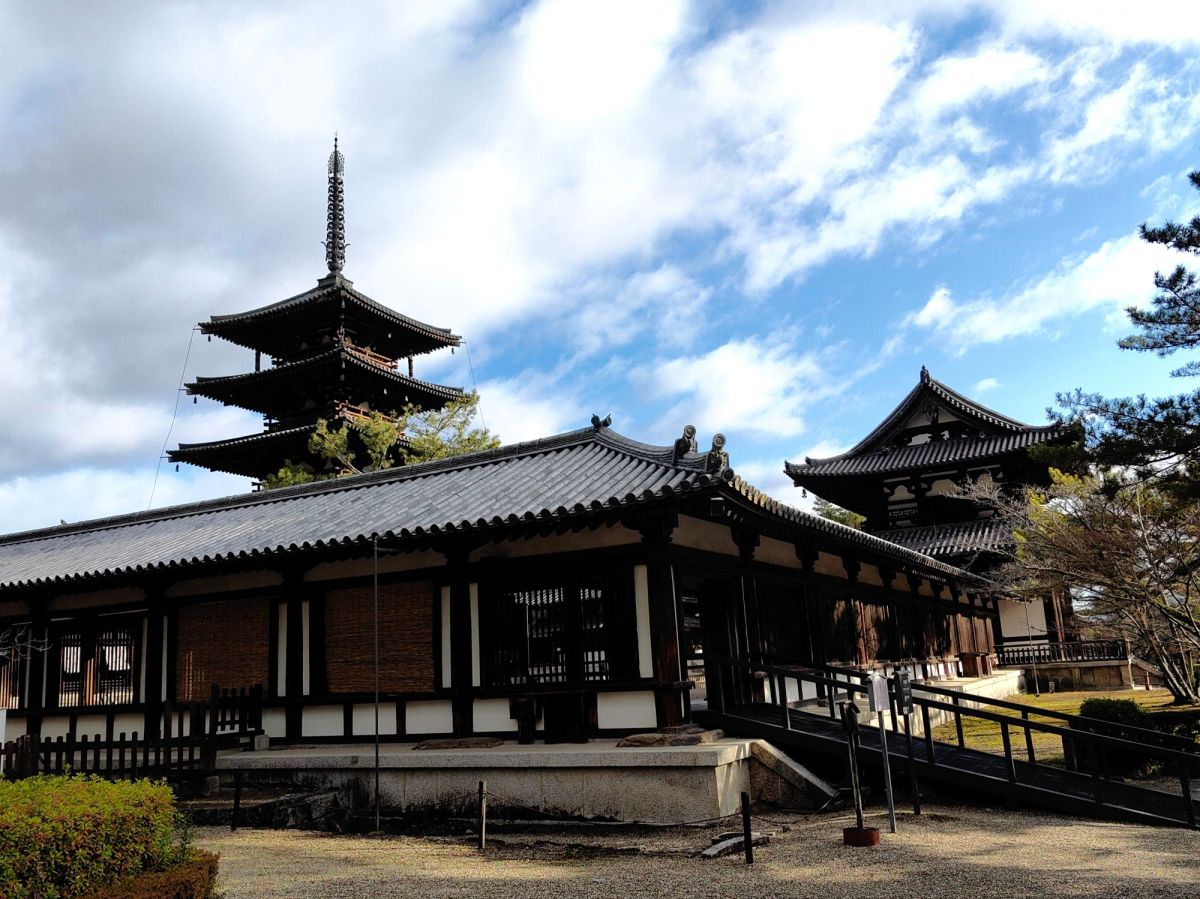
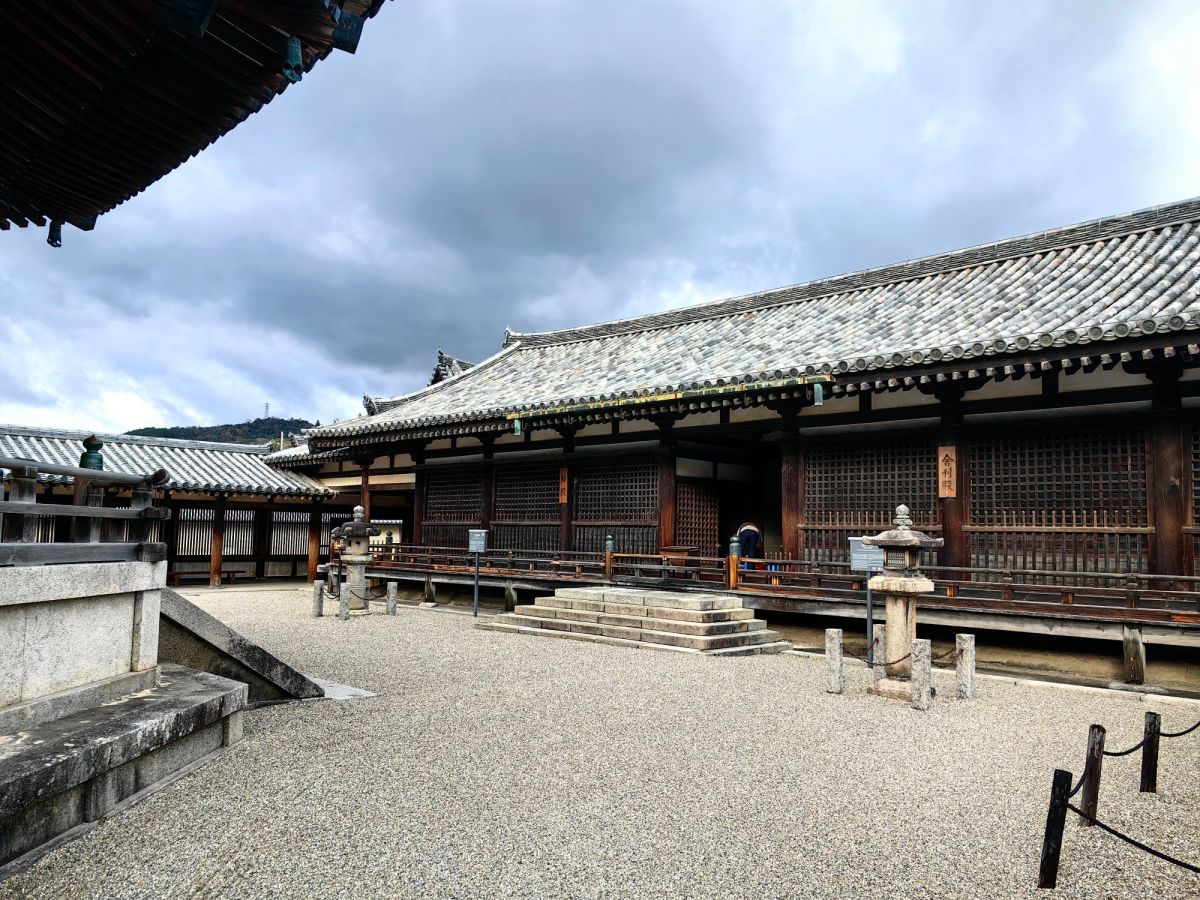
In this temple, I have observed many similar buildings of this style. The Nishimuro is a long, relatively low wooden building, associated with the living quarters and activities of monks. Its architectural speciality is its early Japanese Buddhist timber construction. The building demonstrates the characteristic techniques of the Asuka–Nara architectural tradition which marks the introduction and early development of Buddhism and Buddhist architecture in Japan. It is characterized by timber construction with post-and-lintel structures, large timber columns supported horizontal beams, bracketing systems, large tiled roofs, symmetrical temple layouts. Like other buildings at Hōryū-ji, it is especially significant because the temple preserves some of the oldest surviving wooden architecture in the world.
Daihozoin
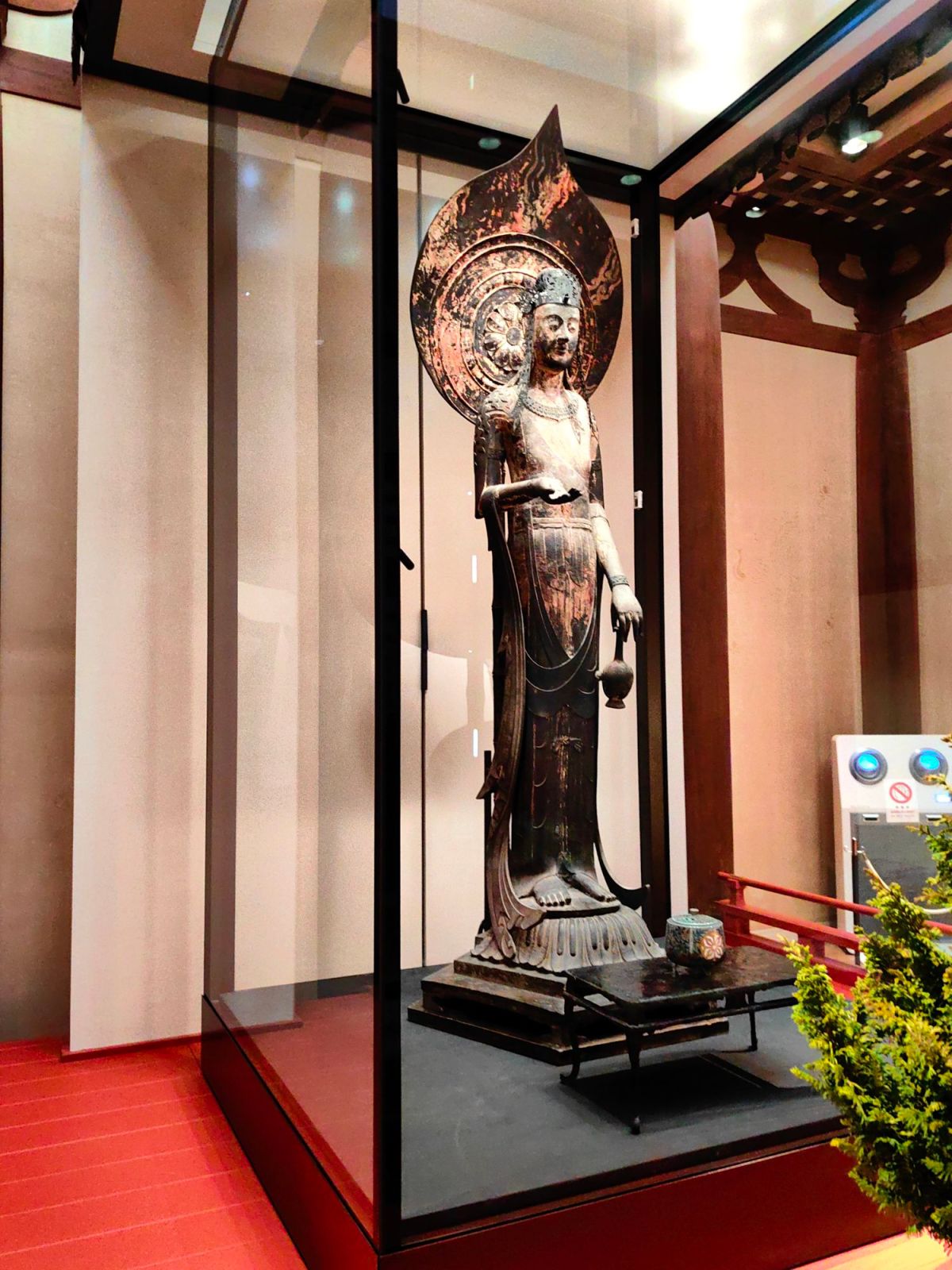
After wandering through the ancient temple grounds, I came to the Daihōzō-in, the Gallery of Temple Treasures. The collection inside is extraordinary in its variety. There are Buddhist statues, bodhisattvas, guardian figures, paintings, ritual objects, textiles and other works of religious art. Many of them are extraordinarily old, reaching back to the Asuka and Nara periods. Looking at them, I was struck by how different their appearance was from the familiar Buddhist images of later Japanese temples.
One of the most remarkable treasures associated with Hōryū-ji is the Kudara Kannon, a tall wooden image of Kannon traditionally associated with Baekje Korea. Its extraordinarily slender proportions and serene expression give it an almost otherworldly presence. The sculpture does not have the massive physicality of many later Buddhist statues. Instead, it seems to rise lightly and vertically, its elongated body creating an impression of extraordinary elegance.
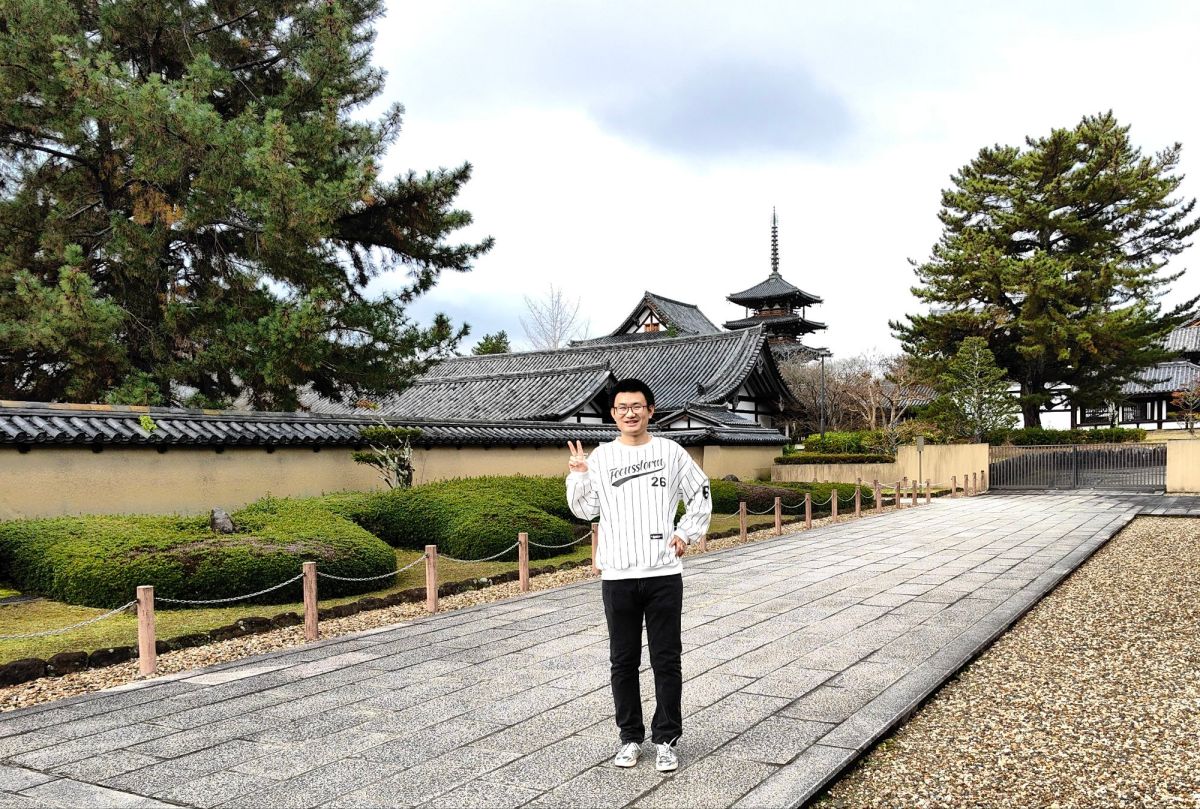
The complex of Hōryū-ji is very large and needs around 1.5 hours to go through all the areas. It is worthy to visit it because I could experience one of the world’s most important surviving collections of early wooden Buddhist architecture in its original temple setting. It gives me a physical way to understand the transition from the Asuka period (538–710) into the Nara period (710–794) and the growing influence of Buddhism on Japanese culture. Of course, everyone will take a photo with the iconic five-story pagoda which is a classical memory of Japanese travel.
The Eastern Precinct (Tō-in) of Hōryū-ji is especially famous for the Yumedono (Hall of Dreams). Compared with the Western Precinct, which is associated with some of Japan’s oldest surviving Buddhist buildings, the Eastern Precinct has a somewhat different character: it is a memorial complex connected with Prince Shōtoku who was an influential Japanese prince, political leader, and patron of Buddhism during the Asuka period. He served as regent for Empress Suiko and is traditionally credited with helping strengthen the central government through the Seventeen-Article Constitution. According to temple tradition, he established the original temple, known as Wakakusa-garan, in the early 7th century.
Yumedono
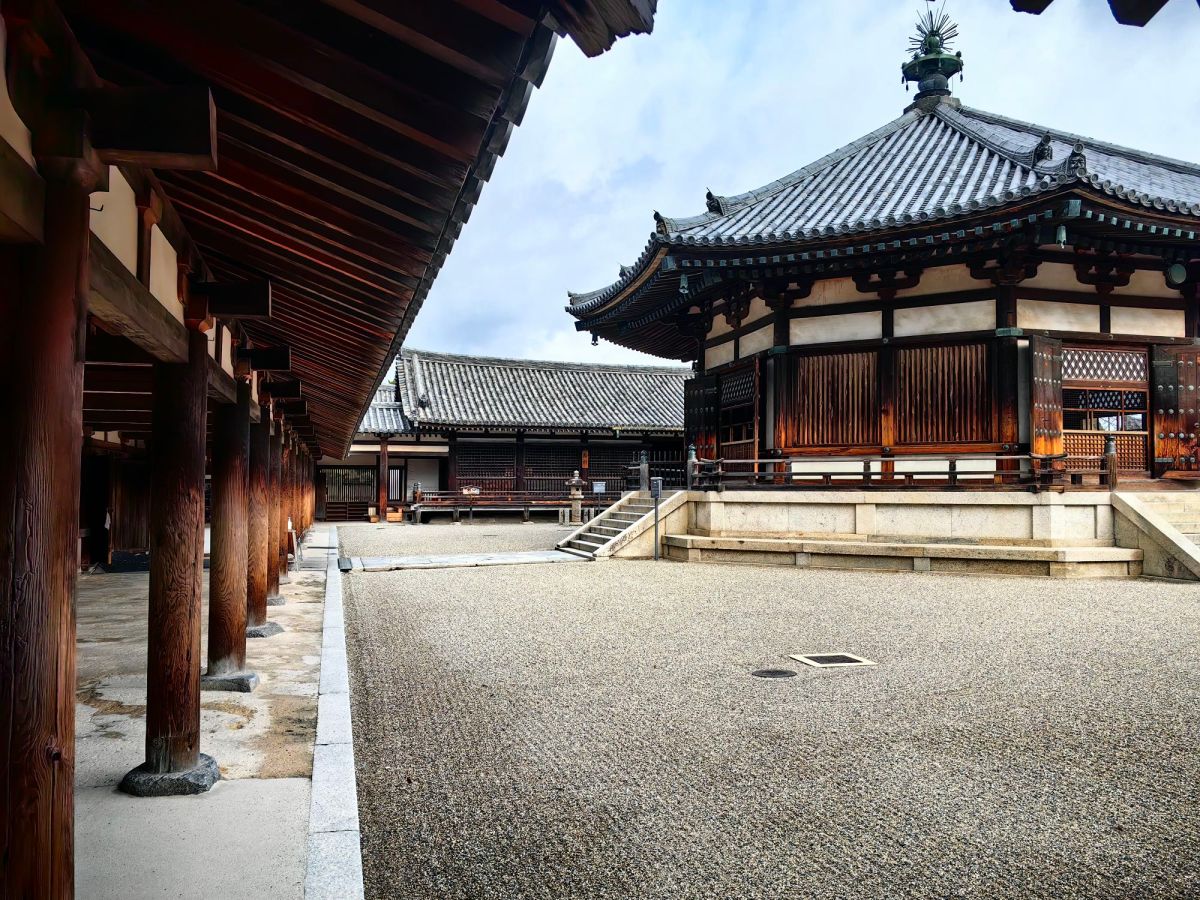
The Eastern Precinct was established later, around the 8th century. Its centre is the famous Yumedono. It functions as a place where Prince Shōtoku’s spiritual legacy is commemorated. It stands at the centre of the Eastern Precinct, surrounded by a cloister. The name Yumedono, translated as “Hall of Dreams,” is connected with traditions about Prince Shōtoku receiving a vision or divine revelation at this location. The octagonal form makes the building visually distinctive.
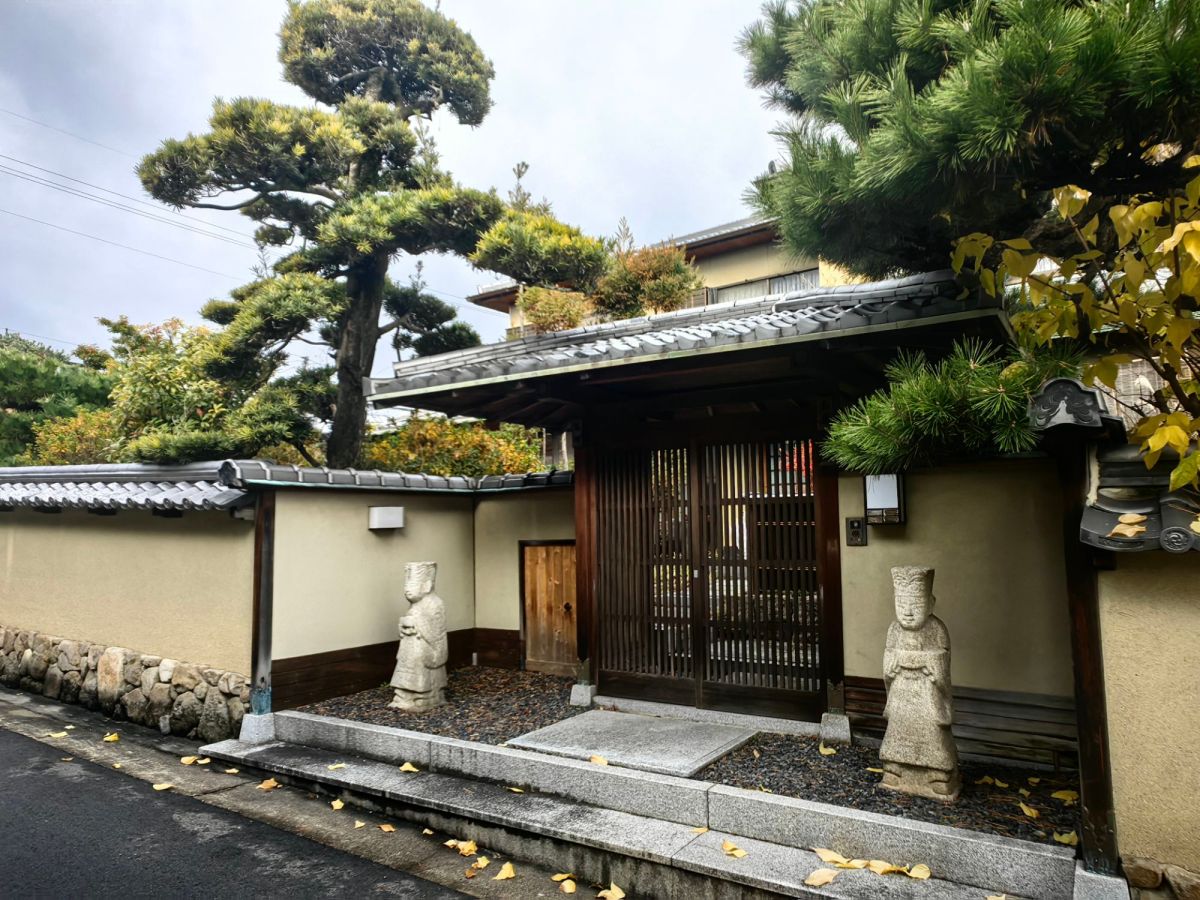
After I left the Hōryū-ji, I passed a traditional Japanese private residence tucked along the quiet road toward Hōrin-ji. Its entrance is set behind a stone-walled courtyard, where green plants grow naturally around the edges, giving the property a secluded and peaceful character. A wooden entrance door forms the focal point, with two stone statues placed in front as quiet guardians. The combination of weathered stone, dark wood, and greenery gives the house a simple beauty typical of the traditional Japanese landscape with a sense of harmony, simplicity, and tranquillity.
Hōrin-ji
Ikaruga was a center of the early Buddhist and political world around Prince Shōtoku. His religious establishments were concentrated in this area. After his death, other members of his family continued establishing temples connected with him and his legacy. That’s why I could find many temples with the similar names. Hōrin-ji is a small and peaceful temple , just north of Hōryū-ji. It has a more rustic atmosphere than the larger Hōryū-ji complex.
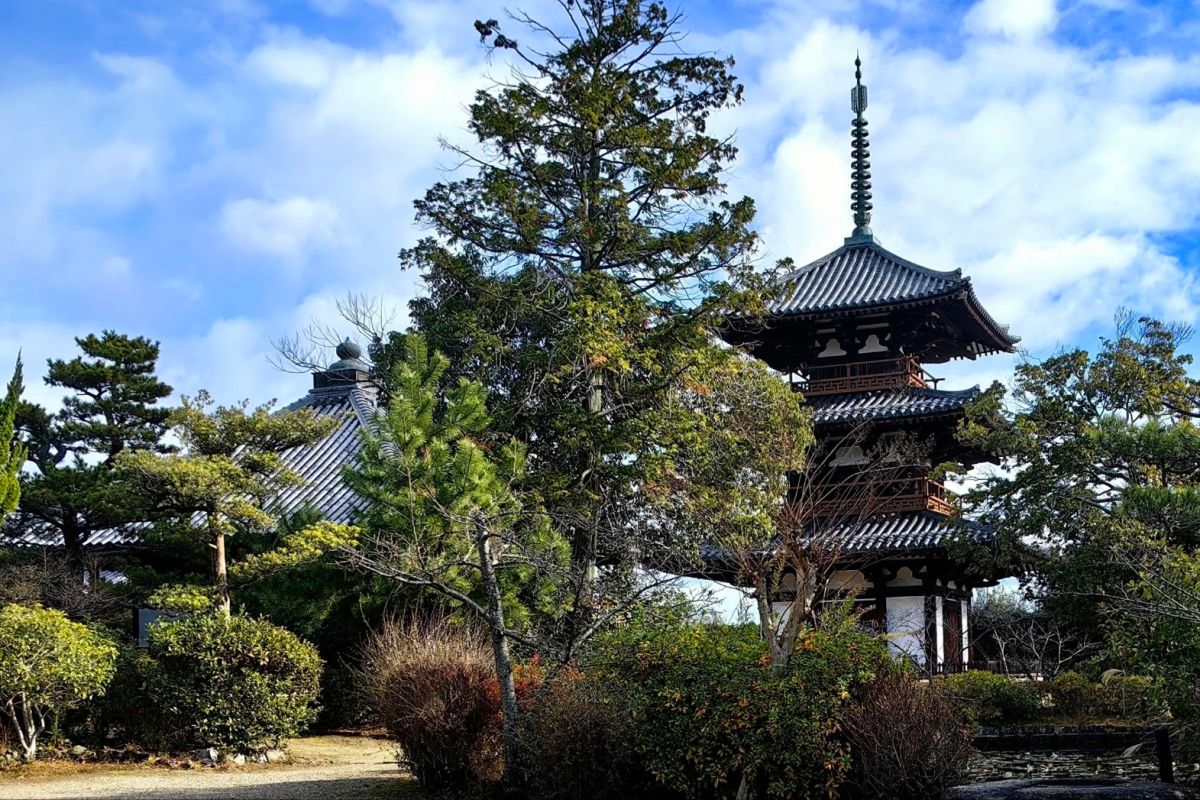
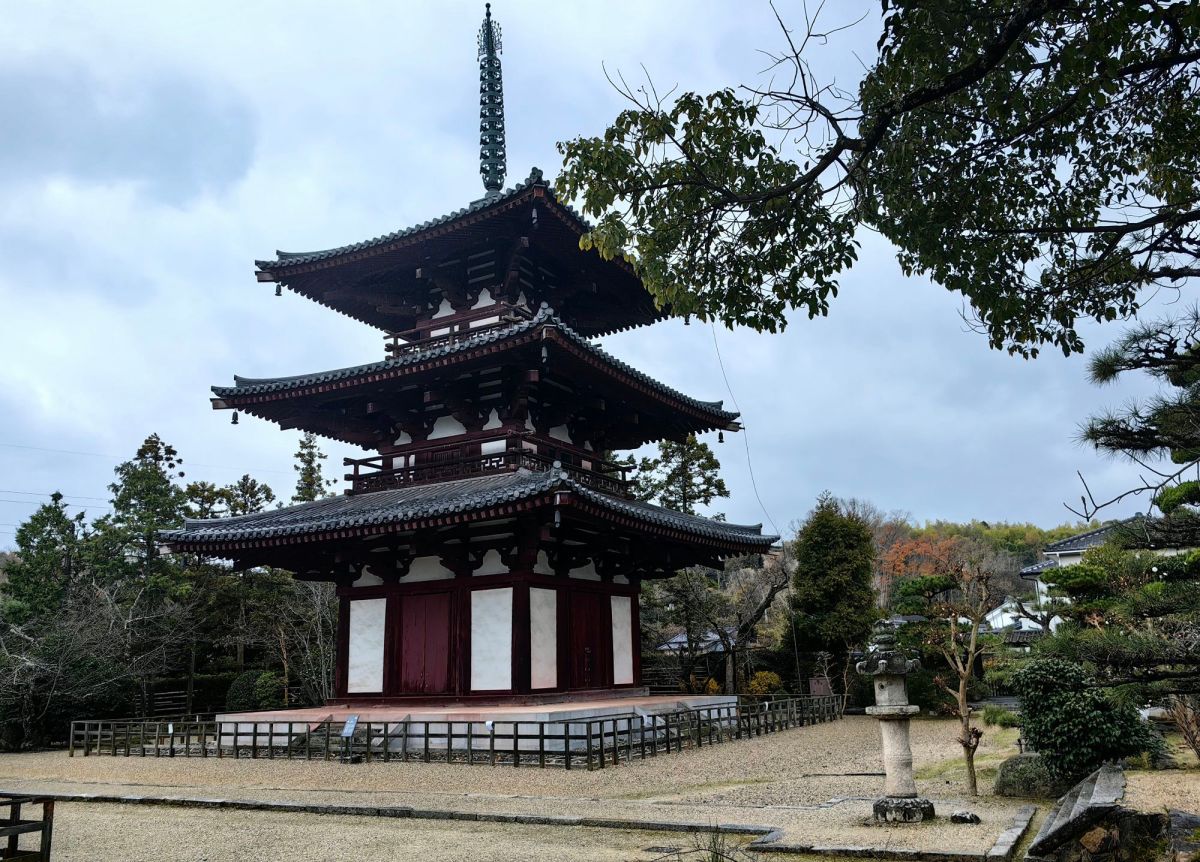
Similar to Hōryū-ji, it has a three-story pagoda rising above the surrounding trees, which is one of the distinctive landmarks of Ikaruga. Traditional wooden temple buildings, with dark timber, tiled roofs, and restrained architectural decoration was surrounded by stone features and garden vegetation. Its name means “Temple of the Dharma Wheel.” Tradition says it was founded by Prince Shōtoku’s son, Prince Yamashiro, to pray for his father’s recovery.
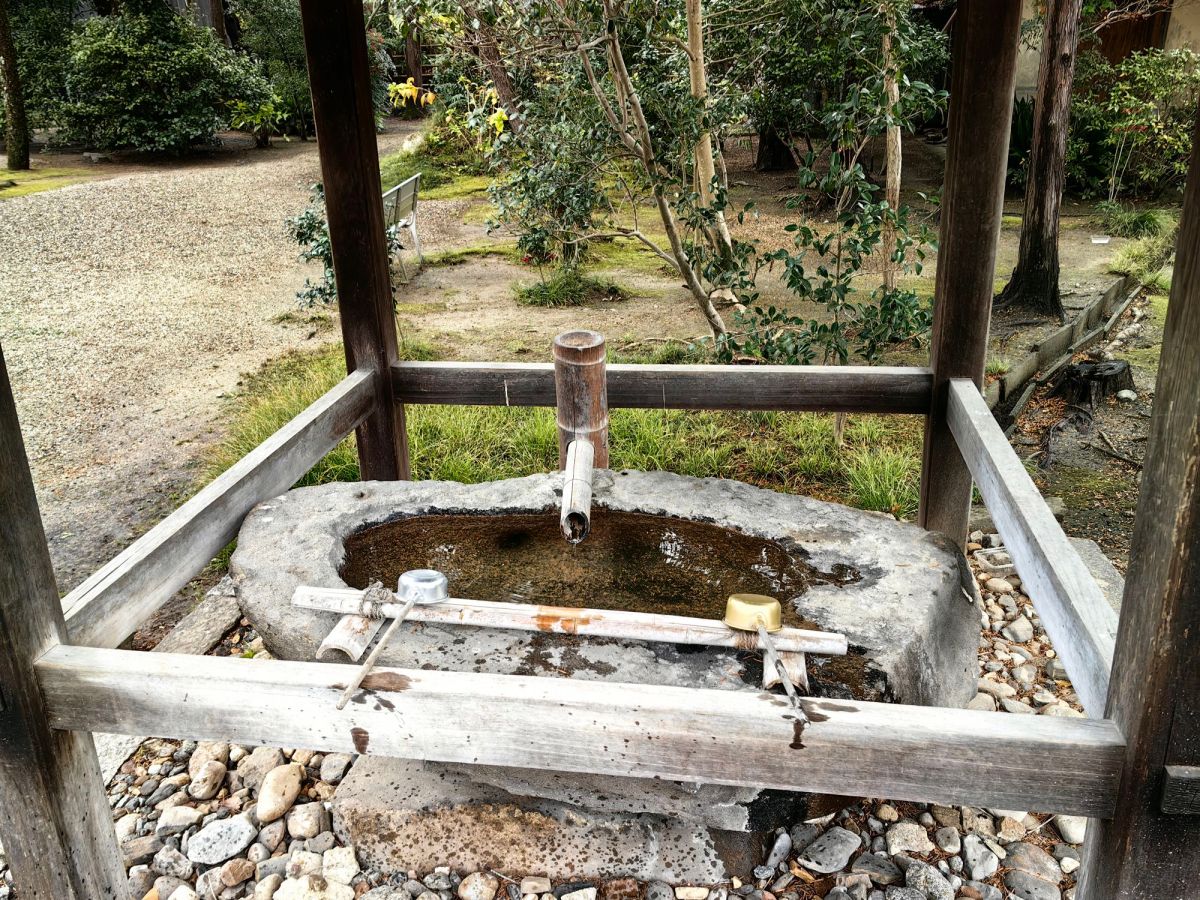
Near the temple buildings stands a large stone temizu basin filled with clear water. A small ladle rests beside it, inviting visitors to scoop the water and purify themselves before continuing through the temple grounds. This kind of device can be seen in many temples in Japan. It maybe a symbolic act of purification before approaching sacred spaces.
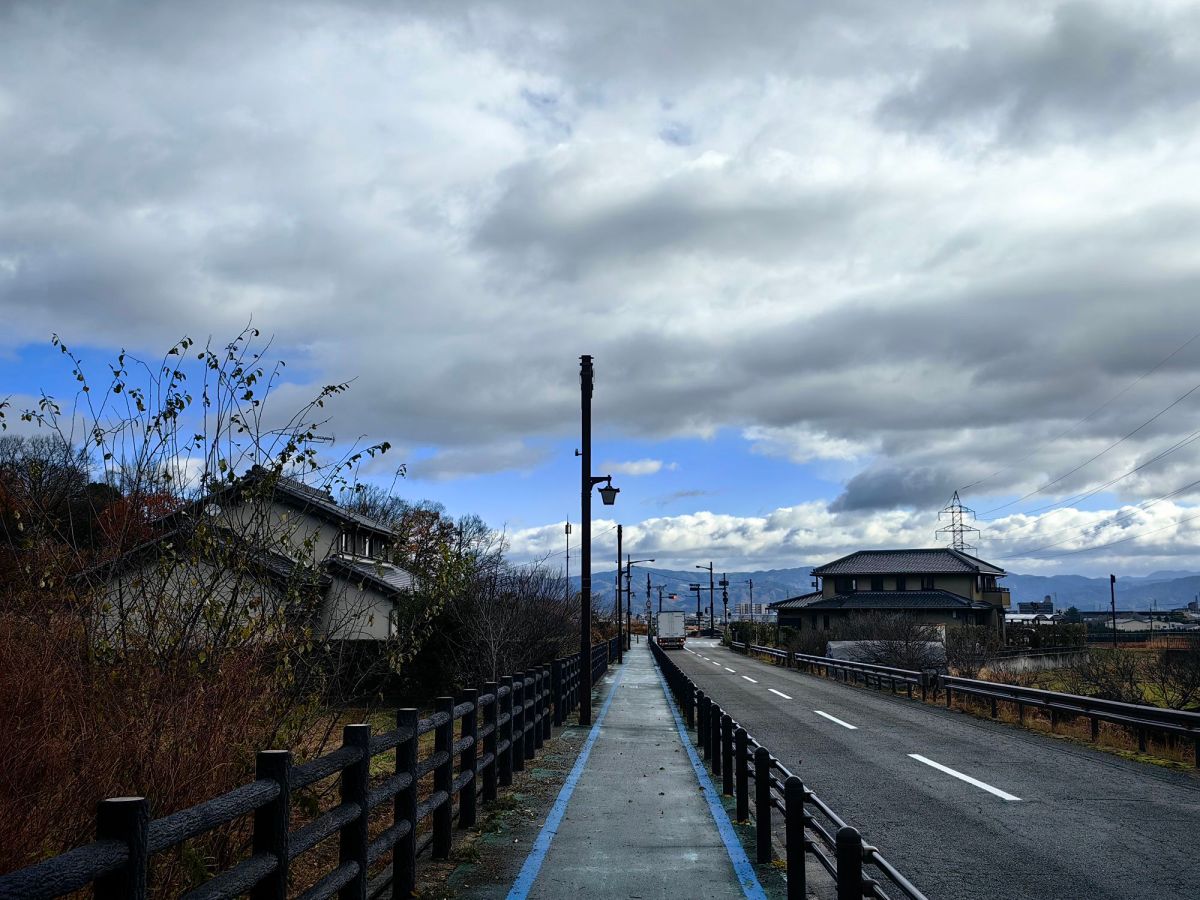
The walk I took from Hōryū-ji to Hōrin-ji to Hōkki-ji is actually passing through one of Japan’s most concentrated landscapes of 7th-century Buddhist history. The ordinary houses, stone walls, fields, and narrow roads between the temples are part of that historic Ikaruga setting rather than simply being a modern neighborhood around three temples.
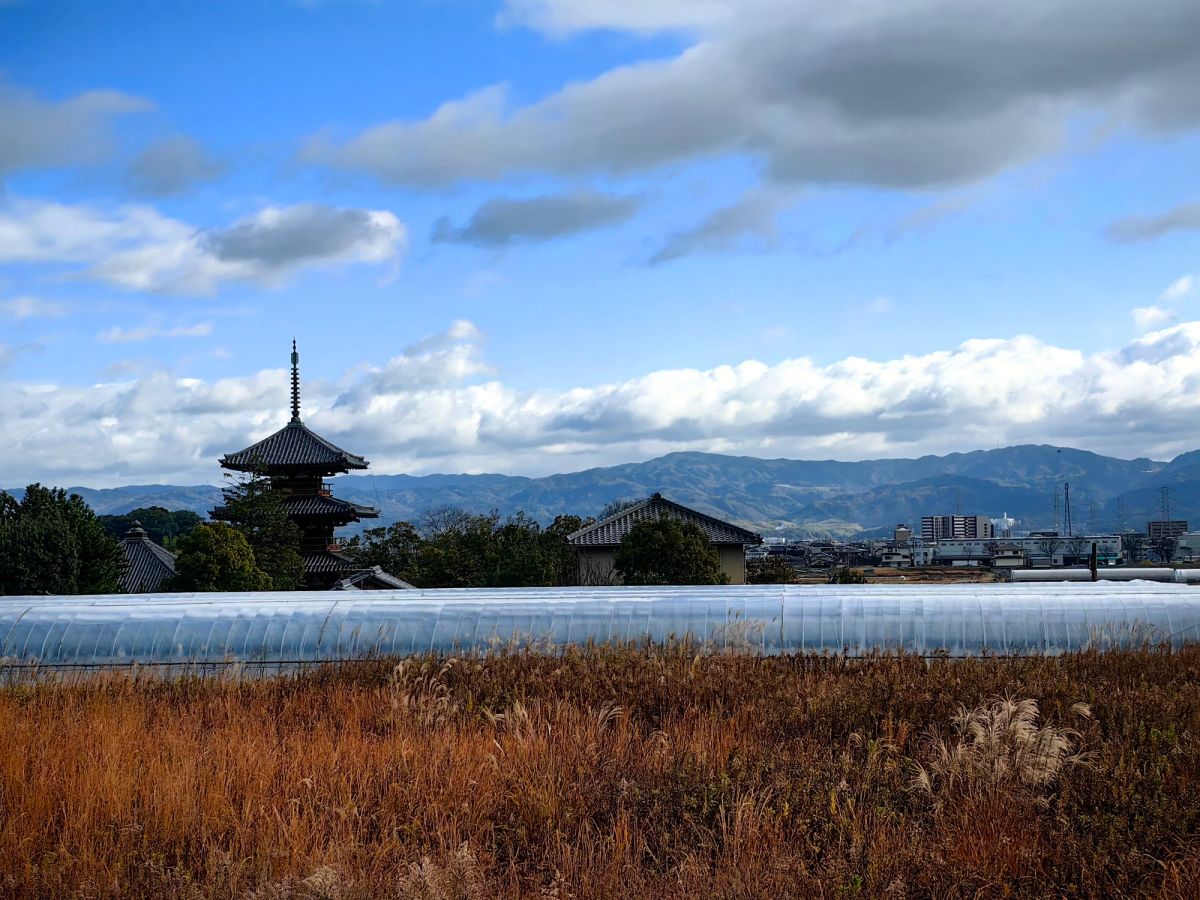
The wide fields, distant mountains and an expansive sky, create a peaceful rural horizon. Standing there with the fields stretching out before me, I took a photograph of the landscape: the low mountains forming a gentle backdrop, the broad agricultural land spreading across the foreground, and the enormous winter sky above. Many Japanese towns are framed by mountains, particularly toward the north, because much of Japan’s interior is mountainous. Even places densely populated often have mountains quietly appearing beyond the buildings. In Ikaruga, however, there were few structures to interrupt the view, so the town, the fields and the surrounding mountains was especially clear.
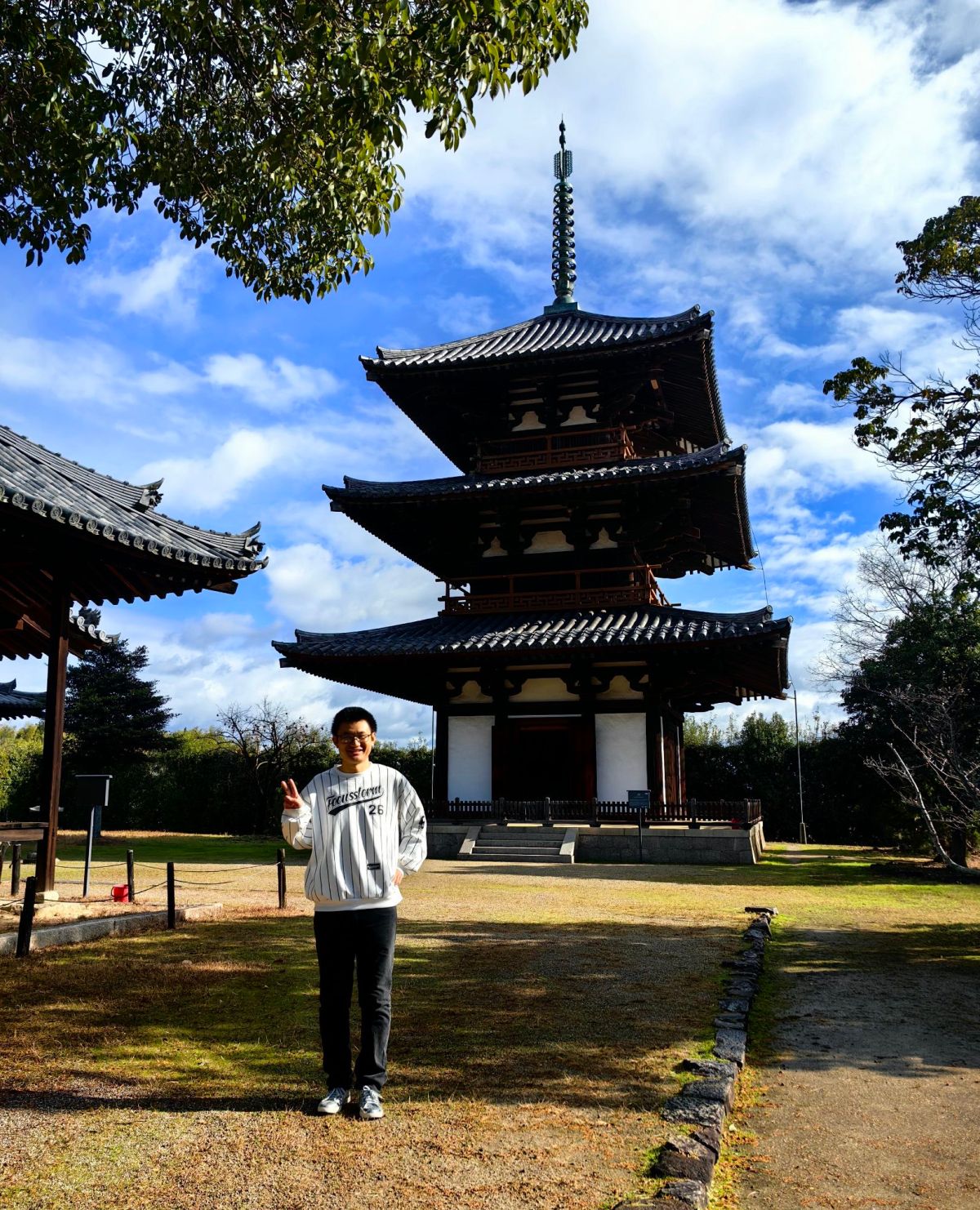
Hōki-ji
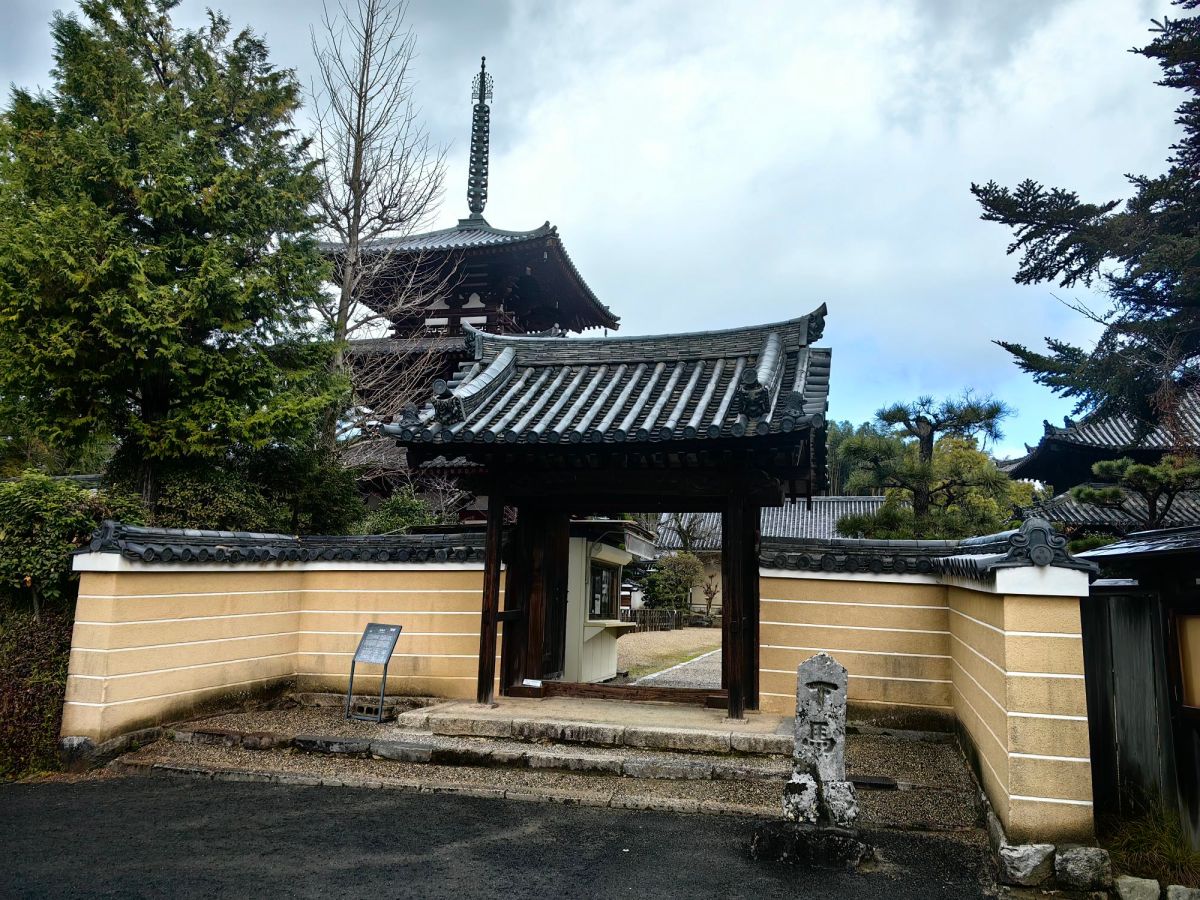
At a quiet corner of the country road, I unexpectedly encountered my last destination, Hōki-ji. It was almost hidden from view, tucked away in a small patch of woodland at the edge of the fields. Through the trees I caught my first glimpse of the three-story pagoda, rising quietly above the surrounding greenery. This temple is also deeply connected with the early history of Japanese Buddhism. Tradition associates it with Prince Yamashiro no Ōe, the son of Prince Shōtoku.
The main hall, although much less imposing than the great halls of Hōryū-ji was modest with traditional tiled roofs, and the surrounding grounds were simple and uncluttered. The three-Story Pagoda was built in the seventh century; one of the oldest surviving three-story pagodas in Japan and the oldest surviving pagoda in the country. Its dark wooden structure stood beautifully against the open sky, each successive roof becoming smaller as the tower rose upward.
By the time I reached Hōki-ji, I had spent the day walking through the small lanes of Ikaruga, visiting ancient temples and gradually moving farther into the countryside. The temple felt like a fitting conclusion to the journey. What moved me most was that history here did not feel like something preserved only for tourists; it remained quietly rooted in everyday life and in the corner of country landscape. That was the most moving part of the journey. After so many centuries, history in Ikaruga does not seem to shout for attention. It was simply waiting for those who are willing to slow down and notice it.
More than a thousand years have passed since Nara stood at the heart of Japan as the imperial capital of Heijō-kyō. In the Man’yōshū, the poet praised the ancient city: “Beautiful Nara, the ancient capital, flourishes now like flowers in full bloom.” Those words conjure Nara in the height of its splendor, when its palaces, temples, and streets were filled with the life and ambition of a flourishing new capital. Today, much of that city has disappeared, leaving only fragments scattered across the landscape. Yet walking through Nara, the passage of time does not feel distant. It lingers in the weathered stones, the ancient wooden halls, the quiet forests, and the deer wandering beneath the trees. The capital that once flourished like flowers has faded, but something of its spirit remains.
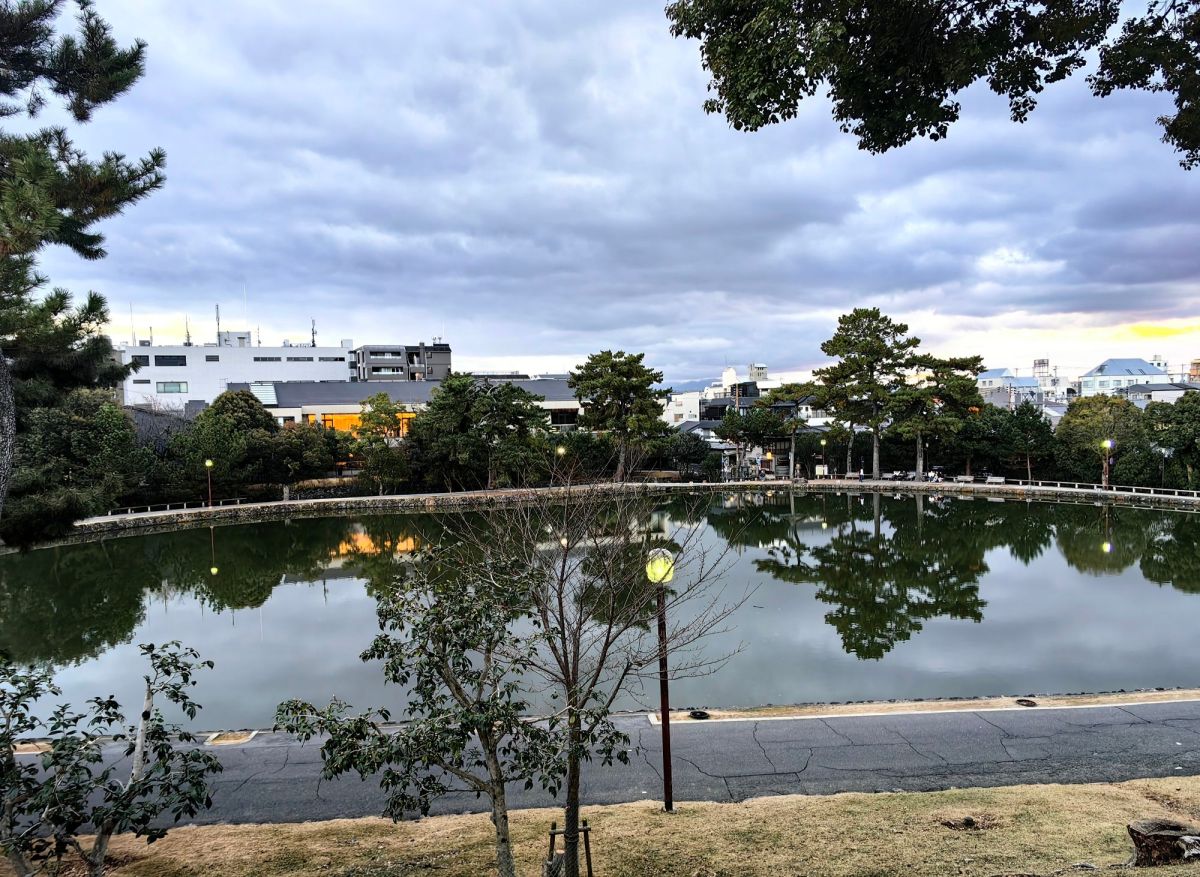
I continued my journey from Osaka to Nara on December 21st 2025 and stayed near the Sarusawa Pond, a peaceful and scenic spot in the heart of the city. The pond is famous for its beautiful views of Kōfuku-ji’s five-story pagoda, which rises above the surrounding trees and traditional streets. Walking around the area, I could enjoy the calm water, historic atmosphere, and glimpse of Nara’s historic scent. It felt like a perfect place to experience the quiet, traditional side of Nara while still being close to the city’s many historic attractions which are parts of the UNESCO World Heritage Site ‘Historic Monuments of Ancient Nara.’
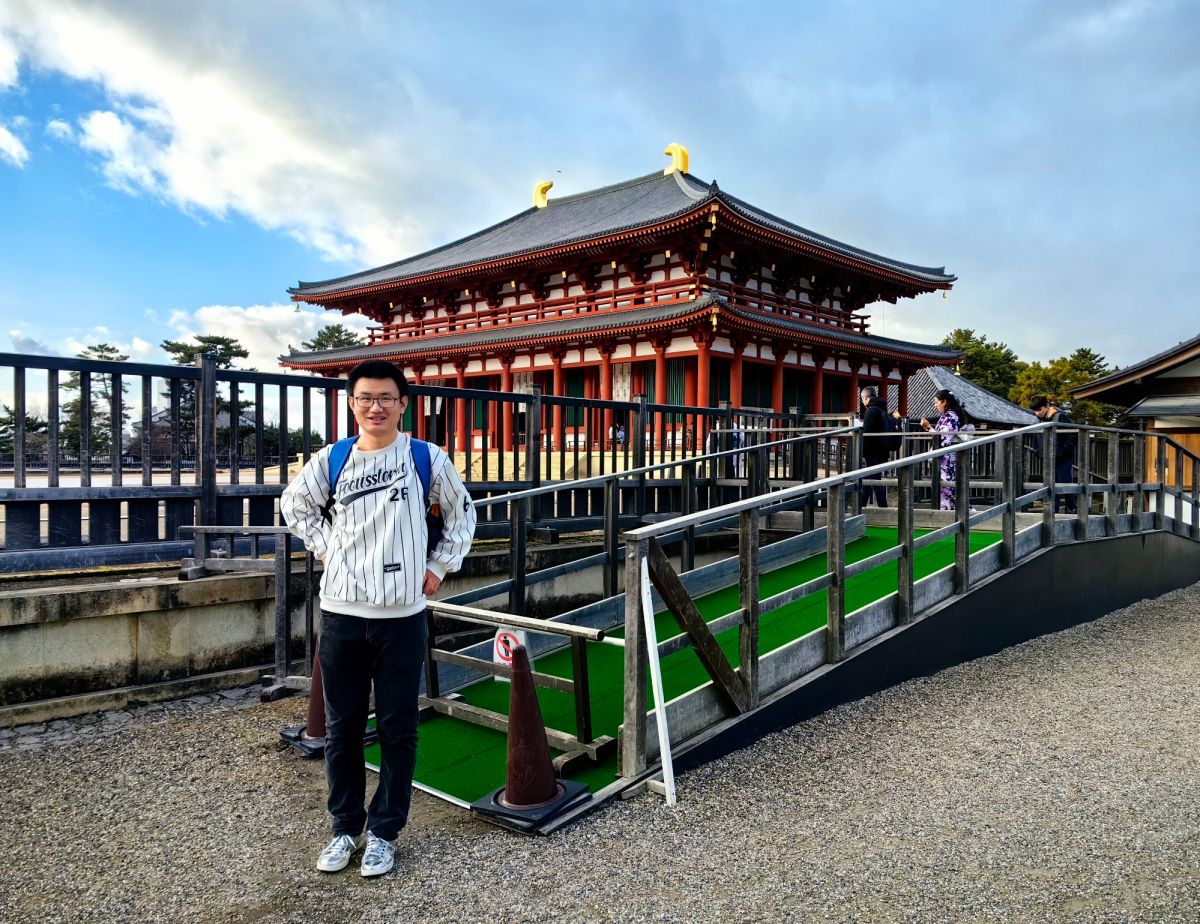
My first point of attraction in Nara was Kōfuku-ji, one of the city’s most famous and historic Buddhist temples. As I walked through the temple grounds, I was surrounded by beautiful traditional architecture and a peaceful atmosphere. Kōfuku-ji’s long history and impressive buildings gave me my first glimpse into Nara’s rich cultural and religious heritage. Kōfuku-ji has a long and fascinating history dating back to 669 AD. It was originally founded in Kyoto by Kagami no Ōkimi to pray for the recovery of her husband, Fujiwara no Kamatari, the founder of the powerful Fujiwara clan. In 710, when the capital was moved to Nara, the temple was relocated to the city and became one of the most important Buddhist temples in Japan.
我在奈良的第一处游览地便是是兴福寺。它是这座古都最著名、也最具历史底蕴的佛教寺院之一。走入寺院的境内,古朴典雅的传统建筑映入眼帘,四周弥漫着一种宁静而悠远的气息。兴福寺悠长的历史与恢弘的建筑,也成为我初次触摸奈良深厚文化与宗教传统的一扇窗口。其历史可以追溯至公元669年。最初,它并不在奈良,而是由日本飞鸟时代的著名女性和歌诗人镜王女(Kagami no Ōkimi)建立于京都,为祈求丈夫藤原镰足(Fujiwara no Kamatari)早日康复。藤原镰足后来成为强大的藤原氏始祖,而这座寺院也由此与日本历史上最具影响力的家族之一结下了深厚的渊源。公元710年,日本迁都奈良,兴福寺也随之迁至这座新都。在此后的岁月里,它逐渐成为日本最重要的佛教寺院之一。
Chū-Kondō
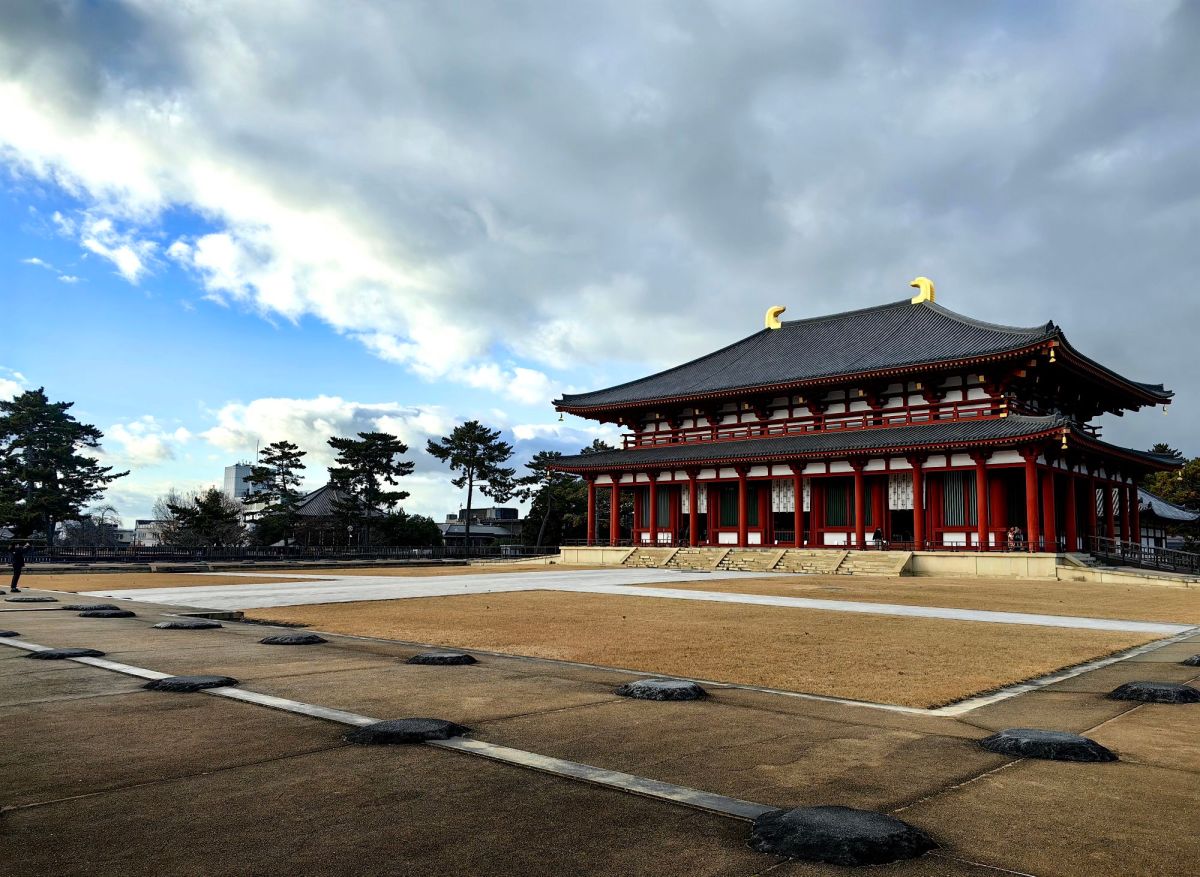
The Central Golden Hall (Chū-Kondō) stood at the heart of Kōfuku-ji, its vermilion columns and broad tiled roof giving the temple precinct a dignified and symmetrical appearance. Although the present hall is a modern reconstruction, its design follows the traditional character of the ancient temple, allowing the historic layout of Kōfuku-ji to emerge once again. Kōfuku-ji has endured repeated fires and destruction throughout its long history, and many of its buildings have been rebuilt over the centuries.
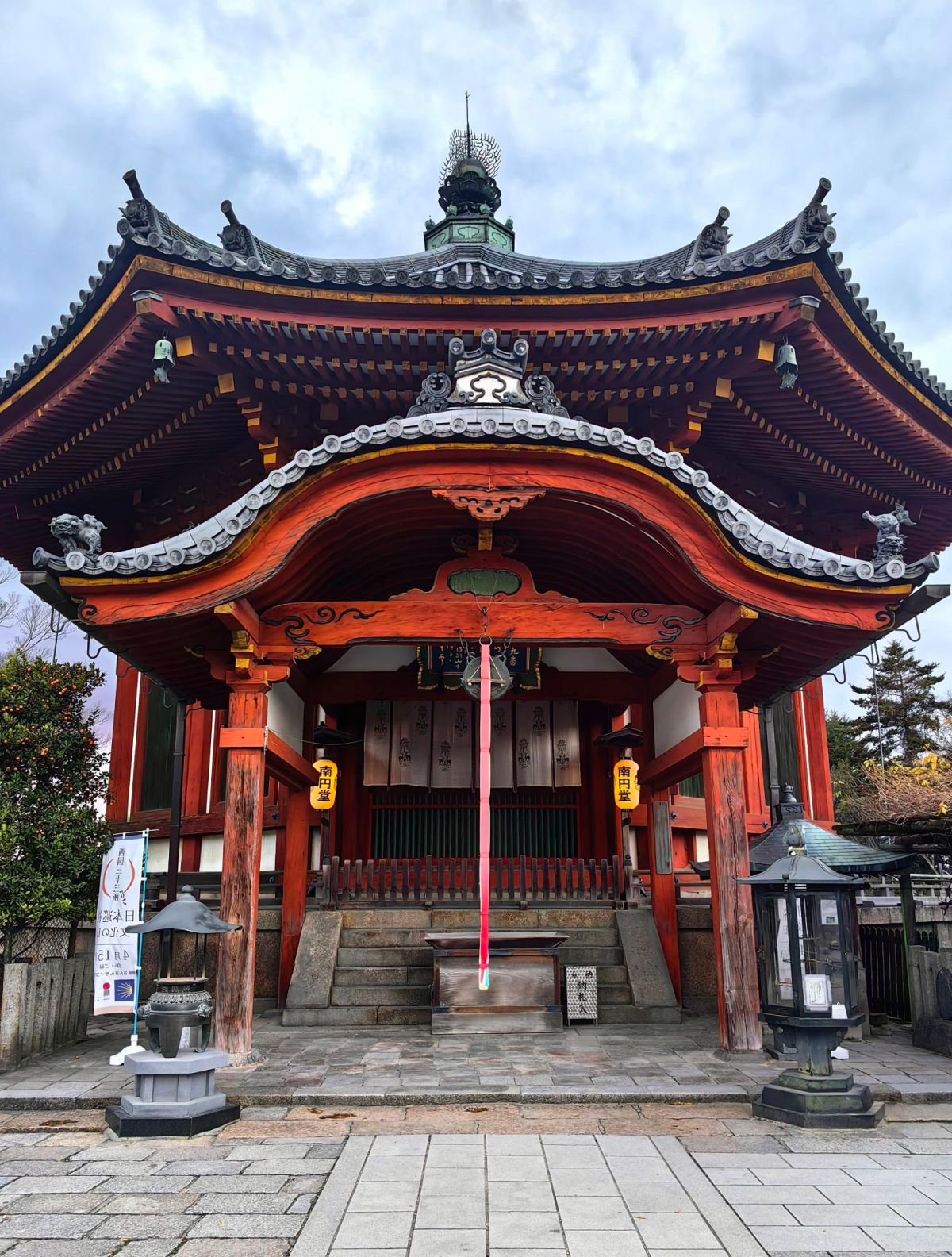
Nanen-dō is a small but historically significant Buddhist hall within Kōfuku-ji. It is especially famous for being the 9th temple on the Saigoku Kannon Pilgrimage, a pilgrimage route connecting 33 temples dedicated to Kannon, the Buddhist bodhisattva of compassion. Built in 813 by Fujiwara no Fuyutsugu, Nanen-dō was originally established as a place of prayer for the Fujiwara family. The present building dates from 1789, after the earlier structure was destroyed by fire. Its simple, octagonal design contrasts with the larger and more elaborate buildings elsewhere at Kōfuku-ji.
The influence of Fujiwara family is deeply woven into the history of Nara. It rose to prominence in the 7th century through Nakatomi no Kamatari, who helped Emperor Tenji carry out the Taika Reforms. In recognition of his service, he was given the surname Fujiwara in 669. His descendants gradually became one of the most influential families at the imperial court. Their greatest political strength came not from becoming emperors themselves, but from controlling the imperial court through marriage. Fujiwara men frequently served as regents and senior court officials, while Fujiwara women married emperors and became mothers of future emperors. Through this network, the family could exercise enormous political influence while remaining behind the imperial throne. Kōfuku-ji became the testimony of this history, it was the family temple of the Fujiwara, functioning not only as a religious institution but also as an important symbol of the family’s status and power.
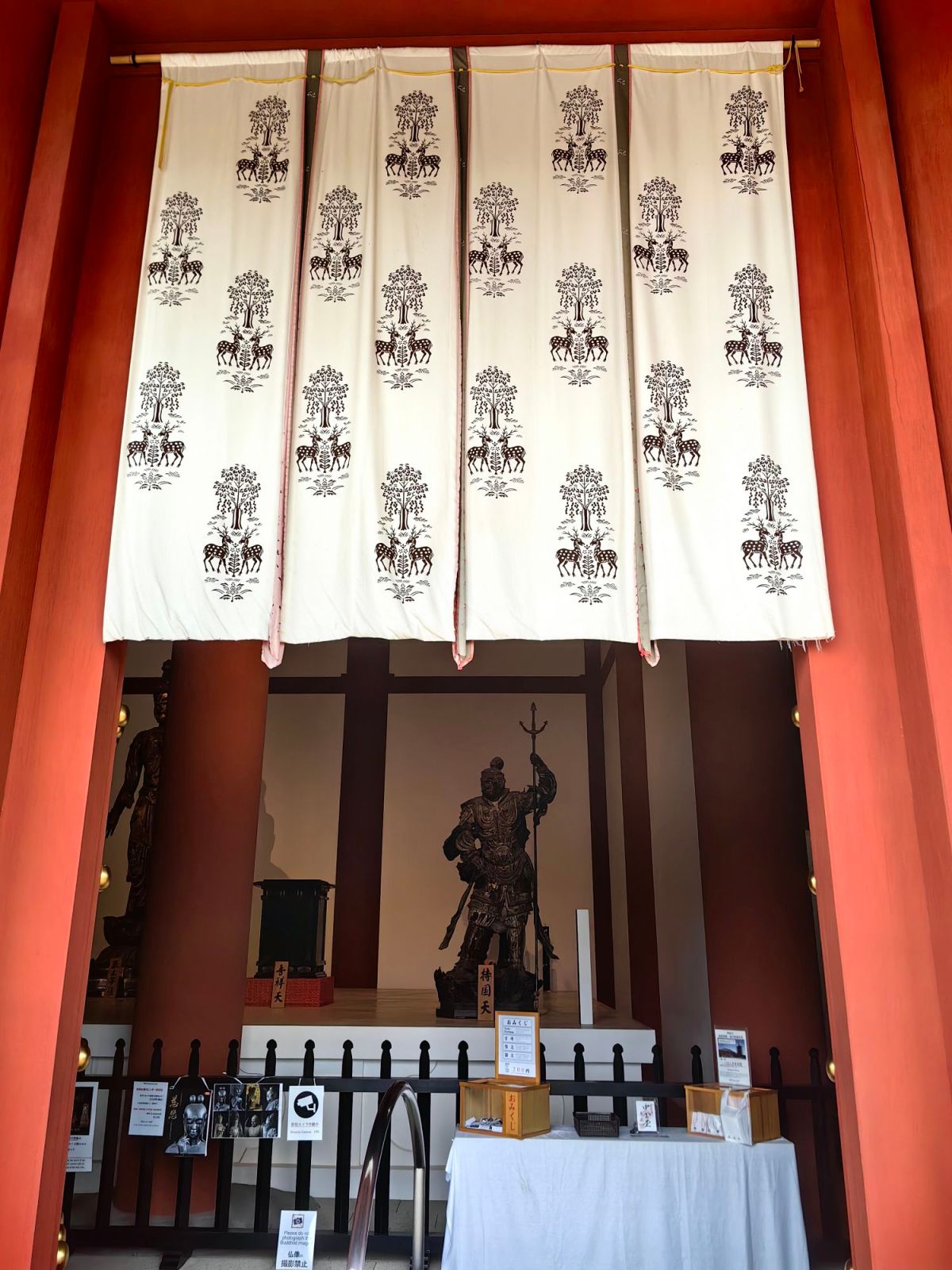
Tōkondō is called Eastern Golden Hall because it belongs to the group of Kon-dō (Golden Halls) that once formed the heart of the temple complex. Its elegant traditional architecture, with its dark wooden structure, copper bells and distinctive tiled roof, gives it a dignified and timeless appearance. It was originally built in726 by Emperor Shōmu to pray for the recovery of his father, Emperor Genmei. The present building dates from 1415.
Inside, Tōkondō is particularly important for its collection of Buddhist statues and religious treasures which made me feel the religious atmosphere. Among them is a revered statue of Yakushi Nyorai, accompanied by other Buddhist figures. The hall provides a peaceful space to appreciate the artistic and spiritual traditions of medieval Japanese Buddhism. At the entrance, I noticed the hanging curtain with a particularly beautiful detail. The curtain features a traditional pattern of two deer under a tree, reflecting the strong connection between Nara and its sacred deer. Deer have long been regarded as sacred messengers of the gods, particularly because of their association with Kasuga Taisha. Seeing the deer motif on the curtain connects the Buddhist temple with the wider spiritual traditions of Nara.
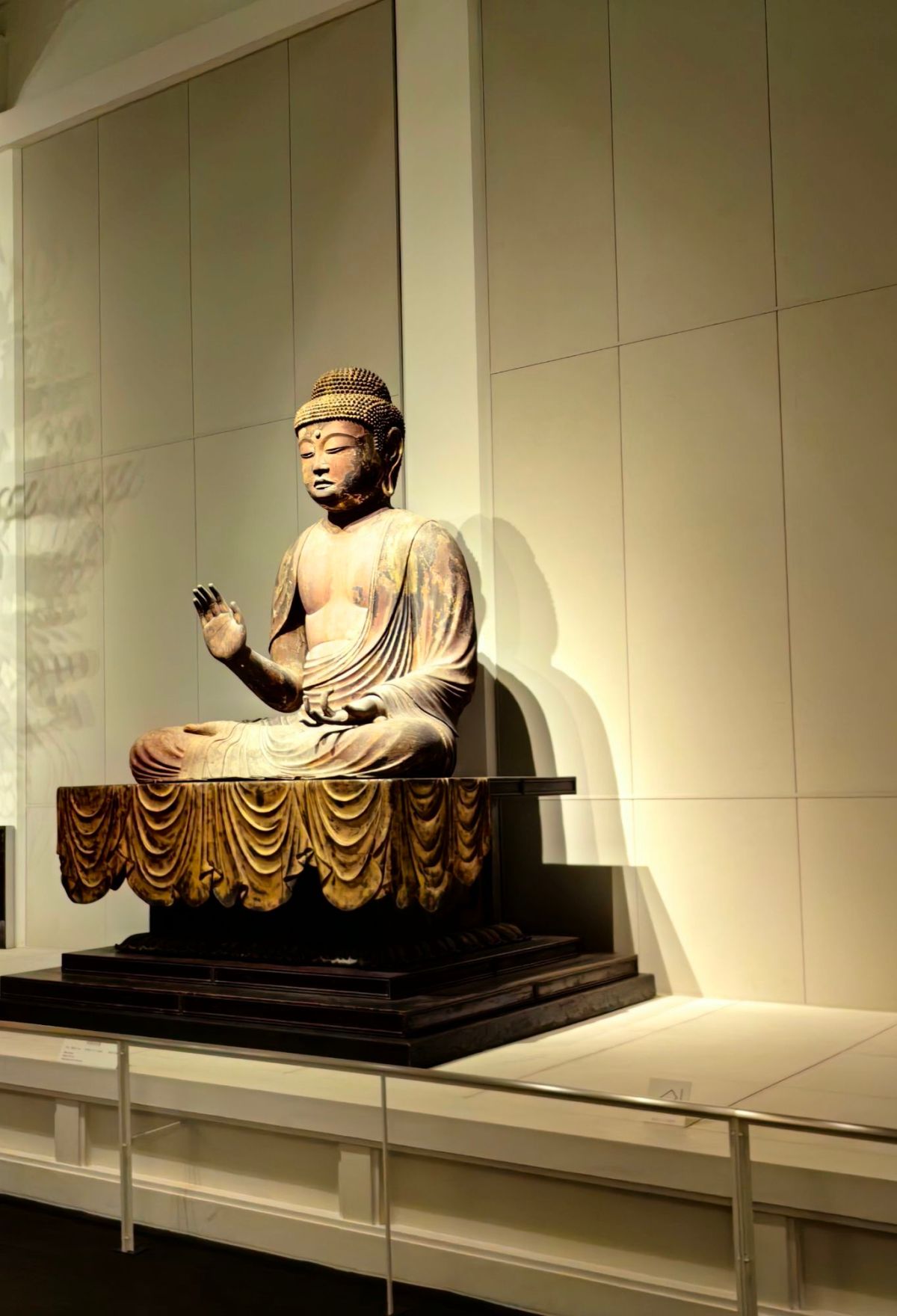
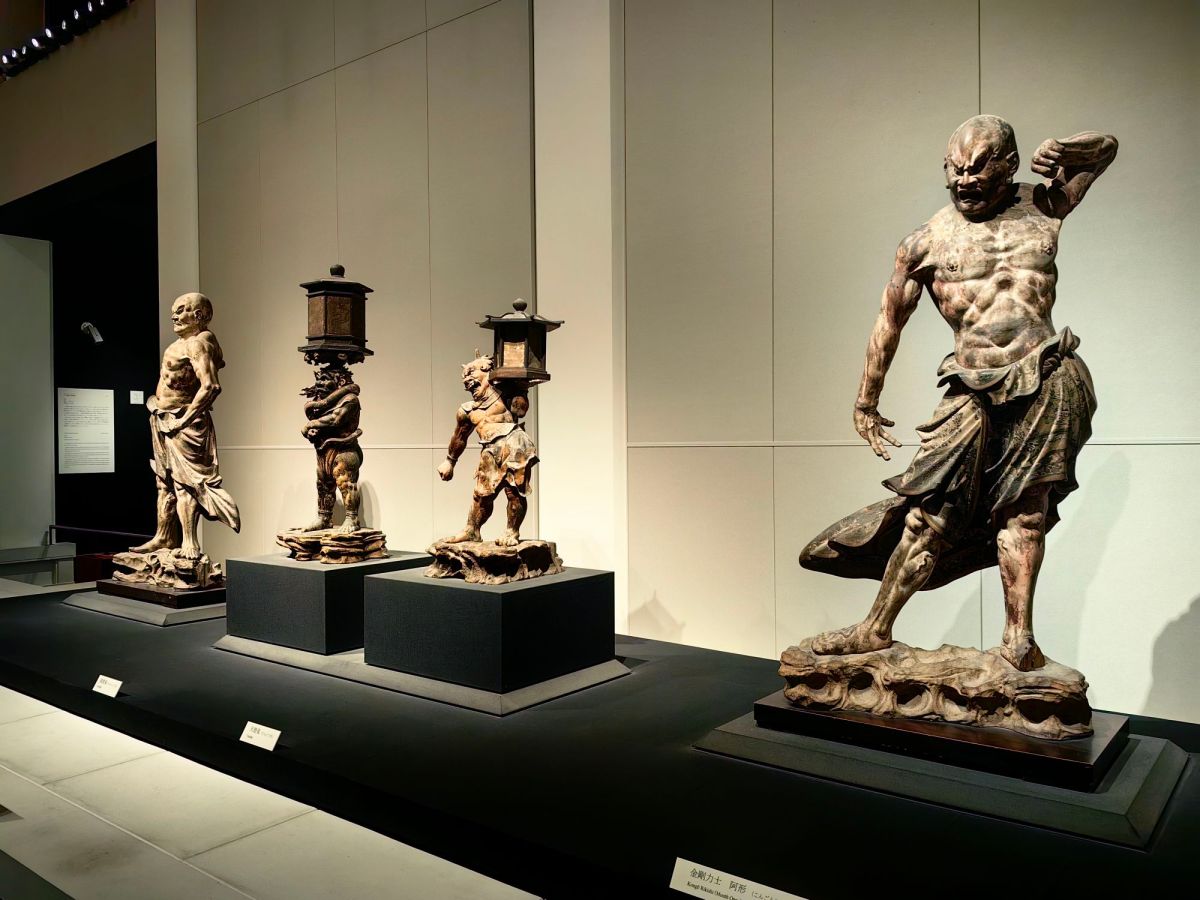
Kōfuku-ji National Treasure Museum is one of the highlights of a visit to Kōfuku-ji, especially for anyone interested in Japanese Buddhist art and history. The museum houses an impressive collection of Buddhist statues, paintings, and other cultural treasures that were preserved by the temple over many centuries. The artworks and statues made the history of the temple feel more personal and tangible.
The Kongō Rikishi are among the temple’s remarkable Buddhist guardian sculptures and are designated National Treasures of Japan. They represent powerful protective deities who guard Buddhist teachings and sacred spaces from evil and harm. The two guardians are traditionally depicted as muscular, dynamic figures with fierce expressions. Their dramatic poses, bulging muscles, flowing robes, and intense facial expressions create a striking contrast with the calm and compassionate appearance of Buddha and bodhisattva statues. What makes the Kongō Rikishi especially impressive is the exceptional craftsmanship of their wooden sculpture. The sculptors captured movement and emotion with remarkable detail, from the tension in the bodies to the expressive faces and flowing garments.
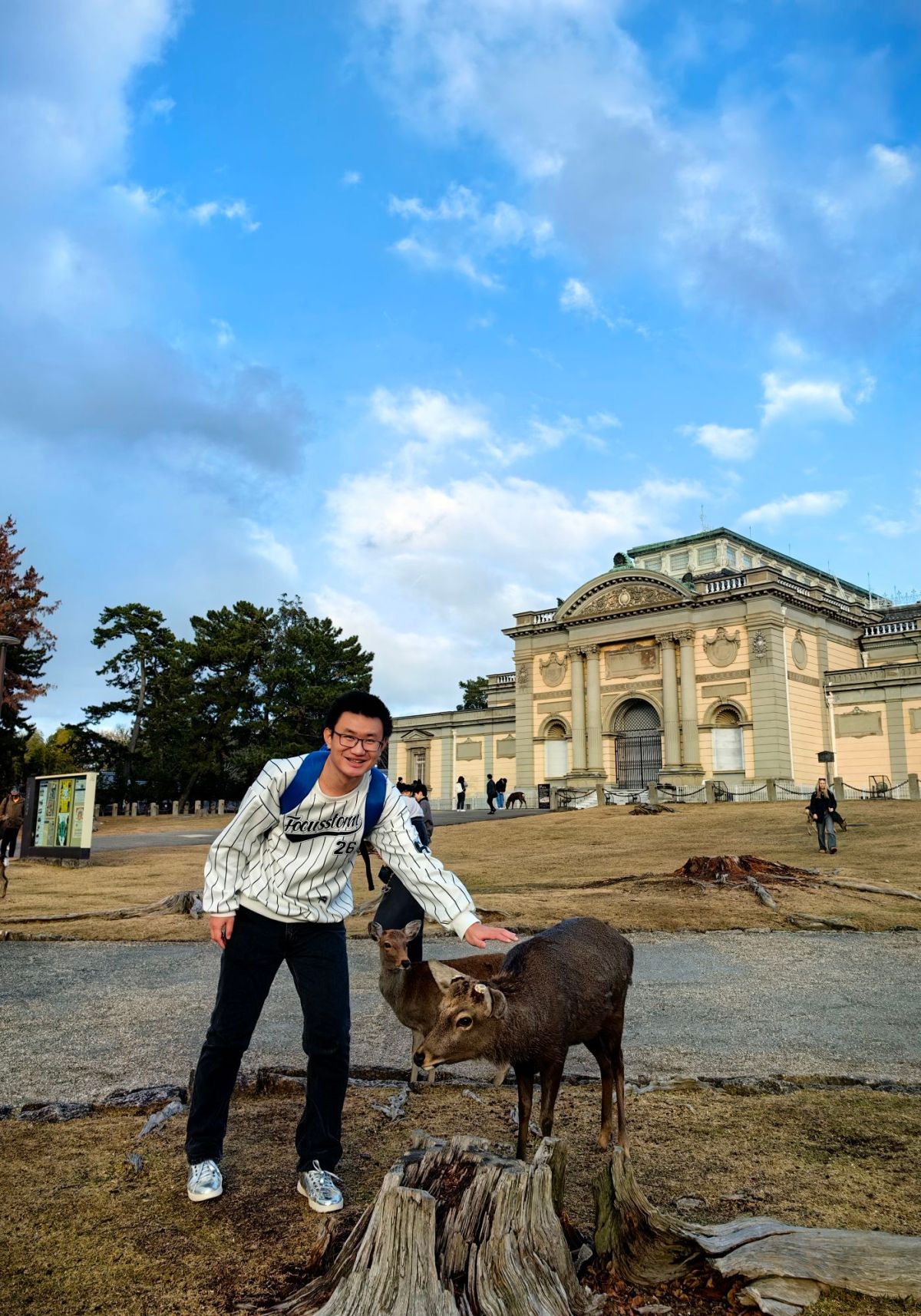
Nara left a deep impression on me, not only because of its rich history and beautiful temples, but also because of its peaceful natural environment and abundance of deer. As I walked through the city, especially around Nara Park, the presence of deer made the experience feel unique and almost magical. They wandered freely among the trees, pathways, and historic temples. Here, the deer seemed to be part of everyday life. They would cross the roads freely, and cars would patiently stop to let them pass. I was amazed by how comfortable they were around people and close to people. Some of the deer came close enough for me to touch their soft fur. They showed little fear of human beings and simply stood there quietly, occasionally lifting their heads to glance at me, before continuing on their way as if nothing had happened.
The calm surroundings, fresh greenery, and gentle presence of the deer offered a refreshing contrast to the busy atmosphere of Osaka. I slowed down and felt the city’s clamor gradually receded behind me, leaving only the shadows of trees, the gentle breeze, and the light, graceful footsteps of the deer. The experience made my visit feel more than just a sightseeing trip. It was a chance to experience the harmony between nature and history that makes Nara so special.
Nara has so many deer because they have been protected there for more than 1,300 years, and they are deeply connected to the city’s religious history. The story goes back to Kasuga Taisha, where deer were traditionally regarded as sacred messengers of the gods. According to legend, the deity Takemikazuchi-no-Mikoto arrived at Mount Mikasa on a white deer. Because of this, deer in the Nara area came to be treated as sacred animals and were protected rather than hunted. Over the centuries, this tradition continued. The deer gradually became an important part of Nara’s cultural identity. Today, the deer roaming freely around Nara Park, Kasuga Taisha, and the surrounding temple grounds. They have become accustomed to human presence, although they remain wild animals, rather than domesticated pets.
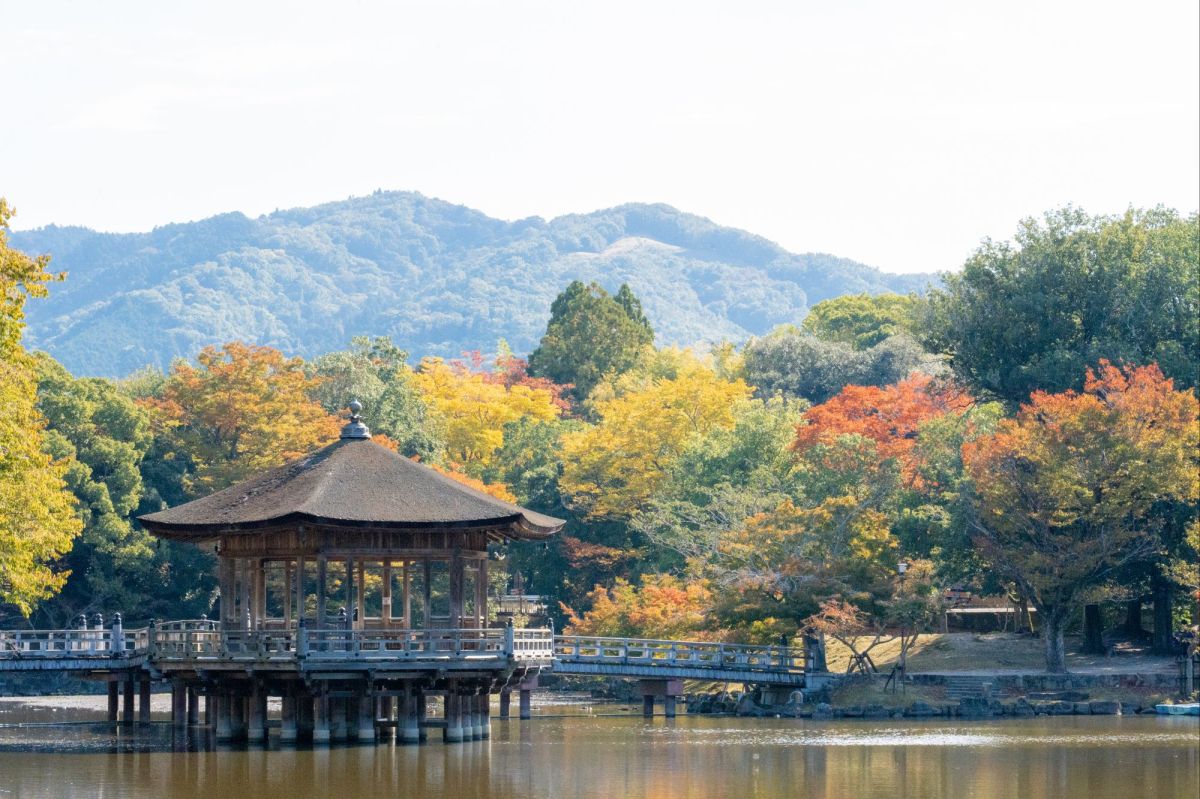
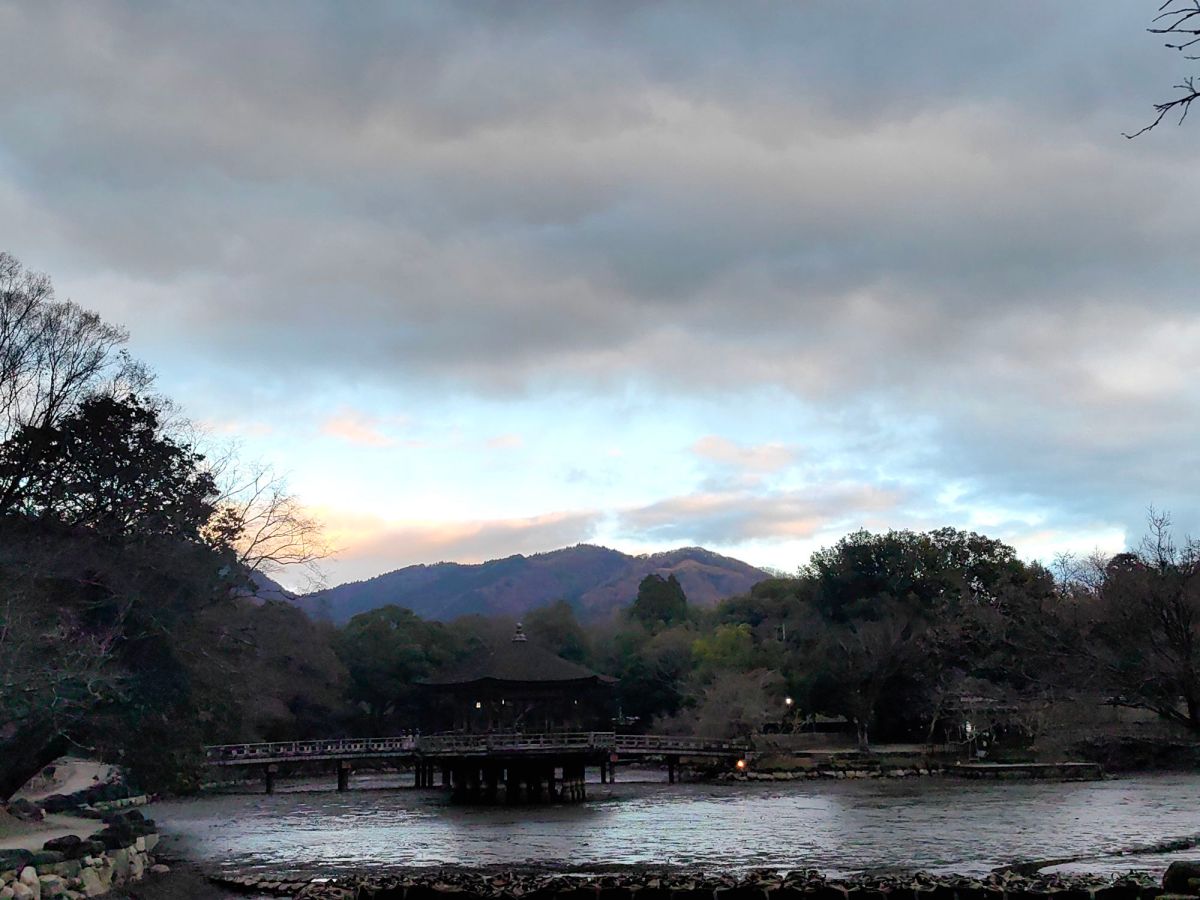
The Ukimido Pavilion is one of the most tranquil and picturesque places in the south of Nara Park.The present pavilion was constructed in 1916 and has a distinctive hexagonal shape with a traditional cypress-bark roof.The surroundings are just as beautiful as the pavilion itself. The pavilion seemed to float on the Sagiike Pond which is enclosed by trees and greenery. The area around the pond forms part of Asajigahara, a quiet, gently hilly section of Nara Park near Kasuga Taisha. I enjoyed the amazing wide landscapes of Nara Park. The vast green forests were filled with deer wandering freely among the trees and along the quiet pathways. In the distance, Mount Kasuga provided a beautiful natural backdrop.
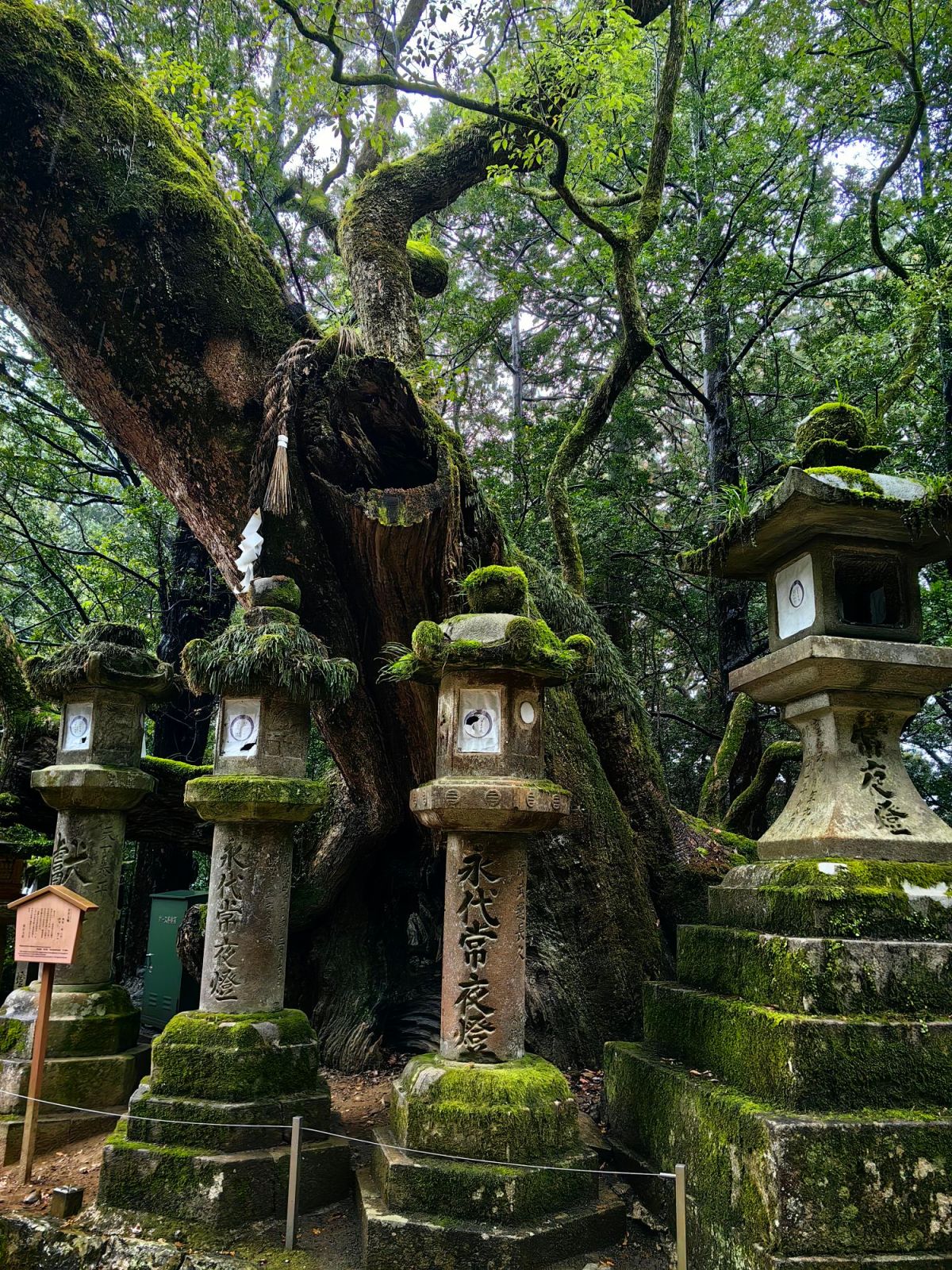
After walking along a stone-paved path lined with rows of perpetual stone lanterns(Eitai Jōyatō), I arrived at the famous Kasuga Taisha in the south of Nara. The path itself was an unforgettable part of the journey. Hundreds of stone lanterns stood quietly among the trees, creating a mysterious and sacred atmosphere as they guided me deeper into the forest. These stone lanterns, known as tōrō, were donated by worshippers over the centuries as offerings to the shrine. Many are covered with green moss, weathered by time, and blend beautifully into the surrounding forest. Seeing so many lanterns standing along both sides of the path made me feel as though I were travelling through a passage connecting the present with Nara’s ancient past.
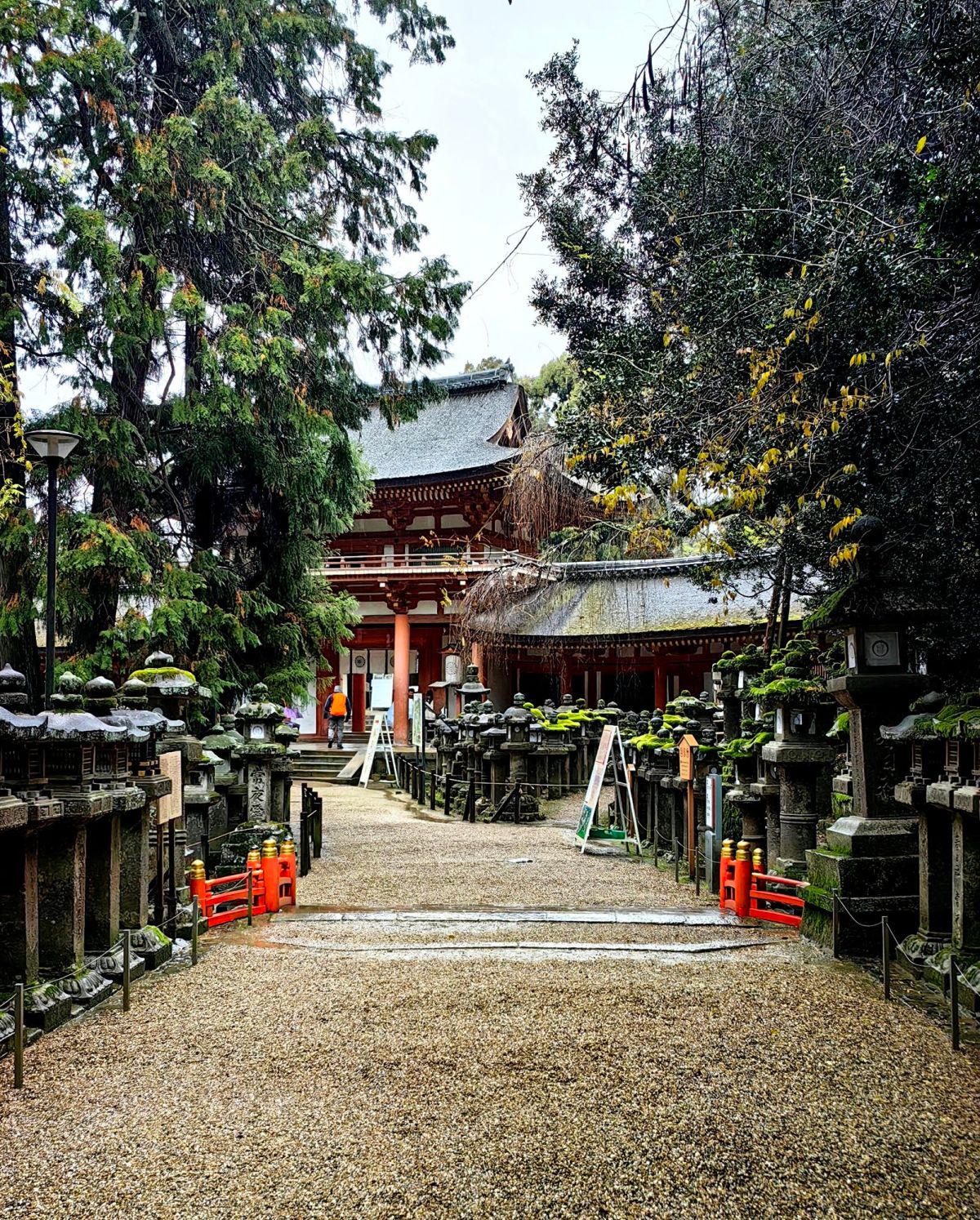
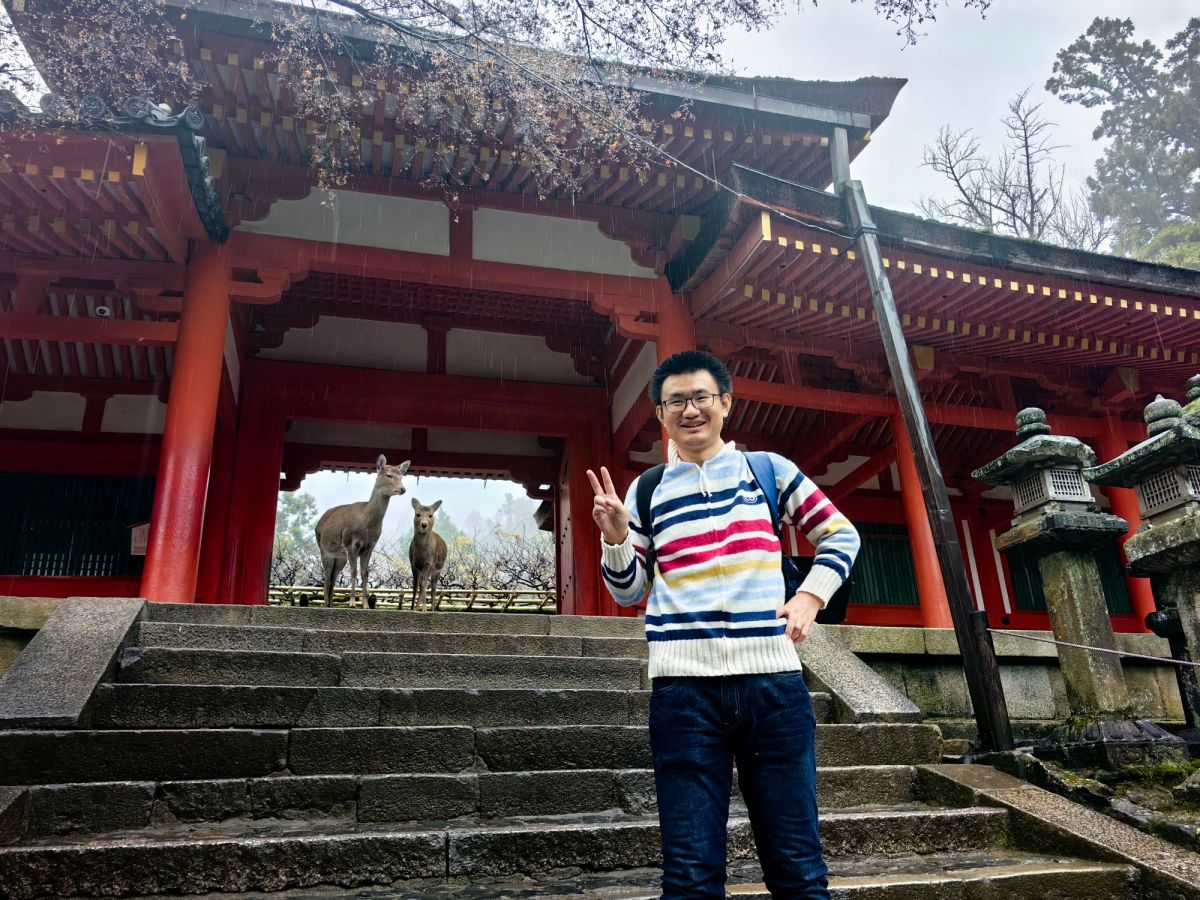
The red main gate of Kasuga Taisha was one of the most striking sights along my journey. Rising about 12 meters high, it is the largest gate of the shrine and serves as the important entrance to the inner shrine precinct. As I approached the red gate, the weathered stone lanterns seemed to form a natural procession leading me toward the sacred grounds. The contrast between the bright vermillion gate, grey stone lanterns, and lush green trees created an unforgettable scene.
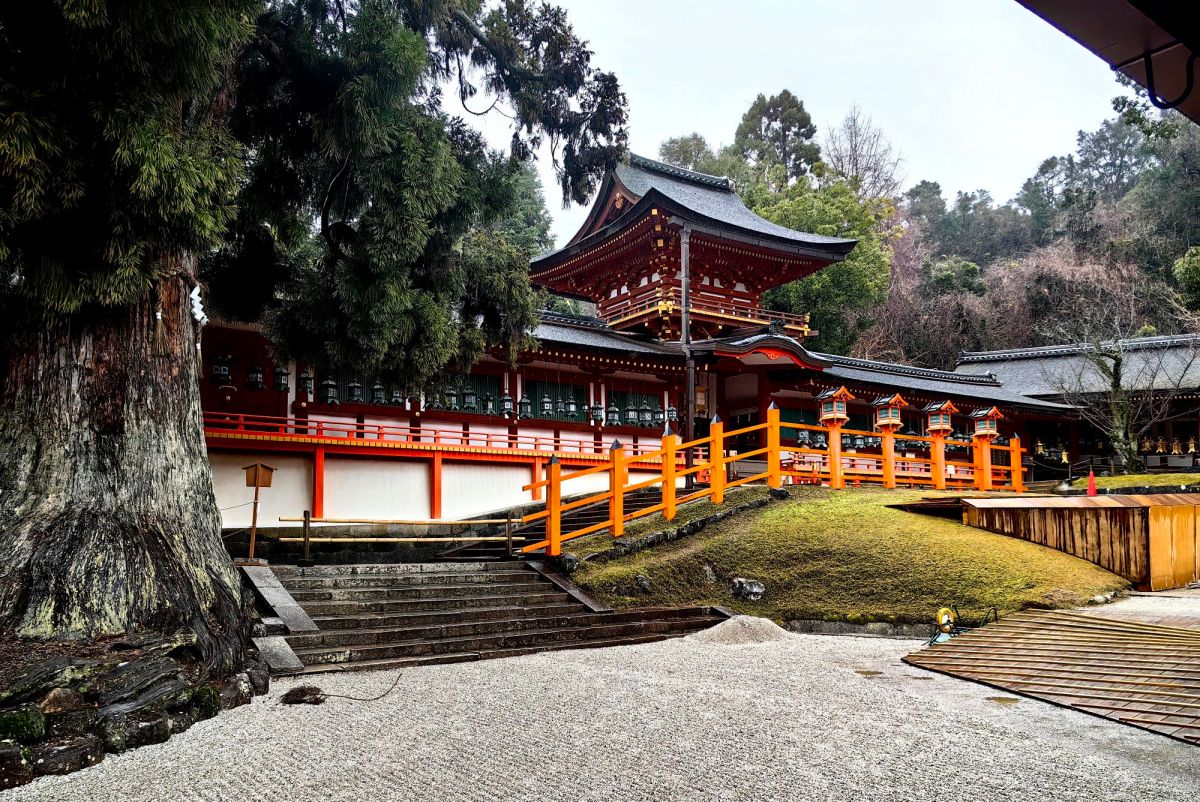
Kasuga Taisha is the most famous and beautiful Shinto shrines in Nara. It was officially established in 768, when the Fujiwara family established the shrine to enshrine their ancestral and tutelary deities and to protect the ancient capital. The Main Sanctuary is the most sacred and architecturally distinctive part of the shrine. Its architecture style ‘the Kasuga-zukuri ‘ is a distinctive form of Japanese Shinto architecture. Each small shrine has a steeply curved gabled roof covered with layers of Japanese cypress bark, with the entrance positioned beneath the gable. A small projecting roof shelters the entrance and staircase. Surrounding the sanctuary is the Oro which is an open veranda whose shape resembles a bird spreading its wings. The surrounding corridors are decorated with numerous hanging ancient bronze lanterns.
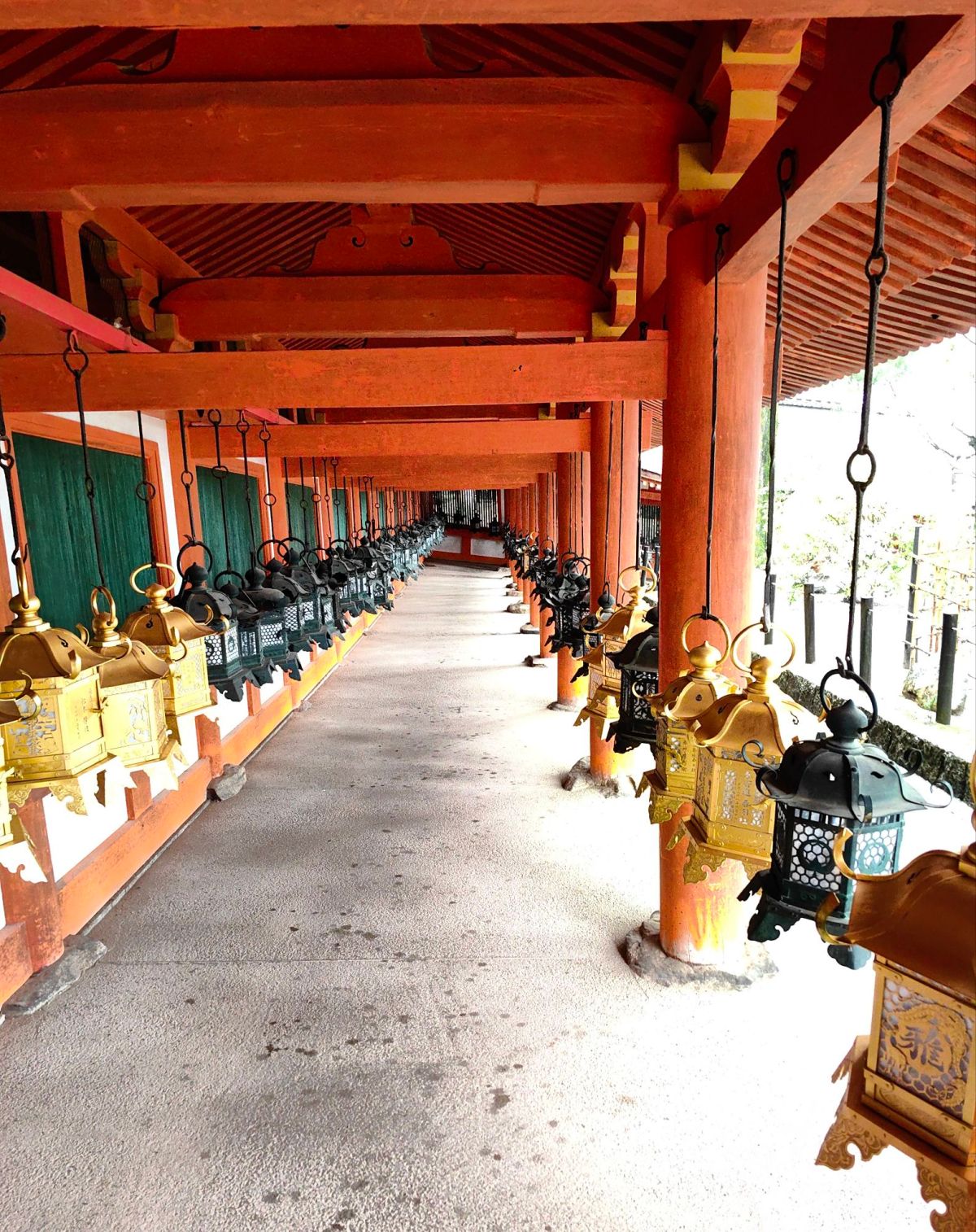
Along the corridor of Kasuga Taisha, there are roughly 1,000 bronze hanging lanterns, called tsuri-dōrō. They were donated by worshippers as offerings to the Shinto deities, representing their prayers, gratitude, and wishes. They were like a physical expression of a person’s devotion. The grey or greenish-black color comes largely from the natural patina that develops on bronze over time. For me, walking beneath the long rows of bronze lanterns was almost like passing through a corridor of thousand prayers.
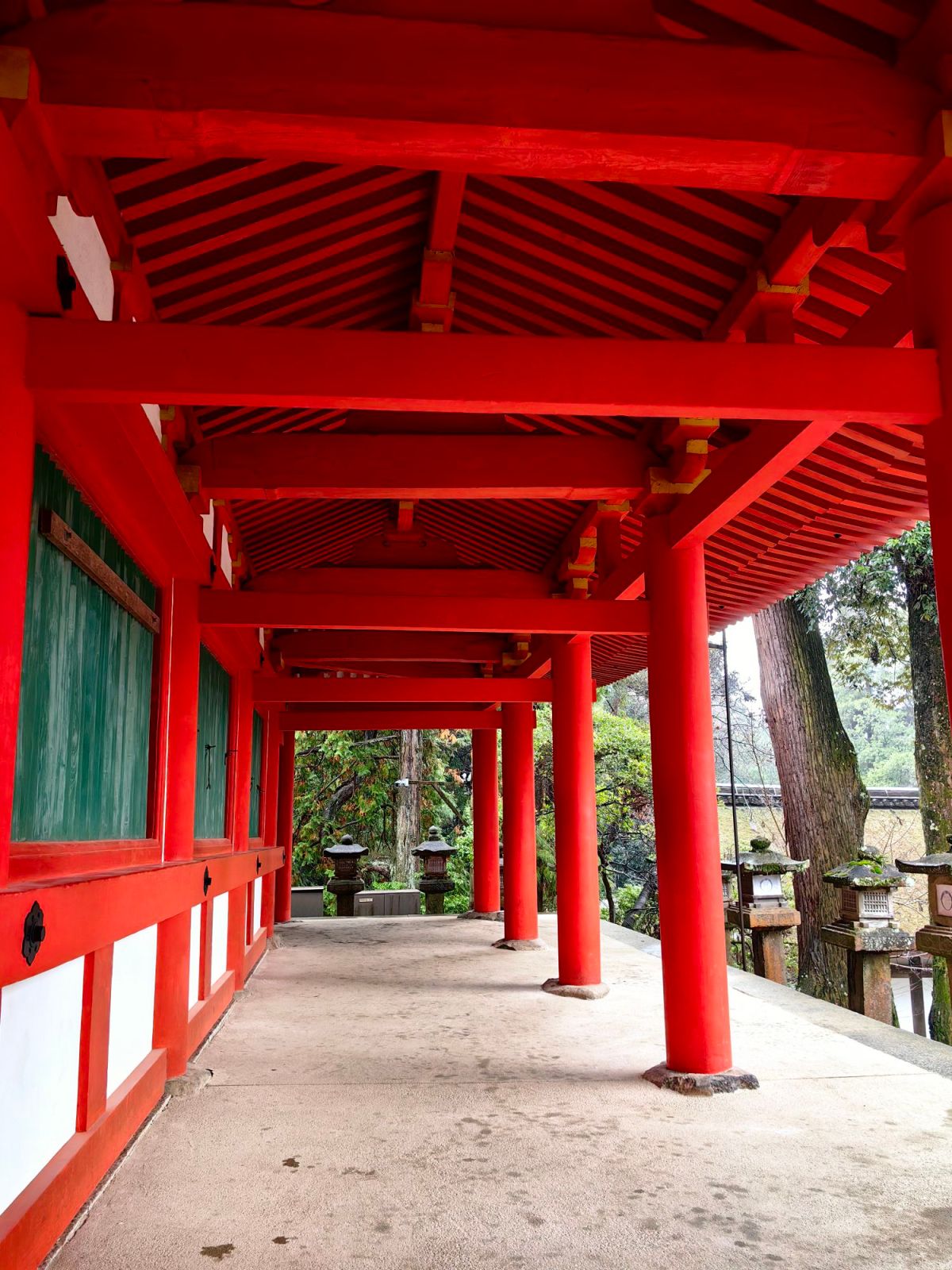
The main sanctuary is famous for its vivid vermilion columns in the long corridor. As the corridor receded into the distance, the repeating columns and lanterns created a graceful rhythm, drawing my eyes deeper into the far end. The brilliant red of the wood, the muted bronze of the lanterns, and the shadowy forest seemed to bring me back to the passing centuries.
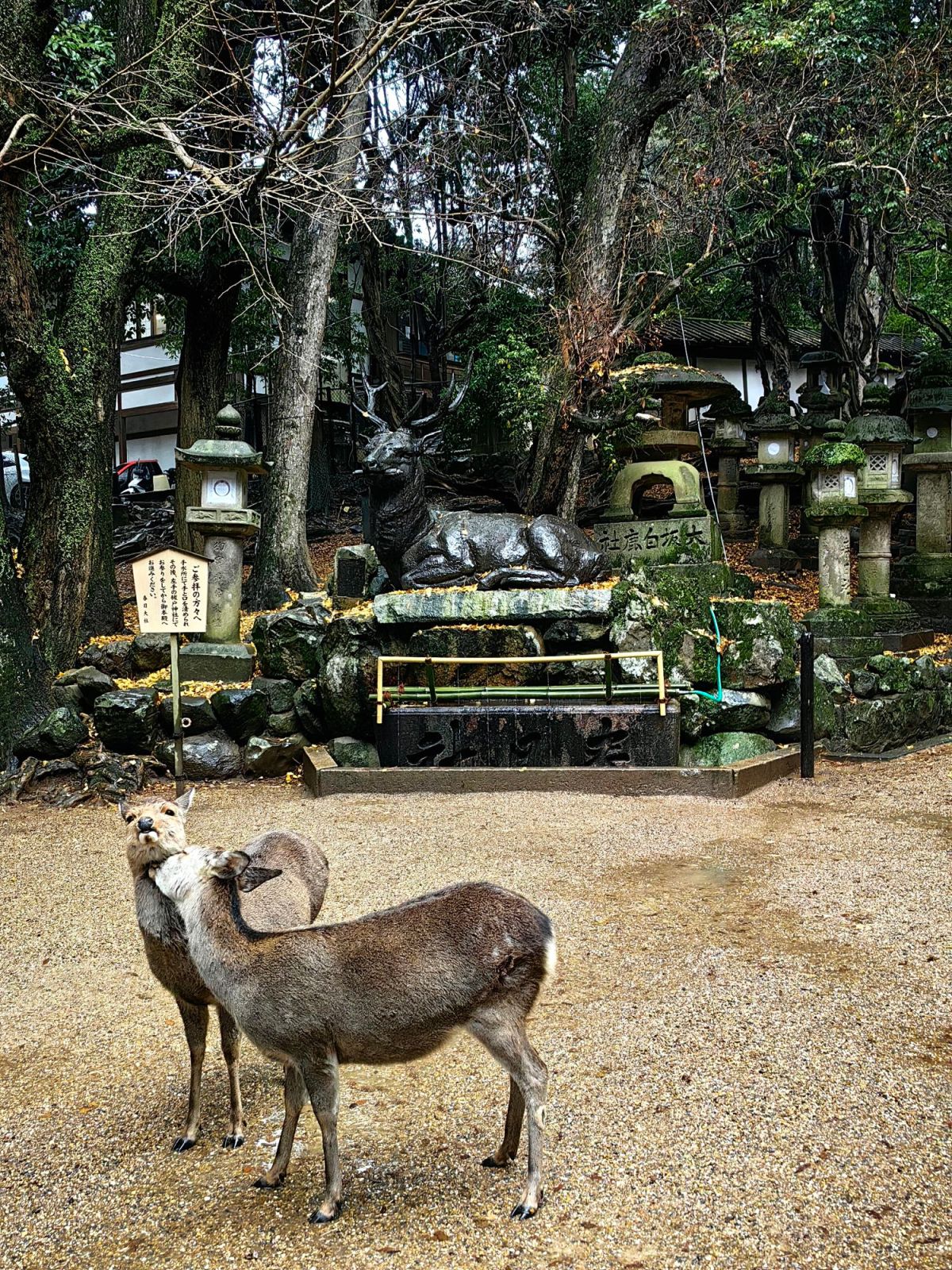
At the side door of the sanctuary, I unexpectedly came upon two deer standing quietly together. They stood there and turned their heads toward me, watching with gentle curiosity, as though wondering what had brought this stranger into their ancient forest. For a moment, we simply stood there looking at one another. Their quiet presence made the shrine feel as if the sacred and the natural seemed to exist side by side.
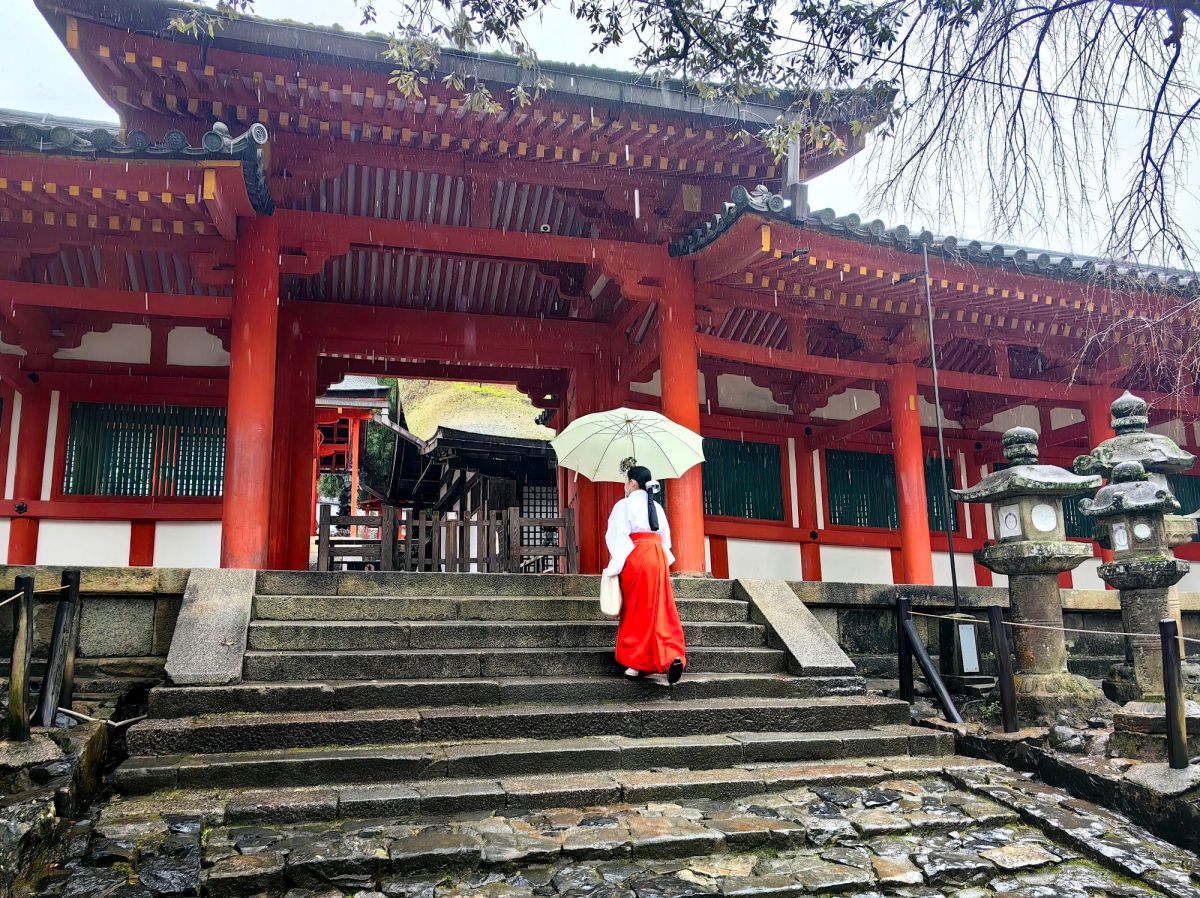
Before I left, a gentle rain fell over Kasuga Taisha, veiling the ancient forest in a soft mist and lending the shrine an almost otherworldly stillness. The vivid vermilion columns glistened with rain, their colors deepening against the moss-covered trees. Beneath a simple umbrella, a shrine maiden appeared in her traditional white and vermilion robes, walking quietly through the rain. For a fleeting moment, the scene felt suspended between past and present. The ancient forest, the sacred shrine, the falling rain, and the solitary figure moving through the vermilion corridor seem to allow a fragment of old Nara to quietly reappear before my eyes.
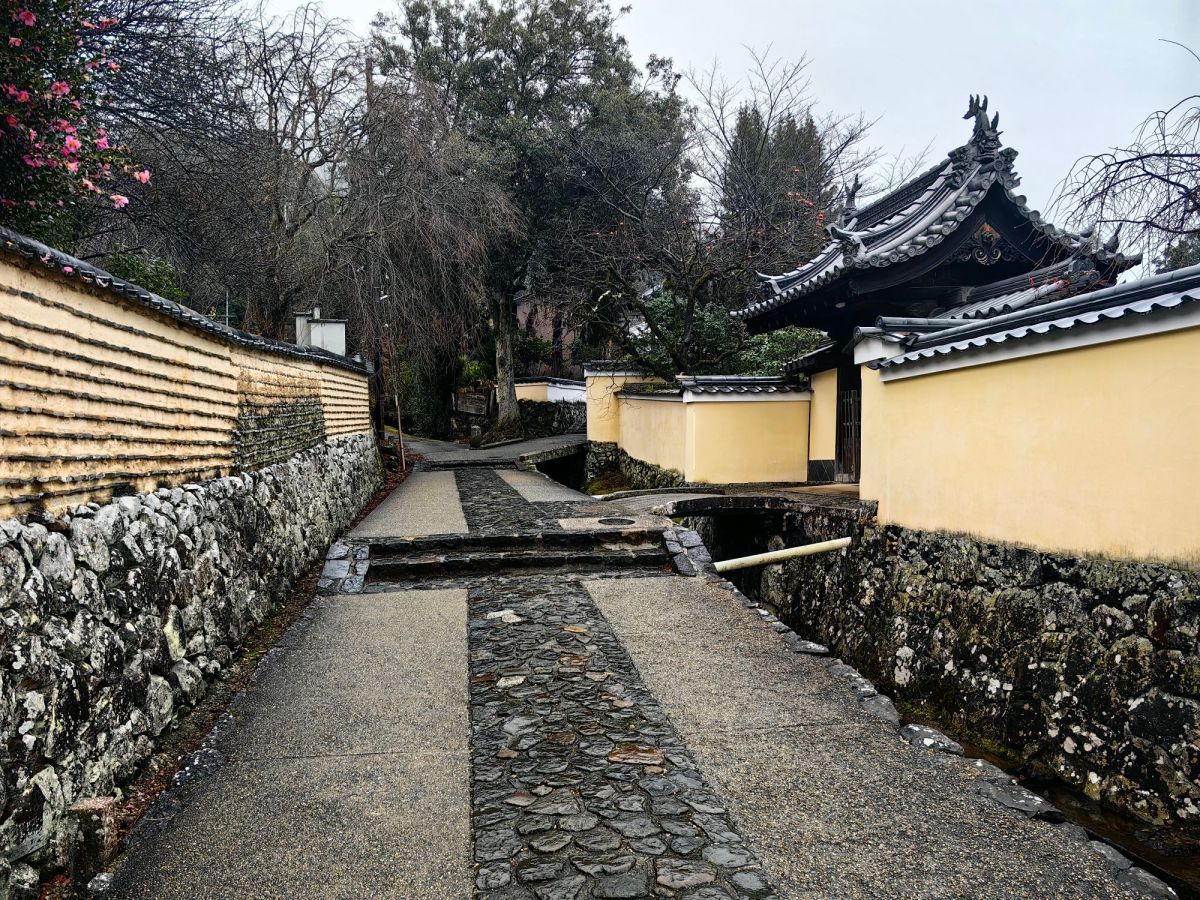
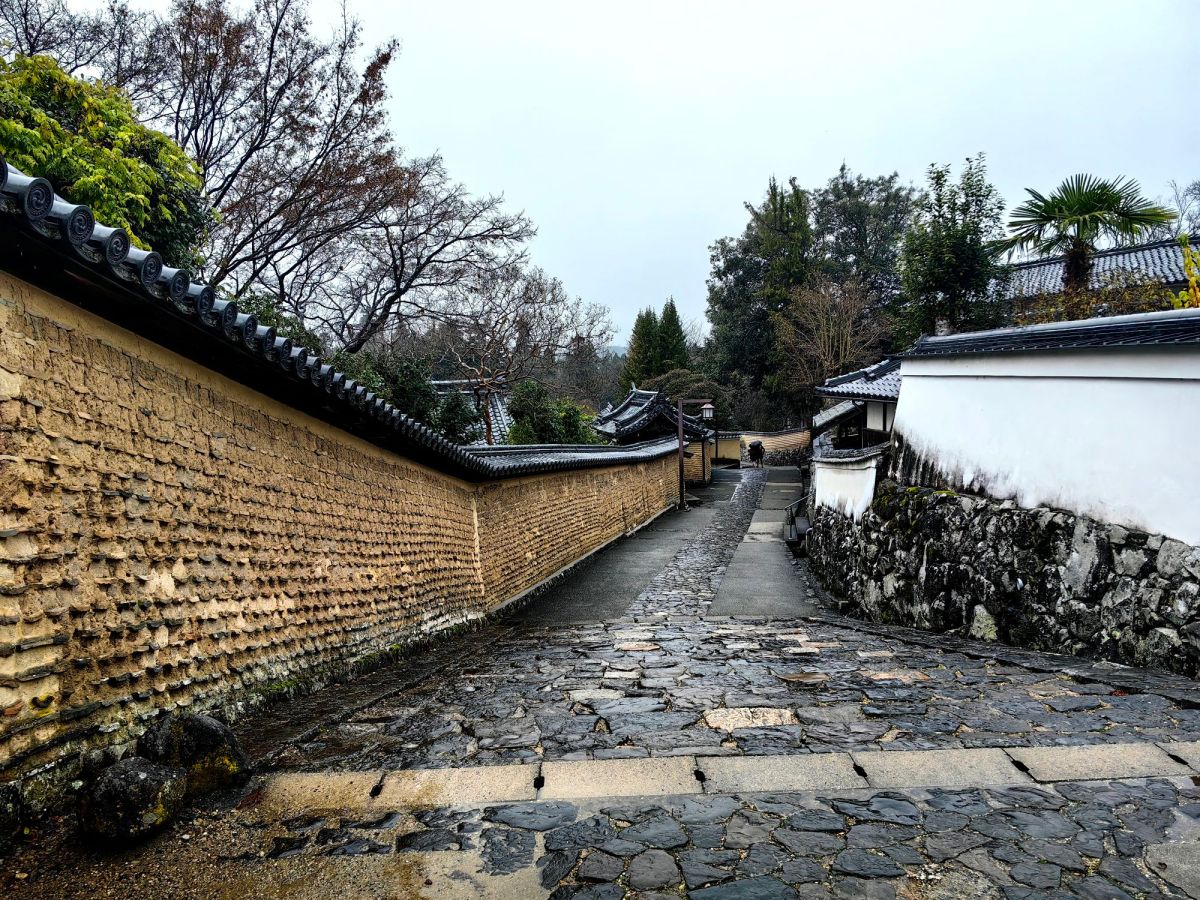
Nara is a place where the passage of time can still be felt, not only in its ancient temples and shrines, but also in the quiet streets that lie beyond the well-trodden paths. In the northern part of the city, narrow stone-paved lanes wind between old houses, many of them sheltered beneath deep, gracefully curved eaves reminiscent of the architectural traditions brought from Tang Dynasty China more than a thousand years ago. Along the walls painted in muted yellow and white, small streams flow quietly beside the streets, their clear water slipping past moss-covered stones as it has done for generations.
The weathered walls, wooden facades, tiled roofs, and the soft sound of running water … Yet perhaps this is where the age of Nara can be felt most intimately. Walking through these unassuming lanes, I imagined that the centuries have not entirely passed, but have simply settled gently into the landscape, leaving behind a quiet world where the present continues to live alongside the memory of the ancient capital. Here I could touch the most authentic essence of Nara. It was not a past story preserved within a museum, but an ancient memory that remains alive in everyday life.
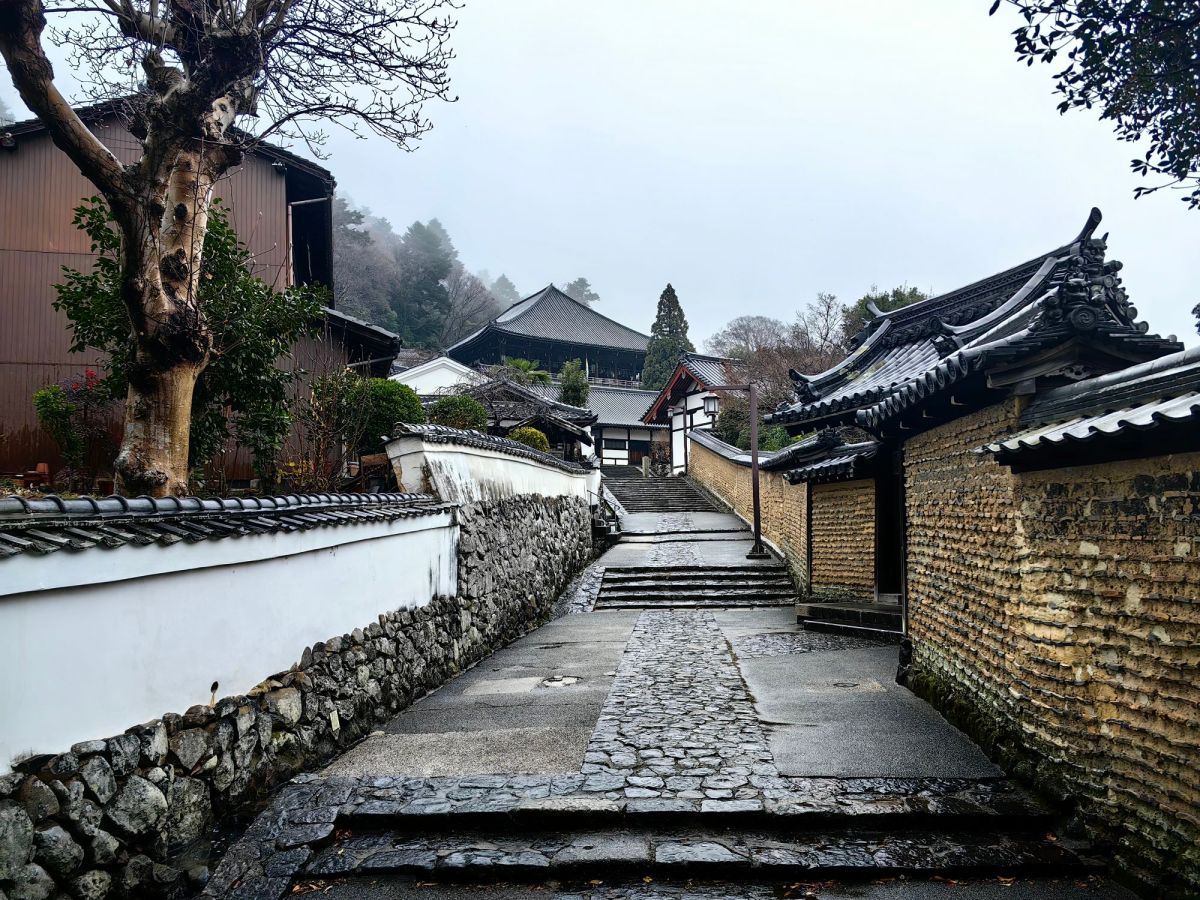
I walked slowly uphill along the Urasando beneath a gentle rain, with no other visitors in sight. The path was quiet and almost entirely my own, winding through the greenery in a peaceful solitude that felt far removed from the crowded streets and well-known sights of Nara. The rain softened the sounds of the surrounding forest, leaving only the faint rustling of leaves and the occasional trickle of water along the path. I loved this quieter side of Nara, where nature seemed to take precedence over everything and every corner invited a slower pace.
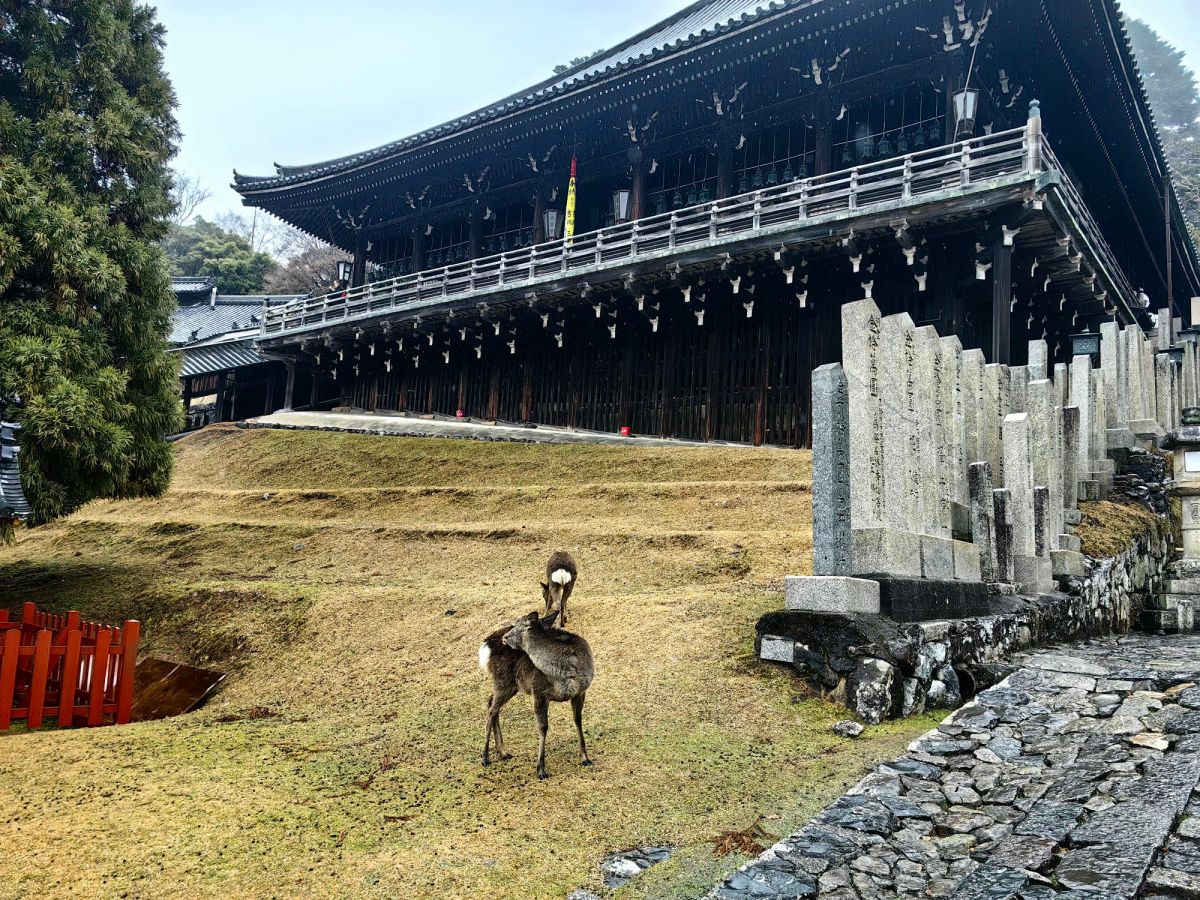
With no crowds to hurry me along, I could pause whenever I wished, observe the details of the landscape, and simply wander without a destination, allowing the ancient atmosphere of Nara to reveal itself gradually. It made me thought of a poem of Song Dynasty: Beside the village shrine, the old thatched inn lies as before; turning past the stream and bridge, it suddenly appears before my eyes. The Nigatsu-do is a small temple on my way. The weathered wooden structure, stone lanterns, ancient trees, and quiet hillside create an leisurely atmosphere quite different from the grandeur of Tōdai-ji below.
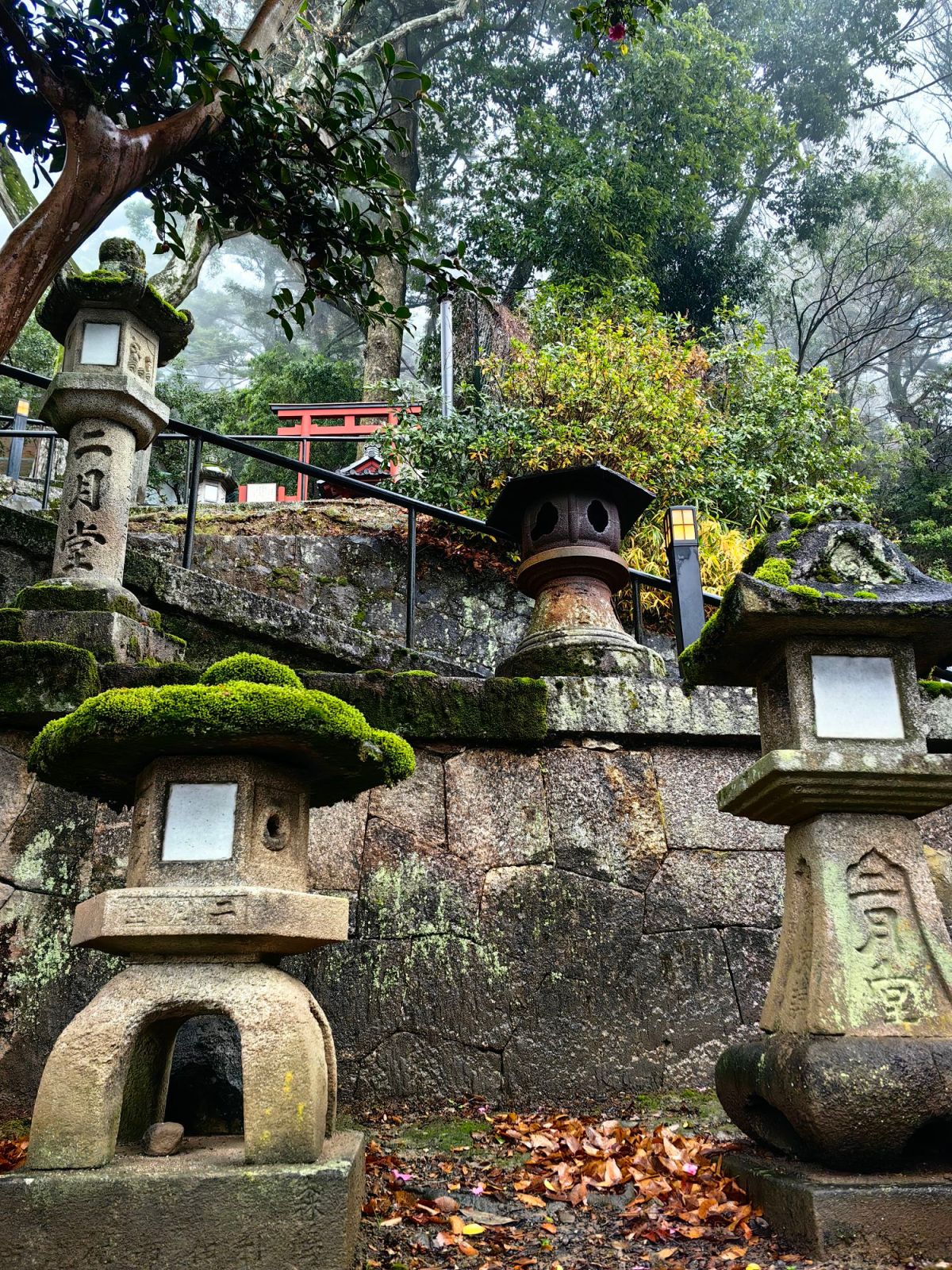
The old wooden hall is raised high on sturdy pillars. Its weathered timbers darkened by the rain. Stone lanterns stood silently along the steps, softened by moss and years of weather, while the broad veranda opened toward the distant roofs and streets of Nara. On the rainy day, the wood darkened with moisture and the surrounding forest becomes veiled in mist, making the place feel even more secluded.
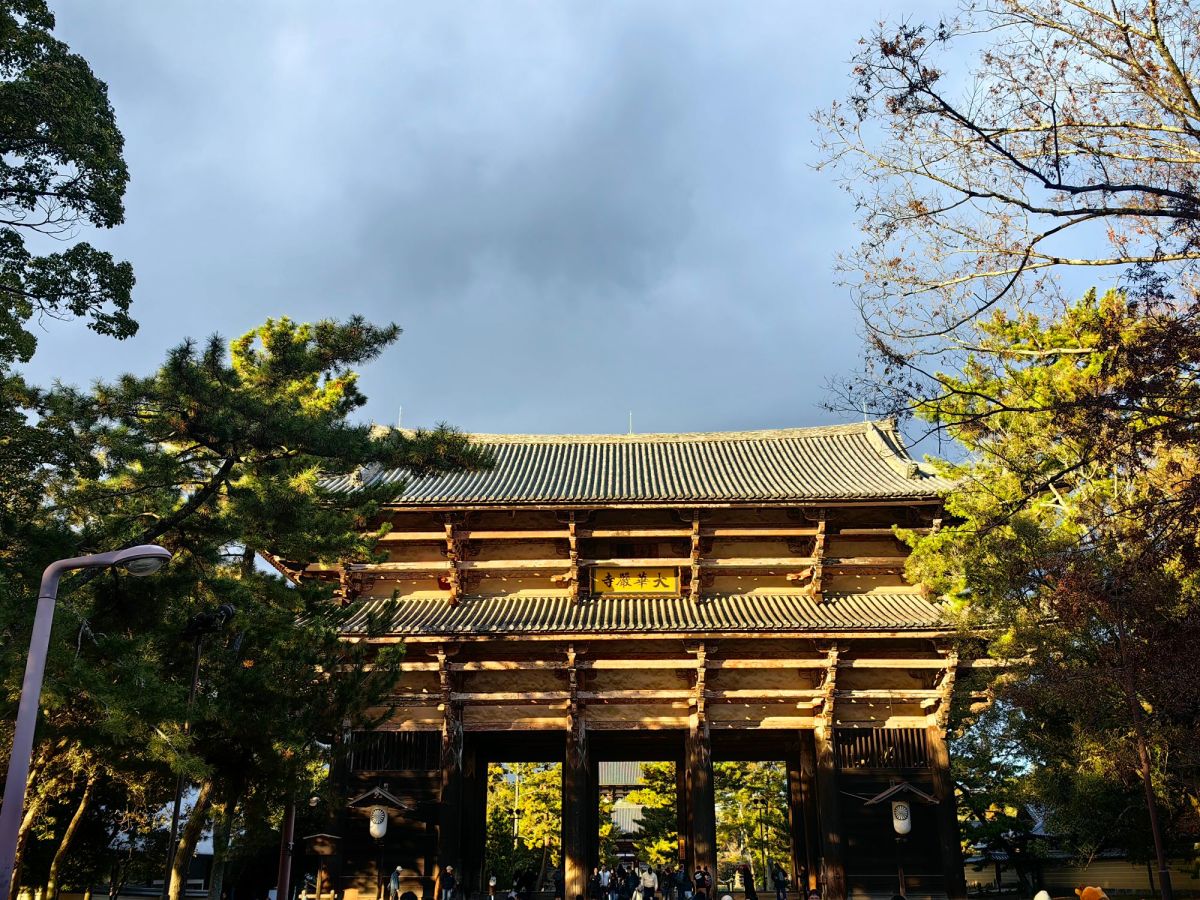
After some time, the Nandaimon Gate of Tōdai-ji rose before me like a monumental gateway. Its enormous wooden pillars, darkened and weathered by centuries of rain and sunlight, seemed to possess a strength that belonged to another age. Beneath the great tiled roof stood the two fierce Niō guardians with powerful bodies and they had been watching over the temple for centuries. Walking beneath the immense gate, I felt small beside the towering timbers and massive statues. More than simply an entrance to Tōdai-ji, it felt like a threshold between the present and the ancient world of Nara.
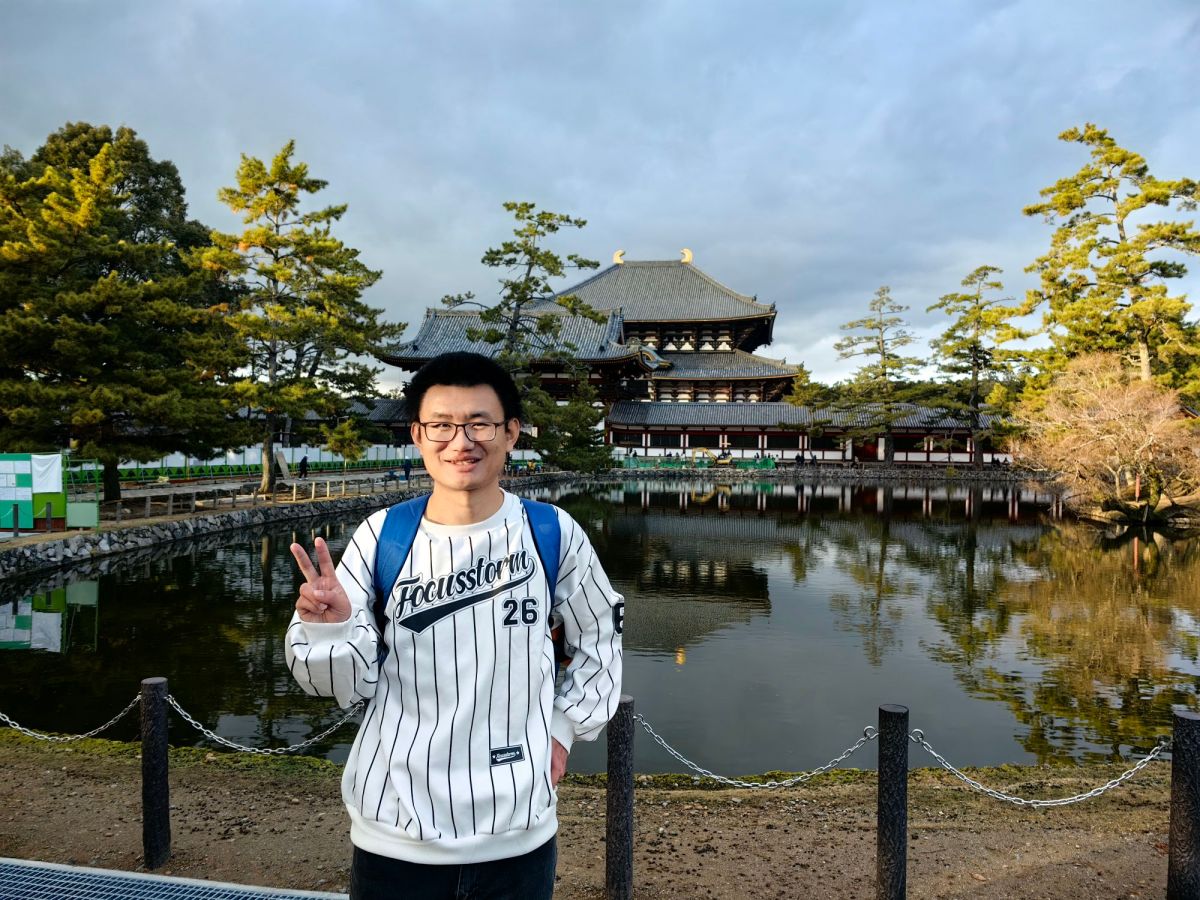
I continued walking through the temple grounds and soon arrived at Kagami-ike Pond, the quiet body of water lying before the entrance to the famous Tōdai-ji. Its still surface reflected the surrounding trees, temple roofs, and muted sky, creating an elegant scene. The gentle rain added another layer of tranquility, softening the outlines of the ancient buildings and turning the pond into a mirror of the misty landscape.
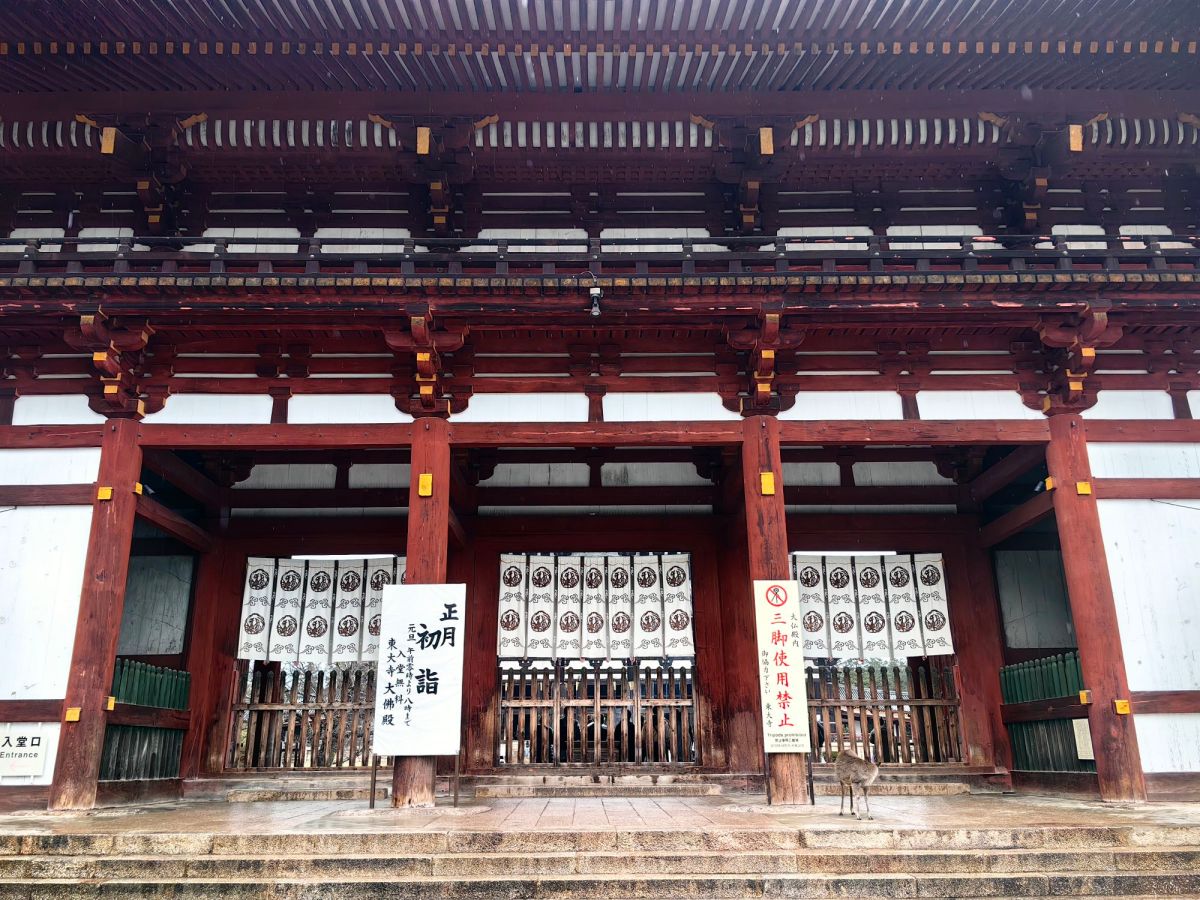
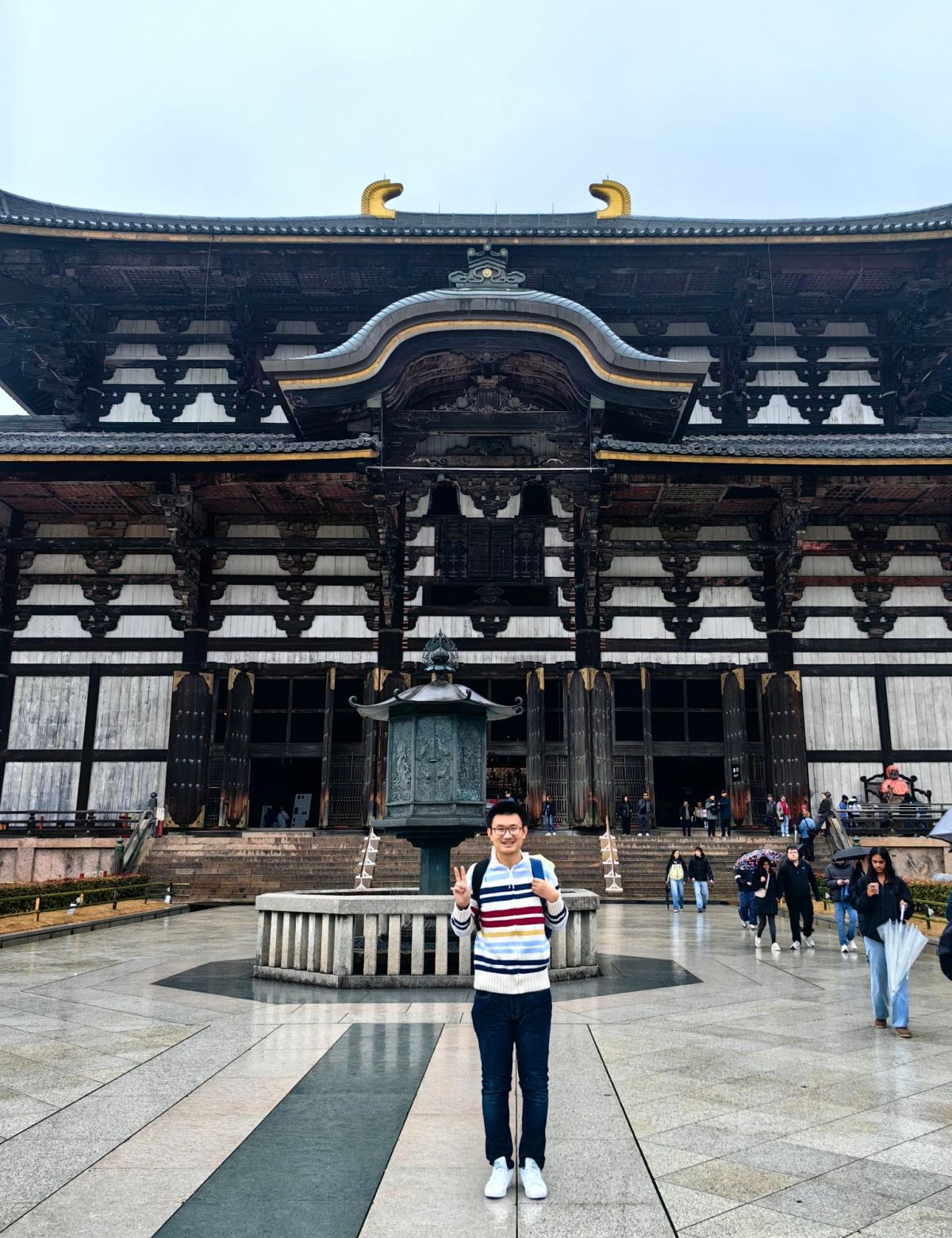
Beyond Kagami-ike Pond, I continued toward the Chūmon, the Central Gate of Tōdai-ji. Its graceful vermilion-and-white structure stood quietly beneath the broad tiled roof, framed by the surrounding trees and the vast temple grounds. After the monumental Nandaimon, the Chūmon felt more restrained and serene, it carried a sense of ceremony. Through the gate, the enormous Great Buddha Hall could be glimpsed beyond, its immense wooden form rising at the heart of the temple precinct.
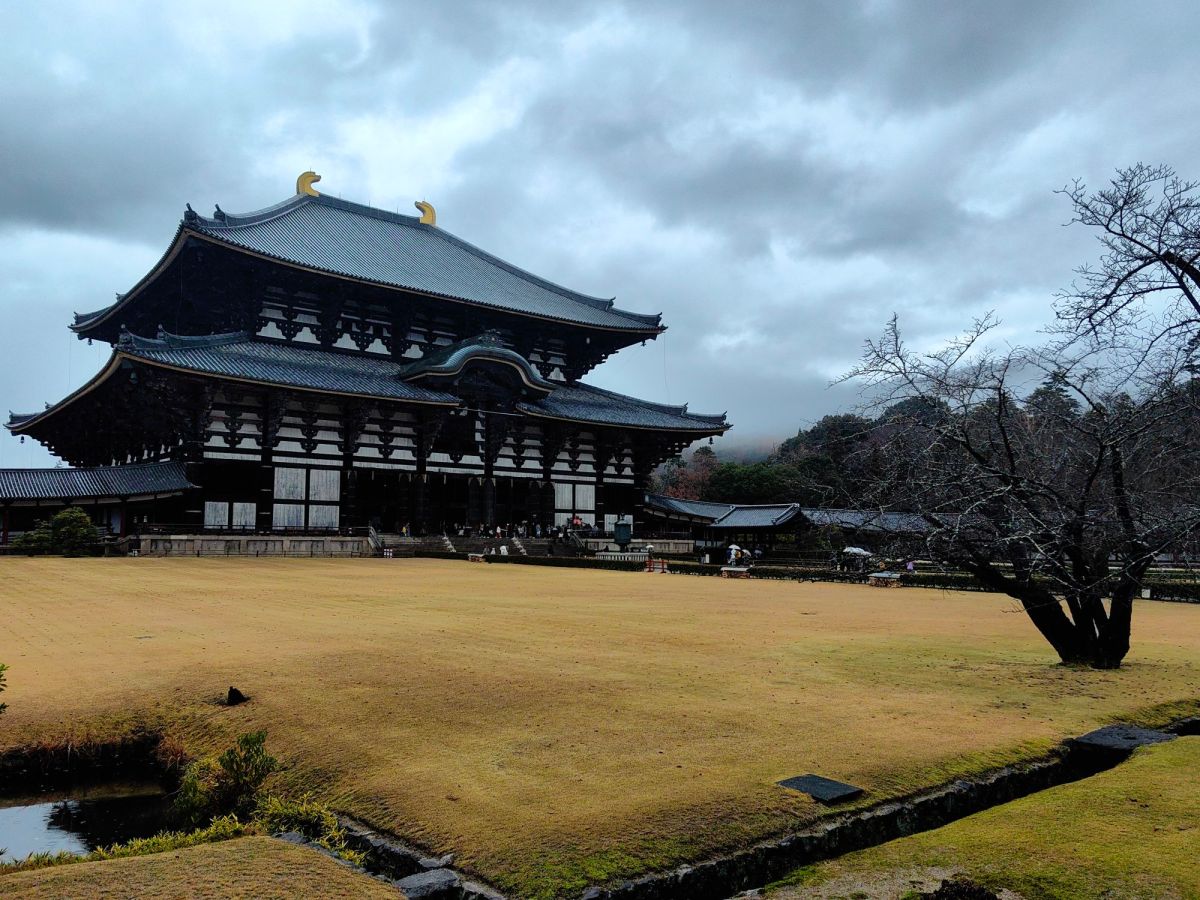
From the entrance, the Great Buddha Hall rose before me with an overwhelming sense of height and scale. Its immense tiled roof seemed to stretch across the sky, while the vast wooden structure beneath it appeared almost impossibly tall and monumental. Standing at the entrance, I could only look upward, gradually taking in the enormous proportions of the building.
Tōdai-ji is perhaps the most representative monument of Nara, embodying the city’s identity as Japan’s ancient capital. Built in the eighth century, when Nara was known as Heijō-kyō, the temple reflected the enormous political and spiritual ambitions of its age. Standing there, I felt that Tōdai-ji was really a surviving expression of Nara’s golden age, where architecture, faith, and history had remained intertwined for more than a thousand years. A bronze octagonal lantern rose quietly in the open space before it. Known as the Kondō Hakkaku Tōrō, the lantern which is one of the relatively few surviving objects from the original Nara-period is a national treasure. In Buddhist tradition, the light of a lantern represents the wisdom of the Buddha, dispelling the darkness of ignorance.
Tōdai-ji’s architecture was strongly influenced by Tang-dynasty China. During the Nara period, Japan actively adopted Chinese institutions, Buddhism, urban planning, and artistic styles. Nara itself was modeled partly on the Tang capital Chang’an. The broad tiled roof, monumental timber framework, bracket systems, and proportions all belong to an architectural tradition that Japan inherited and adapted from China. Standing beneath the vast roof of the Great Buddha Hall, I could almost sense the ancient cultural exchange that had once connected Nara with the distant Tang China.
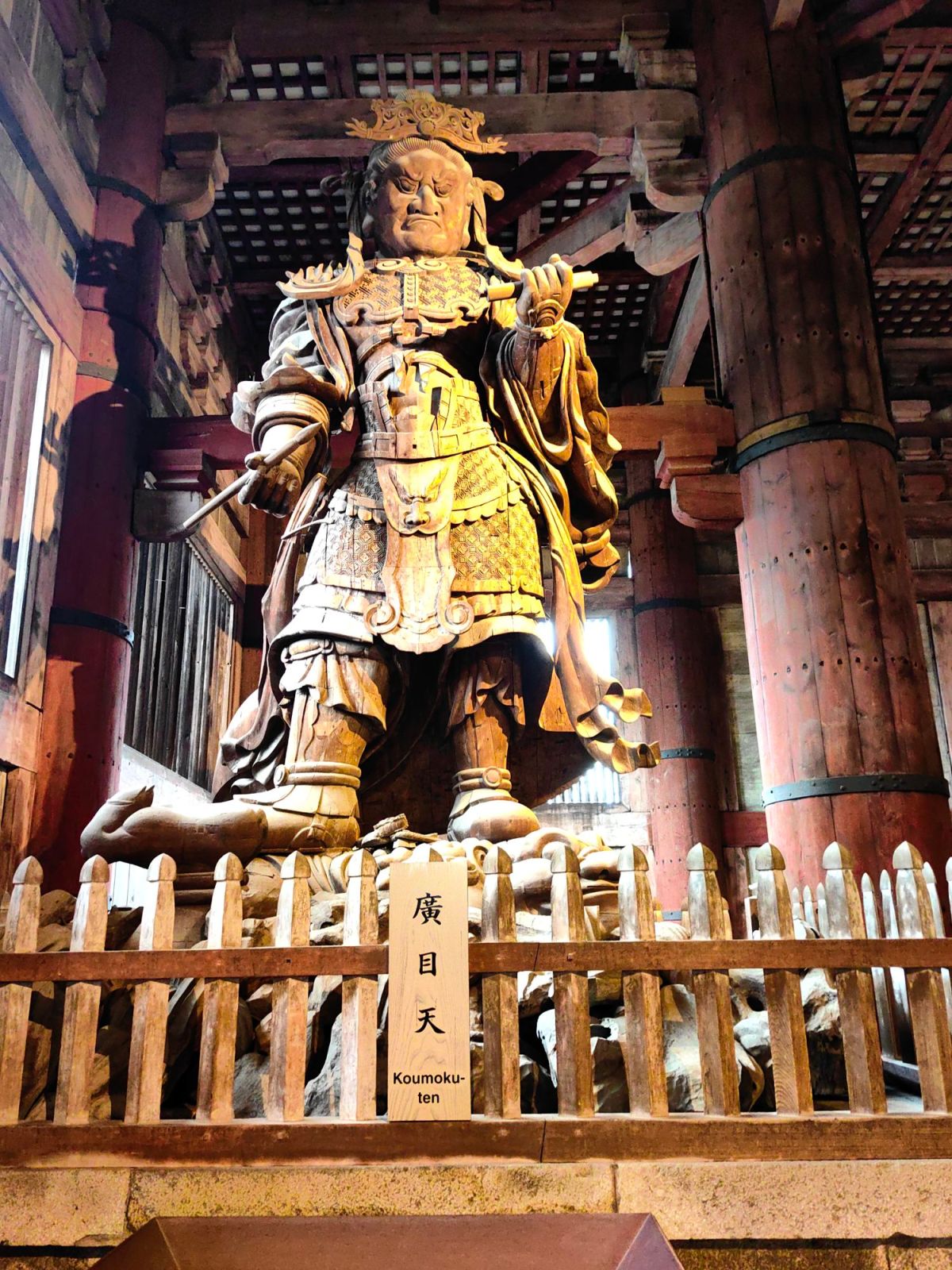
Inside the Great Buddha Hall, I encountered Komokuten, the Heavenly Guardian of the West, standing watch beside the Great Buddha. One hand held his traditional weapon and the expression was full of majesty and power. The central figure in the hall is the Great Buddha (Daibutsu), a colossal bronze statue of Vairocana Buddha. It represents Vairocana, the Cosmic Buddha whose wisdom and light are understood to permeate the entire universe. Buddhism arrived in Japan from the Korean Peninsula in the sixth century. By the Nara period, it had become closely connected with the imperial court and the state, and Emperor Shōmu envisioned Buddhism as a force that could protect and unite the country.
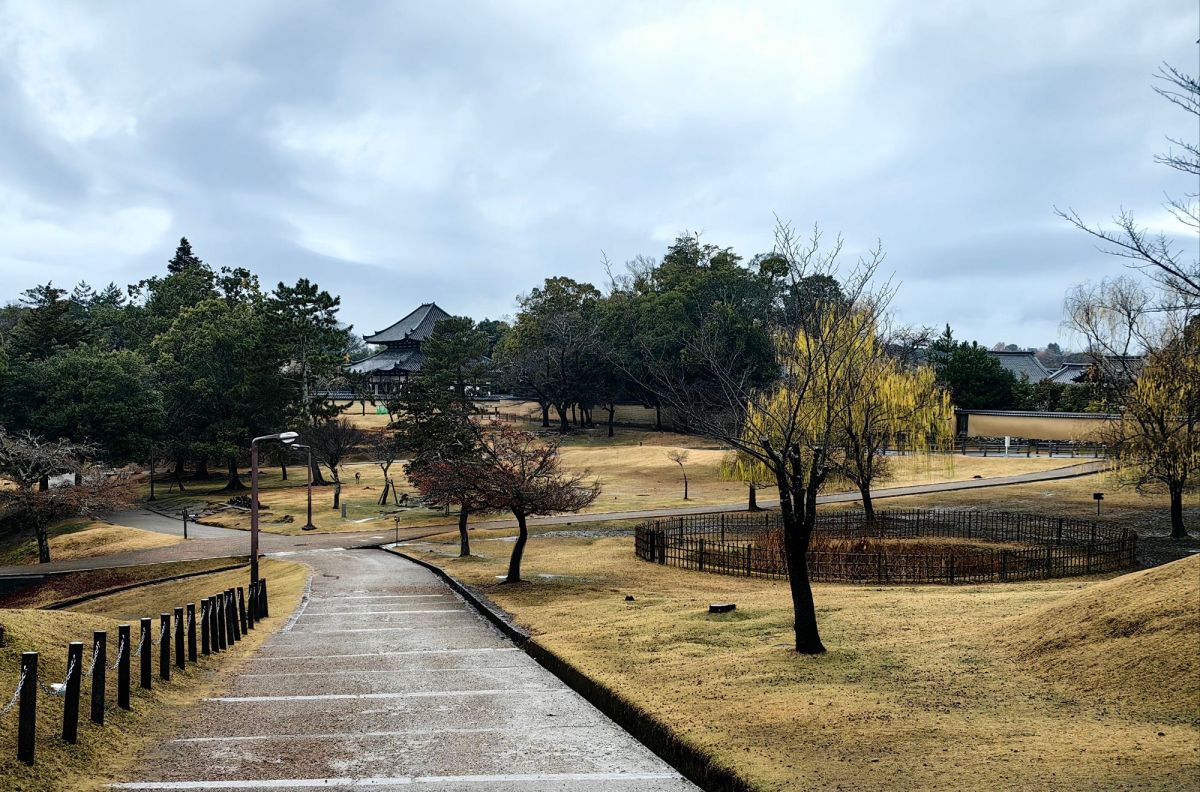
Behind Tōdai-ji, the monumental temple gradually gave way to a broad expanse of green, scattered with mature trees and quiet paths. There were very few tourists here, and the atmosphere was completely different from the busy areas around the Great Buddha Hall. The trees stood peacefully across the open grass, their branches moving gently in the breeze, while the sounds of the temple grounds faded into the distance.
Among these queit buildings, I came upon the Shōsō-in Repository, an ancient wooden storehouse that has preserved treasures from the world of eighth-century Nara. Unlike the monumental Great Buddha Hall, which expresses the grandeur of imperial Buddhism, Shōsō-in seemed almost modest, its walls built from rows of natural timber logs in the distinctive azekura style. Yet within this unassuming structure lay an extraordinary record of the ancient world—Buddhist objects, musical instruments, textiles, manuscripts, and precious belongings associated with Emperor Shōmu and the people of his age.
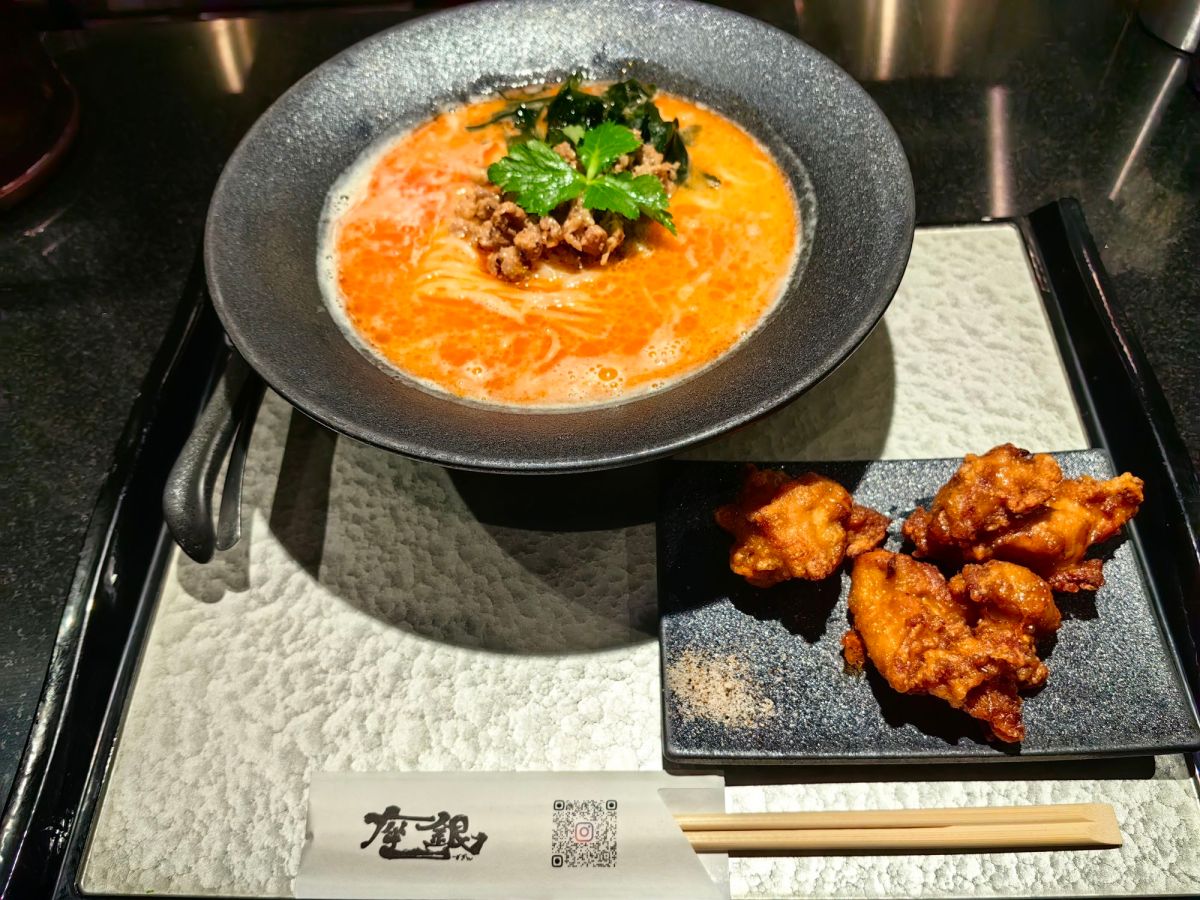
After wandering through Nara’s main sights, I finally brought my first day in the ancient capital to an end. As evening settled over the city, I stopped at a small local restaurant and ordered a simple bowl of ramen. After a long day of walking, the steaming broth and warm noodles were more than enough to satisfy me. Travelling in Japan had also taught me that a memorable meal does not have to come from an expensive or fashionable restaurant. Sometimes, the simplest places like a small shop with a few seats, a steaming bowl of ramen could offer exactly what I need at the end of a long day.
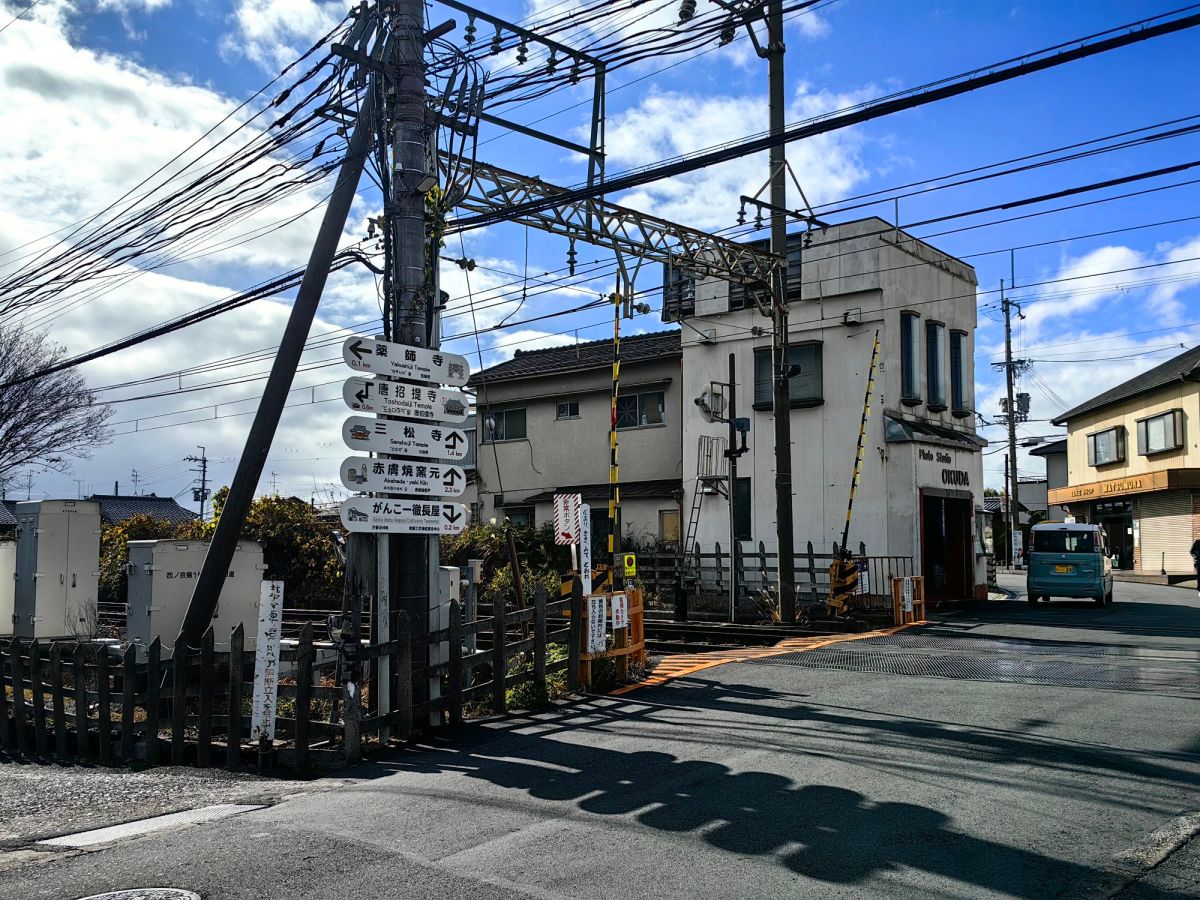
My second day in Nara took me to Nishinokyō, meaning the “Western Capital,” an area west of the ancient Heijō-kyō. Away from the center of modern Nara, this quieter district preserves some of the most important remnants of the city’s eighth-century Buddhist heritage. Two remarkable temples awaited me there: Yakushi-ji and Tōshōdai-ji, both deeply connected with the history of Nara’s ancient capital. Reaching them was remarkably easy. Japan’s railway system is exceptionally convenient, with trains and local lines connecting cities, neighborhoods, and even places far from the main tourist routes.
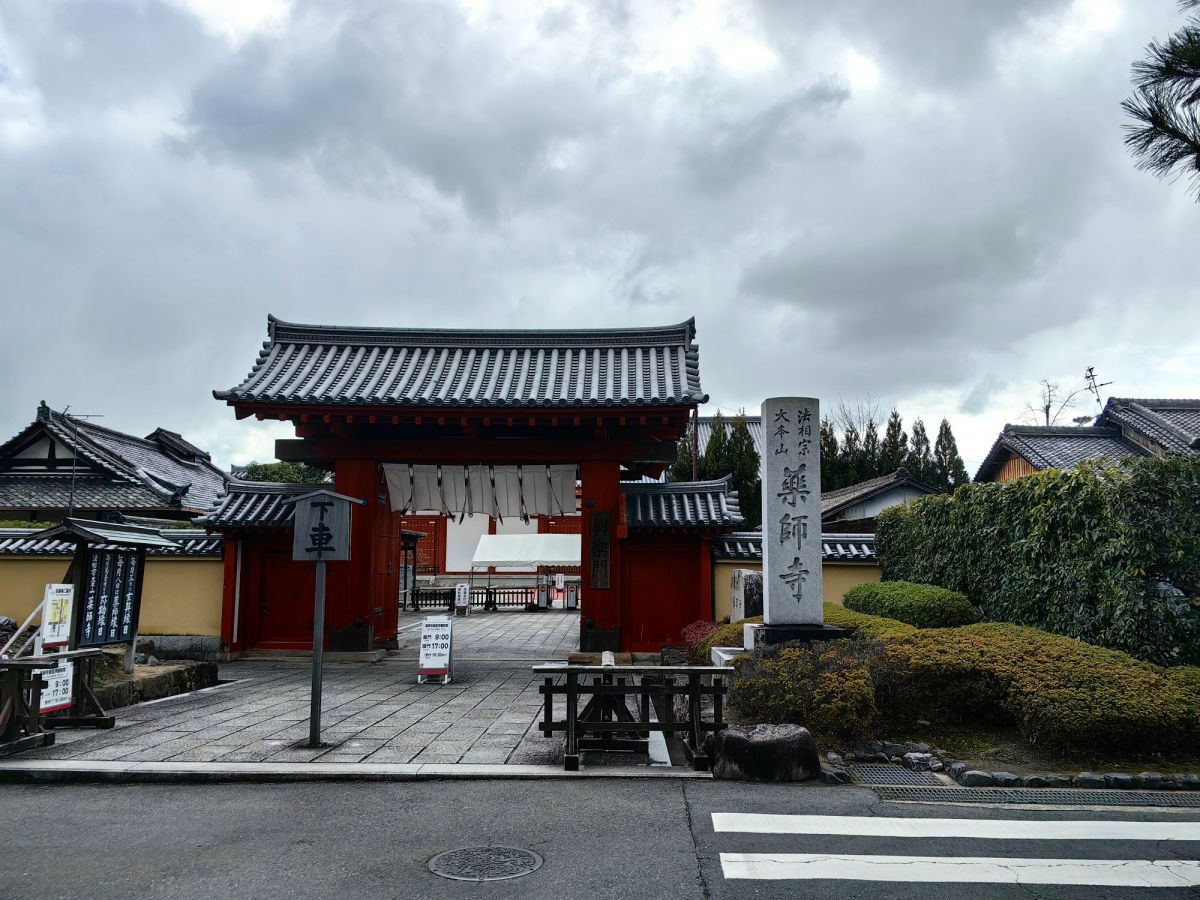
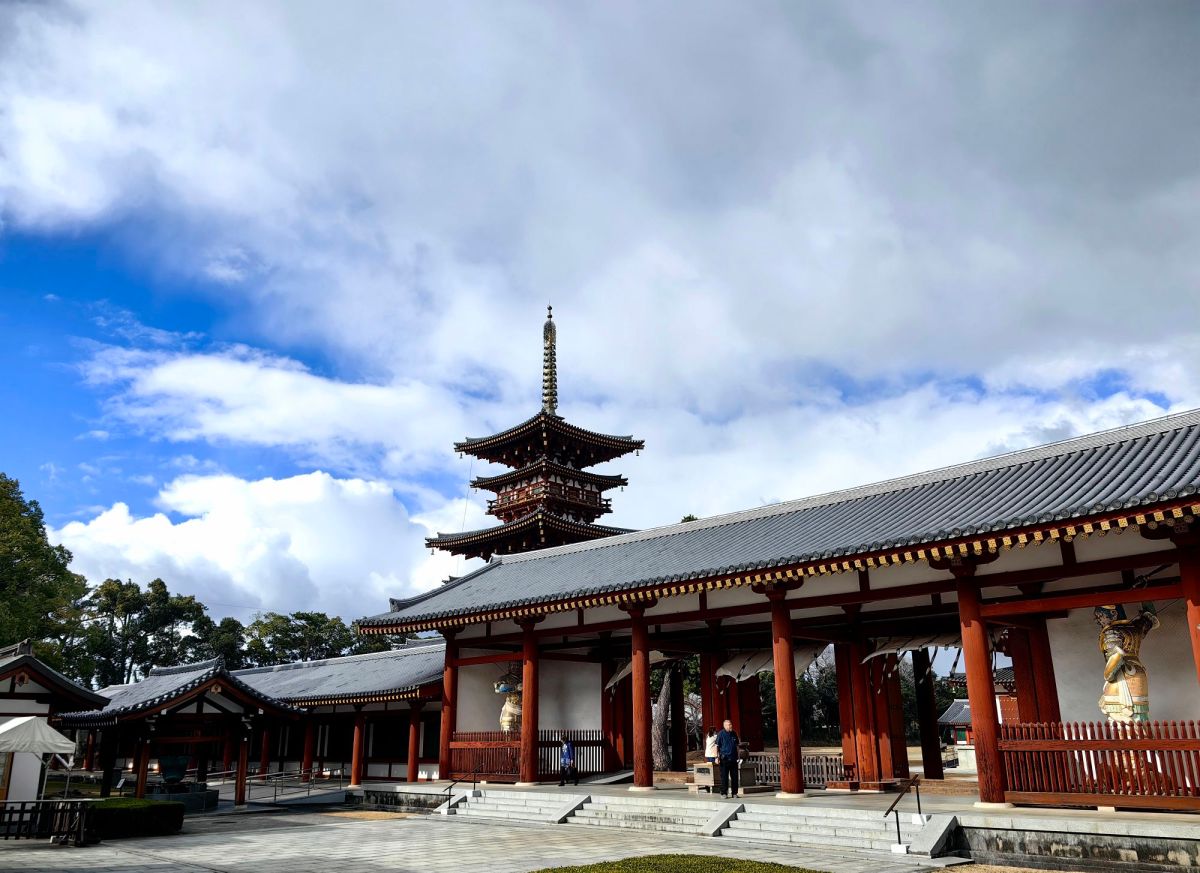
Following the directions, I made my way to my first destination, Yakushi-ji. Even before entering, I was intrigued by its long and fascinating history. It carries a history almost as old as Nara itself. The temple was first founded in 680 by Emperor Tenmu, who prayed for the recovery of his ailing wife and dedicated the temple to Yakushi Nyorai, the Buddha of healing. Originally built at Fujiwara-kyō, it was moved to Heijō-kyō when the capital was transferred to Nara in the early eighth century, becoming one of the great Buddhist temples of the new imperial city.
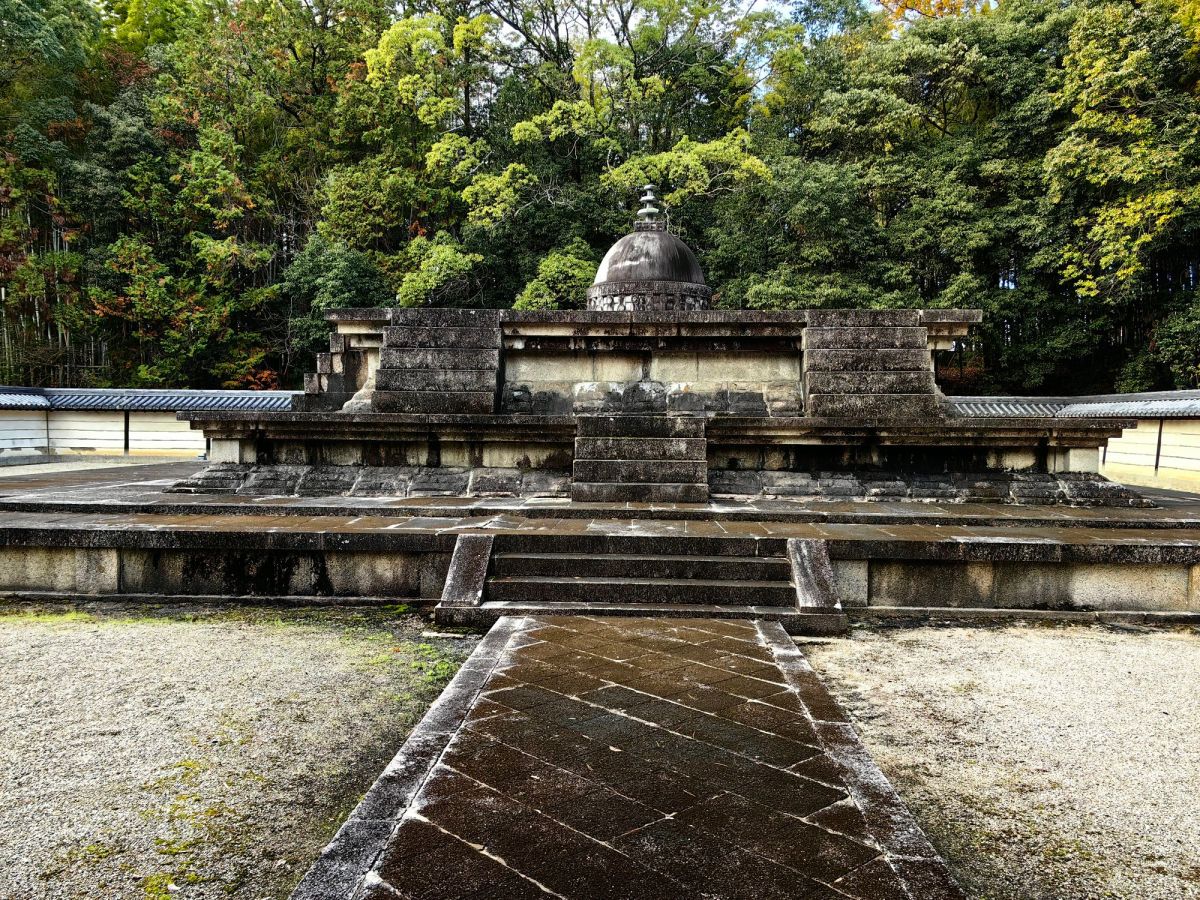
The whole temple was an immense and symmetrical complex, reflecting the sophisticated temple architecture and continental influences of the Nara period. Yet the temple’s long history was marked by repeated fires, wars, and destruction. Much of its ancient architecture disappeared, leaving the East Pagoda as its most remarkable survivor, still standing in its original form from 730.
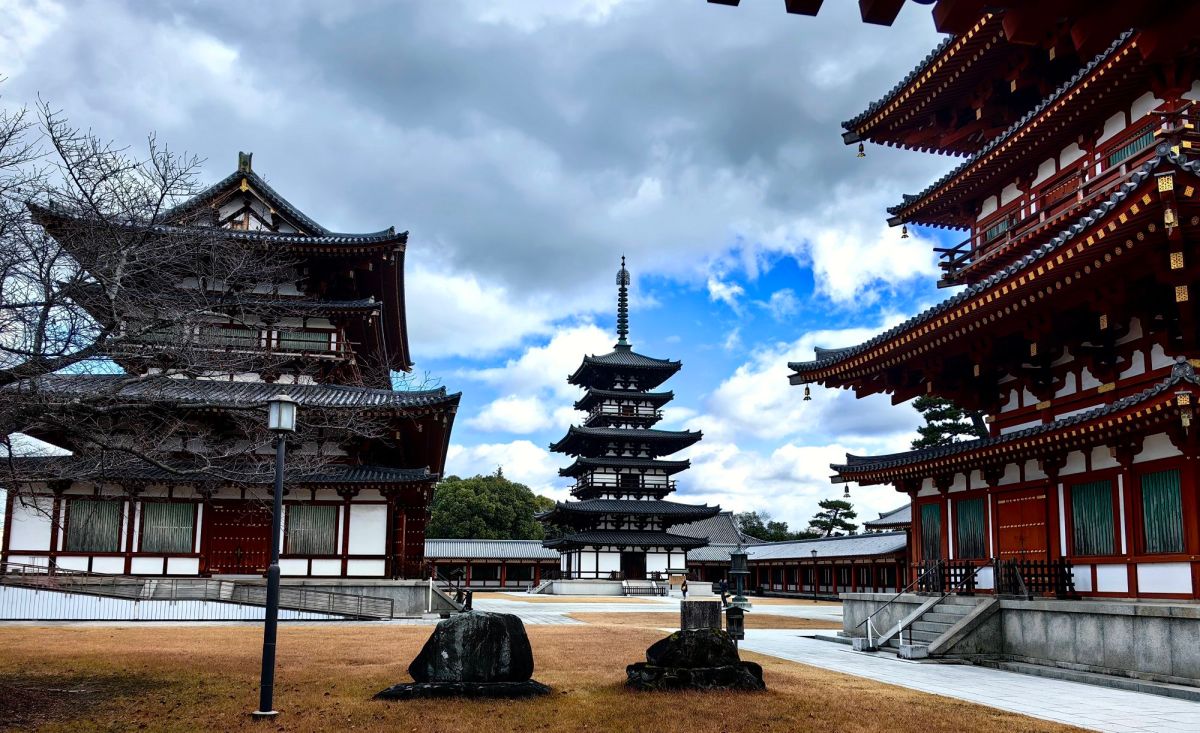
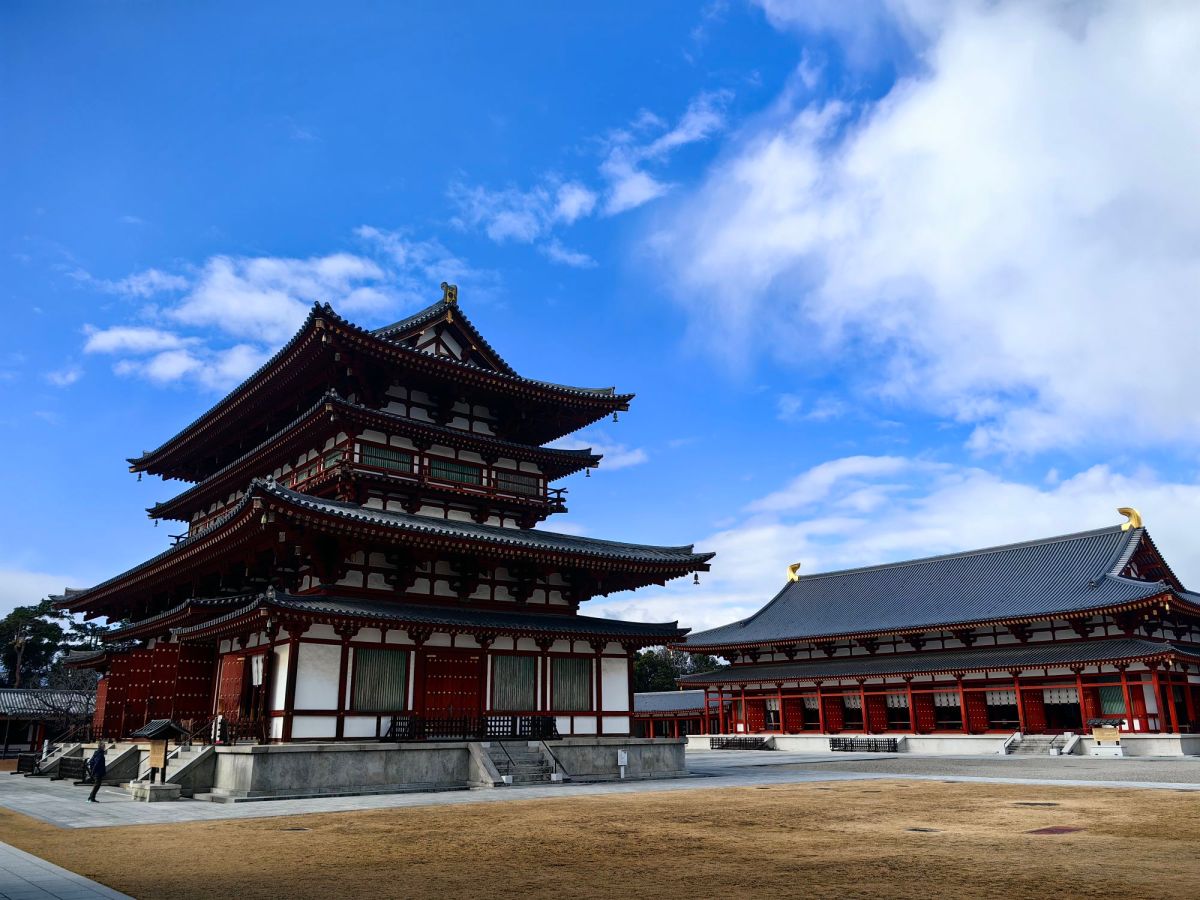
Under the brilliant blue sky, the East Pagoda of Yakushi-ji rose gracefully above the temple grounds, its dark wooden tiers standing in striking contrast to the clear expanse of sky behind it. It is the only surviving original structure of Yakushi-ji from that age. Although only three stories in structure, the smaller roofs between the main levels give the pagoda the appearance of six stories, creating a distinctive rhythm as the eaves rise one above another. Sunlight traced the edges of its sweeping roofs and delicate wooden details, while the deep tones of the aged timber revealed the passing of more than twelve centuries.
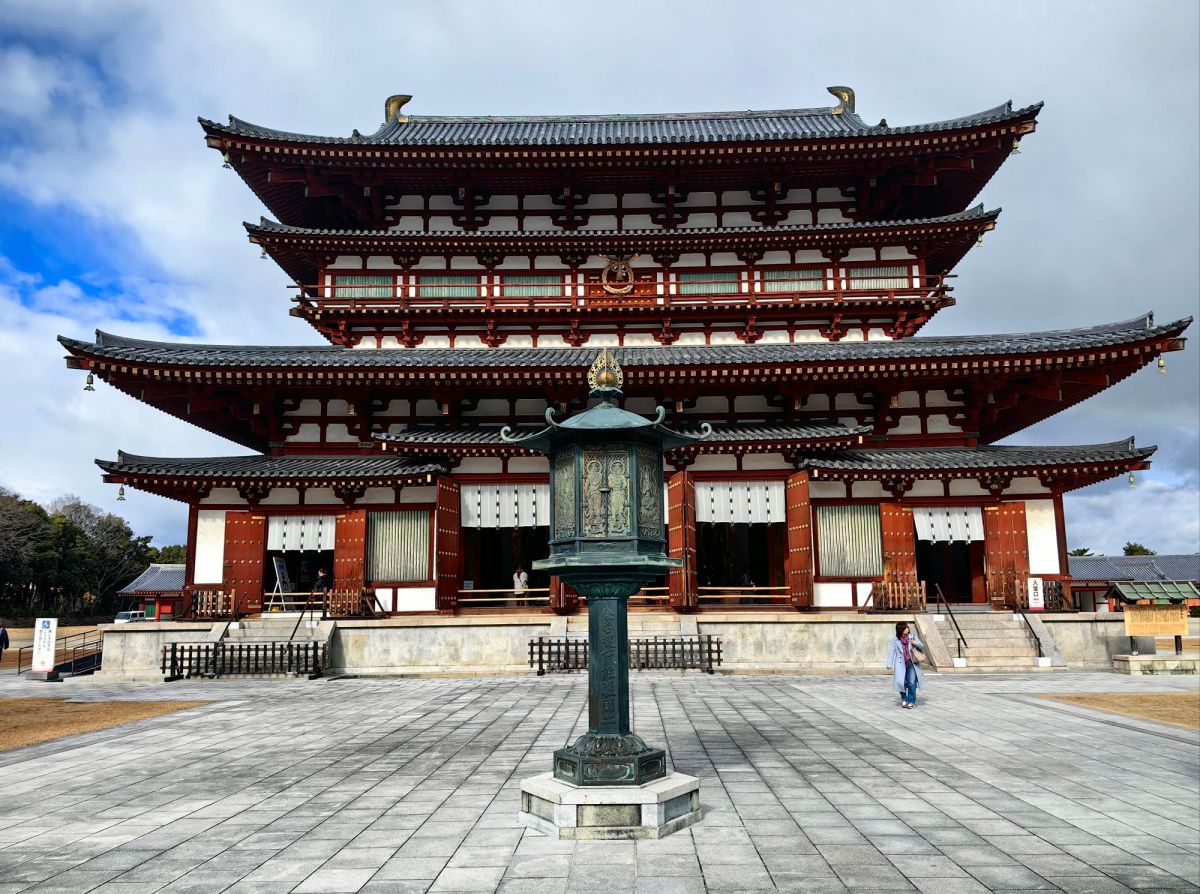
The temple complex of Yakushi-ji unfolded before me in a graceful and carefully ordered arrangement. The buildings including the Golden Hall and the Grand Lecture Hall stood along a central axis. Vermilion pillars and white walls stood vividly against the blue sky, while the dark tiled roofs and wooden details gave the complex a more solemn character.
At the heart of Yakushi-ji stood the magnificent Golden Hall. In front of it stood a solitary stone lantern (tōrō), which is modest in size. In Japanese Buddhism, the light of a lantern symbolizes the wisdom of the Buddha, illuminating the darkness of ignorance and guiding those who seek enlightenment. I could always see such a decoration in the Japanese temple. A lantern placed before the main hall helps create a sacred approach, marking the space between the ordinary world and the Buddha’s realm.
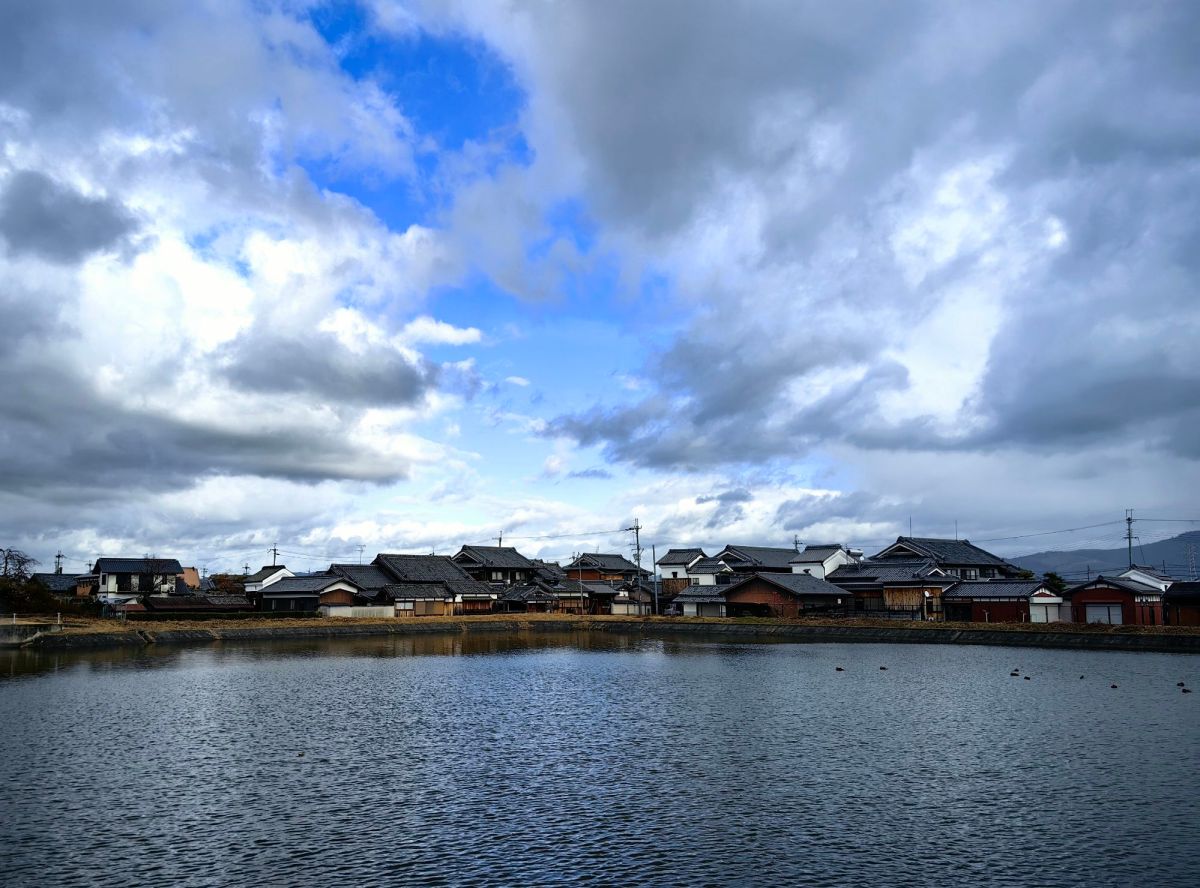
Outside Yakushi-ji, Kannon-ike Pond nearby offered a rustic scene far removed from the grandeur of the temple buildings. The quiet water reflected the surrounding trees and the changing sky, while along its edge stood traditional Japanese wooden houses. Their restrained appearance seemed to belong naturally to the old landscape, as though they had been standing beside the pond for generations. The scene felt like a small corner of old Nara that had escaped the rush of modern life, preserving the simplicity of the past.
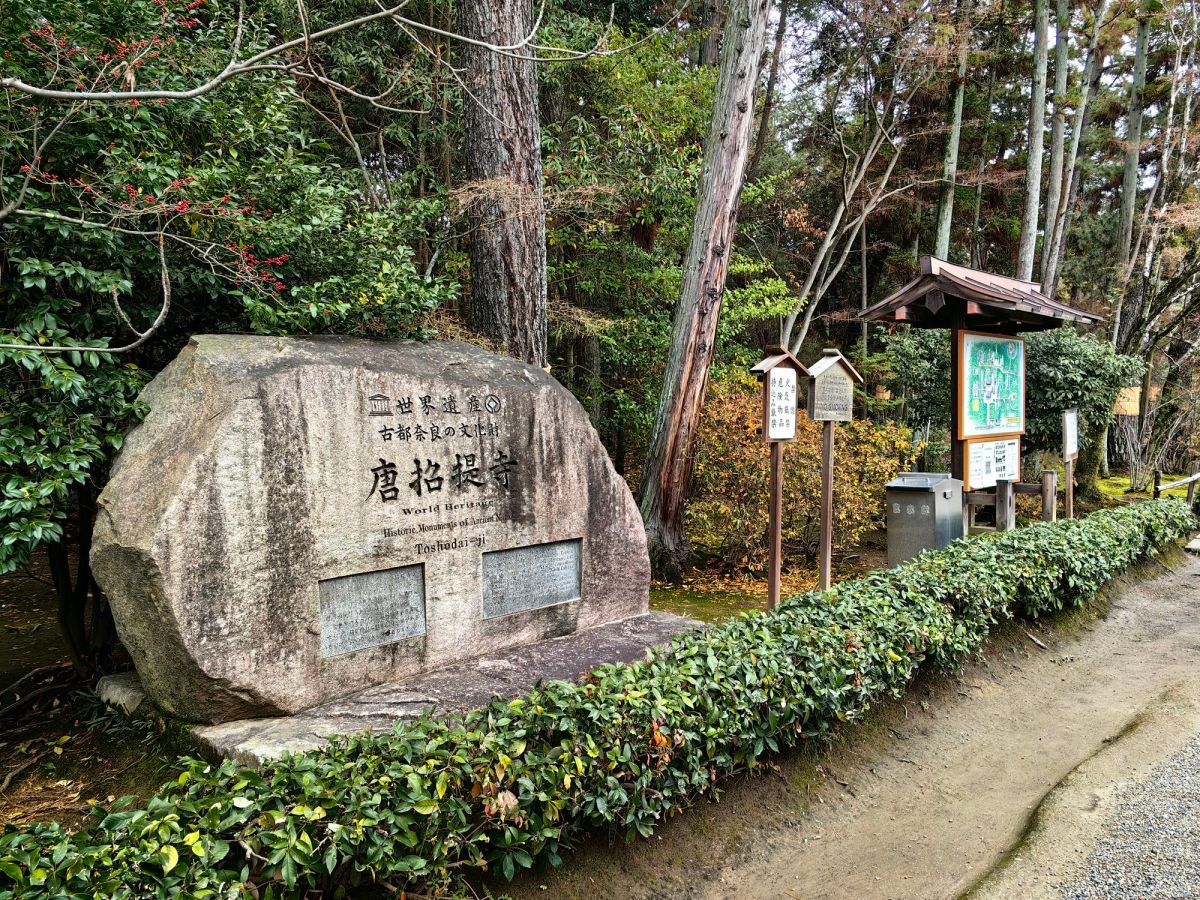
From Yakushi-ji, I continued toward Tōshōdai-ji, another important temple of Nara’s ancient Nishinokyō district. Both temples form part of UNESCO’s World Heritage property, the “Historic Monuments of Ancient Nara,” inscribed in 1998. The temple was nearby, but even its name immediately transported me to a much more distant world. Written as 唐招提寺, the first character, 唐, refers to the Tang dynasty, while 招提 is an ancient Buddhist term connected with a monastic community, giving the name the sense of a temple associated with monks invited from Tang China. For a Chinese speaker, the characters were immediately familiar, creating a curious feeling of recognition across more than a thousand years of history.
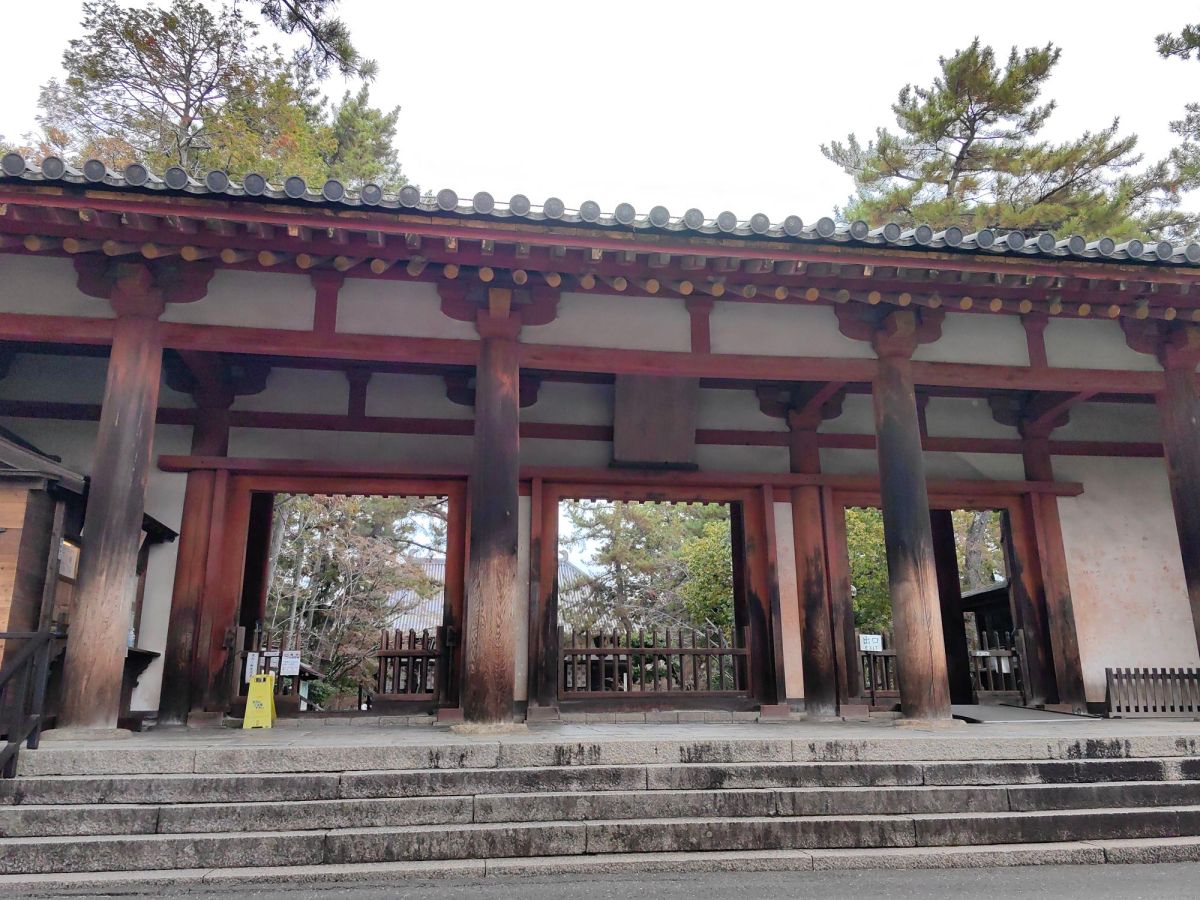
The Nandaimon of Tōshōdai-ji stood quietly at the entrance to the temple grounds, welcoming visitors into one of Nara’s most important Buddhist sites. Compared with the enormous Nandaimon of Tōdai-ji, this gate was more restrained and elegant, with a simple wooden structure, dark tiled roof, and graceful proportions. Its understated appearance seemed perfectly suited to the reserved character of Tōshōdai-ji. Passing through the gate, I felt a subtle transition from the ordinary streets outside into a quieter world of ancient trees, weathered wooden buildings, and long Buddhist history.
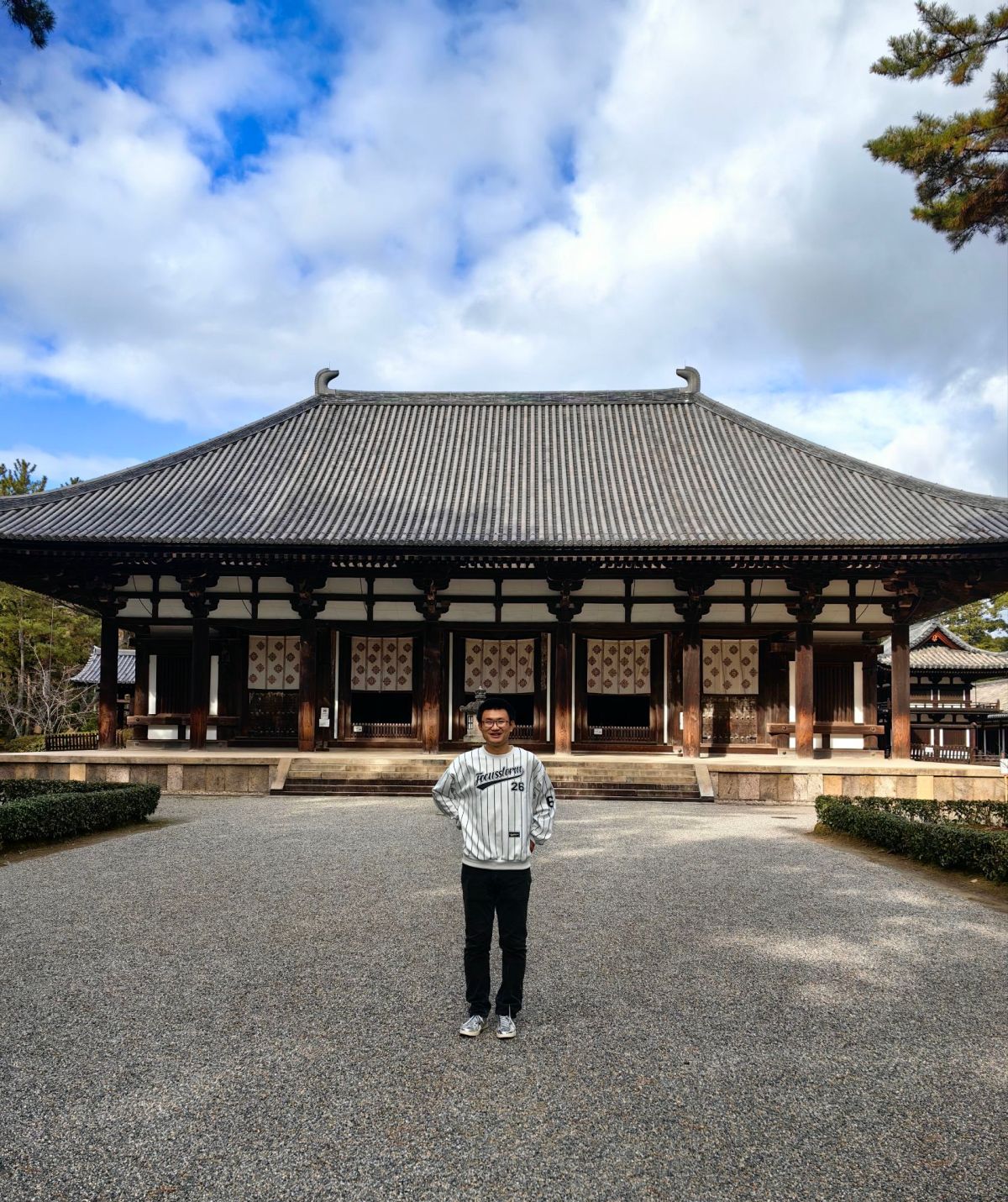
At the heart of Tōshōdai-ji stood the magnificent Golden Hall, the hall completed in Nara period has survived for more than twelve centuries and remains one of the finest expressions of ancient Japanese Buddhist architecture. There was little unnecessary decoration, allowing the elegant proportions, dark timber, and sweeping roofline to speak for themselves. Standing before it, I could see the influence of the Tang Dynasty that had shaped so much of Nara’s early architecture: the ordered symmetry, monumental wooden construction, deep eaves, and sophisticated roof structure. Over centuries, these imported ideas had been absorbed into the Japanese landscape and transformed into something uniquely Japanese.
Walking deeper into this temple, I came upon the Kōdō, or Lecture Hall. Built in the late eighth century, the hall originally belonged to the imperial palace of Heijō-kyō before being moved here and transformed into a Buddhist lecture hall. The timber had witnessed more than twelve centuries of changing seasons, while the hall had passed from the world of the emperor into the world of Buddhist learning. It seemed to embody the continuity of Nara’s history, where buildings themselves could carry their stories from one age into another.
The atmosphere here was very quiet. Narrow paths wound gently through the temple grounds, shaded by tall trees whose branches formed a cool green canopy overhead. Sunlight filtered through the leaves in scattered patches, falling softly across the old stone paths and moss-covered ground.
Tōshōdai-ji was founded by the Chinese monk Jianzhen, who travelled to Japan in the eighth century, bringing with him Buddhist teachings, religious practices, and knowledge from the Tang Dynasty. He had attempted to travel from Tang China to Japan five times, enduring storms, shipwrecks, illness, and eventually losing his eyesight. Even after all these hardships, he continued his journey and finally reached Japan in 754. The Ganjin Wajō Gobyō is the mausoleum of Jianzhen. It lies at the end of a quiet, wooded path within the temple grounds. As I stood in front of it, I felt that I was not simply moving from one Nara temple to another, but following an ancient cultural bridge that once connected Nara Japan with Changan China.
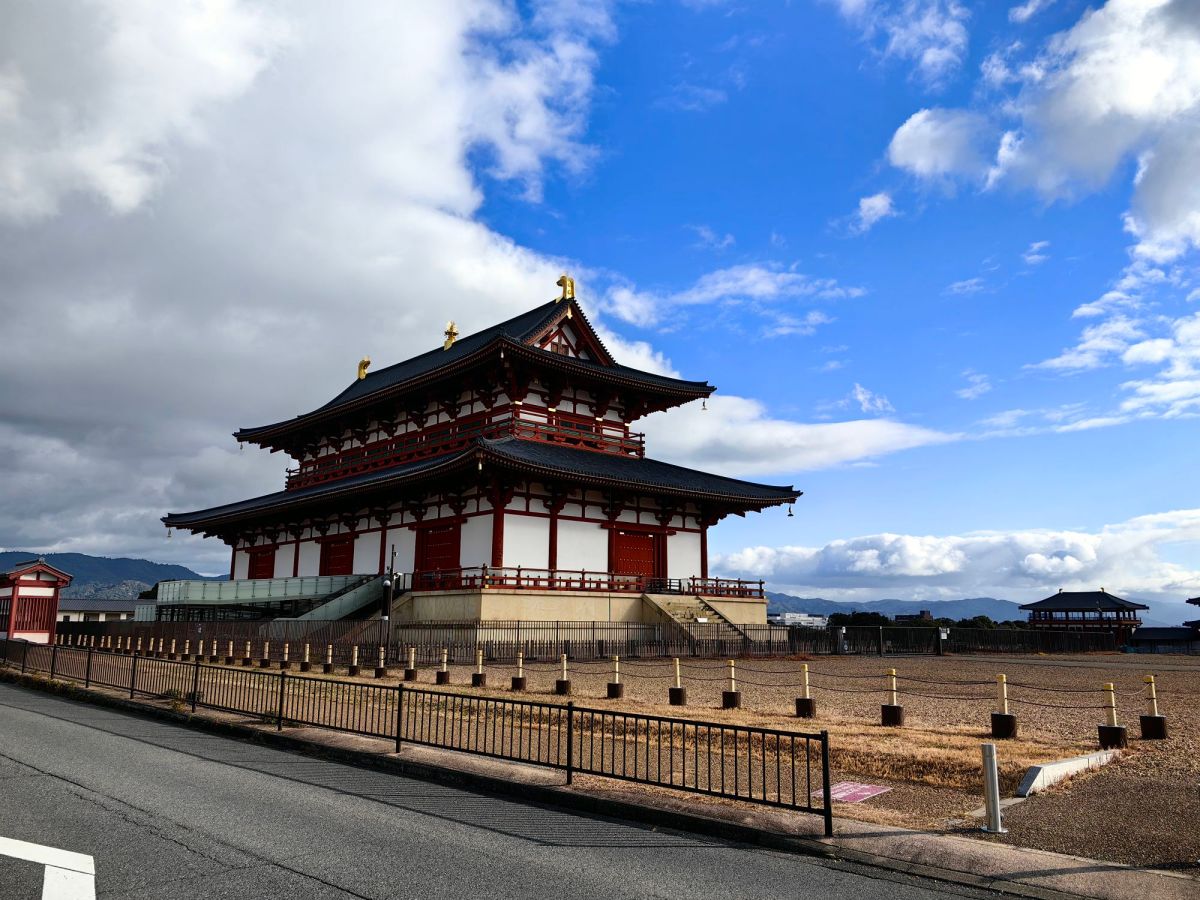
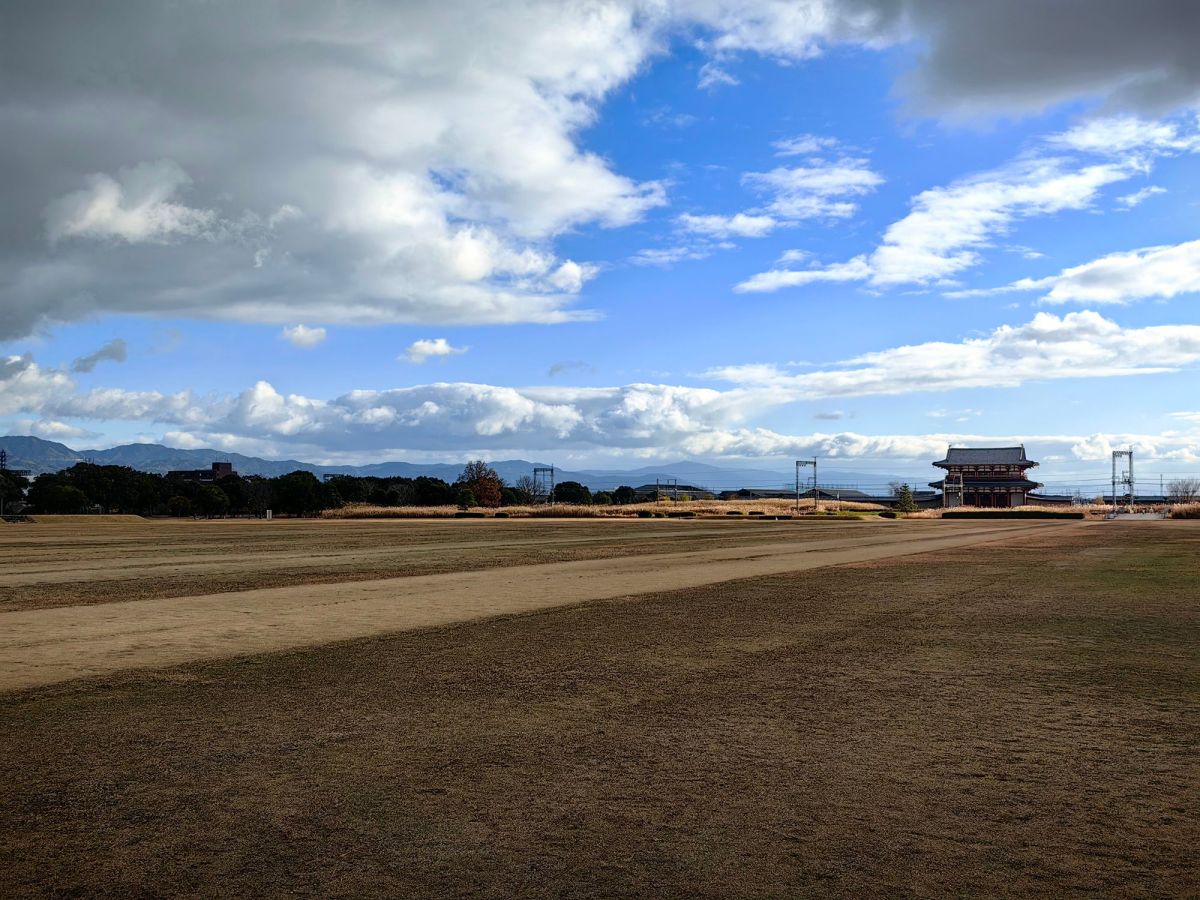
Afterwards, I took the train to the Heijō Palace Site Historical Park, the final major attraction of my Nara journey. After spending the day among ancient temples, I was curious to see the place where the political heart of eighth-century Nara had once stood. I entered the vast site from the northern side, beginning at the First Daigokuden, the reconstructed Great Audience Hall. The enormous open landscape was strikingly different from the shaded temple grounds of Yakushi-ji and Tōshōdai-ji.
As I learned more about the history of Nara, I began to see that the city was the result of a much larger transformation in Japan. One of the important turning points came in 645 with the Taika Reforms. The reforms sought to strengthen the authority of the imperial court and create a more centralized system of government, drawing in part on political and administrative ideas from the continental world. This new political order eventually found its physical expression in the capital of Heijō-kyō, established in Nara in 710. The city was carefully planned, with a great imperial palace, government offices, temples, and broad avenues arranged along a formal grid. All these interesting historic events happened thousand years ago in the place in front of me.
Here, there were broad expanses of grass and sky, with the remains and reconstructions of the ancient palace scattered across the former capital. There were few tourists. As I walked through the grounds, it was easy to imagine the imperial city that once stood here—the ceremonies, officials, and daily activities of a capital that flourished more than twelve centuries ago. Yet much of the original city has disappeared, leaving only traces beneath the open landscape. Perhaps this absence made the passage of time feel even more tangible.
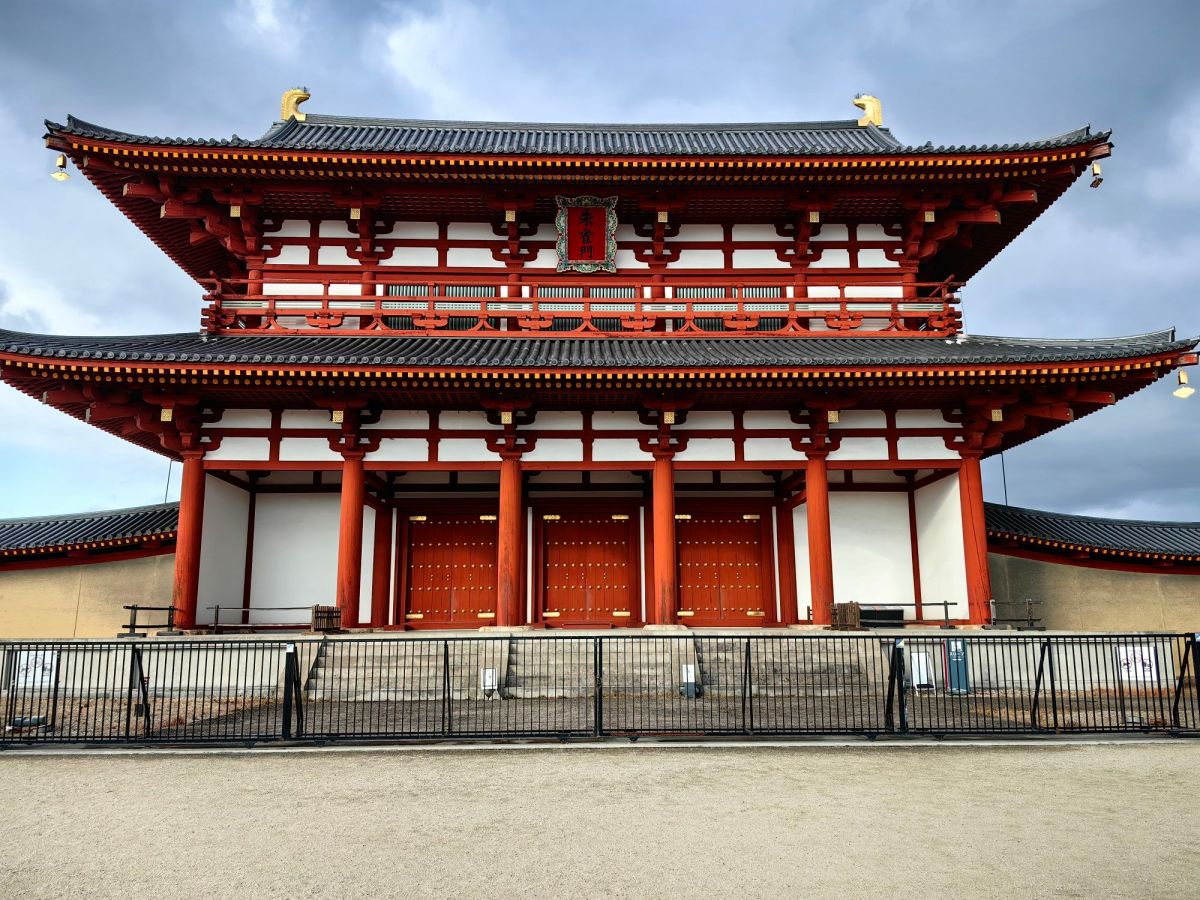
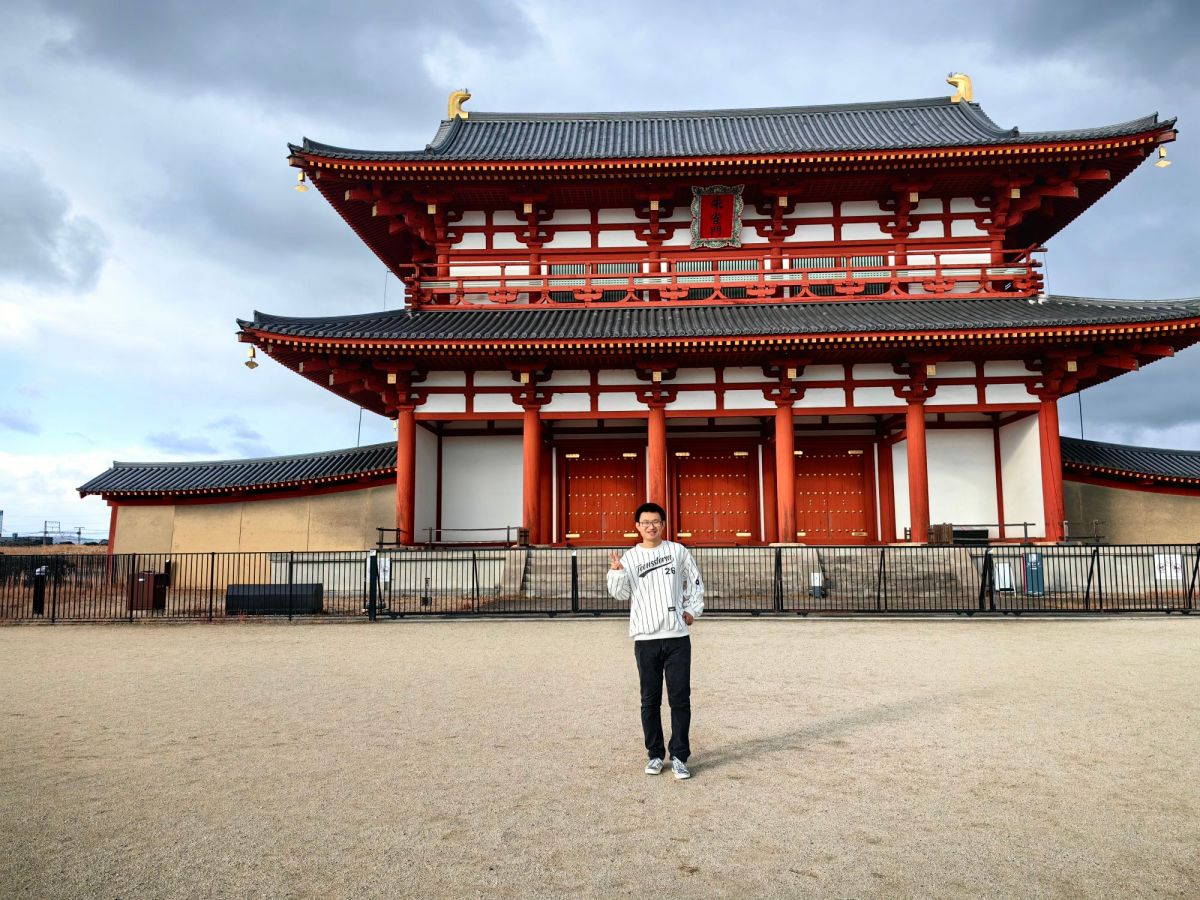
Standing before the magnificent Suzakumon Gate, I was reminded that Nara was once much more than an isolated Japanese capital. The gate was the southern main entrance to the Heijō Palace, opening onto Suzaku Avenue, the great north-south axis of Heijō-kyō. The avenue was once an enormous ceremonial road, about seventy metres wide, running straight through the ancient capital. The name itself carried a connection to China: 朱雀, “Vermilion Bird,” was the sacred creature associated with the south in the traditional East Asian cosmological system. More strikingly, the same name appeared in the great Tang capital of Chang’an, where Zhuque Avenue formed the city’s central north-south axis.
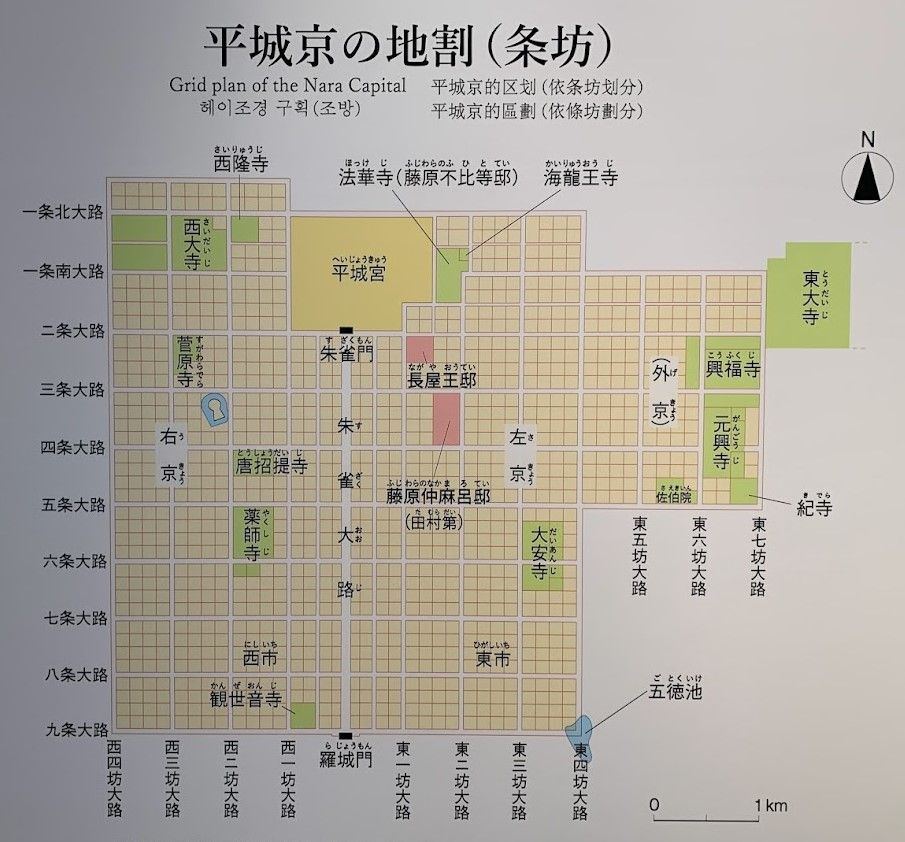
This is the map of Heijō-kyō which had been planned with Chang’an as one of its important models, adopting the continental idea of an orderly city arranged around a powerful central axis. From the map, I could see names of many famous attraction sites like Tōdai-ji, Toshodai-ji and Yakushi-ji. Standing before Suzakumon, I could therefore imagine the ancient avenue stretching straight ahead, with the palace behind the gate and the city unfolding symmetrically to either side. The connection becomes even more fascinating because Zhuque Avenue has not completely disappeared in China. In present-day Xi’an, the modern city still has a major thoroughfare called Zhuque Street, preserving the name and much of the historical north-south axis of Tang Chang’an.
This was one of the most fascinating moments of my journey: history was no longer something I had only read about in books. I felt as though two ancient capitals, separated by the sea, were briefly connected through a single name. More than twelve centuries ago, ideas of urban planning, architecture, government, and culture travelled from the Tang world to Japan. Today, the reconstructed gate in Nara and the surviving name of Zhuque Street in Xi’an offer two distant echoes of that extraordinary period of cultural exchange. This is what makes travelling to historical places so rewarding for me: a name, a building, or a street can suddenly bring something I once encountered in a history book to life. For a moment, the past no longer felt distant, and it was standing directly in front of me.
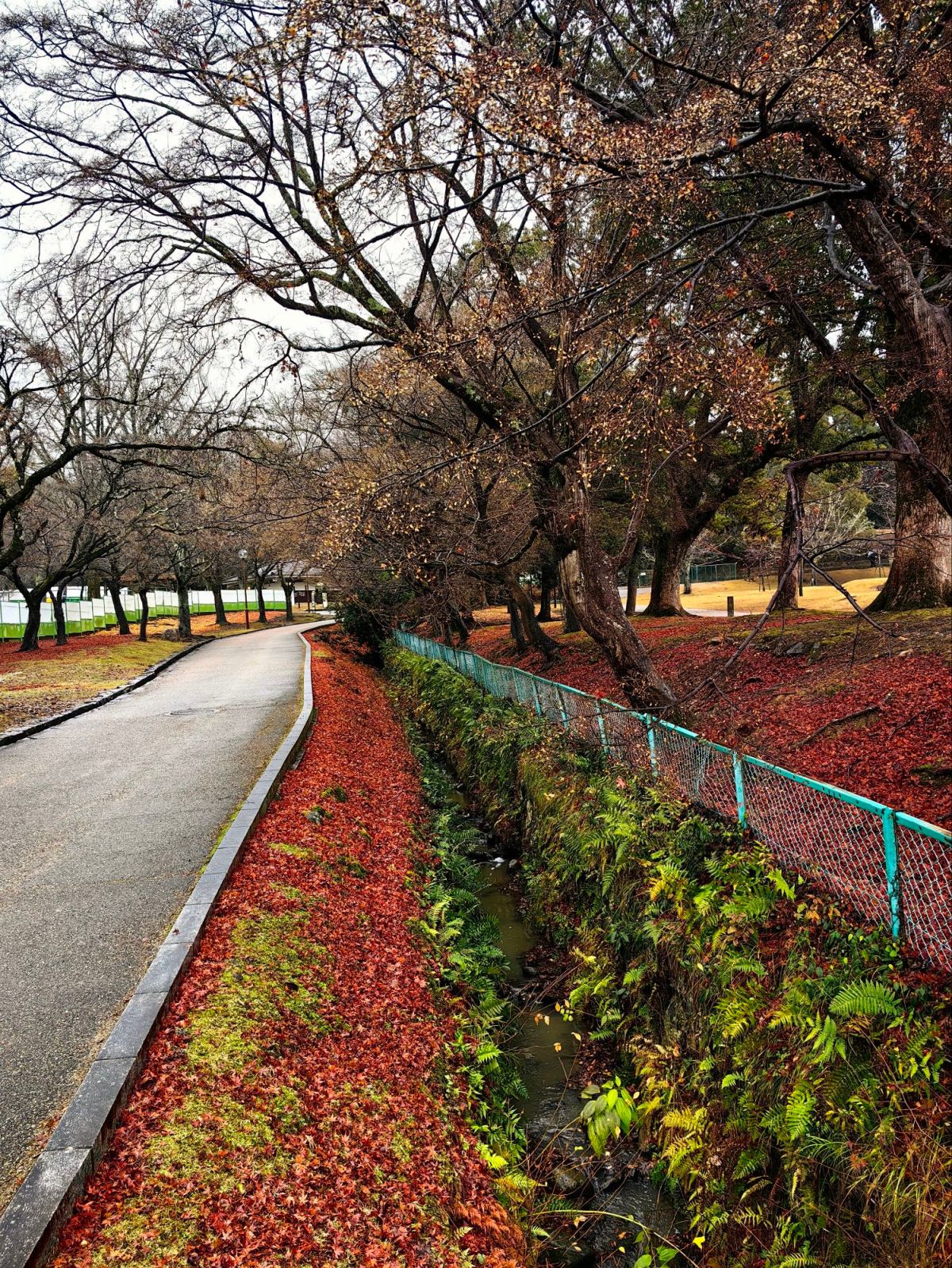
After completing a full day of exploring Nara, I still had some time before sunset, so instead of returning directly to my hotel, I wandered freely along the small lanes around the city. There was no particular destination and no need to follow a schedule. The narrow paths were lined with forests, with fallen red leaves scattered across the green grass and occasional patches of sunlight filtering through the trees. The late afternoon light softened the landscape.
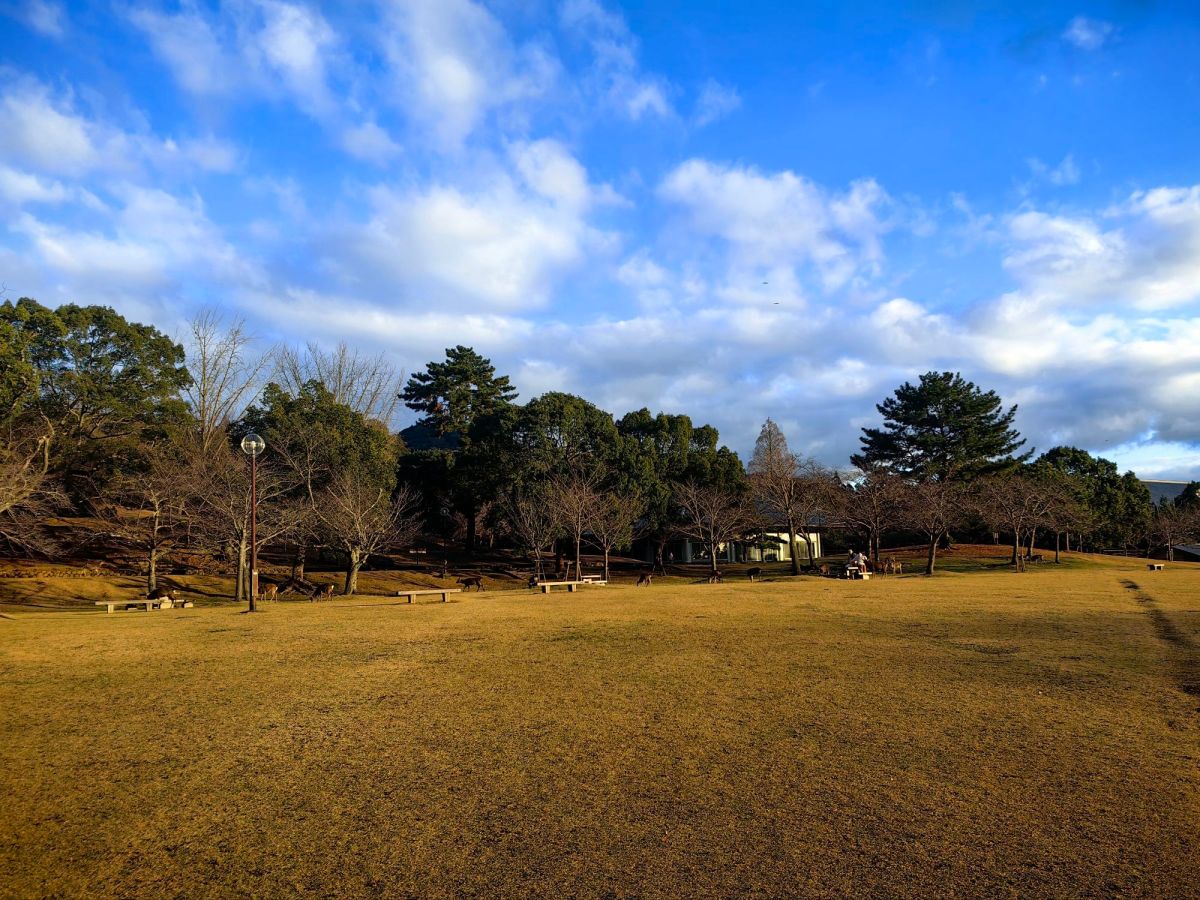
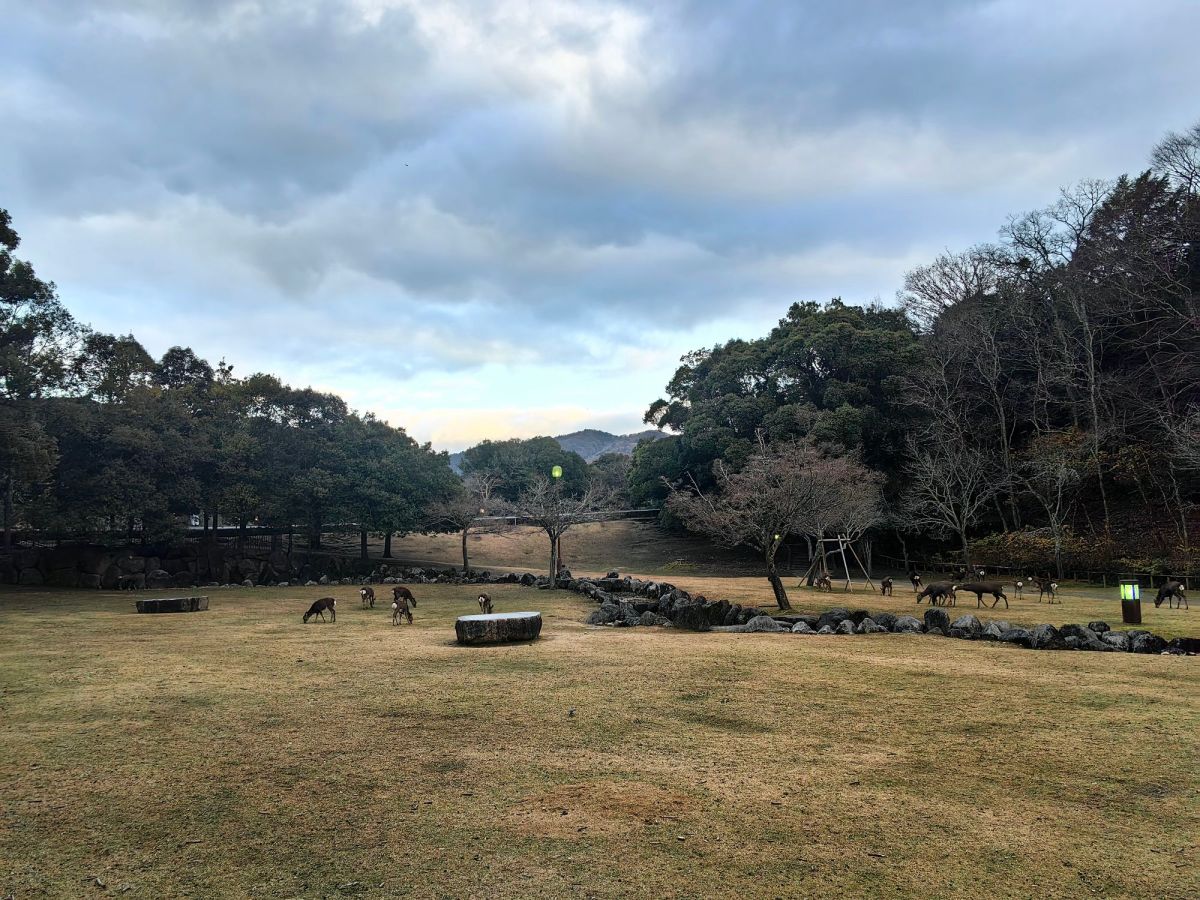
As the afternoon slowly gave way to sunset, many deer lay lazily on the grass, completely undisturbed by the people passing nearby. The soft evening light gradually illuminated the Noborioji park, casting a warm glow over the green landscape. In the distance, Mount Wakakusayama appeared faintly beyond the open fields, its gentle slopes partially hidden by clouds and the fading light of the sunset. I lingered there for a longer time. The deer resting on the grass, the open green space, the distant mountain disappearing into the clouds, and the quiet atmosphere created one of the most treasured moments of my journey through Japan. It was a rare feeling of being completely free and undisturbed, able to admire nature and let time pass without hurry.
Looking back on my journey, this quiet evening in the Noborioji Park left the deepest impressions on me. Nara had given me magnificent temples, ancient architecture, cute deer, and a remarkable sense of history, but it was perhaps this simple landscape at sunset that stayed with me most strongly. Among all the places I visited in Japan, Nara became my favorite. It is a place where history, natural environment, and everyday life seemed to exist together in perfect harmony.
After spending time in the lively streets of Osaka, I decided to take a break from the crowds and travel to Minoh, a peaceful town surrounded by forested hills just outside the city. Compared to the vibrant streets of Namba and Dotonbori, it felt like another world. My pace slowed, the air became fresher, and the city noise gradually faded away, replaced by the rustling of leaves in the wind and the tranquility of nature.
After I get off from the train, I arrived at this small town in the north of Osaka. What I particularly enjoyed about Minoh was its tranquility. Compared with Osaka’s famous tourist attractions, Minoh receives far fewer international travelers, and even the popular walking trail can feel surprisingly peaceful. There were moments when I could simply walk along the forest path without being surrounded by tour groups or crowds, but only the swaying shadows of the trees and the rustling sound of foot accompanying me.
The journey to Minoh was not about checking off famous landmarks. Instead, it was about enjoying the simple experience of walking through the forest, listening to the flowing water, watching the leaves move gently in the breeze, and taking my time to appreciate the scenery. Sometimes, the most memorable places on a journey are not the ones filled with people, but the quiet ones where I can slow down and truly feel my surroundings.
By December, I had already missed the best time to see Minoh’s famous maple leaves. The brilliant reds and oranges of autumn had largely disappeared from the trees, leaving only memories of the season that had just passed. The ground was covered with a thick carpet of fallen leaves, their faded reds, oranges and browns scattered across the forest path.
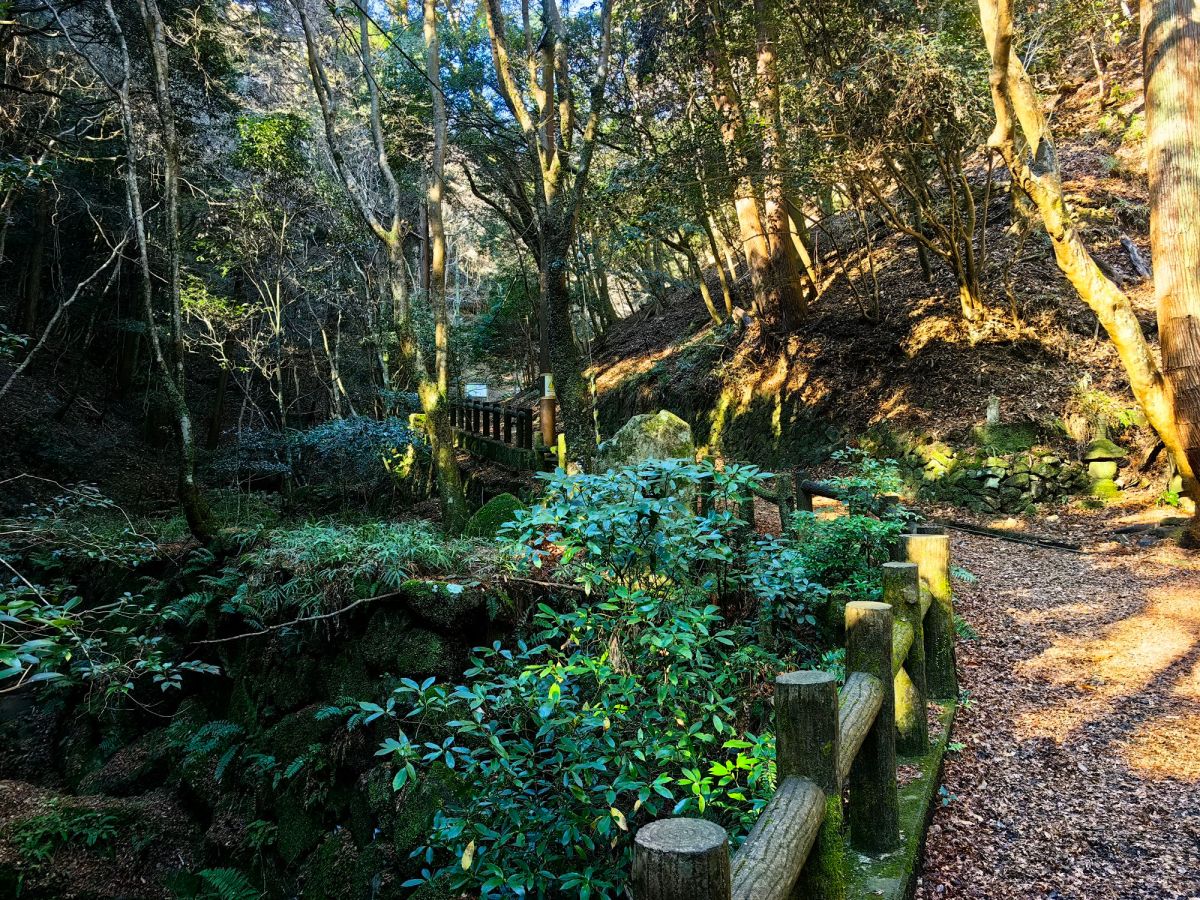
The December morning was a little cold. I could feel the crispness of winter in the air, but the sunlight was warm. Golden rays filtered through the remaining green leaves above me, falling softly onto the path and warmed my face. Looking down at the leaves beneath my feet, I felt that each step made a soft, gentle sound, as if the forest was quietly accompanying my walk. Without the crowds of the autumn season, I could walk slowly and listen to the water, the rustling leaves and the occasional sound of birds.
As I walked through Minoh Park, I passed several old temples that were quiet and almost empty, with very few tourists around. The peaceful surroundings made the journey feel unbothered and unhurried. Being able to walk alone through the temples and forest gave me a sense of solitude and allowed me to fully appreciate the beauty of nature.
Hidden deep within the forest, the ancient temple seems to belong to an isolated world. The weathered wooden beams, etched by time, stood silently beneath the pale winter sky. Moss-covered stones were scattered throughout the woods, quietly disappearing into the dense undergrowth. A thin mist swirled among the treetops and blurred the boundary between heaven and earth, immersing the entire forest in a tranquil and mysterious atmosphere.
I walked all through the main walking route follows the Minoh River through the forest. The path was gentle and enjoyable, making it possible to appreciate the scenery without the feeling of a difficult mountain hike. Along the way, the sound of running water accompanied the walk, while tall trees created a cool and refreshing canopy overhead.
Along the forest trail in Minoh Park, there is a remarkable giant rock known as Himeiwa. Unlike an ordinary boulder, Himeiwa looks as though it has been dramatically cut in half by a giant blade. A narrow passage runs between the two enormous pieces of rock, just wide enough for a person to squeeze through. There is also a charming local belief associated with Himeiwa. Passing through the narrow opening is traditionally said to bring the blessing of children, giving the rock a spiritual meaning beyond its unusual appearance.
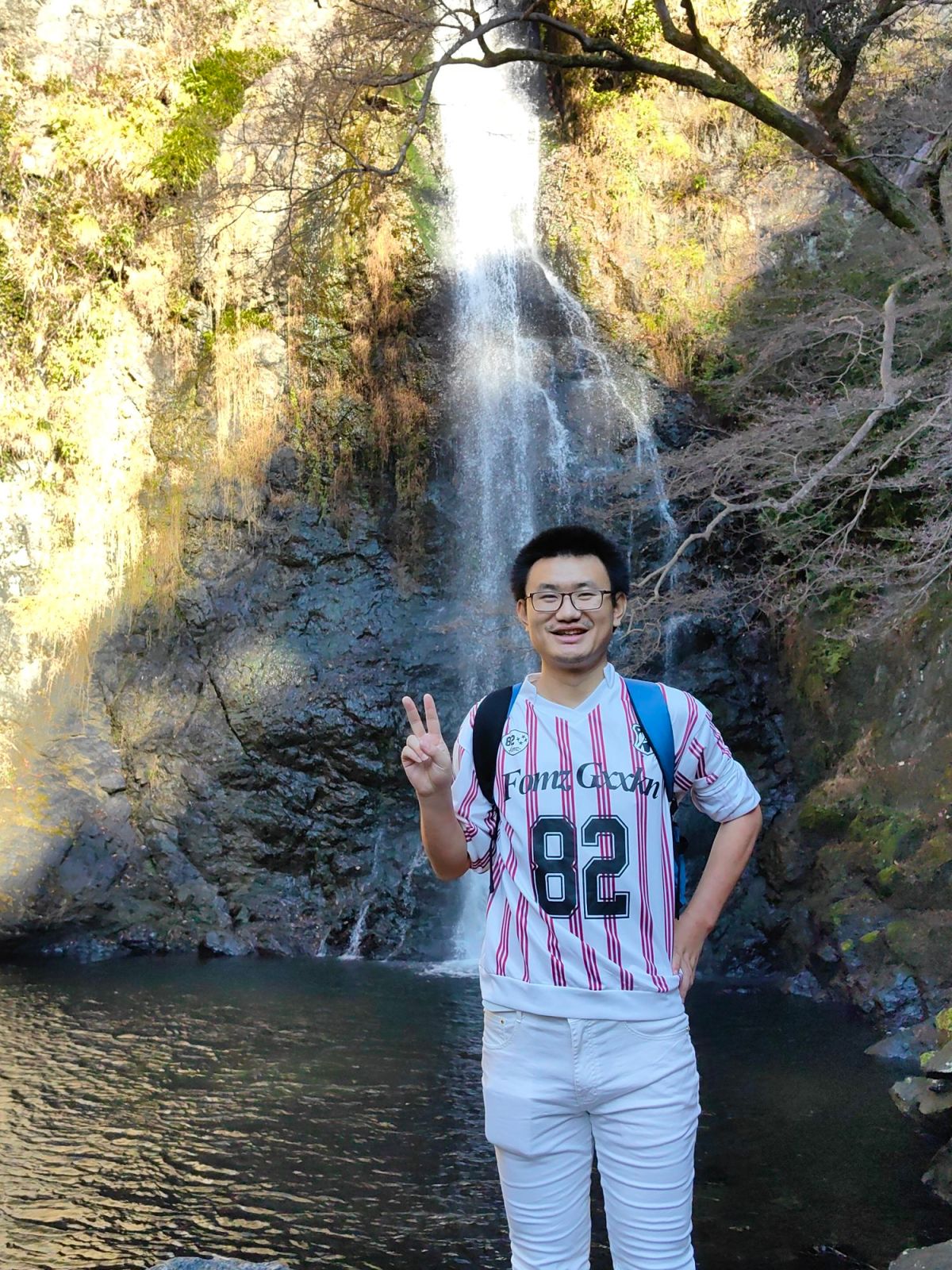
One of the highlights of Minoh Park is Minoh Waterfall, a beautiful 33-metre cascade at the end of the trail. The waterfall is especially impressive after walking quietly through the forest for some time. It is not an enormous waterfall, but its setting makes it particularly beautiful. Surrounded by tall trees and steep forested slopes, the falling water was perfectly integrated into the landscape rather than standing apart from it. I stood there for a while, listening to the continuous sound of water falling over the rocks. The walk through the forest made the waterfall feel like a natural reward at the end of the trail.
After spending some time at Minoh Waterfall, I continued my journey toward Katsuoji Temple, one of the most famous temples in the Minoh area. Instead of returning along the same forest trail, I climbed up from the steps of waterfall toward the main road. The change in scenery was gradual. The narrow forest path gave way to a wider mountain road lined with tall trees. The road gradually led me deeper into the mountains toward Katsuoji. Although the walk was uphill in places, I enjoyed taking my time and appreciating the changing landscape.
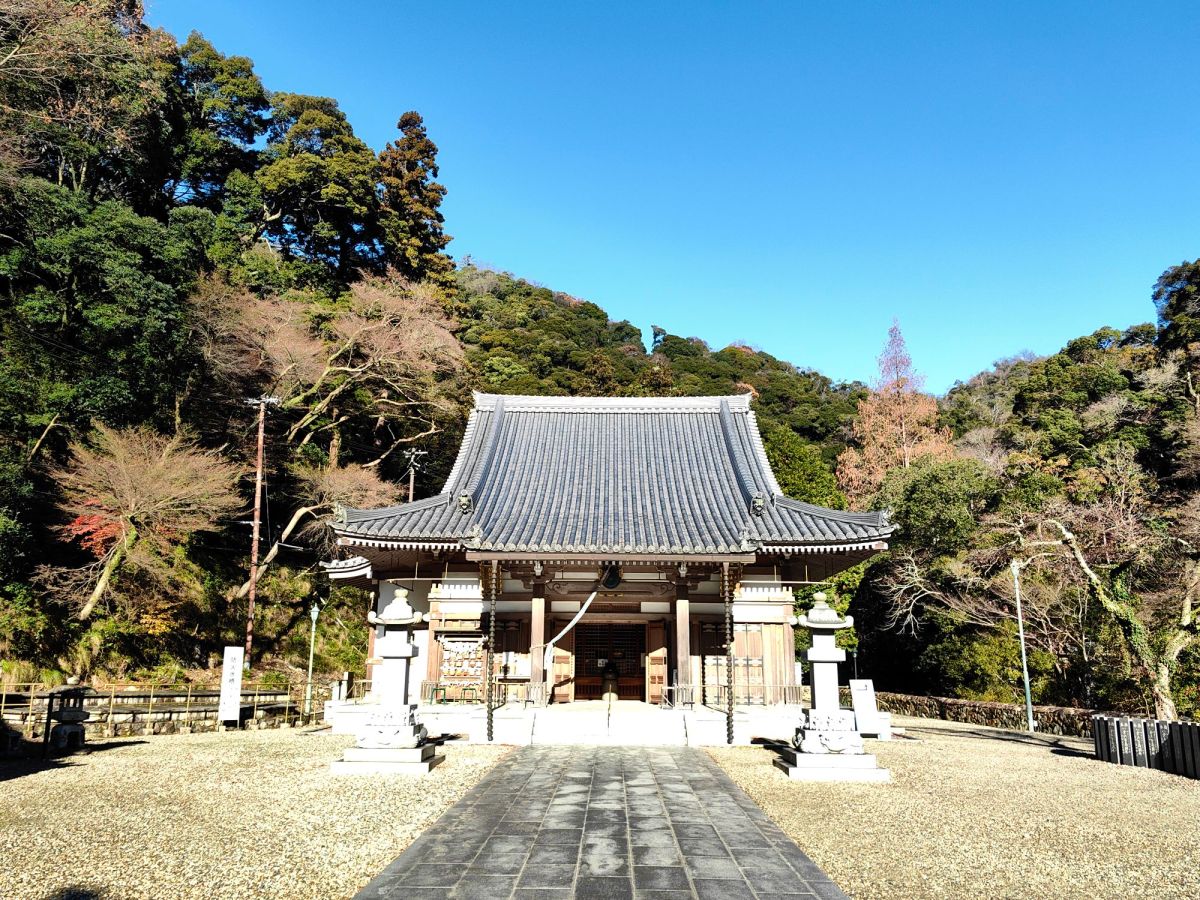
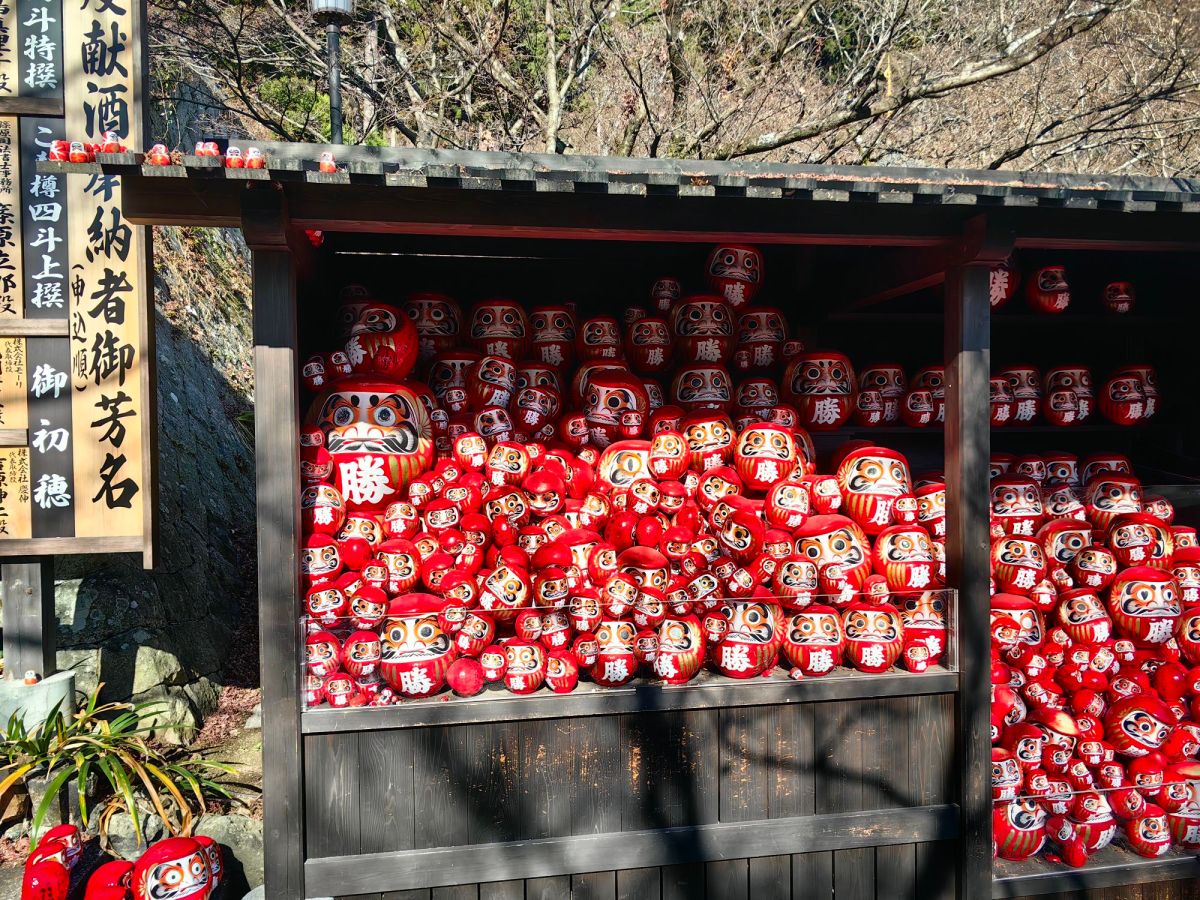
Eventually, I arrived at the Sanmon of Katsuoji Temple, famous for its thousands of Daruma dolls and its long history of being associated with victory and good fortune. Surrounded by dense forest and carefully landscaped gardens, the temple felt peaceful and secluded, despite being one of the best-known places to visit in the Minoh area.
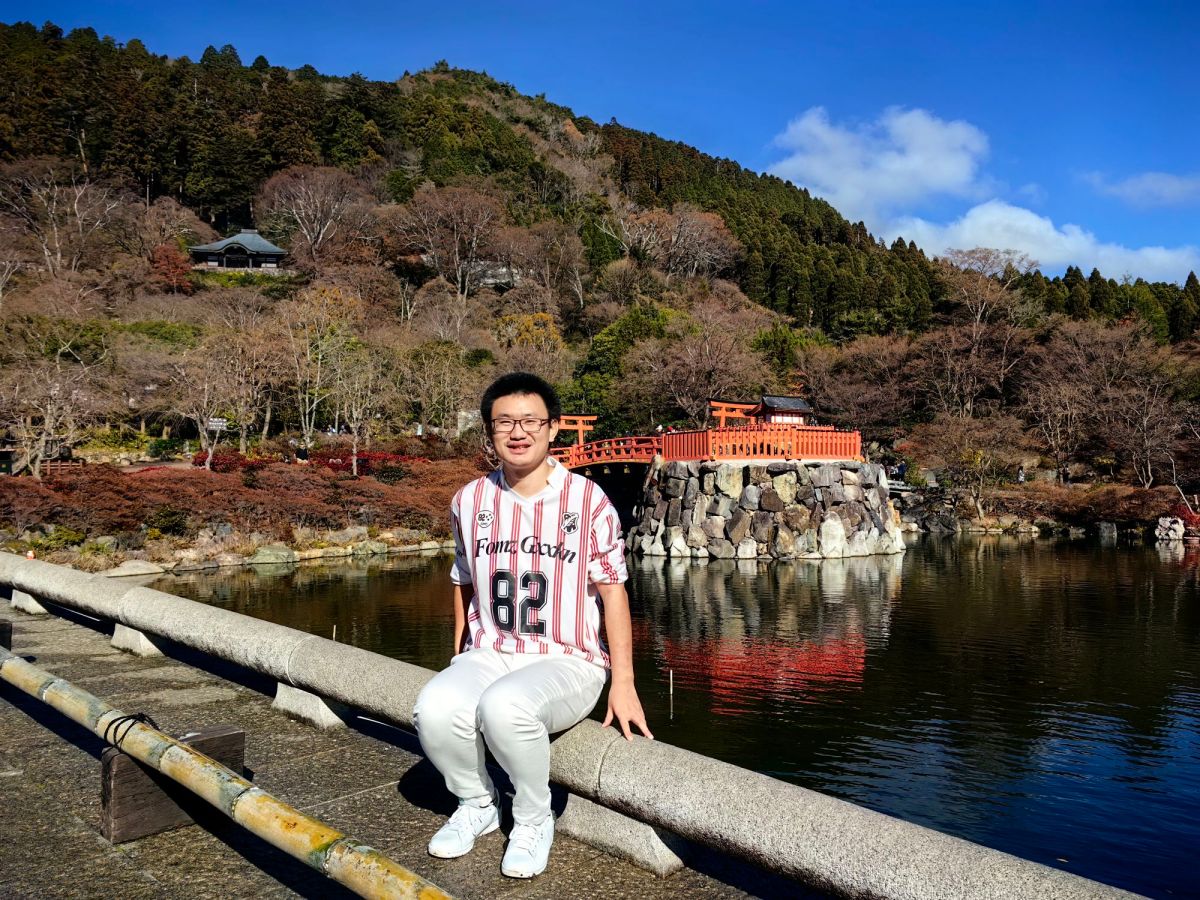
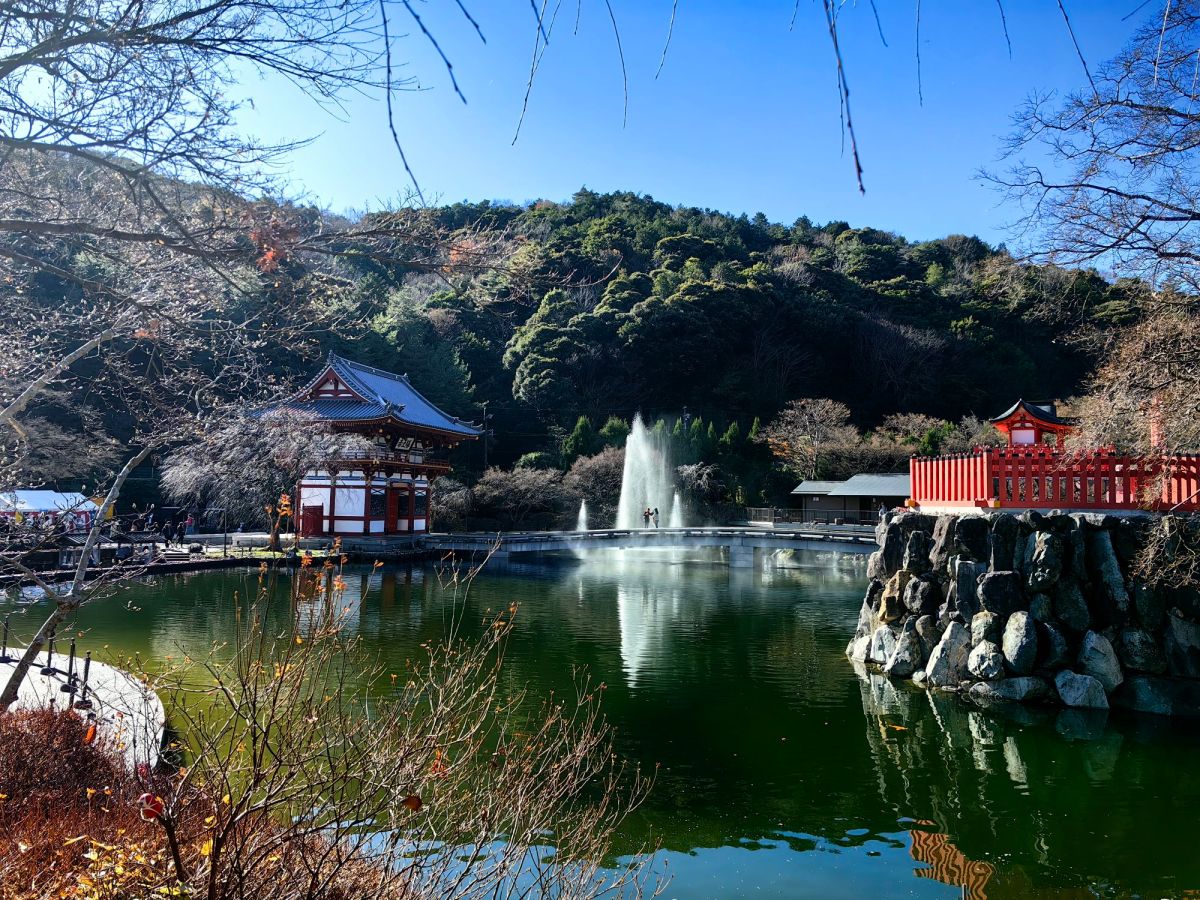
Ponds, bridges, stone paths and carefully maintained gardens blend naturally with the forested mountains. In December, the atmosphere was particularly peaceful. Many of the maple leaves had already fallen, covering the ground with a layer of autumn color. According to temple tradition, the temple was founded in 727 by two brothers, Zenchū and Zensan, who built a small hermitage in the mountains. The temple’s connection with victory also has an interesting origin. During the reign of Emperor Seiwa, the emperor was seriously ill, and prayers were offered at the temple for his recovery. According to tradition, the emperor eventually recovered, and the temple’s spiritual power became associated with victory and overcoming difficulties.
What immediately caught my attention was the extraordinary number of Daruma dolls throughout the temple grounds. These traditional Japanese dolls are symbols of determination and perseverance. Their round bodies and striking faces can be seen sitting on steps, beside pathways, on shelves and among the gardens. Some are large and impressive, while others are tiny enough to fit in the palm of a hand. Walking through the temple grounds felt almost like entering a world of Daruma. Instead of seeing just a few traditional ornaments, I encountered them everywhere I looked. Their presence gave the temple a playful character that contrasted beautifully with its quiet mountain setting.
The Daruma has large eyes, thick eyebrows and moustache which are traditionally associated with Bodhidharma (Daruma). At Katsuoji Temple, it has a special connection with the temple’s reputation for victory and success. Visitors often buy Daruma when praying for success in an examination, or a competition. What makes Katsuoji particularly fascinating is the sheer number of Daruma scattered throughout the temple grounds. Visitors offered Daruma in designated areas, so the dolls gradually accumulate across the gardens, steps and temple buildings. This creates a very distinctive scene: hundreds or even thousands of red Daruma seemingly watching over the temple from every corner. It is one of the things that makes Katsuoji unlike most other traditional temples in Japan.
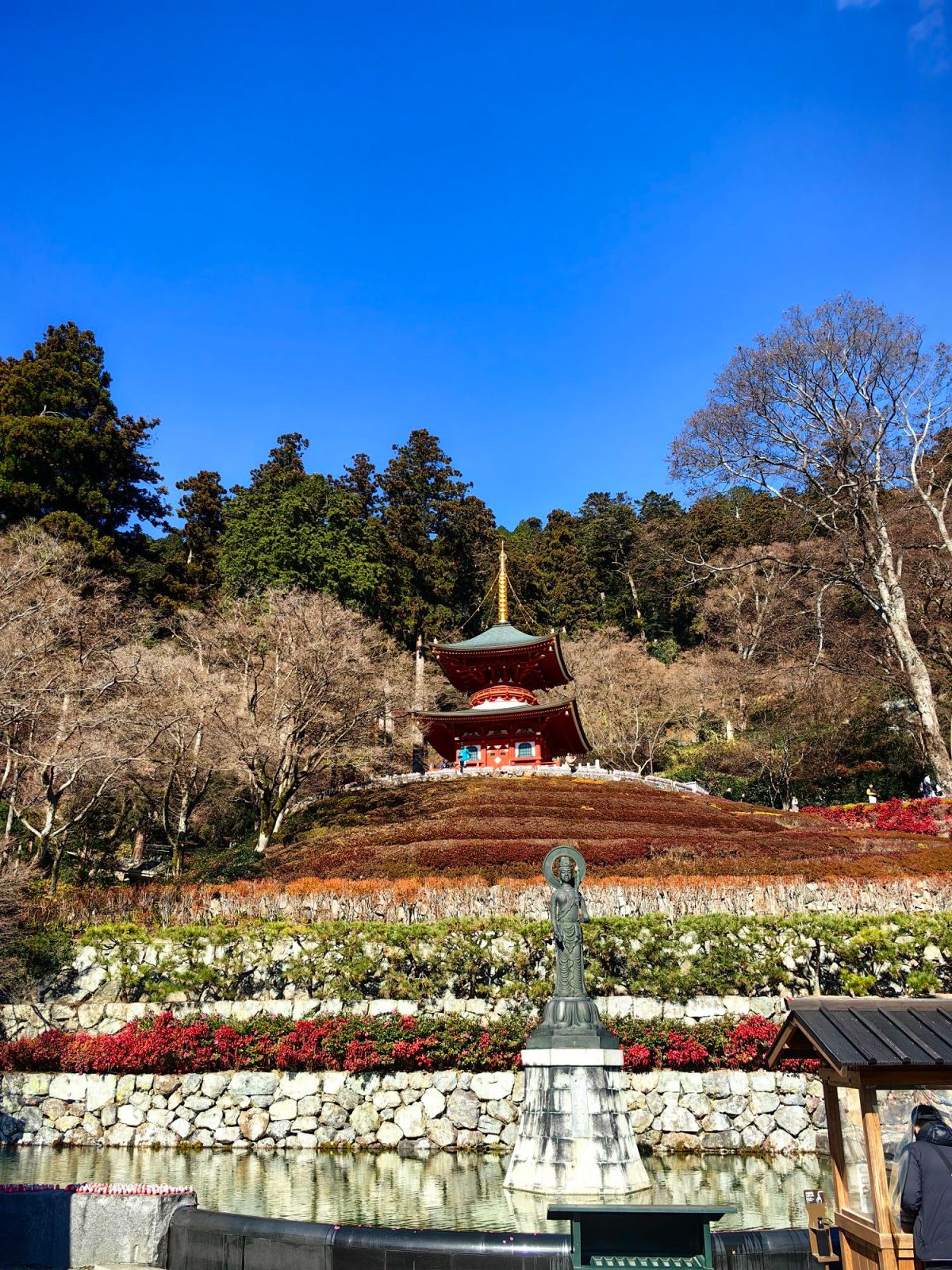
One of the other things that caught my attention at Katsuoji was the vivid red colour of its traditional architecture. Against the deep green of the surrounding mountains, the vermilion buildings, gates and bridges stood out with remarkable intensity, creating a scene that felt both elegant and almost dreamlike. I particularly enjoyed the way Katsuoji combines architecture with nature. The buildings are not isolated monuments surrounded by concrete; they are woven into the mountains, gardens, ponds and forests.
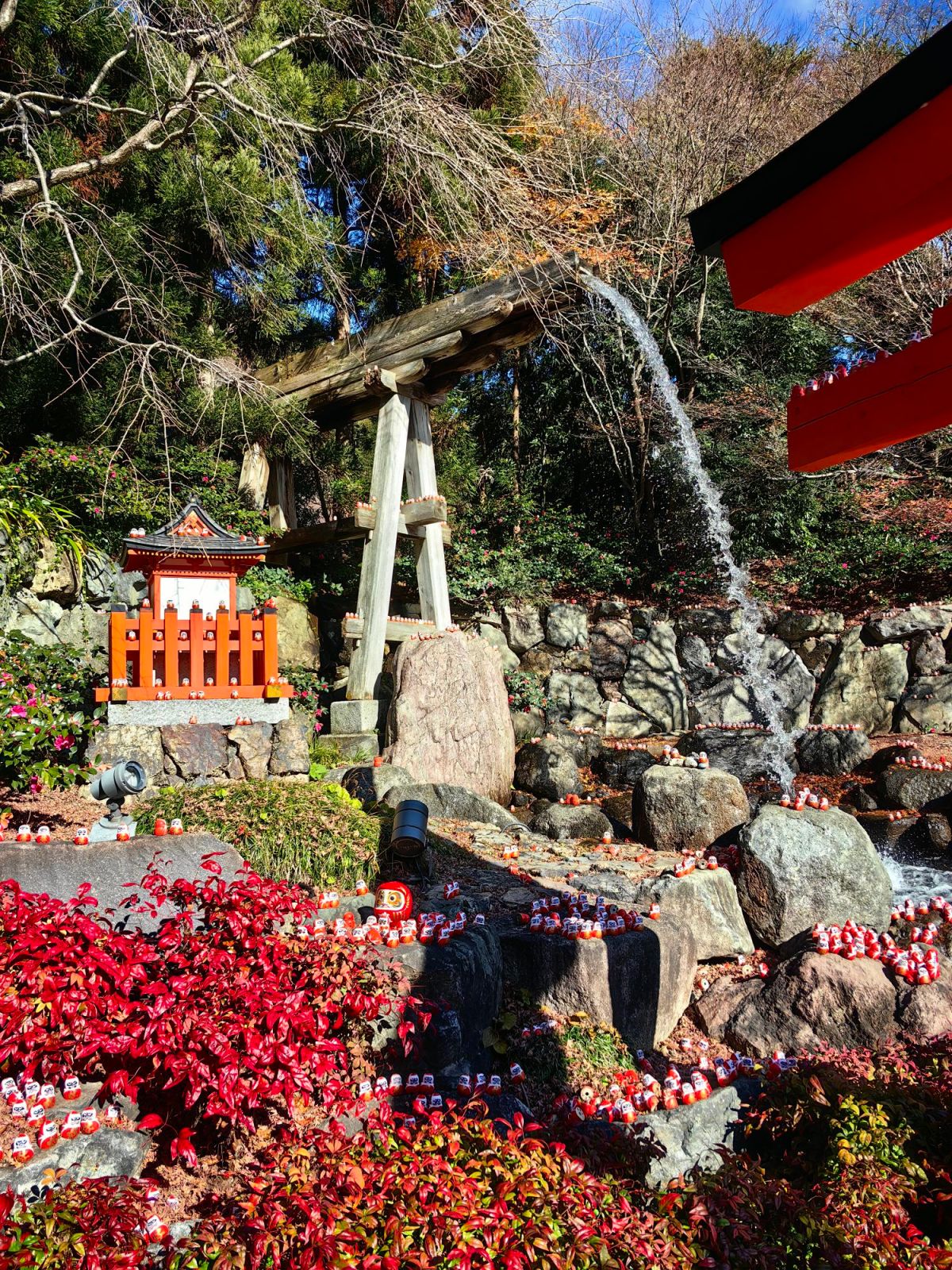
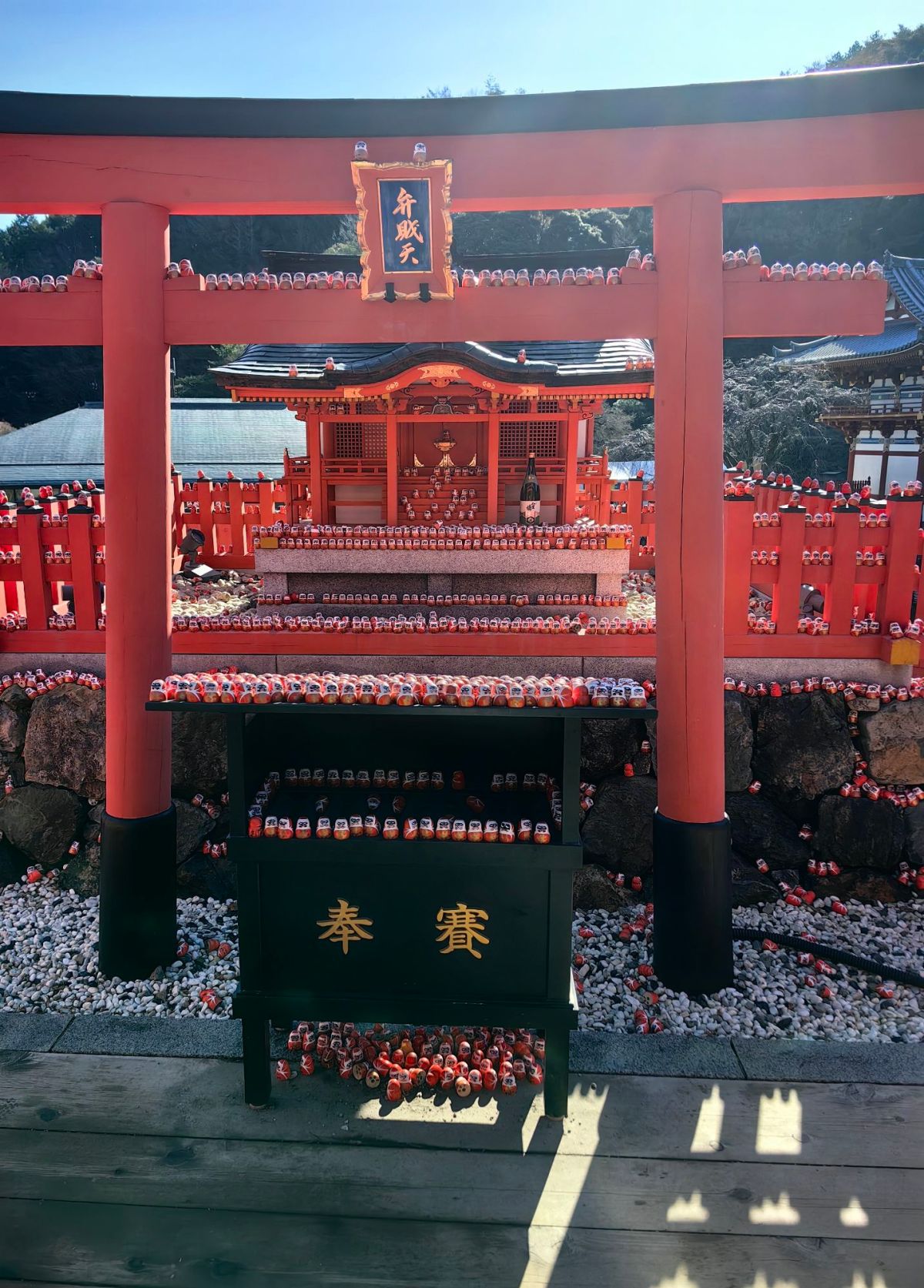
Among the rocks and greenery, I noticed a miniature vermilion shrine surrounded by red railings. A series of bright red traditional torii gates led toward it, creating a striking contrast with the natural landscape. This was Benzaiten Shrine, dedicated to Benzaiten, a deity associated with water, wisdom, music and the arts. I have found many similar things in the garden. Torii are traditionally associated with Shinto shrines, while Katsuoji itself is a Buddhist temple. Historically, however, Buddhism and Shinto were deeply intertwined in Japan for centuries. Before the Meiji period, it was common for Buddhist temples to contain Shinto shrines and for Buddhist and Shinto practices to coexist.
Benzaiten has a fascinating origin. She developed in Japan from Saraswati, an ancient Indian goddess associated with water, knowledge, music and the arts. When Buddhism spread to Japan, this deity was incorporated into Japanese religious traditions and gradually took on additional associations. She is worshipped in many different forms across Japan. Some places have grown into large religious complexes devoted to her, while other, like this little shrine at Katsuoji, was simply a small sacred corner within a much larger temple.
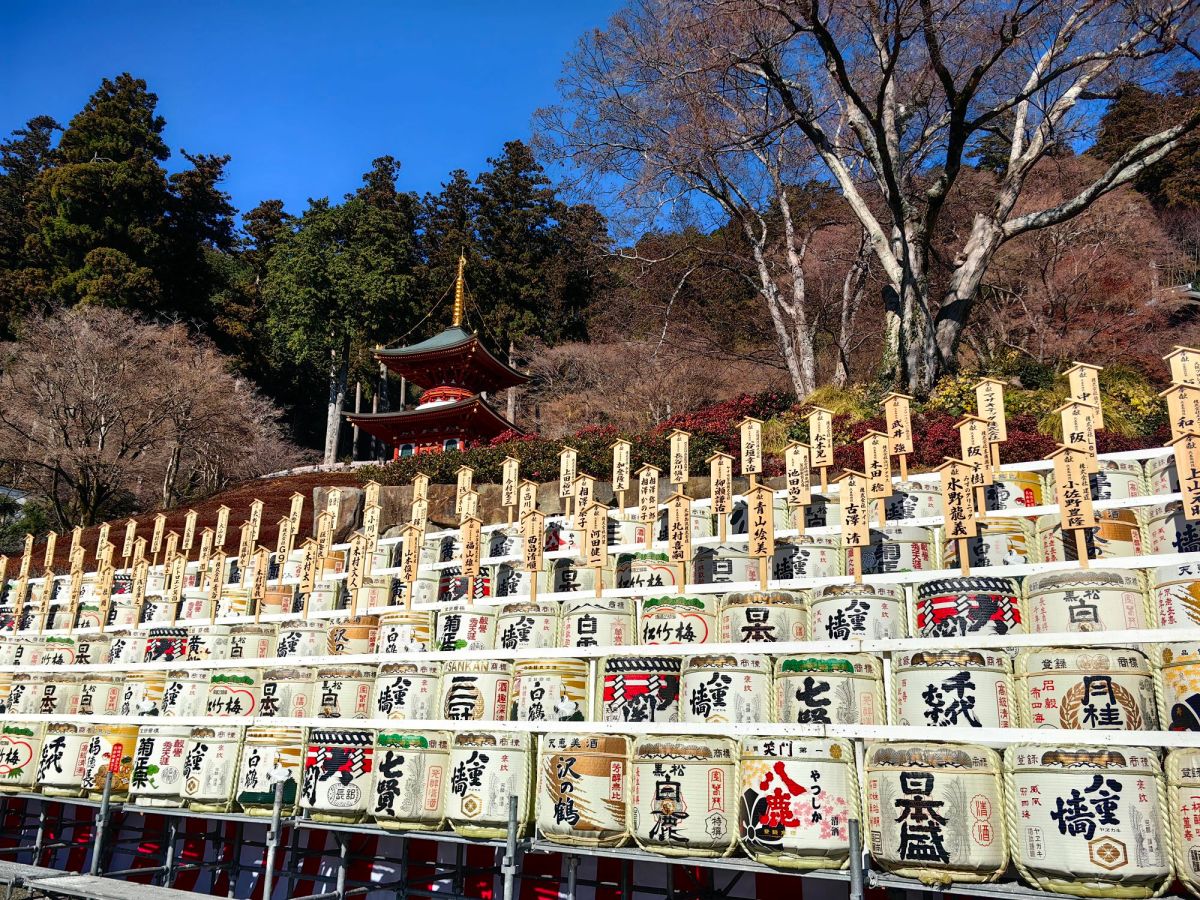
As I walked through Katsuoji, I came across a remarkable display of sake barrels stacked in rows along the hillside. Each barrel carried different Japanese characters, names and colorful logos, representing different sake breweries and producers. These were not simply decorations; sake has long played an important role as a religious offering in Japan, and breweries often donate sake to temples and shrines. The scene was particularly striking at Katsuoji. Hundreds of barrels formed a wall of white, black and red, while the elegant vermilion pagoda rose above them among the trees. This creates a scene with a distinctly Japanese character.
The pagoda called Tahōtō originated in ancient India as the stupa, a structure associated with the Buddha and used to preserve sacred relics. As Buddhism spread through Asia, the stupa gradually evolved into different architectural forms. Japanese pagodas are usually built with three or five storeys, with the five-storey pagoda being particularly iconic. The number five has Buddhist and cosmological significance, traditionally representing the five elements: earth, water, fire, wind and space.
During my trip, I noticed a series of unusual stone towers standing beside the old pilgrimage route. These were Gorintō, not simply memorial stones but Chōishi, distance markers for pilgrims and it shew directions for the pilgrims. The oldest surviving ones date back to 1247, to the Kamakura period. Standing beside them with hundred years history, I imagined the pilgrims who had walked this same route more than seven hundred years ago. They would have passed these stones one by one like me. The stones therefore felt like more than historical objects. They were silent witnesses to generations of journeys, prayers and footsteps.
In this temple, I have seen many ancient-looking Buddhist monuments. A weathered stone pagoda rose on one side, while a tall inscription pillar stood like a silent marker beside the path. The large structure on the left is a stone pagoda, built in the traditional Buddhist architectural form. It has multiple levels with projecting roofs, giving it the appearance of a miniature stone version of pagoda. It is quite different from the Tahōtō behind it. The large stone pillar is an inscription monument with the Japanese name of the mountain Ocho-san (応頂山) and the Japanese name of the temple Katsuō-ji(勝尾寺). Japanese character is similar to the Chinese character even I don’t know any Japanese but I could still recognize them. This sense of familiarity that transcends language and culture makes my travels particularly enjoyable.
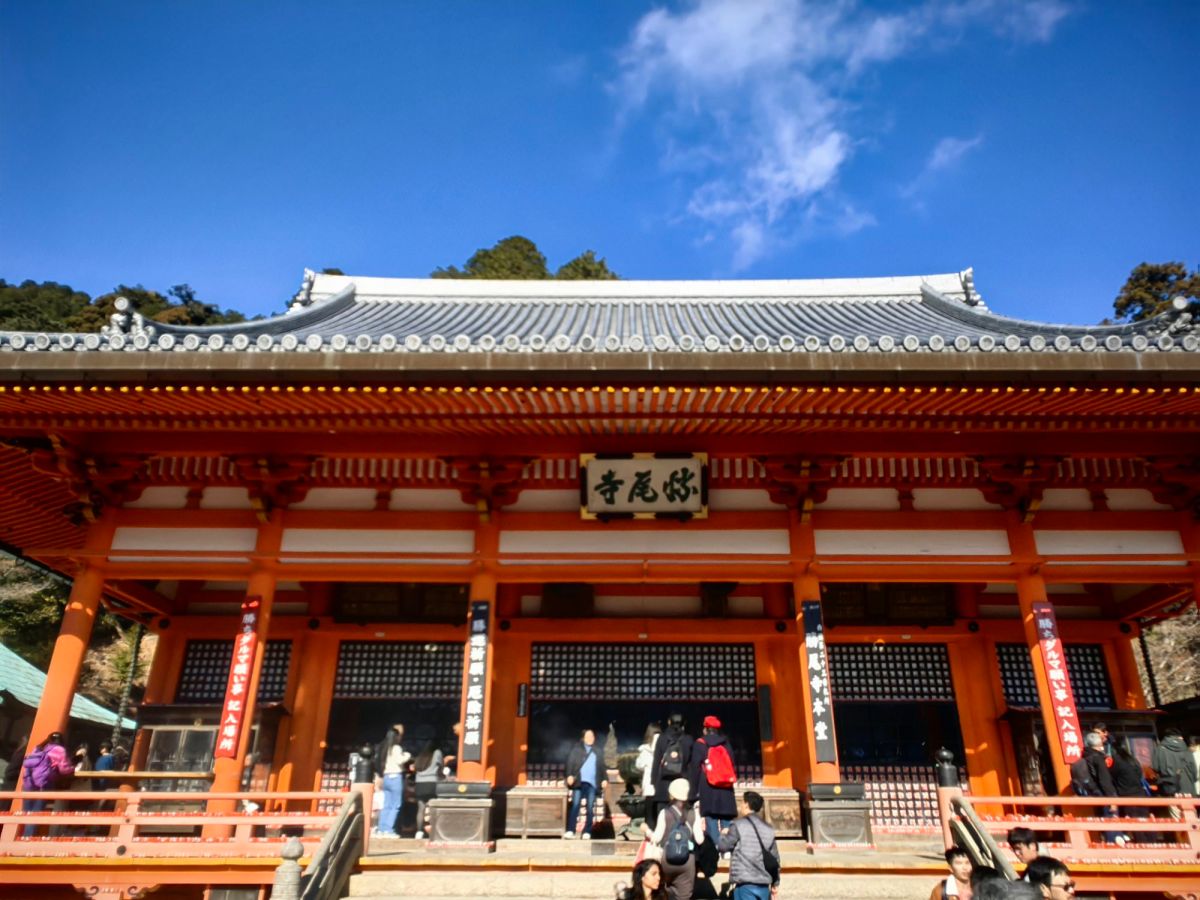
The Hondō(main hall) of Katsuō-ji is a traditional wooden Buddhist main hall characterized by its broad tiled roof, deep eaves, and simple wooden structure. The structure is mainly natural wood, with dark brown and muted tones that blend into the mountain setting. Many people visit the Hondō to pray for success, good fortune, and the fulfillment of their wishes. Standing in front of it, I could feel a solemn and peaceful atmosphere.
In winter, Katsuō-ji offers a peaceful panoramic view of the surrounding mountains and forests. The bare trees and evergreen foliage create a quiet, subdued landscape immersed in the clouds, giving the scenery a calm and misty appearance. From the elevated temple grounds, I could appreciate the beauty and tranquility of the winter mountains.
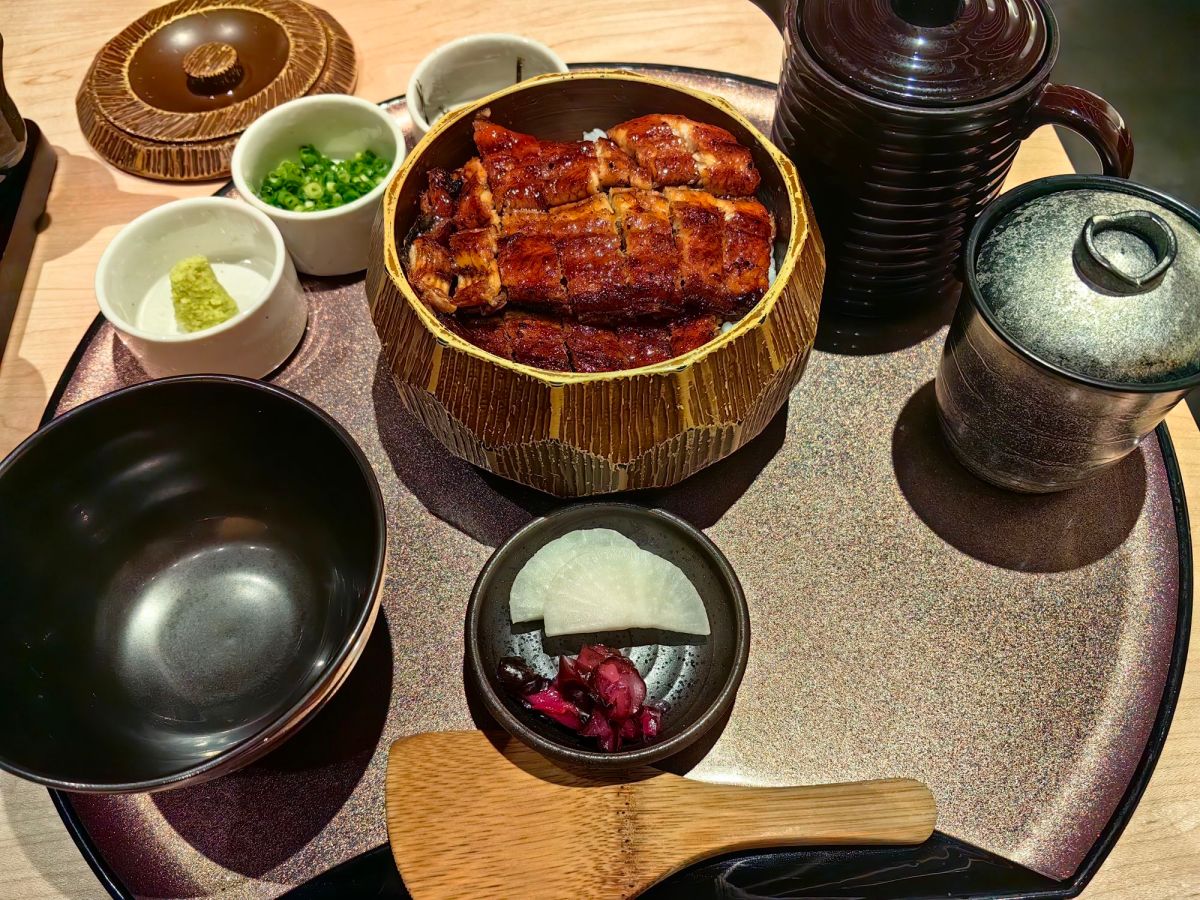
After leaving Katsuō-ji, I stopped at a small local restaurant and had unadon for lunch. The dish consisted of tender grilled eel served on a bowl of warm, fluffy rice and covered with a rich, sweet and savory sauce. The plating of the Japanese food was beautifully arranged and visually appealing. It looked simple, but I could feel the chef’s attention to details. The ingredients were carefully placed in the dish, creating a balanced combination of colors, textures, and shapes. The eel had a slightly smoky flavor from the grilling, while the sauce added a delicious balance of sweetness and saltiness. The simple presentation and cozy atmosphere of the small restaurant made the meal feel especially authentic and comforting after visiting the temple.
By the time I returned to Osaka, I felt refreshed by my brief escape to Minoh. Although it was only a short journey, the quiet forests, mountains, hidden temples, and crisp winter air created a peaceful distance from the bustle of the city. Walking alone through the tranquil landscape, pausing at old temples, enjoying the scenery and a simple Japanese meal, I found myself slowing down and appreciating the moment. Minoh reminded me that a journey does not have to be long to be meaningful; sometimes, a few hours surrounded by nature are enough to relax, clear the mind, and continue my jourmey with a renewed sense of calm.
In December 2025, I embarked on my very first journey to Japan. For years, I had dreamed of exploring a country where ancient traditions coexist with cutting-edge modernity, and the Kansai region was the destination I chose to begin that dream. As the largest city in western Japan and the gateway to the Kansai region, Osaka was the perfect introduction to the country and was the perfect place to experience my first glimpse of Japan. when I arrived, the city welcomed me with its vibrant energy, dazzling streets, and warm, down-to-earth atmosphere.
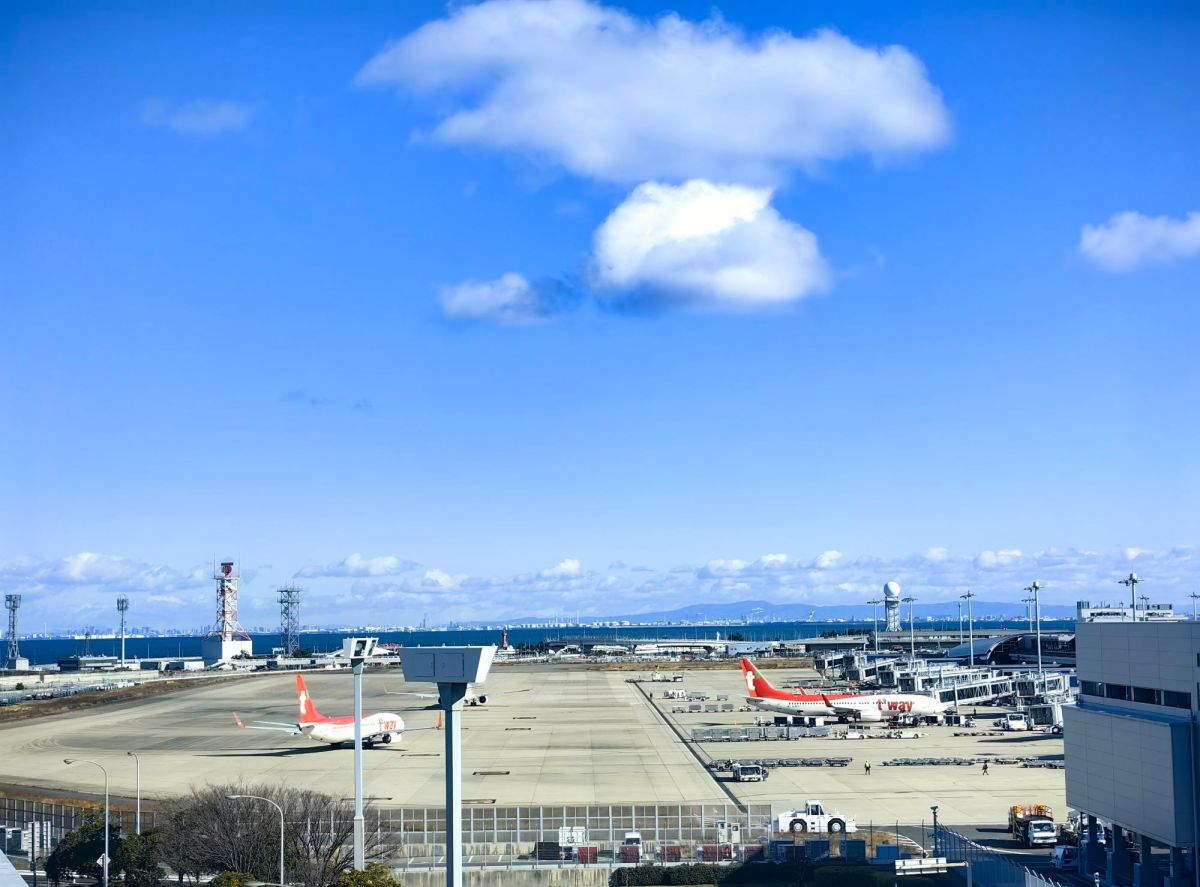
On 19 December 2025, I arrived at Osaka’s Kansai International Airport, the gateway to my first journey in Japan. Even before stepping outside the terminal, the airport itself left a lasting impression. Built entirely on a man-made island in the heart of Osaka Bay, it appears to rise gracefully from the sea, surrounded by water in every direction. As the aircraft began its descent, I gazed out of the window and watched the long, slender runway emerge from the shimmering bay, linked to the mainland by a bridge that seemed to stretch endlessly across the water.
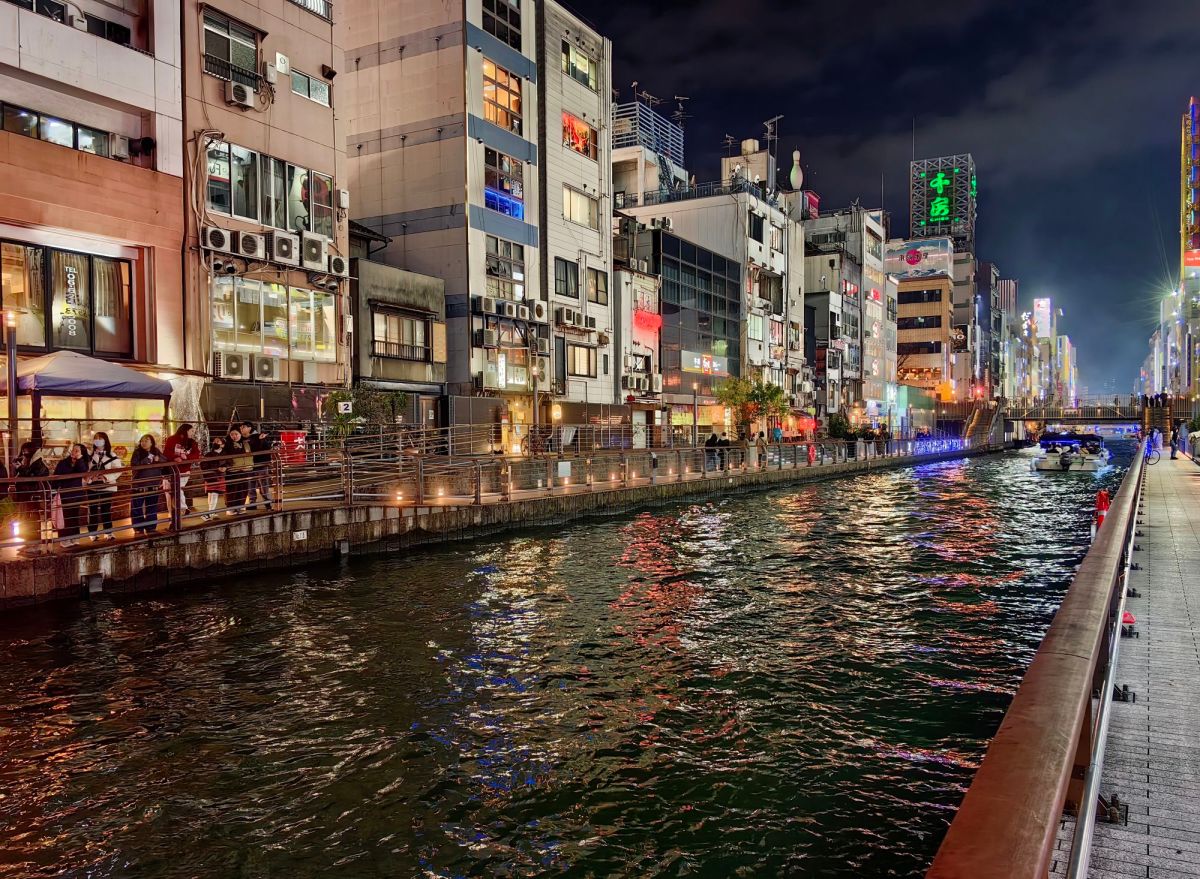
Stepping out of the airport, I was filled with a quiet sense of excitement and anticipation. For my stay in Osaka, I chose a hotel within walking distance of Dotonbori, the city’s most iconic entertainment and shopping district. Staying in the heart of the city meant that everything was only a short stroll away from lively shopping arcades and elegant department stores to countless restaurants serving Osaka’s celebrated local specialties.
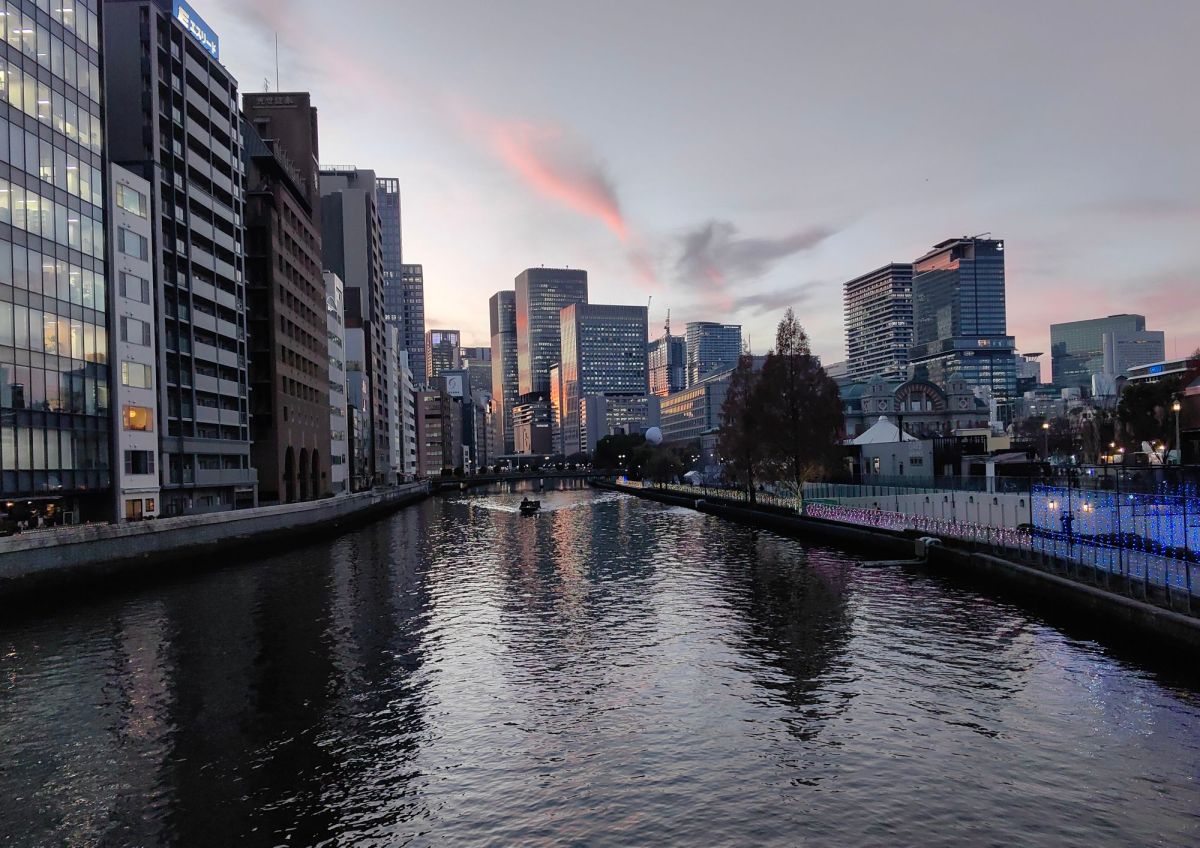
The canal that winds through the district was first excavated in the early Edo period, and over the centuries it has grown into one of Osaka’s most recognizable landmarks. Today, people from every corner of the world gather along its lively waterfront, soaking in the city’s infectious energy and colorful street life. Standing beside the historic canal on my very first evening in Japan, I felt that there could hardly have been a better place to begin my journey.
No visit to Osaka would be complete without tasting takoyaki, the city’s most iconic street food and a dish that perfectly captures its lively culinary culture. As I wandered through the bustling streets of Dotonbori, the irresistible aroma of batter sizzling on hot iron griddles filled the air, drawing people towards the countless food stalls lining the streets. Freshly prepared before my eyes, the takoyaki emerged as perfectly round, golden-brown balls with a crisp, lightly toasted exterior. Each one was filled with tender pieces of octopus, finely chopped green onions and crunchy tempura flakes, then generously topped with savory takoyaki sauce, creamy Japanese mayonnaise, a sprinkle of seaweed powder, and delicate bonito flakes that danced in the rising heat. It looked really delicious.
From the very first bite, I understood why takoyaki has become synonymous with Osaka. I instantly fell in love with it. The crisp outer layer has a soft, creamy centre that was almost molten. The tender octopus added a satisfying chewiness, while the savory sauce and fragrant toppings brought every bite together in a perfect harmony.
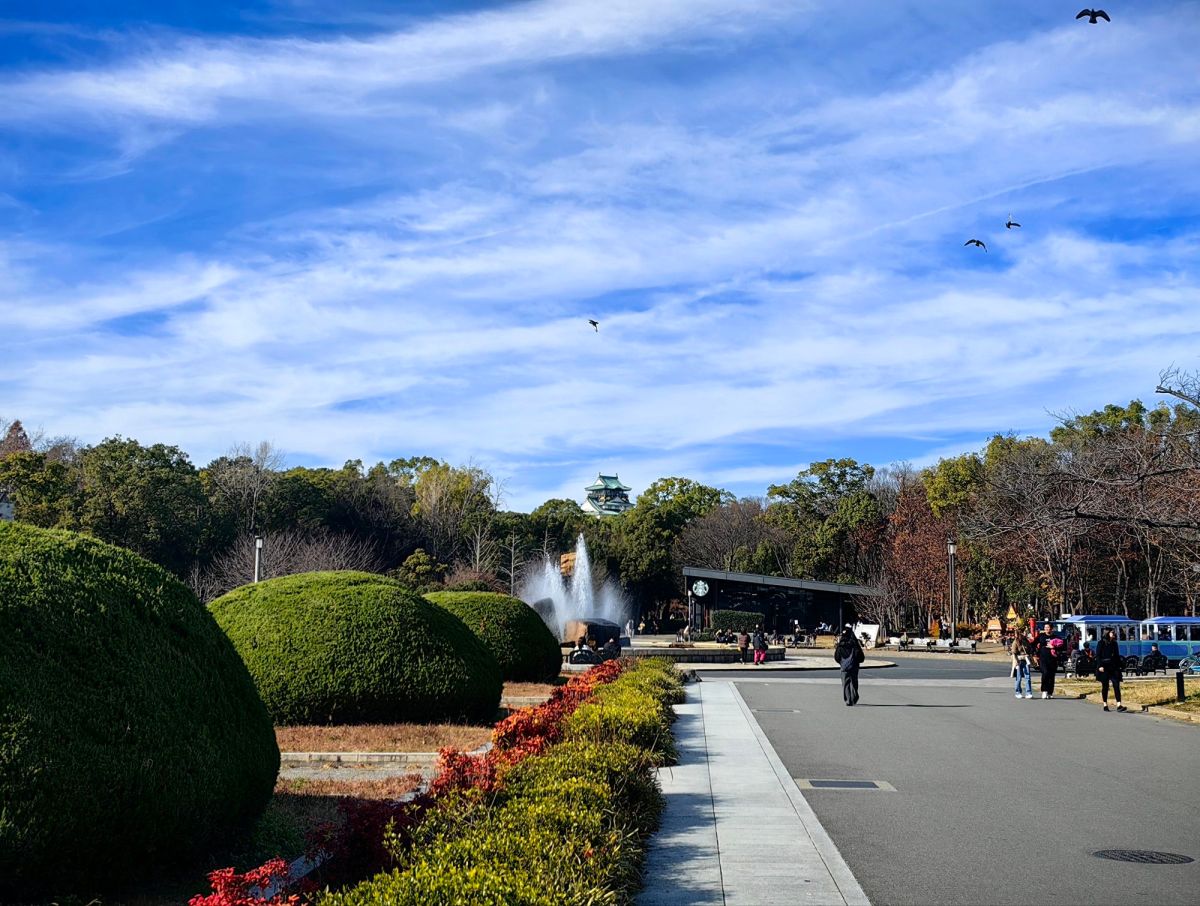
One of the highlights of my journey was my visit to Osaka Castle Park, a vast green oasis surrounding one of Japan’s most celebrated landmarks. In the heart of the bustling city, the park offered a welcome sense of tranquility. Although it was winter, the park possessed a quiet charm of its own. The crisp air, the stillness of the grounds, and the gentle rustle of bare branches invited me to slow my pace and savor the moment. As I approached the castle, the magnificent white-and-green keep gradually emerged above the treetops. Framed by the surrounding greenery and rising proudly above its massive stone foundations, it was an unforgettable sight.
The exterior of Osaka Castle is both elegant and majestic, making it one of Japan’s most recognizable landmarks. Rising above its immense stone foundations, the castle’s brilliant white walls stand in striking contrast to its emerald-green roofs, which are adorned with shimmering gold decorations that gleam in the sunlight. Perched at the corners of the rooftops are magnificent gilded shachihoko (mythical creatures with the head of a tiger and the body of a carp). According to Japanese tradition, these legendary guardians possess the power to summon water and protect buildings from fire.
Beyond its beauty, Osaka Castle occupies a central place in Japanese history. It was originally built in 1583 by the powerful warlord Toyotomi Hideyoshi, who sought to unify Japan after more than a century of civil war during the Sengoku Period (1467–1615). Designed as the political and military headquarters of the Toyotomi clan, the castle became one of the largest and most formidable fortresses in the country. Its massive stone walls, broad moats, and strategic location reflected Hideyoshi’s ambition to establish a unified Japan under his rule. Although the present castle is a modern reconstruction completed in 1931 and later restored, it faithfully preserves the appearance of Toyotomi Hideyoshi’s original masterpiece.
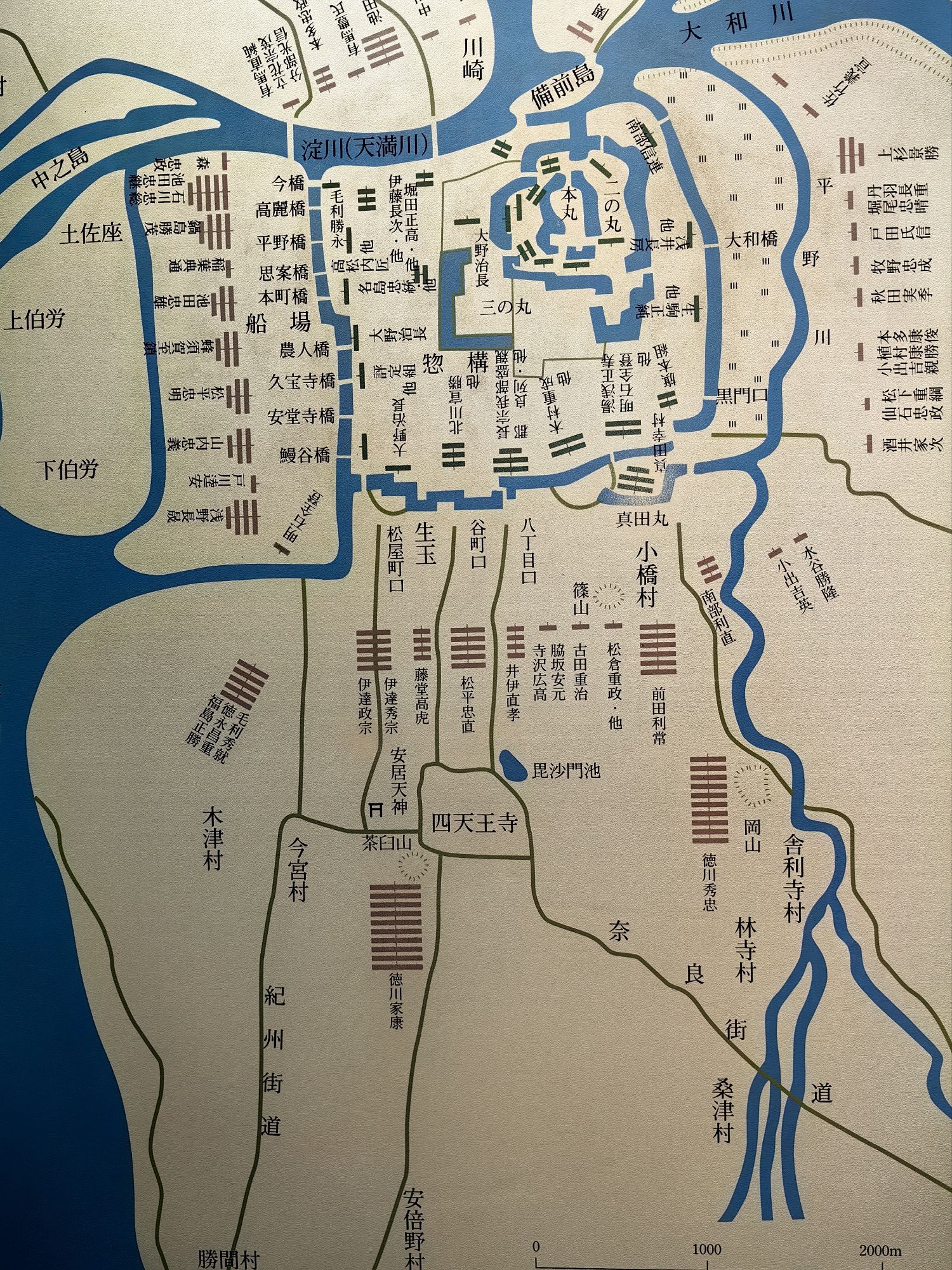
The castle now becomes a museum displaying the model of this castle and the history of that period and narrating the ebb and flow of that period. I like to play games like Nobunaga’s Ambition and familiar with the history of Sengoku Period so I really enjoyed the immersive travel experience here as if I visited that period by myself. The castle also witnessed the dramatic conclusion of the Sengoku era. Following Hideyoshi’s death, tensions between the Toyotomi clan and Tokugawa Ieyasu escalated into the Siege of Osaka in 1614 and 1615. Standing on this castle, I could observe clearly the outline of the whole war field around this castle. I imagined the decisive battle determining Japan’s fate, once took place fiercely here.
Following the death of Toyotomi Hideyoshi, his young son and heir, Toyotomi Hideyori, remained in Osaka Castle, while Tokugawa Ieyasu, victorious at the Battle of Sekigahara in 1600, had already emerged as the most powerful political figure in Japan. Although the Toyotomi clan still possessed immense wealth and the formidable defences of Osaka Castle, Ieyasu regarded them as the final obstacle to bringing the entire country under Tokugawa rule. This rivalry would ultimately culminate in the Siege of Osaka, one of the most decisive conflicts in Japanese history, marking the end of the Toyotomi clan and the beginning of more than two and a half centuries of Tokugawa shogunate rule.
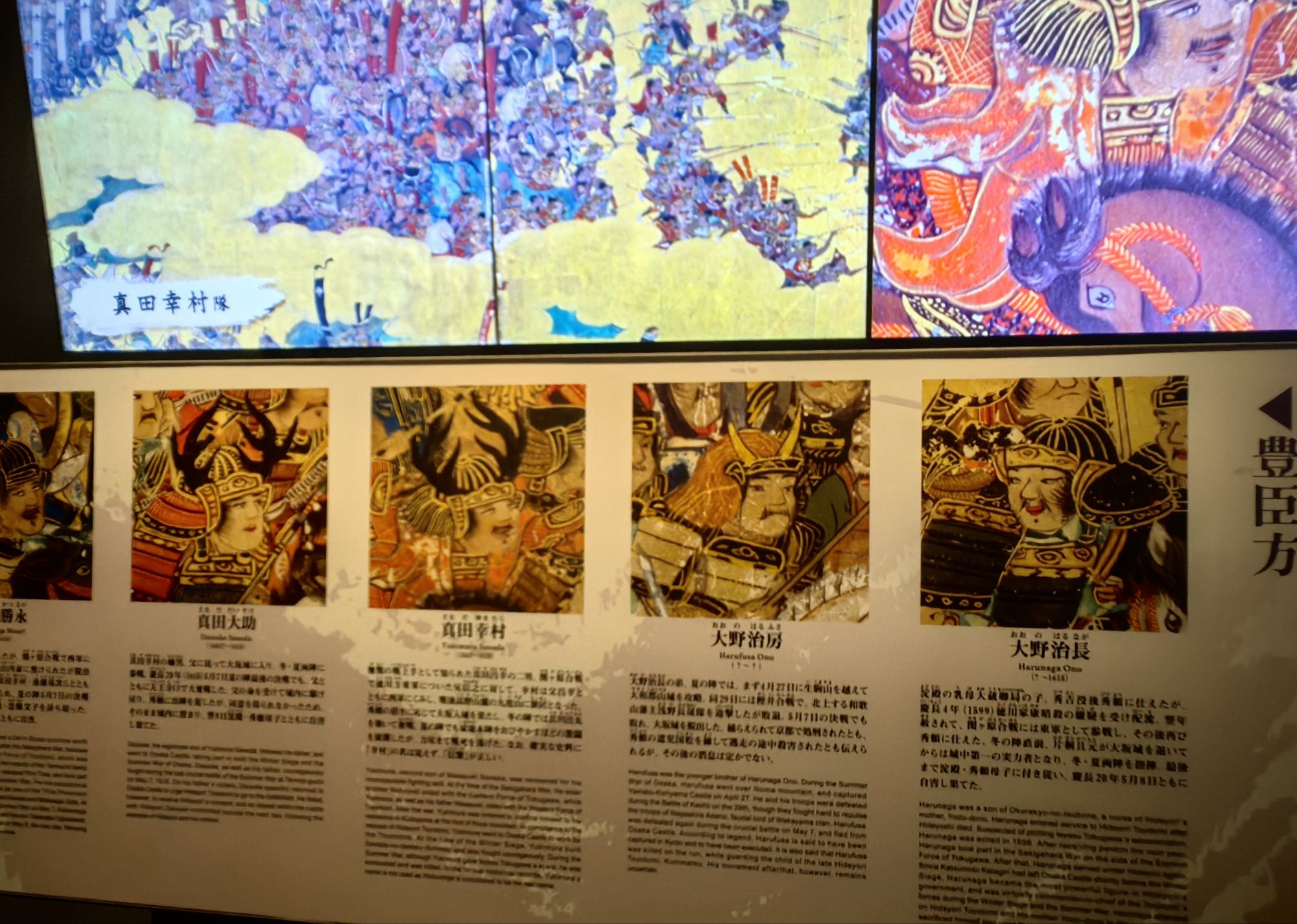
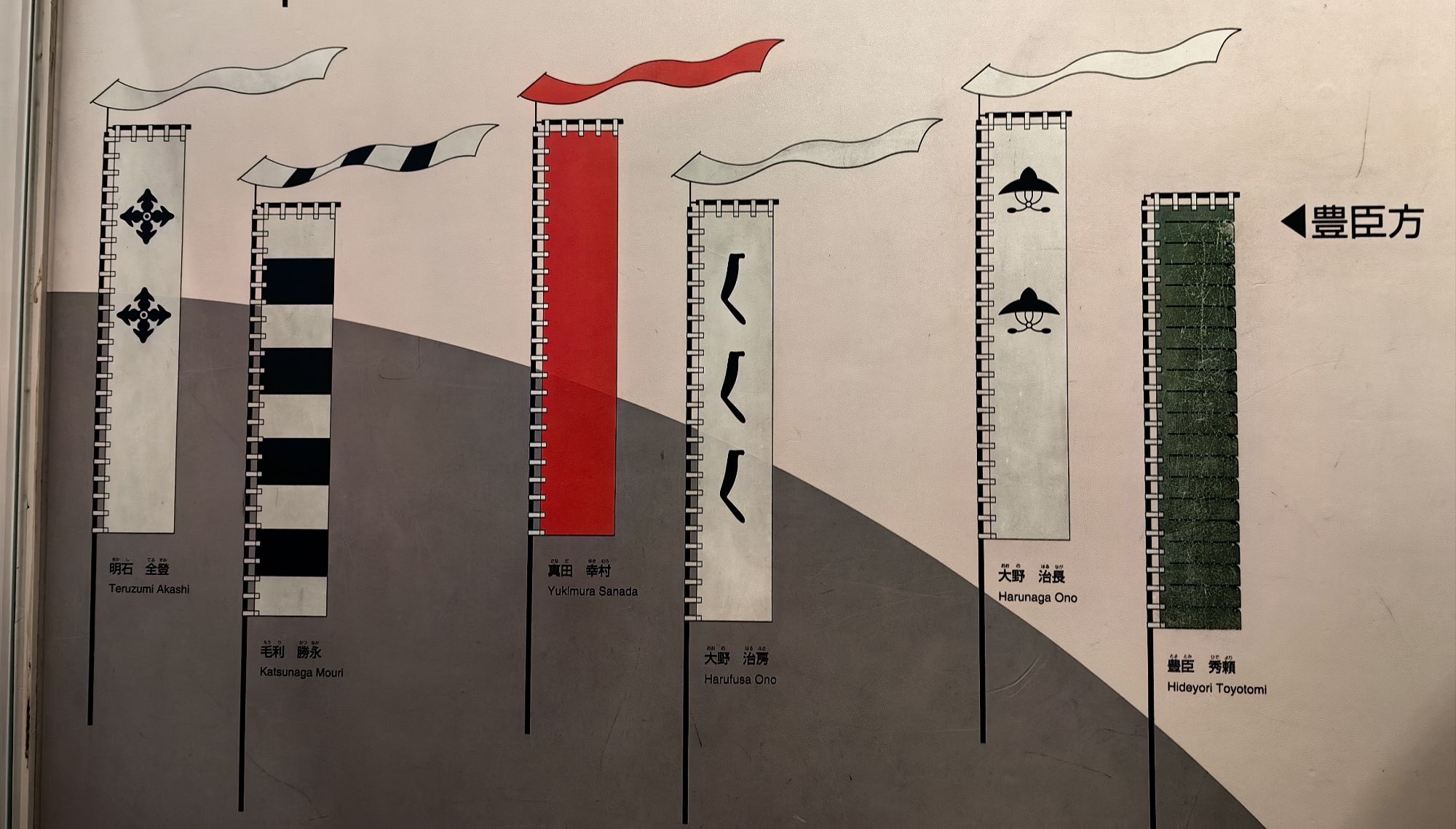
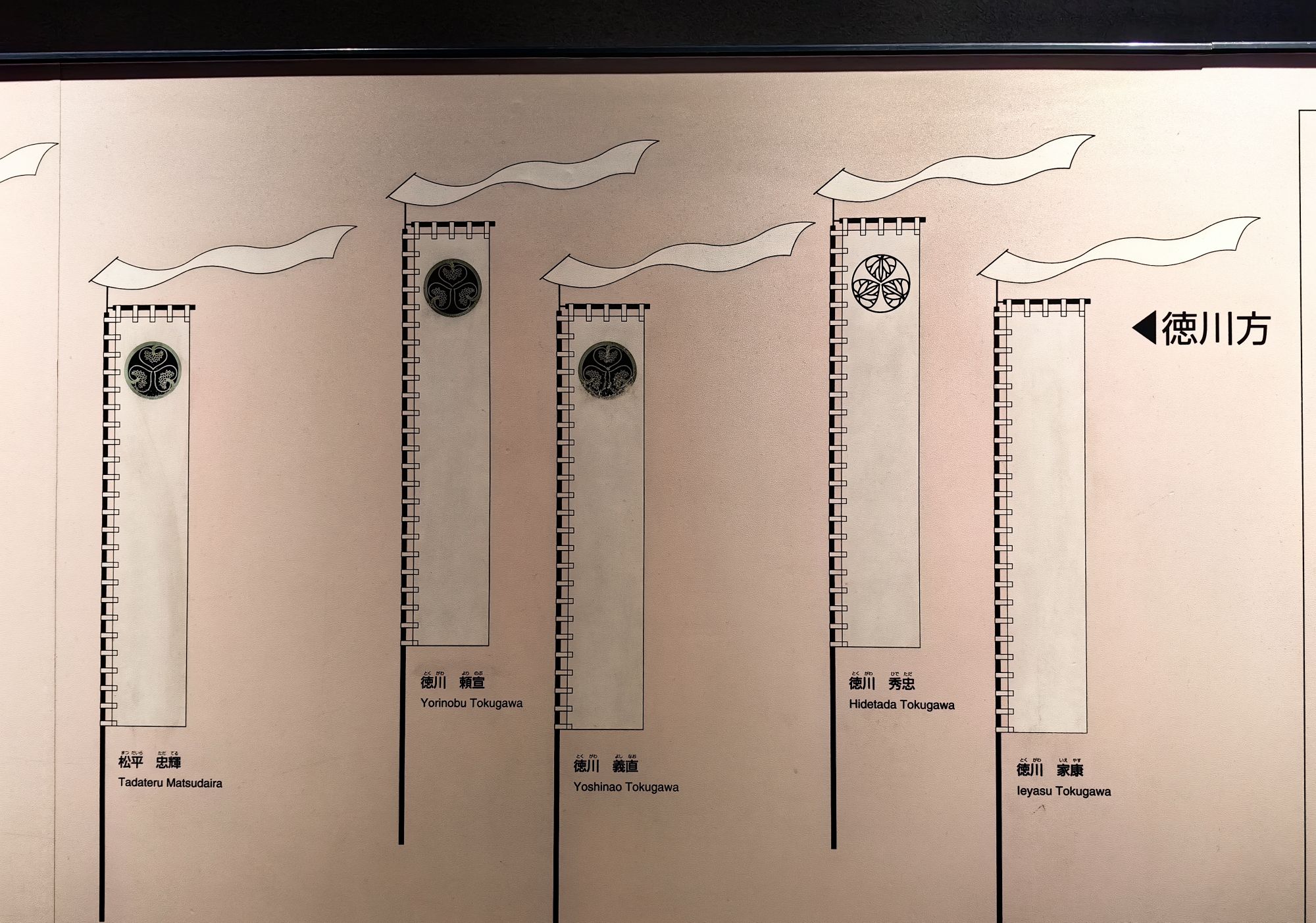
Today, the castle serves not only as one of Osaka’s most famous landmarks but also as a fascinating museum that brings this dramatic chapter of history to life. As I explored its galleries, I found detailed exhibits dedicated to Hideyori’s loyal generals, their armour and weapons, and the distinctive battle standards that once identified their armies on the battlefield.
In the winter of 1614, Tokugawa Ieyasu personally led a vast army to lay siege to Osaka Castle. Rather than relying solely on brute force, he combined overwhelming military strength with calculated strategy to break down the defenders’ resistance. The Winter Campaign ended in a negotiated truce, but the agreement came at a heavy cost for the defenders. Under its terms, the Tokugawa forces dismantled much of the castle’s outer fortifications and filled in large sections of its protective moats, leaving what had once been an impregnable fortress dangerously exposed.
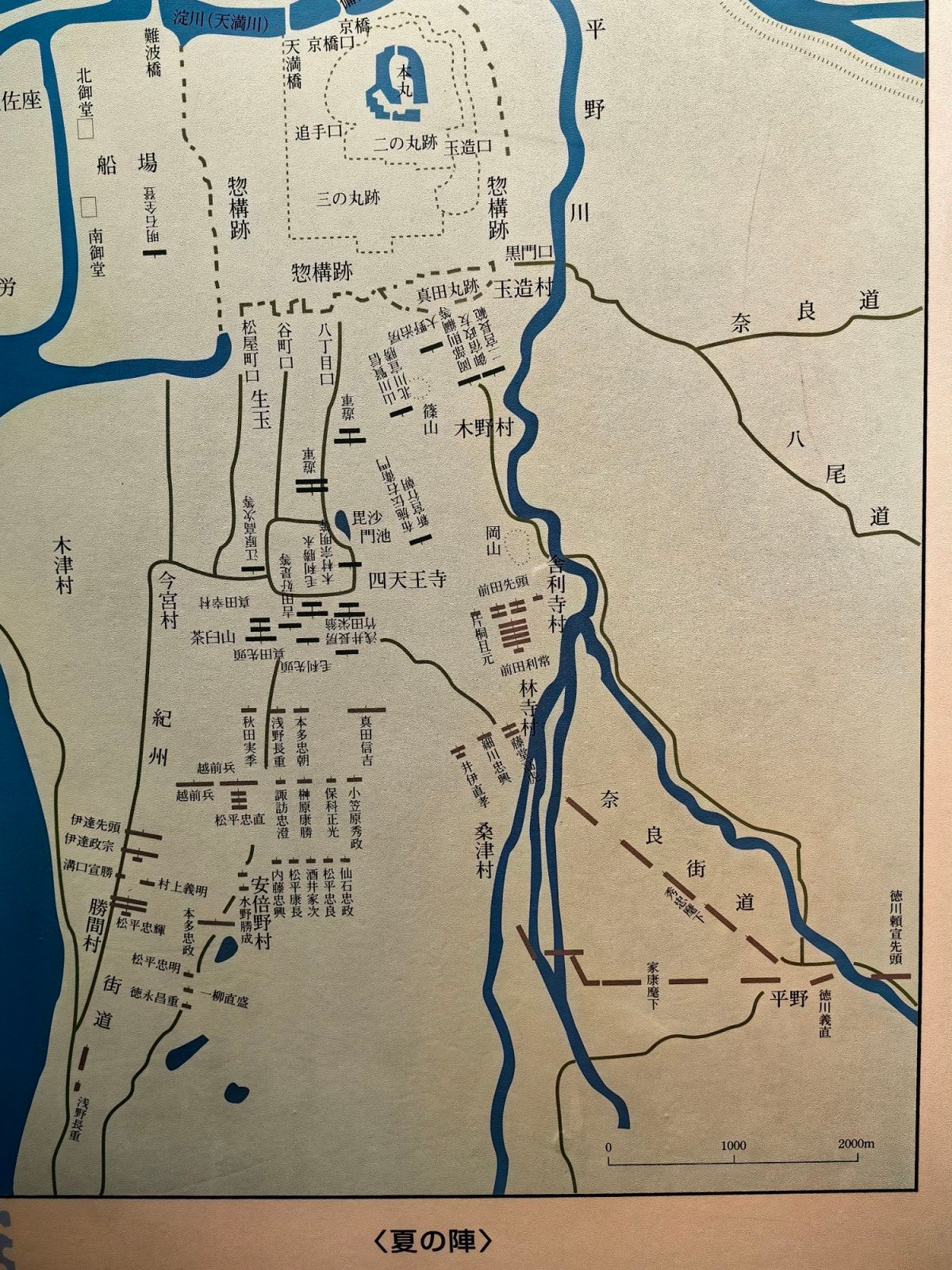
When hostilities resumed during the Summer Campaign of 1615, the balance of power had shifted decisively. Tokugawa’s forces launched a final offensive that overwhelmed the Toyotomi defenders. Osaka Castle fell, and Toyotomi Hideyori died within the castle, bringing the Toyotomi lineage to an end. With that victory, Tokugawa Ieyasu secured control of Japan, ushering in more than 260 years of peace and stability under the Tokugawa shogunate.
The third floor of the castle museum vividly recounts these two historic campaigns. Through detailed battle maps, scale models, and illustrated displays, I could follow the movements of both armies and understand how the siege unfolded step by step. The historical maps depicted Osaka as it appeared more than four hundred years ago, yet many familiar place names have survived to the present day. Among them was Shitennō-ji, one of Japan’s oldest Buddhist temples. Seeing a name that still exists on a map from the early seventeenth century made history feel remarkably tangible.
Several renowned Tokugawa commanders played pivotal roles in the Siege of Osaka. Among them was Ii Naotaka, commander of the legendary “Red Devils” cavalry. Famed for the striking crimson armor worn by his warriors, he led his troops with distinction during the campaign and later became one of the Tokugawa shogunate’s most trusted daimyō. Another prominent figure was Honda Tadatomo, the son of the celebrated warrior Honda Tadakatsu, who was widely regarded as one of the greatest generals of his age. Tadatomo earned recognition for his courage and capable leadership on the battlefield, continuing the military legacy of his distinguished family.
Also fighting on the Tokugawa side was Date Masamune, the powerful lord of Sendai. Easily recognized in portraits by his distinctive crescent-moon helmet, Masamune contributed a substantial force to the Tokugawa coalition while maintaining his reputation as one of the most charismatic and influential daimyō of the era. Seeing these familiar names in the museum exhibits brought the history of the siege vividly to life, transforming what I had once known only from books into the stories of real people who chose their fate in the course of Japan’s history.
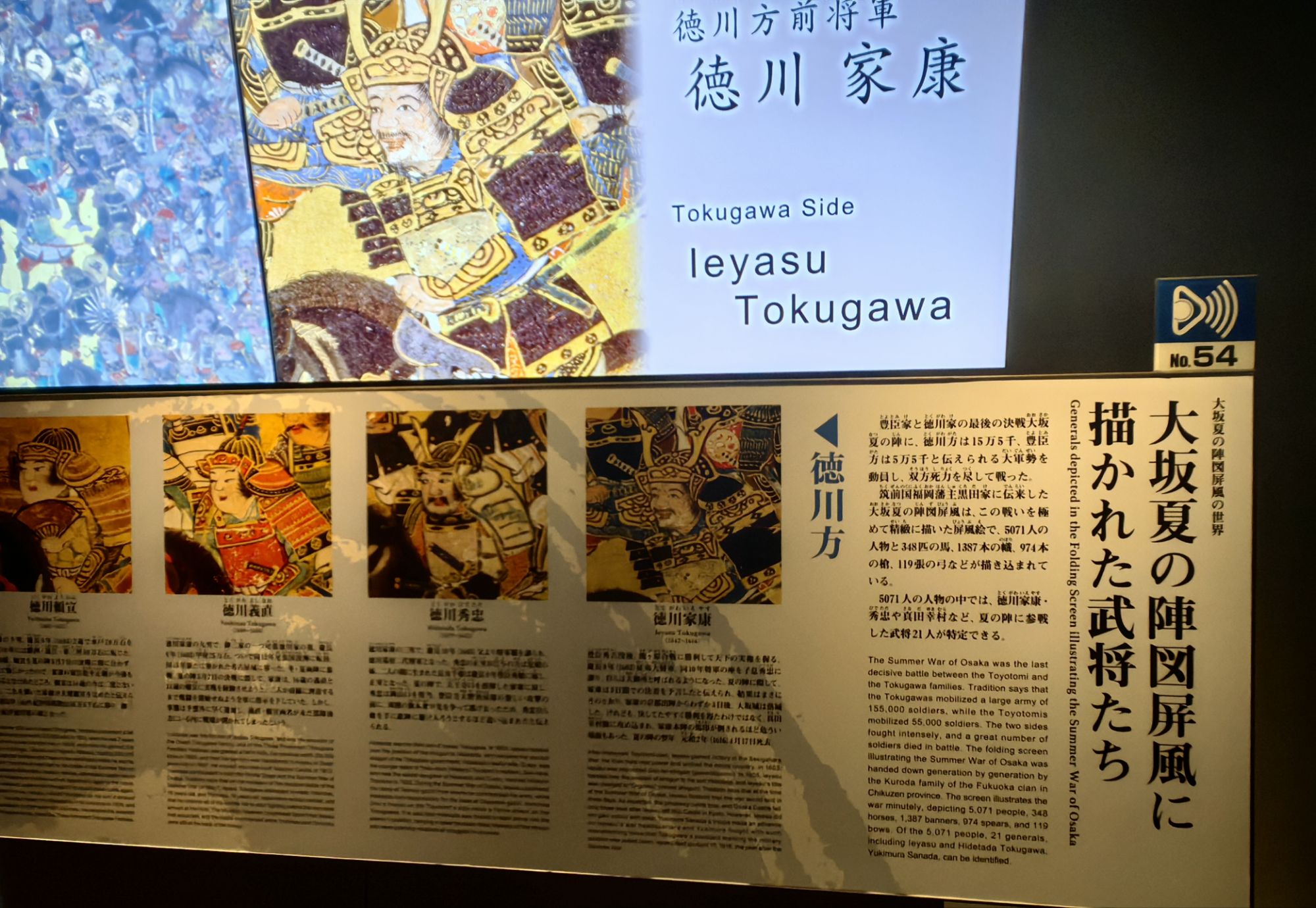
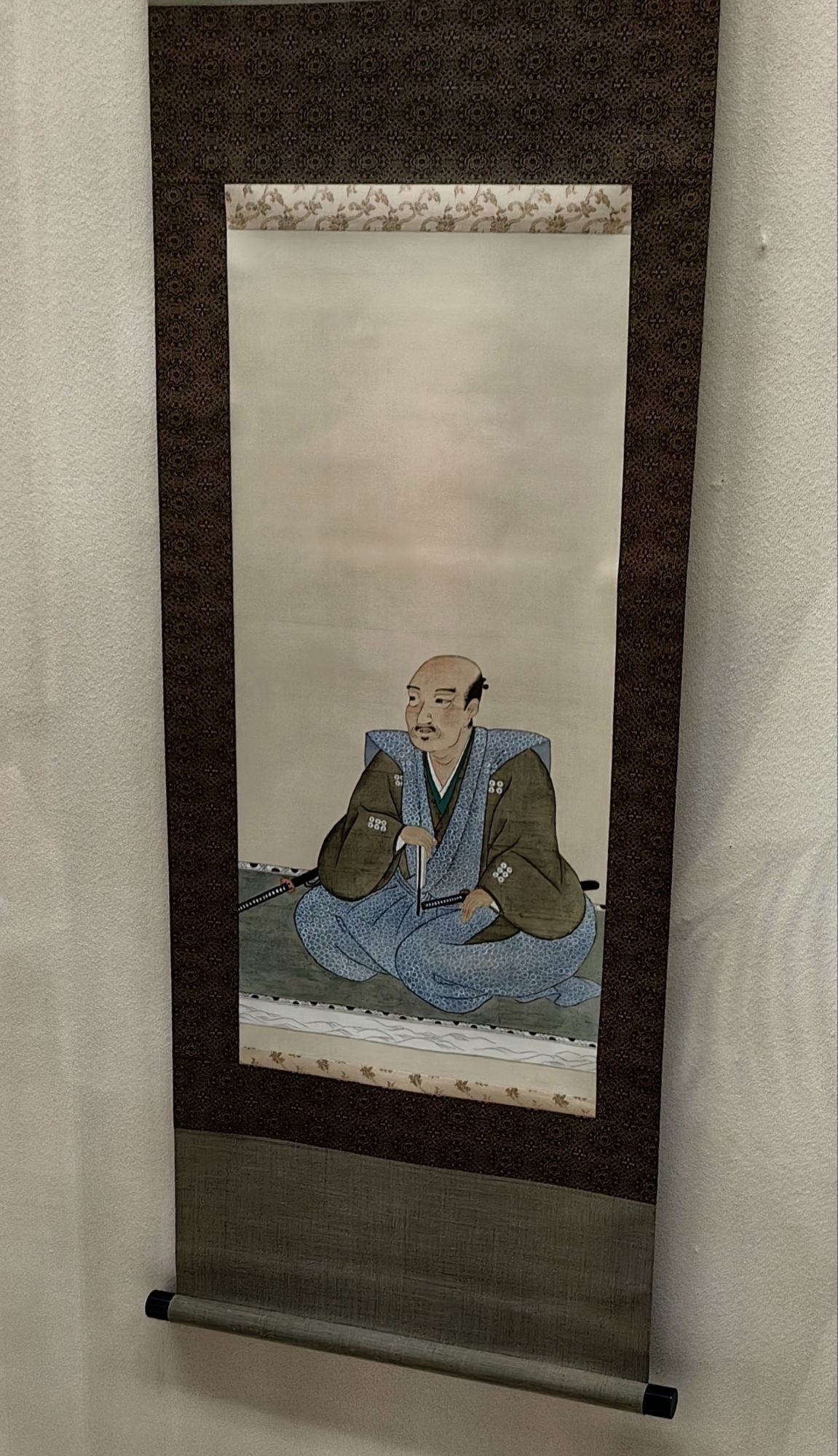
This is the portrait of Tokugawa Ieyasu who was the winner of this war. The victory at Osaka eliminated the final military challenge to Tokugawa authority. With the Toyotomi clan destroyed, Tokugawa Ieyasu secured the foundation of the Tokugawa Shogunate, which would govern Japan for more than 250 years. Walking through Osaka Castle today, it is remarkable to think that these peaceful grounds once witnessed the battle that ended the Age of Warring States and ushered in one of the longest periods of peace in Japanese history.
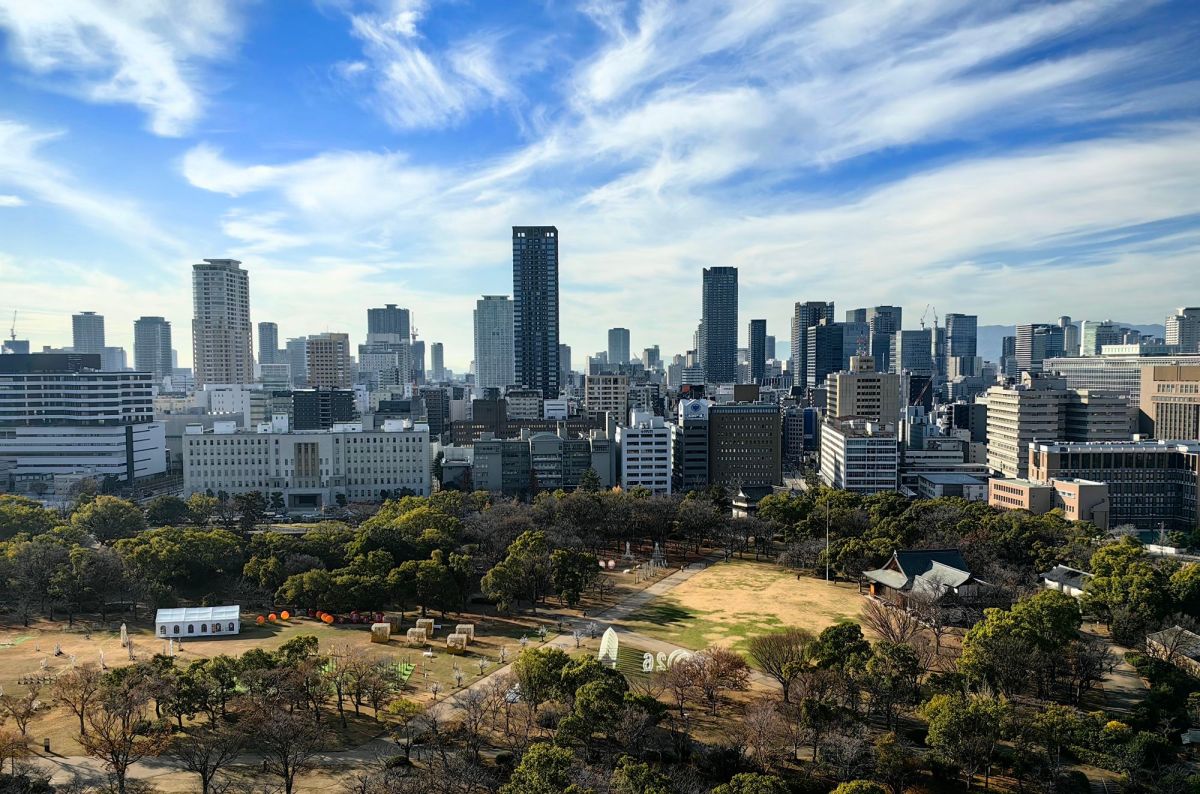
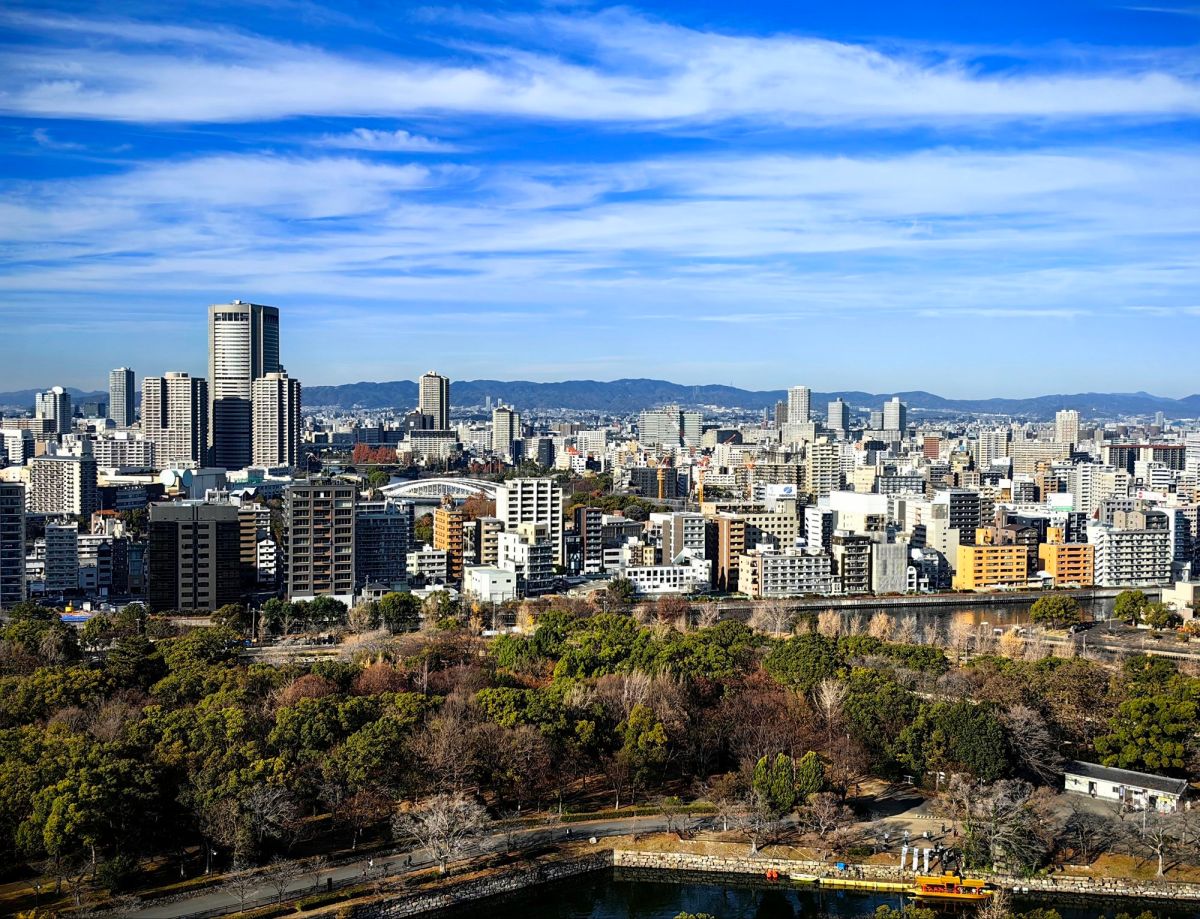
After exploring the castle museum, I made my way to the observation deck at the top of Osaka Castle. From there, a breathtaking panorama unfolded in every direction. The skyline stretched endlessly towards the horizon, where countless skyscrapers, office towers, apartment blocks, and commercial buildings formed a vast sea of steel and glass. The city seemed to pulse with life, its modern skyline standing in striking contrast to the centuries-old castle beneath my feet.
Looking out across the sprawling cityscape, I could truly appreciate how Osaka has evolved over the centuries. What was once a castle town of samurai residences, merchant quarters, and narrow streets has grown into one of Japan’s largest and most dynamic metropolitan centres, home to millions of people. Yet despite its remarkable transformation, Osaka Castle still stands proudly at the heart of the city, serving as a timeless reminder of the events that shaped its history.
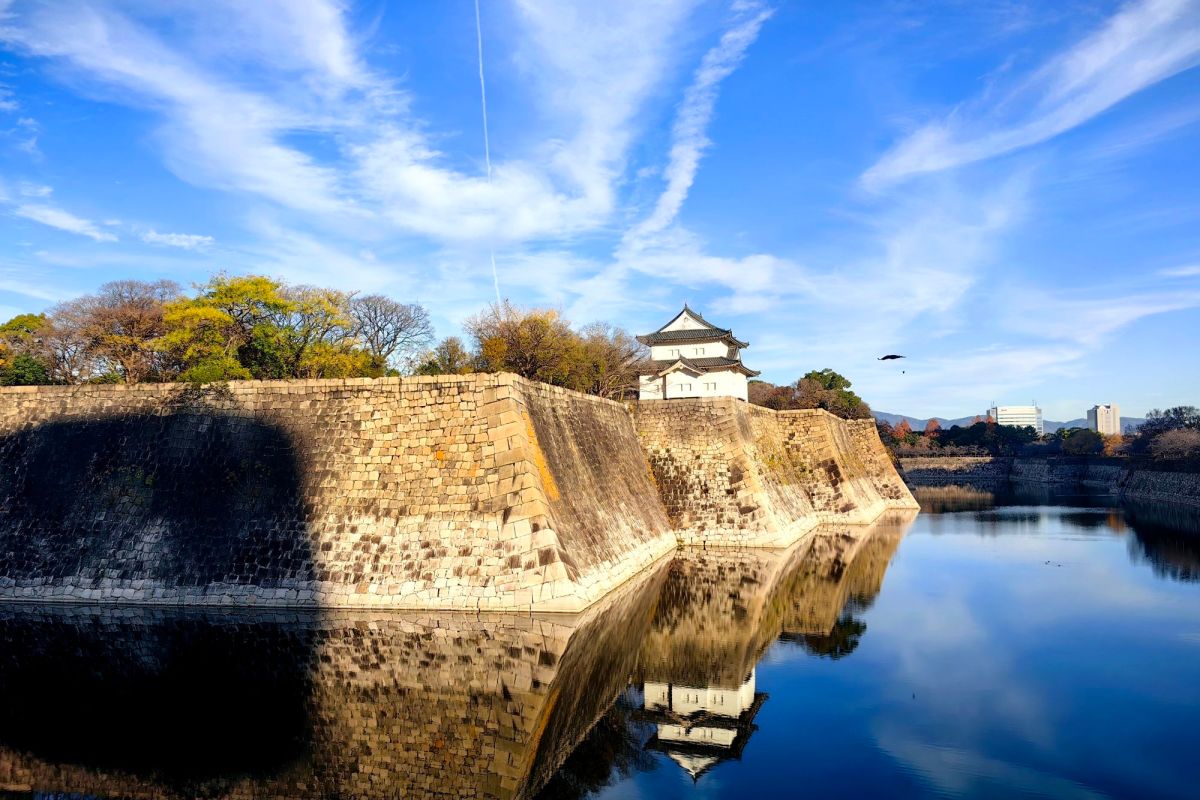
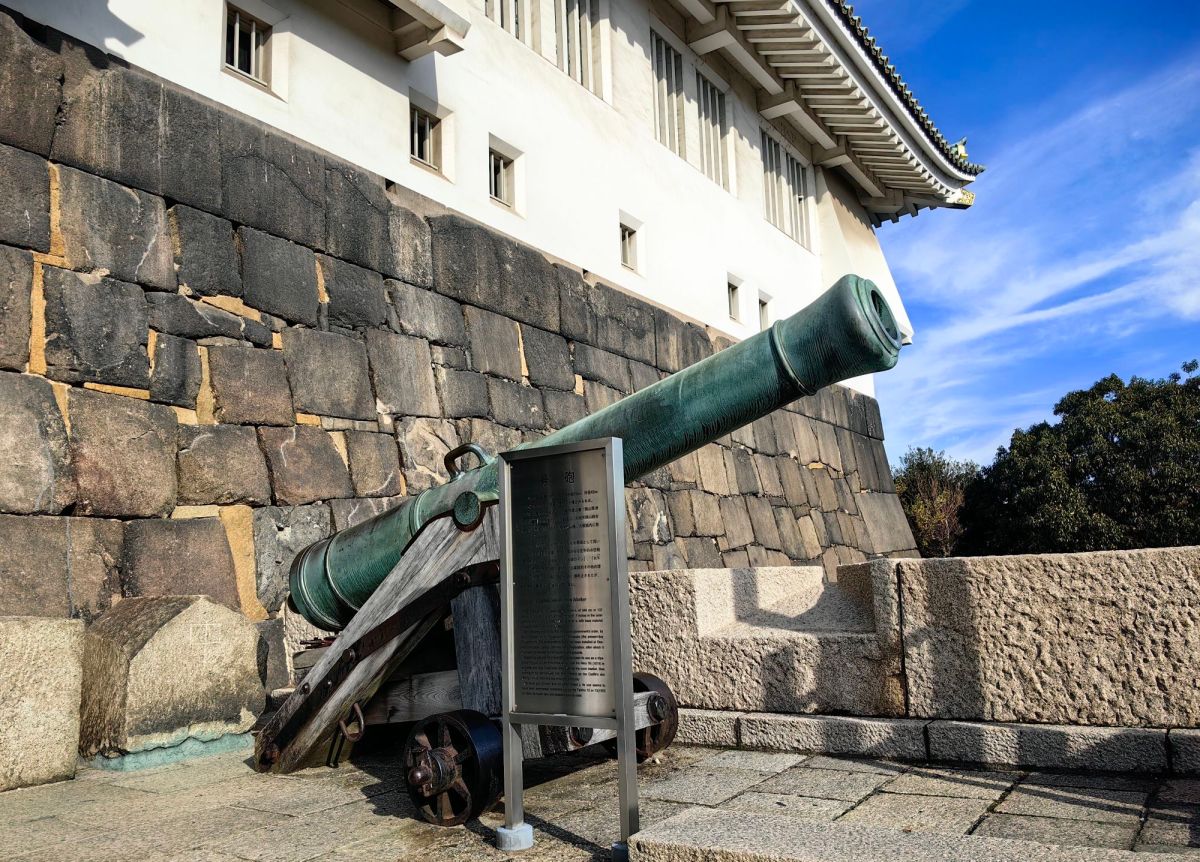
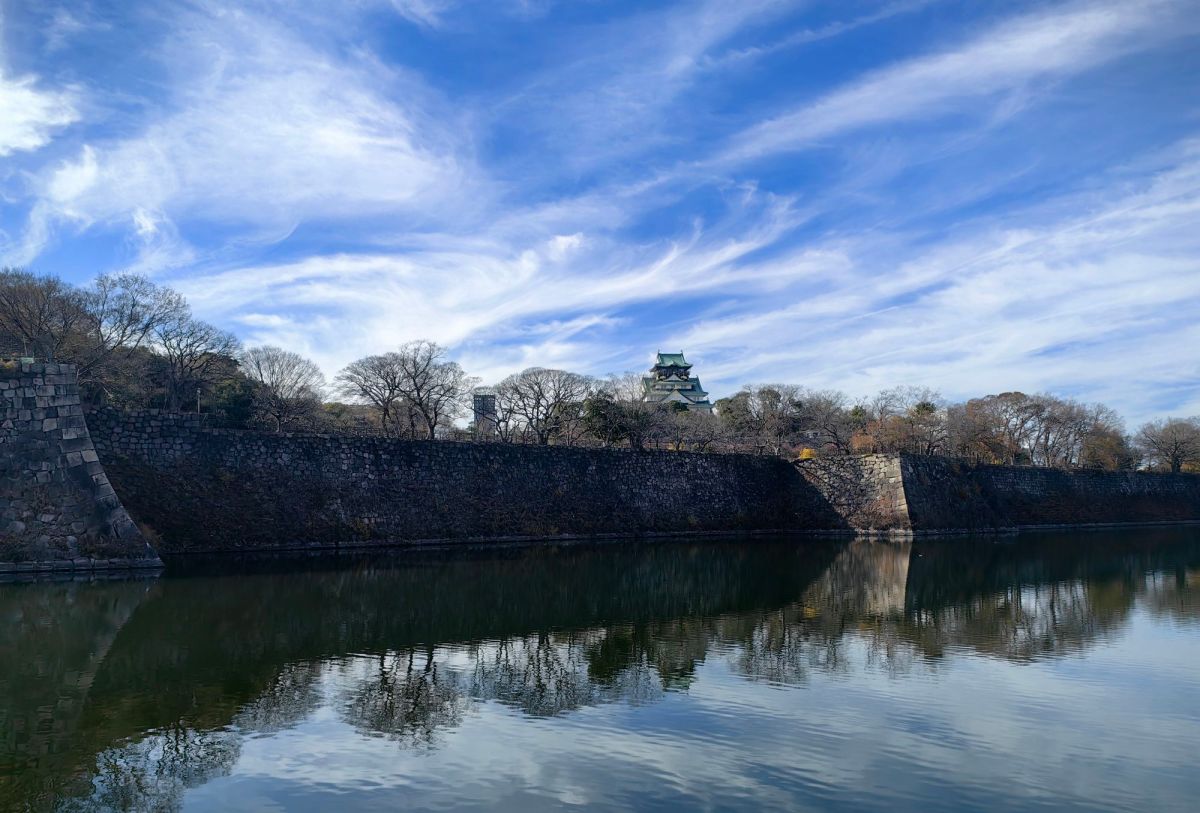
Standing within Osaka Castle Park today, it was difficult to imagine that these peaceful grounds had once witnessed some of the most decisive battles in Japanese history. I also walked around the outer grounds of the castle, where its immense scale became even more apparent. The keep rises from an enormous stone foundation encircled by broad moats that once formed a formidable line of defence. Many of the granite blocks used to construct the massive walls are among the largest ever quarried, transported, and assembled in Japan.
Viewed from across the moat, the castle appeared especially magnificent. It seemed to emerge naturally from its colossal granite base, while its brilliant white walls and emerald-green roofs, adorned with gleaming gold ornaments, shone vividly beneath the pale winter sky. The calm water reflected the castle’s graceful silhouette, creating a scene of quiet beauty.
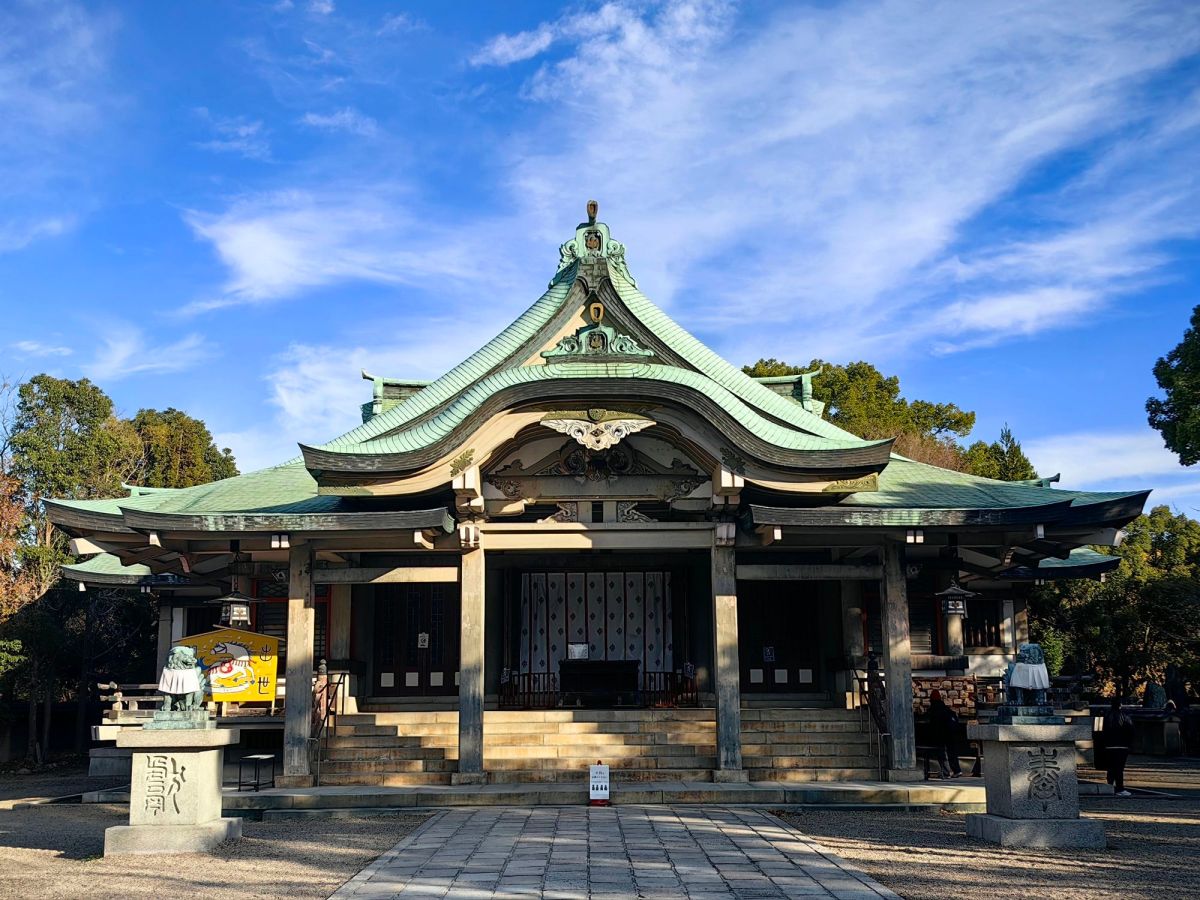
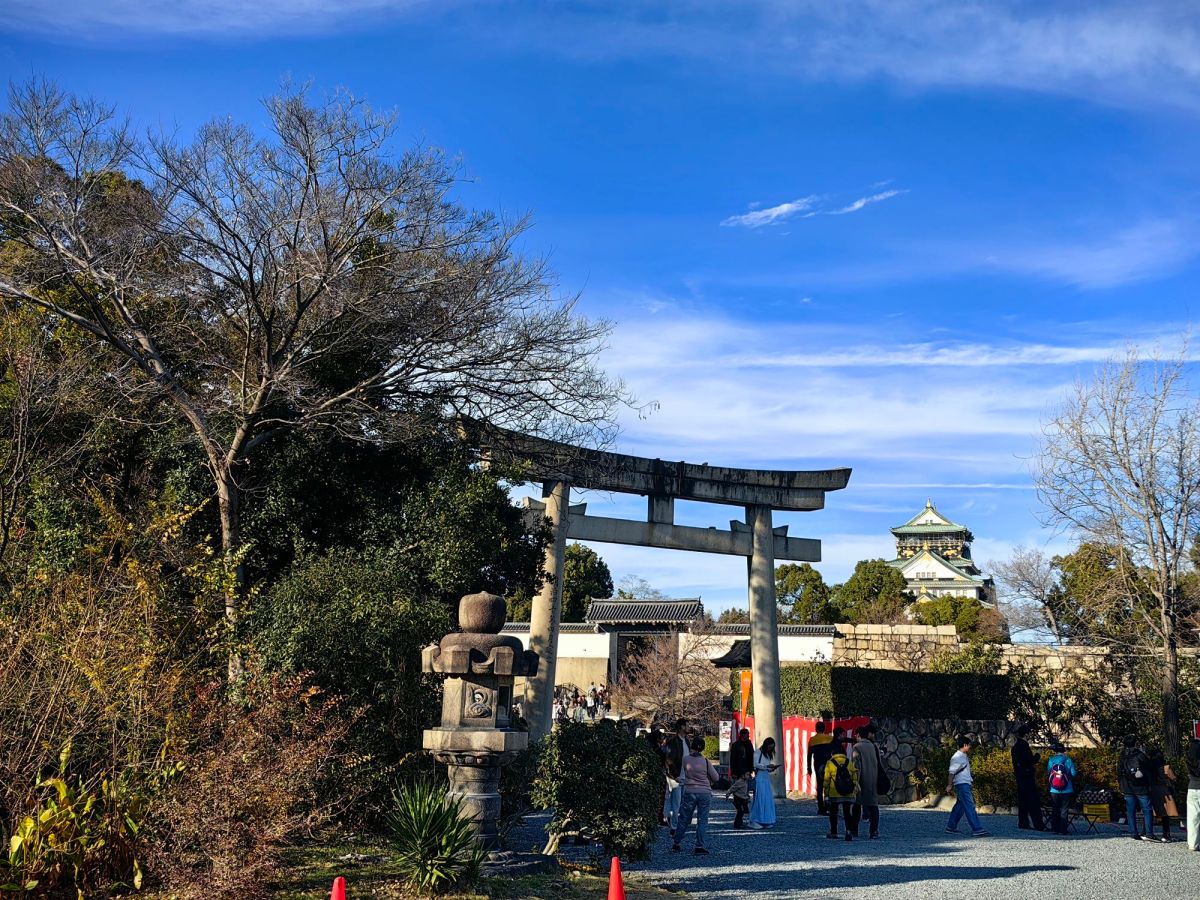
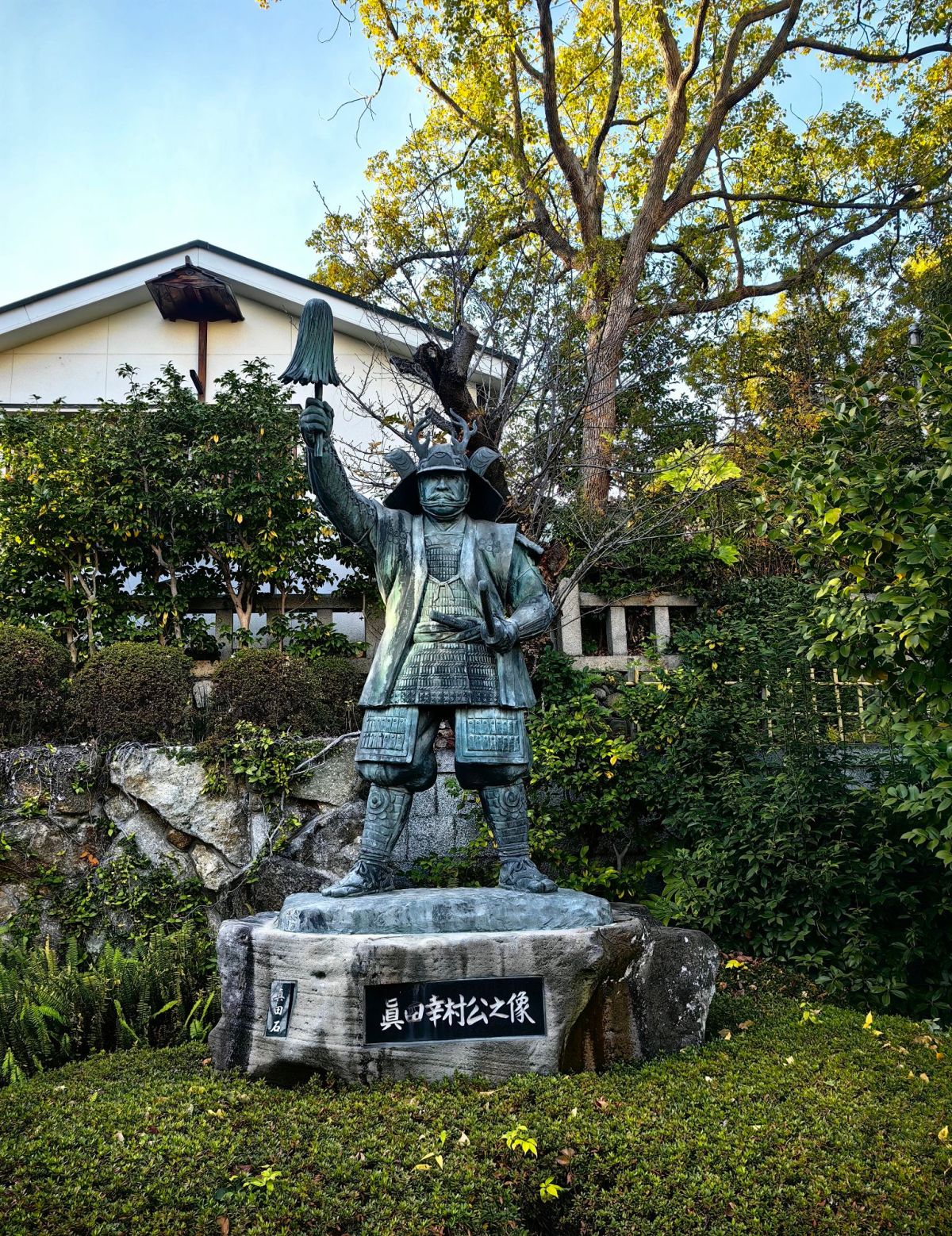
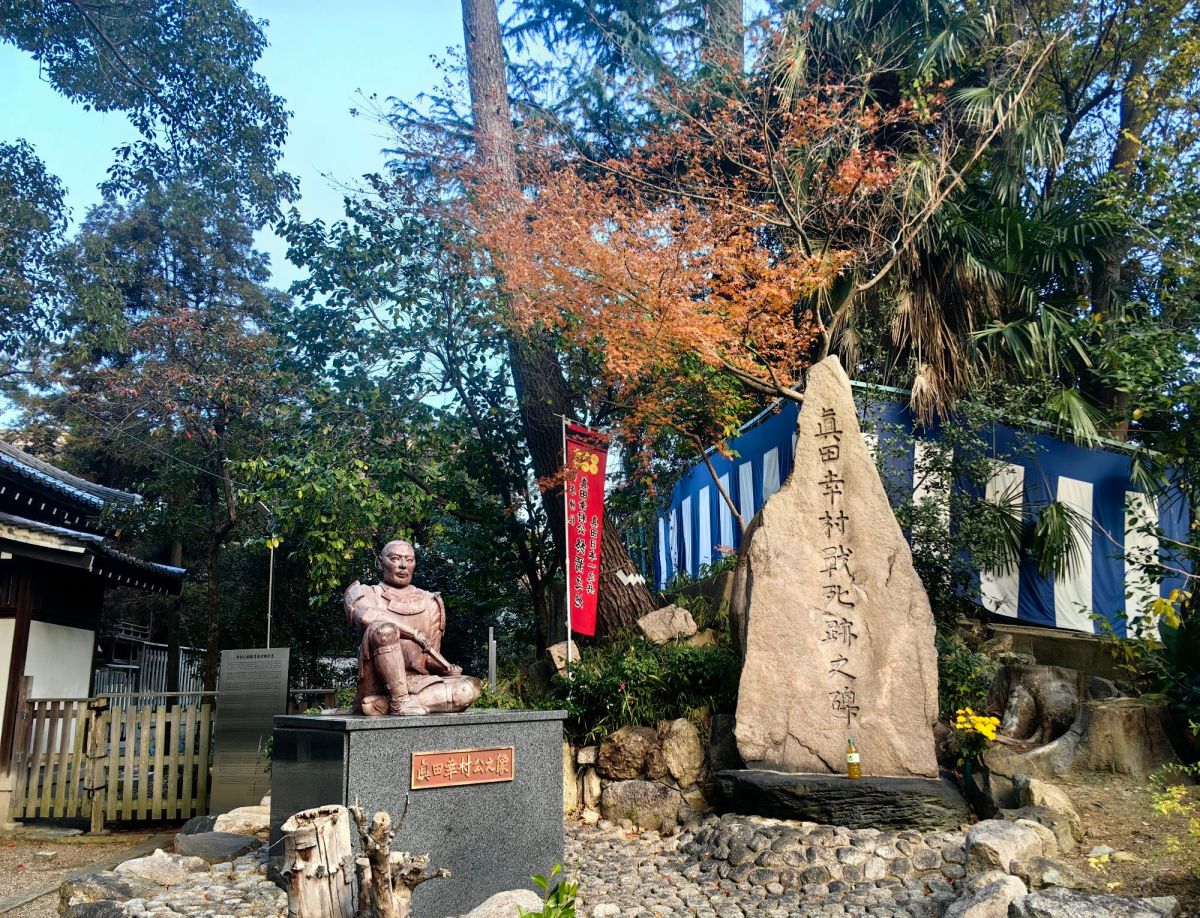
A short walk from Osaka Castle stands Hokoku Shrine, a peaceful Shinto shrine dedicated to Toyotomi Hideyoshi. In front of the shrine stands a striking bronze statue. He is portrayed in formal samurai attire, standing confidently with one hand resting on the hilt of his sword and the other holding a military command baton, symbolizing his authority as one of Japan’s greatest strategists and unifiers. Toyotomi Hideyoshi is a real legend in Japanese history. He rises from humble origins as the son of a peasant to become the most powerful man in Japan. Few figures in Japanese history experienced such a remarkable ascent and obtained such an achievement.
The shrine commemorates not only Toyotomi Hideyoshi, but also members of the Toyotomi family whose efforts contributed to the unification of Japan. Although the Toyotomi political legacy came to an end with the fall of Osaka Castle during the Siege of Osaka, Hideyoshi’s influence on the course of Japanese history remains profound. His military achievements brought an end to more than a century of civil war and laid the foundations for the peaceful Edo period that followed. As I stood before the shrine, I found myself reflecting on the fate of the Toyotomi clan.
In my view, Toyotomi Hideyori’s defeat was not simply the result of a single mistake made during the Siege of Osaka. Rather, its roots can be traced to decisions made years earlier by his father. Although Hideyoshi succeeded in unifying Japan, he did not establish a political system strong enough to endure after his own death. His heir, Hideyori, was still a child and lacked an effective institutional framework to protect his position. At the same time, Tokugawa Ieyasu remained the most powerful daimyō in the country, commanding unrivalled military resources and political influence. Hideyoshi’s costly invasions of Korea also placed a heavy burden on the nation and weakened support for the Toyotomi government. Finally, the stability of his regime depended largely on the personal loyalty of the Council of Five Elders rather than on enduring political institutions. Once Hideyoshi was gone, those personal bonds quickly unraveled, allowing Ieyasu to consolidate power.
History rarely turns on a single battle or a single decision. As I left the shrine, I felt that the fall of the Toyotomi clan was the culmination of choices made over many years. It’s a reminder that lasting political success depends not only on military brilliance, but also on building a mature institution capable of surviving the ambitions and lifetimes of individual leaders.
After leaving Osaka Castle Park, I made my way to Sankō Shrine, a quiet shrine best known for its association with the legendary samurai Sanada Yukimura, one of the most celebrated warriors of Japan’s Sengoku era. The shrine is dedicated to the Shinto deities Amaterasu, Tsukuyomi, and Susanoo. Yet for many visitors, its greatest attraction is the “Sanada’s Escape Tunnel.” According to local tradition, this mysterious underground passage once connected the Sanada Maru which is the fortified stronghold defended by Yukimura during the Siege of Osaka.
The shrine also features a bronze statue of Yukimura and is a popular destination for visitor like me who is interested in Japan’s Sengoku-era history. Born into the Sanada clan, Yukimura was the son of Sanada Masayuki, a skilled strategist. After the decisive Battle of Sekigahara in 1600, Yukimura was defeated for supporting the Western Army (Toyotomi clan) and were exiled to Kudoyama at the foot of Mount Koya, where they spent more than ten years in seclusion.
In 1614, the Siege of Osaka broke out. At the invitation of Toyotomi Hideyori, Sanada Yukimura left his exile and entered Osaka Castle, joining the Toyotomi army and shouldering the heavy responsibility of resisting Tokugawa Ieyasu. In the Siege of Osaka from 1614 to 1615, he led the defending troops in valiant fighting, becoming one of the most representative heroes of the Toyotomi clan’s last resistance against the Tokugawa Shogunate.
This photo was taken in the place near Yasui Shrine where Yukimura Sanada lost the final battle. He earned lasting fame through his brilliant leadership during the Siege of Osaka. He designed and defended the Sanada Maru, a fortified outwork that successfully repelled repeated Tokugawa attacks during the Winter Siege of 1614. During the Summer Siege in 1615, he led a bold and desperate cavalry charge that came close to reaching Tokugawa Ieyasu himself before being overwhelmed and killed in battle.
The portrait of Yukimura Sanada in the Osaka castle museum
I found his portrait in the Osaka castle museum. Although the Toyotomi forces supported by Yukimura were finally defeated, his courage, tactical skill, and unwavering loyalty turned him into a legendary figure. Often called “the greatest warrior in Japan”, he has been immortalized in literature like ‘The Sanada Gunki’, television dramas like ‘Sanada Maru’, video games like Nobunaga’s Ambition, and local legends, making him one of the most famous and admired samurai in Japanese history.
As I wandered through the suburban streets of Osaka, I discovered a quieter side of the city, where everyday life unfolded at an unhurried pace. A network of narrow lanes, often barely wide enough for a single car, wound between rows of modest three-storey houses standing shoulder to shoulder. Small balconies were decorated with potted plants, bicycles rested casually against walls, and neatly arranged entrances reflected the quiet routines of daily life.
Walking through them felt like catching a glimpse of the Osaka that local residents experience every day, far removed from the bright lights and bustling crowds of the city centre. Towering utility poles lined the streets, forming one of the most distinctive features of Japanese residential neighborhoods. Countless power lines stretched from pole to pole, hanging in gentle curves overhead and weaving an intricate pattern against the sky. At first, the dense web of cables seemed almost chaotic, but the longer I looked, the more it became part of the city’s unique visual identity.
As evening approached and I made my way back to my hotel, Nakanoshima revealed a strikingly different side of Osaka from the quiet residential neighborhoods I had explored earlier. Situated on a long island between the Dojima and Tosabori Rivers, Nakanoshima is one of the city’s principal business and cultural districts, where broad boulevards, graceful bridges, and sleek skyscrapers combine to create a sophisticated urban skyline. Towering glass office buildings rose above the waterfront, their façades reflecting the fading colors of the winter sky as daylight gradually gave way to evening. The rivers mirrored the city lights, while the silhouettes of bridges stretched elegantly across the water, lending the district a calm yet cosmopolitan atmosphere.
Unlike the narrow lanes of the suburbs, Nakanoshima offered wide, tree-lined promenades and spacious riverside parks that invited me to slow down and enjoy the scenery. I strolled along the riverbanks, watching office workers, joggers, and couples passing by as the city settled into the evening. Within a single day, I had experienced the city’s historic heart, its peaceful residential streets, and its modern financial centre. Each revealed a different character of Osaka.
At night, the Dōtonbori Canal became one of Osaka’s most vibrant and recognizable urban landscapes. The waterway was bordered by a continuous wall of illuminated buildings, where enormous LED billboards, animated signs, and colorful advertisements reflected across the gently rippling surface of the canal. Both banks of the canal are lined with wide pedestrian promenades crowded with locals and visitors. Restaurants, izakayas and cafés spilled light and laughter onto the waterfront, while the enticing aromas of grilled seafood, ramen and freshly made takoyaki drifted through the air.
I enjoyed dinner at a restaurant by the canal, savoring Japan’s famous Wagyu beef yakiniku. Wagyu is renowned for its fine and marbling, melt-in-mouth tenderness, and rich, full-bodied flavor. Unlike Western steaks, Wagyu yakiniku is typically not served in whole, but rather sliced into thin pieces or bite-sized chunks, which diners grill themselves slowly over charcoal at their tables.
As the beef sizzled on the charcoal, the fine fat gradually melted, giving the slices an enticing sheen and releasing a rich aroma. When the outer layer slightly caramelized and turned golden brown, the inside remained tender and juicy. The grilled Wagyu, served with garlic, onions, and other vegetables, and dipped in a flavorful Japanese yakiniku sauce, offered a multi-layered and unforgettable experience with every bite.
Sitting by the canal, admiring the city lights reflected on the water’s surface while enjoying the steaming Wagyu yakiniku, I found a perfect way to conclude one day’s trip. On a cold winter night, this warm and sumptuous dinner became one of my most unforgettable culinary experiences upon arriving in Japan.
I stayed in Osaka for two days and visited several cultural places on the second day. Sumiyoshi Taisha is one of Japan’s oldest and most revered Shinto shrines. Founded in the 3rd century, before the introduction of Buddhism to Japan, the shrine is dedicated to the Sumiyoshi Sanjin, three deities believed to protect travelers, sailors, fishermen, and all who journey by sea. Because Osaka developed as an important port city, Sumiyoshi Taisha became a spiritual guardian for merchants, seafarers, and imperial envoys. Today, it remains the head shrine of more than 2,000 Sumiyoshi shrines across Japan.
The shrine is internationally renowned for its distinctive Sumiyoshi-zukuri architectural style, one of the oldest surviving forms of Japanese shrine architecture. Unlike many later shrines that incorporated Chinese and Buddhist influences, Sumiyoshi-zukuri preserves a purely indigenous and simple Japanese design. The four main sanctuary buildings stand in a straight line at the central axis, with elevated wooden floors, straight gabled roofs covered in cypress bark, crossed finials (chigi) projecting above the roof, and horizontal log weights (katsuogi) running along the ridge. The simple lines, natural wood, and elegant colors combine to create a rustic and dignified aesthetic, making one feel as if they have traveled back to the beginning of Japanese Shinto culture.
Among the shrine’s most recognizable landmarks is the graceful Sorihashi Bridge, often known as the Taiko Bridge because its elegant arch resembles the curved profile of a traditional Japanese drum. Spanning a tranquil pond before the shrine entrance, the bridge forms one of Osaka’s most picturesque and frequently photographed scenes. Its vivid vermilion railings stand in beautiful contrast to the surrounding greenery and the still waters below, creating a composition of remarkable balance and serenity. As I paused to admire the bridge, its gentle curve seemed to invite visitors to leave the bustle of the outside world behind and enter the sacred precincts of the shrine with a calm and reflective mind.
Culturally, Sumiyoshi Taisha has played a central role in Japanese religious life for nearly two millennia. Throughout its long history, emperors, samurai, merchants, sailors, and ordinary citizens have come here to offer prayers for safe journeys, prosperous businesses, family well-being, and good fortune. As one of Japan’s oldest and most revered Shinto shrines, it continues to be a place where ancient traditions remain an active part of everyday life. When I visited, the shrine was filled with local worshippers with devout solemn expressions, quietly making their way from one shrine building to another. Some people bowed gently before the worship hall, threw incense money, and rang the bell rope according to the shrine’s etiquette, the crisp sound of the bell echoing in the courtyard; others put their hands together and prayed silently, hoping to convey their wishes to the Sumiyoshi Sanjin.
The shrine is also deeply woven into Japanese literature, poetry, and classical art, often appearing as a symbol of longevity, protection, and divine blessing. The main hall is also one of the most sought-after venues for traditional Japanese Shinto wedding ceremonies. Many Japanese couples choose the shrine because marriage in Shinto is regarded as a sacred union witnessed by the kami (deities), with the blessings extending not only to the couple but also to their families and future generations.
I spent nearly an hour at the shrine observing the wedding ceremony, fascinated by this important expression of Japanese culture and tradition. Unlike the grand celebrations often seen elsewhere, the ceremony unfolded with quiet dignity and there was not loud music, nor any grand ceremony. A traditional Shinto wedding at Sumiyoshi Taisha typically begins with a solemn procession led by Shinto priests, followed by purification rituals to symbolically cleanse the couple before the gods. Afterwards, the bride and groom then make offerings to the deities, exchange cups of ceremonial sake in the ancient san-san-kudo ritual, recite their wedding vows, and present sacred evergreen branches, known as tamagushi, as offerings of gratitude and sincerity.
The bride was dressed in an elegant white silk shiromuku, the traditional bridal kimono whose pure white color symbolizes purity and sincerity. Beside her, the groom wore a formal white montsuki haori hakama, the classic ceremonial attire reserved for important occasions. Surrounded by close family members, the couple exchanged their vows in an atmosphere of quiet reverence. Their presence highlighted an important aspect of Japanese culture: marriage is regarded not only as the union of two individuals, but also as the coming together of two families. The ceremony emphasized harmony, mutual respect, and the bonds that extend beyond the bride and groom themselves. As I quietly watched the ceremony unfold, I realized that I was witnessing more than a wedding. It was a living tradition that has been passed down through generations.
Ōsaka Tenman-gū is another shrine that I visited. It is one of Osaka’s most important religious and cultural landmarks. While Sumiyoshi Taisha is dedicated to the deities who protect travelers and the sea, Ōsaka Tenman-gū is dedicated to Sugawara no Michizane, the Heian-period scholar, poet, and statesman who was later deified as Tenjin, the Shinto deity of scholarship, learning, and the arts.
Osaka Tenmangu Shrine’s architecture perfectly embodies the elegant charm of Edo-period shrine architecture. Although the shrine has been destroyed by fire and war multiple times, and most of the current buildings are reconstructed. The exquisitely decorated halls, intricately carved wooden components, vibrant vermilion architecture, and tranquil gardens still perfectly preserve the solemn and rustic atmosphere of a traditional Japanese shrine. The plum trees within the shrine are also renowned. This is because Sugawara no Michizane, who was enshrined here, was deeply fond of plum blossoms, and the plum blossom thus became one of his symbols. It is a legend when Michizane was exiled from Kyoto, the plum tree in his home, longing for its master, flew to his side overnight. This is the famous Japanese legend of the “Flying Plum Blossom.”
It plays an especially important role in the lives of students. Before school entrance examinations, university admissions, or professional certification exams, thousands of people visit the shrine to pray for success. Many purchaseema (wooden prayer plaques) on which they write their academic wishes, or protective amulets (omamori) believed to bring good fortune in examinations. This tradition has made the shrine one of Japan’s most significant centers for educational blessings.
Hidden among the bustling streets of central Osaka, Namba Yasaka Jinja is relatively small compared with Osaka’s more famous historical sites. As I approached the shrine, I was attracted by its extraordinary Shishiden, an enormous lion’s head standing approximately twelve meters high. Its fierce golden eyes, flared nostrils, and wide-open mouth created a dramatic and unforgettable sight. According to local tradition, the lion’s open mouth is believed to swallow evil spirits and bad fortune while attracting good luck, prosperity, and success.
Although it is in the city center, the wooden shrine buildings, stone lanterns, and carefully maintained grounds reflect the quiet elegance of traditional Shinto architecture. The contrast between the ancient shrine and the surrounding high-rise buildings perfectly captures the character of Osaka, where centuries-old traditions continue to thrive within a vibrant modern city.
Osaka is a very modern city but there are still some traditional houses and gardens for me to visit. Within Tennoji Park, Keitakuen Garden is one of Osaka’s finest examples of a traditional Japanese landscape garden. Originally completed in 1908 as part of the residence of the distinguished merchant Sumitomo Kichizaemon, the garden was designed according to the principles of traditional Japanese landscape architecture, recreating the beauty of nature in miniature. Every winding path, carefully placed stone, tranquil pond, and gently shaped hill was arranged with meticulous care to evoke the scenery of mountains, rivers, and forests within a relatively compact space. The concept of miniature landscapes is to encompass an infinite range of mountains and rivers within a limited space.
At the heart of the garden lies a tranquil pond, its surface reflected the surrounding pines, maples, and carefully sculpted shrubs. Winding paths led me around the water, revealing a different perspective at every turn. Small stone bridges span narrow inlets, while natural rock formations and gentle slopes are arranged to resemble mountains and valleys. Every element has been meticulously positioned to create a balanced composition.
Keizei-en Garden was the last stop on my trip to Osaka. There, I sat in a traditional wooden house built beside a pond, quietly admiring the garden view from the wooden-framed window. Ripples spread across the pond, a gentle winter breeze rustled the trees, and a serene tranquility enveloped me. Sitting there quietly, savoring this moment of peace, I couldn’t help but reflect on my journey.
Just the day before, I had arrived at Kansai International Airport, embarking on my first trip to Japan with anticipation; and now, I found myself in a traditional garden that embodies over a century of garden art and Japanese aesthetics, experiencing a completely different side of Japan. In just two days, I witnessed the Sengoku Period history of Osaka Castle, strolled through the vibrant streets and alleys, wandered through the dazzling nightscape of the modern city, and experienced the traditional culture that continues to this day in shrines and gardens. That peaceful winter afternoon ultimately became one of my most precious memories of Osaka. I gradually understood that what truly moves me is not just its world-famous landmarks, but also the moments that allow me to slow down and quietly feel the passage of time.